

IEC 60695-8-2:2016
(Main)Fire hazard testing - Part 8-2: Heat release - Summary and relevance of test methods
General Information
- Abstract
IEC 60695-8-2:2016 presents a summary of published test methods that are relevant to the determination of the heat released in fire tests on electrotechnical products or materials from which they are formed. It represents the current state of the art of the test methods and, where available, includes special observations on their relevance and use. The list of test methods is not to be considered exhaustive, and test methods that were not developed by the IEC are not to be considered as endorsed by the IEC unless this is specifically stated. Heat release data can be used as part of fire hazard assessment and in fire safety engineering, as discussed in IEC 60695-1-10, IEC 60695-1-11 and IEC 60695-1-12. This standard is to be used in conjunction with IEC 60695-8-1.
Key words: Fire Hazard, Heat Release, Fire Safety Engineering, Test Methods
- Status
- Published
- Publication Date
- 15-Nov-2016
- Technical Committee
- TC 89 - Fire hazard testing
- Drafting Committee
- WG 11 - TC 89/WG 11
- Current Stage
- PPUB - Publication issued
- Start Date
- 16-Nov-2016
- Completion Date
- 31-Dec-2016
Overview
IEC 60695-8-2:2016 is an international standard published by the International Electrotechnical Commission (IEC) under the Fire Hazard Testing series. This part-titled Fire hazard testing - Part 8-2: Heat release - Summary and relevance of test methods-provides a comprehensive summary of established test methods relevant to measuring the heat released during fire tests on electrotechnical products and their component materials. It presents the current state of the art in heat release testing methods and discusses their practical relevance and application.
The standard serves as a fundamental safety publication aimed primarily at technical committees preparing related standards. It helps ensure fire safety engineering decisions are grounded in current, verified testing practices. IEC 60695-8-2:2016 is intended to be used alongside IEC 60695-8-1, which offers general guidance on heat release testing.
Key Topics
Heat Release Measurement
The standard outlines test methods to quantify the heat release rate (HRR), a critical parameter in fire safety that influences flame spread and fire severity. Understanding HRR supports fire hazard assessments and fire safety engineering solutions.Test Method Summaries
Various test methods are summarized, including:- Complete combustion measurement methods such as the bomb calorimeter.
- Incomplete combustion measurement approaches like the cone calorimeter, microscale calorimetry, Ohio State University calorimeter, and others.
- Specialized test methods for specific applications like vertical and horizontal cable ladder tests, fire propagation apparatus following ISO 12136, Single Burning Item (SBI) test, and open calorimetry fire tests.
Test Relevance and Use
The document highlights the relevance, repeatability, and reproducibility of different heat release test methods, aiding in selecting the appropriate method for specific electrotechnical applications.Integration with Fire Hazard Assessment
Heat release data is emphasized as a crucial factor in fire hazard evaluation, complementing standards IEC 60695-1-10, IEC 60695-1-11, and IEC 60695-1-12 for comprehensive fire safety engineering.
Applications
Electrotechnical Product Design
Applying IEC 60695-8-2:2016 helps designers and manufacturers assess potential fire hazards related to materials and product configurations by providing reliable data on heat release characteristics.Material Selection
Enables evaluation of materials based on their heat release performance under fire conditions, supporting safer material choices that minimize fire risk.Fire Safety Engineering
Supports engineers conducting fire hazard assessments or consulting fire safety calculations, especially where heat release rate is a critical input parameter.Standard Development
Used by IEC technical committees to develop or update fire hazard testing standards, ensuring alignment with current test methods and fire engineering knowledge.Fire Hazard Reduction
Assists in implementing design and material strategies to reduce ignition risk, constrain flame spread, and mitigate harmful effects of fire such as heat, smoke, and toxic emissions.
Related Standards
IEC 60695-8-1: Heat release – General guidance
Provides the foundational guidelines to complement the methods summarized in IEC 60695-8-2.IEC 60695-1 Series: Fire hazard testing - General provisions
- IEC 60695-1-10: Guide on fire hazard and design considerations.
- IEC 60695-1-11: Flame propagation testing guidance.
- IEC 60695-1-12: Guidance on smoke, toxicity, and heat effects.
ISO 12136: Fire propagation apparatus
Integrated into the standard as one of the referenced test methods for evaluating fire propagation.
Practical Value
IEC 60695-8-2:2016 equips professionals involved in electrotechnical design, fire safety engineering, and standards development with a consolidated reference to contemporary heat release testing methodologies. Its emphasis on test method relevance, reliability, and integration into fire hazard assessment frameworks ensures that fire safety measures can be both scientifically validated and practically applied to reduce fire risks associated with electrical and electronic products. By leveraging this standard, stakeholders can enhance fire protection strategies, improve safety compliance, and contribute to minimizing fire-related losses worldwide.
Keywords: Fire Hazard, Heat Release, Fire Safety Engineering, Test Methods, Electrotechnical Products, Fire Hazard Assessment, Heat Release Rate, Fire Testing, IEC Standards
Relations
- Effective Date
- 05-Sep-2023
Get Certified
Connect with accredited certification bodies for this standard

IMQ S.p.A. (Certification)
Italian electrical product certification.

SLG Prüf- und Zertifizierungs GmbH
German testing and certification body.

UL Solutions
Global safety science company with testing, inspection and certification.
Sponsored listings
Frequently Asked Questions
IEC 60695-8-2:2016 is a standard published by the International Electrotechnical Commission (IEC). Its full title is "Fire hazard testing - Part 8-2: Heat release - Summary and relevance of test methods". This standard covers: IEC 60695-8-2:2016 presents a summary of published test methods that are relevant to the determination of the heat released in fire tests on electrotechnical products or materials from which they are formed. It represents the current state of the art of the test methods and, where available, includes special observations on their relevance and use. The list of test methods is not to be considered exhaustive, and test methods that were not developed by the IEC are not to be considered as endorsed by the IEC unless this is specifically stated. Heat release data can be used as part of fire hazard assessment and in fire safety engineering, as discussed in IEC 60695-1-10, IEC 60695-1-11 and IEC 60695-1-12. This standard is to be used in conjunction with IEC 60695-8-1. Key words: Fire Hazard, Heat Release, Fire Safety Engineering, Test Methods
IEC 60695-8-2:2016 presents a summary of published test methods that are relevant to the determination of the heat released in fire tests on electrotechnical products or materials from which they are formed. It represents the current state of the art of the test methods and, where available, includes special observations on their relevance and use. The list of test methods is not to be considered exhaustive, and test methods that were not developed by the IEC are not to be considered as endorsed by the IEC unless this is specifically stated. Heat release data can be used as part of fire hazard assessment and in fire safety engineering, as discussed in IEC 60695-1-10, IEC 60695-1-11 and IEC 60695-1-12. This standard is to be used in conjunction with IEC 60695-8-1. Key words: Fire Hazard, Heat Release, Fire Safety Engineering, Test Methods
IEC 60695-8-2:2016 is classified under the following ICS (International Classification for Standards) categories: 01 - GENERALITIES. TERMINOLOGY. STANDARDIZATION. DOCUMENTATION; 13.220.40 - Ignitability and burning behaviour of materials and products; 29.020 - Electrical engineering in general. The ICS classification helps identify the subject area and facilitates finding related standards.
IEC 60695-8-2:2016 has the following relationships with other standards: It is inter standard links to IEC TR 60695-8-2:2008. Understanding these relationships helps ensure you are using the most current and applicable version of the standard.
IEC 60695-8-2:2016 is available in PDF format for immediate download after purchase. The document can be added to your cart and obtained through the secure checkout process. Digital delivery ensures instant access to the complete standard document.
Standards Content (Sample)
IEC 60695-8-2 ®
Edition 1.0 2016-11
INTERNATIONAL
STANDARD
NORME
INTERNATIONALE
BASIC SAFETY PUBLICATION
PUBLICATION FONDAMENTALE DE SÉCURITÉ
Fire hazard testing –
Part 8-2: Heat release – Summary and relevance of test methods
Essais relatifs aux risques du feu –
Partie 8-2: Dégagement de chaleur – Résumé et pertinence des méthodes
d’essais
All rights reserved. Unless otherwise specified, no part of this publication may be reproduced or utilized in any form
or by any means, electronic or mechanical, including photocopying and microfilm, without permission in writing from
either IEC or IEC's member National Committee in the country of the requester. If you have any questions about IEC
copyright or have an enquiry about obtaining additional rights to this publication, please contact the address below or
your local IEC member National Committee for further information.
Droits de reproduction réservés. Sauf indication contraire, aucune partie de cette publication ne peut être reproduite
ni utilisée sous quelque forme que ce soit et par aucun procédé, électronique ou mécanique, y compris la photocopie
et les microfilms, sans l'accord écrit de l'IEC ou du Comité national de l'IEC du pays du demandeur. Si vous avez des
questions sur le copyright de l'IEC ou si vous désirez obtenir des droits supplémentaires sur cette publication, utilisez
les coordonnées ci-après ou contactez le Comité national de l'IEC de votre pays de résidence.
IEC Central Office Tel.: +41 22 919 02 11
3, rue de Varembé Fax: +41 22 919 03 00
CH-1211 Geneva 20 info@iec.ch
Switzerland www.iec.ch
About the IEC
The International Electrotechnical Commission (IEC) is the leading global organization that prepares and publishes
International Standards for all electrical, electronic and related technologies.
About IEC publications
The technical content of IEC publications is kept under constant review by the IEC. Please make sure that you have the
latest edition, a corrigenda or an amendment might have been published.
IEC Catalogue - webstore.iec.ch/catalogue Electropedia - www.electropedia.org
The stand-alone application for consulting the entire The world's leading online dictionary of electronic and
bibliographical information on IEC International Standards, electrical terms containing 20 000 terms and definitions in
Technical Specifications, Technical Reports and other English and French, with equivalent terms in 15 additional
documents. Available for PC, Mac OS, Android Tablets and languages. Also known as the International Electrotechnical
iPad. Vocabulary (IEV) online.
IEC publications search - www.iec.ch/searchpub IEC Glossary - std.iec.ch/glossary
The advanced search enables to find IEC publications by a 65 000 electrotechnical terminology entries in English and
variety of criteria (reference number, text, technical French extracted from the Terms and Definitions clause of
committee,…). It also gives information on projects, replaced IEC publications issued since 2002. Some entries have been
and withdrawn publications. collected from earlier publications of IEC TC 37, 77, 86 and
CISPR.
IEC Just Published - webstore.iec.ch/justpublished
Stay up to date on all new IEC publications. Just Published IEC Customer Service Centre - webstore.iec.ch/csc
details all new publications released. Available online and If you wish to give us your feedback on this publication or
also once a month by email. need further assistance, please contact the Customer Service
Centre: csc@iec.ch.
A propos de l'IEC
La Commission Electrotechnique Internationale (IEC) est la première organisation mondiale qui élabore et publie des
Normes internationales pour tout ce qui a trait à l'électricité, à l'électronique et aux technologies apparentées.
A propos des publications IEC
Le contenu technique des publications IEC est constamment revu. Veuillez vous assurer que vous possédez l’édition la
plus récente, un corrigendum ou amendement peut avoir été publié.
Catalogue IEC - webstore.iec.ch/catalogue Electropedia - www.electropedia.org
Application autonome pour consulter tous les renseignements
Le premier dictionnaire en ligne de termes électroniques et
bibliographiques sur les Normes internationales,
électriques. Il contient 20 000 termes et définitions en anglais
Spécifications techniques, Rapports techniques et autres
et en français, ainsi que les termes équivalents dans 15
documents de l'IEC. Disponible pour PC, Mac OS, tablettes
langues additionnelles. Egalement appelé Vocabulaire
Android et iPad.
Electrotechnique International (IEV) en ligne.
Recherche de publications IEC - www.iec.ch/searchpub
Glossaire IEC - std.iec.ch/glossary
65 000 entrées terminologiques électrotechniques, en anglais
La recherche avancée permet de trouver des publications IEC
en utilisant différents critères (numéro de référence, texte, et en français, extraites des articles Termes et Définitions des
comité d’études,…). Elle donne aussi des informations sur les publications IEC parues depuis 2002. Plus certaines entrées
projets et les publications remplacées ou retirées. antérieures extraites des publications des CE 37, 77, 86 et
CISPR de l'IEC.
IEC Just Published - webstore.iec.ch/justpublished
Service Clients - webstore.iec.ch/csc
Restez informé sur les nouvelles publications IEC. Just
Published détaille les nouvelles publications parues. Si vous désirez nous donner des commentaires sur cette
Disponible en ligne et aussi une fois par mois par email. publication ou si vous avez des questions contactez-nous:
csc@iec.ch.
IEC 60695-8-2 ®
Edition 1.0 2016-11
INTERNATIONAL
STANDARD
NORME
INTERNATIONALE
BASIC SAFETY PUBLICATION
PUBLICATION FONDAMENTALE DE SÉCURITÉ
Fire hazard testing –
Part 8-2: Heat release – Summary and relevance of test methods
Essais relatifs aux risques du feu –
Partie 8-2: Dégagement de chaleur – Résumé et pertinence des méthodes
d’essais
INTERNATIONAL
ELECTROTECHNICAL
COMMISSION
COMMISSION
ELECTROTECHNIQUE
INTERNATIONALE
ICS 13.220.40; 29.020 ISBN 978-2-8322-3750-2
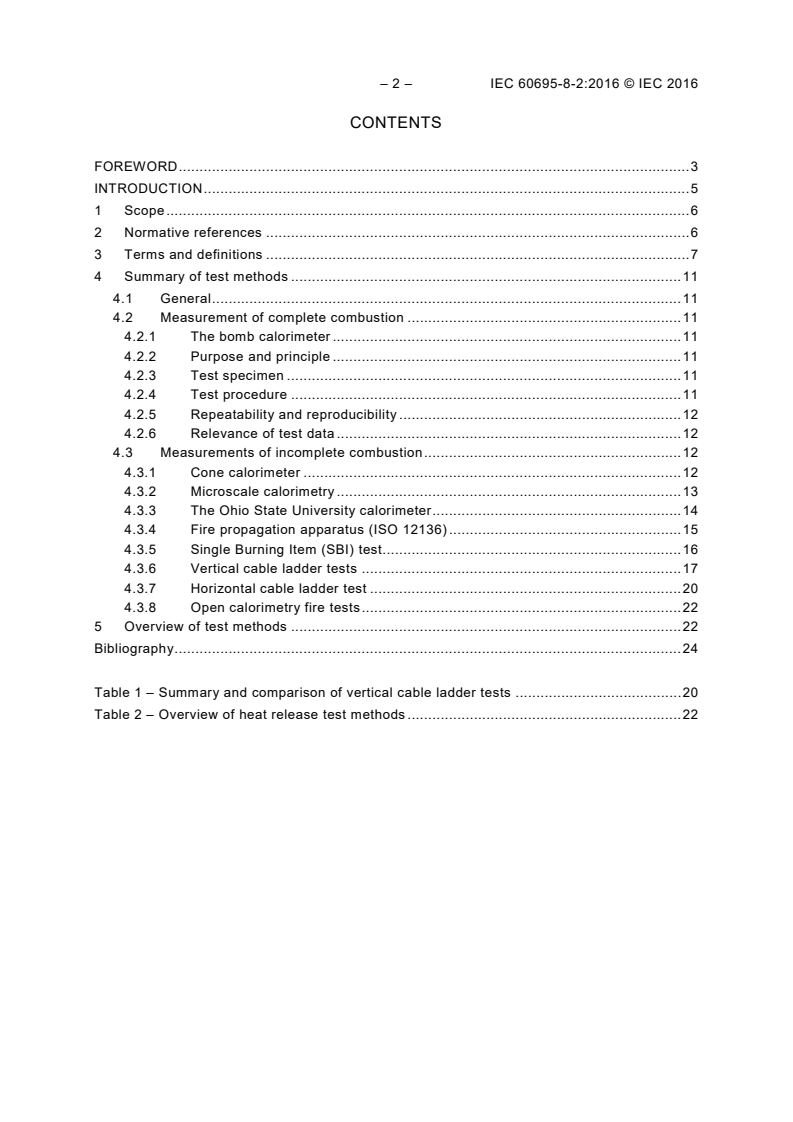
– 2 – IEC 60695-8-2:2016 © IEC 2016
CONTENTS
FOREWORD . 3
INTRODUCTION . 5
1 Scope . 6
2 Normative references . 6
3 Terms and definitions . 7
4 Summary of test methods . 11
4.1 General . 11
4.2 Measurement of complete combustion . 11
4.2.1 The bomb calorimeter . 11
4.2.2 Purpose and principle . 11
4.2.3 Test specimen . 11
4.2.4 Test procedure . 11
4.2.5 Repeatability and reproducibility . 12
4.2.6 Relevance of test data . 12
4.3 Measurements of incomplete combustion . 12
4.3.1 Cone calorimeter . 12
4.3.2 Microscale calorimetry . 13
4.3.3 The Ohio State University calorimeter . 14
4.3.4 Fire propagation apparatus (ISO 12136) . 15
4.3.5 Single Burning Item (SBI) test . 16
4.3.6 Vertical cable ladder tests . 17
4.3.7 Horizontal cable ladder test . 20
4.3.8 Open calorimetry fire tests . 22
5 Overview of test methods . 22
Bibliography . 24
Table 1 – Summary and comparison of vertical cable ladder tests . 20
Table 2 – Overview of heat release test methods . 22
INTERNATIONAL ELECTROTECHNICAL COMMISSION
____________
FIRE HAZARD TESTING –
Part 8-2: Heat release –
Summary and relevance of test methods
FOREWORD
1) The International Electrotechnical Commission (IEC) is a worldwide organization for standardization comprising
all national electrotechnical committees (IEC National Committees). The object of IEC is to promote
international co-operation on all questions concerning standardization in the electrical and electronic fields. To
this end and in addition to other activities, IEC publishes International Standards, Technical Specifications,
Technical Reports, Publicly Available Specifications (PAS) and Guides (hereafter referred to as “IEC
Publication(s)”). Their preparation is entrusted to technical committees; any IEC National Committee interested
in the subject dealt with may participate in this preparatory work. International, governmental and non-
governmental organizations liaising with the IEC also participate in this preparation. IEC collaborates closely
with the International Organization for Standardization (ISO) in accordance with conditions determined by
agreement between the two organizations.
2) The formal decisions or agreements of IEC on technical matters express, as nearly as possible, an international
consensus of opinion on the relevant subjects since each technical committee has representation from all
interested IEC National Committees.
3) IEC Publications have the form of recommendations for international use and are accepted by IEC National
Committees in that sense. While all reasonable efforts are made to ensure that the technical content of IEC
Publications is accurate, IEC cannot be held responsible for the way in which they are used or for any
misinterpretation by any end user.
4) In order to promote international uniformity, IEC National Committees undertake to apply IEC Publications
transparently to the maximum extent possible in their national and regional publications. Any divergence
between any IEC Publication and the corresponding national or regional publication shall be clearly indicated in
the latter.
5) IEC itself does not provide any attestation of conformity. Independent certification bodies provide conformity
assessment services and, in some areas, access to IEC marks of conformity. IEC is not responsible for any
services carried out by independent certification bodies.
6) All users should ensure that they have the latest edition of this publication.
7) No liability shall attach to IEC or its directors, employees, servants or agents including individual experts and
members of its technical committees and IEC National Committees for any personal injury, property damage or
other damage of any nature whatsoever, whether direct or indirect, or for costs (including legal fees) and
expenses arising out of the publication, use of, or reliance upon, this IEC Publication or any other IEC
Publications.
8) Attention is drawn to the Normative references cited in this publication. Use of the referenced publications is
indispensable for the correct application of this publication.
9) Attention is drawn to the possibility that some of the elements of this IEC Publication may be the subject of
patent rights. IEC shall not be held responsible for identifying any or all such patent rights.
International Standard IEC 60695-8-2 has been prepared by IEC technical committee 89: Fire
hazard testing.
This first edition cancels and replaces IEC TR 60695-8-2 published in 2008. This edition
constitutes a technical revision.
The text of this International Standard is based on the following documents:
FDIS Report on voting
89/1343/FDIS 89/1349/RVD
Full information on the voting for the approval of this International Standard can be found in
the report on voting indicated in the above table.
This document has been drafted in accordance with the ISO/IEC Directives, Part 2.
– 4 – IEC 60695-8-2:2016 © IEC 2016
It has the status of a basic safety publication in accordance with IEC Guide 104 and
ISO/IEC Guide 51.
A list of all the parts in the IEC 60695 series, under the general title Fire hazard testing, can
be found on the IEC website.
This International Standard is to be used in conjunction with IEC 60695-8-1.
IEC 60695-8 consists of the following parts:
• Part 8-1: Heat release – General guidance
• Part 8-2: Heat release – Summary and relevance of test methods
The committee has decided that the contents of this document will remain unchanged until the
stability date indicated on the IEC website under "http://webstore.iec.ch" in the data related to
the specific document. At this date, the document will be
• reconfirmed,
• withdrawn,
• replaced by a revised edition, or
• amended.
INTRODUCTION
In the design of an electrotechnical product, the risk of fire and the potential hazards
associated with fire need to be considered. In this respect the objective of component, circuit
and equipment design, as well as the choice of materials, is to reduce the risk of fire to a
tolerable level even in the event of reasonably foreseeable (mis)use, malfunction or failure.
IEC 60695-1-10, IEC 60695-1-11, and IEC 60695-1-12 provide guidance on how this is to be
accomplished.
Fires involving electrotechnical products can also be initiated from external non-electrical
sources. Considerations of this nature are dealt with in an overall fire hazard assessment.
The aim of the IEC 60695 series of standards is to save lives and property by reducing the
number of fires or reducing the consequences of the fire. This can be accomplished by:
• trying to prevent ignition caused by an electrically energised component part and, in the
event of ignition, to confine any resulting fire within the bounds of the enclosure of the
electrotechnical product;
• trying to minimise flame spread beyond the product’s enclosure and to minimise the
harmful effects of fire effluents including heat, smoke, and toxic or corrosive combustion
products.
Fires are responsible for creating hazards to life and property as a result of the generation of
heat (thermal hazard), toxic and/or corrosive compounds and obscuration of vision due to
smoke. The severity of a fire increases as the heat released increases, possibly leading to a
flashover fire.
One of the most important measurements in fire testing is the measurement of heat release
and it is used as an important factor in the determination of fire hazard; it is also used as one
of the parameters in fire safety engineering calculations.
The measurement and use of heat release data, together with other fire test data, can be
used to reduce the likelihood of (or the effects of) fire, even in the event of foreseeable
abnormal use, malfunction or failure of electrotechnical products.
When a material is heated by some external source, fire effluent can be generated and can
form a mixture with air that can ignite and initiate a fire. The heat released in the process is
carried away by the fire effluent-air mixture, radiatively lost or transferred back to the solid
material, to generate further pyrolysis products, thus continuing the process.
Heat may also be transferred to other nearby products, which may burn, and then release
additional heat and fire effluent.
The rate at which thermal energy is released in a fire is defined as the heat release rate. Heat
release rate is important because of its influence on flame spread and on the initiation of
secondary fires. Other characteristics are also important, such as ignitability, flame spread
and other side effects of the fire (see the IEC 60695 series of standards).
– 6 – IEC 60695-8-2:2016 © IEC 2016
FIRE HAZARD TESTING –
Part 8-2: Heat release –
Summary and relevance of test methods
1 Scope
This part of IEC 60695-8 presents a summary of published test methods that are relevant to
the determination of the heat released in fire tests on electrotechnical products or materials
from which they are formed. It represents the current state of the art of the test methods and,
where available, includes special observations on their relevance and use.
The list of test methods is not to be considered exhaustive, and test methods that were not
developed by the IEC are not to be considered as endorsed by the IEC unless this is
specifically stated.
Heat release data can be used as part of fire hazard assessment and in fire safety
engineering, as discussed in IEC 60695-1-10, IEC 60695-1-11 [39] and IEC 60695-1-12 [40].
This basic safety publication is primarily intended for use by technical Committees in the
preparation of standards in accordance with the principles laid down in IEC Guide 104 and
lSO/lEC Guide 51. It is not intended for use by manufacturers or certification bodies.
One of the responsibilities of a technical committee is, wherever applicable, to make use of
basic safety publications in the preparation of its publications. The requirements, test
methods or test conditions of this basic safety publication will not apply unless specifically
referred to or included in the relevant publications.
2 Normative references
The following documents, in whole or in part, are normatively referenced in this document and
are indispensable for its application. For dated references, only the edition cited applies. For
undated references, the latest edition of the referenced document (including any
amendments) applies.
IEC 60695-1-10, Fire hazard testing – Part 1-10: Guidance for assessing the fire hazard of
electrotechnical products – General guidelines
IEC 60695-4:2012, Fire hazard testing – Part 4: Terminology concerning fire tests for
electrotechnical products
IEC 60695-8-1, Fire hazard testing – Part 8-1: Heat release – General guidance
IEC Guide 104, The preparation of safety publications and the use of basic safety publications
and group safety publications
ISO/IEC Guide 51, Safety aspects – Guidelines for their inclusion in standards
ISO 13943:2008, Fire safety – Vocabulary
____________
Numbers in square brackets refer to the Bibliography.
3 Terms and definitions
For the purposes of this document, the terms and definitions given in IEC 60695-4:2012 and
ISO 13943:2008 (some of which are reproduced below), as well as the following, apply.
3.1
combustion
exothermic reaction of a substance with an oxidizing agent
Note 1 to entry: Combustion generally emits fire effluent accompanied by flames and/or glowing.
[SOURCE: ISO 13943:2008, 4.46]
3.2
combustion product
product of combustion
solid, liquid and gaseous material resulting from combustion
Note 1 to entry: Combustion products can include fire effluent, ash, char, clinker and/or soot.
[SOURCE: ISO 13943:2008, 4.48]
3.3
complete combustion
combustion in which all the combustion products are fully oxidized
Note 1 to entry: This means that, when the oxidizing agent is oxygen, all carbon is converted to carbon dioxide
and all hydrogen is converted to water.
Note 2 to entry: If elements other than carbon, hydrogen and oxygen are present in the combustible material,
those elements are converted to the most stable products in their standard states at 298 K.
[SOURCE: ISO 13943:2008, 4.50]
3.4
effective heat of combustion
heat released from a burning test specimen in a given time interval divided by the mass lost
from the test specimen in the same time period
Note 1 to entry: It is the same as the net heat of combustion if all the test specimen is converted to volatile
combustion products and if all the combustion products are fully oxidized.
−1
Note 2 to entry: The typical units are kilojoules per gram (kJ⋅g ).
[SOURCE: ISO 13943:2008, 4.74]
3.5
fire
〈general〉 process of combustion characterized by the emission of heat and fire effluent and
usually accompanied by smoke, flame, glowing or a combination thereof
Note 1 to entry: In the English language the term “fire” is used to designate three concepts, two of which, fire (3.6)
and fire (3.7), relate to specific types of self-supporting combustion with different meanings and two of them are
designated using two different terms in both French and German.
[SOURCE: ISO 13943:2008, 4.96]
3.6
fire
〈controlled〉 self-supporting combustion that has been deliberately arranged to provide useful
effects and is limited in its extent in time and space
– 8 – IEC 60695-8-2:2016 © IEC 2016
[SOURCE: ISO 13943:2008, 4.97]
3.7
fire
〈uncontrolled〉 self-supporting combustion that has not been deliberately arranged to provide
useful effects and is not limited in its extent in time and space
[SOURCE: ISO 13943:2008, 4.98]
3.8
fire effluent
totality of gases and aerosols, including suspended particles, created by combustion or
pyrolysis in a fire
[SOURCE: ISO 13943:2008, 4.105]
3.9
fire hazard
physical object or condition with a potential for an undesirable consequence from fire (3.7)
[SOURCE: ISO 13943:2008, 4.112]
3.10
fire-safety engineering
application of engineering methods based on scientific principles to the development or
assessment of designs in the built environment through the analysis of specific fire scenarios
or through the quantification of risk for a group of fire scenarios
[SOURCE: ISO 13943:2008, 4.126]
3.11
fire test
test that measures behaviour of a fire or exposes an item to the effects of a fire
Note 1 to entry: The results of a fire test can be used to quantify fire severity or determine the fire resistance or
reaction to fire of the test specimen.
[SOURCE: ISO 13943:2008, 4.132]
3.12
flashover
〈stage of fire〉 transition to a state of total surface involvement in a fire of combustible
materials within an enclosure
[SOURCE: ISO 13943:2008, 4.156]
3.13
gross heat of combustion
heat of combustion of a substance when the combustion is complete and any produced water
is entirely condensed under specified conditions
cf. complete combustion (3.3)
−1
Note 1 to entry: The typical units are kilojoules per gram (kJ⋅g ).
[SOURCE: ISO 13943:2008, 4.170]
3.14
heat of combustion
DEPRECATED: calorific potential
DEPRECATED: calorific value
thermal energy produced by combustion of unit mass of a given substance
cf. effective heat of combustion (3.4), gross heat of combustion (3.13) and net heat of
combustion (3.19).
−1
Note 1 to entry: The typical units are kilojoules per gram (kJ⋅g ).
[SOURCE: ISO 13943:2008, 4.174]
3.15
heat release
thermal energy produced by combustion
Note 1 to entry: The typical units are joules (J).
[SOURCE: ISO 13943:2008, 4.176]
3.16
heat release rate
DEPRECATED: burning rate
DEPRECATED: rate of burning
rate of thermal energy production generated by combustion
Note 1 to entry: The typical units are watts (W).
[SOURCE: ISO 13943:2008, 4.177]
3.17
intermediate-scale fire test
fire test performed on a test specimen of medium dimensions
Note 1 to entry: A fire test performed on a test specimen for which the maximum dimension is between 1 m and
3 m is usually called an intermediate-scale fire test.
[SOURCE: ISO 13943:2008, 4.200]
3.18
large-scale fire test
fire test, that cannot be carried out in a typical laboratory chamber, performed on a test
specimen of large dimensions
Note 1 to entry: A fire test performed on a test specimen of which the maximum dimension is greater than 3 m is
usually called a large-scale fire test.
[SOURCE: ISO 13943:2008, 4.205]
3.19
net heat of combustion
heat of combustion when any water produced is considered to be in the gaseous state
Note 1 to entry: The net heat of combustion is always smaller than the gross heat of combustion because the
heat released by the condensation of the water vapour is not included.
−1
Note 2 to entry: The typical units are kilojoules per gram (kJ⋅g ).
[SOURCE: ISO 13943:2008, 4.237]
– 10 – IEC 60695-8-2:2016 © IEC 2016
3.20
oxidation
chemical reaction in which the proportion of oxygen or other electronegative element in a
substance is increased
Note 1 to entry: In chemistry, the term has the broader meaning of a process that involves the loss of an electron
or electrons from an atom, molecule or ion.
[SOURCE: ISO 13943:2008, 4.245]
3.21
oxidizing agent
substance capable of causing oxidation
Note 1 to entry: Combustion is an oxidation.
[SOURCE: ISO 13943:2008, 4.246]
3.22
oxygen consumption principle
proportional relationship between the mass of oxygen consumed during combustion and the
heat released
−1
Note 1 to entry: A value of 13,1 kJ⋅g is commonly used.
[SOURCE: ISO 13943:2008, 4.247]
3.23
pyrolysis
chemical decomposition of a substance by the action of heat
Note 1 to entry: Pyrolysis is often used to refer to a stage of fire before flaming combustion has begun.
Note 2 to entry: In fire science, no assumption is made about the presence or absence of oxygen.
[SOURCE: ISO 13943:2008, 4.266]
3.24
small-scale fire test
fire test performed on a test specimen of small dimensions
Note 1 to entry: A fire test performed on a test specimen of which the maximum dimension is less than 1 m is
usually called a small-scale fire test.
[SOURCE: ISO 13943:2008, 4.292]
3.25
test specimen
item subjected to a procedure of assessment or measurement
Note 1 to entry: In a fire test (3.11), the item may be a material, product, component, element of construction, or
any combination of these. It may also be a sensor that is used to simulate the behaviour of a product.
[SOURCE: ISO 13943:2008, 4.321]
4 Summary of test methods
4.1 General
This summary does not replace published standards, which are the only valid reference
documents.
In cases where fire tests are not yet specified, and need to be developed or altered for the
special purpose of an IEC technical committee, this shall be done in liaison with the relevant
IEC technical committee, as mandated by IEC Guide 104. The test method(s) selected shall
be relevant to the fire scenario of concern. Guidance on the selection and relevance of fire
tests for electrotechnical products is given in IEC 60695-1-10.
General guidance on heat release tests for electrotechnical products is given in
IEC 60695-8-1.
4.2 Measurement of complete combustion
4.2.1 The bomb calorimeter
See ISO 1716 [1].
4.2.2 Purpose and principle
The purpose of the method is to measure the gross heat of combustion at constant volume. A
test specimen of specified mass is burned under standardized conditions, at constant volume,
in an atmosphere of oxygen, in a sealed calorimeter calibrated by combustion of certified
benzoic acid. The heat of combustion determined under these conditions is calculated on the
basis of the observed temperature rise, taking into account heat loss and the latent heat of
vaporization of water.
4.2.3 Test specimen
The test specimen is typically a mixture of 0,5 g of finely powdered benzoic acid and, also in a
finely divided state, 0,5 g of the material under test.
4.2.4 Test procedure
The “bomb” is a central vessel that is sufficiently strong to withstand high pressures so that its
internal volume remains constant. The bomb is immersed in a stirred water bath, and the
combination of bomb and water bath is the calorimeter. The calorimeter is also immersed in
an outer water bath. During a combustion reaction, the temperature of the water in the
calorimeter and in the outer water bath is continuously monitored and adjusted by electrical
heating to the same value. This is to ensure that there is no net loss of heat from the
calorimeter to its surroundings, i.e. to ensure that the calorimeter is adiabatic.
To carry out a measurement, a test specimen, consisting of a known mass of benzoic acid
mixed with a known mass of test material, is placed in a crucible inside the bomb in contact
with an electrical ignition wire. The vessel is filled with oxygen under pressure (3,0 MPa to
3,5 MPa), sealed and allowed to attain thermal equilibrium. The sample is then ignited using a
measured input of energy. Combustion is complete because it takes place in an excess of
high pressure oxygen. The heat released is calculated from the known heat capacity of the
calorimeter and the rise of temperature that occurs as a result of the combustion reaction.
The experiment gives the heat released at constant volume, i.e. the change in internal energy,
∆U. The gross heat of combustion at constant pressure is the enthalpy change, ∆H, where
∆H = ∆U + ∆(PV)
∆(PV) is calculated using the ideal gas law;
– 12 – IEC 60695-8-2:2016 © IEC 2016
-1 −1
∆(PV) = ∆(nRT) [R = 8,314 J⋅K ⋅mol ]
In order to calculate ∆H, it is necessary to be able to define the nature of the combustion
reaction, i.e. to know the chemical composition of the combustion products. This will not
always be known. However, the difference between ∆U and ∆H is normally small and can be
ignored for most fire science purposes. For example, in the case of carbon burning to form
carbon dioxide.
−1 −1
∆U = −32,76 kJ⋅g and ∆H = −32,97 kJ⋅g .
The net heat of combustion can be calculated if the hydrogen content of the test specimen is
known. It is assumed that all the hydrogen is converted into water and the calculation uses a
−1
value of 2,449 kJ⋅g for the latent heat of vaporization of water at 25 °C.
4.2.5 Repeatability and reproducibility
A round-robin exercise was conducted by CEN and the results are summarized in Annex B of
ISO 1716:2010.
4.2.6 Relevance of test data
When measuring the heat of combustion in an oxygen bomb calorimeter, the entire sample is
completely converted to fully oxidized products. In fires (see 3.7) this is rarely the case
because some potentially combustible material is often left as char and products of
combustion are often only partly oxidized, for example, soot particles in smoke, and carbon
monoxide. Heat release in a fire will therefore normally be less than the theoretical maximum
that can be calculated from heat of combustion data.
Heat of combustion data are fundamental to the science of thermochemistry and are of great
importance in fire modelling and fire safety engineering.
In Europe, under the classification system [2] mandated by the Construction Products
Regulation [3], materials are classified as non-combustible if they have a gross heat of
−1
as measured in a bomb calorimeter according to ISO 1716, or if they
combustion of ≤2 kJ⋅g
meet defined requirements when tested to ISO 1182 [4].
Surface finish materials used in accommodation spaces of international trading merchant
ships are required to have a calorific potential (heat of combustion) equal to or less than
−2
45 MJ⋅m measured by ISO 1716 in accordance with the SOLAS Convention [5].
4.3 Measurements of incomplete combustion
4.3.1 Cone calorimeter
4.3.1.1 Test methods
See ISO 5660-1 [6] and ASTM E1354 [7].
4.3.1.2 Purpose and principle
This small-scale test method for determining heat release is based on the oxygen
consumption technique. It incorporates a load cell for mass loss determinations, a test
specimen holder, a conical heater for applying a uniform flux to the test specimen surface and
oxygen consumption measurement equipment.
This test method provides measurements of the rate of heat release, including peak and
average values, total heat release, effective heat of combustion, mass loss, time to ignition
and smoke obscuration. The exposures are made with and without spark ignition. The testing
of specimens takes place in well-ventilated conditions.
-2 -2
The range of external heat flux in ASTM E1354 is from 0 kW⋅m to 100 kW⋅m .in, and from
-2 -2
0 kW⋅m to 75 kW⋅m in ISO 5660-1.
ASTM D6113 [8] has been published as a test method on wires and cables.
4.3.1.3 Test specimen
The specimen holder can accommodate test specimens up to 100 mm × 100 mm × 50 mm
thick. The normal orientation is horizontal, but vertical specimen holders also permit exposure
in a vertical orientation.
4.3.1.4 Test procedure
During the test, a test specimen is exposed to a specified radiant flux from an electrical
conical heater. Piloted ignition is achieved by using an external spark, which is moved into
position over the test specimen until ignition occurs. The heat release rate is assessed by
measuring the oxygen concentration in the exhaust duct and by using the principle of oxygen
consumption (see 3.22 and IEC 60695-8-1).
4.3.1.5 Repeatability and reproducibility
Round-robin evaluation tests have been conducted on building products and on plastic
materials. Details are available in ASTM RR E05-1008 [9].
Other round-robin evaluation tests have been conducted on building products and plastic
materials (see Clauses C.1 to C.3 of ISO 5660-1:2015 [6]) and on plastic materials which
intumesce or deform under heat exposure (see Clause C.4 of ISO 5660-1:2015).
No round-robin evaluation data are currently available on electrotechnical products.
4.3.1.6 Relevance of test data
Data obtained from these tests may be used as input to evaluate the contribution to the
overall fire hazard, as input into fire safety engineering calculations, and for research and
product development.
NOTE 1 In Japan, ISO 5660-1 has been used for the determination of building materials as non-combustible and
quasi-non-combustible, and the cone calorimeter apparatus has been used to test small electrotechnical items.
NOTE 2 Although wires and cables can be installed in the test specimen holder and tested, no relationship to
large-scale tests has been confirmed.
4.3.2 Microscale calorimetry
4.3.2.1 Test method
See ASTM D 7309 [10].
4.3.2.2 Purpose and principle
This small-scale fire test is used to determine the flammability characteristics of combustible
materials, and is based on the oxygen consumption technique. The test is conducted in a
laboratory environment using controlled heating of milligram specimens and complete thermal
oxidation of the specimen gases. Specimens of known mass are thermally decomposed in an
oxygen-free (anaerobic) or oxidizing (aerobic) environment at a constant heating rate.
The apparatus incorporates a temperature-controlled specimen chamber, a test specimen
holder, a mixing chamber, a combustion chamber (combustor) and oxygen consumption
measurement equipment.
– 14 – IEC 60695-8-2:2016 © IEC 2016
This test method provides measurements of the specific heat release rate, heat release
capacity, heat release temperature, specific (total) heat release, pyrolysis residue, and
−2
specific heat of combustion. The external heat flux may be varied from 0 kW⋅m to
−2
100 kW⋅m .
4.3.2.3 Test specimen
Specimens can be in any form (e.g. film, fibre, powder, pellet, or droplet). If liquids are tested
the boiling point has to be above the starting temperature of the sample chamber.
The specimen mass is in the range of 1 mg to 10 mg and is subject to the constraint that
oxidation of the specimen gases consumes less than one half of the available oxygen in the
combustion gas stream at any time during the test and at the heating rate used in the test.
The typical specimen mass is between 2 mg and 5 mg.
4.3.2.4 Test procedure
The test specimen is placed in a sample cup and then placed in the specimen chamber
through which there is a constant flow of purge gas. This purge gas is pure nitrogen for
Method A (anaerobic decomposition) or a mixture of nitrogen and oxygen for Method B
(aerobic decomposition). The specimen chamber (and specimen) is then heated at a constant
rate.
The gases from the specimen chamber pass into the combustion chamber where they are
mixed with excess oxygen and oxidized in a high temperature environment.
The heating rate in the specimen chamber and the flow rate and oxygen concentration of the
gases leaving the combustion chamber are continuously monitored and the specific heat
release rate, heat release capacity, heat release temperature and specific total heat release
are calculated from these data.
The mass of specimen remaining after the test is measured and the pyrolysis residue and
specific heat of combustion calculated.
4.3.2.5 Repeatability and reproducibility
No data are available.
4.3.2.6 Relevance of test data
This method generates thermoanalytical data that can be used for the preliminary screening
of materials.
Specific heat release rates are measured directly and have been shown to be in good
agreement with heat release rates measured in the cone calorimeter. The ignition temperature
of a material can be measured directly. Heats of combustion can be determined and have
been found to be comparable with oxygen bomb calorimeter values.
4.3.3 The Ohio State University calorimeter
4.3.3.1 Test method
See ASTM E906 [11].
4.3.3.2 Purpose and principle
This test method provides measurements of the rate of heat release based on the
temperature measurement technique. It includes peak and average values, total heat release,
time to ignition and smoke obscuration from materials and products.
The test specimens are exposed to radiant energy, with or without piloted ignition via a small
flame.
−2 −2
The external heat flux may be varied from 0 kW⋅m to 100 kW⋅m .
4.3.3.3 Test specimen
The specimen holder can accommodate test specimens up to 150 mm × 150 mm × 50 mm
thick. The normal orientation is vertical, but horizontal specimen holders also permit exposure
in a horizontal orientation.
4.3.3.4 Test procedure
The test specimen is placed in a test chamber through which there is a constant airflow. The
surface of the test specimen is exposed to a radiant energy source. Combustion may be
initiated by non-piloted or piloted ignition of the gases evolved.
The changes in temperature of the gases leaving the chamber are continuously monitored
and the heat release rate is calculated from these data.
4.3.3.5 Repeatability and reproducibility
Data have been obtained by ASTM E-5.21.34, a Task Group on Intermediate Scale
Calorimetry.
4.3.3.6 Relevance of test data
Data from these tests may be used as input to evaluate the contribution to the overall fire
hazard, as input into fire safety engineering calculations and for research and product
development.
The test method is also used by the USA Federal Aviation Authority to assess the compliance
of aircraft cabin materials with Federal Aviation Regulations [12].
4.3.4 Fire propagation apparatus (ISO 12136)
4.3.4.1 Purpose and principle
ISO 12136 provides test methods for determining and quantifying the flammability
characteristics of materials, in relation to their propensity to support fire propagation, by
means of a fire propagation apparatus (FPA). Material flammability characteristics that are
quantified in this international standard include time to ignition, chemical and convective heat
release rates, mass loss rate, effective heat of combustion, heat of gasification and smoke
yield. These properties can be used for fire safety engineering and for fire modelling.
4.3.4.2 Test apparatus
See ISO 12136 [13] and ASTM E2058 [14].
4.3.4.3 Test specimens
Square test specimens are 102 mm × 102 mm and are mounted in a square holder. Circular
test specimens are 96,5 mm in diameter and are mounted in a circular holder. The test
specimen thickness is not less than 3 mm and not greater than 25,4 mm. For the vertical fire
propagation test, the test specimen is 102 mm in width and 305 mm in length and is mounted
in a vertical test specimen holder.
– 16 – IEC 60695-8-2:2016 © IEC 2016
4.3.4.4 Test methods and results
The four test methods given in this international standard are based on measurements of time
to observed ignition, mass loss rate, heat release rate and smoke generation rate. The tests
are performed using a laboratory calorimeter known as fire propagation apparatus whereby
the heat source is isolated from the test specimen. The test methods are intended to produce
flammability property measurements that will characterize fire behaviour during reference-
scale fire tests.
The ignition, combustion or fire propagation test methods, or a combination thereof, have
been performed with materials and products containing a wide range of polymer compositions
and structures, including electrotechnical products, materials for electrotechnical products
and electric cables ([15] to [22]).
The special feature of the fire propagation test method is that it produces laboratory
measurements of the heat release rate during upward fire propagation and burning (from a
material's own flame after initiation by an external radiant flux) on a vertical test specimen in
normal air, oxygen enriched air, or in oxygen-vitiated air.
These test methods are intended for evaluation of specific flammability characteristics of
materials. Materials to be analysed consist of specimens from an end-use product or the
various components used in the end-use product. Results from the test methods provide input
to flame spread and fire growth models, risk analysis studies, building and product designs
and research and development of materials.
This International Standard can be used to measure and describe the response of materials,
products, or assemblies to heat and flame under controlled conditions, but does not by itself
incorporate all factors required for fire hazard or fire risk assessment of the materials,
products or assemblies under actual fire conditions.
4.3.5 Single Burning Item (SBI) test
4.3.5.1 Test method
See EN 13823 [23].
4.3.5.2 Purpose and principle
The SBI test is a reaction to fire test for essentially flat building produ
...