

IEC 62542:2013
(Main)Environmental standardization for electrical and electronic products and systems - Glossary of terms
General Information
- Abstract
IEC 62542:2013 specifies generic terms and definitions that are related to environmental standardization within the IEC. It serves as a glossary of terminology to be considered for environmental aspects of relevant work in IEC. The terms cover environmental issues that are relevant for electrotechnical products across all product life cycle stages. It has the status of a horizontal standard in accordance with IEC Guide 108.
- Status
- Published
- Publication Date
- 26-Jun-2013
- Technical Committee
- TC 111 - Environmental standardization for electrical and electronic products and systems
- Drafting Committee
- PT 62542 - TC 111/PT 62542
- Current Stage
- PPUB - Publication issued
- Start Date
- 27-Jun-2013
- Completion Date
- 30-Jun-2013
Overview
IEC 62542:2013 is an international standard published by the International Electrotechnical Commission (IEC) that provides a comprehensive glossary of terms related to environmental standardization for electrical and electronic products and systems. As a horizontal standard, it applies broadly across IEC technical committees engaged in environmental aspects of electrotechnical work. Its terminology spans the entire product life cycle, supporting consistent communication and understanding of environmental issues in the design, manufacture, use, and disposal of electronic products.
This standard assists in harmonizing definitions used within IEC deliverables on environmental topics, thereby enhancing clarity and facilitating effective environmental management and sustainability practices across the electrotechnical industry.
Key Topics
IEC 62542:2013 covers a broad range of environmental terms and definitions crucial for standardizing environmental considerations in electrical and electronic sectors. The key topics include:
Environmental Protection and Management Terms
Definitions related to design and development, environmental aspects and impacts, environmental management systems (EMS), and environmentally conscious design (ECD).Material and Substance Declaration
Terminology regarding the use, declaration, and analysis of substances and materials that have environmental relevance throughout the product life cycle.Energy Efficiency and Power Consumption
Terms describing power demand, energy use, and efficiency metrics pertinent to electrical and electronic equipment.Resource Conservation and Re-use
Concepts addressing the conservation of natural resources, recycling, and end-of-life treatment of electrical and electronic products.Life Cycle Concepts
Coverage of lifecycle thinking (LCT), life cycle assessment (LCA), stages of product life cycles, and environmental parameters that quantify environmental interactions.
These areas support the development of IEC standards that promote environmental stewardship and regulatory compliance within the electrical and electronics sectors.
Applications
IEC 62542:2013 is invaluable for various stakeholders, including:
Technical Committees and Standards Developers
Use it as a foundational reference to ensure consistent terminology across environmental standards related to electrical and electronic products and systems.Product Designers and Engineers
Apply the glossary to align design processes with environmentally conscious design principles, reducing environmental impacts from product inception.Environmental Managers and Compliance Professionals
Utilize standardized terms to monitor, assess, and report on environmental performance, facilitating compliance with international regulations.Manufacturers and Supply Chain Partners
Employ common terminology to communicate environmental requirements and substance declarations, improving supply chain transparency and sustainability.Researchers and Policy Makers
Reference the glossary to ensure clarity in studies and policies directed at environmental impacts associated with electrical and electronic technologies.
By establishing a common language, IEC 62542:2013 strengthens the integration of environmental concerns into product development, manufacturing, and policy frameworks.
Related Standards
IEC 62542:2013 complements and references several related international standards and guides:
IEC Guide 108 – Guidelines for the application of horizontal standards, ensuring harmonized standard development within IEC.
IEC 62430:2009 – Environmental management - Life cycle assessment - Principles and framework, providing definitions and methodologies aligned with environmental design.
ISO 14001:2004 – Environmental management systems - Requirements with guidance for use, offering foundational environmental management terminology.
ISO 14040:2006 – Environmental management - Life cycle assessment - Principles and framework, referenced for life cycle definitions applied in IEC 62542.
ISO 9000:2005 – Quality management systems - Fundamentals and vocabulary, serving as the basis for process-related terminology.
These interconnected standards allow organizations to adopt streamlined and integrated approaches to environmental standardization in electrical and electronic product ecosystems.
Keywords: IEC 62542, environmental standardization, electrical products, electronic systems, glossary of terms, environmentally conscious design, life cycle assessment, environmental management system, energy efficiency, resource conservation, electrical and electronic standards.
Get Certified
Connect with accredited certification bodies for this standard

BSI Group
BSI (British Standards Institution) is the business standards company that helps organizations make excellence a habit.

Bureau Veritas
Bureau Veritas is a world leader in laboratory testing, inspection and certification services.

DNV
DNV is an independent assurance and risk management provider.
Sponsored listings
Frequently Asked Questions
IEC 62542:2013 is a standard published by the International Electrotechnical Commission (IEC). Its full title is "Environmental standardization for electrical and electronic products and systems - Glossary of terms". This standard covers: IEC 62542:2013 specifies generic terms and definitions that are related to environmental standardization within the IEC. It serves as a glossary of terminology to be considered for environmental aspects of relevant work in IEC. The terms cover environmental issues that are relevant for electrotechnical products across all product life cycle stages. It has the status of a horizontal standard in accordance with IEC Guide 108.
IEC 62542:2013 specifies generic terms and definitions that are related to environmental standardization within the IEC. It serves as a glossary of terminology to be considered for environmental aspects of relevant work in IEC. The terms cover environmental issues that are relevant for electrotechnical products across all product life cycle stages. It has the status of a horizontal standard in accordance with IEC Guide 108.
IEC 62542:2013 is classified under the following ICS (International Classification for Standards) categories: 01.120 - Standardization. General rules; 13.020.30 - Environmental impact assessment; 29.020 - Electrical engineering in general. The ICS classification helps identify the subject area and facilitates finding related standards.
IEC 62542:2013 is available in PDF format for immediate download after purchase. The document can be added to your cart and obtained through the secure checkout process. Digital delivery ensures instant access to the complete standard document.
Standards Content (Sample)
IEC 62542 ®
Edition 1.0 2013-06
INTERNATIONAL
STANDARD
NORME
INTERNATIONALE
colour
inside
HORIZONTAL STANDARD
NORME HORIZONTALE
Environmental standardization for electrical and electronic products and
systems – Glossary of terms
Normalisation environnementale pour les produits et les systèmes électriques
et électroniques – Glossaire des termes
All rights reserved. Unless otherwise specified, no part of this publication may be reproduced or utilized in any form
or by any means, electronic or mechanical, including photocopying and microfilm, without permission in writing from
either IEC or IEC's member National Committee in the country of the requester.
If you have any questions about IEC copyright or have an enquiry about obtaining additional rights to this publication,
please contact the address below or your local IEC member National Committee for further information.
Droits de reproduction réservés. Sauf indication contraire, aucune partie de cette publication ne peut être reproduite ni
utilisée sous quelque forme que ce soit et par aucun procédé, électronique ou mécanique, y compris la photocopie et les
microfilms, sans l'accord écrit de la CEI ou du Comité national de la CEI du pays du demandeur.
Si vous avez des questions sur le copyright de la CEI ou si vous désirez obtenir des droits supplémentaires sur cette
publication, utilisez les coordonnées ci-après ou contactez le Comité national de la CEI de votre pays de résidence.
IEC Central Office Tel.: +41 22 919 02 11
3, rue de Varembé Fax: +41 22 919 03 00
CH-1211 Geneva 20 info@iec.ch
Switzerland www.iec.ch
About the IEC
The International Electrotechnical Commission (IEC) is the leading global organization that prepares and publishes
International Standards for all electrical, electronic and related technologies.
About IEC publications
The technical content of IEC publications is kept under constant review by the IEC. Please make sure that you have the
latest edition, a corrigenda or an amendment might have been published.
Useful links:
IEC publications search - www.iec.ch/searchpub Electropedia - www.electropedia.org
The advanced search enables you to find IEC publications The world's leading online dictionary of electronic and
by a variety of criteria (reference number, text, technical electrical terms containing more than 30 000 terms and
committee,…). definitions in English and French, with equivalent terms in
It also gives information on projects, replaced and additional languages. Also known as the International
withdrawn publications. Electrotechnical Vocabulary (IEV) on-line.
IEC Just Published - webstore.iec.ch/justpublished Customer Service Centre - webstore.iec.ch/csc
Stay up to date on all new IEC publications. Just Published If you wish to give us your feedback on this publication
details all new publications released. Available on-line and or need further assistance, please contact the
also once a month by email. Customer Service Centre: csc@iec.ch.
A propos de la CEI
La Commission Electrotechnique Internationale (CEI) est la première organisation mondiale qui élabore et publie des
Normes internationales pour tout ce qui a trait à l'électricité, à l'électronique et aux technologies apparentées.
A propos des publications CEI
Le contenu technique des publications de la CEI est constamment revu. Veuillez vous assurer que vous possédez
l’édition la plus récente, un corrigendum ou amendement peut avoir été publié.
Liens utiles:
Recherche de publications CEI - www.iec.ch/searchpub Electropedia - www.electropedia.org
La recherche avancée vous permet de trouver des Le premier dictionnaire en ligne au monde de termes
publications CEI en utilisant différents critères (numéro de électroniques et électriques. Il contient plus de 30 000
référence, texte, comité d’études,…). termes et définitions en anglais et en français, ainsi que
Elle donne aussi des informations sur les projets et les les termes équivalents dans les langues additionnelles.
publications remplacées ou retirées. Egalement appelé Vocabulaire Electrotechnique
International (VEI) en ligne.
Just Published CEI - webstore.iec.ch/justpublished
Service Clients - webstore.iec.ch/csc
Restez informé sur les nouvelles publications de la CEI.
Just Published détaille les nouvelles publications parues. Si vous désirez nous donner des commentaires sur
Disponible en ligne et aussi une fois par mois par email. cette publication ou si vous avez des questions
contactez-nous: csc@iec.ch.
IEC 62542 ®
Edition 1.0 2013-06
INTERNATIONAL
STANDARD
NORME
INTERNATIONALE
colour
inside
HORIZONTAL STANDARD
NORME HORIZONTALE
Environmental standardization for electrical and electronic products and
systems – Glossary of terms
Normalisation environnementale pour les produits et les systèmes électriques
et électroniques – Glossaire des termes
INTERNATIONAL
ELECTROTECHNICAL
COMMISSION
COMMISSION
ELECTROTECHNIQUE
PRICE CODE
INTERNATIONALE
CODE PRIX R
ICS 01.120; 13.020.30; 29.020; 31.020 ISBN 978-2-83220-838-0
– 2 – 62542 © IEC:2013
CONTENTS
FOREWORD . 3
INTRODUCTION . 5
1 Scope . 6
2 Normative references . 6
3 General terms relating to environmental protection and management . 6
4 Terms relating to determination and declaration of substances and materials . 9
5 Terms relating to energy efficiency and power consumption . 11
6 Terms relating to resource conservation and re-use . 13
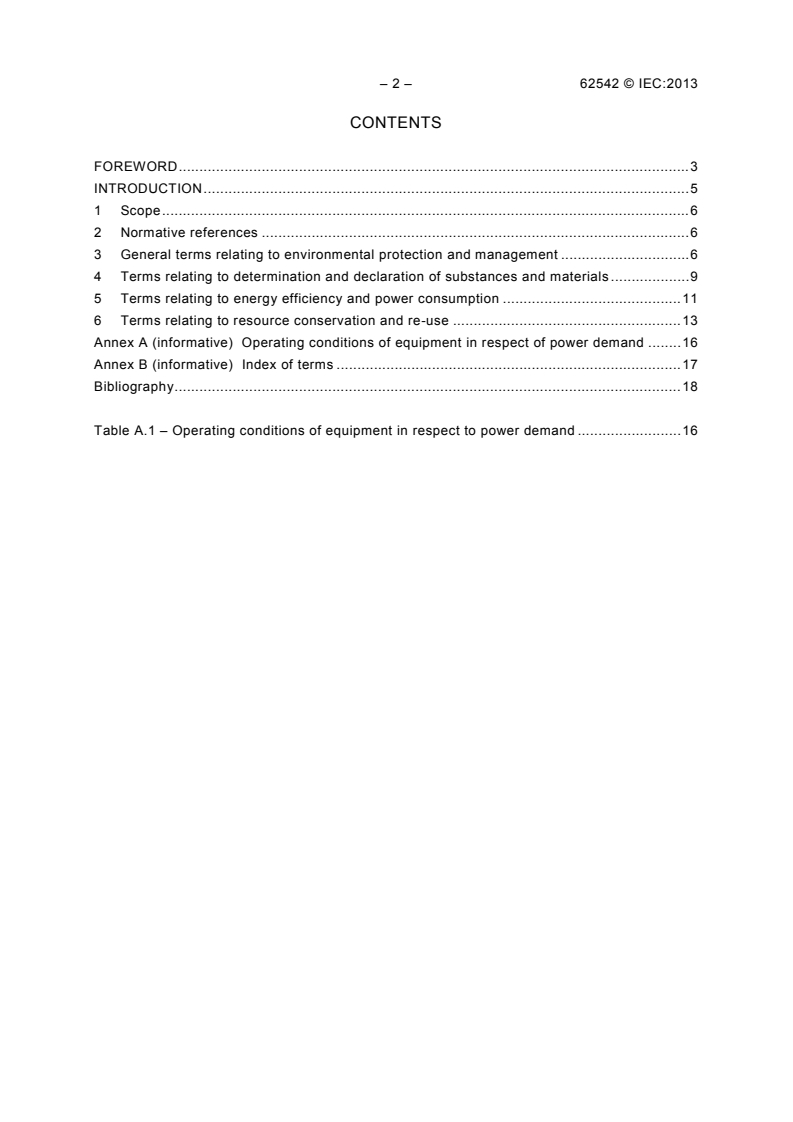
Annex A (informative) Operating conditions of equipment in respect of power demand . 16
Annex B (informative) Index of terms . 17
Bibliography . 18
Table A.1 – Operating conditions of equipment in respect to power demand . 16
62542 © IEC:2013 – 3 –
INTERNATIONAL ELECTROTECHNICAL COMMISSION
____________
ENVIRONMENTAL STANDARDIZATION FOR ELECTRICAL
AND ELECTRONIC PRODUCTS AND SYSTEMS –
GLOSSARY OF TERMS
FOREWORD
1) The International Electrotechnical Commission (IEC) is a worldwide organization for standardization comprising
all national electrotechnical committees (IEC National Committees). The object of IEC is to promote
international co-operation on all questions concerning standardization in the electrical and electronic fields. To
this end and in addition to other activities, IEC publishes International Standards, Technical Specifications,
Technical Reports, Publicly Available Specifications (PAS) and Guides (hereafter referred to as “IEC
Publication(s)”). Their preparation is entrusted to technical committees; any IEC National Committee interested
in the subject dealt with may participate in this preparatory work. International, governmental and non-
governmental organizations liaising with the IEC also participate in this preparation. IEC collaborates closely
with the International Organization for Standardization (ISO) in accordance with conditions determined by
agreement between the two organizations.
2) The formal decisions or agreements of IEC on technical matters express, as nearly as possible, an international
consensus of opinion on the relevant subjects since each technical committee has representation from all
interested IEC National Committees.
3) IEC Publications have the form of recommendations for international use and are accepted by IEC National
Committees in that sense. While all reasonable efforts are made to ensure that the technical content of IEC
Publications is accurate, IEC cannot be held responsible for the way in which they are used or for any
misinterpretation by any end user.
4) In order to promote international uniformity, IEC National Committees undertake to apply IEC Publications
transparently to the maximum extent possible in their national and regional publications. Any divergence
between any IEC Publication and the corresponding national or regional publication shall be clearly indicated in
the latter.
5) IEC itself does not provide any attestation of conformity. Independent certification bodies provide conformity
assessment services and, in some areas, access to IEC marks of conformity. IEC is not responsible for any
services carried out by independent certification bodies.
6) All users should ensure that they have the latest edition of this publication.
7) No liability shall attach to IEC or its directors, employees, servants or agents including individual experts and
members of its technical committees and IEC National Committees for any personal injury, property damage or
other damage of any nature whatsoever, whether direct or indirect, or for costs (including legal fees) and
expenses arising out of the publication, use of, or reliance upon, this IEC Publication or any other IEC
Publications.
8) Attention is drawn to the Normative references cited in this publication. Use of the referenced publications is
indispensable for the correct application of this publication.
9) Attention is drawn to the possibility that some of the elements of this IEC Publication may be the subject of
patent rights. IEC shall not be held responsible for identifying any or all such patent rights.
International Standard IEC 62542 has been prepared by IEC technical committee 111:
Environmental standardization for electrical and electronic products and systems.
It has the status of a horizontal standard in accordance with IEC Guide 108.
The text of this standard is based on the following documents:
FDIS Report on voting
111/302/FDIS 111/312/RVD
Full information on the voting for the approval of this standard can be found in the report on
voting indicated in the above table.
This publication has been drafted in accordance with the ISO/IEC Directives, Part 2.
– 4 – 62542 © IEC:2013
The committee has decided that the contents of this publication will remain unchanged until
the stability date indicated on the IEC web site under "http://webstore.iec.ch" in the data
related to the specific publication. At this date, the publication will be
• reconfirmed,
• withdrawn,
• replaced by a revised edition, or
• amended.
IMPORTANT – The 'colour inside' logo on the cover page of this publication indicates
that it contains colours which are considered to be useful for the correct
understanding of its contents. Users should therefore print this document using a
colour printer.
62542 © IEC:2013 – 5 –
INTRODUCTION
The definitions noted in this International Standard are intended to be considered by all new
and existing IEC standards under maintenance that are meant to fulfil standardization needs,
associated directly or indirectly, with an environmental topic or which may reference
environmental aspects/impacts, even if the standard is not exclusively an environmental one.
In addition this standard aims to utilise and harmonize definitions in other related documents.
This standard will be updated periodically as relevant international standardization documents
evolve.
Wherever possible, the terms and definitions included herein have been taken from other IEC
or ISO deliverables, either verbatim or modified if appropriate so as to make them suitable for
use in a wide range of IEC deliverables on environmental matters. This standard also contains
definitions for terms that are likely to be required by IEC deliverables on environmental
matters, but are not yet described elsewhere.
– 6 – 62542 © IEC:2013
ENVIRONMENTAL STANDARDIZATION FOR ELECTRICAL
AND ELECTRONIC PRODUCTS AND SYSTEMS –
GLOSSARY OF TERMS
1 Scope
This International Standard specifies generic terms and definitions that are related to
environmental standardization within the IEC. It serves as a glossary of terminology to be
considered for environmental aspects of relevant work in IEC.
The terms cover environmental issues that are relevant for electrotechnical products across
all product life cycle stages, including but not limited to
• design and supply chain aspects in general,
• use and declaration of materials,
• analytics of environmentally relevant substances,
• aspects relating to climate protection,
• power consumption and energy efficiency,
• environmental information,
• end of life treatment.
This horizontal standard is primarily intended for use by technical committees in the
preparation of standards in accordance with the principles laid down in IEC Guide 108.
One of the responsibilities of a technical committee is, wherever applicable, to make use of
horizontal standards in the preparation of its publications. The contents of this horizontal
standard will not apply unless specifically referred to or included in the relevant publications.
2 Normative references
The following documents, in whole or in part, are normatively referenced in this document and
are indispensable for its application. For dated references, only the edition cited applies. For
undated references, the latest edition of the referenced document (including any
amendments) applies.
Guide 108, Guidelines for ensuring the coherency of IEC publications – Application of
horizontal standards
3 General terms relating to environmental protection and management
3.1
design and development
activities that take an idea or requirement and transform these into a product
Note 1 to entry: The process of design and development usually follows a series of defined steps starting with an
initial idea, transforming that into a formal specification, and resulting in the creation of a working prototype and
whatever documentation is required to support production of the goods or provision of the service.
[SOURCE: IEC 62430:2009, definition 3.1]
62542 © IEC:2013 – 7 –
3.2
electronic assembly
set of components, at least one of which is an electronic component, assembled into a single
unit
EXAMPLE Group of components mounted on a printed wiring board [printed circuit board].
3.3
electronic component
electronic device that cannot be taken apart without destruction or impairment of its intended
use
EXAMPLE Resistors, capacitors, diodes, integrated circuits, hybrids, application specific integrated circuits,
wound components and relays.
Note 1 to entry: Electronic components are sometimes called electronic parts, or piece parts.
3.4
emission
direct or indirect release from a product or process into the air, water or soil
EXAMPLE A release could include one or more substances, heat, light, sound, electromagnetic fields, etc.
3.5
environment
surroundings in which a product or system exists, including air, water, land, natural resources,
flora, fauna, humans and their interrelation
[SOURCE: ISO 14001:2004, definition 3.5, modified – “in which an organization operates”
replaced by “in which a product or system exists”]
3.6
environmental aspect
element of an organization's activities or products that can interact with the environment
Note 1 to entry: A significant environmental aspect has or can have a significant environmental impact.
[SOURCE: IEC 62430:2009, definition 3.3]
3.7
environmental impact
any change to the environment, whether adverse or beneficial, wholly or partly resulting from
environmental aspects
[SOURCE: ISO 14001:2004, definition 3.7, modified – “an organization’s” before
“environmental aspects" deleted]
3.8
environmental management system
EMS
part of an organization’s management system used to develop and implement its
environmental policy and manage its environmental aspects
Note 1 to entry: A management system is a set of interrelated elements used to establish policy and objectives
and to achieve those objectives.
Note 2 to entry: A management system includes organizational structure, planning activities, responsibilities,
practices, procedures, processes and resources.
[SOURCE: ISO 14001:2004, definition 3.8]
– 8 – 62542 © IEC:2013
3.9
environmental parameter
quantifiable attribute of an environmental aspect
EXAMPLE Environmental parameters include the type and quantity of materials used (weight, volume), power
consumption, emissions, rate of recyclability, etc.
[SOURCE: IEC 62430:2009, definition 3.5]
3.10
environmentally conscious design
ECD
systematic approach which takes into account environmental aspects in the design and
development process with the aim to reduce adverse environmental impacts
[SOURCE: IEC 62430:2009, definition 3.6]
3.11
environmentally conscious design tool
formalized method which facilitates qualitative or quantitative analysis, comparison and/or
solution finding during the ECD process
[SOURCE: IEC 62430:2009, definition 3.7]
3.12
life cycle
consecutive and interlinked stages of a product system, from raw material acquisition or
generation from natural resources to the final disposal
[SOURCE: ISO 14040:2006, definition 3.1]
3.13
life cycle assessment
LCA
compilation and evaluation of the inputs, outputs and the potential environmental impacts of a
product system throughout its life cycle
[SOURCE: ISO 14040:2006, definition 3.2]
3.14
life cycle stage
element of a life cycle
Note 1 to entry: The term "life cycle phase" is sometimes used interchangeably with "life cycle stage"’.
Note 2 to entry: Examples of life cycle stages: raw material acquisition and production; manufacturing; packaging
and distribution; installation and use, maintenance and upgrading and end of life.
[SOURCE: IEC 62430:2009, definition 3.10]
3.15
life cycle thinking
LCT
consideration of all relevant environmental aspects during the entire life cycle of products
[SOURCE: IEC 62430:2009, definition 3.11]
62542 © IEC:2013 – 9 –
3.16
process
set of interrelated or interacting activities which transform inputs into outputs
Note 1 to entry: Inputs to a process are generally outputs of other processes.
Note 2 to entry: Processes in an organization are generally planned and carried out under controlled conditions to
add value.
[SOURCE: ISO 9000:2005, definition 3.4.1, modified – "NOTE 3 A process where the
conformity of the resulting product cannot be readily or economically verified is frequently
referred to as a "special process". deleted]
3.17
product category
group of technologically or functionally similar products where the environmental aspects can
reasonably be expected to be similar
[SOURCE: IEC 62430:2009, definition 3.15]
3.18
product
any goods or service
Note 1 to entry: This includes interconnected and/or interrelated goods or services.
[SOURCE: IEC 62430:2009, definition 3.14]
3.19
stakeholder
individual, group or organization that has an interest in an organization or activity
Note 1 to entry: Usually a stakeholder can affect or is affected by the organization or the activity.
Note 2 to entry: “Interested party” is sometimes used as a synonym for “stakeholder”.
[SOURCE: IEC 62430:2009, definition 3.16, modified – Note 2 to entry added]
4 Terms relating to determination and declaration of substances and materials
4.1
declarable substance and declarable substance group
substance and substance group that meet the criteria stated in IEC 62474 and are specified in
the IEC 62474 database
Note 1 to entry: Declarable substances and declarable substance groups are listed in the IEC 62474 database
with either a mandatory or optional reporting requirement above the specified threshold in the IEC 62474 database.
[SOURCE: IEC 62474:2012, definition 3.2, modified – in the Note 1 to entry, “Such
substances and substance groups” replaced by "Declarable substances and declarable
substance groups”]
4.2
hazardous mixture
hazardous preparation
mixture that has, according to defined classification criteria, the potential for adversely
impacting human health and/or the environment
Note 1 to entry: The criteria for determining whether a mixture (or preparation) is classified as hazardous are
defined by law or regulation.
– 10 – 62542 © IEC:2013
4.3
material
substance or mixture within a product or product part
[SOURCE: IEC 62474:2012, definition 3.4]
4.4
matrix
substance or mixture and its form or state in which analyte is embedded or to which analyte is
attached
4.5
mixture
preparation
mixture or solution composed of two or more substances in which they do not react
Note 1 to entry: An alloy is treated as a mixture.
[SOURCE: IEC 62474:2012, definition 3.6]
4.6
performance-based measurement system
PBMS
set of processes wherein the data needs, mandates or limitations of a program or project are
specified, serving as criteria for selecting appropriate methods to meet those needs in a cost-
effective manner
Note 1 to entry: The criteria may be published in regulations, technical guidance documents, permits, work plans
or enforcement orders.
[SOURCE: IEC 62321:2008, definition 3.1.11]
4.7
reporting threshold level
concentration limit at or above which the presence of a substance in a material or product is
declared if declaration of the substance is mandatory according to the IEC 62474 database, or
if it is agreed on to be declared
[SOURCE: IEC 62474:2012, definition 3.12]
4.8
screening
analytical procedure to determine the presence or absence of substances in the
representative part or section of a product, relative to the value or values chosen as the
criterion for presence, absence or further testing
Note 1 to entry: If the screening method produces values that are not conclusive, then additional analysis or other
follow-up actions may be necessary to make a final presence/absence decision.
4.9
substance
chemical element and its compounds in the natural state or obtained by any manufacturing
process, including any additive necessary to preserve its stability and any impurity deriving
from the process used, but excluding any solvent which may be separated without affecting
the stability of the substance or changing its composition
Note 1 to entry: Definition is taken from Globally harmonized system of classification and labelling (GHS): 2003,
Chapter 1.2, Definitions and abbreviations.
[SOURCE: IEC 62474:2012, definition 3.13]
62542 © IEC:2013 – 11 –
4.10
substance group
one or more substances, where in the case of multiple substances they share at least one
chemical sub-structure, or chemical or physical property under a generic name
[SOURCE: IEC 62474:2012, definition 3.14]
5 Terms relating to energy efficiency and power consumption
The terms relating to energy efficiency and power consumption described in this clause are
intended to be applicable to all electrotechnical products. Table A.1 provides a structured
overview as an aid to understanding these concepts. Where particular product sectors need to
define additional terms to fulfil their particular needs, they should aim to do so within the
structure of these concepts.
5.1
disconnected
condition of the equipment during which all connections to power sources supplying the
equipment are removed or galvanically isolated and no functions depending on those power
sources are provided
Note 1 to entry: The term "power source" includes power sources external and internal to the equipment.
5.2
duty cycle
combined fractions of time a product spends in specific power modes representing a certain
use case
5.3
idle mode
condition during which the equipment can promptly provide a primary function but is not doing
so
5.4
mode
distinct condition
Note 1 to entry: Any transition of equipment from or towards a neighbouring mode, either through user
intervention or automatically initiated, should not be considered to form part of either mode.
Note 2 to entry: Delay between a stimulus and a response might be traded against power consumption in the
current mode.
5.5
network integrity function
function to maintain a communication path external to the equipment
Note 1 to entry: The communication could be via wired or wireless interfaces.
Note 2 to entry: In order to communicate, it is necessary for the equipment to have at least one network port
activated.
Note 3 to entry: The equipment is also considered to offer a network integrity function even though the equipment
is not connected to the respective network (e.g. network cable unplugged)
5.6
off mode
condition during which the equipment only provides tertiary function(s)
– 12 – 62542 © IEC:2013
5.7
on mode
condition during which the equipment provides at least one primary function or can promptly
provide a primary function
5.8
operation mode
condition during which the equipment is performing at least one primary function
5.9
partial on mode
condition during which the equipment provides at least one secondary function but no primary
function
Note 1 to entry: The terms "standby mode" or "sleep mode" also describe the partial on mode.
5.10
power management
automatic control mechanism that achieves the smallest input power consistent with a pre-
determined level of functionality
5.11
primary function
function providing the intended purpose
5.12
protective function
function that operates after the occurrence of a failure in the equipment so as to prevent harm
to persons or damage to property
EXAMPLE 1 A back-siphonage device fitted to a dish washer, this can operate in an off mode.
EXAMPLE 2 Flood protection device fitted to a washing machine, this can operate in an off mode or partial on
mode.
EXAMPLE 3 No movement deactivation switch fitted to a cloths iron, this can operate in an on mode.
5.13
reactivation function
function allowing equipment to be switched into an on mode with an internal signal, with its
remote control unit, or manually
Note 1 to entry: The reactivation function may be indicated using a simple optical device (e.g. a light emitting
diode (LED)).
Note 2 to entry: A mode change during the reactivation function cannot be initiated by a network command.
EXAMPLE A timer could provide the internal signal leading to reactivation.
5.14
secondary function
function that enables, supplements or enhances a primary function
5.15
status information function
function by which the equipment provides simple use-orientated information
Note 1 to entry: Status information can be, for example, date, clock time, timer information; or past or future
operation.
62542 © IEC:2013 – 13 –
5.16
tertiary function
function other than a primary or a secondary function
EXAMPLE 1 An EMC filter, if present, provides its function in off mode, partial on mode and on mode.
EXAMPLE 2 Status indication.
6 Terms relating to resource conservation and re-use
6.1
disassembly
process whereby an item is taken apart in such a way that it could subsequently be
reassembled and made operational
Note 1 to entry: The process typically uses simple tools, such as screwdrivers, pliers and wrenches.
[SOURCE: IEC/PAS 62596:2009, definition 3.1.5, modified – to make wording compliant with
IEC rules, part of the original definition is now in the Note to entry and part of the original
NOTE is now in the definition.]
6.2
disjointment
process whereby materials are separated by mechanical means such that the item cannot
subsequently be reassembled to make it operational
Note 1 to entry: The process typically employs actions such as cutting, grinding, scratching and abrasive
processes.
[SOURCE: IEC/PAS 62596:2009, definition 3.1.6, modified – to make wording compliant with
IEC rules, part of the original definition is now in the Note to entry and part of the original
NOTE is now in the definition.]
6.3
end of life
life cycle stage of a product starting when it is removed from its intended use stage
[SOURCE: IEC 62075:2012, definition 3.4, modified – “a use stage” replaced by “its intended
use stage”]
6.4
energy recovery
production of useful energy through direct and controlled combustion or other processing of
waste
Note 1 to entry: Waste incinerators producing hot water, steam and/or electricity are a common form of energy
recovery.
6.5
feedstock recycling
chemical recycling
conversion to monomer or production of new materials by changing the chemical structure of
waste polymers through cracking, gasification or depolymerisation, excluding energy recovery
and incineration
Note 1 to entry: Feedstock recycling and chemical recycling are synonyms.
[SOURCE: ISO 15270:2008, definition 3.14, modified – deletion of "raw" before "materials"
and “plastics waste” replaced by “waste polymers”]
– 14 – 62542 © IEC:2013
6.6
material recovery
material-processing operations including mechanical recycling, feedstock (chemical) recycling
and organic recycling, but excluding energy recovery
[SOURCE: ISO 15270:2008, definition 3.20]
6.7
mechanical recycling
processing of waste into secondary raw material or products without significantly changing the
chemical structure of the material
Note 1 to entry: Secondary raw material is a synonym of recyclate.
[SOURCE: ISO 15270:2008, definition 3.21 – modified – deletion of “plastics” before “waste"
in the main definition and before “secondary raw material” in the Note 1 to entry]
6.8
organic recycling
controlled microbiological treatment of biodegradable waste under aerobic or anaerobic
conditions
Note 1 to entry: The term "biological recycling" is used synonymously.
[SOURCE: ISO 15270:2008, definition 3.23, modified – deletion of “plastics” before “waste”]
6.9
recyclability
ability of waste materials to be processed for the original purpose or for other purposes,
excluding energy recovery
6.10
recycling
processing of waste materials for the original purpose or for other purposes, excluding energy
recovery
Note 1 to entry: The term "recycling" is used synonymously with the term "material recovery".
[SOURCE: ISO 15270:2008, definition 3.30, modified – deletion of “plastics” before “waste
materials”; addition of the Note 1 to entry]
6.11
refurbishing
functional or aesthetical maintenance or repair of an item to restore to original, upgraded, or
other predetermined form and functionality
6.12
remanufacture
production process that creates products using parts taken from previously used products
6.13
upgradability
characteristic of a product that allows its modules or parts to be separately upgraded or
replaced without having to replace the entire product
[SOURCE: ISO 14021:1999, definition 3.1.4]
62542 © IEC:2013 – 15 –
6.14
upgrading
process to enhance the functionality or capacity of a product
[SOURCE: IEC 62075:2012, definition 3.23]
– 16 – 62542 © IEC:2013
Annex A
(informative)
Operating conditions of equipment in respect of power demand
Table A.1 – Operating conditions of equipment in respect to power demand
As the number of functions increases from left to right in Table A.1, the relevant modes will
generally have higher energy consumption. The existence of a mode in Table A.1 does not
imply that a particular piece of equipment will offer that mode.
62542 © IEC:2013 – 17 –
Annex B
(informative)
Index of terms
chemical recycling, 12 recycling, 13
declarable substance and declarable
refurbish, 13
substance group, 8 remanufacture, 13
design and development, 5
reporting threshold level, 9
disassembly, 12 screening, 9
disconnected, 10
secondary function, 11
disjointment, 12 stakeholder, 8
duty cycle, 10
status information function, 11
ECD, 6 substance, 9
electronic assembly, 5
substance group, 9
electronic component, 5 tertiary function, 11
emission, 6
upgradability, 13
EMS, 6 upgrading, 13
end of life, 12
energy recovery, 12
environment, 6
environmental aspect, 6
environmental impact, 6
environmental management system, 6
environmental parameter, 6
environmentally conscious design, 6
environmentally conscious design tool, 7
feedstock recycling, 12
hazardous mixture (or preparation), 8
idle mode, 10
LCA, 7
LCT, 7
life cycle, 7
life cycle assessment, 7
life cycle stage, 7
life cycle thinking, 7
material, 8
material recovery, 12
matrix, 8
mechanical recycling, 12
mixture, 8
mode, 10
network integrity function, 10
off mode, 10
on mode, 10
operation mode, 11
organic recycling, 13
partial on mode, 11
PBMS, 9
performance-based measurement system, 9
power management, 11
preparation, 8
primary function, 11
process, 7
product, 8
product category, 7
product family, 9
protective function, 11
reactivation function, 11
recyclability, 13
– 18 – 62542 © IEC:2013
Bibliography
IEC 60050 (all parts), International Electrotechnical Vocabulary
IEC 62075:2012, Audio/video, information and communication technology equipment –
Environmentally conscious design
IEC 62301:2011, Household electrical appliances –Measurement of standby power
IEC 62321:2008, Electrotechnical products – Determination of levels of six regulated
substances (lead, mercury, cadmium, hexavalent chromium, polybrominated biphenyls,
polybrominated diphenyl ethers)
IEC 62430:2009, Environmentally conscious design for electrical and electronic products
IEC 62474:2012, Material declaration for products of and for the electrotechnical industry
IEC/PAS 62596:2009, Electrotechnical products – Determination of restricted substances –
Sampling procedure – Guidelines
IEC Guide 109:2012, Environmental aspects – Inclusion in electrotechnical product standards
ISO 9000:2005, Quality management systems – Fundamentals and vocabulary
ISO 14001:2004, Environmental management systems – Requirements with guidance for use
ISO 14021:1999, Environmental labels and declarations – Self-declared environmental claims
(Type II environmental labelling)
ISO 14040:2006, Environmental management – Life cycle assessment – Principles and
framework
ISO 14050:2009, Environmental management – Vocabulary
ISO 15270:2008, Plastics – Guidelines for the recovery and recycling of plastics waste
_____________
– 20 – 62542 © CEI:2013
SOMMAIRE
AVANT-PROPOS . 21
INTRODUCTION . 23
1 Domaine d’application . 24
2 Références normatives . 24
3 Termes généraux relatifs à la protection et au management environnemental . 24
4 Termes relatifs à la détermination et à la déclaration des substances et matériaux . 27
5 Termes relatifs à l'efficacité énergétique et à la consommation d'énergie . 29
6 Termes relatifs à la conservation et à la réutilisation des ressources . 31
Annexe A (informative) Conditions de fonctionnement d'un équipement en termes de
demande d'énergie . 34
Annexe B (informative) Index des termes . 36
Bibliographie . 37
Tableau A.1 – Conditions de fonctionnement d'un équipement en termes de demande
d'énergie . 34
62542 © CEI:2013 – 21 –
COMMISSION ÉLECTROTECHNIQUE INTERNATIONALE
____________
NORMALISATION ENVIRONNEMENTALE POUR LES PRODUITS
ET LES SYSTÈMES ÉLECTRIQUES ET ÉLECTRONIQUES –
GLOSSAIRE DES TERMES
AVANT-PROPOS
1) La Commission Electrotechnique Internationale (CEI) est une organisation mondiale de normalisation
composée de l'ensemble des comités électrotechniques nationaux (Comités nationaux de la CEI). La CEI a
pour objet de favoriser la coopération internationale pour toutes les questions de normalisation dans les
domaines de l'électricité et de l'électronique. A cet effet, la CEI – entre autres activités – publie des Normes
internationales, des Spécifications techniques, des Rapports techniques, des Spécifications accessibles au
public (PAS) et des Guides (ci-après dénommés "Publication(s) de la CEI"). Leur élaboration est confiée à des
comités d'études, aux travaux desquels tout Comité national intéressé par le sujet traité peut participer. Les
organisations internationales, gouvernementales et non gouvernementales, en liaison avec la CEI, participent
également aux travaux. La CEI collabore étroitement avec l'Organisation Internationale de Normalisation (ISO),
selon des conditions fixées par accord entre les deux organisations.
2) Les décisions ou accords officiels de la CEI concernant les questions techniques représentent, dans la mesure
du possible, un accord international sur les sujets étudiés, étant donné que les Comités nationaux de la CEI
intéressés sont représentés dans chaque comité d’études.
3) Les Publications de la CEI se présentent sous la forme de recommandations internationales et sont agréées
comme telles par les Comités nationaux de la CEI. Tous les efforts raisonnables sont entrepris afin que la CEI
s'assure de l'exactitude du contenu technique de ses publications; la CEI ne peut pas être tenue responsable
de l'éventuelle mauvaise utilisation ou interprétation qui en est faite par un quelconque utilisateur final.
4) Dans le but d'encourager l'uniformité internationale, les Comités nationaux de la CEI s'engagent, dans toute la
mesure possible, à appliquer de façon transparente les Publications de la CEI dans leurs publications
nationales et régionales. Toutes divergences entre toutes Publications de la CEI et toutes publications
nationales ou régionales correspondantes doivent être indiquées en termes clairs dans ces dernières.
5) La CEI elle-même ne fournit aucune attestation de conformité. Des organismes de certification indépendants
fournissent des services d'évaluation de conformité et, dans certains secteurs, accèdent aux marques de
conformité de la CEI. La CEI n'est responsable d'aucun des services effectués par les organismes de
certification indépendants.
6) Tous les utilisateurs doivent s'assurer qu'ils sont en possession de la dernière édition de cette publication.
7) Aucune responsabilité ne doit être imputée à la CEI, à ses administrateurs, employés, auxiliaires ou
mandataires, y compris ses experts particuliers et les membres de ses comités d'études et des Comités
nationaux de la CEI, pour tout préjudice causé en cas de dommages corporels et matériels, ou de tout autre
dommage de quelque nature que ce soit, directe ou indirecte, ou pour supporter les coûts (y compris les frais
de justice) et les dépenses découlant de la publication ou de l'utilisation de cette Publication de la CEI ou de
toute autre Publication de la CEI, ou au crédit qui lui est accordé.
8) L'attention est attirée sur les références normatives citées dans cette publication. L'utilisation de publications
référencées est obligatoire pour une application correcte de la présente publication.
9) L’attention est attirée sur le fait que certains des éléments de la présente Publication de la CEI peuvent faire
l’objet de droits de brevet. La CEI ne saurait être tenue pour responsable de ne pas avoir identifié de tels droits
de brevets et de ne pas avoir signalé leur existence.
La Norme internationale CEI 62542 a été établie par le comité d'études 111 de la CEI:
Normalisation environnementale pour les produits et les systèmes électriques et
électroniques.
Elle a le statut d’une norme horizontale conformément au Guide 108 de la CEI.
Le texte de cette norme est issu des documents suivants:
FDIS Rapport de vote
111/302/FDIS 111/312/RVD
Le rapport de vote indiqué dans le tableau ci-dessus donne toute information sur le vote ayant
abouti à l'approbation de cette norme.
– 22 – 62542 © CEI:2013
Cette publication a été rédigée selon les Directives ISO/CEI, Partie 2.
Le comité a décidé que le contenu de cette publication ne sera pas modifié avant la date de
stabilité indiquée sur le site web de la CEI sous "http://webstore.iec.ch" dans les données
relatives à la publication recherchée. A cette date, la publication sera
• reconduite,
• supprimée,
• remplacée par une édition révisée, ou
• amendée.
IMPORTANT – Le logo "colour inside" qui se trouve sur la page de couverture de cette
publication indique qu'elle contient des couleurs qui sont considérées comme utiles à
une bonne compréhension de son contenu. Les utilisateurs devraient, par conséquent,
imprimer cette publication en utilisant une imprimante couleur.
62542 © CEI:2013 – 23 –
INTRODUCTION
Les définitions données dans la présente Norme internationale sont destinées à être prises en
compte dans toutes normes nouvelles et existantes de la CEI soumises à maintenance et
censées répondre à des besoins de normalisation directement ou indirectement liés à un
thème environnemental ou pouvant renvoyer à des aspects/impacts environnementaux, même
s'il ne s'agit pas d'une norme exclusivement environnementale. En outre, cette norme vise à
permettre l’utilisation et l’harmonisation des définitions dans d’autres documents connexes.
La présente norme sera périodiquement mise à jour au fur et à mesure de l'évolution des
documents pertinents de normalisation internationale.
Les termes et définitions inclus dans la présente norme ont été, dans toute la mesure du
possible, extraits d'autres documents CEI ou ISO publiés, soit textuellement, soit modifiés, le
cas échéant, de manière à les adapter pour qu'ils soient utilisables dans une large gamme de
publications de la CEI en matière d'environnement. La présente norme fournit également des
définitions de termes susceptibles d'être nécessaires pour des publications de la CEI traitant
de questions d'environnement, mais qui ne sont encore décrits nulle part ailleurs.
– 24 – 62542 © CEI:2013
NORMALISATION ENVIRONNEMENTALE POUR LES PRODUITS
ET LES SYSTÈMES ÉLECTRIQUES ET ÉLECTRONI
...