

IEC 62752:2016
(Main)In-cable control and protection device for mode 2 charging of electric road vehicles (IC-CPD)
General Information
- Abstract
IEC 62752:2016 applies to in-cable control and protection devices (IC-CPDs) for mode 2 charging of electric road vehicles, hereafter referred to as IC-CPD including control and safety functions. This standard applies to portable devices performing simultaneously the functions of detection of the residual current, of comparison of the value of this current with the residual operating value and of opening of the protected circuit when the residual current exceeds this value.
The contents of the corrigendum of February 2019 have been included in this copy.
- Status
- Published
- Publication Date
- 12-Sep-2018
- Technical Committee
- SC 23E - Circuit-breakers and similar equipment for household use
- Drafting Committee
- WG 7 - TC 23/SC 23E/WG 7
- Current Stage
- DELPUB - Deleted Publication
- Start Date
- 27-Mar-2024
- Completion Date
- 13-Dec-2019
Buy Documents
IEC 62752:2016 - In-cable control and protection device for mode 2 charging of electric road vehicles (IC-CPD) Released:3/4/2016

IEC 62752:2016+AMD1:2018 CSV - In-cable control and protection device for mode 2 charging of electric road vehicles (IC-CPD) Released:9/13/2018
Overview
IEC 62752:2016 is an international standard published by the International Electrotechnical Commission (IEC) that defines requirements for in-cable control and protection devices (IC-CPDs) used in mode 2 charging of electric road vehicles. Often referenced as IC-CPDs, these devices integrate safety and control functions within the charging cable itself to ensure safe charging operations.
The standard applies specifically to portable IC-CPDs which perform residual current detection and comparison, and they are designed to open the circuit if the residual current exceeds a predefined operating value. This protection is critical to safeguard users and prevent electrical accidents during electric vehicle (EV) charging.
The 2019 corrigendum is incorporated, making this the consolidated 1.1 edition from September 2018.
Key Topics
Scope and Functionality
- Applies to in-cable control and protection devices used exclusively for mode 2 charging of electric road vehicles.
- Defines functions such as detection of residual current and automatic circuit interruption in case thresholds are exceeded.
- Ensures devices meet both control and safety performance criteria.
Classification
- According to power supply type: single-phase, two-phase, three-phase, with or without neutral.
- Cemented on construction: units with integrated function boxes, modular designs, or separated components.
- By installation and use case: portable devices, wall-mounted, or combined.
- Differentiates by protective conductor path behavior and verification capabilities.
Technical Characteristics
- Rated operational voltages and currents for IC-CPDs.
- Residual operating current and residual non-operating current specifications.
- Insulation coordination, creepage distances, and clearances in design to ensure safety and durability.
- Breaking capacities for electrical connections.
- Requirements for mechanical and electrical construction, including cable terminations and enclosures.
Safety and Testing
- Comprehensive rules on control between the EV and IC-CPD.
- Defining testing methodologies for verifying electrical performance and mechanical robustness.
- Ensures IC-CPDs provide strong protection against electric shock hazards during charging.
Applications
IEC 62752-compliant IC-CPDs are essential components in mode 2 charging systems, where charging is conducted via household sockets or portable supply points. Typical use cases include:
- Residential EV charging: Portable charging cables equipped with IC-CPDs protect home users.
- Public or semi-public charging points: IC-CPDs help maintain safety in various environments where EVs recharge.
- Electrification of fleets and commercial vehicles: Ensuring safe charging with portable and wall-mounted IC-CPD solutions.
- Retrofit EV charging setups: Where existing power infrastructure needs added safety controls integrated into charging cables.
The standard's requirements support widespread and safe adoption of electric vehicle technology by addressing safety issues associated with varying power supplies and common residential conditions.
Related Standards
Several related standards complement IEC 62752 for a complete EV charging infrastructure safety framework:
- IEC 61851 series – Covers general EV conductive charging systems and modes (including mode 3 and 4).
- IEC 62955 – Addresses residual current monitoring devices for mode 3 charging systems.
- IEC 60364 series – Electrical installation standards focusing on safety and protection against electric shock.
- ISO 15118 – International standard for vehicle-to-grid communication, relevant for advanced charging control beyond mode 2.
- Regional standards and regulations for electrical safety and EV charging interoperability.
Summary
IEC 62752:2016 establishes rigorous international standards for in-cable control and protection devices used in mode 2 charging of electric vehicles. By setting clear safety, construction, and operational criteria, it enables manufacturers to produce reliable IC-CPDs that ensure user protection against residual current faults during charging. Its practical framework supports safe EV charging in residential and other low-power applications, accelerating the safe global adoption of electric mobility solutions.
Relations
- Effective Date
- 05-Sep-2023
- Effective Date
- 05-Sep-2023
- Effective Date
- 05-Sep-2023
Buy Documents
IEC 62752:2016 - In-cable control and protection device for mode 2 charging of electric road vehicles (IC-CPD) Released:3/4/2016
IEC 62752:2016+AMD1:2018 CSV - In-cable control and protection device for mode 2 charging of electric road vehicles (IC-CPD) Released:9/13/2018
Get Certified
Connect with accredited certification bodies for this standard

IMQ S.p.A. (Certification)
Italian electrical product certification.

SLG Prüf- und Zertifizierungs GmbH
German testing and certification body.

UL Solutions
Global safety science company with testing, inspection and certification.
Sponsored listings
Frequently Asked Questions
IEC 62752:2016 is a standard published by the International Electrotechnical Commission (IEC). Its full title is "In-cable control and protection device for mode 2 charging of electric road vehicles (IC-CPD)". This standard covers: IEC 62752:2016 applies to in-cable control and protection devices (IC-CPDs) for mode 2 charging of electric road vehicles, hereafter referred to as IC-CPD including control and safety functions. This standard applies to portable devices performing simultaneously the functions of detection of the residual current, of comparison of the value of this current with the residual operating value and of opening of the protected circuit when the residual current exceeds this value. The contents of the corrigendum of February 2019 have been included in this copy.
IEC 62752:2016 applies to in-cable control and protection devices (IC-CPDs) for mode 2 charging of electric road vehicles, hereafter referred to as IC-CPD including control and safety functions. This standard applies to portable devices performing simultaneously the functions of detection of the residual current, of comparison of the value of this current with the residual operating value and of opening of the protected circuit when the residual current exceeds this value. The contents of the corrigendum of February 2019 have been included in this copy.
IEC 62752:2016 is classified under the following ICS (International Classification for Standards) categories: 29.120.50 - Fuses and other overcurrent protection devices; 31.200 - Integrated circuits. Microelectronics. The ICS classification helps identify the subject area and facilitates finding related standards.
IEC 62752:2016 has the following relationships with other standards: It is inter standard links to IEC 62752:2016/AMD1:2018, IEC 62752:2016/COR1:2019, IEC 62752:2024. Understanding these relationships helps ensure you are using the most current and applicable version of the standard.
IEC 62752:2016 is available in PDF format for immediate download after purchase. The document can be added to your cart and obtained through the secure checkout process. Digital delivery ensures instant access to the complete standard document.
Standards Content (Sample)
IEC 62752
Edition 1.0 2016-03
INTERNATIONAL
STANDARD
NORME
INTERNATIONALE
In-cable control and protection device for mode 2 charging of electric road
vehicles (IC-CPD)
Appareil de contrôle et de protection intégré au câble pour la charge en mode 2
des véhicules électriques (IC-CPD)
All rights reserved. Unless otherwise specified, no part of this publication may be reproduced or utilized in any form
or by any means, electronic or mechanical, including photocopying and microfilm, without permission in writing from
either IEC or IEC's member National Committee in the country of the requester. If you have any questions about IEC
copyright or have an enquiry about obtaining additional rights to this publication, please contact the address below or
your local IEC member National Committee for further information.
Droits de reproduction réservés. Sauf indication contraire, aucune partie de cette publication ne peut être reproduite
ni utilisée sous quelque forme que ce soit et par aucun procédé, électronique ou mécanique, y compris la photocopie
et les microfilms, sans l'accord écrit de l'IEC ou du Comité national de l'IEC du pays du demandeur. Si vous avez des
questions sur le copyright de l'IEC ou si vous désirez obtenir des droits supplémentaires sur cette publication, utilisez
les coordonnées ci-après ou contactez le Comité national de l'IEC de votre pays de résidence.
IEC Central Office Tel.: +41 22 919 02 11
3, rue de Varembé Fax: +41 22 919 03 00
CH-1211 Geneva 20 info@iec.ch
Switzerland www.iec.ch
About the IEC
The International Electrotechnical Commission (IEC) is the leading global organization that prepares and publishes
International Standards for all electrical, electronic and related technologies.
About IEC publications
The technical content of IEC publications is kept under constant review by the IEC. Please make sure that you have the
latest edition, a corrigenda or an amendment might have been published.
IEC Catalogue - webstore.iec.ch/catalogue Electropedia - www.electropedia.org
The stand-alone application for consulting the entire The world's leading online dictionary of electronic and
bibliographical information on IEC International Standards, electrical terms containing 20 000 terms and definitions in
Technical Specifications, Technical Reports and other English and French, with equivalent terms in 16 additional
documents. Available for PC, Mac OS, Android Tablets and languages. Also known as the International Electrotechnical
iPad. Vocabulary (IEV) online.
IEC publications search - www.iec.ch/searchpub IEC Glossary - std.iec.ch/glossary
The advanced search enables to find IEC publications by a 65 000 electrotechnical terminology entries in English and
variety of criteria (reference number, text, technical French extracted from the Terms and Definitions clause of
committee,…). It also gives information on projects, replaced IEC publications issued since 2002. Some entries have been
and withdrawn publications. collected from earlier publications of IEC TC 37, 77, 86 and
CISPR.
IEC Just Published - webstore.iec.ch/justpublished
Stay up to date on all new IEC publications. Just Published IEC Customer Service Centre - webstore.iec.ch/csc
details all new publications released. Available online and If you wish to give us your feedback on this publication or
also once a month by email. need further assistance, please contact the Customer Service
Centre: csc@iec.ch.
A propos de l'IEC
La Commission Electrotechnique Internationale (IEC) est la première organisation mondiale qui élabore et publie des
Normes internationales pour tout ce qui a trait à l'électricité, à l'électronique et aux technologies apparentées.
A propos des publications IEC
Le contenu technique des publications IEC est constamment revu. Veuillez vous assurer que vous possédez l’édition la
plus récente, un corrigendum ou amendement peut avoir été publié.
Catalogue IEC - webstore.iec.ch/catalogue Electropedia - www.electropedia.org
Application autonome pour consulter tous les renseignements
Le premier dictionnaire en ligne de termes électroniques et
bibliographiques sur les Normes internationales,
électriques. Il contient 20 000 termes et définitions en anglais
Spécifications techniques, Rapports techniques et autres
et en français, ainsi que les termes équivalents dans 16
documents de l'IEC. Disponible pour PC, Mac OS, tablettes
langues additionnelles. Egalement appelé Vocabulaire
Android et iPad.
Electrotechnique International (IEV) en ligne.
Recherche de publications IEC - www.iec.ch/searchpub
Glossaire IEC - std.iec.ch/glossary
65 000 entrées terminologiques électrotechniques, en anglais
La recherche avancée permet de trouver des publications IEC
en utilisant différents critères (numéro de référence, texte, et en français, extraites des articles Termes et Définitions des
comité d’études,…). Elle donne aussi des informations sur les publications IEC parues depuis 2002. Plus certaines entrées
projets et les publications remplacées ou retirées. antérieures extraites des publications des CE 37, 77, 86 et
CISPR de l'IEC.
IEC Just Published - webstore.iec.ch/justpublished
Service Clients - webstore.iec.ch/csc
Restez informé sur les nouvelles publications IEC. Just
Published détaille les nouvelles publications parues. Si vous désirez nous donner des commentaires sur cette
Disponible en ligne et aussi une fois par mois par email. publication ou si vous avez des questions contactez-
nous: csc@iec.ch.
IEC 62752
Edition 1.0 2016-03
INTERNATIONAL
STANDARD
NORME
INTERNATIONALE
In-cable control and protection device for mode 2 charging of electric road
vehicles (IC-CPD)
Appareil de contrôle et de protection intégré au câble pour la charge en mode 2
des véhicules électriques (IC-CPD)
INTERNATIONAL
ELECTROTECHNICAL
COMMISSION
COMMISSION
ELECTROTECHNIQUE
INTERNATIONALE
ICS 29.120.50 ISBN 978-2-8322-3182-1
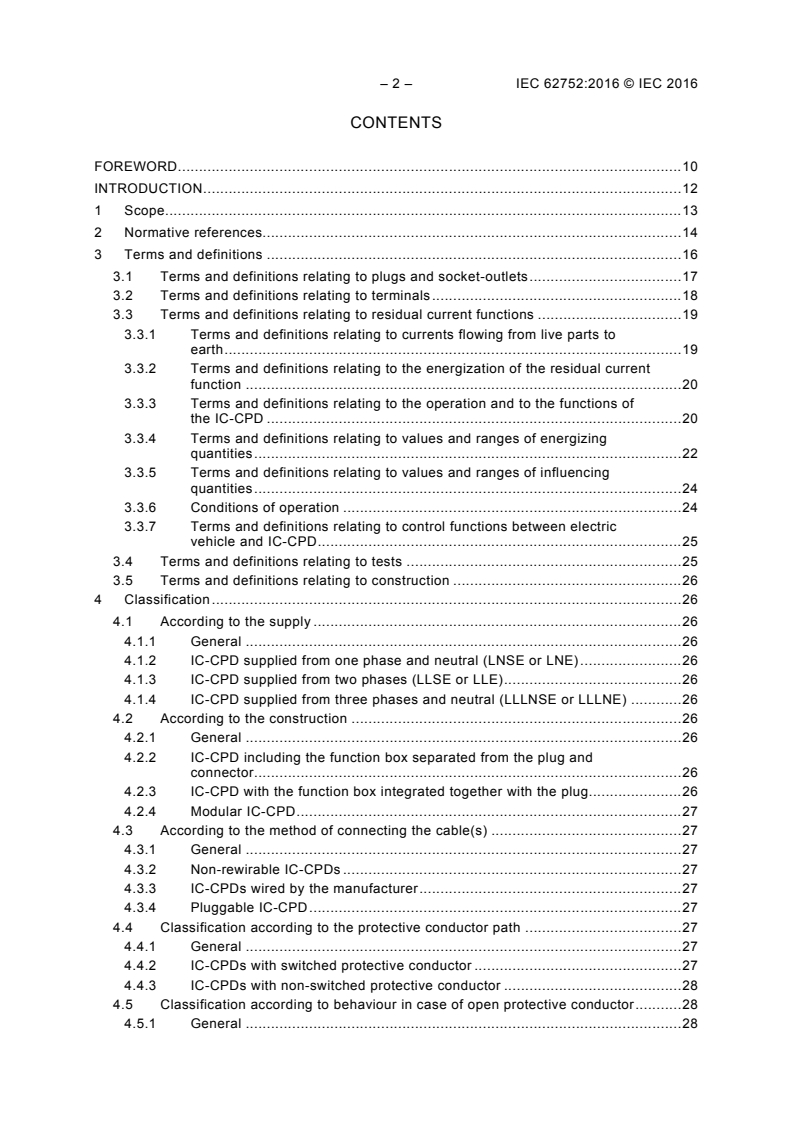
– 2 – IEC 62752:2016 © IEC 2016
CONTENTS
FOREWORD . 10
INTRODUCTION . 12
1 Scope . 13
2 Normative references. 14
3 Terms and definitions . 16
3.1 Terms and definitions relating to plugs and socket-outlets . 17
3.2 Terms and definitions relating to terminals . 18
3.3 Terms and definitions relating to residual current functions . 19
3.3.1 Terms and definitions relating to currents flowing from live parts to
earth . 19
3.3.2 Terms and definitions relating to the energization of the residual current
function . 20
3.3.3 Terms and definitions relating to the operation and to the functions of
the IC-CPD . 20
3.3.4 Terms and definitions relating to values and ranges of energizing
quantities . 22
3.3.5 Terms and definitions relating to values and ranges of influencing
quantities . 24
3.3.6 Conditions of operation . 24
3.3.7 Terms and definitions relating to control functions between electric
vehicle and IC-CPD . 25
3.4 Terms and definitions relating to tests . 25
3.5 Terms and definitions relating to construction . 26
4 Classification . 26
4.1 According to the supply . 26
4.1.1 General . 26
4.1.2 IC-CPD supplied from one phase and neutral (LNSE or LNE) . 26
4.1.3 IC-CPD supplied from two phases (LLSE or LLE) . 26
4.1.4 IC-CPD supplied from three phases and neutral (LLLNSE or LLLNE) . 26
4.2 According to the construction . 26
4.2.1 General . 26
4.2.2 IC-CPD including the function box separated from the plug and
connector . 26
4.2.3 IC-CPD with the function box integrated together with the plug. 26
4.2.4 Modular IC-CPD . 27
4.3 According to the method of connecting the cable(s) . 27
4.3.1 General . 27
4.3.2 Non-rewirable IC-CPDs . 27
4.3.3 IC-CPDs wired by the manufacturer . 27
4.3.4 Pluggable IC-CPD . 27
4.4 Classification according to the protective conductor path . 27
4.4.1 General . 27
4.4.2 IC-CPDs with switched protective conductor . 27
4.4.3 IC-CPDs with non-switched protective conductor . 28
4.5 Classification according to behaviour in case of open protective conductor . 28
4.5.1 General . 28
4.5.2 IC-CPD with verification of the availability of the upstream protective
conductor . 28
4.5.3 IC-CPD without verification of the availability of the upstream protective
conductor . 28
5 Characteristics of IC-CPDs . 28
5.1 Summary of characteristics . 28
5.2 Rated quantities and other characteristics . 29
5.2.1 Rated voltages . 29
5.2.2 Rated current (I ) . 29
n
5.2.3 Rated residual operating current (I ) . 29
∆n
5.2.4 Rated residual non-operating current (I ) . 29
∆no
5.2.5 Rated frequency . 29
5.2.6 Rated making and breaking capacity (I ) . 29
m
5.2.7 Rated residual making and breaking capacity (I ) . 30
∆m
5.2.8 Operating characteristics in case of residual currents comprising a d.c.
component . 30
5.2.9 Insulation coordination including creepage distances and clearances . 30
5.2.10 Coordination with short-circuit protection devices (SCPDs) . 30
5.3 Standard and preferred values . 30
5.3.1 Preferred values of rated operational voltage (U ) . 30
e
5.3.2 Preferred values of rated current (I ) . 30
n
5.3.3 Standard values of rated residual operating current (I ) . 31
∆n
5.3.4 Standard value of rated residual non-operating current (I ) . 31
∆no
5.3.5 Standard minimum value of the non-operating overcurrent through the
IC-CPD . 31
5.3.6 Preferred values of rated frequency . 31
5.3.7 Minimum value of the rated making and breaking capacity (I ) . 31
m
5.3.8 Minimum value of the rated residual making and breaking capacity
(I ) . 31
∆m
5.3.9 Standard value of the rated conditional short-circuit current (I ) . 32
nc
5.3.10 Standard value of the rated conditional residual short-circuit current
(I ) . 32
∆c
5.3.11 Limit values of break time . 32
6 Marking and other product information . 32
6.1 Data to be marked on the IC-CPD . 32
6.2 Information to be provided to the end-user . 34
7 Standard conditions for operation in service and for installation . 35
7.1 Standard conditions . 35
7.2 Conditions for installations . 36
8 Requirements for construction and operation . 36
8.1 Mechanical design . 36
8.2 Pluggable electrical connections of pluggable IC-CPDs according to 4.3.4 . 37
8.2.1 General . 37
8.2.2 Degree of protection of pluggable electrical connection against solid
foreign objects and water for pluggable IC-CPD . 37
8.2.3 Breaking capacity of pluggable electrical connection for pluggable IC-
CPD . 38
8.2.4 Additional requirements . 38
8.3 Construction . 38
8.3.1 General . 38
– 4 – IEC 62752:2016 © IEC 2016
8.3.2 Terminations of IC-CPDs . 39
8.3.3 Enclosure of IC-CPDs according to 4.3.3 . 39
8.3.4 Terminal screws or nuts of IC-CPDs according to 4.3.3 . 39
8.3.5 Strain on the conductors of IC-CPDs according to 4.3.3 . 40
8.3.6 Additional requirements for IC-CPDs according to 4.3.3 . 40
8.3.7 Insulating parts which keep the live parts in position . 40
8.3.8 Screws for IC-CPD according to 4.3.3 . 40
8.3.9 Means for suspension from a wall or other mounting surfaces . 40
8.3.10 Plug as an integral part of plug-in equipment . 40
8.3.11 Flexible cables and cords and their connection . 41
8.4 Electrical performance . 42
8.4.1 Protective conductor path . 42
8.4.2 Contact mechanism . 42
8.4.3 Clearances and creepage distances (see Annex C) . 43
8.5 Protection against electric shock . 45
8.5.1 General . 45
8.5.2 Requirements relating to plugs, whether incorporated or not in integral
items . 46
8.5.3 Degree of protection of the function box . 46
8.5.4 Requirements relating to vehicle connectors . 46
8.6 Dielectric properties . 46
8.7 Temperature rise . 47
8.8 Operating characteristics . 47
8.8.1 General . 47
8.8.2 Safe connection operating characteristics . 47
8.8.3 Operating characteristics with a.c. residual currents and residual
currents having a d.c. component . 47
8.8.4 Operating characteristics with smooth d.c. residual current . 48
8.8.5 Behaviour of the IC-CPD after a residual current operation . 48
8.8.6 Residual pulsating direct currents which may result from rectifying
circuits supplied from two phases . 48
8.8.7 Residual pulsating direct currents which may result from rectifying
circuits supplied from three phases. 48
8.9 Mechanical and electrical endurance . 48
8.10 Performance at short-circuit currents . 49
8.11 Resistance to mechanical shock and impact . 49
8.12 Resistance to heat . 49
8.13 Resistance to abnormal heat and to fire . 49
8.14 Performance of the test function . 49
8.15 Behaviour in case of loss of the supply voltage . 50
8.16 Resistance of IC-CPDs against unwanted tripping due to surge currents to
earth resulting from impulse voltages . 50
8.17 Control pilot function controller . 50
8.18 Reliability . 50
8.19 Resistance to tracking . 50
8.20 Electromagnetic compatibility (EMC) . 51
8.21 Behaviour of the IC-CPD at low ambient air temperature . 51
8.22 Operation with supply failure and hazardous live protective conductor
conditions . 51
8.23 Verification of a standing current in the protective conductor in normal
service . 51
8.24 Behaviour at specific environmental conditions . 51
8.25 Resistance to vibration and shock . 51
9 Tests . 52
9.1 General . 52
9.1.1 Opening and closing of contacts . 52
9.1.2 Type tests . 52
9.1.3 Test sequences . 53
9.1.4 Routine tests. 54
9.2 Test conditions . 54
9.3 Test of indelibility of marking . 54
9.4 Verification of protection against electric shock . 55
9.5 Test of dielectric properties . 55
9.5.1 Resistance to humidity . 55
9.5.2 Insulation resistance of the main circuit . 56
9.5.3 Dielectric strength of the main circuit . 57
9.5.4 Secondary circuit of detection transformers . 57
9.5.5 Verification of impulse withstand voltages (across clearances and
across solid insulation) and of leakage current across open contacts . 57
9.6 Temperature-rise test . 60
9.6.1 Test conditions . 60
9.6.2 Test procedure . 60
9.6.3 Measurement of the temperature rise of different parts . 61
9.6.4 Temperature rise of a part . 61
9.7 Verification of the operating characteristic . 61
9.7.1 General . 61
9.7.2 Test circuit . 61
9.7.3 Residual sinusoidal alternating currents tests . 62
9.7.4 Verification of the correct operation with residual currents having a d.c.
component . 64
9.7.5 Verification of behaviour in case of composite residual current . 65
9.7.6 Verification of the correct operation in case of smooth d.c. residual
current . 66
9.7.7 Miswiring and supply failure tests . 67
9.7.8 Verification of protective conductor contact behaviour . 71
9.7.9 Verification that the protective conductor is connected to the electric
vehicle . 72
9.7.10 Verification of standing current in the protective conductor connection in
normal service . 72
9.7.11 Verification of the correct operation in case of residual direct currents
which may result from rectifying circuits supplied from two phases . 72
9.7.12 Verification of the correct operation in case of residual direct currents
which may result from rectifying circuits supplied from three phases . 73
9.8 Verification of mechanical and electrical endurance . 73
9.8.1 Endurance of plug and vehicle connector part . 73
9.8.2 Endurance of the residual current function of the IC-CPD . 73
9.9 Verification of the behaviour of the IC-CPD under overcurrent conditions . 75
9.9.1 List of the overcurrent tests . 75
9.9.2 Short-circuit tests . 75
– 6 – IEC 62752:2016 © IEC 2016
9.9.3 Verification of the making and breaking capacity of the plug of the IC-
CPD . 81
9.10 Verification of resistance to mechanical shock and impact . 81
9.10.1 General . 81
9.10.2 Drop test . 81
9.10.3 Test for screwed glands of IC-CPDs . 82
9.10.4 Mechanical strength test on IC-CPDs provided with cords . 82
9.11 Test of resistance to heat . 82
9.11.1 General . 82
9.11.2 Temperature test in heating cabinet . 82
9.11.3 Ball pressure test for insulating material necessary to retain in position
current-carrying parts . 83
9.11.4 Ball pressure test for insulating material not necessary to retain in
position current-carrying parts . 83
9.12 Resistance of insulating material to abnormal heat and to fire . 84
9.13 Verification of the self test . 84
9.14 Verification of the behaviour of IC-CPDs in case of loss of the supply voltage . 85
9.14.1 Verification of correct operation at the minimum operating voltage (U ) . 85
x
9.14.2 Verification of the automatic opening in case of loss of the supply
voltage . 85
9.14.3 Verification of the reclosing function . 86
9.15 Verification of the limiting values of the non-operating current under
overcurrent conditions . 86
9.16 Verification of resistance against unwanted tripping due to surge currents to
earth resulting from impulse voltages . 86
9.17 Verification of reliability . 86
9.17.1 Climatic test . 86
9.17.2 Test at a temperature of 45 °C . 88
9.18 Resistance to ageing . 89
9.19 Resistance to tracking . 89
9.20 Test on pins provided with insulating sleeves . 90
9.21 Test of mechanical strength of non-solid pins of plugs . 90
9.22 Verification of the effects of strain on the conductors . 90
9.23 Checking of the torque exerted by IC-CPDs on fixed socket-outlets . 90
9.24 Tests of the cord anchorage . 90
9.25 Flexing test of non-rewirable IC-CPDs . 91
9.26 Verification of the electromagnetic compatibility (EMC) . 92
9.27 Tests replacing verifications of creepage distances and clearances . 93
9.27.1 General . 93
9.27.2 Abnormal conditions . 93
9.27.3 Temperature rise resulting from fault conditions . 93
9.28 Verifications for single electronic components used in IC-CPDs . 94
9.28.1 General . 94
9.28.2 Capacitors . 94
9.28.3 Resistors and inductors . 94
9.29 Chemical loads . 96
9.30 Heat test under solar radiation . 96
9.31 Resistance to ultra-violet (UV) radiation . 96
9.32 Damp and salt mist test for marine and coastal environments . 97
9.32.1 Test for internal metallic parts . 97
9.32.2 Test for external metallic parts only . 97
9.32.3 Test criteria . 97
9.33 Hot damp test for tropical environments . 97
9.34 Vehicle drive-over . 97
9.34.1 General . 97
9.34.2 Test at crushing force 5 000 N . 98
9.34.3 Test at crushing force 11 000 N . 98
9.34.4 Performance after the tests . 98
9.35 Low storage temperature test . 98
9.36 Vibration and shock test . 99
Annex A (normative) Test sequences and number of samples to be submitted for
verification of conformity to this standard. 140
A.1 Verification of conformity . 140
A.2 Test sequences . 140
A.3 Number of samples to be submitted for full test procedure . 142
A.4 Number of samples to be submitted for simplified test procedures in case of
submitting simultaneously a range of IC-CPDs of the same fundamental
design . 144
Annex B (normative) Routine tests . 146
Annex C (normative) Determination of clearances and creepage distances . 147
C.1 Overview. 147
C.2 Orientation and location of a creepage distance . 147
C.3 Creepage distances where more than one material is used . 147
C.4 Creepage distances split by a floating conductive part . 147
C.5 Measurement of creepage distances and clearances . 147
Annex D (informative) Switched-protective conductor application . 152
D.1 Explanation of switched-protective conductor (SPE) function and application . 152
D.2 Examples of incorrect supply wiring . 153
Annex E (informative) Example of IC-CPD for mode 2 charging . 156
Annex F (informative) Types of IC-CPD according to construction and assembly . 157
Annex G (informative) Methods for determination of short-circuit power factor . 158
G.1 Overview. 158
G.2 Method I – Determination from d.c. components . 158
G.3 Method II – Determination with pilot generator . 158
Bibliography . 160
Figure 1 – Desired characteristics for maintaining the same level of protection over the
frequency range . 61
Figure 2 – Test circuit for the verification of operating characteristic (9.7.3), endurance
test (9.8.2) and reduced supply voltage (9.14.1) . 101
Figure 3 – Test circuit for the verification when plugged in incompatible supply systems
(9.7.7.4) . 104
Figure 4 – Verification of correct operation for hazardous live PE (see Table 14 and
Table 15) . 107
Figure 5 – Verification of temperature rise of the protective conductor . 108
Figure 6 – Verification of open neutral for LNSE types, and open line for LLSE types . 109
Figure 7 – Verification of a standing current in the protective conductor in normal
service . 110
– 8 – IEC 62752:2016 © IEC 2016
Figure 8 – Test circuit for the verification of the making and breaking capacity and the
short-circuit coordination with an SCPD (see 9.9.2) . 114
Figure 9 – Standard test wire 1,0 mm . 114
Figure 10 – Test circuit for the verification of the correct operation in the case of
residual pulsating direct currents (see 9.7.4) . 116
Figure 11 – Test circuit for the verification of the correct operation in the case of
residual pulsating direct currents superimposed by a smooth direct current (see
9.7.4.3) . 118
Figure 12 – Verification of open protective conductor (see 9.7.7.5) . 120
Figure 13 – Arrangement for compression test for verification of protection against
electric shock . 121
Figure 14 – Ball-pressure test apparatus . 121
Figure 15 – Test circuit for IC-CPD according to 4.1.3 to verify the correct operation in
case of residual pulsating direct currents which may result from rectifying circuits
supplied from two phases . 122
Figure 16 – Tests circuit for IC-CPD according to 4.1.4 to verify the correct operation in
case of residual pulsating direct currents which may result from rectifying circuits
supplied from three phases . 123
Figure 17 – Apparatus for testing the cord retention . 124
Figure 18 – Apparatus for flexing test . 125
Figure 19 – Arrangement for mechanical strength test on IC-CPDs provided with cords
(9.10.4) . 126
Figure 20 – Stabilizing period for reliability test (9.17.1.4) . 126
Figure 21 – Reliability test cycle (9.17.1.4) . 127
Figure 22 – Example for test circuit for verification of ageing of electronic components
(9.18) . 128
Figure 23 – Current ring wave 0,5 µs/100 kHz . 129
Figure 24 – Example of test circuit for the verification of resistance to unwanted
tripping . 129
Figure 25 – Minimum creepage distances and clearances as a function of peak value
of voltage (see 9.27.3 a)) . 130
Figure 26 – Minimum creepage distances and clearances as a function of peak value
of operating voltage (see 9.27.3 a)) . 131
Figure 27 – Test cycle for low temperature test . 132
Figure 28 – Test circuit for verification of connection of protective conductor to the EV,
according to 9.7.9 . 133
Figure 29 – Verification of correct operation in case of smooth d.c. leakage current,
according to 9.7.6 . 134
Figure 30 – Example of a test circuit for the verification of correct operation in case of
residual sinusoidal alternating currents composed of multi-frequency components . 135
Figure 31 – Test circuit for endurance test according to 9.8 . 136
Figure 32 – The use of the IC-CPD . 137
Figure 33 – Informative wave shape of inrush current for tests according to 9.8.2. 138
Figure 34 – Test finger . 139
Figure D.1 – Examples of incorrect supply wirings for LLSE types . 154
Figure D.2 – Examples of incorrect supply wirings for LNSE types . 155
Figure E.1 – Example for IC-CPD showing the different parts and functions . 156
Figure F.1 – Example of IC-CPD including function box, cables, plug and connector
according to 4.2.2 . 157
Figure F.2 – Example of plug integrated function box according to 4.2.3 . 157
Figure F.3 – Example of modular IC-CPD according to 4.2.4a) . 157
Figure F.4 – Example of modular IC-CPD according to 4.2.4b) . 157
Table 1 – Preferred values of rated current and corresponding preferred values of
rated voltages . 31
Table 2 – Limit values of break time for a.c. residual currents at rated frequency . 32
Table 3 – Limit values of break time for smooth d.c. residual currents . 32
Table 4 – Limit values of break time for residual pulsating direct currents which may
result from rectif
...
IEC 62752 ®
Edition 1.1 2018-09
CONSOLIDATED VERSION
INTERNATIONAL
STANDARD
NORME
INTERNATIONALE
colour
inside
In-cable control and protection device for mode 2 charging of electric road
vehicles (IC-CPD)
Appareil de contrôle et de protection intégré au câble pour la charge en mode 2
des véhicules électriques (IC-CPD)
All rights reserved. Unless otherwise specified, no part of this publication may be reproduced or utilized in any form
or by any means, electronic or mechanical, including photocopying and microfilm, without permission in writing from
either IEC or IEC's member National Committee in the country of the requester. If you have any questions about IEC
copyright or have an enquiry about obtaining additional rights to this publication, please contact the address below or
your local IEC member National Committee for further information.
Droits de reproduction réservés. Sauf indication contraire, aucune partie de cette publication ne peut être reproduite
ni utilisée sous quelque forme que ce soit et par aucun procédé, électronique ou mécanique, y compris la photocopie
et les microfilms, sans l'accord écrit de l'IEC ou du Comité national de l'IEC du pays du demandeur. Si vous avez des
questions sur le copyright de l'IEC ou si vous désirez obtenir des droits supplémentaires sur cette publication, utilisez
les coordonnées ci-après ou contactez le Comité national de l'IEC de votre pays de résidence.
IEC Central Office Tel.: +41 22 919 02 11
3, rue de Varembé info@iec.ch
CH-1211 Geneva 20 www.iec.ch
Switzerland
About the IEC
The International Electrotechnical Commission (IEC) is the leading global organization that prepares and publishes
International Standards for all electrical, electronic and related technologies.
About IEC publications
The technical content of IEC publications is kept under constant review by the IEC. Please make sure that you have the
latest edition, a corrigenda or an amendment might have been published.
IEC Catalogue - webstore.iec.ch/catalogue Electropedia - www.electropedia.org
The stand-alone application for consulting the entire The world's leading online dictionary of electronic and
bibliographical information on IEC International Standards, electrical terms containing 21 000 terms and definitions in
Technical Specifications, Technical Reports and other English and French, with equivalent terms in 16 additional
documents. Available for PC, Mac OS, Android Tablets and languages. Also known as the International Electrotechnical
iPad. Vocabulary (IEV) online.
IEC publications search - webstore.iec.ch/advsearchform IEC Glossary - std.iec.ch/glossary
The advanced search enables to find IEC publications by a 67 000 electrotechnical terminology entries in English and
variety of criteria (reference number, text, technical French extracted from the Terms and Definitions clause of
committee,…). It also gives information on projects, replaced IEC publications issued since 2002. Some entries have been
and withdrawn publications. collected from earlier publications of IEC TC 37, 77, 86 and
CISPR.
IEC Just Published - webstore.iec.ch/justpublished
Stay up to date on all new IEC publications. Just Published IEC Customer Service Centre - webstore.iec.ch/csc
details all new publications released. Available online and If you wish to give us your feedback on this publication or
also once a month by email. need further assistance, please contact the Customer Service
Centre: sales@iec.ch.
A propos de l'IEC
La Commission Electrotechnique Internationale (IEC) est la première organisation mondiale qui élabore et publie des
Normes internationales pour tout ce qui a trait à l'électricité, à l'électronique et aux technologies apparentées.
A propos des publications IEC
Le contenu technique des publications IEC est constamment revu. Veuillez vous assurer que vous possédez l’édition la
plus récente, un corrigendum ou amendement peut avoir été publié.
Catalogue IEC - webstore.iec.ch/catalogue Electropedia - www.electropedia.org
Application autonome pour consulter tous les renseignements
Le premier dictionnaire en ligne de termes électroniques et
bibliographiques sur les Normes internationales,
électriques. Il contient 21 000 termes et définitions en anglais
Spécifications techniques, Rapports techniques et autres
et en français, ainsi que les termes équivalents dans 16
documents de l'IEC. Disponible pour PC, Mac OS, tablettes
langues additionnelles. Egalement appelé Vocabulaire
Android et iPad.
Electrotechnique International (IEV) en ligne.
Recherche de publications IEC -
Glossaire IEC - std.iec.ch/glossary
webstore.iec.ch/advsearchform
67 000 entrées terminologiques électrotechniques, en anglais
La recherche avancée permet de trouver des publications IEC et en français, extraites des articles Termes et Définitions des
en utilisant différents critères (numéro de référence, texte, publications IEC parues depuis 2002. Plus certaines entrées
comité d’études,…). Elle donne aussi des informations sur les antérieures extraites des publications des CE 37, 77, 86 et
projets et les publications remplacées ou retirées. CISPR de l'IEC.
IEC Just Published - webstore.iec.ch/justpublished Service Clients - webstore.iec.ch/csc
Restez informé sur les nouvelles publications IEC. Just Si vous désirez nous donner des commentaires sur cette
Published détaille les nouvelles publications parues. publication ou si vous avez des questions contactez-nous:
Disponible en ligne et aussi une fois par mois par email. sales@iec.ch.
IEC 62752 ®
Edition 1.1 2018-09
CONSOLIDATED VERSION
INTERNATIONAL
STANDARD
NORME
INTERNATIONALE
colour
inside
In-cable control and protection device for mode 2 charging of electric road
vehicles (IC-CPD)
Appareil de contrôle et de protection intégré au câble pour la charge en mode 2
des véhicules électriques (IC-CPD)
INTERNATIONAL
ELECTROTECHNICAL
COMMISSION
COMMISSION
ELECTROTECHNIQUE
INTERNATIONALE
ICS 29.120.50 ISBN 978-2-8322-6048-7
IEC 62752 ®
Edition 1.1 2018-09
CONSOLIDATED VERSION
REDLINE VERSION
VERSION REDLINE
colour
inside
In-cable control and protection device for mode 2 charging of electric road
vehicles (IC-CPD)
Appareil de contrôle et de protection intégré au câble pour la charge en mode 2
des véhicules électriques (IC-CPD)
– 2 – IEC 62752:2016+AMD1:2018 CSV
© IEC 2018
CONTENTS
FOREWORD . 10
INTRODUCTION . 12
1 Scope . 13
2 Normative references. 14
3 Terms and definitions . 16
3.1 Terms and definitions relating to plugs and socket-outlets . 17
3.2 Terms and definitions relating to terminals . 18
3.3 Terms and definitions relating to residual current functions . 19
3.3.1 Terms and definitions relating to currents flowing from live parts to
earth . 19
3.3.2 Terms and definitions relating to the energization of the residual current
function . 20
3.3.3 Terms and definitions relating to the operation and to the functions of
the IC-CPD . 20
3.3.4 Terms and definitions relating to values and ranges of energizing
quantities . 22
3.3.5 Terms and definitions relating to values and ranges of influencing
quantities . 24
3.3.6 Conditions of operation . 24
3.3.7 Terms and definitions relating to control functions between electric
vehicle and IC-CPD . 25
3.4 Terms and definitions relating to tests . 25
3.5 Terms and definitions relating to construction . 26
4 Classification . 26
4.1 According to the supply . 26
4.1.1 General . 26
4.1.2 IC-CPD supplied from one phase and neutral (LNSE or LNE) . 26
4.1.3 IC-CPD supplied from two phases (LLSE or LLE) . 26
4.1.4 IC-CPD supplied from three phases and neutral (LLLNSE or LLLNE) . 26
4.2 According to the construction . 26
4.2.1 General . 26
4.2.2 IC-CPD including the function box separated from the plug and
connector . 26
4.2.3 IC-CPD with the function box integrated together with the plug. 26
4.2.4 Modular IC-CPD . 27
4.3 According to the method of connecting the cable(s) . 27
4.3.1 General . 27
4.3.2 Non-rewirable IC-CPDs . 27
4.3.3 IC-CPDs wired by the manufacturer . 27
4.3.4 Pluggable IC-CPD . 27
4.4 Classification according to the protective conductor path . 27
4.4.1 General . 27
4.4.2 IC-CPDs with switched protective conductor . 27
4.4.3 IC-CPDs with non-switched protective conductor . 28
4.5 Classification according to behaviour in case of open protective conductor . 28
4.5.1 General . 28
© IEC 2018
4.5.2 IC-CPD with verification of the availability of the upstream protective
conductor . 28
4.5.3 IC-CPD without verification of the availability of the upstream protective
conductor . 28
4.6 Classification according to the usage . 28
4.6.1 IC-CPD for portable use . 28
4.6.2 IC-CPD for wall mounting . 28
4.6.3 IC-CPD for portable use and for wall mounting . 28
5 Characteristics of IC-CPDs . 28
5.1 Summary of characteristics . 28
5.2 Rated quantities and other characteristics . 29
5.2.1 Rated voltages . 29
5.2.2 Rated current (I ) . 29
n
5.2.3 Rated residual operating current (I ) . 29
∆n
5.2.4 Rated residual non-operating current (I ) . 30
∆no
5.2.5 Rated frequency . 30
5.2.6 Rated making and breaking capacity (I ) . 30
m
5.2.7 Rated residual making and breaking capacity (I ) . 30
∆m
5.2.8 Operating characteristics in case of residual currents comprising a d.c.
component . 30
5.2.9 Insulation coordination including creepage distances and clearances . 30
5.2.10 Coordination with short-circuit protection devices (SCPDs) . 30
5.3 Standard and preferred values . 31
5.3.1 Preferred values of rated operational voltage (U ) . 31
e
5.3.2 Preferred values of rated current (I ) . 31
n
5.3.3 Standard values of rated residual operating current (I ) . 31
∆n
5.3.4 Standard value of rated residual non-operating current (I ) . 31
∆no
5.3.5 Standard minimum value of the non-operating overcurrent through the
IC-CPD . 32
5.3.6 Preferred values of rated frequency . 32
5.3.7 Minimum value of the rated making and breaking capacity (I ) . 32
m
5.3.8 Minimum value of the rated residual making and breaking capacity
(I ) . 32
∆m
5.3.9 Standard value of the rated conditional short-circuit current (I ) . 32
nc
5.3.10 Standard value of the rated conditional residual short-circuit current
(I ) . 32
∆c
5.3.11 Limit values of break time . 32
6 Marking and other product information . 33
6.1 Data to be marked on the IC-CPD . 33
6.2 Information to be provided to the end-user . 35
7 Standard conditions for operation in service and for installation . 36
7.1 Standard conditions . 36
7.2 Conditions for installations . 36
8 Requirements for construction and operation . 36
8.1 Mechanical design . 36
8.2 Pluggable electrical connections of pluggable IC-CPDs according to 4.3.4 . 38
8.2.1 General . 38
8.2.2 Degree of protection of pluggable electrical connection against solid
foreign objects and water for pluggable IC-CPD . 38
– 4 – IEC 62752:2016+AMD1:2018 CSV
© IEC 2018
8.2.3 Breaking capacity of pluggable electrical connection for pluggable IC-
CPD . 38
8.2.4 Additional requirements . 39
8.3 Construction . 39
8.3.1 General . 39
8.3.2 Terminations of IC-CPDs . 40
8.3.3 Enclosure of IC-CPDs according to 4.3.3 . 40
8.3.4 Terminal screws or nuts of IC-CPDs according to 4.3.3 . 40
8.3.5 Strain on the conductors of IC-CPDs according to 4.3.3 . 40
8.3.6 Additional requirements for IC-CPDs according to 4.3.3 . 41
8.3.7 Insulating parts which keep the live parts in position . 41
8.3.8 Screws for IC-CPD according to 4.3.3 . 41
8.3.9 Means for suspension from a wall or other mounting surfaces . 41
8.3.10 Plug as an integral part of plug-in equipment . 41
8.3.11 Flexible cables and cords and their connection . 42
8.4 Electrical performance . 43
8.4.1 Protective conductor path . 43
8.4.2 Contact mechanism . 43
8.4.3 Clearances and creepage distances (see Annex C) . 43
8.5 Protection against electric shock . 46
8.5.1 General . 46
8.5.2 Requirements relating to plugs, whether incorporated or not in integral
items . 47
8.5.3 Degree of protection of the function box . 47
8.5.4 Requirements relating to vehicle connectors . 47
8.6 Dielectric properties . 47
8.7 Temperature rise . 48
8.8 Operating characteristics . 48
8.8.1 General . 48
8.8.2 Safe connection operating characteristics . 48
8.8.3 Operating characteristics with a.c. residual currents and residual
currents having a d.c. component . 48
8.8.4 Operating characteristics with smooth d.c. residual current . 49
8.8.5 Behaviour of the IC-CPD after a residual current operation . 49
8.8.6 Residual pulsating direct currents which may result from rectifying
circuits supplied from two phases . 49
8.8.7 Residual pulsating direct currents which may result from rectifying
circuits supplied from three phases. 49
8.9 Mechanical and electrical endurance . 49
8.10 Performance at short-circuit currents . 50
8.11 Resistance to mechanical shock and impact . 50
8.12 Resistance to heat . 50
8.13 Resistance to abnormal heat and to fire . 50
8.14 Performance of the test function . 50
8.15 Behaviour in case of loss of the supply voltage . 51
8.16 Resistance of IC-CPDs against unwanted tripping due to surge currents to
earth resulting from impulse voltages . 51
8.17 Control pilot function controller . 51
8.18 Reliability . 51
8.19 Resistance to tracking . 51
© IEC 2018
8.20 Electromagnetic compatibility (EMC) . 52
8.21 Behaviour of the IC-CPD at low ambient air temperature . 52
8.22 Operation with supply failure and hazardous live protective conductor
conditions . 52
8.23 Verification of a standing current in the protective conductor in normal
service . 52
8.24 Behaviour at specific environmental conditions . 52
8.25 Resistance to vibration and shock . 52
9 Tests . 53
9.1 General . 53
9.1.1 Opening and closing of contacts . 53
9.1.2 Type tests . 53
9.1.3 Test sequences . 54
9.1.4 Routine tests. 55
9.2 Test conditions . 55
9.3 Test of indelibility of marking . 55
9.4 Verification of protection against electric shock . 56
9.5 Test of dielectric properties . 56
9.5.1 Resistance to humidity . 56
9.5.2 Insulation resistance of the main circuit . 57
9.5.3 Dielectric strength of the main circuit . 58
9.5.4 Secondary circuit of detection transformers . 58
9.5.5 Verification of impulse withstand voltages (across clearances and
across solid insulation) and of leakage current across open contacts . 58
9.6 Temperature-rise test . 61
9.6.1 Test conditions . 61
9.6.2 Test procedure . 61
9.6.3 Measurement of the temperature rise of different parts . 62
9.6.4 Temperature rise of a part . 62
9.7 Verification of the operating characteristic . 62
9.7.1 General . 62
9.7.2 Test circuit . 62
9.7.3 Residual sinusoidal alternating currents tests . 63
9.7.4 Verification of the correct operation with residual currents having a d.c.
component . 65
9.7.5 Verification of behaviour in case of composite residual current . 66
9.7.6 Verification of the correct operation in case of smooth d.c. residual
current . 68
9.7.7 Miswiring and supply failure tests . 68
9.7.8 Verification of protective conductor contact behaviour . 72
9.7.9 Verification that the protective conductor is connected to the electric
vehicle . 73
9.7.10 Verification of standing current in the protective conductor connection in
normal service . 73
9.7.11 Verification of the correct operation in case of residual direct currents
which may result from rectifying circuits supplied from two phases . 73
9.7.12 Verification of the correct operation in case of residual direct currents
which may result from rectifying circuits supplied from three phases . 74
9.8 Verification of mechanical and electrical endurance . 74
9.8.1 Endurance of plug and vehicle connector part . 74
9.8.2 Endurance of the residual current function of the IC-CPD . 74
– 6 – IEC 62752:2016+AMD1:2018 CSV
© IEC 2018
9.9 Verification of the behaviour of the IC-CPD under overcurrent conditions . 76
9.9.1 List of the overcurrent tests . 76
9.9.2 Short-circuit tests . 76
9.9.3 Verification of the making and breaking capacity of the plug of the IC-
CPD . 82
9.10 Verification of resistance to mechanical shock and impact . 82
9.10.1 General . 82
9.10.2 Drop test . 82
9.10.3 Test for screwed glands of IC-CPDs . 83
9.10.4 Mechanical strength test on IC-CPDs provided with cords . 83
9.10.5 Verification requirements for IC-CPD according to 4.6.2 and 4.6.3 . 83
9.11 Test of resistance to heat . 83
9.11.1 General . 83
9.11.2 Temperature test in heating cabinet . 84
9.11.3 Ball pressure test for insulating material necessary to retain in position
current-carrying parts . 84
9.11.4 Ball pressure test for insulating material not necessary to retain in
position current-carrying parts . 85
9.12 Resistance of insulating material to abnormal heat and to fire . 85
9.13 Verification of the self test . 86
9.14 Verification of the behaviour of IC-CPDs in case of loss of the supply voltage . 86
9.14.1 Verification of correct operation at the minimum operating voltage (U ) . 86
x
9.14.2 Verification of the automatic opening in case of loss of the supply
voltage . 86
9.14.3 Verification of the reclosing function . 87
9.15 Verification of the limiting values of the non-operating current under
overcurrent conditions . 87
9.16 Verification of resistance against unwanted tripping due to surge currents to
earth resulting from impulse voltages . 87
9.17 Verification of reliability . 88
9.17.1 Climatic test . 88
9.17.2 Test at a temperature of 45 °C . 89
9.18 Resistance to ageing . 90
9.19 Resistance to tracking . 91
9.20 Test on pins provided with insulating sleeves . 91
9.21 Test of mechanical strength of non-solid pins of plugs . 91
9.22 Verification of the effects of strain on the conductors . 91
9.23 Checking of the torque exerted by IC-CPDs on fixed socket-outlets . 91
9.24 Tests of the cord anchorage . 92
9.25 Flexing test of non-rewirable IC-CPDs . 92
9.26 Verification of the electromagnetic compatibility (EMC) . 93
9.27 Tests replacing verifications of creepage distances and clearances . 94
9.27.1 General . 94
9.27.2 Abnormal conditions . 94
9.27.3 Temperature rise resulting from fault conditions . 94
9.28 Verifications for single electronic components used in IC-CPDs . 95
9.28.1 General . 95
9.28.2 Capacitors . 95
9.28.3 Resistors and inductors . 96
9.29 Chemical loads . 98
© IEC 2018
9.30 Heat test under solar radiation . 98
9.31 Resistance to ultra-violet (UV) radiation . 98
9.32 Damp and salt mist test for marine and coastal environments . 99
9.32.1 Test for internal metallic parts . 99
9.32.2 Test for external metallic parts only . 99
9.32.3 Test criteria . 99
9.33 Hot damp test for tropical environments . 99
9.34 Vehicle drive-over . 99
9.34.1 General . 99
9.34.2 Test at crushing force 5 000 N . 100
9.34.3 Test at crushing force 11 000 N . 100
9.34.4 Performance after the tests . 100
9.35 Low storage temperature test . 100
9.36 Vibration and shock test . 101
Annex A (normative) Test sequences and number of samples to be submitted for
verification of conformity to this standard. 143
A.1 Verification of conformity . 143
A.2 Test sequences . 143
A.3 Number of samples to be submitted for full test procedure . 146
A.4 Number of samples to be submitted for simplified test procedures in case of
submitting simultaneously a range of IC-CPDs of the same fundamental
design . 148
Annex B (normative) Routine tests . 150
Annex C (normative) Determination of clearances and creepage distances . 151
C.1 Overview. 151
C.2 Orientation and location of a creepage distance . 151
C.3 Creepage distances where more than one material is used . 151
C.4 Creepage distances split by a floating conductive part . 151
C.5 Measurement of creepage distances and clearances . 151
Annex D (informative) Switched-protective conductor application . 156
D.1 Explanation of switched-protective conductor (SPE) function and application . 156
D.2 Examples of incorrect supply wiring . 157
Annex E (informative) Example of IC-CPD for mode 2 charging . 160
Annex F (informative) Types of IC-CPD according to construction and assembly . 161
Annex G (informative) Methods for determination of short-circuit power factor . 162
G.1 Overview. 162
G.2 Method I – Determination from d.c. components . 162
G.3 Method II – Determination with pilot generator . 162
Bibliography . 164
Figure 1 – Desired characteristics for maintaining the same level of protection over the
frequency range . 62
Figure 2 – Test circuit for the verification of operating characteristic (9.7.3), endurance
test (9.8.2) and reduced supply voltage (9.14.1) . 103
Figure 3 – Test circuit for the verification when plugged in incompatible supply systems
(9.7.7.4) . 106
Figure 4 – Verification of correct operation for hazardous live PE (see Table 14 and
Table 15) . 109
Figure 5 – Verification of temperature rise of the protective conductor . 110
– 8 – IEC 62752:2016+AMD1:2018 CSV
© IEC 2018
Figure 6 – Verification of open neutral for LNSE types, and open line for LLSE types . 111
Figure 7 – Verification of a standing current in the protective conductor in normal
service . 112
Figure 8 – Test circuit for the verification of the making and breaking capacity and the
short-circuit coordination with an SCPD (see 9.9.2) . 116
Figure 9 – Standard test wire 1,0 mm . 116
Figure 10 – Test circuit for the verification of the correct operation in the case of
residual pulsating direct currents (see 9.7.4) . 118
Figure 11 – Test circuit for the verification of the correct operation in the case of
residual pulsating direct currents superimposed by a smooth direct current (see
9.7.4.3) . 120
Figure 12 – Verification of open protective conductor (see 9.7.7.5) . 122
Figure 13 – Arrangement for compression test for verification of protection against
electric shock . 123
Figure 14 – Ball-pressure test apparatus . 124
Figure 15 – Test circuit for IC-CPD according to 4.1.3 to verify the correct operation in
case of residual pulsating direct currents which may result from rectifying circuits
supplied from two phases . 125
Figure 16 – Tests circuit for IC-CPD according to 4.1.4 to verify the correct operation in
case of residual pulsating direct currents which may result from rectifying circuits
supplied from three phases . 126
Figure 17 – Apparatus for testing the cord retention . 127
Figure 18 – Apparatus for flexing test . 128
Figure 19 – Arrangement for mechanical strength test on IC-CPDs provided with cords
(9.10.4) . 129
Figure 20 – Stabilizing period for reliability test (9.17.1.4) . 129
Figure 21 – Reliability test cycle (9.17.1.4) . 130
Figure 22 – Example for test circuit for verification of ageing of electronic components
(9.18) . 131
Figure 23 – Current ring wave 0,5 µs/100 kHz . 131
Figure 24 – Example of test circuit for the verification of resistance to unwanted
tripping . 132
Figure 25 – Minimum creepage distances and clearances as a function of peak value
of voltage (see 9.27.3 a)) . 133
Figure 26 – Minimum creepage distances and clearances as a function of peak value
of operating voltage (see 9.27.3 a)) . 134
Figure 27 – Test cycle for low temperature test . 134
Figure 28 – Test circuit for verification of connection of protective conductor to the EV,
according to 9.7.9 . 135
Figure 29 – Verification of correct operation in case of smooth d.c. leakage current,
according to 9.7.6 . 137
Figure 30 – Example of a test circuit for the verification of correct operation in case of
residual sinusoidal alternating currents composed of multi-frequency components . 138
Figure 31 – Test circuit for endurance test according to 9.8 . 139
Figure 32 – The use of the IC-CPD . 140
Figure 33 – Informative wave shape of inrush current for tests according to 9.8.2. 141
Figur
...