

IEC TR 61000-1-9:2024
(Main)Electromagnetic compatibility (EMC) - Part 1-9: General - Evaluation of uncertainty for the measurement of harmonic current emissions
General Information
- Abstract
IEC TR 61000-1-9:2024 which is a Technical Report, provides examples for the evaluation of measurement uncertainty of harmonic emission tests performed using IEC 61000-3-2 and IEC 61000-3-12, and their application to the relevant conformity decisions. It also contains practical formulae to enable calculations in accordance with ISO/IEC Guide 98-3 (GUM).
- Status
- Published
- Publication Date
- 29-Jul-2026
- Technical Committee
- SC 77A - EMC - Low frequency phenomena
- Current Stage
- PPUB - Publication issued
- Start Date
- 11-Mar-2024
- Completion Date
- 15-Mar-2024
Buy Documents
iectr61000-1-9{ed1.0}en - IEC TR 61000-1-9:2024 - Electromagnetic compatibility (EMC) - Part 1-9: General - Evaluation of uncertainty for the measurement of harmonic current emissions Released:3/11/2024
iectr61000-1-9{ed1.1}en - IEC TR 61000-1-9:2024+AMD1:2026 CSV - Electromagnetic compatibility (EMC) - Part 1-9: General - Evaluation of uncertainty for the measurement of harmonic current emissions
Overview
IEC TR 61000-1-9:2024 is a Technical Report from the IEC that addresses electromagnetic compatibility (EMC) measurement uncertainty for harmonic current emissions. It provides practical formulae, worked examples and spreadsheet files to evaluate measurement uncertainty for tests performed under IEC 61000-3-2 and IEC 61000-3-12, using the ISO/IEC Guide 98-3 (GUM) approach. The report is aimed at helping testing laboratories and conformity assessors apply uncertainty analysis to conformity decisions.
Key topics and technical requirements
- Scope and methodology: Applies the GUM (ISO/IEC Guide 98-3) method to harmonic emission tests and describes a measurement model (including single-phase measurement circuits).
- Uncertainty components: Detailed treatment of major contributors, including:
- current measurement equipment performance,
- input impedance of current measurement devices,
- test voltage RMS value and its harmonic distortion,
- loading effect of voltmeters,
- method-related effects and worst‑case scenarios.
- Worst‑case and typical examples: Tables and annexes present worst‑case uncertainty budgets for different equipment classes and selected harmonics (e.g., Class A, C, D, various harmonic numbers).
- Formulas and spreadsheets: Practical formulae link each uncertainty source to its contribution; accompanying spreadsheets facilitate hands‑on calculations in line with GUM.
- Conformity decisions: Guidance on how measurement uncertainty supports pass/fail decisions for harmonic current limits, compatible with ISO/IEC 17025 and JCGM 106 practices.
Practical applications and users
Who benefits:
- Accredited testing laboratories (ISO/IEC 17025) performing EMC harmonic tests.
- Conformity assessment bodies and certification schemes evaluating compliance with harmonic limits.
- EMC engineers and product manufacturers who need to quantify uncertainty when demonstrating compliance with IEC 61000-3-2 / IEC 61000-3-12 limits.
- Metrology and quality managers implementing GUM-based uncertainty budgets for power-harmonics testing.
How it is used:
- Prepare measurement uncertainty budgets for harmonic emission tests.
- Inform conformity decisions by combining measured values with calculated expanded uncertainties.
- Reduce unnecessary failures by distinguishing true non‑compliance from measurement uncertainty.
Related standards
- IEC 61000-3-2 (harmonic limits for equipment ≤16 A)
- IEC 61000-3-12 (harmonic limits for 16 A–75 A)
- IEC 61000-4-7 (harmonics measurement instrumentation)
- ISO/IEC Guide 98-3 (GUM)
- ISO/IEC 17025 (laboratory competence)
- JCGM 106 / ISO/IEC Guide 115 (conformity assessment guidance)
Keywords: IEC TR 61000-1-9:2024, EMC, measurement uncertainty, harmonic current emissions, IEC 61000-3-2, IEC 61000-3-12, GUM, ISO/IEC 17025, conformity assessment.
Relations
- Effective Date
- 26-Oct-2025
Buy Documents
iectr61000-1-9{ed1.0}en - IEC TR 61000-1-9:2024 - Electromagnetic compatibility (EMC) - Part 1-9: General - Evaluation of uncertainty for the measurement of harmonic current emissions Released:3/11/2024
iectr61000-1-9{ed1.1}en - IEC TR 61000-1-9:2024+AMD1:2026 CSV - Electromagnetic compatibility (EMC) - Part 1-9: General - Evaluation of uncertainty for the measurement of harmonic current emissions
Get Certified
Connect with accredited certification bodies for this standard

ANCE
Mexican certification and testing association.

Intertek Slovenia
Intertek testing, inspection, and certification services in Slovenia.

LNE (Laboratoire National de Métrologie et d'Essais)
French national laboratory for metrology and testing.
Sponsored listings
Frequently Asked Questions
IEC TR 61000-1-9:2024 is a technical report published by the International Electrotechnical Commission (IEC). Its full title is "Electromagnetic compatibility (EMC) - Part 1-9: General - Evaluation of uncertainty for the measurement of harmonic current emissions". This standard covers: IEC TR 61000-1-9:2024 which is a Technical Report, provides examples for the evaluation of measurement uncertainty of harmonic emission tests performed using IEC 61000-3-2 and IEC 61000-3-12, and their application to the relevant conformity decisions. It also contains practical formulae to enable calculations in accordance with ISO/IEC Guide 98-3 (GUM).
IEC TR 61000-1-9:2024 which is a Technical Report, provides examples for the evaluation of measurement uncertainty of harmonic emission tests performed using IEC 61000-3-2 and IEC 61000-3-12, and their application to the relevant conformity decisions. It also contains practical formulae to enable calculations in accordance with ISO/IEC Guide 98-3 (GUM).
IEC TR 61000-1-9:2024 is classified under the following ICS (International Classification for Standards) categories: 33.100.01 - Electromagnetic compatibility in general; 33.100.10 - Emission. The ICS classification helps identify the subject area and facilitates finding related standards.
IEC TR 61000-1-9:2024 has the following relationships with other standards: It is inter standard links to IEC TR 61000-1-9:2024/AMD1:2026. Understanding these relationships helps ensure you are using the most current and applicable version of the standard.
IEC TR 61000-1-9:2024 is available in PDF format for immediate download after purchase. The document can be added to your cart and obtained through the secure checkout process. Digital delivery ensures instant access to the complete standard document.
Standards Content (Sample)
IEC TR 61000-1-9 ®
Edition 1.0 2024-03
TECHNICAL
REPORT
Electromagnetic compatibility (EMC) –
Part 1-9: General – Evaluation of uncertainty for the measurement of harmonic
current emissions
All rights reserved. Unless otherwise specified, no part of this publication may be reproduced or utilized in any form
or by any means, electronic or mechanical, including photocopying and microfilm, without permission in writing from
either IEC or IEC's member National Committee in the country of the requester. If you have any questions about IEC
copyright or have an enquiry about obtaining additional rights to this publication, please contact the address below or
your local IEC member National Committee for further information.
IEC Secretariat Tel.: +41 22 919 02 11
3, rue de Varembé info@iec.ch
CH-1211 Geneva 20 www.iec.ch
Switzerland
About the IEC
The International Electrotechnical Commission (IEC) is the leading global organization that prepares and publishes
International Standards for all electrical, electronic and related technologies.
About IEC publications
The technical content of IEC publications is kept under constant review by the IEC. Please make sure that you have the
latest edition, a corrigendum or an amendment might have been published.
IEC publications search - webstore.iec.ch/advsearchform IEC Products & Services Portal - products.iec.ch
The advanced search enables to find IEC publications by a Discover our powerful search engine and read freely all the
variety of criteria (reference number, text, technical publications previews, graphical symbols and the glossary.
committee, …). It also gives information on projects, replaced With a subscription you will always have access to up to date
and withdrawn publications. content tailored to your needs.
IEC Just Published - webstore.iec.ch/justpublished
Electropedia - www.electropedia.org
Stay up to date on all new IEC publications. Just Published
The world's leading online dictionary on electrotechnology,
details all new publications released. Available online and once
containing more than 22 500 terminological entries in English
a month by email.
and French, with equivalent terms in 25 additional languages.
Also known as the International Electrotechnical Vocabulary
IEC Customer Service Centre - webstore.iec.ch/csc
(IEV) online.
If you wish to give us your feedback on this publication or need
further assistance, please contact the Customer Service
Centre: sales@iec.ch.
IEC TR 61000-1-9 ®
Edition 1.0 2024-03
TECHNICAL
REPORT
Electromagnetic compatibility (EMC) –
Part 1-9: General – Evaluation of uncertainty for the measurement of harmonic
current emissions
INTERNATIONAL
ELECTROTECHNICAL
COMMISSION
ICS 33.100.10; 33.100.01 ISBN 978-2-8322-8282-3
– 2 – IEC TR 61000-1-9:2024 © IEC 2024
CONTENTS
FOREWORD . 3
INTRODUCTION . 5
1 Scope . 6
2 Normative references . 6
3 Terms and definitions . 7
4 Uncertainty evaluation for harmonic emissions tests in IEC 61000-3-2 and
IEC 61000-3-12 . 7
4.1 Methodology . 7
4.2 Measurement model. 8
4.3 Uncertainty components for worst-case scenario . 9
4.3.1 Method . 9
4.3.2 Current measurement equipment . 9
4.3.3 Input impedance of the current measurement equipment . 9
4.3.4 Test voltage RMS value . 10
4.3.5 Harmonic distortion of the test voltage . 10
4.3.6 Loading effect of the voltmeter. 11
4.4 Uncertainty budget for Class A harmonic 5 . 11
5 Uncertainty budget for typical measurement data . 12
5.1 General . 12
5.2 Current measurement equipment . 12
5.3 Input impedance of the measurement equipment . 13
5.4 Test voltage RMS value . 13
5.5 Harmonic distortion of the test voltage . 14
5.6 Loading effect of the voltmeter . 14
6 Measurement uncertainty supporting conformity decisions . 15
Annex A (informative) Worst-case uncertainty budgets for various EUT classes of
tests and selected harmonics . 16
Bibliography . 23
Figure 1 – Measurement circuit for single-phase equipment . 8
Table 1 – Worst-case uncertainty budget for Class A, Harmonic 5 . 11
Table A.1 – Worst-case uncertainty budget for Class A, Harmonic 5 . 16
Table A.2 – Worst-case uncertainty budget for Class A, Harmonic 6 . 17
Table A.3 – Worst-case uncertainty budget for Class A, Harmonic15 . 17
Table A.4 – Worst-case uncertainty budget for Class A, Harmonic 40 . 18
Table A.5 – Worst-case uncertainty budget for Class C, Harmonic 3 . 18
Table A.6 – Worst-case uncertainty budget for Class C, Harmonic 5 . 19
Table A.7 – Worst-case uncertainty budget for Class C, Harmonic 11 . 20
Table A.8 – Worst-case uncertainty budget for Class D, Harmonic 3 . 21
Table A.9 – Worst-case uncertainty budget for Class D, Harmonic 11 . 22
INTERNATIONAL ELECTROTECHNICAL COMMISSION
____________
ELECTROMAGNETIC COMPATIBILITY (EMC) –
Part 1-9: General – Evaluation of uncertainty for
the measurement of harmonic current emissions
FOREWORD
1) The International Electrotechnical Commission (IEC) is a worldwide organization for standardization comprising
all national electrotechnical committees (IEC National Committees). The object of IEC is to promote international
co-operation on all questions concerning standardization in the electrical and electronic fields. To this end and
in addition to other activities, IEC publishes International Standards, Technical Specifications, Technical Reports,
Publicly Available Specifications (PAS) and Guides (hereafter referred to as "IEC Publication(s)"). Their
preparation is entrusted to technical committees; any IEC National Committee interested in the subject dealt with
may participate in this preparatory work. International, governmental and non-governmental organizations liaising
with the IEC also participate in this preparation. IEC collaborates closely with the International Organization for
Standardization (ISO) in accordance with conditions determined by agreement between the two organizations.
2) The formal decisions or agreements of IEC on technical matters express, as nearly as possible, an international
consensus of opinion on the relevant subjects since each technical committee has representation from all
interested IEC National Committees.
3) IEC Publications have the form of recommendations for international use and are accepted by IEC National
Committees in that sense. While all reasonable efforts are made to ensure that the technical content of IEC
Publications is accurate, IEC cannot be held responsible for the way in which they are used or for any
misinterpretation by any end user.
4) In order to promote international uniformity, IEC National Committees undertake to apply IEC Publications
transparently to the maximum extent possible in their national and regional publications. Any divergence between
any IEC Publication and the corresponding national or regional publication shall be clearly indicated in the latter.
5) IEC itself does not provide any attestation of conformity. Independent certification bodies provide conformity
assessment services and, in some areas, access to IEC marks of conformity. IEC is not responsible for any
services carried out by independent certification bodies.
6) All users should ensure that they have the latest edition of this publication.
7) No liability shall attach to IEC or its directors, employees, servants or agents including individual experts and
members of its technical committees and IEC National Committees for any personal injury, property damage or
other damage of any nature whatsoever, whether direct or indirect, or for costs (including legal fees) and
expenses arising out of the publication, use of, or reliance upon, this IEC Publication or any other IEC
Publications.
8) Attention is drawn to the Normative references cited in this publication. Use of the referenced publications is
indispensable for the correct application of this publication.
9) IEC draws attention to the possibility that the implementation of this document may involve the use of (a)
patent(s). IEC takes no position concerning the evidence, validity or applicability of any claimed patent rights in
respect thereof. As of the date of publication of this document, IEC had not received notice of (a) patent(s), which
may be required to implement this document. However, implementers are cautioned that this may not represent
the latest information, which may be obtained from the patent database available at https://patents.iec.ch. IEC
shall not be held responsible for identifying any or all such patent rights.
IEC TR 61000-1-9 has been prepared by subcommittee 77A: EMC - Low frequency phenomena,
of IEC technical committee 77: Electromagnetic compatibility. It is a Technical Report.
The text of this Technical Report is based on the following documents:
Draft Report on voting
77A/1194/DTR 77A/1204/RVDTR
Full information on the voting for its approval can be found in the report on voting indicated in
the above table.
The language used for the development of this Technical Report is English.
– 4 – IEC TR 61000-1-9:2024 © IEC 2024
This document was drafted in accordance with ISO/IEC Directives, Part 2, and developed in
accordance with ISO/IEC Directives, Part 1 and ISO/IEC Directives, IEC Supplement, available
at www.iec.ch/members_experts/refdocs. The main document types developed by IEC are
described in greater detail at www.iec.ch/publications.
A list of all parts in the IEC 61000 series, published under the general title Electromagnetic
compatibility (EMC), can be found on the IEC website.
This document contains attached files in the form of a spreadsheet. These files are intended to
be used as a complement and do not form an integral part of the document.
The committee has decided that the contents of this document will remain unchanged until the
stability date indicated on the IEC website under webstore.iec.ch in the data related to the
specific document. At this date, the document will be
• reconfirmed,
• withdrawn, or
• revised.
INTRODUCTION
IEC 61000 is published in separate parts, according to the following structure:
Part 1: General
General considerations (introduction, fundamental principles)
Definitions, terminology
Part 2: Environment
Description levels
Classification of the environment
Compatibility levels
Part 3: Limits
Emission limits
Immunity limits (in so far as they do not fall under the responsibility of the product
committees)
Part 4: Testing and measurement techniques
Measurement techniques
Testing techniques
Part 5: Installation and mitigation guidelines
Installation guidelines
Mitigation methods and devices
Part 6: Generic standards
Part 9: Miscellaneous
Each part is further subdivided into several parts, published either as international standards
or as technical specifications or technical reports, some of which have already been published
as sections. Others will be published with the part number followed by a dash and a second
number identifying the subdivision (example: IEC 61000-6-1).
The purpose of this document is to help testing laboratories that operate in accordance with
ISO/IEC 17025 to evaluate measurement uncertainty of harmonic current emission tests for
IEC 61000-3-2 and IEC 61000-3-12.
The document contains practical formulae that enable uncertainty calculations in accordance
with ISO/IEC Guide 98-3 (GUM).
The tables in this document provide examples relating to a worst-case scenario when the
measurement equipment introduces maximum permissible errors, as specified in IEC 61000-4-7
and IEC 61000-3-2 and the combination of fundamental and harmonic currents drawn by the
equipment under test (EUT) is least favourable.
Furthermore the detailed formulae, linking the uncertainty contribution with the corresponding
source of uncertainty, allow the user of the document to calculate measurement uncertainties
based on their own measurement data. Typically, these uncertainties would be significantly
lower than the worst-case uncertainties.
– 6 – IEC TR 61000-1-9:2024 © IEC 2024
ELECTROMAGNETIC COMPATIBILITY (EMC) –
Part 1-9: General – Evaluation of uncertainty for
the measurement of harmonic current emissions
1 Scope
This document provides examples for the evaluation of measurement uncertainty of harmonic
emission tests performed using IEC 61000-3-2 and IEC 61000-3-12, and their application to the
relevant conformity decisions. It also contains practical formulae to enable calculations in
accordance with ISO/IEC Guide 98-3 (GUM).
2 Normative references
The following documents are referred to in the text in such a way that some or all of their content
constitutes requirements of this document. For dated references, only the edition cited applies.
For undated references, the latest edition of the referenced document (including any
amendments) applies.
IEC 61000-3-2:2018, Electromagnetic compatibility (EMC) – Part 3-2: Limits – Limits for
harmonic current emissions (equipment input current ≤16 A per phase)
IEC 61000-3-2:2018/AMD1:2020
IEC 61000-3-12, Electromagnetic Compatibility (EMC) – Part 3-12: Limits – Limits for harmonic
currents produced by equipment connected to public low-voltage systems with input
current >16 A and ≤75 A per phase
IEC 61000-4-7:2002, Electromagnetic compatibility (EMC) – Part 4-7: Testing and
measurement techniques – General guide on harmonics and interharmonics measurements and
instrumentation, for power supply systems and equipment connected thereto
IEC 61000-4-7:2002/AMD1:2008
IEC GUIDE 115, Application of uncertainty of measurement to conformity assessment activities
in the electrotechnical sector
ISO/IEC 17025:2017, General requirements for the competence of testing and calibration
laboratories
ISO/IEC GUIDE 98-3, Uncertainty of measurement – Part 3: Guide to the expression of
uncertainty in measurement (GUM:1995)
ISO/IEC GUIDE 99, International vocabulary of metrology – Basic and general concepts and
associated terms (VIM)
JCGM 106:2012, Evaluation of measurement data – The role of measurement uncertainty in
conformity assessment
3 Terms and definitions
For the purposes of this document, the terms and definitions given in IEC 61000-3-2,
IEC 61000-3-12, IEC 61000-4-7, IEC GUIDE 115, ISO/IEC 17025, ISO/IEC GUIDE 98-3,
ISO/IEC GUIDE 99 and JCGM 106, apply.
ISO and IEC maintain terminology databases for use in standardization at the following
addresses:
• IEC Electropedia: available at https://www.electropedia.org/
• ISO Online browsing platform: available at https://www.iso.org/obp
4 Uncertainty evaluation for harmonic emissions tests in IEC 61000-3-2 and
IEC 61000-3-12
4.1 Methodology
Testing laboratories that operate in accordance with ISO/IEC 17025 are required to evaluate
measurement uncertainty (ISO/IEC 17025:2017, 7.6.3). Other laboratories could, likewise, do
so.
This document applies ISO/IEC Guide 98-3 (GUM) to calculate the measurement uncertainty
for the tests performed as specified in IEC 61000-3-2 and IEC 61000-3-12.
In 4.3, the uncertainty calculation is made for the worst-case scenario, when the following
conditions are met:
– measurement equipment introduces maximum permissible errors, as specified in
IEC 61000-4-7 and IEC 61000-3-2;
– the combination of fundamental and harmonic currents drawn by the equipment under test
(EUT) is the least favourable. It is based on an EUT that reacts linearly to every external
influence quantity. While not every EUT item exhibits such behaviour, the use of a linear
model provides a meaningful uncertainty estimate for the purpose of conformity assessment.
When the EUT is known to be non-linear, for example, when its harmonic emission currents
depend on the harmonic composition of the test voltage, further evaluation can be required
if accurate uncertainty assessment is sought.
Examples for typical uncertainties are given in Clause 5.
The calculated worst-case uncertainty values are expressed as a percentage of permissible
harmonic current limit for a particular class of the EUT and harmonic number.
The detailed formulae, linking the uncertainty contribution with the corresponding source of
uncertainty, allow the user of the document to calculate measurement uncertainties for the
relevant tests. Typically, these uncertainties would be significantly lower than the worst-case
uncertainties.
To calculate measurement uncertainty in accordance with ISO/IEC Guide 98-3, the following
steps are performed:
a) a measurement model is established, where the measurement is expressed in terms of
formulae linking the measurand with each input quantity (see 4.2);
b) all uncertainty components are listed, their values characterized, and their effect on the
measurement calculated numerically (see 4.3);
c) the combined standard uncertainty and the expanded uncertainty values are calculated and
tabulated in the uncertainty budget (see 4.4).
– 8 – IEC TR 61000-1-9:2024 © IEC 2024
4.2 Measurement model
An equipment setup shown in IEC 61000-3-2:2018, Figure A.1, is considered. The setup is used
to measure current harmonics of a Class A appliance, see IEC 61000-3-2:2018 and
IEC 61000-3-2:2018/AMD1:2020, 5.1.
Key
S power supply source Z input impedance of measurement equipment
M
M measurement equipment Z internal impedance of the supply source
S
EUT equipment under test I harmonic component of order h of the line current
h
U test voltage G open-loop voltage of the supply source
[SOURCE: IEC 61000-3-2:2018, Figure A.1]
Figure 1 – Measurement circuit for single-phase equipment
The measured harmonic current can be expressed as:
YI= (11+δδ)− 1+δ 1+δ (1−δ ) . (1)
hM ( ZU)( )( U ) V
M RMS THD
where:
Y is the measured value of harmonic current of a particular harmonic frequency,
corrected for all known systematic effects,
is the true value of harmonic current,
I
h
δ is the error of the current measurement equipment such as a power analyser,
M
δ is the error due to the input impedance of current measurement equipment,
Z
M
δ is the error due to the RMS value of the test voltage,
U
RMS
δ is the error due to the harmonic distortion in the test voltage, and
U
THD
δ is the loading effect of the voltmeter (connected in parallel to the EUT but not shown
V
in Figure 1).
The positive or negative sign indicates whether the measured value Y will increase or decrease
when a positive value of a particular error component is present. The sign has no bearing on
the uncertainty as the uncertainty components are root sum squared to obtain the standard
uncertainty, see Formula (8).
4.3 Uncertainty components for worst-case scenario
4.3.1 Method
As an example, to calculate worst-case uncertainties, a Class A EUT drawing a rated RMS
th
current of 16 A and a harmonic current equal to the maximum permissible current of the 5
harmonic (1,14 A) is considered. The EUT and the measurement equipment are connected as
shown in Figure 1.
ISO/IEC Guide 98-3 (GUM) is applied to calculate standard uncertainties contributed by each
error component in 4.2. Maximum permissible errors, as specified in IEC 61000-4-7 and
IEC 61000-3-2, are used for the calculation of each uncertainty component.
th
In this example, the uncertainties are exp
...
IEC TR 61000-1-9 ®
Edition 1.1 2026-07
TECHNICAL
REPORT
CONSOLIDATED VERSION
Electromagnetic compatibility (EMC) -
Part 1-9: General - Evaluation of uncertainty for the measurement of harmonic
current emissions
ICS 33.100.10; 33.100.01 ISBN 978-2-8327-1434-8
All rights reserved. Unless otherwise specified, no part of this publication may be reproduced or utilized in any form or
by any means, electronic or mechanical, including photocopying and microfilm, without permission in writing from either
IEC or IEC's member National Committee in the country of the requester. If you have any questions about IEC copyright
or have an enquiry about obtaining additional rights to this publication, please contact the address below or your local
IEC member National Committee for further information.
IEC Secretariat Tel.: +41 22 919 02 11
3, rue de Varembé info@iec.ch
CH-1211 Geneva 20 www.iec.ch
Switzerland
About the IEC
The International Electrotechnical Commission (IEC) is the leading global organization that prepares and publishes
International Standards for all electrical, electronic and related technologies.
About IEC publications
The technical content of IEC publications is kept under constant review by the IEC. Please make sure that you have the
latest edition, a corrigendum or an amendment might have been published.
IEC publications search - IEC Products & Services Portal - products.iec.ch
webstore.iec.ch/advsearchform Discover our powerful search engine and read freely all the
The advanced search enables to find IEC publications by a publications previews, graphical symbols and the glossary.
variety of criteria (reference number, text, technical With a subscription you will always have access to up to date
committee, …). It also gives information on projects, content tailored to your needs.
replaced and withdrawn publications.
Electropedia - www.electropedia.org
The world's leading online dictionary on electrotechnology,
IEC Just Published - webstore.iec.ch/justpublished
Stay up to date on all new IEC publications. Just Published containing more than 22 500 terminological entries in English
details all new publications released. Available online and and French, with equivalent terms in 25 additional languages.
once a month by email. Also known as the International Electrotechnical Vocabulary
(IEV) online.
IEC Customer Service Centre - webstore.iec.ch/csc
If you wish to give us your feedback on this publication or
need further assistance, please contact the Customer
Service Centre: sales@iec.ch.
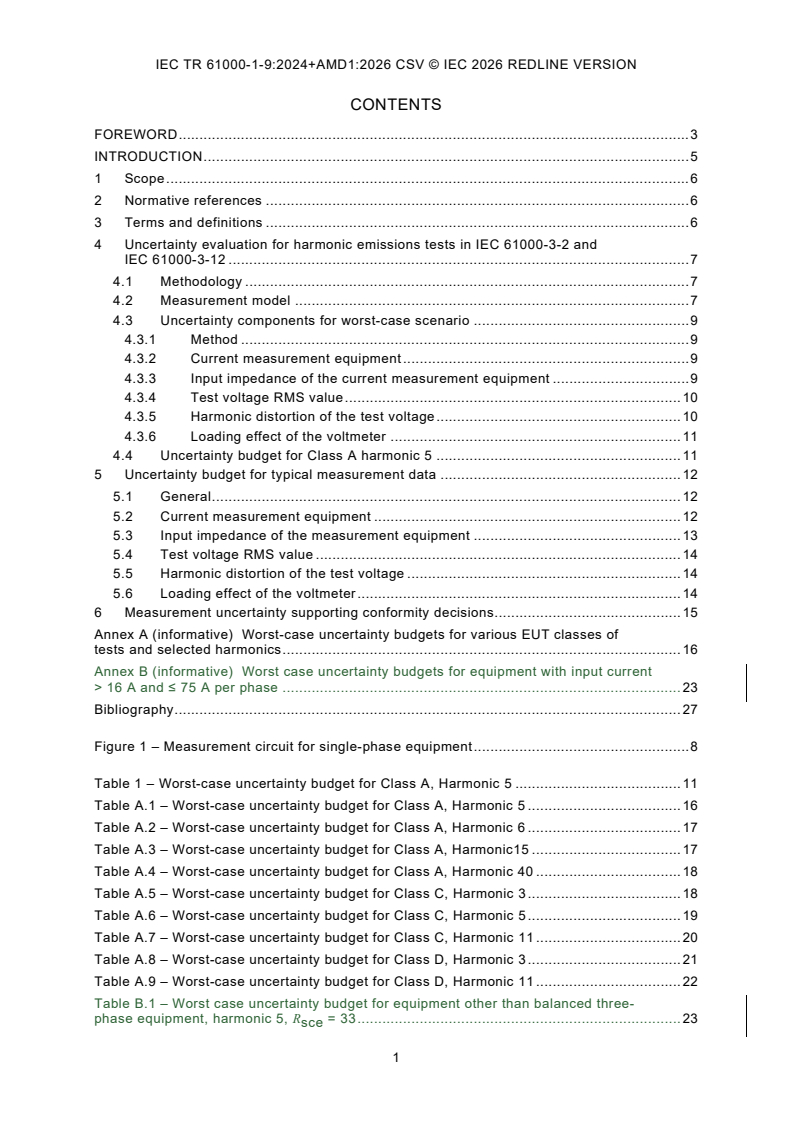
CONTENTS
FOREWORD . 3
INTRODUCTION . 5
1 Scope . 6
2 Normative references . 6
3 Terms and definitions . 6
4 Uncertainty evaluation for harmonic emissions tests in IEC 61000-3-2 and
IEC 61000-3-12 . 7
4.1 Methodology . 7
4.2 Measurement model . 7
4.3 Uncertainty components for worst-case scenario . 9
4.3.1 Method . 9
4.3.2 Current measurement equipment . 9
4.3.3 Input impedance of the current measurement equipment . 9
4.3.4 Test voltage RMS value . 10
4.3.5 Harmonic distortion of the test voltage . 10
4.3.6 Loading effect of the voltmeter . 11
4.4 Uncertainty budget for Class A harmonic 5 . 11
5 Uncertainty budget for typical measurement data . 12
5.1 General . 12
5.2 Current measurement equipment . 12
5.3 Input impedance of the measurement equipment . 13
5.4 Test voltage RMS value . 14
5.5 Harmonic distortion of the test voltage . 14
5.6 Loading effect of the voltmeter . 14
6 Measurement uncertainty supporting conformity decisions. 15
Annex A (informative) Worst-case uncertainty budgets for various EUT classes of
tests and selected harmonics . 16
Annex B (informative) Worst case uncertainty budgets for equipment with input current
> 16 A and ≤ 75 A per phase . 23
Bibliography . 27
Figure 1 – Measurement circuit for single-phase equipment . 8
Table 1 – Worst-case uncertainty budget for Class A, Harmonic 5 . 11
Table A.1 – Worst-case uncertainty budget for Class A, Harmonic 5 . 16
Table A.2 – Worst-case uncertainty budget for Class A, Harmonic 6 . 17
Table A.3 – Worst-case uncertainty budget for Class A, Harmonic15 . 17
Table A.4 – Worst-case uncertainty budget for Class A, Harmonic 40 . 18
Table A.5 – Worst-case uncertainty budget for Class C, Harmonic 3 . 18
Table A.6 – Worst-case uncertainty budget for Class C, Harmonic 5 . 19
Table A.7 – Worst-case uncertainty budget for Class C, Harmonic 11 . 20
Table A.8 – Worst-case uncertainty budget for Class D, Harmonic 3 . 21
Table A.9 – Worst-case uncertainty budget for Class D, Harmonic 11 . 22
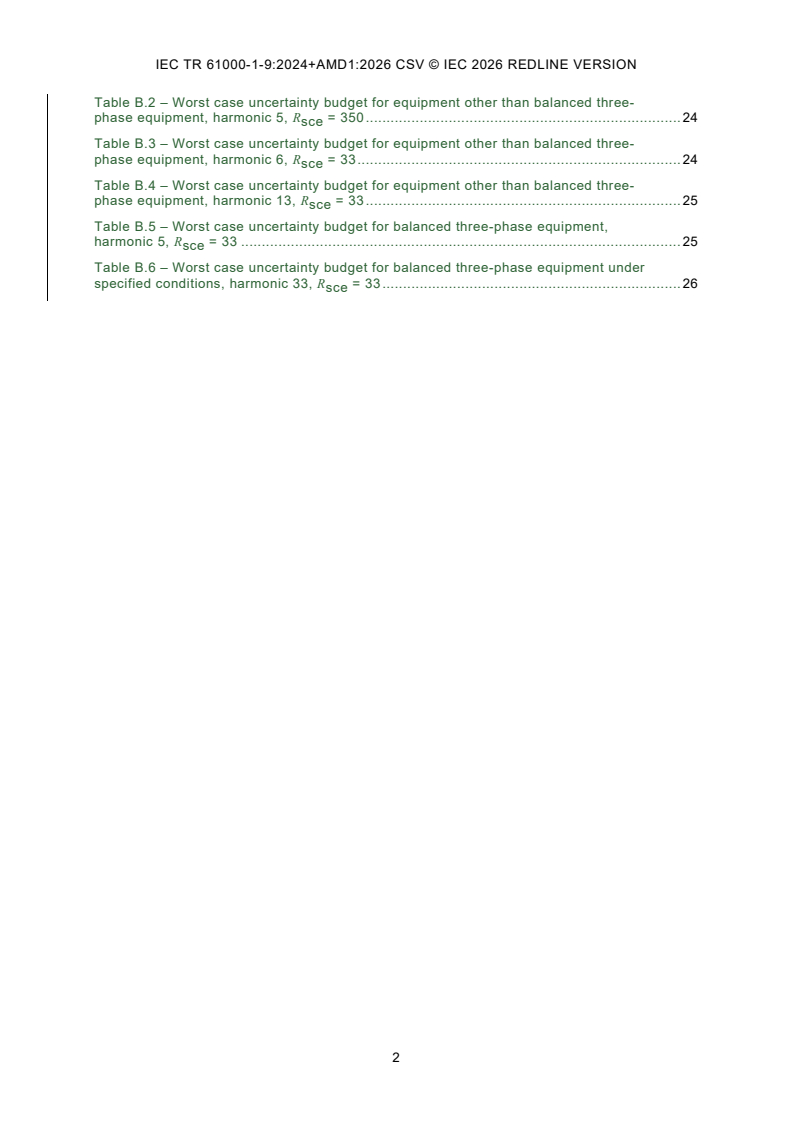
Table B.1 – Worst case uncertainty budget for equipment other than balanced three-
phase equipment, harmonic 5, R = 33 . 23
sce
Table B.2 – Worst case uncertainty budget for equipment other than balanced three-
phase equipment, harmonic 5, R = 350 . 24
sce
Table B.3 – Worst case uncertainty budget for equipment other than balanced three-
phase equipment, harmonic 6, R = 33 . 24
sce
Table B.4 – Worst case uncertainty budget for equipment other than balanced three-
phase equipment, harmonic 13, R = 33 . 25
sce
Table B.5 – Worst case uncertainty budget for balanced three-phase equipment,
harmonic 5, R = 33 . 25
sce
Table B.6 – Worst case uncertainty budget for balanced three-phase equipment under
specified conditions, harmonic 33, R = 33 . 26
sce
INTERNATIONAL ELECTROTECHNICAL COMMISSION
____________
Electromagnetic compatibility (EMC) -
Part 1-9: General - Evaluation of uncertainty for
the measurement of harmonic current emissions
FOREWORD
1) The International Electrotechnical Commission (IEC) is a worldwide organization for standardization comprising
all national electrotechnical committees (IEC National Committees). The object of IEC is to promote international
co-operation on all questions concerning standardization in the electrical and electronic fields. To this end and
in addition to other activities, IEC publishes International Standards, Technical Specifications, Technical Reports,
Publicly Available Specifications (PAS) and Guides (hereafter referred to as "IEC Publication(s)"). Their
preparation is entrusted to technical committees; any IEC National Committee interested in the subject dealt with
may participate in this preparatory work. International, governmental and non-governmental organizations liaising
with the IEC also participate in this preparation. IEC collaborates closely with the International Organization for
Standardization (ISO) in accordance with conditions determined by agreement between the two organizations.
2) The formal decisions or agreements of IEC on technical matters express, as nearly as possible, an international
consensus of opinion on the relevant subjects since each technical committee has representation from all
interested IEC National Committees.
3) IEC Publications have the form of recommendations for international use and are accepted by IEC National
Committees in that sense. While all reasonable efforts are made to ensure that the technical content of IEC
Publications is accurate, IEC cannot be held responsible for the way in which they are used or for any
misinterpretation by any end user.
4) In order to promote international uniformity, IEC National Committees undertake to apply IEC Publications
transparently to the maximum extent possible in their national and regional publications. Any divergence between
any IEC Publication and the corresponding national or regional publication shall be clearly indicated in the latter.
5) IEC itself does not provide any attestation of conformity. Independent certification bodies provide conformity
assessment services and, in some areas, access to IEC marks of conformity. IEC is not responsible for any
services carried out by independent certification bodies.
6) All users should ensure that they have the latest edition of this publication.
7) No liability shall attach to IEC or its directors, employees, servants or agents including individual experts and
members of its technical committees and IEC National Committees for any personal injury, property damage or
other damage of any nature whatsoever, whether direct or indirect, or for costs (including legal fees) and
expenses arising out of the publication, use of, or reliance upon, this IEC Publication or any other IEC
Publications.
8) Attention is drawn to the Normative references cited in this publication. Use of the referenced publications is
indispensable for the correct application of this publication.
9) IEC draws attention to the possibility that the implementation of this document may involve the use of (a)
patent(s). IEC takes no position concerning the evidence, validity or applicability of any claimed patent rights in
respect thereof. As of the date of publication of this document, IEC had not received notice of (a) patent(s), which
may be required to implement this document. However, implementers are cautioned that this may not represent
the latest information, which may be obtained from the patent database available at https://patents.iec.ch [and/or]
www.iso.org/patents. IEC shall not be held responsible for identifying any or all such patent rights.
This consolidated version of the official IEC Standard and its amendment has been prepared
for user convenience.
IEC TR 61000-1-9 edition 1.1 contains the first edition (2024-03) [documents 77A/1194/DTR
and 77A/1204/RVDTR] and its amendment 1 (2026-07) [documents 77A/1281/DTR and
77A/1287/RVDTR].
In this Redline version, a vertical line in the margin shows where the technical content is
modified by amendment 1. Additions are in green text, deletions are in strikethrough red text.
A separate Final version with all changes accepted is available in this publication.
IEC TR 61000-1-9 has been prepared by subcommittee 77A: EMC - Low frequency phenomena,
of IEC technical committee 77: Electromagnetic compatibility. It is a Technical Report.
The text of this Technical Report is based on the following documents:
Draft Report on voting
77A/1194/DTR 77A/1204/RVDTR
Full information on the voting for its approval can be found in the report on voting indicated in
the above table.
The language used for the development of this Technical Report is English.
This document was drafted in accordance with ISO/IEC Directives, Part 2, and developed in
accordance with ISO/IEC Directives, Part 1 and ISO/IEC Directives, IEC Supplement, available
at www.iec.ch/members_experts/refdocs. The main document types developed by IEC are
described in greater detail at www.iec.ch/publications.
A list of all parts in the IEC 61000 series, published under the general title Electromagnetic
compatibility (EMC), can be found on the IEC website.
This document contains attached files in the form of a spreadsheet. These files are intended to
be used as a complement and do not form an integral part of the document.
The committee has decided that the contents of this document and its amendment will remain
unchanged until the stability date indicated on the IEC website under webstore.iec.ch in the
data related to the specific document. At this date, the document will be
– reconfirmed,
– withdrawn, or
– revised.
INTRODUCTION
IEC 61000 is published in separate parts, according to the following structure:
Part 1: General
General considerations (introduction, fundamental principles)
Definitions, terminology
Part 2: Environment
Description levels
Classification of the environment
Compatibility levels
Part 3: Limits
Emission limits
Immunity limits (in so far as they do not fall under the responsibility of the product
committees)
Part 4: Testing and measurement techniques
Measurement techniques
Testing techniques
Part 5: Installation and mitigation guidelines
Installation guidelines
Mitigation methods and devices
Part 6: Generic standards
Part 9: Miscellaneous
Each part is further subdivided into several parts, published either as international standards
or as technical specifications or technical reports, some of which have already been published
as sections. Others will be published with the part number followed by a dash and a second
number identifying the subdivision (example: IEC 61000-6-1).
The purpose of this document is to help testing laboratories that operate in accordance with
ISO/IEC 17025 to evaluate measurement uncertainty of harmonic current emission tests for
IEC 61000-3-2 and IEC 61000-3-12.
The document contains practical formulae that enable uncertainty calculations in accordance
with ISO/IEC Guide 98-3 (GUM).
The tables in this document provide examples relating to a worst-case scenario when the
measurement equipment introduces maximum permissible errors, as specified in IEC 61000-4-7
and IEC 61000-3-2 and the combination of fundamental and harmonic currents drawn by the
equipment under test (EUT) is least favourable.
Furthermore the detailed formulae, linking the uncertainty contribution with the corresponding
source of uncertainty, allow the user of the document to calculate measurement uncertainties
based on their own measurement data. Typically, these uncertainties would be significantly
lower than the worst-case uncertainties.
1 Scope
This document provides examples for the evaluation of measurement uncertainty of harmonic
emission tests performed using IEC 61000-3-2 and IEC 61000-3-12, and their application to the
relevant conformity decisions. It also contains practical formulae to enable calculations in
accordance with ISO/IEC Guide 98-3 (GUM).
2 Normative references
The following documents are referred to in the text in such a way that some or all of their content
constitutes requirements of this document. For dated references, only the edition cited applies.
For undated references, the latest edition of the referenced document (including any
amendments) applies.
IEC 61000-3-2:2018, Electromagnetic compatibility (EMC) – Part 3-2: Limits – Limits for
harmonic current emissions (equipment input current ≤16 A per phase)
IEC 61000-3-2:2018/AMD1:2020
IEC 61000-3-12:2011, Electromagnetic compatibility (EMC) - Part 3-12: Limits - Limits for
harmonic currents produced by equipment connected to public low-voltage systems with input
current >16 A and ≤ 75 A per phase
IEC 61000-3-12:2011/AMD1:2021
IEC 61000-4-7:2002, Electromagnetic compatibility (EMC) – Part 4-7: Testing and
measurement techniques – General guide on harmonics and interharmonics measurements and
instrumentation, for power supply systems and equipment connected thereto
IEC 61000-4-7:2002/AMD1:2008
IEC GUIDE 115:2023, Application of uncertainty of measurement to conformity assessment
activities in the electrotechnical sector
ISO/IEC 17025:2017, General requirements for the competence of testing and calibration
laboratories
ISO/IEC GUIDE 98-3, Uncertainty of measurement – Part 3: Guide to the expression of
uncertainty in measurement (GUM:1995)
ISO/IEC GUIDE 99, International vocabulary of metrology – Basic and general concepts and
associated terms (VIM)
JCGM 106:2012, Evaluation of measurement data – The role of measurement uncertainty in
conformity assessment
3 Terms and definitions
For the purposes of this document, the terms and definitions given in IEC 61000-3-2,
IEC 61000-3-12, IEC 61000-4-7, IEC GUIDE 115, ISO/IEC 17025, ISO/IEC GUIDE 98-3,
ISO/IEC GUIDE 99 and JCGM 106, apply.
ISO and IEC maintain terminology databases for use in standardization at the following
addresses:
• IEC Electropedia: available at https://www.electropedia.org/
• ISO Online browsing platform: available at https://www.iso.org/obp
4 Uncertainty evaluation for harmonic emissions tests in IEC 61000-3-2 and
IEC 61000-3-12
4.1 Methodology
Testing laboratories that operate in accordance with ISO/IEC 17025 are required to evaluate
measurement uncertainty (ISO/IEC 17025:2017, 7.6.3). Other laboratories could, likewise, do
so.
This document applies ISO/IEC Guide 98-3 (GUM) to calculate the measurement uncertainty
for the tests performed as specified in IEC 61000-3-2 and IEC 61000-3-12.
In 4.3, the uncertainty calculation is made for the worst-case scenario, when the following
conditions are met:
– measurement equipment introduces maximum permissible errors, as specified in
IEC 61000-4-7, IEC 61000-3-2 and IEC 61000-3-12;
– the combination of fundamental and harmonic currents drawn by the equipment under test
(EUT) is the least favourable. It is based on an EUT that reacts linearly to every external
influence quantity. While not every EUT item exhibits such behaviour, the use of a linear
model provides a meaningful uncertainty estimate for the purpose of conformity assessment.
When the EUT is known to be non-linear, for example, when its harmonic emission currents
depend on the harmonic composition of the test voltage, further evaluation can be required
if accurate uncertainty assessment is sought.
Examples for typical uncertainties are given in Clause 5.
The calculated worst-case uncertainty values are expressed as a percentage of permissible
harmonic current limit for a particular class of the EUT and harmonic number.
The detailed formulae, linking the uncertainty contribution with the corresponding source of
uncertainty, allow the user of the document to calculate measurement uncertainties for the
relevant tests. Typically, these uncertainties would be significantly lower than the worst-case
uncertainties.
To calculate measurement uncertainty in accordance with ISO/IEC Guide 98-3, the following
steps are performed:
a) a measurement model is established, where the measurement is expressed in terms of
formulae linking the measurand with each input quantity (see 4.2);
b) all uncertainty components are listed, their values characterized, and their effect on the
measurement calculated numerically (see 4.3);
c) the combined standard uncertainty and the expanded uncertainty values are calculated and
tabulated in the uncertainty budget (see 4.4).
4.2 Measurement model
An equipment setup shown in IEC 61000-3-2:2018, Figure A.1, is considered. The setup is used
to measure current harmonics of a Class A appliance, see IEC 61000-3-2:2018 and
IEC 61000-3-2:2018/AMD1:2020, 5.1.
Key
S power supply source Z input impedance of measurement equipment
M
M measurement equipment Z internal impedance of the supply source
S
EUT equipment under test I harmonic component of order h of the line current
h
U test voltage G open-loop voltage of the supply source
[SOURCE: IEC 61000-3-2:2018, Figure A.1]
Figure 1 – Measurement circuit for single-phase equipment
The measured harmonic current can be expressed as:
YI= 11+δδ− 1+δ 1+δ 1−δ
( ) ( ) . (1)
( ) ( )
hM ZU( ) U V
M RMS THD
where:
Y is the measured value of harmonic current of a particular harmonic frequency,
corrected for all known systematic effects,
I is the true value of harmonic current,
h
δ is the error of the current measurement equipment such as a power analyser,
M
is the error due to the input impedance of current measurement equipment,
δ
Z
M
δ is the error due to the RMS value of the test voltage,
U
RMS
δ is the error due to the harmonic distortion in the test voltage, and
U
THD
δ is the loading effect of the voltmeter (connected in parallel to the EUT but not shown
V
in Figure 1).
The positive or negative sign indicates whether the measured value Y will increase or decrease
when a positive value of a particular error component is present. The sign has no bearing on
the uncertainty as the uncertainty components are root sum squared to obtain the standard
uncertainty, see Formula (8).
4.3 Uncertainty components for worst-case scenario
4.3.1 Method
As an example, to calculate worst-case uncertainties, a Class A EUT drawing a rated RMS
th
current of 16 A and a harmonic current equal to the maximum permissible current of the 5
harmonic (1,14 A) is considered. The EUT and the measurement equipment are connected as
shown in Figure 1.
ISO/IEC Guide 98-3 (GUM) is applied to calculate standard uncertainties contributed by each
error component in 4.2. Maximum permissible errors, as specified in IEC 61000-4-7 and
IEC 61000-3-2, are used for the calculation of each uncertainty component.
th
In this example, the uncertainties are expressed as a percentage of the permissible 5
harmonic current for Class A EUT (harmonic current limit).
4.3.2 Current measurement equipment
The uncertainty of the current measurement equipment is the expanded uncertainty of the
measurement equipment, such as a power analyser. Ideally, the measurement equipment
uncertainty is derived from the calibration report and the long-term stability, which is determined
from the calibration history or the manufacturer's stability specifications. Alternatively, the
measurement equipment uncertainty can be derived from the manufacturer’s accuracy
specification.
For the worst-case scenario, the largest of the two values, 5 % of permissible current limit or
0,15 % of the rated current, is used, see IEC 61000-4-7:2002 and
IEC 61000-4-7:2002/AMD1:2008, 5.3. For a Class A EUT and harmonic 5, the former is larger
and therefore:
U δ = 5 %
( ) (2)
M
The uncertainty of a power analyser depends on multiple factors and is therefore normally
distributed in accordance with the central limit theorem. Furthermore, it is likely to have a large
number of degrees of freedom associated with it. Therefore, a division factor of 2 is used in
Table 1 to calculate the standard uncertainty.
The measurement equipment uncertainty includes the effects of the variation of temperature,
humidity, supply voltage and other identified factors on the measurement equipment.
4.3.3 Input impedance of the current measurement equipment
The input impedance of the current measurement equipment affects harmonic currents drawn
by the equipment under test from the voltage source.
In the worst-case scenario, the voltage drop across the input impedance of the current
measurement equipment produces a peak voltage drop in the measurement circuit, V , equal
Z
M
th
to the limit stated in IEC 61000-4-7:2002, 5.1, for the 5 harmonic. For the nominal test voltage
and harmonic current equal to the permissible value this would result in an uncertainty
V
nom
component of:
V
Z 0,5
M
(3)
U δ= ×=100% ×=100% 0,2%
( )
Z
M
V 230
nom
This uncertainty component can take any value between zero and 0,2 %, with little prior
knowledge of the distribution. Thus a rectangular probability distribution and, hence, a division
U δ
factor of 3 are most appropriate for .
( )
Z
M
For equipment with input current > 16 A and ≤ 75 A per phase, within the scope of
IEC 61000-3-12, this component of uncertainty is replaced by the uncertainty due to system
impedance. See Annex B.
4.3.4 Test voltage RMS value
The deviation of the RMS value of the test voltage from the nominal value is assumed, in this
worst-case evaluation, to produce a linear effect on the measured harmonic current. Then the
uncertainty due to the instability of the test voltage can be expressed, as a percentage of
harmonic limit, as:
∆V I
RMS h
U δ ××100 % ,
(4)
( )
U
RMS
VI
nom lim
where
is the absolute deviation of the RMS value of the test voltage from nominal;
∆V
RMS
is the harmonic current; and
I
h
I is the permissible value of harmonic current for a particular frequency.
lim
∆
RMS
For the worst-case scenario, =0,02, as in IEC 61000-4-7:2002 and
V
nom
I
h
IEC 61000-4-7:2002/AMD1:2008, 5.4.2.2, and = 1, giving U δ = 2 % .
( )
U
RMS
I
lim
4.3.5 Harmonic distortion of the test voltage
Different types of equipment under test react differently to the harmonic distortion of the test
voltage. To estimate the upper value of this uncertainty contribution, this worst-case evaluation
uses an appliance that draws the maximum rated RMS current I , maximum permissible
r
and reacts linearly to test voltage distortion at the frequency of a particular
harmonic current I
lim
harmonic. Then
VI
hr
U δ ××100 % ,
( ) (5)
U
THD
VI
nom lim
=
=
where V is the harmonic component of the test voltage at a particular frequency. For harmonic
h
V
h
5, taking = 0,004 (see IEC 61000-4-7:2002 and IEC 61000-4-7:2002/AMD1:2008,
V
nom
5.4.2.2), the rated current of 16 A and permissible current of 1,14 A (see IEC 61000-3-2:2018,
Table 1) gives:
U δ 0,004××100 % 5,6 % (6)
( U )
THD
1,14
4.3.6 Loading effect of the voltmeter
The input impedance of the voltmeter part of the measuring instrument can produce a small
change in the test voltage, causing an error. The worst-case uncertainty component caused by
this error is estimated using the limit of 0,05 % stated in IEC 61000-4-7:2002 and
IEC 61000-4-7:2002/AMD1:2008, 5.4.2.2. Therefore,
U δ = 0,05 %
( ) (7)
V
4.4 Uncertainty budget for Class A harmonic 5
Uncertainty components detailed in 4.3.2 to 4.3.6 are summarised in Table 1.
Table 1 – Worst-case uncertainty budget for Class A, Harmonic 5
Source of Uncertainty Probability Distribution Standard Sensitivity Uncertainty
uncertainty estimate distribution division uncertainty coefficient contribution
X U(X ) factor k u(X ) c u (y)
i i i i i
(% of limit) (% of limit) (% of limit)
Current 5,0 Normal 2 2,5 1 2,5
measurement
equipment
uncertainty
Input impedance 0,2 Rectangular 1,73 0,1 1 0,1
of the
measurement
equipment
Test voltage RMS
2,0 Rectangular 1,73 1,2 1 1,2
value
Test voltage 5,6 Rectangular 1,73 3,2 1 3,2
harmonic
distortion
Loading effect of 0,05 Rectangular 1,73 0,03 1 0,03
voltmeter
u 4,3
c
U 8,5
The combined uncertainty u has been calculated as the square root of the sum of squares of
c
the uncertainty contributions in the right column of Table 1:
= =
n
u = u y (8)
( )
c ∑ i
i=1
The expanded uncertainty U at 95 % probability level has been calculated by multiplying u by
c
a coverage factor of 2. Formula (8) is based on the premise that all uncertainty components are
independent of one another.
5 Uncertainty budget for typical measurement data
5.1 General
Clause 5 provides examples of uncertainly calculations based on real-life measurement data
for harmonic emission currents and voltage harmonics of the source.
The uncertainly components and formulae for their calculation are similar to those of Clause 4.
However, rather than using limits (worst-case scenario) they use actual measured data and
actual parameters of the system, confirmed by measurement or calibration where appropriate.
Note that the values for one system cannot be used to predict any values for another system.
The tables only give a calculation scheme which can be used for a specific system, based on
the values for that system.
The formulae for the calculation of uncertainty estimates, used in the spreadsheet, are given in
5.2 to 5.6. The uncertainty estimates are expressed both as a percentage of current harmonic
limit and as an absolute harmonic current value.
5.2 Current measurement equipment
As percentage of the harmonic current limit:
U δ =IU×+I ×U /I
( ) (9)
( )
M h read range floor lim
As harmonic current:
U δ =IU×+I ×U / 100
( ) (10)
( )
M h read range floor
where
I is the measured value of harmonic current,
h
U is the harmonic current meter (power analyser) uncertainty component expressed as
read
a percentage of reading,
I is the current range of the harmonic current meter (power analyser),
range
U is the "floor" uncertainty component of harmonic current meter (power analyser)
floor
expressed as a percentage of current range, and
is the permissible value of harmonic current for harmonic h.
I
lim
5.3 Input impedance of the measurement equipment
As a percentage of the harmonic current limit:
V
Z
M
I
(11)
2 h
U δ ××100 %
( )
Z
M
V I
nom lim
As harmonic current:
V
Z
M
2 (12)
U δI×
( )
Z h
M
V
nom
where
is the measured value of harmonic current,
I
h
V is the peak voltage drop in the measurement circuit,
Z
M
V is the nominal test voltage, and
nom
I is the permissible value of harmonic current for harmonic h.
lim
For equipment with input current > 16 A and ≤ 75 A per phase, where IEC 61000-3-12 is
applicable, this component of uncertainty is replaced by the uncertainty due to system
impedance:
As a percentage of the harmonic current limit:
1 I
h
U δ ××100%
( ) (19)
syst imp
RI
sce lim
As harmonic current:
U δI×
( ) (20)
syst imp h
R
sce
where
is the short-circuit ratio of the EUT (see IEC 61000-3-12:2011, 3.14).
R
sce
=
=
=
=
5.4 Test voltage RMS value
As a percentage of the harmonic current limit:
∆V I
RMS
h
U δ ××100 %
( ) (13)
U
RMS
VI
nom lim
As harmonic current:
∆V
RMS
U δ ×I
( ) (14)
U h
RMS
V
nom
where
∆V is the absolute deviation of the RMS value of the test voltage from nominal,
RMS
V is the nominal test voltage,
nom
I is the harmonic current, and
h
is the permissible value of harmonic current for harmonic h.
I
lim
5.5 Harmonic distortion of the test voltage
As a percentage of the harmonic current limit:
VI
h1
U δ ××100 %
( ) (15)
U
THD
VI
nom lim
As harmonic current:
V
h
U δI×
( ) (16)
U 1
THD
V
nom
where
V is the measured harmonic component of the test voltage,
h
V is the nominal test voltage,
nom
I is the fundamental current, and
is the permissible value of harmonic current for harmonic h.
I
lim
NOTE When the value of is not readily available the rms current value can be used instead, which would lead
I
to a somewhat higher uncertainty estimate.
5.6 Loading effect of the voltmeter
As a percentage of the harmonic current limit:
=
=
=
=
∆VI
VM h
U(δ ) ××100 %
(17)
V
V I
nom lim
As harmonic current:
∆V
VM
U δI×
( )
(18)
V h
V
nom
where
∆V is the measured change in the source RMS voltage caused by the voltmeter,
VM
V is the nominal test voltage,
nom
I is the harmonic current, and
h
I is the permissible value of harmonic current for harmonic h.
lim
The spreadsheet contains two examples of practical uncertainty calculation for an
IEC 61000-3-2 Class A test and one example for an IEC 61000-3-12 test. The evaluation for
IEC 61000-3-12 assumes that harmonic distortion of the test voltage is measured during the
test.
6 Measurement uncertainty supporting conformity decisions
According to ISO/IEC 17025, when a statement of conformity to a specification or a standard is
provided, the laboratory is required to document the decision rule employed, taking into account
the level of risk (such as false acceptance or rejection and statistical assumptions) associated
with the decision rule employed, and apply the decision rule (ISO/IEC 17025:2017 7.8.6).
The decision rule employed in IEC 61000-3-2 follows from what is referred to as the "accuracy
method simple acceptance" described in IEC Guide 115 (see IEC 61000-3-2:2018, Annex C).
In this approach, a well-characterised test method described in IEC 61000-3-2 is used for
testing, and sources of variability are minimised, in accordance with JCGM 106:2012, 8.2.4, by:
a) using measuring instruments with maximum permissible errors within specified limits;
b) maintaining environmental influences, such as temperature and relative humidity, within
specified limits;
c) a documented control of laboratory procedures;
d) a documented competency of measurement personnel
By controlling the sources of variability within specified limits, the measurement uncertainty
associated with the best estimate of the measurand plays no role in a conformity decision
(JCGM 106:2012, 8.2.5).
The values obtained in 4.4, Annex A and Annex B are deemed to be low enough to satisfy the
requirement of JCGM 106:2012, 8.2.5, and therefore to adopt IEC Guide 115 Procedure 2 (the
"accuracy method" simple acceptance principle) for compliance decision rules. Accordingly, the
measurement results for current harmonics are considered in conformance with the relevant
IEC 61000-3-2 harmonic limits if the measurement values are within the specified limit. Then it
is not necessary to report the uncertainty associated with the measurement result. Then, in
accordance with IEC Guide 115:2023, 4.3.3, measurement uncertainty is not applied when
providing statements of conformity.
=
=
Annex A
(informative)
Worst-case uncertainty budgets for various EUT classes
of tests and selected harmonics
The uncertainty budgets shown in Table A.1 to Table A.9. have been calculated using
Formula (2) to Formula (8) and maximum permissible errors of the measuring equipment, as
specified in IEC 61000-4-7 and IEC 61000-3-2.
Unless specified otherwise, the worst-case uncertainties are for a case when the EUT draws a
rated RMS current and a harmonic current equal to the corresponding harmonic limit.
The same approach can be used to calculate uncertainty estimates for other test and
measurement equipment parameters. These uncertainties are likely to be significantly smaller,
particularly as harmonic ratios of the test voltage for real-life sources are lower than specified
in IEC 61000-3-2:2018, Clause A.2, particularly at higher harmonics. See Clause 5.
Table A.1 – Worst-case uncertainty budget for Class A, Harmonic 5
Source of Uncertainty Probability Distribution Standard Sensitivity Uncertainty
uncertainty estimate distribution division uncertainty coefficient contribution
X U(X ) factor k u(X ) c u (y)
i i i i i
(% of limit) (% of limit) (% of limit)
Current measurement
5,0 Normal 2 2,5 1 2,5
equipment uncertainty
Input impedance of the 0,2 Rectangular 1,73 0,1 1 0,1
measurement equipment
Test voltage RMS value 2,0 Rectangular 1,73 1,2 1 1,2
Test voltage harmonic 5,6 Rectangular 1,73 3,2 1 3,2
distortion
Loading effect of voltmeter 0,05 Rectangular 1,73 0,03 1 0,03
u 4,3
c
U 8,5
NOTE Rated current 16 A, harmonic current limit 1,14 A, voltage distortion 0,4 %.
Table A.2 – Worst-case uncertainty budget for Class A, Harmonic 6
Source of Uncertainty Probability Distribution Standard Sensitivity Uncertainty
uncertainty estimate distribution division uncertainty coefficient contribution
X U(X ) u(X ) c u (y)
factor k
i i i i i
(% of limit) (% of limit) (% of limit)
Current measurement 5,0 Normal 2 2,5 1 2,5
equipment uncertainty
Input impedance of the 0,2 Rectangular 1,73 0,1 1 0,1
measurement equipment
Test voltage RMS value 2,0 Rectangular 1,73 1,2 1 1,2
Test voltage harmonic 10,7 Rectangular 1,73 6,2 1 6,2
distortion
Loading effect of voltmeter 0,05 Rectangular 1,73 0,03 1 0,03
u 6,7
c
U 13,5
NOTE Rated current 16 A, harmonic current limit 0,3 A, voltage distortion 0,2 %.
Table A.3 – Worst-case uncertainty budget for Class A, Harmonic15
Source of Uncertainty Probability Distribution Standard Sensitivity Uncertainty
uncertainty estimate distribution division uncertainty coefficient contribution
X U(X ) u(X ) c u (y)
factor k
i i i i i
(% of limit) (% of limit) (% of limit)
Current measurement 16,0 Normal 2 8 1 8,0
equipment uncertainty
Input impedance of the 0,2 Rectangular 1,73 0,1 1 0,1
measurement equipment
Test voltage RMS value 2,0 Rectangular 1,73 1,2 1 1,2
Test voltage harmonic 10,7 Rectangular 1,73 6,2 1 6,2
distortion
Loading effect of voltmeter 0,05 Rectangular 1,73 0,03 1 0,03
u
10,2
c
U 20,3
NOTE Rated current 16 A, harmonic current limit 0,15 A, voltage distortion 0,1 %. The current measurement
equipment uncertainty has been calculated as 0,15 % of the rated current divided by the harmonic current limit.
Table A.4 – Worst-case uncertainty budget for Class A, Harmonic 40
Source of Uncertainty Probability Distribution Standard Sensitivity Uncertainty
uncertainty estimate istribution division uncertainty coefficient contribution
X U(X ) u(X ) c u (y)
i factor k
i i i i i
(% of limit) (% of limit) (% of limit)
Current measurement 41,6 Normal 2 20,8 1 20,8
equipment uncertainty
Input impedance of the 0,2 Rectangular 1,73 0,1 1 0,1
measurement equipment
Test voltage RMS value 2,0 Rectangular 1,73 1,2 1 1,2
Test voltage harmonic 27,7 Rectangular 1,73 16,0 1 16,0
distortion
Loading effect of 0,05 Rectangular 1,73 0,03 1 0,03
voltmeter
u 26,3
c
U 52.5
NOTE Rated current 16 A, harmonic current limit 0,046 A, voltage distortion 0,1 %. The current measurement
equipment uncertainty has been calculated as 0,15 % of the rated current divided by the harmonic current limit.
Table A.5 – Worst-case uncertainty budget for Class C, Harmonic 3
Source of Type Uncertainty Probability Distribution Standard Sensitivity Uncertainty
uncertainty estimate contribution
distribution division uncertainty coefficient
X U(X ) factor k u(X ) c u (y)
i i ii
i i i i i
(% of limit) (% of limit) (% of limit)
Current B 5,0 Normal 2 2,5 1 2,5
measurement
equipment
uncertainty
Input
B 0,2 Rectangular 1,73 0,1 1 0,1
impedance of
the
measurement
equipment
Test voltage B 0,0 Rectangular 1,73 0,0 1 0,0
RMS value
Test voltage B 3,3 Rectangular 1,73 1,9 1 1,9
harmonic
distortion
Loading effect B 0,05 Rectangular 1,73 0,03 1 0,03
of voltmeter
u 3,2
c
U 6,3
NOTE 1 Rated current 16 A, harmonic current limit 4,32 A, voltage distortion 0,9 %.
NOTE 2 The harmonic current limit for Class C equipment depends on the fundamental current, see
IEC 61000-3-2:2018, Table 2. The fundamental current is a measured quantity, associated with the corresponding
measurement uncertainty. However, this uncertainty has a second order effect on the uncertainty of harmonic
current measurement that can normally be neglected.
Table A.6 – Worst-case uncertainty budget for Class C, Harmonic 5
Source of Uncertainty Probability Distribution Standard Sensitivity Uncertainty
uncertainty estimate distribution division uncertainty coefficient contribution
X U(X ) factor k u(X ) c u (y)
i i i
i i i i i
(% of limit) (% of limit) (% of limit)
Current 5,0 Normal 2 2,5 1 2,5
measurement
equipment
uncertainty
Input 0,2 Rectangular 1,73 0,1 1 0,1
impedance of
the
measurement
equipment
Test voltage 0,0 Rectangular 1,73 0,0 1 0,0
RMS value
Test voltage 4,0 Rectangular 1,73 2,3 1 2,3
harmonic
distortion
Loading effect 0,05 Rectangular 1,73 0,03 1 0,03
of voltmeter
u
3,4
c
U 6,8
NOTE 1 Rated current 16 A, harmonic current limit 1,6 A, voltage distortion 0,4 %.
NOTE 2 The harmonic current limit for Class C equipment depends on the fundamental current, see
IEC 61000-3-2:2018, Table 2. The fundamental current is a measured quantity, associated with the corresponding
measurement uncertainty. However, this uncertainty has a second order effect on the uncertainty of harmonic
current measurement that can normally be neglected.
Table A.7 – Worst-case uncerta
...