


IEC 62047-19:2013
(Main)Semiconductor devices - Micro-electromechanical devices - Part 19: Electronic compasses
General Information
- Abstract
IEC 62047-19:2013 defines terms, definitions, essential ratings and characteristics, and measuring methods of electronic compasses. This standard applies to electronic compasses composed of magnetic sensors and acceleration sensors, or magnetic sensors alone. This standard applies to electronic compasses for mobile electronic equipment.
- Status
- Published
- Publication Date
- 16-Jul-2013
- Technical Committee
- SC 47F - Micro-electromechanical systems
- Drafting Committee
- WG 1 - TC 47/SC 47F/WG 1
- Current Stage
- PPUB - Publication issued
- Start Date
- 17-Jul-2013
- Completion Date
- 15-Aug-2013
Overview
IEC 62047-19:2013 is an international standard developed by the International Electrotechnical Commission (IEC) that defines the terminology, essential ratings and characteristics, and measurement methods for electronic compasses, also known as e-compasses. This standard is specifically designed for e-compasses used in mobile electronic equipment, providing a comprehensive framework for manufacturers and testing bodies to ensure the quality, repeatability, and compatibility of these semiconductor-based micro-electromechanical devices.
The scope of IEC 62047-19:2013 covers e-compasses composed of magnetic sensors alone or in combination with acceleration sensors, supporting various types such as 2-axis, 3-axis, and 6-axis e-compasses. The document sets out clear procedures for ensuring accurate azimuth calculations and reliable performance in portable electronics.
Key Topics
Terminology and Definitions
The standard establishes a common vocabulary for electronic compass technology, including definitions for:- E-compass hardware and software components
- 2-axis, 3-axis, and 6-axis configurations
- Terms such as "magnetic north," "true north," and "azimuth angle"
Essential Ratings and Characteristics
IEC 62047-19:2013 details necessary and recommended performance ratings such as:- Power supply and input voltage ranges
- Storage and operating temperature limits
- Mechanical shocks (particularly for 6-axis compasses)
- Measurement parameters including sensor sensitivity, linearity, measuring range, frequency bandwidth, and current consumption
Component Composition
The standard defines typical e-compass architecture, which may include:- Magnetic sensor section (detects Earth's magnetic field)
- Acceleration sensor section (detects gravity for tilt compensation)
- Signal processing, peripheral hardware, and software sections for data handling and output
Testing and Measuring Methods
Standardized test methods are provided to ensure repeatable and comparable results for:- Sensitivity, linearity, and cross-axis sensitivity of the magnetic sensor
- Acceleration sensor sensitivity and offset (for 6-axis devices)
- Output behavior in zero magnetic field conditions
- Power consumption profiles
Applications
IEC 62047-19:2013 is crucial for industries and organizations developing, specifying, or testing electronic compasses for mobile devices, including but not limited to:
- Smartphones and Tablets
Reliable orientation and navigation features are essential for map applications, gaming, and augmented reality. - Wearable Devices and Smart Accessories
Accurate heading and motion detection support fitness tracking and user interface control. - Handheld Navigation Tools
Specialty devices such as GPS handhelds and outdoor gear depend on precise compass readings in varied environments. - Consumer Electronics and IoT
E-compasses are integral to smart home devices, robotics, and location-aware applications. - Automotive and Industrial Instruments
Embedded compasses contribute to advanced driver-assistance systems (ADAS) and automated machinery.
By adhering to IEC 62047-19:2013, manufacturers and integrators can ensure that their products meet globally recognized standards for accuracy, interoperability, and safety in mobile electronics.
Related Standards
For further context and compatibility, consider these relevant standards:
- ISO 11606
For marine electronic compasses, refer to ISO 11606, which covers compass devices used in nautical applications. - IEC 62047 Series
This standard is part 19 of the IEC 62047 series, which addresses a broader range of micro-electromechanical devices in semiconductor applications. - IEC Electropedia
The IEC Electropedia provides a global reference for vocabulary in electrical and electronic technologies.
Implementing IEC 62047-19:2013 supports product quality, accelerates certification, and facilitates market access for electronic compass-equipped mobile devices worldwide.
Frequently Asked Questions
IEC 62047-19:2013 is a standard published by the International Electrotechnical Commission (IEC). Its full title is "Semiconductor devices - Micro-electromechanical devices - Part 19: Electronic compasses". This standard covers: IEC 62047-19:2013 defines terms, definitions, essential ratings and characteristics, and measuring methods of electronic compasses. This standard applies to electronic compasses composed of magnetic sensors and acceleration sensors, or magnetic sensors alone. This standard applies to electronic compasses for mobile electronic equipment.
IEC 62047-19:2013 defines terms, definitions, essential ratings and characteristics, and measuring methods of electronic compasses. This standard applies to electronic compasses composed of magnetic sensors and acceleration sensors, or magnetic sensors alone. This standard applies to electronic compasses for mobile electronic equipment.
IEC 62047-19:2013 is classified under the following ICS (International Classification for Standards) categories: 31.080.99 - Other semiconductor devices; 31.220.10 - Plug-and-socket devices. Connectors. The ICS classification helps identify the subject area and facilitates finding related standards.
IEC 62047-19:2013 is available in PDF format for immediate download after purchase. The document can be added to your cart and obtained through the secure checkout process. Digital delivery ensures instant access to the complete standard document.
Standards Content (Sample)
IEC 62047-19 ®
Edition 1.0 2013-07
INTERNATIONAL
STANDARD
NORME
INTERNATIONALE
colour
inside
Semiconductor devices – Micro-electromechanical devices –
Part 19: Electronic compasses
Dispositifs à semiconducteurs – Dispositifs microélectromécaniques –
Partie 19: Compas électroniques
All rights reserved. Unless otherwise specified, no part of this publication may be reproduced or utilized in any form
or by any means, electronic or mechanical, including photocopying and microfilm, without permission in writing from
either IEC or IEC's member National Committee in the country of the requester.
If you have any questions about IEC copyright or have an enquiry about obtaining additional rights to this publication,
please contact the address below or your local IEC member National Committee for further information.
Droits de reproduction réservés. Sauf indication contraire, aucune partie de cette publication ne peut être reproduite ni
utilisée sous quelque forme que ce soit et par aucun procédé, électronique ou mécanique, y compris la photocopie et les
microfilms, sans l'accord écrit de la CEI ou du Comité national de la CEI du pays du demandeur.
Si vous avez des questions sur le copyright de la CEI ou si vous désirez obtenir des droits supplémentaires sur cette
publication, utilisez les coordonnées ci-après ou contactez le Comité national de la CEI de votre pays de résidence.
IEC Central Office Tel.: +41 22 919 02 11
3, rue de Varembé Fax: +41 22 919 03 00
CH-1211 Geneva 20 info@iec.ch
Switzerland www.iec.ch
About the IEC
The International Electrotechnical Commission (IEC) is the leading global organization that prepares and publishes
International Standards for all electrical, electronic and related technologies.
About IEC publications
The technical content of IEC publications is kept under constant review by the IEC. Please make sure that you have the
latest edition, a corrigenda or an amendment might have been published.
Useful links:
IEC publications search - www.iec.ch/searchpub Electropedia - www.electropedia.org
The advanced search enables you to find IEC publications The world's leading online dictionary of electronic and
by a variety of criteria (reference number, text, technical electrical terms containing more than 30 000 terms and
committee,…). definitions in English and French, with equivalent terms in
It also gives information on projects, replaced and additional languages. Also known as the International
withdrawn publications. Electrotechnical Vocabulary (IEV) on-line.
IEC Just Published - webstore.iec.ch/justpublished Customer Service Centre - webstore.iec.ch/csc
Stay up to date on all new IEC publications. Just Published If you wish to give us your feedback on this publication
details all new publications released. Available on-line and or need further assistance, please contact the
also once a month by email. Customer Service Centre: csc@iec.ch.
A propos de la CEI
La Commission Electrotechnique Internationale (CEI) est la première organisation mondiale qui élabore et publie des
Normes internationales pour tout ce qui a trait à l'électricité, à l'électronique et aux technologies apparentées.
A propos des publications CEI
Le contenu technique des publications de la CEI est constamment revu. Veuillez vous assurer que vous possédez
l’édition la plus récente, un corrigendum ou amendement peut avoir été publié.
Liens utiles:
Recherche de publications CEI - www.iec.ch/searchpub Electropedia - www.electropedia.org
La recherche avancée vous permet de trouver des Le premier dictionnaire en ligne au monde de termes
publications CEI en utilisant différents critères (numéro de électroniques et électriques. Il contient plus de 30 000
référence, texte, comité d’études,…). termes et définitions en anglais et en français, ainsi que
Elle donne aussi des informations sur les projets et les les termes équivalents dans les langues additionnelles.
publications remplacées ou retirées. Egalement appelé Vocabulaire Electrotechnique
International (VEI) en ligne.
Just Published CEI - webstore.iec.ch/justpublished
Service Clients - webstore.iec.ch/csc
Restez informé sur les nouvelles publications de la CEI.
Just Published détaille les nouvelles publications parues. Si vous désirez nous donner des commentaires sur
Disponible en ligne et aussi une fois par mois par email. cette publication ou si vous avez des questions
contactez-nous: csc@iec.ch.
IEC 62047-19 ®
Edition 1.0 2013-07
INTERNATIONAL
STANDARD
NORME
INTERNATIONALE
colour
inside
Semiconductor devices – Micro-electromechanical devices –
Part 19: Electronic compasses
Dispositifs à semiconducteurs – Dispositifs microélectromécaniques –
Partie 19: Compas électroniques
INTERNATIONAL
ELECTROTECHNICAL
COMMISSION
COMMISSION
ELECTROTECHNIQUE
PRICE CODE
INTERNATIONALE
CODE PRIX U
ICS 31.080.99 ISBN 978-2-8322-0961-5
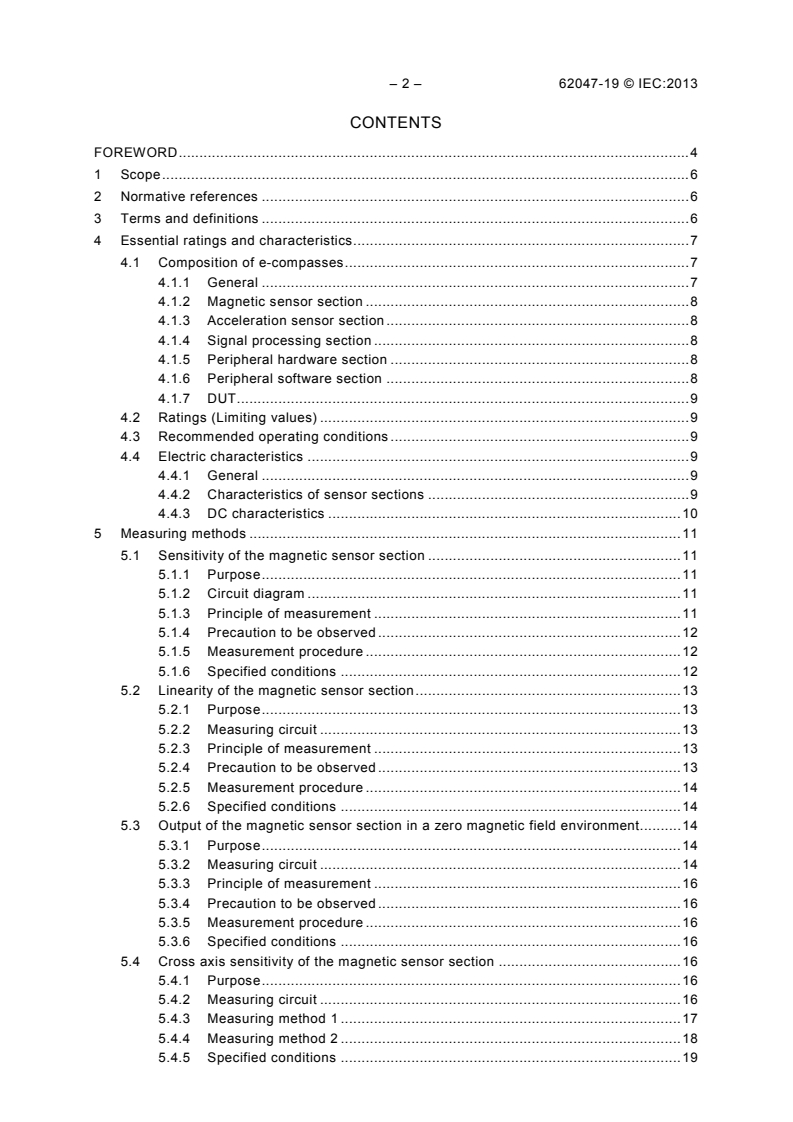
– 2 – 62047-19 © IEC:2013
CONTENTS
FOREWORD . 4
1 Scope . 6
2 Normative references . 6
3 Terms and definitions . 6
4 Essential ratings and characteristics . 7
4.1 Composition of e-compasses . 7
4.1.1 General . 7
4.1.2 Magnetic sensor section . 8
4.1.3 Acceleration sensor section . 8
4.1.4 Signal processing section . 8
4.1.5 Peripheral hardware section . 8
4.1.6 Peripheral software section . 8
4.1.7 DUT . 9
4.2 Ratings (Limiting values) . 9
4.3 Recommended operating conditions . 9
4.4 Electric characteristics . 9
4.4.1 General . 9
4.4.2 Characteristics of sensor sections . 9
4.4.3 DC characteristics . 10
5 Measuring methods . 11
5.1 Sensitivity of the magnetic sensor section . 11
5.1.1 Purpose . 11
5.1.2 Circuit diagram . 11
5.1.3 Principle of measurement . 11
5.1.4 Precaution to be observed . 12
5.1.5 Measurement procedure . 12
5.1.6 Specified conditions . 12
5.2 Linearity of the magnetic sensor section . 13
5.2.1 Purpose . 13
5.2.2 Measuring circuit . 13
5.2.3 Principle of measurement . 13
5.2.4 Precaution to be observed . 13
5.2.5 Measurement procedure . 14
5.2.6 Specified conditions . 14
5.3 Output of the magnetic sensor section in a zero magnetic field environment. 14
5.3.1 Purpose . 14
5.3.2 Measuring circuit . 14
5.3.3 Principle of measurement . 16
5.3.4 Precaution to be observed . 16
5.3.5 Measurement procedure . 16
5.3.6 Specified conditions . 16
5.4 Cross axis sensitivity of the magnetic sensor section . 16
5.4.1 Purpose . 16
5.4.2 Measuring circuit . 16
5.4.3 Measuring method 1 . 17
5.4.4 Measuring method 2 . 18
5.4.5 Specified conditions . 19
62047-19 © IEC:2013 – 3 –
5.5 Sensitivity and offset of the acceleration sensor section . 19
5.5.1 Purpose . 19
5.5.2 Measuring circuit . 20
5.5.3 Principle of measurement . 20
5.5.4 Precaution of measurement . 21
5.5.5 Measurement procedure . 21
5.5.6 Specified conditions . 21
5.6 Frequency bandwidth of the magnetic sensor section (analogue output) . 21
5.6.1 Purpose . 21
5.6.2 Measuring circuit . 21
5.6.3 Principle of measurement . 22
5.6.4 Measurement procedure . 23
5.6.5 Specified conditions . 23
5.7 Current consumption . 23
5.7.1 Purpose . 23
5.7.2 Measuring circuit . 23
5.7.3 Principle of measurement . 24
5.7.4 Precaution for measurement . 24
5.7.5 Measurement procedure . 24
5.7.6 Specified conditions . 24
Annex A (informative) Considerations on essential ratings and characteristics . 25
Annex B (informative) Terminal coordinate system of e-compasses . 26
Annex C (informative) Descriptions of the pitch angle, roll angle, and yaw angle with
drawings . 28
Bibliography . 30
Figure 1 – Composition of e-compasses . 8
Figure 2 – Circuit to measure sensitivity . 11
Figure 3 – Measuring method of linearity . 13
Figure 5 – Measuring circuit using a magnetic shield room or a magnetic shield box. 15
Figure 6 – Direction of DUT . 20
Figure 7 – Block diagram of frequency measurement . 22
Figure 8 – Current consumption measuring circuit . 24
Figure B.1 – Mobile terminal coordinate system of magnetic sensors . 26
Figure B.2 – Terminal coordinate system of acceleration sensors . 27
Figure C.1 – Descriptions of the pitch angle, roll angle, and yaw angle with drawings . 29
Table 1 – Characteristics of sensor sections . 10
Table 2 – DC characteristics of e-compasses. 10
– 4 – 62047-19 © IEC:2013
INTERNATIONAL ELECTROTECHNICAL COMMISSION
____________
SEMICONDUCTOR DEVICES –
MICRO-ELECTROMECHANICAL DEVICES –
Part 19: Electronic compasses
FOREWORD
1) The International Electrotechnical Commission (IEC) is a worldwide organization for standardization comprising
all national electrotechnical committees (IEC National Committees). The object of IEC is to promote
international co-operation on all questions concerning standardization in the electrical and electronic fields. To
this end and in addition to other activities, IEC publishes International Standards, Technical Specifications,
Technical Reports, Publicly Available Specifications (PAS) and Guides (hereafter referred to as “IEC
Publication(s)”). Their preparation is entrusted to technical committees; any IEC National Committee interested
in the subject dealt with may participate in this preparatory work. International, governmental and non-
governmental organizations liaising with the IEC also participate in this preparation. IEC collaborates closely
with the International Organization for Standardization (ISO) in accordance with conditions determined by
agreement between the two organizations.
2) The formal decisions or agreements of IEC on technical matters express, as nearly as possible, an international
consensus of opinion on the relevant subjects since each technical committee has representation from all
interested IEC National Committees.
3) IEC Publications have the form of recommendations for international use and are accepted by IEC National
Committees in that sense. While all reasonable efforts are made to ensure that the technical content of IEC
Publications is accurate, IEC cannot be held responsible for the way in which they are used or for any
misinterpretation by any end user.
4) In order to promote international uniformity, IEC National Committees undertake to apply IEC Publications
transparently to the maximum extent possible in their national and regional publications. Any divergence
between any IEC Publication and the corresponding national or regional publication shall be clearly indicated in
the latter.
5) IEC itself does not provide any attestation of conformity. Independent certification bodies provide conformity
assessment services and, in some areas, access to IEC marks of conformity. IEC is not responsible for any
services carried out by independent certification bodies.
6) All users should ensure that they have the latest edition of this publication.
7) No liability shall attach to IEC or its directors, employees, servants or agents including individual experts and
members of its technical committees and IEC National Committees for any personal injury, property damage or
other damage of any nature whatsoever, whether direct or indirect, or for costs (including legal fees) and
expenses arising out of the publication, use of, or reliance upon, this IEC Publication or any other IEC
Publications.
8) Attention is drawn to the Normative references cited in this publication. Use of the referenced publications is
indispensable for the correct application of this publication.
9) Attention is drawn to the possibility that some of the elements of this IEC Publication may be the subject of
patent rights. IEC shall not be held responsible for identifying any or all such patent rights.
International Standard IEC 62047-19 has been prepared by subcommittee 47F: Micro-
electromechanical systems, of IEC technical committee 47: Semiconductor devices.
The text of this standard is based on the following documents:
FDIS Report on voting
47F/156/FDIS 47F/163/RVD
Full information on the voting for the approval of this standard can be found in the report on
voting indicated in the above table.
This publication has been drafted in accordance with the ISO/IEC Directives, Part 2.
62047-19 © IEC:2013 – 5 –
A list of all parts in the IEC 62047 series, published under the general title Semiconductor
devices – Micro-electromechanical devices, can be found on the IEC website.
The committee has decided that the contents of this publication will remain unchanged until
the stability date indicated on the IEC web site under "http://webstore.iec.ch" in the data
related to the specific publication. At this date, the publication will be
• reconfirmed,
• withdrawn,
• replaced by a revised edition, or
• amended.
IMPORTANT – The 'colour inside' logo on the cover page of this publication indicates
that it contains colours which are considered to be useful for the correct
understanding of its contents. Users should therefore print this document using a
colour printer.
– 6 – 62047-19 © IEC:2013
SEMICONDUCTOR DEVICES –
MICRO-ELECTROMECHANICAL DEVICES –
Part 19: Electronic compasses
1 Scope
This part of IEC 62047 defines terms, definitions, essential ratings and characteristics, and
measuring methods of electronic compasses. This standard applies to electronic compasses
composed of magnetic sensors and acceleration sensors, or magnetic sensors alone. This
standard applies to electronic compasses for mobile electronic equipment.
For marine electronic compasses, see ISO 11606.
Electronic compasses are called “e-compasses” for short. Types of e-compasses are: 2-axis
e-compasses, 3-axis e-compasses, 6-axis e-compasses, etc., all of which are covered by this
standard.
2 Normative references
The following documents, in whole or in part, are normatively referenced in this document and
are indispensable for its application. For dated references, only the edition cited applies. For
undated references, the latest edition of the referenced document (including any
amendments) applies.
None
3 Terms and definitions
For the purposes of this document, the following terms and definitions apply.
3.1
3-axis Helmholtz coil
three Helmholtz coils that generate magnetic fields at right angles to each other
3.2
zero magnetic field environment
magnetic field environments where magnetic field strength in a space including a device
under test is lower than the strength specified
Note 1 to entry: The device under test (DUT) is defined in 4.1.7.
3.3
e-compass
electronic compass
compass that calculates and outputs an azimuth using the electrical output of sensors
Note 1 to entry: The term “e-compass” is used as an abbreviated term of electronic compass. (See the above
Scope.)
3.4
2-axis e-compass
e-compass that uses a 2-axis magnetic sensor as a geomagnetism detection element
62047-19 © IEC:2013 – 7 –
3.5
3-axis e-compass
e-compass that uses a 3-axis magnetic sensor as a geomagnetism detection element
3.6
6-axis e-compass
e-compass that uses a 3-axis magnetic sensor as a geomagnetism detection element, and a
3-axis acceleration sensor as an gravity detection element
3.7
magnetic north
direction of the horizontal component of an environment magnetic vector at a location, which
is the same direction a compass points to
Note 1 to entry: Geomagnetism is sometimes warped by artificial structures (buildings, vehicles, etc.), or is
sometimes affected by their magnetization especially in urban areas. Strictly, therefore, the geomagnetic vector
should be called a kind of environmental magnetic vector. Although the environmental magnetic vector does not
point to the magnetic north pole exactly, here “magnetic north” is defined as the horizontal component of an
environmental magnetic vector.
3.8
true north
direction of the horizontal component of a vector pointing to the North Pole of the Earth (north
end of rotational axis) at a location, which is the same as the north to which longitude lines or
a meridian point
3.9
azimuth angle
rotational angle around z-axis of a terminal coordinate system, which is defined as zero
degree when the xy-plane of a terminal coordinate system is horizontal and the yz-plane
includes the North Pole, where a clockwise turn is defined as positive when the z-axis is
viewed from the positive direction to the negative direction
Note 1 to entry: Azimuth angle is the same as the yaw angle, see Annex C.
Note 2 to entry: For coordinate systems of e-compasses, see Annex B.
Note 3 to entry: For an explanation with diagrams, see Annex C.
Note 4 to entry: Definitions for cases in which the xy-plane of a terminal coordinate system are not horizontal are
under consideration.
4 Essential ratings and characteristics
4.1 Composition of e-compasses
4.1.1 General
As shown in Figure 1, an e-compass is composed of the following sections:
– Magnetic sensor section;
– Acceleration sensor section;
– Signal processing section;
– Peripheral hardware sections;
– Peripheral software sections.
In some cases, an e-compass does not contain the acceleration sensor section and/or the
peripheral hardware section.
– 8 – 62047-19 © IEC:2013
1 2
3 4
IEC 1720/13
Key
1 Magnetic sensor section 4 Peripheral hardware section
2 Acceleration sensor section 5 Peripheral software section
3 Signal processing section 6 DUT
Figure 1 – Composition of e-compasses
4.1.2 Magnetic sensor section
A magnetic sensor section is a magnetic sensor to measure magnetic fields of an Earth's
magnetism level, which measures two or more axes of magnetic fields that are at right angles
to each other for calculating azimuth angles using its output.
In the case of a 3-axis magnetic sensor, for example, the sensor section is composed of an x-
axis sensor, a y-axis sensor, and a z-axis sensor, and the sensitivity axis of the x-axis sensor
is set to the x-axis.
4.1.3 Acceleration sensor section
An acceleration sensor section is an acceleration sensor to measure gravity. Vertical direction
(horizontal plane) is known from its output, and then an azimuth angle is calculated based on
the information with correction considering the attitude of the magnetic sensor section (tilt
angle).
In the case of a 3-axis acceleration sensor, for example, the sensor section is composed of an
x-axis sensor, a y-axis sensor, and a z-axis sensor, and the sensitivity axis of the x-axis
sensor is set to the x-axis.
4.1.4 Signal processing section
A signal processing section is a circuit section to drive the sensor section and to amplify its
signal. In some cases, this section includes an analog-digital converter.
4.1.5 Peripheral hardware section
A peripheral hardware section includes sections of a digital interface, data storage for
information to control registers and devices, and an information processing.
4.1.6 Peripheral software section
A peripheral software section includes not only a device driver section to acquire data but
also software to convert the coordinate data from magnetic sensors and acceleration sensors
and to calculate azimuth angles based on the results.
62047-19 © IEC:2013 – 9 –
4.1.7 DUT
The DUT is a functional composition composed of the magnetic sensor section, the
acceleration sensor section, the signal processing section, and the peripheral hardware
section. For e-compasses not having the acceleration sensor section and/or the peripheral
hardware section, the DUT is a functional composition composed of the magnetic sensor
section and the signal processing section. Measurements of ratings and characteristics are
made using the DUT.
4.2 Ratings (Limiting values)
The following items should be described in the specification, unless otherwise stated in the
relevant procurement specifications. Stresses over these limits can be one of the causes of
permanent damage to the devices:
– Power supply voltage;
– Input voltage;
– Input current;
– Storage temperature;
– Mechanical shock (requisite for 6-axis e-compasses);
– Maximum magnetic field (can be omitted).
4.3 Recommended operating conditions
The following items should be described in the specification, unless otherwise stated in the
relevant procurement specifications. These conditions are recommended in order to keep the
characteristics of the DUT (the devices) stable state during operation:
– Power supply voltage;
– Input voltage;
– Operating temperature.
4.4 Electric characteristics
4.4.1 General
Electric characteristics specified in this standard are those of sensor sections and DC
characteristics. For the selection of essential ratings and characteristics, see Annex A.
4.4.2 Characteristics of sensor sections
Characteristics of sensor sections are listed as shown in Table 1.
– 10 – 62047-19 © IEC:2013
Table 1 – Characteristics of sensor sections
Value
Measuring
Parameter Mandatory optional Remarks
method
Min Typ Max
Measuring time of magnetic x x See 5.1 NOTE 1
sensor (at one time)
Sensitivity of magnetic sensor x x See 5.1 NOTE 1
Measuring range of magnetic x x x See 5.1 NOTE 1
sensor NOTE 4
Linearity of magnetic sensor x x See 5.2 NOTE 1
Zero magnetic field output of x x See 5.3 NOTE 1
magnetic sensor
Cross axis sensitivity of x x See 5.4 NOTE 1
magnetic sensor NOTE 2
Frequency range of magnetic x x x See 5.6 NOTE 1
sensor (analog output)
Measuring time of acceleration x x See 5.5 NOTE 3
sensor (at one time) (only 6-axis)
Sensitivity of acceleration x x x x See 5.5 NOTE 3
sensor (only 6-axis)
Measuring range of x x x See 5.5 NOTE 3
acceleration sensor (only 6-axis) NOTE 4
NOTE 1 Measurement at the magnetic sensor section is made using 1 Magnetic sensor section, 3 Signal
processing section, 4 Peripheral hardware section and 5 Peripheral software section of Figure 1.
NOTE 2 As there are two types of definitions, describe which one is followed. See 5.4.3.1 and 5.4.4.1 for these
two definitions.
NOTE 3 Measurement at acceleration sensor section is performed using 2 Acceleration sensor section, 3 Signal
processing section, 4 Peripheral hardware section and 5 Peripheral software section of Figure 1.
NOTE 4 It is specified as the minimum value of the positive direction and the negative direction.
4.4.3 DC characteristics
DC characteristics of e-compasses are listed as shown in Table 2.
Table 2 – DC characteristics of e-compasses
Value
Measuring
Parameter Mandatory optional
method
Min Typ Max
Average current consumption during x x See 5.7
magnetic field measurement in a described
measuring period
Max. current consumption during x x See 5.7
measurement
Current consumption during standby x x See 5.7
Average current consumption during x x See 5.7
intermittent measurement
62047-19 © IEC:2013 – 11 –
5 Measuring methods
5.1 Sensitivity of the magnetic sensor section
5.1.1 Purpose
To measure the sensitivity of the magnetic sensor section under specified conditions.
5.1.2 Circuit diagram
IEC 1721/13
Key
1 Computer for data processing
2 Data reader
3 Power supply for x-axis coil
4 Power supply for y-axis coil
5 Power supply for z-axis coil
6 Power supply for DUT
7 3-axis Helmholtz coil
8 DUT
Figure 2 – Circuit to measure sensitivity
The same configuration is used for analogue output sensors.
5.1.3 Principle of measurement
5.1.3.1 General
The sensitivity is defined as the output change by application of a magnetic field in the
direction of the sensitivity axis of each sensor (x-axis, y-axis, or z-axis sensor) divided by the
strength of the magnetic field applied.
5.1.3.2 Principle of measurement for sensitivity of x-axis sensor
Sensitivity of the x-axis sensor, A , is given by the following equation:
x
V −V
xp xn
(1)
A =
x
2H
– 12 – 62047-19 © IEC:2013
where
A is the sensitivity of the x-axis sensor, given in V·m/A represented with LSB (Least
x
Significant Bit). ‘A’ (current), s (time), etc., may be also used as the units;
V is the output of the x-axis sensor at the magnetic sensor section when a magnetic field
xp
of strength H is applied in the positive direction of x-axis at the magnetic sensor
section, and the unit is ‘V’ represented with LSB;
V is the output of the x-axis sensor at the magnetic sensor section when a magnetic field
xn
of strength H is applied in the negative direction of x-axis at the magnetic sensor
section, and the unit is ‘V’ represented with LSB;
H is the magnetic field strength in A/m. (See the note below).
NOTE The magnetic flux density (unit: T) can be used instead of the magnetic field strength, H.
5.1.3.3 Principle of measurement for sensitivity of y-axis sensor
The principle of measurement for y-axis sensors is as described in 5.1.3.2.
5.1.3.4 Principle of measurement for sensitivity of z-axis sensor
The principle of measurement for z-axis sensors is as described in 5.1.3.2.
5.1.4 Precaution to be observed
The sensitivity axis of the sensor shall correspond to the direction of the magnetic field of the
coil. Measurement for magnetic sensors with analogue output shall be made pursuant to this
measurement.
5.1.5 Measurement procedure
5.1.5.1 Measurement procedure of the sensitivity of the x-axis sensor
The measurement of the sensitivity of the x-axis sensor will be taken as follows.
a) Set an ambient temperature.
b) Apply power supply voltage to the DUT, and initialize registers if necessary.
c) Apply a specified magnetic field in the positive direction of x-axis of the DUT.
d) Measure the x-axis sensor output of the DUT.
e) Apply a specified magnetic field in the negative direction of x-axis of the DUT.
f) Measure the x-axis sensor output of the DUT.
g) Calculate the sensitivity with Equation (1) using the output value of the x-axis sensor.
5.1.5.2 Measurement procedure of the sensitivity of the y-axis sensor
The measurement procedure for the y-axis sensor is as described in 5.1.5.1.
5.1.5.3 Measurement procedure of the sensitivity of the z-axis sensor
The measurement procedure for the z-axis sensor is as described in 5.1.5.1.
5.1.6 Specified conditions
– Strength of the magnetic field applied;
– Ambient temperature;
– Power supply voltage.
62047-19 © IEC:2013 – 13 –
5.2 Linearity of the magnetic sensor section
5.2.1 Purpose
To measure the linearity of the magnetic sensor section under specified conditions.
5.2.2 Measuring circuit
The same circuit as shown in Figure 2 is used.
5.2.3 Principle of measurement
The output values of the magnetic sensor are measured against a magnetic field applied.
Then, the least square line is plotted from the output values as shown in Figure 3.
Linearity, L, is given by the following equation:
L = a /b (2)
max
where
L is the linearity represented in %;
a is the maximum of a, the difference between the sensor output value calculated for
max
each measuring point and the least squares line;
b is the difference between the maximum and minimum values of the sensor output.
b
a
(-) 0 (+)
Magnetic field applied
IEC 1722/13
Figure 3 – Measuring method of linearity
5.2.4 Precaution to be observed
– When a magnetic field is applied, the strength can be increased from negative to positive,
or decreased from positive to negative;
– If there is a difference in the sensor output value between the case the magnetic field is
increased and the case it is decreased, evaluation shall be made by applying the magnetic
field in both directions (from positive and from negative);
– The range of the magnetic field applied shall be the entire range of the measurement, or a
particular range of the actual Earth’s magnetism.
Output of magnetic sensor
– 14 – 62047-19 © IEC:2013
5.2.5 Measurement procedure
5.2.5.1 Measurement procedure for the x-axis sensor
a) Supply power to the 3D coil and DUT.
b) Set the ambient temperature to a specified temperature.
c) Apply a magnetic field to the DUT in the direction of x-axis with a strength determined by
the specified strength range of the magnetic field applied and the strength step of it.
d) Measure the output of the x-axis sensor of the DUT.
e) Calculate linearity with Equation (2).
5.2.5.2 Measurement procedure for the y-axis sensor
The measurement procedure for the y-axis sensor is as described in 5.2.5.1.
5.2.5.3 Measurement procedure for the z-axis sensor
The measurement procedure for the z-axis sensor is as described in 5.2.5.1.
5.2.6 Specified conditions
– Strength range of the magnetic field applied;
– Strength step of the magnetic field applied or the number of measuring points;
– Ambient temperature;
– Power supply voltage.
5.3 Output of the magnetic sensor section in a zero magnetic field environment
5.3.1 Purpose
To measure the output of the magnetic sensor section in a zero magnetic field environment
under specified conditions.
5.3.2 Measuring circuit
Figure 4 shows the measuring circuit using a 3-axis Helmholtz coil, while Figure 5 shows that
using a magnetic shield room or a magnetic shield box.
62047-19 © IEC:2013 – 15 –
6 7
IEC 1723/13
Key
1 DUT
2 3-axis Helmholtz coil
3 Magnetometer
4 Measurement sensor for magnetic field
5 Computer for data processing
6 Power supply for DUT
7 Power supply for 3-axis Helmholtz coil
8 Data reader
Figure 4 – Measuring circuit using a 3-axis Helmholtz coil
6 5
IEC 1724/13
Key
1 DUT
2 Magnetic shield room or magnetic shield box
3 Magnetometer
4 Measurement sensor for magnetic field
5 Computer for data processing
6 Power supply for DUT
7 Data reader
Figure 5 – Measuring circuit using a magnetic
shield room or a magnetic shield box
– 16 – 62047-19 © IEC:2013
5.3.3 Principle of measurement
Measure the output value from the DUT under a zero magnetic field environment. The unit of
the output is ‘V’ represented with LSB. ‘A’ (current), s (time), etc., other than ‘V’, may be also
used as the units.
5.3.4 Precaution to be observed
It is effective to use a magnetic shield room or a magnetic shield box for creating a zero
magnetic field environment. However, they are not required if the environment is created with
a 3-axis Helmholtz coil.
5.3.5 Measurement procedure
5.3.5.1 Measuring circuit using a 3-axis Helmholtz coil (Figure 4)
a) Apply particular currents to particular coils of a 3-axis Helmholtz coil so that the strength
of the magnetic field becomes lower than a specified strength equivalent to a zero
magnetic field.
b) With a magnetic sensor installed at the 3-axis Helmholtz coil, confirm that a zero magnetic
field environment has been created.
c) Install the DUT within the 3-axis Helmholtz coil so that the direction of each side of the
DUT package is parallel to each axis of the magnetic fields generated by the 3-axis
Helmholtz coil.
d) Apply a desired power supply voltage to the DUT to operate the DUT.
e) Using a PC, acquire the digital output from the DUT by serial communication.
NOTE The order of the measurement can be c) → a) → b) → d) → e).
5.3.5.2 Measuring circuit using a magnetic shield room or a magnetic shield box
(Figure 5)
a) With a magnetic sensor installed at a magnetic shield room or a magnetic shield box,
confirm that the magnetic field strength in the room or box is lower than that equivalent to
a zero magnetic field.
b) Apply a desired power supply voltage to the DUT to operate the DUT.
c) Using a PC, acquire the digital output from the DUT by serial communication.
5.3.6 Specified conditions
– Ambient temperature;
– Magnetic field strength equivalent to a zero magnetic field.
5.4 Cross axis sensitivity of the magnetic sensor section
5.4.1 Purpose
To measure the cross axis sensitivity of a magnetic sensor under specified conditions. As the
cross axis sensitivity has two types of definitions, there are two types of measuring methods.
For these two definitions, see 5.4.3.1 and 5.4.4.1.
5.4.2 Measuring circuit
The same circuit as Figure 2 is used.
62047-19 © IEC:2013 – 17 –
5.4.3 Measuring method 1
5.4.3.1 Principle of measurement
The cross axis sensitivity is defined as the output change by application of a magnetic field in
the direction perpendicular to the sensitivity axis of each sensor (x-axis, y-axis, or z-axis
sensor) divided by the sensitivity.
Cross axis sensitivity of the x-axis sensor in the direction of y-axis, A , is given by the
xy
following equation:
V −V
yp yn
A = ×100 (3)
xy
2HA
x
where
A is the cross axis sensitivity of the x-axis sensor in the direction of y-axis represented
xy
in %;
V is the output of the x-axis sensor at the magnetic sensor section when a magnetic field
yp
of strength H is applied in the positive direction of y-axis at the magnetic sensor section,
and the unit is ‘V’ represented with LSB;
V is the output of the x-axis sensor at the magnetic sensor section when a magnetic field
yn
of strength H is applied in the negative direction of y-axis at the magnetic sensor
section, and the unit is ‘V’ represented with LSB;
H is the magnetic field strength in A/m (See the note below);
A is the sensitivity of the x-axis sensor, and the unit is ‘V’ represented with LSB;
x
NOTE The magnetic flux density (unit: T) can be used instead of the magnetic field strength, H.
5.4.3.2 Precaution for measurement
The direction of each surface of the package shall correspond to that of the magnetic field of
the coil.
5.4.3.3 Measurement procedure
5.4.3.3.1 Measurement procedure of the y-axis direction sensitivity of the x-axis
sensor
The measurement of the y-axis direction sensitivity of the x-axis sensor will be taken as
follows.
a) Set an ambient temperature.
b) Apply power supply voltage to the DUT, and initialize registers if necessary.
c) Apply a specified magnetic field in the positive direction of y-axis of the DUT.
d) Measure the x-axis sensor output of the DUT.
e) Apply a specified magnetic field in the negative direction of y-axis of the DUT.
f) Measure the x-axis sensor output of the DUT.
g) Calculate the cross axis sensitivity with Equation (3) using the output value of the x-axis
sensor.
5.4.3.3.2 Measurement procedure of the z-axis direction sensitivity of the x-axis
sensor
The measurement procedure is as described in 5.4.3.3.1.
– 18 – 62047-19 © IEC:2013
5.4.3.3.3 Measurement procedure of the x-axis direction sensitivity of the y-axis
sensor
The measurement procedure is as described in 5.4.3.3.1.
5.4.3.3.4 Measurement procedure of the z-axis direction sensitivity of the y-axis
sensor
The measurement procedure is as described in 5.4.3.3.1.
5.4.3.3.5 Measurement procedure of the x-axis direction sensitivity of the z-axis
sensor
The measurement procedure is as described in 5.4.3.3.1.
5.4.3.3.6 Measurement procedure of the y-axis direction sensitivity of the z-axis
sensor
The measurement procedure is as described in 5.4.3.3.1.
5.4.4 Measuring method 2
5.4.4.1 Principle of measurement
5.4.4.1.1 Principle of measurement for xy cross axis sensitivity
An angle deviation from orthogonality between the x-axis and y-axis sensor outputs is defined
as δ. The xy-cross axis sensitivity is defined as tan δ represented in percentage.
Specifically, the cross axis sensitivity A is given by the following equation:
xy
Α = tanδ×100 (4)
xy
V −V V −V
yxp yxn xyp xyn
δ = − arctan + arctan (5)
V −V V −V
xxp xxn yyp yyn
where
is the xy cross axis sensitivity represented in %;
A
xy
V is the x-axis sensor output of the magnetic sensor when a magnetic field of strength H
xxp
is applied in the positive direction of x-axis, and the unit is ‘V’ represented with LSB;
V is the x-axis sensor output of the magnetic sensor when a magnetic field of strength H
xxn
is applied in the negative direction of x-axis, and the unit is ‘V’ represented with LSB;
V is the y-axis sensor output of the magnetic sensor when a magnetic field of strength H
xyp
is applied in the positive direction of x-axis, and the unit is ‘V’ represented with LSB;
V is the y-axis sensor output of the magnetic sensor when a magnetic field of strength H
xyn
is applied in the negative direction of x-axis, and the unit is ‘V’ represented with LSB;
V is the x-axis sensor output of the magnetic sensor when a magnetic field of strength H
yxp
is applied in the positive direction of y-axis, and the unit is ‘V’ represented with LSB;
V is the x-axis sensor output of the magnetic sensor when a magnetic field of strength H
yxn
is applied in the negative direction of y-axis, and the unit is ‘V’ represented with LSB;
V is the y-axis sensor output of the magnetic sensor when a magnetic field of strength H
yyp
is applied in the positive direction of y-axis, and the unit is ‘V’ rep
...