

IEC 60335-1:2010/AMD1:2013
(Amendment)Amendment 1 - Household and similar electrical appliances - Safety - Part 1: General requirements
General Information
- Abstract
Applies to analogue pneumatic signals used in process control systems to transmit information between the elements of systems and gives definitions, units and the recommended value of the range of the analogue pneumatic signal.
- Status
- Published
- Publication Date
- 09-Dec-2013
- Technical Committee
- TC 61 - Safety of household and similar electrical appliances
- Current Stage
- DELPUB - Deleted Publication
- Start Date
- 02-Sep-2020
- Completion Date
- 28-Aug-2026
Overview
IEC 60335-1:2010/AMD1:2013 is an important amendment to the international standard concerning the safety of household and similar electrical appliances. Published by the International Electrotechnical Commission (IEC), this amendment updates Part 1 of IEC 60335-1, which provides the general safety requirements that all such appliances must meet. It encompasses revised definitions, testing methods, marking requirements, and safety measures necessary to ensure user protection during appliance operation under normal and abnormal conditions.
This amendment applies broadly to electrical appliances powered by mains or battery, including dual supply appliances with battery operation modes. It addresses safety aspects such as insulation, leakage current, temperature rise limits, and protective earth functions to mitigate risks of electric shock, fire, or mechanical hazards.
Key Topics
- Scope and Application: Covers household and similar electrical appliances, including battery-operated and dual supply devices. Defines classification of appliance types such as Class II and battery-operated appliances for safety testing.
- Normative References: Updates core references, including IEC 60252-1 for AC motor capacitors and other key standards related to transformers, rotating electrical machines, and automatic electrical controls.
- Definitions: Clarifies interconnection cords, battery boxes, and introduces new definitions aligned with modern appliance designs.
- Test Conditions: Specifies test setups for appliances powered by rechargeable or non-rechargeable batteries. Includes details on power input and current measurement methods during appliance operation.
- Marking and Instructions: Enhances marking requirements, including new symbols (IEC 60417-5018) for class II and III appliances with functional earth connections. Details instructions for voltage/frequency adjustments, altitude specifications, and user guidance.
- Temperature Limits: Provides updated temperature rise limits for various materials and appliance parts, ensuring components do not reach unsafe temperatures during operation.
- Leakage Current and Insulation Testing: Defines test circuits and limits for leakage currents for different appliance classes to prevent electric shock hazards.
- Moisture Resistance: Outlines test procedures involving standardized spillage solutions to verify appliance resistance to moisture ingress.
- Abnormal Operation: Includes protections and tests for electronic timers and programmers to ensure safe performance during abnormal operating conditions and voltage surges.
Applications
IEC 60335-1:2010/AMD1:2013 serves as a mandatory reference for manufacturers, testing laboratories, and regulatory authorities involved in the design, certification, and approval of household electrical appliances such as:
- Kitchen appliances (e.g., mixers, toasters, coffee makers)
- Cleaning equipment (e.g., vacuum cleaners, steam cleaners)
- Personal care devices (e.g., hair dryers, electric shavers)
- Battery-operated devices and portable appliances with interchangeable power sources
- Electrical heating and cooling devices for home use
Implementing the updated safety requirements ensures appliances meet internationally recognized safety levels, improving user protection and product reliability. Manufacturers can better align with global market regulations and reduce the risks associated with electrical hazards through compliance with amended tests and marking rules.
Related Standards
- IEC 60252-1:2010 – AC Motor Capacitors: Safety requirements and testing procedures for capacitors used in motor operations.
- IEC 60034-1 – Rotating Electrical Machines: Covers rating and performance of electrical machines used in appliances.
- IEC 60730-2-9:2008 – Automatic Electrical Controls for Household Use: Particular requirements for temperature sensing controls.
- IEC 61558-2-16 – Safety of Transformers and Power Supplies: Specific tests for switch mode power supplies used in household appliances.
- IEC 62477-1 – Power Electronic Converter Systems: General safety requirements for electronic converters used within appliances.
- IEC 61000-4-5 – Electromagnetic Compatibility (EMC): Testing for electrical surges applied to appliance power terminals.
Keywords: IEC 60335-1 amendment, household electrical appliance safety, battery-operated appliance standards, electrical appliance testing, leakage current limits, equipment marking requirements, temperature rise limits, moisture resistance tests, electrical safety standards.
Relations
- Effective Date
- 05-Sep-2023
- Effective Date
- 05-Sep-2023
- Effective Date
- 05-Sep-2023
Get Certified
Connect with accredited certification bodies for this standard

DVS-ZERT GmbH
German welding certification society.
CARES (UK Certification Authority for Reinforcing Steels)
UK certification for reinforcing steels and construction.
CIS Institut d.o.o.
Personal Protective Equipment (PPE) certification body. Notified Body NB-2890 for EU Regulation 2016/425 PPE.
Sponsored listings
Frequently Asked Questions
IEC 60335-1:2010/AMD1:2013 is a standard published by the International Electrotechnical Commission (IEC). Its full title is "Amendment 1 - Household and similar electrical appliances - Safety - Part 1: General requirements". This standard covers: Applies to analogue pneumatic signals used in process control systems to transmit information between the elements of systems and gives definitions, units and the recommended value of the range of the analogue pneumatic signal.
Applies to analogue pneumatic signals used in process control systems to transmit information between the elements of systems and gives definitions, units and the recommended value of the range of the analogue pneumatic signal.
IEC 60335-1:2010/AMD1:2013 is classified under the following ICS (International Classification for Standards) categories: 13.120 - Domestic safety; 25.040.40 - Industrial process measurement and control; 97.030 - Domestic electrical appliances in general. The ICS classification helps identify the subject area and facilitates finding related standards.
IEC 60335-1:2010/AMD1:2013 has the following relationships with other standards: It is inter standard links to IEC 60335-1:2010, IEC 60335-1:2010/AMD1:2013/COR1:2014, IEC 60335-1:2020. Understanding these relationships helps ensure you are using the most current and applicable version of the standard.
IEC 60335-1:2010/AMD1:2013 is available in PDF format for immediate download after purchase. The document can be added to your cart and obtained through the secure checkout process. Digital delivery ensures instant access to the complete standard document.
Standards Content (Sample)
IEC 60335-1 ®
Edition 5.0 2013-12
INTERNATIONAL
STANDARD
NORME
INTERNATIONALE
AMENDMENT 1
AMENDEMENT 1
Household and similar electrical appliances – Safety –
Part 1: General requirements
Appareils électrodomestiques et analogues – Sécurité –
Partie 1: Exigences générales
IEC 60335-1:2010/A1:2013
All rights reserved. Unless otherwise specified, no part of this publication may be reproduced or utilized in any form
or by any means, electronic or mechanical, including photocopying and microfilm, without permission in writing from
either IEC or IEC's member National Committee in the country of the requester.
If you have any questions about IEC copyright or have an enquiry about obtaining additional rights to this publication,
please contact the address below or your local IEC member National Committee for further information.
Droits de reproduction réservés. Sauf indication contraire, aucune partie de cette publication ne peut être reproduite ni
utilisée sous quelque forme que ce soit et par aucun procédé, électronique ou mécanique, y compris la photocopie et les
microfilms, sans l'accord écrit de la CEI ou du Comité national de la CEI du pays du demandeur.
Si vous avez des questions sur le copyright de la CEI ou si vous désirez obtenir des droits supplémentaires sur cette
publication, utilisez les coordonnées ci-après ou contactez le Comité national de la CEI de votre pays de résidence.
IEC Central Office Tel.: +41 22 919 02 11
3, rue de Varembé Fax: +41 22 919 03 00
CH-1211 Geneva 20 info@iec.ch
Switzerland www.iec.ch
About the IEC
The International Electrotechnical Commission (IEC) is the leading global organization that prepares and publishes
International Standards for all electrical, electronic and related technologies.
About IEC publications
The technical content of IEC publications is kept under constant review by the IEC. Please make sure that you have the
latest edition, a corrigenda or an amendment might have been published.
Useful links:
IEC publications search - www.iec.ch/searchpub Electropedia - www.electropedia.org
The advanced search enables you to find IEC publications The world's leading online dictionary of electronic and
by a variety of criteria (reference number, text, technical electrical terms containing more than 30 000 terms and
committee,…). definitions in English and French, with equivalent terms in
It also gives information on projects, replaced and additional languages. Also known as the International
withdrawn publications. Electrotechnical Vocabulary (IEV) on-line.
IEC Just Published - webstore.iec.ch/justpublished Customer Service Centre - webstore.iec.ch/csc
Stay up to date on all new IEC publications. Just Published If you wish to give us your feedback on this publication
details all new publications released. Available on-line and or need further assistance, please contact the
also once a month by email. Customer Service Centre: csc@iec.ch.
A propos de la CEI
La Commission Electrotechnique Internationale (CEI) est la première organisation mondiale qui élabore et publie des
Normes internationales pour tout ce qui a trait à l'électricité, à l'électronique et aux technologies apparentées.
A propos des publications CEI
Le contenu technique des publications de la CEI est constamment revu. Veuillez vous assurer que vous possédez
l’édition la plus récente, un corrigendum ou amendement peut avoir été publié.
Liens utiles:
Recherche de publications CEI - www.iec.ch/searchpub Electropedia - www.electropedia.org
La recherche avancée vous permet de trouver des Le premier dictionnaire en ligne au monde de termes
publications CEI en utilisant différents critères (numéro de électroniques et électriques. Il contient plus de 30 000
référence, texte, comité d’études,…). termes et définitions en anglais et en français, ainsi que
Elle donne aussi des informations sur les projets et les les termes équivalents dans les langues additionnelles.
publications remplacées ou retirées. Egalement appelé Vocabulaire Electrotechnique
International (VEI) en ligne.
Just Published CEI - webstore.iec.ch/justpublished
Service Clients - webstore.iec.ch/csc
Restez informé sur les nouvelles publications de la CEI.
Just Published détaille les nouvelles publications parues. Si vous désirez nous donner des commentaires sur
Disponible en ligne et aussi une fois par mois par email. cette publication ou si vous avez des questions
contactez-nous: csc@iec.ch.
IEC 60335-1 ®
Edition 5.0 2013-12
INTERNATIONAL
STANDARD
NORME
INTERNATIONALE
AMENDMENT 1
AMENDEMENT 1
Household and similar electrical appliances – Safety –
Part 1: General requirements
Appareils électrodomestiques et analogues – Sécurité –
Partie 1: Exigences générales
INTERNATIONAL
ELECTROTECHNICAL
COMMISSION
COMMISSION
ELECTROTECHNIQUE
PRICE CODE
INTERNATIONALE
CODE PRIX S
ICS 13.120, 97.030 ISBN 978-2-8322-1203-5
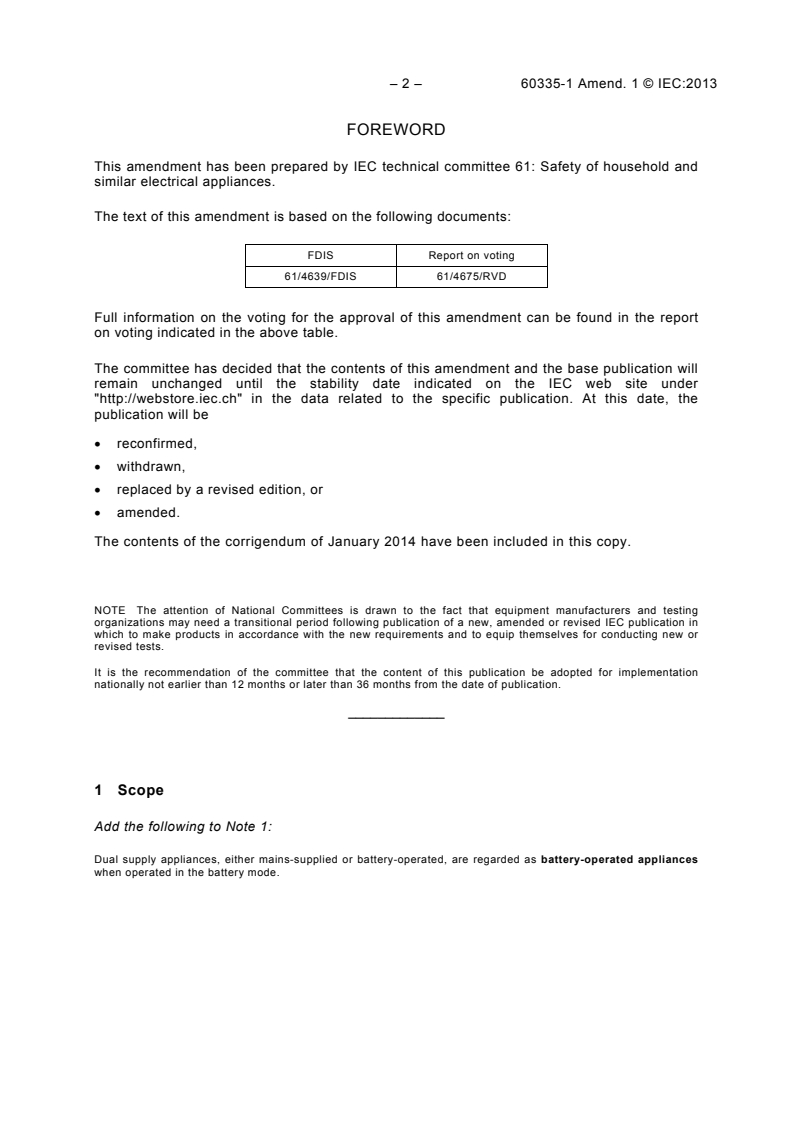
– 2 – 60335-1 Amend. 1 © IEC:2013
FOREWORD
This amendment has been prepared by IEC technical committee 61: Safety of household and
similar electrical appliances.
The text of this amendment is based on the following documents:
FDIS Report on voting
61/4639/FDIS 61/4675/RVD
Full information on the voting for the approval of this amendment can be found in the report
on voting indicated in the above table.
The committee has decided that the contents of this amendment and the base publication will
remain unchanged until the stability date indicated on the IEC web site under
"http://webstore.iec.ch" in the data related to the specific publication. At this date, the
publication will be
reconfirmed,
withdrawn,
replaced by a revised edition, or
amended.
The contents of the corrigendum of January 2014 have been included in this copy.
NOTE The attention of National Committees is drawn to the fact that equipment manufacturers and testing
organizations may need a transitional period following publication of a new, amended or revised IEC publication in
which to make products in accordance with the new requirements and to equip themselves for conducting new or
revised tests.
It is the recommendation of the committee that the content of this publication be adopted for implementation
nationally not earlier than 12 months or later than 36 months from the date of publication.
_____________
1 Scope
Add the following to Note 1:
Dual supply appliances, either mains-supplied or battery-operated, are regarded as battery-operated appliances
when operated in the battery mode.
60335-1 Amend. 1 © IEC:2013 – 3 –
2 Normative references
Replace the reference to IEC 60252-1 by the following:
IEC 60252-1:2010, AC motor capacitors – Part 1: General – Performance, testing and rating –
Safety requirements – Guidance for installation and operation
Add the following references:
IEC 60034-1, Rotating electrical machines – Part 1: Rating and performance
IEC 60730-2-9:2008 , Automatic electrical controls for household and similar use – Part 2-9:
Particular requirements for temperature sensing controls
IEC 61558-2-16, Safety of transformers, reactors, power supply units and similar products for
supply voltages up to 1 100 V – Part 2-16: Particular requirements and tests for switch mode
power supply units and transformers for switch mode power supply units
IEC 62477-1, Safety requirements for power electronic converter systems and equipment –
Part 1: General
3 Terms and definitions
3.2.2 interconnection cord
Replace the existing definition and note by the following:
external flexible cord between two parts of an appliance, provided as part of a complete
appliance for purposes other than connection to the supply mains
NOTE In battery-operated appliances, if the battery is placed in a separate box, the flexible lead or flexible cord
connecting the box with the appliance is considered to be an interconnection cord.
3.3.10 class II appliance
Delete Note 3.
Add the following new definitions:
3.3.16
battery-operated appliance
appliance deriving its energy from batteries enabling the appliance to perform its intended
function without a mains connection
3.6.7
battery box
separate compartment for containing the batteries that is detachable from the appliance
5 General conditions for the tests
5.17 Replace the existing text by the following:
Appliances powered by rechargeable batteries that are recharged in the appliance are tested
in accordance with Annex B.
—————————
There exists a consolidated edition 3.1 (2011) that includes edition 3:2008 and its Amendment 1:2011.
– 4 – 60335-1 Amend. 1 © IEC:2013
Battery-operated appliances powered by batteries that are non-rechargeable or not
recharged in the appliance are tested in accordance with Annex S.
7 Marking and instructions
7.1 Add the following new paragraph after Note 4:
Class II appliances and class III appliances incorporating a functional earth shall be marked
with the symbol IEC 60417-5018 (2011-07).
7.3 In Note 3, replace the text of the example by the following.
EXAMPLE: 230 V /400 V 3N : The appliance is only suitable for the voltage values indicated, 230 V being
for single-phase, a.c. operation and 400 V 3N for three-phase, a.c. with neutral operation (an appliance with
terminals for both supplies).
7.4 Replace the requirement by the following:
If the appliance can be adjusted for different rated voltages or rated frequencies, the
voltage or the frequency to which the appliance is adjusted shall be clearly discernible. If
frequent changes in voltage setting or frequency setting are not required, this requirement is
considered to be met if the rated voltage or rated frequency to which the appliance is to be
adjusted can be determined from a wiring diagram fixed to the appliance.
7.6 Replace [symbol ISO 7000-0434 (2004-01)] by [symbol ISO 7000-0434A (2004-01)].
7.8 Add the following to the first paragraph of the requirement:
– functional earthing terminals shall be indicated by symbol IEC 60417-5018 (2011-07).
7.12 Delete “for use” in the first paragraph and in the Note.
Add the following after the existing last paragraph of the requirement:
For appliances intended for use at altitudes exceeding 2 000 m, the maximum altitude of use
shall be stated.
The instructions for appliances incorporating a functional earth shall state the substance of
the following:
This appliance incorporates an earth connection for functional purposes only.
7.12.1 Add the following text:
For appliances marked with different rated voltages or different rated frequencies
(separated by a /), instructions shall be included to indicate to the user or installer what action
must be taken to adjust the appliance for operation at the required rated voltage or rated
frequency.
7.15 Add the following:
The symbol IEC 60417-5018 (2011-07) shall be placed next to the symbol IEC 60417-5172
(2003-02) or the symbol IEC 60417-5180 (2003-02) as appropriate.
8 Protection against access to live parts
8.1.1 Delete the Note.
60335-1 Amend. 1 © IEC:2013 – 5 –
10 Power input and current
10.1 Replace the penultimate paragraph of the test specification by the following:
If the power input varies throughout the operating cycle and the maximum value of the power
input exceeds, by a factor greater than two, the arithmetic mean value of the power input
occurring during a representative period, then the power input is the maximum value that is
exceeded for more than 10 % of the representative period. Otherwise the power input is taken
as the arithmetic mean value.
10.2 Replace the penultimate paragraph of the test specification by the following:
If the current varies throughout the operating cycle and the maximum value of the current
exceeds, by a factor greater than two, the arithmetic mean value of the current occurring
during a representative period, then the current is the maximum value that is exceeded for
more than 10 % of the representative period. Otherwise the current is taken as the arithmetic
mean value.
11 Heating
11.8 Delete the second sentence of the first paragraph.
Table 3 – Maximum normal temperature rises
After the entry for pins of appliance inlets, add the following new entry:
Pins of appliances for insertion into socket-outlets 45
Replace the second to last, third to last and fourth to last entries in Table 3 by the following:
m
External enclosure of motor-operated appliances except handles held in normal use:
– of bare metal 48
n
– of coated metal 59
– of glass and ceramic 65
l
– of plastic having a thickness exceeding 0,4 mm 74
Surfaces of handles, knobs, grips and similar parts which are continuously held in normal use
m
(e.g. soldering irons):
– of bare metal 30
n
– of coated metal 34
– of porcelain or vitreous material 40
l
– of rubber or of plastic having a thickness exceeding 0,4 mm 50
– of wood 50
k
Surfaces of handles, knobs, grips and similar parts which are held for short periods only in normal
m
use (e.g. switches):
– of bare metal 35
n
– of coated metal 39
– of porcelain or vitreous material 45
l
– of rubber or of plastic having a thickness exceeding 0,4 mm 60
– of wood 65
– 6 – 60335-1 Amend. 1 © IEC:2013
Add the following footnotes to Table 3:
k
The temperature rise limits of controls actuated by contact or proximity of a finger, with no movement of the
contact surface also includes all surfaces within 5 mm of such controls, regardless of their shape.
l
The temperature rise limit of plastic also applies for plastic material having a metal finish of thickness less than
0,1 mm.
m
When the thickness of the plastic coating does not exceed 0,4 mm, the temperature rise limits of the coated
metal or of glass and ceramic material apply.
n
Metal is considered coated when a coating having a minimum thickness of 90 µm made by enamel, powder or
non-substantially plastic coating is used.
13 Leakage current and electric strength at operating temperature
13.2 In the first paragraph, after “class II appliances” add “, class II constructions” and
replace the second sentence by the following:
For class 0I appliances and class I appliances, C may be replaced by a low impedance
ammeter responding to the rated frequency of the appliance.
Replace the second paragraph by the following:
The leakage current is measured between any pole of the supply and
– accessible metal parts intended to be connected to protective earth, for class l
appliances and class 0l appliances;
– metal foil having an area not exceeding 20 cm × 10 cm which is in contact with accessible
surfaces of insulating material and metal parts not intended to be connected to protective
earth, for class 0 appliances, class II appliances, class ll constructions and class III
appliances.
Replace the fourth paragraph by the following:
For single-phase appliances, the measuring circuit is shown in the following figures:
– if they are class II appliances or parts of class II construction, Figure 1;
– if they are neither class II appliances nor parts of class II construction, Figure 2.
Replace the sixth paragraph by the following:
For three-phase with neutral (3N~) connected appliances, the measuring circuit is shown in
the following figures:
– if they are class II appliances or parts of class II construction, Figure 3;
– if they are neither class II appliances nor parts of class II construction, Figure 4.
Delete “For three-phase appliances,” from the first sentence of the seventh paragraph.
Replace the third sentence of the seventh paragraph by the following:
For three-phase without neutral (3~) connected appliances, the measuring circuit in Figure 3
or Figure 4 shall be used as applicable, but the neutral is not connected to the appliance.
In the existing eighth paragraph, replace the first dashed item by the following:
– for class II appliances and for parts of class II construction 0,35 mA peak
60335-1 Amend. 1 © IEC:2013 – 7 –
15 Moisture resistance
15.2
Replace the first paragraph of the test specification by the following:
Compliance is checked by the following test using a spillage solution comprising water
containing approximately 1 % NaCl and 0,6 % rinsing agent.
Replace the fifth paragraph of the test specification by the following:
The liquid container of the appliance is completely filled with the solution and a further
quantity equal to 15 % of the capacity of the container or 0,25 l, whichever is the greater, is
poured in steadily over a period of 1 min.
Add the following new text as a penultimate paragraph:
Any commercially available rinsing agent may be used, but if there is any doubt with regards
to the test results, the rinsing agent shall have the following properties:
– viscosity, 17 mPa⋅s;
– pH, 2,2 (1 % in water).
and its composition shall be
Substance Parts by mass
%
15,0
Plurafac ® LF 221
Cumene sulfonate (40 % solution) 11,5
Citric acid (anhydrous) 3,0
Deionized water 70,5
16 Leakage current and electric strength
16.2 Replace the first paragraph by the following:
An a.c. test voltage is applied between live parts and
– accessible metal parts intended to be connected to protective earth, for class l
appliances and class 0l appliances;
– metal foil having an area not exceeding 20 cm × 10 cm which is in contact with accessible
surfaces of insulating material and metal parts not intended to be connected to protective
earth, for class 0 appliances, class II appliances, class ll constructions and class III
appliances.
In the fourth paragraph, replace the first dashed item by the following:
– for class II appliances and for parts of class II construction 0,25 mA
—————————
Plurafac ® LF 221 is the trade name of a product supplied by BASF. This information is given for the
convenience of users of this document and does not constitute an endorsement by IEC of this product.
– 8 – 60335-1 Amend. 1 © IEC:2013
19 Abnormal operation
19.7 Add the following to the fourth paragraph.
If the timer or programmer is an electronic type that operates to ensure compliance with the
test before the maximum period under the conditions of Clause 11 is reached, it is considered
to be a protective electronic circuit as well as a control that operates under the conditions
of Clause 11.
19.11.4.4 Replace the first paragraph by the following:
The power supply terminals of the appliance are subjected to voltage surges in accordance
with IEC 61000-4-5, five positive impulses and five negative impulses being applied at the
selected points. An open circuit test voltage of 2 kV is applicable for the line-to-line coupling
mode, a generator having a source impedance of 2 Ω being used. An open circuit test voltage
of 4 kV is applicable for the line-to-earth coupling mode, a generator having a source
impedance of 12 Ω being used.
22 Construction
22.5 In the requirement, replace “exceeding” by “equal to or greater than”.
Add the following text after the existing last paragraph of the test specification.
If compliance relies on the operation of an electronic circuit, the electromagnetic
phenomena tests of 19.11.4.3 and 19.11.4.4 are applied one at a time to the appliance. The
discharge test is then repeated three times and for each test, the voltage shall not exceed
34 V.
22.32 Replace the words ‘Insulating material’ at the beginning of the 4th paragraph of the
requirement by ‘Ceramic and similar porous material’ and combine this paragraph with the
third paragraph of the requirement.
22.33 Add the following to the first sentence of the first paragraph of the requirement:
“or unearthed metal parts that are separated from live parts by basic insulation only.”
22.35 In the second paragraph of the requirement add ‘and cordless appliances’ after
‘stationary appliances’.
Add the following note after the requirement:
NOTE A cordless appliance is an appliance that is connected to the supply only when placed on its associated
stand.
Add the following new subclauses:
22.53 Class II appliances and class III appliances that incorporate functionally earthed
parts shall have at least double insulation or reinforced insulation between live parts and
the functionally earthed parts.
Compliance is checked by inspection and test.
60335-1 Amend. 1 © IEC:2013 – 9 –
22.54 Button cells and batteries designated R1 shall not be accessible without the aid of a
tool unless the cover of their compartment can only be opened after at least two independent
movements have been applied simultaneously.
Compliance is checked by inspection and by manual test.
NOTE Batteries are specified in IEC 60086-2.
23 Internal wiring
23.5 Replace Note 2 by the following text.
For class II construction, the requirements for supplementary insulation and reinforced
insulation apply except that the sheath of a cord complying with IEC 60227 or IEC 60245
may provide supplementary insulation.
A single layer of internal wiring insulation does not provide reinforced insulation.
24 Components
24.1 Replace Notes 1, 2, 3 and 4 by the following, and renumber Note 5 to Note 2.
Compliance with the IEC standard for the relevant component does not necessarily ensure
compliance with the requirements of this standard.
Motors are not required to comply with IEC 60034-1. They are tested as part of the appliance
according to this standard.
Relays shall be tested as part of the appliance according to this standard. They may be
alternatively tested to IEC 60730-1, in which case they must also meet the additional
requirements in IEC 60335-1.
Unless otherwise specified, the requirements of Clause 29 of this standard apply between live
parts of components and accessible parts of the appliance. Unless otherwise specified,
components may comply with the requirements for clearances and creepage distances for
functional insulation as specified in the relevant component standard.
Unless otherwise specified, the requirements of 30.2 of this standard apply to parts of non-
metallic material in components including parts of non-metallic material supporting current-
carrying connections inside components.
Components that have not been previously tested and shown to comply with the IEC standard
for the relevant component are tested according to the requirements of 30.2 of this standard.
Components that have been previously tested and shown to comply with the resistance to fire
requirements in the IEC standard for the relevant component need not be retested provided
that
− the severity specified in the component standard is not less than the severity specified in
30.2 of this standard, and
− unless the pre-selection alternatives in 30.2 are used, the test report for the component
states the values of t and t . as required by IEC 60695-2-11.
e i
If the above two conditions are not satisfied, the component shall be tested as part of the
appliance.
– 10 – 60335-1 Amend. 1 © IEC:2013
NOTE 1 There are two levels of severity specified for appliances for which 30.2.3 is applicable.
Power electronic converter circuits are not required to comply with IEC 62477-1. They are
tested as part of the appliance according to this standard.
24.1.2 Add the following text as a new first paragraph.
The relevant standard for transformers in associated switch mode power supplies is Annex BB
of IEC 61558-2-16. Clause 26 of IEC 61558-1 and Annex H of IEC 61558-1 are not applicable.
24.1.4 Add the following new paragraph:
Thermal cut-outs of the capillary type shall comply with the requirements for type 2.K controls
in IEC 60730-2-9.
24.1.5 In the second sentence of the first paragraph, add “class II” before “appliances”.
25 Supply connection and external flexible cords
25.1 Replace the first dashed item of the requirement by the following:
– supply cord fitted with a plug, the current rating and voltage rating of the plug being not
less than the corresponding ratings of its associated appliance;
25.7 Delete the third dashed item in the first paragraph of the requirement.
25.10 Add the following as a new paragraph to the requirement.
In multi-phase appliances, the colour of the neutral conductor of the supply cord, if any, shall
be blue.
25.13 In the requirement, replace the second sentence by the following:
If it is not evident from the construction of the appliance that the supply cord can be
introduced without risk of damage, a non-detachable lining or non-detachable bushing
shall be provided that complies with 29.3 for supplementary insulation.
25.15 Replace the second paragraph of the test specification by the following:
A mark is made on the cord at a distance of approximately 20 mm from the cord anchorage or
other suitable point. The mark is made while the cord is subjected to a pull force of
– 100 N, for fixed appliances regardless of the mass of the appliance;
– the value as shown in Table 12, for other appliances.
25.20 Delete, in the first sentence, the word "insulated" in the phrase "insulated conductors
of the supply cord" and the word "additionally" in the phrase "shall be additionally insulated".
27 Provision for earthing
27.1 In the first paragraph of the requirement replace “an insulation fault” by “a failure of
basic insulation”.
Delete Note 1 and replace “Note 2” by “Note”.
60335-1 Amend. 1 © IEC:2013 – 11 –
Replace the third paragraph by the following:
Class 0 appliances, class II appliances and class III appliances shall have no provision for
protective earthing. Class II appliances and class III appliances may incorporate an earth
for functional purposes.
27.2 Add the following paragraph to the requirement:
These requirements are not applicable to class II appliances and class III appliances that
incorporate an earth for functional purposes.
27.3 Add the following paragraph to the requirement:
These requirements are not applicable to class II appliances and class III appliances that
incorporate an earth for functional purposes.
27.4 Add the following paragraph to the requirement:
These requirements are not applicable to class II appliances and class III appliances that
incorporate an earth for functional purposes.
27.5 Add the following paragraph to the requirement:
These requirements are not applicable to class II appliances and class III appliances that
incorporate an earth for functional purposes.
Replace existing Note 1 by the following as an addition to the existing second paragraph of
the test specification.
The test is carried out until steady conditions have been established.
Replace existing Note 2 by the following as an addition to the last paragraph of the test
specification.
The resistance of the supply cord is not included in the resistance calculation.
Renumber existing Note 3 as Note.
27.6 Add the following sentence to the requirement:
This requirement is not applicable to class II appliances and class III appliances that
incorporate an earth for functional purposes.
28 Screws and connections
28.2 In the second paragraph of the requirement, replace bullets with dashes in the two
bulleted items.
29 Clearances, creepage distances and solid insulation
29.1 Add the following as a new second paragraph of the requirement:
For appliances intended for use at altitudes exceeding 2 000 m, the clearances in Table 16
shall be increased according to the relevant multiplier values in Table A.2 of IEC 60664-1.
– 12 – 60335-1 Amend. 1 © IEC:2013
Add the following to the existing second paragraph of the requirement:
or to appliances intended for use at altitudes exceeding 2 000 m.
Delete Note 5.
Table 17 – Minimum creepage distances for basic insulation
Replace Note 1 by the following:
Lacquered conductors of windings are considered to be bare conductors but creepage distances for basic
insulation in other than a double insulation construction need not be greater than the associated clearance
specified in Table 16 taking into account 29.1.1.
29.3 Replace the third dashed item by the following:
– for insulation, other than single layer internal wiring insulation, by an assessment of the
thermal quality of the material combined with an electric strength test, in accordance with
29.3.3 and for accessible parts of reinforced insulation consisting of a single layer, by
measurement in accordance with 29.3.4, or
Add the following as the fourth dashed item of the test specification:
− by an assessment of the thermal quality of the material according to 29.3.3 combined with
an electric strength test in accordance with 23.5, for each single layer internal wiring
insulation touching each other, or
Figures
Figure 1 – Circuit diagram for leakage current measurement at operating temperature
for single-phase connection of class II appliances
Replace the title of Figure 1 by the following:
Figure 1 – Circuit diagram for leakage current measurement at operating temperature
for single-phase connection of class II appliances and for parts of class ll construction
Figure 2 – Circuit diagram for leakage current measurement at operating temperature
for single-phase connection of appliances, other than those of class II
Replace the note of Figure 2 by the following:
NOTE For class 0I appliances and class I appliances, C can be replaced by a low impedance ammeter
responding to the rated frequency of the appliance.
Replace the title of Figure 2 by the following:
Figure 2 – Circuit diagram for leakage current measurement at operating temperature
for single-phase connection of other than class II appliances or parts of class ll
construction
60335-1 Amend. 1 © IEC:2013 – 13 –
Replace Figure 3 and Figure 4 by the following new figures:
C
c
a b
N
Z
PE
L
L
L
IEC 2847/13
Key Connections and supplies
C circuit of figure 4 of IEC 60990 L L L N supply voltage with neutral
1, 2, 3,
1 accessible part PE protective earth conductor
2 inaccessible metal part Z IT system neutral to earth high impedance
3 basic insulation
4 supplementary insulation
5 double insulation
NOTE If the test laboratory is supplied from a TN or TT distribution system then Z will be zero. Consequently,
always connecting “C” to the neutral conductor will ensure reproducibility of the test result regardless of the type of
distribution system (TN, TT or IT) used by the test laboratory and will cover the most onerous condition likely to be
encountered during normal use of the appliance.
Figure 3 – Circuit diagram for leakage current measurement at operating temperature
for three-phase with neutral class ll appliances and for parts of class ll construction
– 14 – 60335-1 Amend. 1 © IEC:2013
C
c
a b
N
Z
PE
L
L
L
IEC 2848/13
Key Connections and supplies
C circuit of Figure 4 of IEC 60990 L L L N supply voltage with neutral
1, 2, 3,
1 accessible part PE protective earth conductor
2 basic insulation Z IT system neutral to earth high impedance
NOTE 1 For class 0I appliances and class I appliances, C can be replaced by a low impedance ammeter
responding to the rated frequency of the appliance.
NOTE 2 If the test laboratory is supplied from a TN or TT distribution system then Z will be zero. Consequently,
always connecting “C” to the neutral conductor will ensure reproducibility of the test result regardless of the type of
distribution system (TN, TT or IT) used by the test laboratory and will cover the most onerous condition likely to be
encountered during normal use of the appliance.
Figure 4 – Circuit diagram for leakage current measurement at operating temperature
for three-phase with neutral appliances other than those of class lI or parts of class ll
construction
60335-1 Amend. 1 © IEC:2013 – 15 –
Annex B – Appliances powered by rechargeable batteries
Replace the existing title by the following:
Appliances powered by rechargeable batteries that are recharged in the
appliance
Replace the introductory text by the following:
The following modifications to this standard are applicable for appliances powered by
batteries that are recharged in the appliance.
NOTE 1 Rechargeable batteries are also referred to as secondary batteries.
NOTE 2 This Annex B does not apply to battery chargers (IEC 60335-2-29).
These appliances take one of the following three forms of construction:
a) The appliance can be supplied directly from the supply mains or a renewable energy
source such as a solar cell, the battery charging circuitry and other supply unit circuitry
being incorporated within the appliance.
b) The part of the appliance incorporating the battery is supplied from the supply mains or a
renewable energy source such as a solar cell, via a detachable supply unit. The battery
charging circuitry is incorporated within the part of the appliance containing the battery.
In this case, the complete appliance is the detachable supply unit plus the part of the
appliance containing the battery and the battery charging circuitry.
c) The part of the appliance incorporating the battery is supplied from the supply mains or a
renewable energy source such as a solar cell, via a detachable supply unit. The battery
charging circuitry is incorporated within the detachable supply unit. In this case, the
complete appliance is the detachable supply unit with the battery charging circuitry plus
the part of the appliance containing the battery.
NOTE 3 Examples of the forms of construction covered by this Annex B are shown in Figure B.1.
NOTE 4 If the appliance incorporates a non-rechargeable (primary) battery or a rechargeable (secondary) battery
that must be removed from the appliance for charging, then Annex S is applicable. In this case, the appliance is
simply a battery-operated appliance and the safety requirements for the battery charger for charging the
rechargeable battery are contained in IEC 60335-2-29.
7 Marking and instructions
7.1 Add the following:
Appliances intending to be supplied from a detachable supply unit for the purposes of
recharging the battery shall be marked with symbol IEC 60417-6181 (2013-03) and its type
reference along with symbol ISO 7000-0790 (2004-01) or with the substance of the following:
Use only with supply unit
7.6 Add the following:
detachable supply unit
[symbol IEC 60417-6181 (2013-03)]
– 16 – 60335-1 Amend. 1 © IEC:2013
7.12 Add the following:
For appliances intending to be supplied from a detachable supply unit for the purposes of
recharging the battery, the type reference of the detachable supply unit shall be stated
along with the substance of the following:
WARNING: For the purposes of recharging the battery, only use the detachable supply
unit provided with this appliance.
If the symbol for detachable supply unit is used, its meaning shall be explained.
7.15 Add the following:
The type reference of the detachable supply unit shall be placed in close proximity to the
symbol.
11 Heating
Add the following:
11.8 The temperature rise of the battery surface shall not exceed the temperature rise limit
in the battery manufacturer’s specification for the type of battery supplied. If no limit is
specified, the temperature rise shall not exceed 20 K.
19 Abnormal operation
Add the following text and figure:
19.13 The battery shall not rupture or ignite.
60335-1 Amend. 1 © IEC:2013 – 17 –
Add the following new Figure B.1:
A
B
S
IEC 2849/13
CC
A
B
SU
S
CC
IEC 2850/13
A
B
SU
S
CC
IEC 2851/13
Key
A appliance
B battery
S supply mains
CC charging circuitry
SU supply unit
Figure B.1 – Examples of forms of constructions for appliances covered by Annex B
– 18 – 60335-1 Amend. 1 © IEC:2013
Annex H – Switches
20 Clearances, creepage distances, solid insulation and coatings of rigid
printed board assemblies
Replace the text by the following:
Clause 20 is applicable to clearances across full disconnection and micro-disconnection. It is
also applicable to creepage distances for functional insulation, across full disconnection
and micro-disconnection, as stated in Table 24.
Add the following new annex:
Annex S
(normative)
Battery-operated appliances powered by batteries that are
non-rechargeable or not recharged in the appliance
The following modifications to this standard are applicable for battery-operated appliances
where the batteries are either non-rechargeable (primary batteries) or rechargeable batteries
(secondary batteries) that are not recharged in the appliance.
NOTE 1 Non-rechargeable batteries can also be referred to as primary batteries.
NOTE 2 Requirements for appliances powered by batteries that are recharged in the appliance are given in
Annex B.
5 General conditions for the tests
5.8.1 Where the supply terminals for the connection of the battery have no indication of
polarity, the more unfavourable polarity shall be applied.
5.S.101 Battery-operated appliances intended for use with a battery box are tested with
the battery box supplied with the appliance or with the battery box recommended in the
instructions.
5.S.102 Battery-operated appliances are tested as motor-operated appliances.
7 Marking and instructions
7.1 Battery-operated appliances shall be marked with the battery voltage and the polarity
of the terminals unless the polarity is irrelevant.
Battery-operated appliances shall also be marked with the
– name, trade mark or identification mark of the manufacturer or responsible vendor;
– model or type reference;
– IP number according to degree of protection against ingress of water, other than IPX0;
– type reference of battery or batteries.
If relevant, the positive terminal shall be indicated by the symbol IEC 60417-5005 (2002-10)
and the negative terminal by the symbol IEC 60417-5006 (2002-10).
60335-1 Amend. 1 © IEC:2013 – 19 –
If appliances use more than one battery, they shall be marked to indicate correct polarity
connection of the batteries.
NOTE 1 Examples of acceptable marking representing three batteries are shown in Figure S.1.
NOTE 2 It is not necessary for the rated current or rated power input to be marked.
7.6
[symbol IEC 60417-5005 (2002-10)] plus; positive polarity
[symbol IEC 60417-5006 (2002-10)] minus; negative polarity
7.12 The instructions for battery-operated appliances shall contain the substance of the
following, as applicable:
– the types of batteries that may be used;
– how to remove and insert the batteries;
– non-rechargeable batteries are not to be recharged;
– rechargeable batteries are to be removed from the appliance before being charged;
– different types of batteries or new and used batteries are not to be mixed;
– batteries are to be inserted with the correct polarity;
– exhausted batteries are to be removed from the appliance and safely disposed of;
– if the appliance is to be stored unused for a long period, the batteries should be removed;
– the supply terminals are not to be short-circuited.
11 Heating
11.5 By means of an external power supply, battery-operated appliances are supplied at
the terminals for the connection of the battery with the most unfavourable supply voltage
between
– 0,55 and 1,0 times the battery voltage, if the appliance can be used with non-rechargeable
batteries;
– 0,75 and 1,0 times battery voltage, if the appliance is designed for use with rechargeable
batteries only.
The values specified in Table S.101 for the internal resistance per cell of the battery shall be
taken into account.
Table S.101 – Battery source impedance
Internal resistance per cell
a
Supply to the terminals for the
Ω
connection of the battery
Non-rechargeable batteries Rechargeable batteries
1,0 times battery voltage 0,10 0,001 5
0,75 times battery voltage 0,75 0,006 0
0,55 times battery voltage 2,00 –
a
When determining the internal resistance of a battery, two or more cells connected in parallel are considered
to be one cell.
– 20 – 60335-1 Amend. 1 © IEC:2013
19 Abnormal operation
19.1 For battery-operated appliances, the tests are carried out with the battery fully
charged unless otherwise specified.
19.13 The battery shall not rupture or ignite.
19.S.101 Battery-operated appliances are supplied with the voltage specified in 11.5. The
supply terminals having an indication of polarity are connected to the opposite polarity, unless
such a connection is unlikely to occur due to the construction of the appliance.
19.S.102 For battery-operated appliances with provision for multiple batteries, one or more
of the batteries shall be reversed and the appliance shall be operated, if reversal of batteries
is allowed by the construction.
25 Supply connection and external flexible cords
25.5 The flexible leads or flexible cord used to connect an external battery or battery box in
battery-operated appliances shall be connected to the appliance by a type X attachment.
25.13 This requirement is not applicable to the flexible leads or flexible cord connecting
external batteries or a battery box with an appliance.
25.S.101 Battery-operated appliances shall have suitable means for connection of the
battery. If the type of battery is marked on the appliance, the means of connection shall be
suitable for this type of battery.
Compliance is checked by inspection.
26 Terminals for external conductors
26.5 Terminal devices in an appliance for the connection of the flexible leads or flexible cord
connecting an external battery or battery box shall be so located or shielded that there is no
risk of accidental connection between supply terminals.
30 Resistance to heat and fire
30.2.3.2 Addition:
There shall be no battery in the area of the vertical cylinder used for the consequential needle
flame test unless the battery is shielded by a barrier that meets the needle flame test of
Annex E or that comprises material classified as V-0 or V-1 according to IEC 60695-11-10
provided that the test sample used for the classification was no thicker than the relevant part
of the appliance.
60335-1 Amend. 1 © IEC:2013 – 21 –
1,5 V +
1,5 V + 1,5 V +
× 3
1,5 V +
3 × 1,5 V +
3 × 1,5 V
+
IEC 2976/02
Figure S.1 – Examples of battery marking representing three batteries
Bibliography
Add the following:
IEC 60086-2, Primary batteries – Part 2: Physical and electrical specifications
Delete reference to IEC 60034-1.
_____________
– 22 – 60335-1 Amend. 1 © CEI:2013
AVANT-PROPOS
Le présent amendement a été établi par le comité d’études 61 de la CEI: Sécurité des
appareils électrodomestiques et analogues.
Le texte de cet amendement est issu des documents suivants:
FDIS Rapport de vote
61/4639/FDIS 61/4675/RVD
Le rapport de vote indiqué dans le tableau ci-dessus donne toute information sur le vote ayant
abouti à l'approbation de cet amendement.
Le comité a décid
...