

IEC TS 63014-1:2018
(Main)High voltage direct current (HVDC) power transmission - System requirements for DC-side equipment - Part 1: Using line-commutated converters
General Information
- Abstract
IEC TS 63014-1:2018(E) is intended to provide an overall and consistent set of guidelines to facilitate the specification of equipment for the DC-side of a high-voltage direct current (HVDC) system using line-commutated converters. For point-to-point HVDC transmission systems, this document covers all DC-side equipment located between the converter valves and the DC overhead line or cable termination, excluding the converter valves themselves. For back-to-back HVDC systems, this document covers all DC-side equipment excluding the converter valves themselves.
- Status
- Published
- Publication Date
- 07-Mar-2018
- Technical Committee
- TC 115 - High Voltage Direct Current (HVDC) transmission for DC voltages above 100 kV
- Drafting Committee
- WG 9 - TC 115/WG 9
- Current Stage
- PPUB - Publication issued
- Start Date
- 08-Mar-2018
- Completion Date
- 03-Apr-2018
Buy Documents
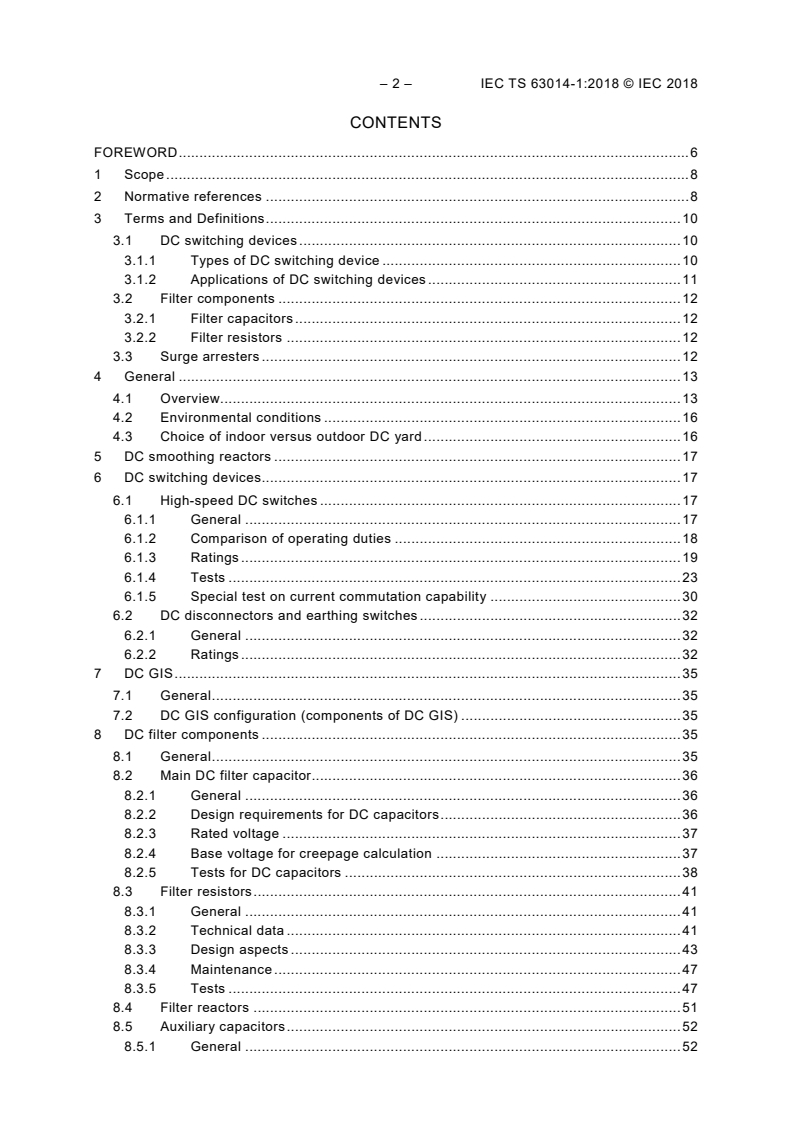
IEC TS 63014-1:2018 - High voltage direct current (HVDC) power transmission - System requirements for DC-side equipment - Part 1: Using line-commutated converters Released:3/8/2018
Overview
IEC TS 63014-1:2018 provides a comprehensive set of guidelines for specifying equipment on the DC side of high voltage direct current (HVDC) power transmission systems utilizing line-commutated converters. Developed by the International Electrotechnical Commission (IEC), this technical specification focuses on point-to-point and back-to-back HVDC schemes, excluding the converter valves. It addresses a broad range of auxiliary DC-side equipment located between the converter valves and the DC line or cable termination, aiming to ensure consistency and clarity for HVDC project designers, manufacturers, and utilities.
Standardization of DC-side equipment is essential due to the rapid evolution of HVDC technology and the growing demand for reliable long-distance power transmission. While many product standards exist for AC applications, this document clarifies the unique requirements for DC-side components and supplements areas lacking dedicated DC standards.
Key Topics
IEC TS 63014-1:2018 covers the following major topics related to DC-side equipment in HVDC systems using line-commutated converters:
- Scope of DC-side equipment: Guidelines for equipment between converter valves and line/cable terminations, explicitly excluding converter valves themselves.
- Switching devices: Definitions and requirements for high-speed DC switches, DC commutation switches, disconnectors, earthing switches, bypass switches, line and converter paralleling switches.
- Filter components: Design considerations for DC filter capacitors, auxiliary capacitors, harmonic filter resistors, filter reactors, and DC neutral bus capacitors.
- Surge protection: Specification for DC-side surge arresters, including operating voltages and energy dissipation capabilities.
- Instrument transformers: Application and specifications for DC current and voltage transformers, as well as current transformers in DC filter circuits.
- Insulation coordination: Guidance for selecting and testing insulators and bushings, considering DC-specific stresses and interfaces.
- Monitoring systems: Requirements for monitoring equipment for electrode lines and dedicated metallic return paths, supporting operational reliability.
These topics aim to create clear, harmonized requirements for DC equipment that ensures safe, reliable, and efficient HVDC transmission.
Applications
IEC TS 63014-1:2018 finds practical application in:
- Design and specification of HVDC projects: Assisting engineers, manufacturers, and consultants in selecting and specifying suitable DC-side equipment for new and existing HVDC schemes.
- System integration: Ensuring compatibility between components through internationally aligned guidelines, reducing the risk of equipment failure or incompatibility.
- Testing and validation: Providing references for appropriate testing conditions and performance criteria for DC-side components, leveraging both existing AC standards and tailored DC requirements.
- Asset protection and maintenance: Outlining the specification of surge arresters, insulation, and monitoring necessary for reliable HVDC system operation and long service life.
By adhering to the technical requirements of IEC TS 63014-1:2018, stakeholders can achieve better system performance, reduced downtime, and enhanced safety for DC-side HVDC installations.
Related Standards
IEC TS 63014-1:2018 references and aligns with several other important IEC standards, including:
- IEC 60700 series: Covers converter valves excluded from this document’s scope.
- IEC 62271 series: Relating to switchgear, disconnectors, and earthing switches.
- IEC 60099-9: Surge arresters for HVDC converter stations.
- IEC 61869 series: Instrument transformers, including parts specific to DC applications.
- IEC 60071-5: Insulation coordination for HVDC converter stations.
- IEC TS 60815-4: Selection and dimensioning of insulators for DC systems.
- IEC/IEEE 65700-19-03: Bushings for DC application.
For systems based on voltage-sourced converters (VSC), a future second part of IEC 63014 will provide relevant guidelines.
Adopting IEC TS 63014-1:2018 supports robust specification and international harmonization for equipment in HVDC systems, ultimately contributing to safer and more resilient power transmission infrastructure worldwide.
Buy Documents
IEC TS 63014-1:2018 - High voltage direct current (HVDC) power transmission - System requirements for DC-side equipment - Part 1: Using line-commutated converters Released:3/8/2018
Get Certified
Connect with accredited certification bodies for this standard

IMQ S.p.A. (Certification)
Italian electrical product certification.

SLG Prüf- und Zertifizierungs GmbH
German testing and certification body.

UL Solutions
Global safety science company with testing, inspection and certification.
Sponsored listings
Frequently Asked Questions
IEC TS 63014-1:2018 is a technical specification published by the International Electrotechnical Commission (IEC). Its full title is "High voltage direct current (HVDC) power transmission - System requirements for DC-side equipment - Part 1: Using line-commutated converters". This standard covers: IEC TS 63014-1:2018(E) is intended to provide an overall and consistent set of guidelines to facilitate the specification of equipment for the DC-side of a high-voltage direct current (HVDC) system using line-commutated converters. For point-to-point HVDC transmission systems, this document covers all DC-side equipment located between the converter valves and the DC overhead line or cable termination, excluding the converter valves themselves. For back-to-back HVDC systems, this document covers all DC-side equipment excluding the converter valves themselves.
IEC TS 63014-1:2018(E) is intended to provide an overall and consistent set of guidelines to facilitate the specification of equipment for the DC-side of a high-voltage direct current (HVDC) system using line-commutated converters. For point-to-point HVDC transmission systems, this document covers all DC-side equipment located between the converter valves and the DC overhead line or cable termination, excluding the converter valves themselves. For back-to-back HVDC systems, this document covers all DC-side equipment excluding the converter valves themselves.
IEC TS 63014-1:2018 is classified under the following ICS (International Classification for Standards) categories: 01 - GENERALITIES. TERMINOLOGY. STANDARDIZATION. DOCUMENTATION; 29.180 - Transformers. Reactors; 29.200 - Rectifiers. Convertors. Stabilized power supply; 29.240.01 - Power transmission and distribution networks in general. The ICS classification helps identify the subject area and facilitates finding related standards.
IEC TS 63014-1:2018 is available in PDF format for immediate download after purchase. The document can be added to your cart and obtained through the secure checkout process. Digital delivery ensures instant access to the complete standard document.
Standards Content (Sample)
IEC TS 63014-1 ®
Edition 1.0 2018-03
TECHNICAL
SPECIFICATION
colour
inside
High voltage direct current (HVDC) power transmission – System requirements
for DC-side equipment
Part 1: Using line-commutated converters
All rights reserved. Unless otherwise specified, no part of this publication may be reproduced or utilized in any form
or by any means, electronic or mechanical, including photocopying and microfilm, without permission in writing from
either IEC or IEC's member National Committee in the country of the requester. If you have any questions about IEC
copyright or have an enquiry about obtaining additional rights to this publication, please contact the address below or
your local IEC member National Committee for further information.
IEC Central Office Tel.: +41 22 919 02 11
3, rue de Varembé info@iec.ch
CH-1211 Geneva 20 www.iec.ch
Switzerland
About the IEC
The International Electrotechnical Commission (IEC) is the leading global organization that prepares and publishes
International Standards for all electrical, electronic and related technologies.
About IEC publications
The technical content of IEC publications is kept under constant review by the IEC. Please make sure that you have the
latest edition, a corrigenda or an amendment might have been published.
IEC Catalogue - webstore.iec.ch/catalogue Electropedia - www.electropedia.org
The stand-alone application for consulting the entire The world's leading online dictionary of electronic and
bibliographical information on IEC International Standards, electrical terms containing 21 000 terms and definitions in
Technical Specifications, Technical Reports and other English and French, with equivalent terms in 16 additional
documents. Available for PC, Mac OS, Android Tablets and languages. Also known as the International Electrotechnical
iPad. Vocabulary (IEV) online.
IEC publications search - webstore.iec.ch/advsearchform IEC Glossary - std.iec.ch/glossary
The advanced search enables to find IEC publications by a 67 000 electrotechnical terminology entries in English and
variety of criteria (reference number, text, technical French extracted from the Terms and Definitions clause of
committee,…). It also gives information on projects, replaced IEC publications issued since 2002. Some entries have been
and withdrawn publications. collected from earlier publications of IEC TC 37, 77, 86 and
CISPR.
IEC Just Published - webstore.iec.ch/justpublished
Stay up to date on all new IEC publications. Just Published IEC Customer Service Centre - webstore.iec.ch/csc
details all new publications released. Available online and If you wish to give us your feedback on this publication or
also once a month by email. need further assistance, please contact the Customer Service
Centre: sales@iec.ch.
IEC TS 63014-1 ®
Edition 1.0 2018-03
TECHNICAL
SPECIFICATION
colour
inside
High voltage direct current (HVDC) power transmission – System requirements
for DC-side equipment
Part 1: Using line-commutated converters
INTERNATIONAL
ELECTROTECHNICAL
COMMISSION
ICS 29.200; 29.240.01 ISBN 978-2-8322-5451-6
– 2 – IEC TS 63014-1:2018 © IEC 2018
CONTENTS
FOREWORD . 6
1 Scope . 8
2 Normative references . 8
3 Terms and Definitions . 10
3.1 DC switching devices . 10
3.1.1 Types of DC switching device . 10
3.1.2 Applications of DC switching devices . 11
3.2 Filter components . 12
3.2.1 Filter capacitors . 12
3.2.2 Filter resistors . 12
3.3 Surge arresters . 12
4 General . 13
4.1 Overview. 13
4.2 Environmental conditions . 16
4.3 Choice of indoor versus outdoor DC yard . 16
5 DC smoothing reactors . 17
6 DC switching devices. 17
6.1 High-speed DC switches . 17
6.1.1 General . 17
6.1.2 Comparison of operating duties . 18
6.1.3 Ratings . 19
6.1.4 Tests . 23
6.1.5 Special test on current commutation capability . 30
6.2 DC disconnectors and earthing switches . 32
6.2.1 General . 32
6.2.2 Ratings . 32
7 DC GIS . 35
7.1 General . 35
7.2 DC GIS configuration (components of DC GIS) . 35
8 DC filter components . 35
8.1 General . 35
8.2 Main DC filter capacitor. 36
8.2.1 General . 36
8.2.2 Design requirements for DC capacitors . 36
8.2.3 Rated voltage . 37
8.2.4 Base voltage for creepage calculation . 37
8.2.5 Tests for DC capacitors . 38
8.3 Filter resistors . 41
8.3.1 General . 41
8.3.2 Technical data . 41
8.3.3 Design aspects . 43
8.3.4 Maintenance . 47
8.3.5 Tests . 47
8.4 Filter reactors . 51
8.5 Auxiliary capacitors . 52
8.5.1 General . 52
8.5.2 Rated voltage of the auxiliary capacitor banks . 52
8.5.3 Base voltage for creepage calculation for auxiliary DC filter capacitors . 52
8.6 Series blocking filters . 52
8.7 DC neutral bus capacitor . 53
9 Coupling capacitors and line traps for power line carrier (PLC) . 53
10 DC surge arresters . 53
10.1 General . 53
10.2 Surge arrester specification . 53
10.2.1 General . 53
10.2.2 Continuous operating voltage (COV) . 54
10.2.3 Protective characteristics . 54
10.2.4 Insulation withstand levels of arrester housing . 55
10.2.5 Energy dissipation capability . 55
10.3 Test requirements . 55
11 Instrument transformers . 55
11.1 DC current transformer . 55
11.2 DC voltage transformer . 55
11.3 Current transformers in DC filter circuits . 55
12 DC insulators and bushings . 55
12.1 Bushings . 55
12.2 Post insulators . 56
12.2.1 General . 56
12.2.2 Type tests . 56
12.2.3 Routine tests . 58
12.2.4 Special tests (subject to agreement between the manufacturer and the
purchaser) . 58
12.3 Suspension insulators . 58
13 Monitoring equipment for electrode line or dedicated metallic return . 58
Annex A (informative) Overview of DC-side equipment . 59
A.1 General . 59
A.2 DC smoothing reactor . 60
A.3 Filter equipment . 61
A.3.1 DC harmonic filters . 61
A.3.2 Series DC blocking filters . 63
A.4 DC bushings . 64
A.5 Instrument transformers . 65
A.5.1 General . 65
A.5.2 Direct voltage measurement . 65
A.5.3 DC current measurement . 66
A.6 Surge arresters . 69
A.7 Electrode line monitoring and protection equipment . 72
Annex B (informative) DC switching devices for HVDC converter stations . 74
B.1 General . 74
B.2 Typical DC switching device applications . 76
B.2.1 Metallic return transfer switch (MRTS) and earth return transfer switch
(ERTS) . 76
B.2.2 Neutral bus switch (NBS) . 78
B.2.3 Neutral bus earthing switch (NBES) . 79
– 4 – IEC TS 63014-1:2018 © IEC 2018
B.2.4 Bypass switch (BPS) . 80
B.2.5 Converter paralleling switch . 81
B.2.6 Line paralleling switch . 82
B.3 Design . 83
Bibliography . 87
Figure 1 – Scope of DC-side equipment for a back-to-back HVDC converter station
with one 12-pulse bridge per end . 14
Figure 2 – Scope of DC-side equipment for a transmission HVDC converter station
with one 12-pulse bridge per pole . 15
Figure 3 – Key for application of test voltages . 24
Figure 4 – Test circuit for commutation test . 31
Figure 5 – Typical arrangement of shunt DC filter . 36
Figure 6 – Typical scheme of a resistor composed of one module . 43
Figure 7 – Transient current performance of resistor . 51
Figure 8 – Operating voltage of a converter bus arrester (CB), rectifier operation . 54
Figure A.1 – Main items of DC yard equipment for a typical HVDC transmission
scheme . 59
Figure A.2 – Some commonly used DC filter configurations . 62
Figure A.3 – Series blocking filter . 64
Figure A.4 – Resistive voltage divider for measurement of direct voltage . 65
Figure A.5 – Operating principle of zero-flux CT (simplified) . 67
Figure A.6 – Current measurement by resistive shunt using optical powering. 68
Figure A.7 – Optical current measurement . 68
Figure A.8 – Typical arrangement of surge arresters in a converter station with one 12-
pulse bridge per pole (only one pole shown) . 71
Figure A.9 – Electrode line monitoring by AC current injection . 73
Figure B.1 – Typical arrangement of DC switching devices for a bipolar transmission
scheme with one 12-pulse bridge per pole . 75
Figure B.2 – Typical arrangement of bypass switches and disconnectors for a bipolar
transmission scheme with two 12-pulse bridges per pole . 76
Figure B.3 – Example arrangement of line paralleling switches for a bipolar HVDC
transmission scheme . 76
Figure B.4 – Example arrangement of converter paralleling switches for a bipolar
HVDC transmission scheme . 82
Figure B.5 – Commutation switch based on the divergent current oscillation method,
without (left) and with (right) making switch . 84
Figure B.6 – Oscillogram of a commutation event . 85
Figure B.7 – Commutation switch with pre-charged capacitor. 86
Figure B.8 – Parallel arrangement of switches used at very high current . 86
Table 1 – Summary of main parameters affecting specification of high-speed DC
switches. 19
Table 2 – Table of standard ratings in accordance with IEC 62271-100 and their
applicability to high-speed DC switches . 20
Table 3 – Test conditions for direct voltage test . 25
Table 4 – Test conditions for partial discharge test . 25
Table 5 – Test conditions for polarity reversal test . 26
Table 6 – Test conditions for RIV test . 27
Table 7 – Test conditions for lightning-impulse withstand test . 28
Table 8 – Test conditions for switching impulse withstand test . 29
Table 9 – Test conditions for power frequency withstand test . 29
Table 10 – Table of standard ratings in accordance with IEC 62271-102 and their
applicability to HVDC disconnectors and earthing switches . 32
Table 11 – Ratings for resistors . 42
Table 12 – Recommended temperature and temperature rise limits for bolted and
welded connections . 46
Table B.1 – Summary of main parameters affecting specification of MRTS and ERTS . 78
Table B.2 – Summary of main parameters affecting specification of NBS . 79
Table B.3 – Summary of main parameters affecting specification of NBES . 80
Table B.4 –Summary of main parameters affecting specification of BPS . 81
Table B.5 – Summary of main parameters affecting specification of CPS . 82
Table B.6 – Summary of main parameters affecting specification of LPS . 83
– 6 – IEC TS 63014-1:2018 © IEC 2018
INTERNATIONAL ELECTROTECHNICAL COMMISSION
____________
HIGH VOLTAGE DIRECT CURRENT (HVDC) POWER TRANSMISSION –
SYSTEM REQUIREMENTS FOR DC-SIDE EQUIPMENT
Part 1: Using line-commutated converters
FOREWORD
1) The International Electrotechnical Commission (IEC) is a worldwide organization for standardization comprising
all national electrotechnical committees (IEC National Committees). The object of IEC is to promote
international co-operation on all questions concerning standardization in the electrical and electronic fields. To
this end and in addition to other activities, IEC publishes International Standards, Technical Specifications,
Technical Reports, Publicly Available Specifications (PAS) and Guides (hereafter referred to as "IEC
Publication(s)"). Their preparation is entrusted to technical committees; any IEC National Committee interested
in the subject dealt with may participate in this preparatory work. International, governmental and non-
governmental organizations liaising with the IEC also participate in this preparation. IEC collaborates closely
with the International Organization for Standardization (ISO) in accordance with conditions determined by
agreement between the two organizations.
2) The formal decisions or agreements of IEC on technical matters express, as nearly as possible, an international
consensus of opinion on the relevant subjects since each technical committee has representation from all
interested IEC National Committees.
3) IEC Publications have the form of recommendations for international use and are accepted by IEC National
Committees in that sense. While all reasonable efforts are made to ensure that the technical content of IEC
Publications is accurate, IEC cannot be held responsible for the way in which they are used or for any
misinterpretation by any end user.
4) In order to promote international uniformity, IEC National Committees undertake to apply IEC Publications
transparently to the maximum extent possible in their national and regional publications. Any divergence
between any IEC Publication and the corresponding national or regional publication shall be clearly indicated in
the latter.
5) IEC itself does not provide any attestation of conformity. Independent certification bodies provide conformity
assessment services and, in some areas, access to IEC marks of conformity. IEC is not responsible for any
services carried out by independent certification bodies.
6) All users should ensure that they have the latest edition of this publication.
7) No liability shall attach to IEC or its directors, employees, servants or agents including individual experts and
members of its technical committees and IEC National Committees for any personal injury, property damage or
other damage of any nature whatsoever, whether direct or indirect, or for costs (including legal fees) and
expenses arising out of the publication, use of, or reliance upon, this IEC Publication or any other IEC
Publications.
8) Attention is drawn to the Normative references cited in this publication. Use of the referenced publications is
indispensable for the correct application of this publication.
9) Attention is drawn to the possibility that some of the elements of this IEC Publication may be the subject of
patent rights. IEC shall not be held responsible for identifying any or all such patent rights.
The main task of IEC technical committees is to prepare International Standards. In
exceptional circumstances, a technical committee may propose the publication of a technical
specification when
• the required support cannot be obtained for the publication of an International Standard,
despite repeated efforts, or
• the subject is still under technical development or where, for any other reason, there is the
future but no immediate possibility of an agreement on an International Standard.
Technical specifications are subject to review within three years of publication to decide
whether they can be transformed into International Standards.
IEC TS 63014, which is a Technical Specification, has been prepared by IEC technical
committee 115: High Voltage Direct Current (HVDC) transmission for DC voltages above
100 kV.
The text of this Technical Specification is based on the following documents:
Enquiry draft Report on voting
115/167/DTS 115/178/RVDTS
Full information on the voting for the approval of this technical specification can be found in
the report on voting indicated in the above table.
This document has been drafted in accordance with the ISO/IEC Directives, Part 2.
The committee has decided that the contents of this document will remain unchanged until the
stability date indicated on the IEC website under "http://webstore.iec.ch" in the data related to
the specific document. At this date, the document will be
• reconfirmed,
• withdrawn,
• replaced by a revised edition, or
• amended.
A bilingual version of this publication may be issued at a later date.
IMPORTANT – The 'colour inside' logo on the cover page of this publication indicates
that it contains colours which are considered to be useful for the correct
understanding of its contents. Users should therefore print this document using a
colour printer.
– 8 – IEC TS 63014-1:2018 © IEC 2018
HIGH VOLTAGE DIRECT CURRENT (HVDC) POWER TRANSMISSION –
SYSTEM REQUIREMENTS FOR DC-SIDE EQUIPMENT
Part 1: Using line-commutated converters
1 Scope
This Technical Specification is intended to provide an overall and consistent set of guidelines
to facilitate the specification of equipment for the DC-side of a high-voltage direct current
(HVDC) system using line-commutated converters. For point-to-point HVDC transmission
systems, this document covers all DC-side equipment located between the converter valves
and the DC overhead line or cable termination, excluding the converter valves themselves.
For back-to-back HVDC systems, this document covers all DC-side equipment excluding the
converter valves themselves. Throughout this publication, the terms 'direct voltage' and 'DC
voltage' are used interchangeably, as are 'direct current' and 'DC current'.
Traditionally, the largest items of such equipment, such as the DC smoothing reactor and DC
harmonic filters, have generally been located outdoors but increasingly the trend is to locate
such equipment indoors (although not in the valve hall itself) to provide protection from
pollution. Although product standards exist for some DC-side equipment types, many such
items of equipment have only standards written for AC applications and, in such cases, the
purpose of this document is to provide guidance as to how to specify the additional
requirements (particularly with regard to testing) for such equipment to cover their use in DC
conditions.
The converter itself is excluded from this scope, being covered by IEC 60700-1 [1] and
IEC 60700-2 [2].
Although this document includes requirements for DC disconnectors and certain types of
specialised DC switching devices (such as the Metallic Return Transfer Switch (MRTS)), it
excludes any type of DC circuit-breaker designed to interrupt fault currents.
DC-side equipment for HVDC systems based on voltage-sourced converter (VSC) technology
is excluded from this document and will be covered in a future Part 2 of IEC 63014.
2 Normative references
The following documents are referred to in the text in such a way that some or all of their
content constitutes requirements of this document. For dated references, only the edition
cited applies. For undated references, the latest edition of the referenced document (including
any amendments) applies.
IEC 60060-1, High-voltage test techniques – Part 1: General definitions and test requirements
IEC 60071-1, Insulation co-ordination – Part 1: Definitions, principles and rules
IEC 60071-5, Insulation co-ordination – Part 5: Procedures for high-voltage direct current
(HVDC) converter stations
___________
Numbers in square brackets refer to the Bibliography.
IEC 60076-6:2007, Power transformers – Part 6: Reactors
IEC 60099-9:2014, Surge arresters – Part 9: Metal-oxide surge arresters without gaps for
HVDC converter stations
IEC 60168, Tests on indoor and outdoor post insulators of ceramic material or glass for
systems with nominal voltages greater than 1000 V
IEC 60353, Line traps for a.c. power systems
IEC 60358-1, Coupling capacitors and capacitor dividers – Part 1: General rules
IEC 60383 (all parts), Insulators for overhead lines with a nominal voltage above 1 000 V
IEC 60437, Radio interference test on high-voltage insulators
IEC 60633, Terminology for high-voltage direct current (HVDC) transmission
IEC TS 60815-4, Selection and dimensioning of high-voltage insulators intended for use in
polluted conditions – Part 4: Insulators for d.c. systems
IEC 60871-1:2014, Shunt capacitors for a.c. power systems having a rated voltage above
1 000 V – Part 1: General
IEC 60871-4:2014, Shunt capacitors for AC power systems having a rated voltage above
1 000 V – Part 4: Internal fuses
IEC TS 61245, Artificial pollution tests on high-voltage ceramic and glass insulators to be
used on d.c. systems
IEC 61462, Composite hollow insulators – Pressurized and unpressurized insulators for use in
electrical equipment with rated voltage greater than 1 000 V – Definitions, test methods,
acceptance criteria and design recommendations
IEC 61466 (all parts), Composite string insulator units for overhead lines with a nominal
voltage greater than 1 000 V
IEC 61850-9-2, Communication networks and systems for power utility automation – Part 9-2:
Specific communication service mapping (SCSM) – Sampled values over ISO/IEC 8802-3
IEC 61869-9, Instrument transformers – Part 9: Digital interface for instrument transformers
IEC 61869-14, Instrument transformers – Part 14: Specific requirements for DC current
transformers
IEC 61869-15, Instrument transformers – Part 15: Specific requirements for DC voltage
transformers
IEC TS 61936-2, Power installations exceeding 1 kV AC and 1,5 kV DC – Part 2: DC
___________
Under preparation. Stage at the time of publication: IEC/FDIS 61869-14:2017.
Under preparation. Stage at the time of publication: IEC/FDIS 61869-15:2017.
– 10 – IEC TS 63014-1:2018 © IEC 2018
IEC 62217, Polymeric HV insulators for indoor and outdoor use – General definitions, test
methods and acceptance criteria
IEC 62231, Composite station post insulators for substations with a.c. voltages greater than
1 000 V up to 245 kV – Definitions, test methods and acceptance criteria
IEC 62271-1, High-voltage switchgear and controlgear – Part 1: Common specifications for
alternating current switchgear and controlgear
IEC 62271-100:2008, High-voltage switchgear and controlgear – Part 100: Alternating current
circuit-breakers
IEC 62271-102:2001, High-voltage switchgear and controlgear – Part 102: Alternating current
disconnectors and earthing switches
IEC 62271-109:2008, High-voltage switchgear and controlgear – Part 109: Alternating-current
series capacitor by-pass switches
IEC 62772, Composite hollow core station post insulators for substations with a.c. voltage
greater than 1 000 V and d.c. voltage greater than 1 500 V – Definitions, test methods and
acceptance criteria
IEC TS 62896, Hybrid insulators for AC and DC for high-voltage applications – Definitions,
test methods and acceptance criteria
IEC Guide No. 111, Electrical high-voltage equipment in high-voltage substations – Common
recommendations for product standards
IEC/IEEE 65700-19-03:2014, Bushings for DC application
3 Terms and Definitions
For the purposes of this document, the terms and definitions given in IEC 60633 and the
following apply.
ISO and IEC maintain terminological databases for use in standardization at the following
addresses:
• IEC Electropedia: available at http://www.electropedia.org/
• ISO Online browsing platform: available at http://www.iso.org/obp
3.1 DC switching devices
3.1.1 Types of DC switching device
3.1.1.1
high-speed DC switch
type of switching device used on an HVDC scheme, required to open or close rapidly
(<1 second), including in some cases the need to commutate load current into a parallel
conducting path, but with no requirement to interrupt fault or load current
Note 1 to entry: DC switching devices are usually based on a single-phase unit of an AC circuit-breaker,
appropriately modified for their DC applications. Their capabilities to perform faster opening and closing than
disconnect switches are used but the function of breaking short-circuit currents is not required.
3.1.1.2
DC commutation switch
type of high-speed DC switch specifically designed to commutate load current into an
alternative parallel current path
Note 1 to entry: The metallic return transfer switch (MRTS) and the earth return transfer switch (ERTS) defined in
IEC 60633 are well-known examples of DC commutation switch.
3.1.1.3
mechanical switch
mechanical switching device forming part of a high-speed DC switch
3.1.2 Applications of DC switching devices
3.1.2.1
neutral bus switch
NBS
DC commutation switch connected in series with the neutral bus on a bipolar HVDC scheme,
designed to commutate current out of the pole conductor or neutral bus and into the electrode
line or dedicated metallic return conductor or earth in response to a fault in a converter or
neutral bus
3.1.2.2
neutral bus earthing switch
NBES
neutral bus ground switch
NBGS
DC commutation switch connected from the neutral bus to the station earth mat on a bipolar
HVDC scheme, designed to provide a temporary earth connection in the event of an open-
circuit fault on the electrode line until the imbalance of current between the two poles can be
reduced to a safe minimum level or the electrode line connection can be restored
3.1.2.3
bypass switch
BPS
high-speed DC switch connected across each converter valve group in HVDC schemes using
more than one independent converter per pole, designed to close rapidly to bypass a
converter group that is being taken out of service and commutate the current back into a valve
group that is being taken back into service
3.1.2.4
line paralleling switch
LPS
DC commutation switch placed in series with one or more high-voltage pole conductors,
allowing two or more lines to be connected in parallel or to revert to single-line operation
while conducting load current
3.1.2.5
converter paralleling switch
CPS
high-speed DC switch connected in series with each converter at the high-voltage DC terminal
in HVDC schemes where two or more converters are connected in parallel onto a common
pole conductor, designed to allow additional converter(s) to be connected in parallel or
disconnected without affecting the load current in the other converter
– 12 – IEC TS 63014-1:2018 © IEC 2018
3.2 Filter components
3.2.1 Filter capacitors
3.2.1.1
main DC filter capacitor
high-voltage DC filter capacitor which is exposed to a substantial direct voltage
3.2.1.2
auxiliary capacitor
LV filter capacitor
capacitor in a DC filter not exposed to direct voltage across its terminals (such as C2 in
Figure 5)
3.2.1.3
DC neutral bus capacitor
capacitor connected between the DC neutral bus and the substation earth
3.2.1.4
DC surge capacitor
capacitor connected between the DC line and the substation earth (directly or indirectly) to
serve the primary function of reducing the amplitude and steepness of lightning surges
applied to the substation equipment
3.2.2 Filter resistors
3.2.2.1
resistor
power resistor forming part of some types of harmonic filter bank and connected in parallel
and/or series with the LV filter capacitors and/or filter reactors, usually at the neutral side of
the filter
3.2.2.2
resistor element
single part of resistor, which is not possible to be divided into smaller parts (such as a grid, a
mat, a spring coil, etc. depending on the technology)
3.2.2.3
bank of resistor elements
mechanical assembly of several single elements electrically connected together, plus a
mechanical structure, insulating parts, terminals, etc.
3.2.2.4
resistor module
part of the resistor in one enclosure (if applicable)
3.2.3
filter reactors
power reactor forming part of a harmonic filter bank, responsible (sometimes together with the
LV filter capacitors, where used) for defining the tuned frequency(ies) of the filter bank and
usually connected at the neutral side of the filter
3.3 Surge arresters
3.3.1
continuous operating voltage
COV
maximum continuous voltage characterized by the voltages CCOV, PCOV, DCOV and ECOV
where applicable and that may be applied continuously between the arrester terminals
Note 1 to entry: Operation voltages of several arrester types can vary significantly during different operation
conditions of the HVDC converters (e.g. depending on firing angles, tap position) as well as in different
configuration of the DC system (e.g. metallic return configuration). The specified requirements shall consider the
applicable operating conditions accordingly.
3.3.2
crest value of continuous operating voltage
CCOV
highest continuously occurring crest value of the voltage across the arrester excluding
commutation overshoots and commutation notches and calculated with a system model valid
for up to approximately 5 kHz
3.3.3
peak value of continuous operating voltage
PCOV
highest continuously occurring crest value of the voltage at the equipment on the DC side of
the converter station including commutation overshoots, commutation notches and ripple
calculated with a model which takes into account stray capacitances/inductances of converter
transformers, valves, buswork, etc. and valid for at least 50 kHz
3.3.4
DC component of continuous operating voltage
DCOV
highest mean or average of the continuous operating voltage across the arrester excluding
harmonics and commutation overshoots
3.3.5
equivalent continuous operating voltage
ECOV
RMS value of the sinusoidal power-frequency voltage or direct voltage at a metal-oxide surge
arrester stressed by operating voltage of any wave shape that generates the same power
losses in the metal-oxide material as the actual operating voltage
3.3.6
switching impulse protective level
SIPL
residual voltage of a surge arrester subjected to a discharge current corresponding to the
coordination switching impulse current
3.3.7
lightning-impulse protective level
LIPL
residual voltage of a surge arrester subjected to a discharge current corresponding to the
coordination lightning-impulse current
3.3.8
steep-front impulse protective level
SFIPL
STIPL
residual voltage of a surge arrester subjected to a discharge current corresponding to the
coordination steep-front impulse current
4 General
4.1 Overview
"DC-side equipment" is the overall name given to a collection of high-voltage equipment
located on the DC side of the HVDC converter in a converter station, excluding the converter
itself.
– 14 – IEC TS 63014-1:2018 © IEC 2018
In a back-to-back HVDC converter station, the DC-side equipment (Figure 1) is relatively
limited in extent, generally only comprising DC instrument transformers, valve and bridge
surge arresters (inside), DC smoothing reactor (outside) and DC wall bushings
interconnecting the DC smoothing reactor to the valve hall. Since there is no DC line that can
be subject to frequent flashovers, the main function of the DC smoothing reactor in a back-to-
back HVDC converter station is to prevent or limit the cross-modulation of harmonics from one
AC system to the other. Some back-to-back HVDC converter stations have been built without
DC smoothing reactors; in such cases, the only DC-side equipment are the DC instrument
transformers and valve and bridge surge arresters.
L
dc
DC-side equipment
AC system 1
AC system 2
IEC
Figure 1 – Scope of DC-side equipment for a back-to-back HVDC
converter station with one 12-pulse bridge per end
In a converter station for a transmission HVDC scheme (Figure 2), the DC-side equipment is
more extensive in scope. DC harmonic filters are usually required in order to prevent
interference with nearby telephone systems, especially on DC overhead line schemes. Where
fitted, DC harmonic filters generally occupy the largest amount of space of all DC-side
equipment. DC smoothing reactors are always needed, their main function being to limit the
amplitude and rate of change of current in the event of either a DC line fault or commutation
failure. DC smoothing reactors for transmission schemes can be very large, with inductances
of several hundred millihenries being common.
DC line or cable
HVDC
DC midpoint
Pole 1
DC neutral
AC system Electrode line
DC-side equipment
DC neutral
DC midpoint
Pole 2
DC line or cable
HVDC
IEC
Figure 2 – Scope of DC-side equipment for a transmission HVDC
converter station with one 12-pulse bridge per pole
The DC-side equipment for a transmission HVDC scheme usually also includes several types
of DC switching devices, including DC disconnectors and several types of specialised "high-
speed DC switch". The high-speed DC switches are normally derived from conventional AC
circuit-breakers, but they are not circuit-breakers in the conventional sense of the word since
they are not designed to break DC fault currents. Their function, instead, is typically to divert
normal load current from one current path into another. There are many different applications
of DC switching devices in a transmission HVDC scheme and these are described in greater
detail in Annex B.
Finally, in transmission HVDC schemes that are equipped with earth electrodes to permit
operation with an earth return current, the electrode line linking the converter station to the
earth electrode may require addit
...