

IEC/IEEE 82079-1:2019
(Main)Preparation of information for use (instructions for use) of products - Part 1: Principles and general requirements
General Information
- Abstract
IEC/IEEE 82079-1:2019 is jointly developed and published by IEC, IEEE, and ISO and provides general principles and detailed requirements for the design and formulation of all types of instructions for use that will be necessary or helpful for users of products of all kinds, ranging from a tin of paint to large or highly complex products, such as large industrial machinery, turnkey based plants or buildings.
IEC/IEEE 82079-1:2019 cancels and replaces the first edition IEC 82079-1:2012. This edition constitutes a technical revision. It includes the following significant technical changes with respect to the previous edition:
a) The structure of this document has been rearranged in order to facilitate application of the standard and to make it easier to find information. Where possible, the language has been simplified.
b) Information for use is introduced as a generic term. Instructions for use is a synonym for information for use. Step-by-step instructions is used as a subset of information for use.
c) Clause 5 (principles) is revised and focuses on the purpose of information for use, the quality of information and the process for management of information.
d) The process for preparation of information for use is integrated in the normative part and addressed comprehensively.
e) Empirical methods for the evaluation of information for use are described in the normative part.
f) The professional competencies needed for the preparation of information for use are addressed more comprehensively.
g) Some aspects have been added to general requirements for information for use for complex systems of systems.
h) Consideration is given to instructions for self-assembly products.
i) An informative annex providing guidance on the fulfilment of specified requirements is introduced.
IEC/IEEE 82079-1:2019 has the status of a horizontal standard in accordance with IEC Guide 108. It is primarily intended for use by technical committees in the preparation of standards in accordance with the principles laid down in IEC Guide 108.
One of the responsibilities of a technical committee is, wherever applicable, to make use of horizontal standards in the preparation of its publications. The contents of this horizontal standard will not apply unless specifically referred to or included in the relevant publications.
- Status
- Published
- Publication Date
- 15-May-2019
- Technical Committee
- TC 3 - Documentation, graphical symbols and representations of technical information
- Drafting Committee
- JWG 16 - TC 3/JWG 16
- Current Stage
- PPUB - Publication issued
- Start Date
- 16-May-2019
- Completion Date
- 17-May-2019
Overview
IEC/IEEE 82079-1:2019 is an internationally recognized horizontal standard jointly developed by the International Electrotechnical Commission (IEC), the Institute of Electrical and Electronics Engineers (IEEE), and the International Organization for Standardization (ISO). This standard provides principles and general requirements for the preparation of information for use (instructions for use) of all types of products, from simple consumer goods like paint tins to complex industrial machinery and turnkey plants.
This second edition replaces IEC 82079-1:2012 and includes significant revisions aimed at improving clarity, usability, and applicability. It introduces a more structured approach to designing, formulating, and managing instructions to ensure safety, compliance, and effectiveness in communication with target users.
Key Topics
Information for Use Terminology
- The document adopts "information for use" as the overarching term, with "instructions for use" as a synonym and "step-by-step instructions" as a subset focused on procedural guidance.
Purpose and Quality of Information
- Emphasizes the goal of facilitating safe and effective use of products.
- Addresses essential quality attributes such as completeness, correctness, minimalism, conciseness, consistency, comprehensibility, and accessibility.
Information Management Process
- Stresses a repeatable, systematic process including analysis, planning, design, review, production, distribution, sustainment, and improvement.
- Includes empirical evaluation methods for assessing usability and quality of information for use.
- Covers project management, risk management, configuration, human resource competencies, and quality assurance.
Content Requirements
- Detailed guidance on content types: product identification, safety-related information, product description, accessories, installation, operation, maintenance, troubleshooting, recycling, and disposal.
- Special attention to complex systems and self-assembly products.
- Incorporation of safety notes, warnings, signs, and precise terminology.
Structure, Media, and Format
- Recommendations for organizing information logically and clearly, including navigation aids for printed and electronic media.
- Use of dynamic delivery and user interaction features.
- Focus on durability, legibility, and accessibility of media formats suitable for various user environments.
Professional Competencies
- Highlights the qualifications and skills required for preparing effective and compliant user information.
Applications
IEC/IEEE 82079-1:2019 serves as a foundational guideline for organizations developing user instructions, operation manuals, maintenance guides, and related documentation for:
- Consumer products
- Industrial machinery and equipment
- Building systems and turnkey solutions
- Self-assembly products and kits
- Complex systems of systems
The standard facilitates effective communication ensuring the safe and compliant use of products, reducing misuse, enhancing customer satisfaction, and supporting regulatory requirements. Compliance with this standard helps manufacturers and technical committees produce high-quality user information, fostering clear understanding across diverse user groups, languages, and media.
Related Standards
- IEC Guide 108: Provides principles for the preparation of standards and references horizontal standards like IEC/IEEE 82079-1 to harmonize user information requirements.
- ISO 9001: Quality management systems that may incorporate requirements for documentation and user information quality assurance.
- Standards for product safety, risk management, and technical documentation relevant to specific industries often complement the guidance in IEC/IEEE 82079-1.
By following IEC/IEEE 82079-1:2019, technical communicators and manufacturers ensure product instructions meet international best practices, thereby improving usability, safety, and compliance worldwide. For the latest edition and supporting resources, consult the official IEC and IEEE webstores.
Relations
- Effective Date
- 25-Aug-2026
- Effective Date
- 05-Sep-2023
Get Certified
Connect with accredited certification bodies for this standard

IMQ S.p.A. (Certification)
Italian electrical product certification.

SLG Prüf- und Zertifizierungs GmbH
German testing and certification body.

UL Solutions
Global safety science company with testing, inspection and certification.
Sponsored listings
Frequently Asked Questions
IEC/IEEE 82079-1:2019 is a standard published by the International Electrotechnical Commission (IEC). Its full title is "Preparation of information for use (instructions for use) of products - Part 1: Principles and general requirements". This standard covers: IEC/IEEE 82079-1:2019 is jointly developed and published by IEC, IEEE, and ISO and provides general principles and detailed requirements for the design and formulation of all types of instructions for use that will be necessary or helpful for users of products of all kinds, ranging from a tin of paint to large or highly complex products, such as large industrial machinery, turnkey based plants or buildings. IEC/IEEE 82079-1:2019 cancels and replaces the first edition IEC 82079-1:2012. This edition constitutes a technical revision. It includes the following significant technical changes with respect to the previous edition: a) The structure of this document has been rearranged in order to facilitate application of the standard and to make it easier to find information. Where possible, the language has been simplified. b) Information for use is introduced as a generic term. Instructions for use is a synonym for information for use. Step-by-step instructions is used as a subset of information for use. c) Clause 5 (principles) is revised and focuses on the purpose of information for use, the quality of information and the process for management of information. d) The process for preparation of information for use is integrated in the normative part and addressed comprehensively. e) Empirical methods for the evaluation of information for use are described in the normative part. f) The professional competencies needed for the preparation of information for use are addressed more comprehensively. g) Some aspects have been added to general requirements for information for use for complex systems of systems. h) Consideration is given to instructions for self-assembly products. i) An informative annex providing guidance on the fulfilment of specified requirements is introduced. IEC/IEEE 82079-1:2019 has the status of a horizontal standard in accordance with IEC Guide 108. It is primarily intended for use by technical committees in the preparation of standards in accordance with the principles laid down in IEC Guide 108. One of the responsibilities of a technical committee is, wherever applicable, to make use of horizontal standards in the preparation of its publications. The contents of this horizontal standard will not apply unless specifically referred to or included in the relevant publications.
IEC/IEEE 82079-1:2019 is jointly developed and published by IEC, IEEE, and ISO and provides general principles and detailed requirements for the design and formulation of all types of instructions for use that will be necessary or helpful for users of products of all kinds, ranging from a tin of paint to large or highly complex products, such as large industrial machinery, turnkey based plants or buildings. IEC/IEEE 82079-1:2019 cancels and replaces the first edition IEC 82079-1:2012. This edition constitutes a technical revision. It includes the following significant technical changes with respect to the previous edition: a) The structure of this document has been rearranged in order to facilitate application of the standard and to make it easier to find information. Where possible, the language has been simplified. b) Information for use is introduced as a generic term. Instructions for use is a synonym for information for use. Step-by-step instructions is used as a subset of information for use. c) Clause 5 (principles) is revised and focuses on the purpose of information for use, the quality of information and the process for management of information. d) The process for preparation of information for use is integrated in the normative part and addressed comprehensively. e) Empirical methods for the evaluation of information for use are described in the normative part. f) The professional competencies needed for the preparation of information for use are addressed more comprehensively. g) Some aspects have been added to general requirements for information for use for complex systems of systems. h) Consideration is given to instructions for self-assembly products. i) An informative annex providing guidance on the fulfilment of specified requirements is introduced. IEC/IEEE 82079-1:2019 has the status of a horizontal standard in accordance with IEC Guide 108. It is primarily intended for use by technical committees in the preparation of standards in accordance with the principles laid down in IEC Guide 108. One of the responsibilities of a technical committee is, wherever applicable, to make use of horizontal standards in the preparation of its publications. The contents of this horizontal standard will not apply unless specifically referred to or included in the relevant publications.
IEC/IEEE 82079-1:2019 is classified under the following ICS (International Classification for Standards) categories: 01 - GENERALITIES. TERMINOLOGY. STANDARDIZATION. DOCUMENTATION; 01.110 - Technical product documentation; 29.020 - Electrical engineering in general. The ICS classification helps identify the subject area and facilitates finding related standards.
IEC/IEEE 82079-1:2019 has the following relationships with other standards: It is inter standard links to EN ISO 13849-1:2023, IEC 82079-1:2012. Understanding these relationships helps ensure you are using the most current and applicable version of the standard.
IEC/IEEE 82079-1:2019 is available in PDF format for immediate download after purchase. The document can be added to your cart and obtained through the secure checkout process. Digital delivery ensures instant access to the complete standard document.
Standards Content (Sample)
IEC/IEEE 82079-1
Edition 2.0 2019-05
INTERNATIONAL
STANDARD
NORME
INTERNATIONALE
colour
inside
HORIZONTAL STANDARD
NORME HORIZONTALE
Preparation of information for use (instructions for use) of products –
Part 1: Principles and general requirements
Élaboration des informations d'utilisation (instructions d'utilisation) des
produits –
Partie 1: Principes et exigences générales
All rights reserved. Unless otherwise specified, no part of this publication may be reproduced or utilized in any form
or by any means, electronic or mechanical, including photocopying and microfilm, without permission in writing from
IEC, or IEEE at the respective address given below.
IEC Central Office Institute of Electrical and Electronics Engineers, Inc.
3, rue de Varembé 3 Park Avenue
CH-1211 Geneva 20 New York, NY 10016-5997
Switzerland United States of America
Tel.: +41 22 919 02 11 stds.info@ieee.org
info@iec.ch www.ieee.org
www.iec.ch
About the IEC
The International Electrotechnical Commission (IEC) is the leading global organization that prepares and publishes
International Standards for all electrical, electronic and related technologies.
About IEC publications
The technical content of IEC publications is kept under constant review by the IEC. Please make sure that you have the
latest edition, a corrigendum or an amendment might have been published.
IEC publications search - webstore.iec.ch/advsearchform Electropedia - www.electropedia.org
The advanced search enables to find IEC publications by a The world's leading online dictionary on electrotechnology,
variety of criteria (reference number, text, technical containing more than 22 000 terminological entries in English
committee,…). It also gives information on projects, replaced and French, with equivalent terms in 16 additional languages.
and withdrawn publications. Also known as the International Electrotechnical Vocabulary
(IEV) online.
IEC Just Published - webstore.iec.ch/justpublished
Stay up to date on all new IEC publications. Just Published IEC Glossary - std.iec.ch/glossary
details all new publications released. Available online and 67 000 electrotechnical terminology entries in English and
once a month by email. French extracted from the Terms and Definitions clause of
IEC publications issued since 2002. Some entries have been
IEC Customer Service Centre - webstore.iec.ch/csc collected from earlier publications of IEC TC 37, 77, 86 and
If you wish to give us your feedback on this publication or CISPR.
need further assistance, please contact the Customer Service
Centre: sales@iec.ch.
A propos de l'IEC
La Commission Electrotechnique Internationale (IEC) est la première organisation mondiale qui élabore et publie des
Normes internationales pour tout ce qui a trait à l'électricité, à l'électronique et aux technologies apparentées.
A propos des publications IEC
Le contenu technique des publications IEC est constamment revu. Veuillez vous assurer que vous possédez l’édition la
plus récente, un corrigendum ou amendement peut avoir été publié.
Recherche de publications IEC - Electropedia - www.electropedia.org
webstore.iec.ch/advsearchform Le premier dictionnaire d'électrotechnologie en ligne au
La recherche avancée permet de trouver des publications IEC monde, avec plus de 22 000 articles terminologiques en
en utilisant différents critères (numéro de référence, texte, anglais et en français, ainsi que les termes équivalents dans
comité d’études,…). Elle donne aussi des informations sur les 16 langues additionnelles. Egalement appelé Vocabulaire
projets et les publications remplacées ou retirées. Electrotechnique International (IEV) en ligne.
IEC Just Published - webstore.iec.ch/justpublished Glossaire IEC - std.iec.ch/glossary
Restez informé sur les nouvelles publications IEC. Just 67 000 entrées terminologiques électrotechniques, en anglais
Published détaille les nouvelles publications parues. et en français, extraites des articles Termes et Définitions des
Disponible en ligne et une fois par mois par email. publications IEC parues depuis 2002. Plus certaines entrées
antérieures extraites des publications des CE 37, 77, 86 et
Service Clients - webstore.iec.ch/csc CISPR de l'IEC.
Si vous désirez nous donner des commentaires sur cette
publication ou si vous avez des questions contactez-nous:
sales@iec.ch.
IEC/IEEE 82079-1
Edition 2.0 2019-05
INTERNATIONAL
STANDARD
NORME
colour
INTERNATIONALE
inside
HORIZONTAL STANDARD
NORME HORIZONTALE
Preparation of information for use (instructions for use) of products –
Part 1: Principles and general requirements
Élaboration des informations d'utilisation (instructions d'utilisation) des
produits –
Partie 1: Principes et exigences générales
INTERNATIONAL
ELECTROTECHNICAL
COMMISSION
COMMISSION
ELECTROTECHNIQUE
INTERNATIONALE
ICS 01.110; 29.020 ISBN 978-2-8322-6835-3
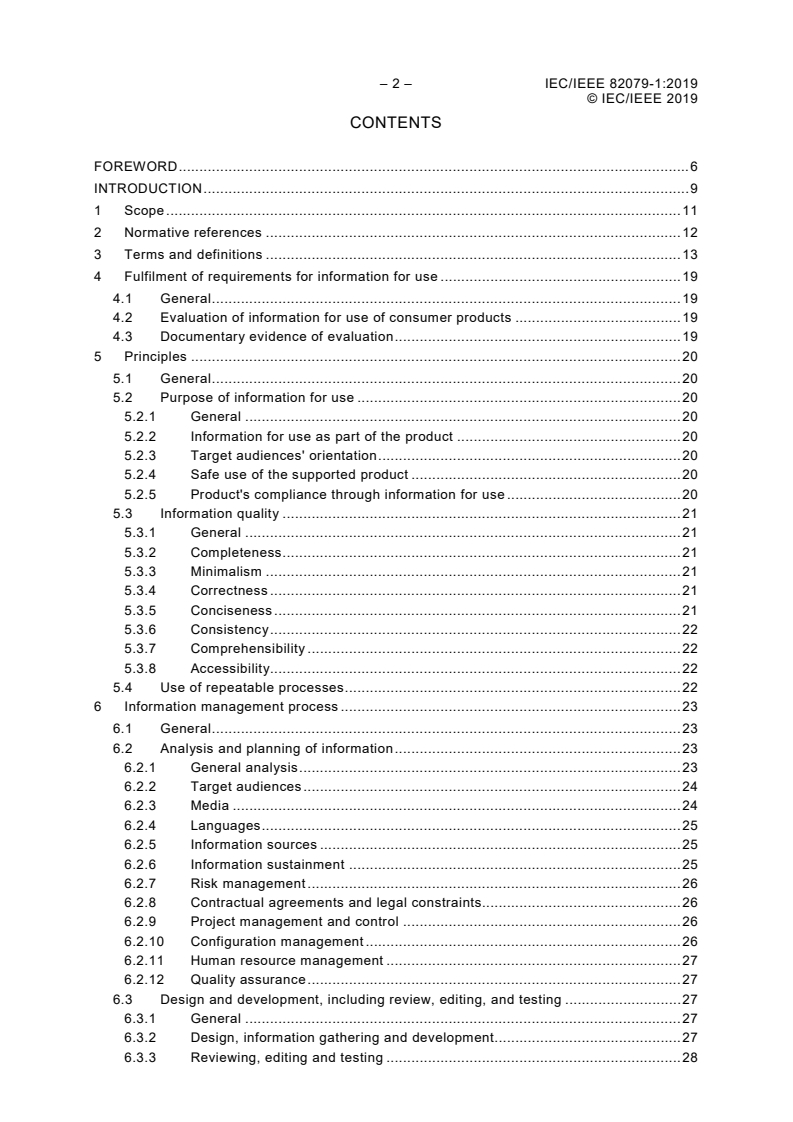
– 2 – IEC/IEEE 82079-1:2019
© IEC/IEEE 2019
CONTENTS
FOREWORD . 6
INTRODUCTION . 9
1 Scope . 11
2 Normative references . 12
3 Terms and definitions . 13
4 Fulfilment of requirements for information for use . 19
4.1 General . 19
4.2 Evaluation of information for use of consumer products . 19
4.3 Documentary evidence of evaluation . 19
5 Principles . 20
5.1 General . 20
5.2 Purpose of information for use . 20
5.2.1 General . 20
5.2.2 Information for use as part of the product . 20
5.2.3 Target audiences' orientation . 20
5.2.4 Safe use of the supported product . 20
5.2.5 Product's compliance through information for use . 20
5.3 Information quality . 21
5.3.1 General . 21
5.3.2 Completeness . 21
5.3.3 Minimalism . 21
5.3.4 Correctness . 21
5.3.5 Conciseness . 21
5.3.6 Consistency . 22
5.3.7 Comprehensibility . 22
5.3.8 Accessibility. 22
5.4 Use of repeatable processes . 22
6 Information management process . 23
6.1 General . 23
6.2 Analysis and planning of information . 23
6.2.1 General analysis . 23
6.2.2 Target audiences . 24
6.2.3 Media . 24
6.2.4 Languages . 25
6.2.5 Information sources . 25
6.2.6 Information sustainment . 25
6.2.7 Risk management . 26
6.2.8 Contractual agreements and legal constraints. 26
6.2.9 Project management and control . 26
6.2.10 Configuration management . 26
6.2.11 Human resource management . 27
6.2.12 Quality assurance . 27
6.3 Design and development, including review, editing, and testing . 27
6.3.1 General . 27
6.3.2 Design, information gathering and development. 27
6.3.3 Reviewing, editing and testing . 28
© IEC/IEEE 2019
6.4 Production and distribution. 29
6.5 Sustainment, maintenance and improvement . 29
7 Content of information for use . 29
7.1 General . 29
7.2 Identifiers . 30
7.2.1 Identification of information for use . 30
7.2.2 Identification of the supported product . 30
7.2.3 Identification of the supplier . 30
7.3 Importance of retaining printed information for use . 30
7.4 Presentational conventions . 31
7.5 Terminology . 31
7.6 Acronyms, abbreviations and technical terms . 31
7.7 Explanation of safety signs, graphical symbols and markings . 31
7.8 Product description . 32
7.8.1 General description . 32
7.8.2 Visualization . 32
7.8.3 Specifications . 32
7.9 Supplied accessories, consumables and spare parts. 32
7.9.1 Accessories supplied with the product . 32
7.9.2 Consumables . 33
7.9.3 Spare parts . 33
7.10 Information for use needed during the lifetime of the supported product . 33
7.10.1 General . 33
7.10.2 Re-packaging of the supported product . 33
7.10.3 Transportation and storage of the supported product . 33
7.10.4 Installation of the supported product . 34
7.10.5 Commissioning of the supported product . 34
7.10.6 Modification of the supported product . 34
7.10.7 Operation of the supported product . 34
7.10.8 Indications of faults and warning device signals of the supported
product . 35
7.10.9 Meanings of signals of the supported product . 36
7.10.10 Maintenance of the supported product by non-skilled and skilled
persons . 36
7.10.11 Maintenance of complex systems . 36
7.10.12 Troubleshooting and repair of the supported product by non-skilled and
skilled persons. 37
7.10.13 Replacement of parts of the supported product by non-skilled and
skilled persons. 38
7.10.14 Disassembly, recycling, disposal of the supported product . 38
7.11 Safety-related information . 39
7.11.1 Types of safety-related information . 39
7.11.2 Location of safety-related information . 39
7.11.3 Precautions for particular target audiences . 39
7.11.4 Safety notes . 40
7.11.5 Warning messages . 40
7.11.6 Safety-related information in quick-start guides . 41
7.12 Instructions for assembly of self-assembly products . 41
7.13 Information for use for a complex system . 42
7.14 Information security and data privacy . 42
– 4 – IEC/IEEE 82079-1:2019
© IEC/IEEE 2019
7.14.1 General . 42
7.14.2 Functions for access control or protection of sensitive data . 42
7.15 Training . 43
8 Structure of information for use . 43
8.1 General . 43
8.2 Information types . 43
8.3 Structuring . 44
8.3.1 General . 44
8.3.2 Use of information models . 44
8.3.3 Use of leading criteria . 44
8.3.4 Detailed structure of step-by-step instructions . 45
8.4 Navigation and information delivery . 46
8.4.1 General . 46
8.4.2 Navigating printed information for use . 46
8.4.3 Dynamic delivery . 46
9 Media and format of information for use . 47
9.1 General . 47
9.2 Durability of chosen media . 48
9.3 Use of animation or audio-visual demonstrations . 48
9.4 Location and availability . 48
9.5 Printable information . 48
9.6 User interaction and search features . 49
9.7 Downloadable information for use . 49
9.8 Suitability for the conditions of use of the supported product . 49
9.9 Consistency of format . 49
9.10 Legibility, readability and comprehensibility . 50
9.10.1 Text font sizes and heights of safety signs and graphical symbols . 50
9.10.2 Maximum brightness contrast . 52
9.10.3 Information for use provided on the supported product or packaging . 52
9.10.4 Minimum heights of safety signs and graphical symbols . 52
9.10.5 Rules for simple wording . 52
9.10.6 Function of information sections . 52
9.11 Use of visualization . 52
9.11.1 Graphical symbols and safety signs . 52
9.11.2 Illustrations . 53
9.11.3 Information content of illustrations . 53
9.11.4 Illustration with captions . 53
9.12 Use of tables. 53
9.13 Use of colours . 53
9.14 Use of icons . 53
9.15 Attracting attention to safety-related information . 54
9.15.1 General . 54
9.15.2 Durability and visibility . 54
10 Professional competencies . 54
10.1 General . 54
10.2 Task-related competencies . 54
10.3 Level of proficiency . 55
10.3.1 General . 55
10.3.2 Proficiency level 1 . 55
© IEC/IEEE 2019
10.3.3 Proficiency level 2 . 55
10.3.4 Proficiency level 3 . 56
10.4 Competencies of translators. 56
Annex A (informative) Guidance on evaluation . 57
A.1 General . 57
A.2 Assessing fulfillment of requirements for information for use supporting a
particular product . 57
A.2.1 Comprehensiveness check . 57
A.2.2 Inspection for effectiveness (desk check) . 57
A.2.3 Empirical effectiveness check . 57
A.2.4 Useful additional checks . 58
A.3 Evaluating the fulfilment of requirements for an information management
process . 58
A.3.1 Process evaluation . 58
A.3.2 Competency evaluation . 58
A.4 Guidance on conducting an evaluation . 58
A.4.1 Result of the evaluation and corrective actions . 58
A.4.2 Evaluation of similar information for use (conferrable evaluations) . 59
Bibliography . 60
Figure 1 – Concept of information for use . 9
Figure 2 – Examples for notice to retain information . 31
Table 1 – Examples of empirical methods . 28
Table 2 – Structuring principles . 45
Table 3 – Examples of considerations for the choice of media . 49
Table 4 – Minimum recommended text font sizes and heights of safety signs and
graphical symbols . 51
– 6 – IEC/IEEE 82079-1:2019
© IEC/IEEE 2019
INTERNATIONAL ELECTROTECHNICAL COMMISSION
____________
PREPARATION OF INFORMATION FOR USE
(INSTRUCTIONS FOR USE) OF PRODUCTS –
Part 1: Principles and general requirements
FOREWORD
1) The International Electrotechnical Commission (IEC) is a worldwide organization for standardization comprising
all national electrotechnical committees (IEC National Committees). The object of IEC is to promote
international co-operation on all questions concerning standardization in the electrical and electronic fields. To
this end and in addition to other activities, IEC publishes International Standards, Technical Specifications,
Technical Reports, Publicly Available Specifications (PAS) and Guides (hereafter referred to as "IEC
Publication(s)"). Their preparation is entrusted to technical committees; any IEC National Committee interested
in the subject dealt with may participate in this preparatory work. International, governmental and non-
governmental organizations liaising with the IEC also participate in this preparation.
IEEE Standards documents are developed within IEEE Societies and Standards Coordinating Committees of the
IEEE Standards Association (IEEE-SA) Standards Board. IEEE develops its standards through a consensus
development process, which brings together volunteers representing varied viewpoints and interests to achieve
the final product. Volunteers are not necessarily members of IEEE and serve without compensation. While IEEE
administers the process and establishes rules to promote fairness in the consensus development process, IEEE
does not independently evaluate, test, or verify the accuracy of any of the information contained in its
standards. Use of IEEE Standards documents is wholly voluntary. IEEE documents are made available for use
subject to important notices and legal disclaimers (see http://standards.ieee.org/IPR/disclaimers.html for more
information).
IEC collaborates closely with IEEE in accordance with conditions determined by agreement between the two
organizations.
2) The formal decisions of IEC on technical matters express, as nearly as possible, an international consensus of
opinion on the relevant subjects since each technical committee has representation from all interested IEC
National Committees. The formal decisions of IEEE on technical matters, once consensus within IEEE Societies
and Standards Coordinating Committees has been reached, is determined by a balanced ballot of materially
interested parties who indicate interest in reviewing the proposed standard. Final approval of the IEEE
standards document is given by the IEEE Standards Association (IEEE-SA) Standards Board.
3) IEC/IEEE Publications have the form of recommendations for international use and are accepted by IEC
National Committees/IEEE Societies in that sense. While all reasonable efforts are made to ensure that the
technical content of IEC/IEEE Publications is accurate, IEC or IEEE cannot be held responsible for the way in
which they are used or for any misinterpretation by any end user.
4) In order to promote international uniformity, IEC National Committees undertake to apply IEC Publications
(including IEC/IEEE Publications) transparently to the maximum extent possible in their national and regional
publications. Any divergence between any IEC/IEEE Publication and the corresponding national or regional
publication shall be clearly indicated in the latter.
5) IEC and IEEE do not provide any attestation of conformity. Independent certification bodies provide conformity
assessment services and, in some areas, access to IEC marks of conformity. IEC and IEEE are not responsible
for any services carried out by independent certification bodies.
6) All users should ensure that they have the latest edition of this publication.
7) No liability shall attach to IEC or IEEE or their directors, employees, servants or agents including individual
experts and members of technical committees and IEC National Committees, or volunteers of IEEE Societies
and the Standards Coordinating Committees of the IEEE Standards Association (IEEE-SA) Standards Board,
for any personal injury, property damage or other damage of any nature whatsoever, whether direct or indirect,
or for costs (including legal fees) and expenses arising out of the publication, use of, or reliance upon, this
IEC/IEEE Publication or any other IEC or IEEE Publications.
8) Attention is drawn to the normative references cited in this publication. Use of the referenced publications is
indispensable for the correct application of this publication.
9) Attention is drawn to the possibility that implementation of this IEC/IEEE Publication may require use of
material covered by patent rights. By publication of this standard, no position is taken with respect to the
existence or validity of any patent rights in connection therewith. IEC or IEEE shall not be held responsible for
identifying Essential Patent Claims for which a license may be required, for conducting inquiries into the legal
validity or scope of Patent Claims or determining whether any licensing terms or conditions provided in
connection with submission of a Letter of Assurance, if any, or in any licensing agreements are reasonable or
non-discriminatory. Users of this standard are expressly advised that determination of the validity of any patent
rights, and the risk of infringement of such rights, is entirely their own responsibility.
© IEC/IEEE 2019
International Standard IEC/IEEE 82079-1 has been prepared by IEC technical committee 3:
Information structures and elements, identification and marking principles, documentation and
graphical symbols, in cooperation with the Computer Society, Systems and Software
Engineering Standards Committee of the IEEE, under the IEC/IEEE Dual Logo Agreement and
in cooperation with subcommittee 1: Basic conventions of ISO technical committee 10:
Technical product documentation.
It is published as an IEC/ISO/IEEE triple logo standard.
It has the status of a horizontal standard in accordance with IEC Guide 108 [59].
This second edition cancels and replaces the first edition published in 2012. This edition
constitutes a technical revision.
This edition includes the following significant technical changes with respect to the previous
edition:
a) The structure of this document has been rearranged in order to facilitate application of the
standard and to make it easier to find information. Where possible, the language has been
simplified.
b) Information for use is introduced as a generic term. Instructions for use is a synonym for
information for use. Step-by-step instructions is used as a subset of information for use.
c) Clause 5 (principles) is revised and focuses on the purpose of information for use, the
quality of information and the process for management of information.
d) The process for preparation of information for use is integrated in the normative part and
addressed comprehensively.
e) Empirical methods for the evaluation of information for use are described in the normative
part.
f) The professional competencies needed for the preparation of information for use are
addressed more comprehensively.
g) Some aspects have been added to general requirements for information for use for
complex systems of systems.
h) Consideration is given to instructions for self-assembly products.
i) An informative annex providing guidance on the fulfilment of specified requirements is
introduced.
The text of this International Standard is based on the following IEC documents:
FDIS Report on voting
3/1390/FDIS 3/1401/RVD
Full information on the voting for the approval of this International Standard can be found in
the report on voting indicated in the above table.
International Standards are drafted in accordance with the rules given in the ISO/IEC
Directives, Part 2.
A list of all parts of the 82079 International Standard, published under the general title
Preparation of information for use (instructions for use) of products, can be found on the IEC
website.
– 8 – IEC/IEEE 82079-1:2019
© IEC/IEEE 2019
The committee has decided that the contents of this document will remain unchanged until the
stability date indicated on the IEC website under "http://webstore.iec.ch" in the data related to
the specific document. At this date, the document will be
• reconfirmed,
• withdrawn,
• replaced by a revised edition, or
• amended.
IMPORTANT – The 'colour inside' logo on the cover page of this publication indicates
that it contains colours which are considered to be useful for the correct
understanding of its contents. Users should therefore print this document using a
colour printer.
© IEC/IEEE 2019
INTRODUCTION
Information for use is a part of any type of product it supports. A product can be a system, a
service, goods, software, information, or a combination thereof. People depend on the
information provided to use products safely, effectively, and efficiently, unless they receive
training from a human instructor or unless the functions are entirely intuitive. Confusing
product information and inadequate instructions are major sources of frustration for
consumers and skilled workers. Defective information can pose a risk of harm or loss, leading
to prosecution or liability claims against the supplier or brand owner.
Information for use consists of three information types: conceptual information that the target
audience needs to understand, instructional information to be followed or considered, and
reference information to be consulted when needed. The information for use can include
various information products that are selected, presented, and delivered on different media to
meet the needs of different target audiences (Figure 1).
Figure 1 – Concept of information for use
Some product-specific information requirements (e.g. the wording of warnings or positioning
of labels) are specified in standards for individual types or classes of products, but these do
not provide a complete set of requirements for information for use. This document gives
principles and general requirements for conveying information to users that are as applicable
to complex and safety-critical systems (e.g. industrial plants), as they are to simple consumer
products (e.g. a can of paint), to software, and to specialized testing equipment. Information
for use is needed for anyone (skilled and unskilled) who encounters a product for the first
time: whether to assemble from a kit, install, operate, maintain, or dispose of it.
The principles for preparing information for use of products are horizontally applicable across
product sectors because all target audiences are human and subject to human error. The
techniques found to be most effective to help such audiences to absorb new information are
generally similar, as are their capabilities for misunderstanding language or images. What
– 10 – IEC/IEEE 82079-1:2019
© IEC/IEEE 2019
works best in information gathering and delivery (e.g. in content, wording, graphics, testing,
and management of the whole process) has emerged from experience and practice in the
fields of human factors and technical communication. This document is applicable on its own
or can be referenced in product standards that include requirements to provide the target
audience with information for use, for example, step-by-step instructions or other information
products.
This document is addressed to those who prepare information for use; managers of
organizations that produce or purchase products, systems, or services; human factors
consultants; and product enforcement agencies.
It covers the following aspects:
• information content: conceptual information the target audiences need to understand,
procedures they have to undertake, and the reference information they need to consult at
some point;
• options for information to be provided as a single deliverable (e.g. a product manual) or
across several types of information product, such as labelling on the product itself or
packaging, accompanying electronic files, sheets, a website, booklets, printable files,
videos, or searchable databases;
• effective use of language, text, illustrations, symbols, audio or video to communicate
elements of information;
• processes and competencies involved in establishing content and preparing output; and
• means of assessing the fulfilment of requirements in accordance with this document.
© IEC/IEEE 2019
PREPARATION OF INFORMATION FOR USE
(INSTRUCTIONS FOR USE) OF PRODUCTS –
Part 1: Principles and general requirements
1 Scope
This part of 82079 International Standard provides principles and general requirements for
information for the use of products.
Information for use is:
• necessary for the safe use of a product;
• helpful for the efficient and effective use of a product; and
• often necessary to fulfil market, legal, and regulatory obligations.
Products include, for example:
• industrial products (e.g. machinery, components, devices, and equipment);
• consumer products (e.g. household appliances, audio-visual devices, communication
devices, and do-it-yourself products);
• medical devices, equipment and systems;
• complex systems of systems (e.g. industrial plants, refineries, production sites, and data
centres);
• means of transport (e.g. cars, trucks, ships, and airplanes);
• application software (e.g. office software and web applications);
• software for operation and automatic control of systems; and
• technical services.
Information for use of products applies to phases of the product life cycle such as transport,
assembly, installation, commissioning, operation, monitoring, troubleshooting, maintenance,
repair, decommissioning, and disposal, and the appropriate tasks performed by skilled and
unskilled persons.
This document provides the common and fundamental aspects serving as the binding and
generic framework for prospective additional parts of this document.
This document applies to information for use whether provided as electronic or printed
information products, for example:
• service information for machinery, provided as PDF file for web download for trained
service technicians;
• information for operation of software, provided electronically with the software as an online
help;
• troubleshooting information for an operator, on a machine's on-screen display;
• functional description of a medical device on a website;
• information for assembly, printed and provided in the packaging of a piece of furniture for
consumers;
• printed information for maintenance for an automatic coffee machine;
– 12 – IEC/IEEE 82079-1:2019
© IEC/IEEE 2019
• installation planning information for a safety sensor, downloadable from a website for
mechanical engineers;
• product tutorial as a web-based training aid;
• materials for product on-site training; and
• label for transportation personnel, printed on the packaging of a heavy containment
vessel.
This document is intended for use by all parties responsible for or involved in the
conceptualization, creation, maintenance, translation, localization, integration of content,
production, provision and evaluation, acquisition and supply of information for use.
The parties concerned with information for use include the following:
• acquirers and suppliers of products;
• managers with process or product responsibilities;
• content owners and content creators such as technical writers, information developers,
and illustrators;
• technical translators, localization and terminology experts; and
• authorities, agencies and authorized experts.
The aim of this document is to provide these parties with the common and fundamental basis
for developing information for use of supported products of the required quality.
This document is intended to be applied and referenced in product-specific standards,
including those that specify the content of information for use of those products, for example,
IEC 60335 for all parts for household electrical products, ISO 20607* for machinery, and
ISO/IEC 26514 for systems and software. It is intended as a basis to elaborate
product-specific requirements for target audiences or product information.
* Under preparation. Stage at the time of publication: ISO/DIS 20607:2018.
This horizontal standard is primarily intended for use by technical committees in the
preparation of standards in accordance with the principles laid down in IEC Guide 108.
One of the responsibilities of a technical committee is, wherever applicable, to make use of
horizontal standards in the preparation of its publications. The contents of this horizontal
standard will not apply unless specifically referred to or included in the relevant publications.
2 Normative references
The following documents are referred to in the text in such a way that some or all of their
content constitutes requirements of this document. For dated references, only the edition
cited applies. For undated references, the latest edition of the referenced document (including
any amendments) applies.
IEC 60417, Graphical symbols for use on equipment (available at http://www.graphical-
symbols.info/equipment)
IEC 60617, Graphical symbols for diagrams (available at http://std.iec.ch/iec60617)
IEC 60825-1, Safety of laser products – Part 1: Equipment classification and requirements
ISO 3864 (all parts), Graphical symbols – Safety colours and safety signs
© IEC/IEEE 2019
ISO 5807, Information processing – Documentation symbols and conventions for data,
program and system flowcharts, program network charts and system resources charts
ISO 7000, Graphical symbols for use on equipment (available at http://www.graphical-
symbols.info/equipment)
ISO 7010:2011, Graphical symbols – Safety colours and safety signs – Registered safety
signs
ISO 9241-300, Ergonomics of human-system interaction – Part 300: Introduction to electronic
visual display requirements
ISO 14617 (all parts), Graphical symbols for diagrams
3 Terms and definitions
For the purposes of this document, the following terms and definitions apply.
IEC, ISO, and IEEE maintain terminological databases for use in standardization at the
following addresses:
• IEC Electropedia: available at http://www.electropedia.org/
• ISO Online browsing platform: available at http://www.iso.org/obp
• IEEE Standards Dictionary Online: available at
http://ieeexplore.ieee.or
...