

ISO TS 25558:2026
(Main)Ageing societies - Guidance for enhancing safety and usability of smart home products, services, and systems for older persons in smart home environment
General Information
- Abstract
ISO TS 25558:2026 This document provides guidance for enhancing safety and usability aspects of smart home products, services, and systems to enable older persons to live the healthy lives they desire. It presents a process to assess the needs of older persons who use smart products, services, and systems in the smart home, the general living space of the future society, to select, apply, and evaluate appropriate smart home products, services, and systems.
This document addresses older persons’ safety and usability needs as their health conditions and lifestyles change. It applies to designers, developers, and providers of smart homes for older persons and products, services, and systems in smart homes.
- Status
- Published
- Publication Date
- 09-Feb-2026
- Technical Committee
- SyC AAL - Active Assisted Living
- Current Stage
- PPUB - Publication issued
- Start Date
- 16-Feb-2026
- Completion Date
- 30-Mar-2026
Overview
ISO TS 25558:2026 – developed by the International Organization for Standardization (ISO) in partnership with the International Electrotechnical Commission (IEC) – provides essential guidance for enhancing the safety and usability of smart home products, services, and systems tailored for older persons. As the global population ages, many older individuals express a strong desire to age in place, maintaining independence and a high quality of life within their homes and communities. Smart home environments, powered by advances in information and communication technology (ICT), are a key driver of independence, comfort, and well-being for ageing societies. ISO TS 25558:2026 supports designers, developers, and providers by presenting a comprehensive framework for assessing user needs, selecting, applying, and evaluating appropriate smart home solutions for older people whose physical, psychological, and lifestyle needs may change over time.
Key Topics
Assessment of older persons’ needs: The standard introduces a process for identifying and evaluating physical, psychological, and social changes that influence the use of smart home technologies.
Safety enhancement: Focuses on minimizing hazards and supporting freedom from unacceptable risk, particularly relevant considering age-related physical and cognitive decline.
Usability improvement: Emphasizes ensuring smart home products and systems are effective, efficient, and satisfying for older users, addressing issues of accessibility and cognitive load.
Personalization and self-determination: Highlights the importance of recognizing the individual needs, preferences, and autonomy of older persons in technology adoption.
Privacy and security: Stresses the need for informed consent and the protection of personal data when implementing smart technologies in older adults' homes.
Interoperability and ethical considerations: Encourages seamless integration of different smart home devices and services while addressing ethical aspects such as digital equity and accessibility.
Applications
ISO TS 25558:2026 is designed for a wide range of stakeholders involved in the smart home sector, especially where older users are concerned. Key application areas include:
Product design and development: Guides manufacturers and developers in creating smart home devices-such as sensors, alarms, communication tools, and appliances-that are safer, more user-friendly, and adaptable to various abilities and preferences.
Service provision: Assists smart home service providers and care organizations in tailoring offerings that enhance independent living, monitoring, and health management for older persons.
System integration: Enables integrators and installers to select and combine technologies that maximize usability and minimize barriers related to vision, hearing, mobility, cognition, or digital literacy.
Policy and program development: Inform governments, healthcare bodies, and NGOs on best practices for supporting ageing in place using smart home solutions, consistent with international principles of independence, participation, care, and self-fulfilment.
User and carer education: Provides a baseline for educating older adults and their carers about the potential and safe use of smart home technology.
Related Standards
Integration and application of ISO TS 25558:2026 can be supported by other related standards, including:
- ISO 9241-11 – Guidance on usability and user experience.
- ISO/IEC Guide 71 – Guidelines for addressing accessibility in standards.
- IEC 60050-871 – International Electrotechnical Vocabulary on active assisted living and daily activities.
- ISO 22287 – Concepts related to product safety management.
- ISO 25551 – Requirements and frameworks for the smart community infrastructure in ageing societies.
- WHO’s International Classification of Functioning, Disability, and Health (ICF): Used as a framework for understanding health and functional status in this context.
By following ISO TS 25558:2026, organizations contribute to more inclusive, supportive, and safe living environments for older people, addressing the unique challenges they face and fostering greater adoption of smart home solutions in ageing societies. This not only supports healthy, independent living but also aligns with global best practices for usability, safety, and digital equity in smart homes.
Get Certified
Connect with accredited certification bodies for this standard

BSI Group
BSI (British Standards Institution) is the business standards company that helps organizations make excellence a habit.

TÜV Rheinland
TÜV Rheinland is a leading international provider of technical services.

TÜV SÜD
TÜV SÜD is a trusted partner of choice for safety, security and sustainability solutions.
Sponsored listings
Frequently Asked Questions
ISO TS 25558:2026 is a technical specification published by the International Electrotechnical Commission (IEC). Its full title is "Ageing societies - Guidance for enhancing safety and usability of smart home products, services, and systems for older persons in smart home environment". This standard covers: ISO TS 25558:2026 This document provides guidance for enhancing safety and usability aspects of smart home products, services, and systems to enable older persons to live the healthy lives they desire. It presents a process to assess the needs of older persons who use smart products, services, and systems in the smart home, the general living space of the future society, to select, apply, and evaluate appropriate smart home products, services, and systems. This document addresses older persons’ safety and usability needs as their health conditions and lifestyles change. It applies to designers, developers, and providers of smart homes for older persons and products, services, and systems in smart homes.
ISO TS 25558:2026 This document provides guidance for enhancing safety and usability aspects of smart home products, services, and systems to enable older persons to live the healthy lives they desire. It presents a process to assess the needs of older persons who use smart products, services, and systems in the smart home, the general living space of the future society, to select, apply, and evaluate appropriate smart home products, services, and systems. This document addresses older persons’ safety and usability needs as their health conditions and lifestyles change. It applies to designers, developers, and providers of smart homes for older persons and products, services, and systems in smart homes.
ISO TS 25558:2026 is classified under the following ICS (International Classification for Standards) categories: 11.020.10 - Health care services in general; 11.180.01 - Aids for disabled and handicapped persons in general; 35.240.95 - Internet applications. The ICS classification helps identify the subject area and facilitates finding related standards.
ISO TS 25558:2026 is available in PDF format for immediate download after purchase. The document can be added to your cart and obtained through the secure checkout process. Digital delivery ensures instant access to the complete standard document.
Standards Content (Sample)
Technical
Specification
ISO/TS 25558
First edition
Ageing societies — Guidance for
2026-02
enhancing safety and usability of
smart home products, services, and
systems for older persons in smart
home environment
Vieillissement de la population — Recommandations pour
l'amélioration de la sécurité et de l'aptitude à l'emploi des
produits, des services et des systèmes pour maisons intelligentes
destinés aux personnes âgées dans un environnement de maison
intelligente
Reference number
ISO/TS 25558:2026(en) © ISO 2026
ISO/TS 25558:2026(en)
© ISO 2026
All rights reserved. Unless otherwise specified, or required in the context of its implementation, no part of this publication may
be reproduced or utilized otherwise in any form or by any means, electronic or mechanical, including photocopying, or posting on
the internet or an intranet, without prior written permission. Permission can be requested from either ISO at the address below
or ISO’s member body in the country of the requester.
ISO copyright office
CP 401 • Ch. de Blandonnet 8
CH-1214 Vernier, Geneva
Phone: +41 22 749 01 11
Email: copyright@iso.org
Website: www.iso.org
Published in Switzerland
ii
ISO/TS 25558:2026(en)
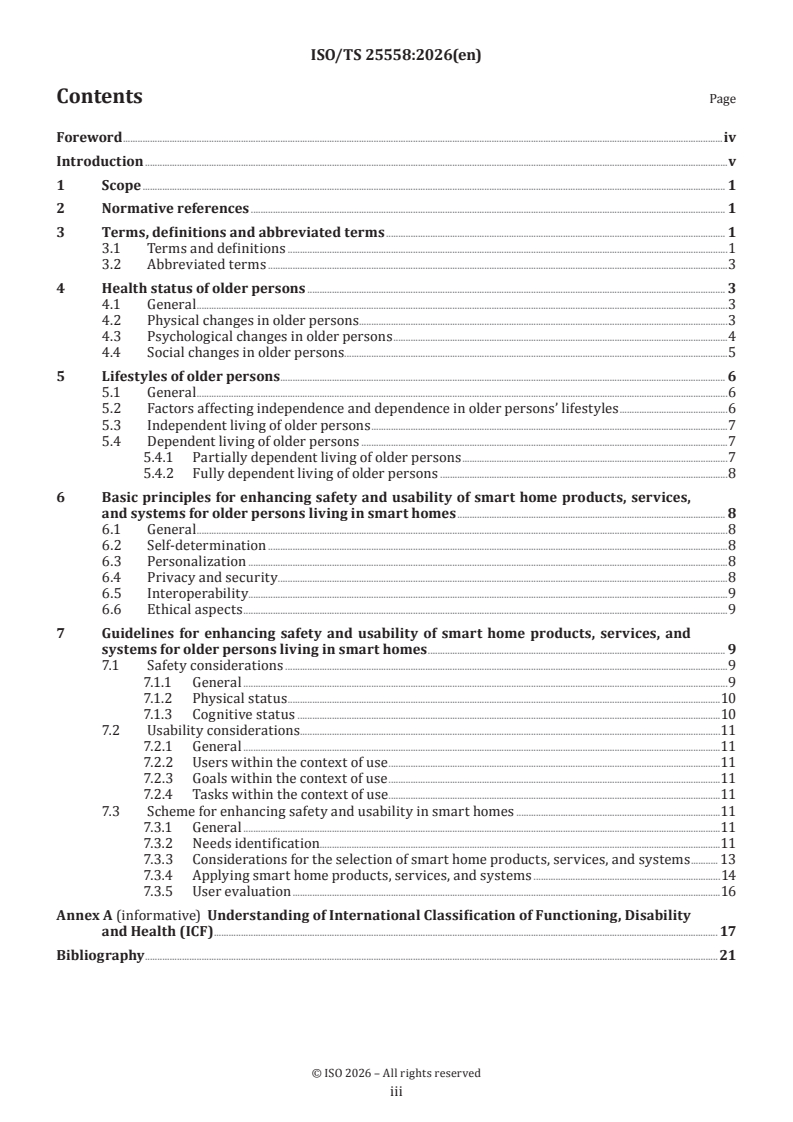
Contents Page
Foreword .iv
Introduction .v
1 Scope . 1
2 Normative references . 1
3 Terms, definitions and abbreviated terms . 1
3.1 Terms and definitions .1
3.2 Abbreviated terms .3
4 Health status of older persons . 3
4.1 General .3
4.2 Physical changes in older persons.3
4.3 Psychological changes in older persons .4
4.4 Social changes in older persons.5
5 Lifestyles of older persons . 6
5.1 General .6
5.2 Factors affecting independence and dependence in older persons’ lifestyles .6
5.3 Independent living of older persons .7
5.4 Dependent living of older persons .7
5.4.1 Partially dependent living of older persons .7
5.4.2 Fully dependent living of older persons .8
6 Basic principles for enhancing safety and usability of smart home products, services,
and systems for older persons living in smart homes . 8
6.1 General .8
6.2 Self-determination .8
6.3 Personalization .8
6.4 Privacy and security .8
6.5 Interoperability.9
6.6 Ethical aspects .9
7 Guidelines for enhancing safety and usability of smart home products, services, and
systems for older persons living in smart homes . 9
7.1 Safety considerations .9
7.1.1 General .9
7.1.2 Physical status .10
7.1.3 Cognitive status .10
7.2 Usability considerations.11
7.2.1 General .11
7.2.2 Users within the context of use .11
7.2.3 Goals within the context of use .11
7.2.4 Tasks within the context of use .11
7.3 Scheme for enhancing safety and usability in smart homes .11
7.3.1 General .11
7.3.2 Needs identification.11
7.3.3 Considerations for the selection of smart home products, services, and systems . 13
7.3.4 Applying smart home products, services, and systems .14
7.3.5 User evaluation .16
Annex A (informative) Understanding of International Classification of Functioning, Disability
and Health (ICF) . 17
Bibliography .21
iii
ISO/TS 25558:2026(en)
Foreword
ISO (the International Organization for Standardization) is a worldwide federation of national standards
bodies (ISO member bodies). The work of preparing International Standards is normally carried out through
ISO technical committees. Each member body interested in a subject for which a technical committee
has been established has the right to be represented on that committee. International organizations,
governmental and non-governmental, in liaison with ISO, also take part in the work. ISO collaborates closely
with the International Electrotechnical Commission (IEC) on all matters of electrotechnical standardization.
The procedures used to develop this document and those intended for its further maintenance are described
in the ISO/IEC Directives, Part 1. In particular, the different approval criteria needed for the different types
of ISO documents should be noted. This document was drafted in accordance with the editorial rules of the
ISO/IEC Directives, Part 2 (see www.iso.org/directives).
ISO draws attention to the possibility that the implementation of this document may involve the use of (a)
patent(s). ISO takes no position concerning the evidence, validity or applicability of any claimed patent
rights in respect thereof. As of the date of publication of this document, ISO had not received notice of (a)
patent(s) which may be required to implement this document. However, implementers are cautioned that
this may not represent the latest information, which may be obtained from the patent database available at
www.iso.org/patents. ISO shall not be held responsible for identifying any or all such patent rights.
Any trade name used in this document is information given for the convenience of users and does not
constitute an endorsement.
For an explanation of the voluntary nature of standards, the meaning of ISO specific terms and expressions
related to conformity assessment, as well as information about ISO’s adherence to the World Trade
Organization (WTO) principles in the Technical Barriers to Trade (TBT), see www.iso.org/iso/foreword.html.
This document was prepared jointly by Technical Committee ISO/TC 314, Ageing societies, and Technical
Committee IEC/SyC AAL, Active Assisted Living.
Any feedback or questions on this document should be directed to the user’s national standards body. A
complete listing of these bodies can be found at www.iso.org/members.html.
iv
ISO/TS 25558:2026(en)
Introduction
[1]
According to World Population Prospects 2024 , the world population is expected to grow from 8,2 billion
in 2024 to 10,3 billion in the mid-2080s. The report shows that the share of the world’s population aged 65
and over has nearly doubled in the last 50 years (1974 to 2024), from 5,5 % to 10,3 %, and is expected to
double again in the next 50 years (2024 to 2074), to 20,7 %. In addition, the number of people aged 80 and
over is expected to triple during the same period.
The economic growth of modern society and recent developments in medicine, public health, and medical
technologies have led to an increase in life expectancy and an upward trend in the global ageing population.
Virtually every country in the world is experiencing growth in the number and proportion of older persons
in their population. Although the situation varies from country to country, many countries that are already
at an advanced stage of population ageing are preparing and implementing policies and measures to address
the challenges and opportunities of an ageing society.
[2]
The United Nations Principles for Older Persons encourage countries to incorporate the principles of
independence, participation, care, dignity, and self-fulfilment into their national programmes for older
persons. Reflecting these societal needs and the desires of older persons, the direction of policies in
countries preparing for an ageing society also focuses on how to implement these policies and programmes.
The orientation to life in an ageing society is being explained in concepts such as “ageing in place” [CDC
(Centre for Disease Control and Prevention)], “active ageing” [(European Commission, WHO (World Health
Organization)], and “Healthy ageing” [PAHO (Pan American Health Organization), WHO].
The concept of ageing in place has gained significant attention in the context of global population ageing.
Most older persons wish to age in place as long as possible as it fosters a sense of identity, independence,
and connectedness. Ageing in place means having access to services and the health and social support older
persons need to live safely and independently in their homes or communities. Policies and programmes that
support ageing in place have emerged as priorities in many countries.
The rapid development of information and communication technology (ICT) is highly promising in fostering
active and healthy ageing. Smart homes with several assistive technologies provide various benefits for
older adults and their carers who want to live independently in the comfort of their homes and improve their
quality of life (QoL).
The variety of devices that now populate the smart home − smart speakers and voice assistants, smart
thermostats, smart lighting systems, smart appliances, smart security systems, wearable devices, smart
TVs, entertainment systems, and more − is becoming part of day-to-day life. The COVID-19 pandemic has
led to an increased use of technology in consumers’ homes and continues to shape the attitude of older
adults towards their use of technology and their interest in aging in place. The use of these smart devices is
becoming more common due in part to the health conditions of older persons, and it is expected that older
persons can improve their QoL by gradually adapting to a smart home environment. While older persons
and their carers recognize the potential value of smart home technology, there are concerns about adopting
and accepting it.
This document provides guidance on considering the safety and usability of smart home products, services,
and systems as an important step in helping older persons and their carers use smart home devices
effectively, efficiently, and satisfactorily. The needs, interests, and experiences of older persons and their
carers need to be considered when developing products, services, and environments for smart home
technology used by older persons.
In addition to the guidance provided in this document, it is important to understand that there are also
ethical and equity concerns with smart home technology for older persons, including data and privacy
protection, access, affordability, social isolation, digital literacy, cognitive abilities, and cultural differences.
Older persons are by no means the only group affected by digital exclusion – for example, people living with
disabilities, people on low incomes, people with long-term health conditions, and those living in rural or
remote areas face barriers in a digital world. While these issues are beyond the scope of this document,
other standards, policies, and programmes established to support the implementation of the “ageing in
place” strategy will be part of integrated solutions.
v
Technical Specification ISO/TS 25558:2026(en)
Ageing societies — Guidance for enhancing safety and
usability of smart home products, services, and systems for
older persons in smart home environment
1 Scope
This document provides guidance for enhancing safety and usability aspects of smart home products,
services, and systems to enable older persons to live the healthy lives they desire. It presents a process to
assess the needs of older persons who use smart products, services, and systems in the smart home, the
general living space of the future society, to select, apply, and evaluate appropriate smart home products,
services, and systems.
This document addresses older persons’ safety and usability needs as their health conditions and lifestyles
change. It applies to designers, developers, and providers of smart homes for older persons and products,
services, and systems in smart homes.
2 Normative references
There are no normative references in this document.
3 Terms, definitions and abbreviated terms
For the purposes of this document, the following terms and definitions apply.
ISO and IEC maintain terminology databases for use in standardization at the following addresses:
— ISO Online browsing platform: available at https://www.iso.org/obp
— IEC Electropedia: available at https://www.electropedia.org/
3.1 Terms and definitions
3.1.1
smart home
residence equipped with a smart electrical installation
[SOURCE: IEC 60050-617:2009, 617-04-29]
3.1.2
smart home product
tangible devices and appliances that are digitally interconnected and provide a level of automation to
provide enhanced services to household residents
Note 1 to entry: Adapted from Reference [17].
3.1.3
safety
freedom from unacceptable risk
[SOURCE: ISO 22287:2024, 3.15]
ISO/TS 25558:2026(en)
3.1.4
usability
extent to which a product can be used by specified users to achieve specified goals with effectiveness,
efficiency, and satisfaction in a specified context of use
[SOURCE: ISO/IEC Guide 71:2014, 2.12]
3.1.5
activity of daily living
ADL
basic human action that involves physical self-maintenance ability
Note 1 to entry: ADL comprises the following six areas: transferring; bathing; eating; dressing; continence; grooming
and toileting.
[SOURCE: IEC 60050-871:2018/AMD1:2023, 871-01-10]
3.1.6
instrumental activity of daily living
IADL
human action that involves physical/social/cognitive skills related to instruments for independent living in
addition to ADL (3.1.5)
Note 1 to entry: IADL includes various actions: transportation; communication (i.e. use of telephone, e-mails);
shopping; meal preparation; housekeeping; managing medications; managing personal finances.
[SOURCE: IEC 60050-871:2018/AMD1:2023, 871-01-12]
3.1.7
active assisted living
AAL
concepts, products, services, and systems combining technologies and social environment with the aim of
improving the quality of people’s lives
[SOURCE: IEC 60050-871:2018/AMD1:2023, 871-01-02]
3.1.8
AAL level of assistance
designation indicating the degree of assistance needed by an active assisted living (AAL) (3.1.7) care recipient
Note 1 to entry: There are four AAL levels of assistance:
Level 0 – Independent: able to live independently with minimal assistance.
Level 1 – Some assistance: able to live independently but some assistance is needed occasionally (not on a permanent
basis).
Level 2 – Assistance with instrumental activity of daily living (IADL) (3.1.6): level of assistance that involves physical/
social/cognitive skills related to independent living in addition to ADL (3.1.5). This may include transportation,
communication (i.e. use of telephone, e-mails), shopping, meal preparation, housekeeping, managing medications, and
managing personal finances.
Level 3 – Assistance with ADL: level of assistance that includes basic human activities like walking and moving around,
going up a few steps, bathing (plus eating, clothing, continence, grooming).
[SOURCE: IEC 60050-871:2018/AMD1:2023, 871-07-03]
3.1.9
user experience
person’s perceptions and responses resulting from the use and/or anticipated use of a product, system or
service
Note 1 to entry: User experience includes all the users’ emotions, beliefs, preferences, perceptions, physical and
psychological responses, behaviours and accomplishments that occur before, during and after use.
ISO/TS 25558:2026(en)
Note 2 to entry: User experience is a consequence of brand image, presentation, functionality, system performance,
interactive behaviour and assistive capabilities of a system, product or service. It also results from the user's internal
and physical state resulting from prior experiences, attitudes, skills and personality, and the context of use.
[SOURCE: ISO 9241-11:2018, 3.2.3, modified — In Note 1 to entry, “comfort” was changed to “physical and
psychological responses”; Notes 3 and 4 to entry were removed.]
3.1.10
carer
person who cares, unpaid, for a family member, friend or significant person who, due to a lifelong condition,
illness, disability, serious injury, a mental health condition or an addiction, cannot cope without their support
Note 1 to entry: This term includes carers who are generally unpaid but can receive some financial support for care
they provide from time to time. It does not include trained care providers affiliated with home care agencies.
Note 2 to entry: Carers can provide emotional or financial support, as well as hands-on help with different tasks.
Caregiving can also be done from long distance.
Note 3 to entry: The terms “carer”, “family caregiver” and “caregiver” are often used interchangeably. “Carer” is more
commonly used in Europe, UK, New Zealand, and Australia. In North America, “caregiver” or “family caregiver” is
more commonly used. In Asia and Latin America, “carer” more commonly refers to a paid care provider.
[SOURCE: ISO 25551:2021, 3.4, modified — The preferred terms “caregiver” and “family caregiver” were
removed.]
3.2 Abbreviated terms
ICF International Classification of Functioning, Disability, and Health
WHO World Health Organization
IoT Internet of Things
4 Health status of older persons
4.1 General
The health of older persons has physical, psychological, and social aspects, and changes in each of these
factors can have a combined effect on their overall health and the safety and usability of their living
environment.
To enhance interoperability and clarity, this document utilizes the International Classification of
[3]
Functioning, Disability, and Health (ICF) Codes issued by the World Health Organization , which provides
an internationally accepted and standardized method for describing and categorizing functioning and
disability (see Annex A).
4.2 Physical changes in older persons
Older persons can experience various physical changes as they age and their physical capabilities decline.
The following are some areas of the body that could potentially be functionally declined;
— circulatory system;
— nervous system;
— respiratory system;
— digestive system;
— seeing and hearing;
ISO/TS 25558:2026(en)
— sensory, balance, and motor reflex functions.
In addition, older persons can have an increased incidence of disease compared to younger people, and, as
seen in Table 1, various physical symptoms can lead to changes in daily life, such as restrictions on daily life
activities or physical decline.
Table 1 — Physical attributes, symptoms, and ICF reference codes
Attributes Symptoms ICF two-level classification
Low vision, night blindness, poor colour
discrimination, failure to follow doctor’s
Seeing Seeing and related functions (b210-b229)
instructions for eye treatments, cataracts,
glaucoma, etc.
Declined hearing, declined ability to distin-
guish sounds, hearing distance, hearing loss,
Hearing Hearing and vestibular functions (b230-b249)
reduced perception of pitch and intensity of
sounds, etc.
Increased risk of atherosclerosis, high blood Functions of the haematological and
Blood circulation
pressure, stroke, anaemia, etc. immunological systems (b430-b439)
Increased respiratory illness, declined lung
Functions of the respiratory system
Respiratory system capacity, bacterial growth, difficulty breath-
(b440-b449)
ing, etc.
Functions related to the digestive system
Declined digestive capacity, declined diges-
(b510-b539)
Digestive system tive enzyme secretion, slowed bowel move-
ments, etc.
Urinary functions (b610-b639)
Reduced skeletal and muscular strength,
Skeleton / Muscle declined flexibility, declined endurance, de- Muscle functions (b730-b749)
clined reflexes and reaction time, etc.
Changes in posture, loss of height and weight, Changing and maintaining body position
Height / Weight
declined body surface area, etc. (d410-d429)
NOTE 1 Physical changes in older persons correspond to Part 1 (Functioning and Disability) of the ICF, ‘Body Function’ and
‘Activity and Participation’, and the coding system is b (body function) and d (activity and participation).
NOTE 2 Body functions are the physiological functions of body systems, including psychological functions.
NOTE 3 Activity is the execution of a task or action by an individual.
NOTE 4 Participation is involvement in life situations.
NOTE 5 The positive aspects of body functions and structures are integrating functions and structures, and the negative aspects
are impairment and disability.
NOTE 6 Physical changes directly impact the use and functionality of smart home technologies. Flexibility in types of user
interfaces can help with changes in physical capabilities (see 7.3.3.4).
4.3 Psychological changes in older persons
As older persons age, they can experience various psychological or mental changes and feel a decline in
psychological abilities. This can lead to frequent psychological or mental discomfort, and they can experience
various psychological symptoms as shown in Table 2.
However, not all older people experience psychological decline, and this can vary depending on each
individual’s lifestyle and level of health.
ISO/TS 25558:2026(en)
Table 2 — Psychological attributes, symptoms, and ICF reference codes
Attributes Symptoms ICF two-level classification
Declined attention, memory deterioration,
perceptual and thinking ability, difficulty
Global mental functions (b110-b139),
constructing language, difficulty controlling
Specific mental functions (b140-b189)
emotions, lower-level cognition, dementia,
Mental
Basic learning (d130-d159)
etc.
Applying knowledge (d160-d179)
Declined learning, difficulty in decision mak-
ing, declined problem-solving skills, etc.
Declined passion and vitality, loss of con-
Global mental functions (b110-b139),
Emotion fidence, feelings of alienation, depression,
Specific mental functions (b140-b189)
obsession with the past, etc.
NOTE 1 Psychological changes in older persons correspond to Part 1 (Functioning and Disability) of the ICF, ‘Body Function’ and
‘Activity and Participation’, and the coding system is b (body function) and d (activity and participation).
NOTE 2 Body functions are the physiological functions of body systems, including psychological functions.
NOTE 3 The positive aspects of body functions and structures are integrating functions and structures, and the negative aspects
are impairment and disability.
4.4 Social changes in older persons
As physical and psychological functions change, older persons can experience difficulties performing their
activities and problems while engaging in life situations.
The social abilities of older persons can be affected by changes in their place of residence, lifestyle, and
economic power, and various symptoms related to these are shown in Table 3.
ISO/TS 25558:2026(en)
Table 3 — Social attributes, symptoms, and ICF reference codes
Attributes Symptoms ICF two-level classification
Particular interpersonal relationships (d730-
d779)-d760 Family relationships
Changes in living arrangements (residential
ENVIRONMENTAL FACTORS − Chapter 4 Atti-
Residence area, residential environment) due to re-
tudes − e410 Individual attitudes of immedi-
duced family size, income, health, etc.
ate family members, e415 Individual attitudes
of extended family members
ACTIVITIES AND PARTICIPATION − Chapter 2
General tasks and demands − d230 Carrying
out daily routine
Change in life cycle, change in lifestyle,
General interpersonal interactions
Daily living narrowing of behavioural radius, decline in
(d710-d729)
self-management ability, etc.
ENVIRONMENTAL FACTORS − Chapter 4
Attitudes − e465 Social norms, practices and
ideologies
Loss or decline in economic power, behav-
Economic ability ioural atrophy, loneliness, emptiness, sense of Economic life (d860-d879)
loss, etc.
Declined motivation to learn, fewer opportu-
ENVIRONMENTAL FACTORS − Chapter 5 Ser-
nities to absorb information, difficulty using
Intellectual ability vices, systems, and policies − e535 Communi-
new technologies and devices, and growing
cation services, systems, and policies
generational differences.
NOTE 1 Social changes in older persons correspond to Part 1 (Functioning and Disability) of the ICF, ‘Activities and Participation’,
and Part 2 (Contextual Factors), ‘Environmental Factors’ and ‘Personal Factors’, and are coded as d (Activities and Participation)
and e (Environmental Factors),
NOTE 2 Activity is the execution of a task or action by an individual.
NOTE 3 Participation is the involvement in life situations.
NOTE 4 Environmental factors comprise the physical, social, and attitudinal environment in which people live and perform their
lives.
NOTE 5 The positive aspects of body functions and structures are integrating functions and structures, and the negative aspects
are impairment and disability.
NOTE 6 The positive aspects of environmental factors are facilitators, and the negative aspects are barriers/hindrances.
NOTE 7 Personal factors are not categorized in the ICF. However, personal factors can influence various outcomes of an
intervention.
5 Lifestyles of older persons
5.1 General
In general, as the physical, mental, and social functions of older persons decline, they can have more difficulty
with activities of daily living such as eating, dressing, and toileting, as well as with daily living using tools
such as transportation, shopping, preparing food, and cleaning the house. Therefore, the physical, mental,
and social needs of older persons should be considered to provide practical support for their daily activities
and encourage independent living.
5.2 Factors affecting independence and dependence in older persons’ lifestyles
The lifestyle of older persons is comprehensively determined not only by physical ability but also by
psychological state and social relationships. Additionally, environmental factors related to the individual, as
well as their personal views on aging, perceived social status, and personal values, can affect the lifestyle of
older persons.
The lifestyle of older persons can be considered from a holistic approach, including the following:
ISO/TS 25558:2026(en)
a) Physical and psychological status: Physiological functions and anatomical structures of the body,
including mental and psychological functions.
EXAMPLE 1 Relationship between depression and instrumental activities of daily living.
EXAMPLE 2 Decline in IADL ability due to disease.
EXAMPLE 3 Decline in IADL ability due to subjective health status.
NOTE 1 Body functions and body structure of ICF two-level classification.
b) Social activities: Performance of an individual’s daily activities and tasks.
EXAMPLE 4 The ability for hands and eyes to work together (visual-motor integration) can decline with
ageing, and the higher the visual perception, the higher the IADL ability.
NOTE 2 Activities and participation of ICF two-level classification.
c) Social support: Performing social roles by being involved in practical life situations.
EXAMPLE 5 Participation in social activities through the formation of social networks in older persons affects
the instrumental ability to perform daily activities.
NOTE 3 Activities and participation of ICF two-level classification.
d) Environmental factors: The physical, social, and attitudinal environment in which people live and
conduct their lives can have a positive or negative impact on an individual’s ability to perform as a
member of society, their ability to perform behaviours or tasks, or their body functions or structures.
NOTE 4 Environmental factors of ICF two-level classification.
e) Personal factors: All personal characteristics that affect health status.
EXAMPLE 6 Level of disease (acute, subacute, chronic, etc.).
EXAMPLE 7 Willingness to perform IADL.
EXAMPLE 8 Level of education.
EXAMPLE 9 Efforts to maintain social relationships.
5.3 Independent living of older persons
Independent living of older persons can include engaging in regular exercise, practicing self-care, adopting
healthy lifestyle habits, and maintaining physical, mental, and social well-being, which enables rational
thinking and behaviour. Therefore, independent living of older persons can be possible when all five factors
(see 5.2) are balanced and continuously maintained in the context of daily life. This state of health can
provide older persons with a high quality of life.
NOTE Independent living of older persons refers to a lifestyle that goes beyond the “Independent: able to live
independently with minimal assistance” stipulated in AAL level of assistance, Level 0.
5.4 Dependent living of older persons
5.4.1 Partially dependent living of older persons
Partially dependent living in older persons can arise when any of the five factors (see 5.2) that influence the
lifestyles of older persons function intermittently or become unbalanced.
It is possible to maintain their living with assistance from a person, device, or system, including instrumental
activities of daily living (IADLs).
EXAMPLE 1 A condition in which an older person can participate in activities of daily living to some extent and can
walk, but uses a cane, walker, clutch, etc., to prevent falls and falls due to declined lower extremity muscle strength.
ISO/TS 25558:2026(en)
EXAMPLE 2 A condition in which the person needs partial assistance from a carer to maintain daily activities such
as toileting and bathing.
EXAMPLE 3 Most of the day is spent sitting, but movement is possible.
NOTE Partially dependent living of older persons refers to a level of living with “some assistance or assistance
with IADL” as defined by AAL level of assistance, Level 1 to 2.
5.4.2 Fully dependent living of older persons
The lifestyle of an older person who lives a fully dependent life can be characterized by an imbalance in most
of the five factors (see 5.2), requiring ongoing assistance to maintain ADL levels.
EXAMPLE 1 A condition in which the person completely depends on a carer’s assistance to maintain daily activities
such as toileting and bathing.
EXAMPLE 2 A stage in which assistance is needed in all aspects of daily life (e.g. most of the day is spent in a
bedridden state, and walking is impossible).
NOTE Fully dependent living of older persons refers to a level of living with assistance with ADL as defined by
AAL level of assistance, Level 3.
6 Basic principles for enhancing safety and usability of smart home products,
services, and systems for older persons living in smart homes
6.1 General
The health status of older persons varies from person to person, and thus, there can be various lifestyles.
Therefore, to enhance the safety and usability of smart home products, services, and systems for older
persons, the basic principles in 6.2 to 6.6 should be considered to reflect the changing needs and abilities of
this demographic.
6.2 Self-determination
Older persons should be able to make their own choices and decisions by participating in the decision-
making process regarding their lifestyle in smart homes. In addition, even older persons with a decline in
judgment may be able to make decisions with support.
6.3 Personalization
Older persons live in diverse environments and experience a range of thoughts and feelings. Some have
experienced living in a smart home, while others have not. Therefore, older persons should be understood as
individuals with unique characteristics.
a) It should be ensured that there is no bias against older persons and that products and services are
inclusive and non-discriminatory.
b) Both the individual and environmental aspects of older persons should be considered.
NOTE Environmental aspects can include the technical, physical, social, cultural, and organizational environments
(see ISO 9241-11:2018, 7.6).
When designing or providing smart home products, services, and systems for older persons, they should be
recognized as unique individuals with distinct characteristics and needs.
6.4 Privacy and security
Designers, developers, and suppliers of smart home products, services, and systems for older persons
should obtain prior consent from these individuals when sharing personal information and protect their
information.
ISO/TS 25558:2026(en)
Additionally, designers, developers, and suppliers of smart home products, services, and systems should
clearly explain the limits of confidentiality and rights within the scope of their professional and legal
obligations to older persons to ensure proper conformity with the principles of privacy.
A reliable security system is crucial for collecting, analysing, and transmitting the personal information of
older persons who utilize smart home products, services, and systems. This is to prevent damage caused
by personal information leaks and privacy invasions, as a large amount of detailed personal information
related to individuals can be generated.
NOTE In smart homes, data encryption, anonymization, and compliance with local data protection regulations
can be applied to ensure the privacy of older persons and protect stored data.
6.5 Interoperability
When designing or providing smart home products, services, and systems, the safety and usability of older
persons should be ensured in all areas addressed.
Smart homes, which feature products, services, and systems, are interconnected through a standardized
platform, allowing older persons to control their functions.
Interconnected smart home technologies can impact the experiences of older persons with smart home
products, services, and systems. Therefore, interoperability should be considered to enable older persons
to easily access various products, services, and systems by leveraging smart home devices. IEC 63430
identifies the information items to be considered in the interoperability of smart home products, services,
and systems for older persons.
6.6 Ethical aspects
When older persons use smart home products, services, and systems in their daily lives, they can be exposed
to ethical issues such as privacy invasion, security threats, data leaks, or surveillance.
a) Privacy invasion and surveillance: Smart home products, services, and systems collect and analyse
personal data to provide convenient services, but there is also a risk of privacy invasion.
b) Security threats and hacking: Smart home products, services, and systems are connected to IoT
networks and can be vulnerable to hacking risks.
c) Responsibility and ethical issues: If an accident occurs with a smart home product, service, or system,
responsibility can be unclear. If the scope of responsibility of each party, such as the manufacturer, user,
and platform operator, is not clearly defined, evasion of responsibility can occur.
d) Unequal accessibility: Smart home products, services, and systems can be more readily accessible to
certain social classes, which can exacerbate social inequality.
e) Violation of human freedom and rights: If smart home technology is used in a manner that monitors or
controls human behaviour, human freedom and rights can be compromised.
7 Guidelines for enhancing safety and usability of smart home products, services,
and systems for older persons living in smart homes
7.1 Safety considerations
7.1.1 General
The inherent characteristics of older persons, including their health conditions, combined with their
exposure to hazards, put them at risk. Health conditions encompass many areas, including body functions
and structures, cognitive abilities, emotional states, and behaviour.
ISO/TS 25558:2026(en)
These characteristics can change slowly or rapidly, specifically or broadly, depending on the health status
of older persons. Therefore, older persons and their care providers and unpaid carers can overestimate or
underestimate their capabilities based on their health status, which can put them at risk.
Safety considerations for smart home products, services, and systems for older persons living in smart
homes should be informed by the content of ISO/IEC Guide 50.
Electrical devices installed and operated in smart homes should also refer to requirements regarding safety
for household and similar electrical appliances in the IEC 60335 series.
7.1.2 Physical status
Older persons’ activities can be influenced by their physical capabilities, which refers to a decline in body
size, a decline in body organs and motor systems, and a significant decline in function.
Understanding the challenges faced by older persons in their daily activities can be crucial for eliminating
or mitigating risks in the design, development, and manufacture of smart home products, services, and
systems.
EXAMPLE 1 Longer response time of nerves and muscles, loss of agility, and a significant reduction in range of
motion and workspace.
EXAMPLE 2 Poor grip makes it difficult to grasp or turn a product firmly.
In addition to body size and motor function, health changes with ageing in older persons include many
other physiological functions. These include sensory function, biomechanical properties, reaction time,
metabolism, and organ decline.
Sensory decline in older persons varies from person to person, but it can occur at different rates over time.
EXAMPLE 3 Visual impairment in the elderly affects in
...