


IEC 61427-2:2015
(Main)Secondary cells and batteries for renewable energy storage - General requirements and methods of test - Part 2: On-grid applications
Secondary cells and batteries for renewable energy storage - General requirements and methods of test - Part 2: On-grid applications
IEC 61427-2:2015 relates to secondary batteries used in on-grid Electrical Energy Storage (EES) applications and provides the associated methods of test for the verification of their endurance, properties and electrical performance in such applications. The test methods are essentially battery chemistry neutral, i.e. applicable to all secondary battery types. On-grid applications are characterized by the fact that batteries are connected, via power conversion devices, to a regional or nation- or continent-wide electricity grid and act as instantaneous energy sources and sinks to stabilize the grids performance when randomly major amounts of electrical energy from renewable energy sources are fed into it. Related power conversion and interface equipment is not covered by this part of IEC 61427.
Accumulateurs pour le stockage de l'énergie renouvelable - Exigences générales et méthodes d'essais - Partie 2: Applications en réseau
L'IEC 61427-2:2015 porte sur les batteries d'accumulateurs utilisées dans les applications de stockage de l'énergie électrique (EES) en réseau et définit les méthodes d'essai associées pour la vérification de leur endurance, de leurs propriétés et des performances électriques dans une telle application. Les méthodes d'essai sont indépendants de la chimie de la batterie, c'est-à-dire applicables à tout type de batterie d'accumulateurs. Les applications en réseau sont caractérisées par le fait que les batteries sont connectées, via des dispositifs de conversion d'énergie, à un réseau d'électricité régional, national ou continental et font office de sources ou de réservoir d'énergie instantanées pour stabiliser les performances du réseau électrique lorsque de grandes quantités d'énergie électrique provenant de sources d'énergie renouvelables sont introduites aléatoirement dans celui-ci. Les équipements de conversion d'énergie et d'interface associés ne sont pas couverts par la présente partie de l'IEC 61427.
General Information
- Status
- Published
- Publication Date
- 27-Mar-2024
- Technical Committee
- TC 21 - Secondary cells and batteries
- Drafting Committee
- JWG 82 - TC 21/JWG 82
- Current Stage
- PPUB - Publication issued
- Start Date
- 28-Aug-2015
- Completion Date
- 15-Oct-2015
Relations
- Effective Date
- 05-Sep-2023
Overview
IEC 61427-2:2015 (Consolidated Edition 1.1 2024-03) defines general requirements and methods of test for secondary (rechargeable) batteries used in on‑grid electrical energy storage (EES). It is chemistry‑neutral and applies to all secondary battery types intended to operate connected-via power conversion devices-to regional, national or continental electricity grids. The standard focuses on verifying battery endurance, electrical properties and performance in grid‑stabilizing roles; note that related power conversion and interface equipment are not covered by this part.
Key Topics
- Battery endurance tests for common grid services:
- Frequency‑regulation service
- Load‑following service
- Peak‑power shaving service
- Photovoltaic (PV) time‑shift (daily energy shift)
- General test conditions and measurement requirements:
- Accuracy of voltage, current, temperature and time measurements
- Test object selection and sizing (full‑sized battery (FSB) vs test‑object battery (TOB))
- Test planning and sequencing for endurance and performance measurement
- Performance metrics and methods:
- Determination of energy content at +25 °C
- Energy efficiency during endurance cycles (including min/max ambient temperatures)
- Determination of waste heat generation and idle‑state energy requirements
- State of Charge (SoC) maintenance parameters during tests
- Supporting content:
- Informative annexes on battery‑related hazards and a supplemental frequency‑regulation profile for extended evaluation
Applications
IEC 61427-2 is intended for practical use in:
- Battery manufacturers validating cell/module/system performance for grid services
- Test laboratories and certification bodies performing standardized endurance and efficiency testing
- System integrators and EPCs specifying battery performance for on‑grid renewable projects
- Grid operators and asset owners evaluating technology suitability for frequency regulation, load following, peak shaving or PV time‑shift applications
- R&D teams comparing chemistries and control strategies under standardized duty cycles
Using the standard helps ensure repeatable, comparable test results for grid‑scale batteries and supports procurement specifications, type testing and lifecycle performance assessments.
Related Standards
- Other parts of the IEC 61427 series (e.g., the off‑grid application part) cover renewable energy storage test methods for different use cases.
- For full compliance and integration, users should consider related IEC publications on battery safety, testing and performance measurement when developing test plans or certification scopes.
Keywords: IEC 61427-2, on-grid battery testing, renewable energy storage, battery endurance tests, grid-scale batteries, battery performance standard.
Buy Documents
IEC 61427-2:2015+AMD1:2024 CSV - Secondary cells and batteries for renewable energy storage - General requirements and methods of test - Part 2: On-grid applications Released:3/28/2024
IEC 61427-2:2015 - Secondary cells and batteries for renewable energy storage - General requirements and methods of test - Part 2: On-grid applications Released:8/28/2015
Get Certified
Connect with accredited certification bodies for this standard

Intertek Testing Services NA Inc.
Intertek certification services in North America.

TL 9000 QuEST Forum
Telecommunications quality management system.

UL Solutions
Global safety science company with testing, inspection and certification.
Sponsored listings
Frequently Asked Questions
IEC 61427-2:2015 is a standard published by the International Electrotechnical Commission (IEC). Its full title is "Secondary cells and batteries for renewable energy storage - General requirements and methods of test - Part 2: On-grid applications". This standard covers: IEC 61427-2:2015 relates to secondary batteries used in on-grid Electrical Energy Storage (EES) applications and provides the associated methods of test for the verification of their endurance, properties and electrical performance in such applications. The test methods are essentially battery chemistry neutral, i.e. applicable to all secondary battery types. On-grid applications are characterized by the fact that batteries are connected, via power conversion devices, to a regional or nation- or continent-wide electricity grid and act as instantaneous energy sources and sinks to stabilize the grids performance when randomly major amounts of electrical energy from renewable energy sources are fed into it. Related power conversion and interface equipment is not covered by this part of IEC 61427.
IEC 61427-2:2015 relates to secondary batteries used in on-grid Electrical Energy Storage (EES) applications and provides the associated methods of test for the verification of their endurance, properties and electrical performance in such applications. The test methods are essentially battery chemistry neutral, i.e. applicable to all secondary battery types. On-grid applications are characterized by the fact that batteries are connected, via power conversion devices, to a regional or nation- or continent-wide electricity grid and act as instantaneous energy sources and sinks to stabilize the grids performance when randomly major amounts of electrical energy from renewable energy sources are fed into it. Related power conversion and interface equipment is not covered by this part of IEC 61427.
IEC 61427-2:2015 is classified under the following ICS (International Classification for Standards) categories: 01 - GENERALITIES. TERMINOLOGY. STANDARDIZATION. DOCUMENTATION; 29.220.20 - Acid secondary cells and batteries; 33.180.20 - Fibre optic interconnecting devices. The ICS classification helps identify the subject area and facilitates finding related standards.
IEC 61427-2:2015 has the following relationships with other standards: It is inter standard links to IEC 61427-2:2015/AMD1:2024. Understanding these relationships helps ensure you are using the most current and applicable version of the standard.
IEC 61427-2:2015 is available in PDF format for immediate download after purchase. The document can be added to your cart and obtained through the secure checkout process. Digital delivery ensures instant access to the complete standard document.
Standards Content (Sample)
IEC 61427-2 ®
Edition 1.1 2024-03
CONSOLIDATED VERSION
INTERNATIONAL
STANDARD
colour
inside
Secondary cells and batteries for renewable energy storage – General
requirements and methods of test –
Part 2: On-grid applications
All rights reserved. Unless otherwise specified, no part of this publication may be reproduced or utilized in any form
or by any means, electronic or mechanical, including photocopying and microfilm, without permission in writing from
either IEC or IEC's member National Committee in the country of the requester. If you have any questions about IEC
copyright or have an enquiry about obtaining additional rights to this publication, please contact the address below or
your local IEC member National Committee for further information.
IEC Secretariat Tel.: +41 22 919 02 11
3, rue de Varembé info@iec.ch
CH-1211 Geneva 20 www.iec.ch
Switzerland
About the IEC
The International Electrotechnical Commission (IEC) is the leading global organization that prepares and publishes
International Standards for all electrical, electronic and related technologies.
About IEC publications
The technical content of IEC publications is kept under constant review by the IEC. Please make sure that you have the
latest edition, a corrigendum or an amendment might have been published.
IEC publications search - webstore.iec.ch/advsearchform IEC Products & Services Portal - products.iec.ch
The advanced search enables to find IEC publications by a Discover our powerful search engine and read freely all the
variety of criteria (reference number, text, technical publications previews, graphical symbols and the glossary.
committee, …). It also gives information on projects, replaced With a subscription you will always have access to up to date
and withdrawn publications. content tailored to your needs.
IEC Just Published - webstore.iec.ch/justpublished
Electropedia - www.electropedia.org
Stay up to date on all new IEC publications. Just Published
The world's leading online dictionary on electrotechnology,
details all new publications released. Available online and once
containing more than 22 500 terminological entries in English
a month by email.
and French, with equivalent terms in 25 additional languages.
Also known as the International Electrotechnical Vocabulary
IEC Customer Service Centre - webstore.iec.ch/csc
(IEV) online.
If you wish to give us your feedback on this publication or need
further assistance, please contact the Customer Service
Centre: sales@iec.ch.
IEC 61427-2 ®
Edition 1.1 2024-03
CONSOLIDATED VERSION
INTERNATIONAL
STANDARD
colour
inside
Secondary cells and batteries for renewable energy storage – General
requirements and methods of test –
Part 2: On-grid applications
INTERNATIONAL
ELECTROTECHNICAL
COMMISSION
ICS 29.220.20 ISBN 978-2-8322-8676-0
REDLINE VERSION – 2 – IEC 61427-2:2015+AMD1:2024 CSV
© IEC 2024
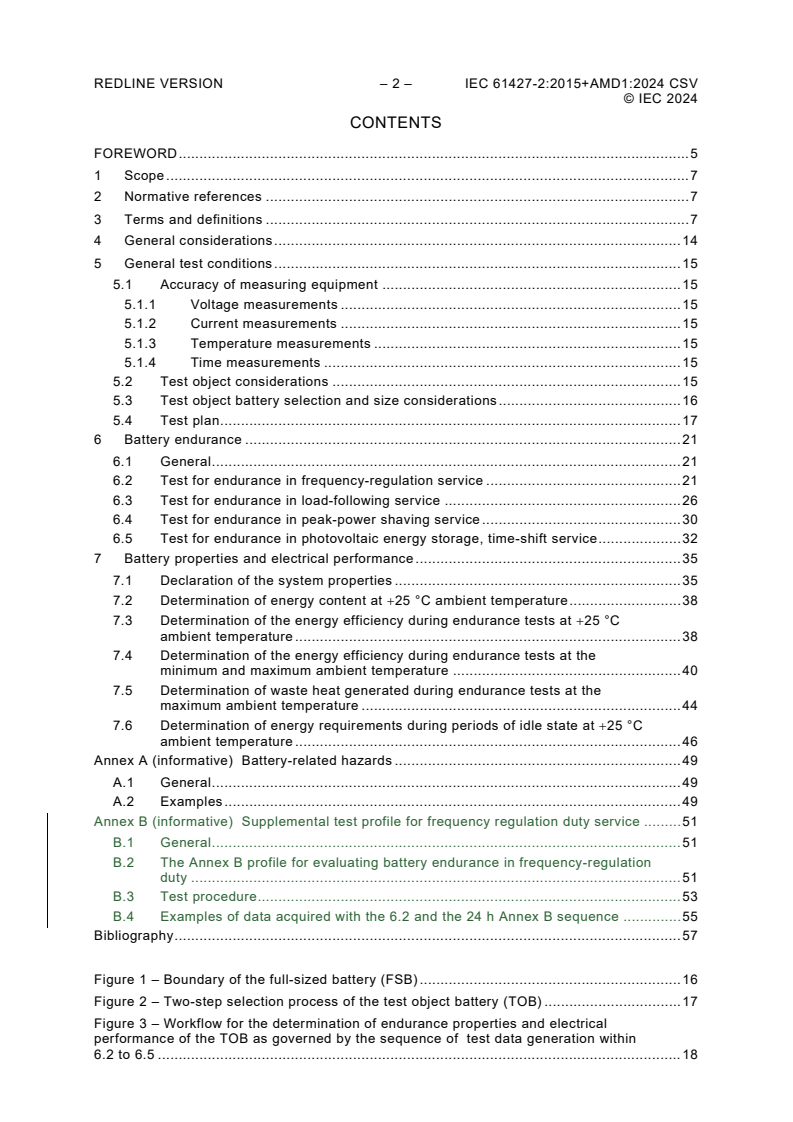
CONTENTS
FOREWORD . 5
1 Scope . 7
2 Normative references . 7
3 Terms and definitions . 7
4 General considerations . 14
5 General test conditions . 15
5.1 Accuracy of measuring equipment . 15
5.1.1 Voltage measurements . 15
5.1.2 Current measurements . 15
5.1.3 Temperature measurements . 15
5.1.4 Time measurements . 15
5.2 Test object considerations . 15
5.3 Test object battery selection and size considerations . 16
5.4 Test plan . 17
6 Battery endurance . 21
6.1 General . 21
6.2 Test for endurance in frequency-regulation service . 21
6.3 Test for endurance in load-following service . 26
6.4 Test for endurance in peak-power shaving service . 30
6.5 Test for endurance in photovoltaic energy storage, time-shift service . 32
7 Battery properties and electrical performance . 35
7.1 Declaration of the system properties . 35
7.2 Determination of energy content at +25 °C ambient temperature . 38
7.3 Determination of the energy efficiency during endurance tests at +25 °C
ambient temperature . 38
7.4 Determination of the energy efficiency during endurance tests at the
minimum and maximum ambient temperature . 40
7.5 Determination of waste heat generated during endurance tests at the
maximum ambient temperature . 44
7.6 Determination of energy requirements during periods of idle state at +25 °C
ambient temperature . 46
Annex A (informative) Battery-related hazards . 49
A.1 General . 49
A.2 Examples . 49
Annex B (informative) Supplemental test profile for frequency regulation duty service . 51
B.1 General . 51
B.2 The Annex B profile for evaluating battery endurance in frequency-regulation
duty . 51
B.3 Test procedure . 53
B.4 Examples of data acquired with the 6.2 and the 24 h Annex B sequence . 55
Bibliography . 57
Figure 1 – Boundary of the full-sized battery (FSB) . 16
Figure 2 – Two-step selection process of the test object battery (TOB) . 17
Figure 3 – Workflow for the determination of endurance properties and electrical
performance of the TOB as governed by the sequence of test data generation within
6.2 to 6.5 . 18
© IEC 2024
Figure 4 – Sequence of performance tests carried out with TOB 1 within an endurance
test 6.x . 18
Figure 5 – Workflow and decision tree for endurance tests 6.2 through 6.5 . 20
Figure 6 – Frequency regulation service test routine profile (6.2) – Profile a . 23
Figure 7 – Frequency regulation service test routine profile (6.2) – Profile b . 24
Figure 8 – Frequency regulation service test routine profile (6.2) – Profile c . 24
Figure 9 – Schematic view of the evolution of battery voltage over time during cycling
with constant power discharge and charge pulses . 25
Figure 10 – Load-following service test routine profile (6.3) – Profile a . 28
Figure 11 – Load-following service test routine profile (6.3) – Profile b . 28
Figure 12 – Load-following service test routine profile (6.3) – Profile c . 29
Figure 13 – Daily peak-power shaving service test routine profile (6.4) . 31
Figure 14 – Daily photovoltaic energy storage time-shift service test routine (6.5) –
3 kW . 33
Figure 15 – Daily photovoltaic energy storage time-shift service test routine (6.5) –
30 kW . 34
Figure 16 – Schematic view of the location of the two sets of energy values (energy to
auxiliaries and energy to and from TOB) to be used for the determination of the
energy storage efficiency factor η . 39
Figure 17 – Schematic view of the location of the two sets of energy values (energy to
auxiliaries and energy to and from battery) to be used for the determination of the
amount of waste heat generated . 45
Figure 18 – Schematic view of the location of the two sets of energy values (energy to
auxiliaries and energy to battery) to be used for the determination of the energy
requirements during periods of idle state of the battery . 47
Figure B.1 – 24 h sequence of the Annex B profile for a supplemental evaluation of the
service-induced performance decay of a battery in frequency-regulation service . 52
Figure B.2 – Development of excessive on-charge voltage levels after about 40 days of
simulated frequency-regulation with the 6.2 c profile . 55
Figure B.3 – Decay of charge acceptance resulting, after about 20 days, in the need
for an increased number of SoC recovery actions when tested with the Annex B
OT
sequence profile . 56
Table 1 – Summary of endurance test related electrical property data of the full-sized
(FSB) and the test object (TOB) battery . 36
Table 2 – Summary of physical dimension data of the full-sized battery (FSB) . 37
Table 3 – Summary description of the full-sized battery (FSB) . 37
Table 4 – Summary description of the test-object battery (TOB) . 37
Table 5 – Summary of the constant power discharge performance of the TOB at an
ambient temperature of +25 °C ± 3 K . 38
Table 6 – Summary of energy efficiencies determined in endurance tests at an
ambient temperature of +25 °C ± 3 K . 40
Table 7 – Summary of energy efficiencies determined in endurance cycle tests at the
minimum and maximum ambient temperature . 42
Table 8 – Parameters to achieve and maintain the target operational state of charge,
SoC , during tests at the minimum ambient temperature . 43
OT
Table 9 – Parameters to achieve and maintain the target operational state of charge,
SoC , during tests at the maximum ambient temperature . 44
OT
REDLINE VERSION – 4 – IEC 61427-2:2015+AMD1:2024 CSV
© IEC 2024
Table 10 – Summary of energy released as heat during endurance tests at the
maximum ambient temperature . 46
Table 11 – Summary of energy required during idle state periods at +25 °C ± 3 K
ambient temperature . 48
Table A.1 – Non-exhaustive listing of potential battery-related hazards to be taken in
consideration in risk assessment activities . 49
Table A.2 – Non-exhaustive listing of potential installation-related hazards to be taken
in consideration in risk assessment activities . 50
© IEC 2024
INTERNATIONAL ELECTROTECHNICAL COMMISSION
____________
SECONDARY CELLS AND BATTERIES
FOR RENEWABLE ENERGY STORAGE –
GENERAL REQUIREMENTS AND METHODS OF TEST –
Part 2: On-grid applications
FOREWORD
1) The International Electrotechnical Commission (IEC) is a worldwide organization for standardization comprising
all national electrotechnical committees (IEC National Committees). The object of IEC is to promote
international co-operation on all questions concerning standardization in the electrical and electronic fields. To
this end and in addition to other activities, IEC publishes International Standards, Technical Specifications,
Technical Reports, Publicly Available Specifications (PAS) and Guides (hereafter referred to as “IEC
Publication(s)”). Their preparation is entrusted to technical committees; any IEC National Committee interested
in the subject dealt with may participate in this preparatory work. International, governmental and non-
governmental organizations liaising with the IEC also participate in this preparation. IEC collaborates closely
with the International Organization for Standardization (ISO) in accordance with conditions determined by
agreement between the two organizations.
2) The formal decisions or agreements of IEC on technical matters express, as nearly as possible, an international
consensus of opinion on the relevant subjects since each technical committee has representation from all
interested IEC National Committees.
3) IEC Publications have the form of recommendations for international use and are accepted by IEC National
Committees in that sense. While all reasonable efforts are made to ensure that the technical content of IEC
Publications is accurate, IEC cannot be held responsible for the way in which they are used or for any
misinterpretation by any end user.
4) In order to promote international uniformity, IEC National Committees undertake to apply IEC Publications
transparently to the maximum extent possible in their national and regional publications. Any divergence
between any IEC Publication and the corresponding national or regional publication shall be clearly indicated in
the latter.
5) IEC itself does not provide any attestation of conformity. Independent certification bodies provide conformity
assessment services and, in some areas, access to IEC marks of conformity. IEC is not responsible for any
services carried out by independent certification bodies.
6) All users should ensure that they have the latest edition of this publication.
7) No liability shall attach to IEC or its directors, employees, servants or agents including individual experts and
members of its technical committees and IEC National Committees for any personal injury, property damage or
other damage of any nature whatsoever, whether direct or indirect, or for costs (including legal fees) and
expenses arising out of the publication, use of, or reliance upon, this IEC Publication or any other IEC
Publications.
8) Attention is drawn to the Normative references cited in this publication. Use of the referenced publications is
indispensable for the correct application of this publication.
9) IEC draws attention to the possibility that the implementation of this document may involve the use of (a)
patent(s). IEC takes no position concerning the evidence, validity or applicability of any claimed patent rights in
respect thereof. As of the date of publication of this document, IEC had not received notice of (a) patent(s),
which may be required to implement this document. However, implementers are cautioned that this may not
represent the latest information, which may be obtained from the patent database available at
https://patents.iec.ch. IEC shall not be held responsible for identifying any or all such patent rights.
This consolidated version of the official IEC Standard and its amendment has been
prepared for user convenience.
IEC 61427-2 edition 1.1 contains the first edition (2015-08) [documents 21/862/FDIS and
21/863/RVD] and its amendment 1 (2024-03) [documents 21/1179/FDIS and 21/1194/RVD].
In this Redline version, a vertical line in the margin shows where the technical content
is modified by amendment 1. Additions are in green text, deletions are in strikethrough
red text. A separate Final version with all changes accepted is available in this
publication.
REDLINE VERSION – 6 – IEC 61427-2:2015+AMD1:2024 CSV
© IEC 2024
International Standard IEC 61427-2 has been prepared by IEC technical committee 21:
Secondary cells and batteries.
A list of all parts in the IEC 61427 series, published under the general title Secondary cells
and batteries for renewable energy storage – General requirements and methods of test, can
be found on the IEC website.
This publication has been drafted in accordance with the ISO/IEC Directives, Part 2.
The committee has decided that the contents of this document and its amendment will remain
unchanged until the stability date indicated on the IEC website under webstore.iec.ch in the
data related to the specific document. At this date, the document will be
• reconfirmed,
• withdrawn, or
• revised.
IMPORTANT – The 'colour inside' logo on the cover page of this publication indicates
that it contains colours which are considered to be useful for the correct
understanding of its contents. Users should therefore print this document using a
colour printer.
© IEC 2024
SECONDARY CELLS AND BATTERIES
FOR RENEWABLE ENERGY STORAGE –
GENERAL REQUIREMENTS AND METHODS OF TEST
Part 2: On-grid applications
1 Scope
This part of IEC 61427 relates to secondary batteries used in on-grid Electrical Energy
Storage (EES) applications and provides the associated methods of test for the verification of
their endurance, properties and electrical performance in such applications. The test methods
are essentially battery chemistry neutral, i.e. applicable to all secondary battery types.
On-grid applications are characterized by the fact that batteries are connected, via power
conversion devices, to a regional or nation- or continent-wide electricity grid and act as
instantaneous energy sources and sinks to stabilize the grid’s performance when randomly
major amounts of electrical energy from renewable energy sources are fed into it.
Related power conversion and interface equipment is not covered by this part of IEC 61427.
2 Normative references
The following documents, in whole or in part, are normatively referenced in this document and
are indispensable for its application. For dated references, only the edition cited applies. For
undated references, the latest edition of the referenced document (including any
amendments) applies.
None.
3 Terms and definitions
For the purposes of this document, the following terms and definitions apply.
3.1
accuracy
quality which characterizes the ability of a measuring instrument to provide an indicated value
close to a true value of the quantity to be measured
Note 1 to entry: This term is used in the “true” value approach.
Note 2 to entry: Accuracy is better when the indicated value is closer to the corresponding true value.
[SOURCE: IEC 60050-311:2001, 311-06-08]
3.2
accuracy class
category of measuring instruments, all of which are intended to comply with a set of
specifications regarding uncertainty
[SOURCE: IEC 60050-311:2001, 311-06-09]
REDLINE VERSION – 8 – IEC 61427-2:2015+AMD1:2024 CSV
© IEC 2024
3.3
ambient temperature
average temperature of the air or another medium in the vicinity of the equipment
Note 1 to entry - During the measurement of the ambient temperature the measuring instrument/probe should be
shielded from draughts and radiant heating.
[SOURCE: IEC 60050-826:2004, 826-10-03]
3.4
maximum ambient temperature
highest ambient temperature at which the battery is operable and
should perform according to specified requirements
[SOURCE: IEC 60050-426:2008, 426-20-17, modified — In the definition, “trace heating” has
been replaced with “battery”.]
3.5
minimum ambient temperature
lowest ambient temperature at which the battery is operable and
should perform according to specified requirements
[SOURCE: IEC 60050-426:2008, 426-20-20, modified — In the definition, “trace heating” has
been replaced with “battery”.]
3.6
ampere hour
quantity of electrical charge obtained by integrating the current in amperes with respect to
time in hours
Note 1 to entry: The SI unit for electric charge is the coulomb (1 C = 1 As) but in practice it is usually expressed
in ampere hours (Ah).
3.7
battery
two or more cells fitted with devices necessary for use, for example case, terminals, marking
and protective devices
[SOURCE: IEC 60050-482:2004, 482-01-04, modified — In the definition, “one” has been
replaced with “two”.]
3.8
battery management system
BMS
battery management unit
BMU
electronic system associated with a battery which monitors and/or manages its state,
calculates secondary data, reports that data and/or controls its environment to influence the
battery’s performance and/or service life
Note 1 to entry: The function of the battery management system can be fully or partially assigned to the battery
pack and/or to equipment that uses this battery.
Note 2 to entry: A battery management system is also called a "battery management unit" (BMU).
Note 3 to entry: This note applies to the French language only.
Note 4 to entry: This note applies to the French language only.
© IEC 2024
3.9
idle state
state of a battery which is fully functional but not actively delivering or
absorbing energy
Note 1 to entry: Such a system can deliver and absorb energy on demand with a reaction time as required by the
application.
Note 2 to entry: The reaction time can vary from a few milliseconds to a few seconds.
3.10
battery support system
BSS
group of interconnected and interactive parts that perform an essential task as a component
of a battery system
Note 1 to entry: Such systems are for example electrolyte storage tanks and circulation pumps, cooling and
heating devices, exhaust gas abatement systems, fire extinguishers, spill catchment systems, safety barriers, racks
and similar facilities.
Note 2 to entry: This note applies to the French language only.
3.11
capacity
quantity of electric charge which a cell or battery can deliver under
specified discharge conditions
Note 1 to entry: The SI unit for electric charge, or quantity of electricity, is the coulomb (1 C = 1 As) but in
practice, capacity is usually expressed in ampere hours (Ah).
[SOURCE: IEC 60050-482:2004, 482-03-14, modified — In the definition, “quantity of” has
been added.]
3.12
charging
operation during which a secondary battery is supplied with electric energy
from an external circuit which results in chemical changes within the cell and thus the storage
of energy as chemical energy
Note 1 to entry: A charge operation is defined by its maximum voltage, current, duration and other conditions as
specified by the manufacturer.
[SOURCE: IEC 60050-482:2004, 482-05-27, modified — Note 1 to entry has been added.]
3.13
constant power charge
operation in which the charge power input, i.e. the product of charge current
and charge voltage, is held constant and where the current and voltage freely adjust
according to polarization effects of the battery
3.14
discharge
operation by which a battery delivers, to an external electric circuit and under specified
conditions, electric energy produced in the cells
[SOURCE: IEC 60050-482:2004, 482-03-23]
3.15
constant power discharge
operation in which the discharge power output, i.e. the product of discharge
current and discharge voltage, is held constant and where the current and voltage freely
adjust according to polarization effects of the battery
REDLINE VERSION – 10 – IEC 61427-2:2015+AMD1:2024 CSV
© IEC 2024
3.16
electrolyte
substance containing mobile ions that render it ionically conductive
Note 1 to entry: The electrolyte may be a liquid, solid or a gel.
[SOURCE: IEC 60050-482:2004, 482-02-29]
3.17
endurance
numerically defined performance during a given test simulating specified
conditions of service
[SOURCE: IEC 60050-482:2004, 482-03-44]
3.18
endurance test
test carried out over a time interval to investigate how the properties are
affected by the application of stated stresses and by their time duration or repeated
application
[SOURCE: IEC 60050-151:2001, 151-16-22, modified — “” has been added
before the definition and “of an item” has been deleted from the definition.]
3.19
energy
energy which a battery delivers under specified conditions
Note 1 to entry: The SI unit for energy is the joule (1 J = 1 Ws) but in practice, energy of a battery is usually
expressed in watt hours (Wh) (1 Wh = 3 600 J).
Note 2 to entry: Such energy content is generally determined with a constant power (W) discharge.
Note 3 to entry: k or M are unit prefixes in the metric system denoting multiplication of the unit by one thousand
(k) or one million (M).
[SOURCE: IEC 60050-482:2004, 482-03-21, modified —Notes 2 and 3 to entry have been
added.]
3.20
actual energy
energy content value, determined experimentally at a defined instant of time
with a constant power discharge at a specified rate to a specified final voltage and at a
specified temperature
Note 1 to entry: This value is expressed in watt hours (Wh) and varies over the operational cycle or life of the
battery.
3.21
final voltage
end-of-discharge voltage
cut-off voltage
end-point-voltage
U
final
specified voltage of a battery at which the battery discharge is terminated
[SOURCE: IEC 60050-482:2004, 482-03-30]
© IEC 2024
3.22
flow cell
secondary cell characterized by the spatial separation of the electrode from the fluid volumes
which contain active materials
Note 1 to entry: The fluids, consisting of liquids, solutions, suspensions or gases, flow separately through the
electrode spaces.
Note 2 to entry: A flow cell in which one of the active materials is, depending on the state of charge, a solid
deposited on one of the electrodes, is called a hybrid flow cell.
3.23
flow battery
two or more flow cells electrically connected in series and including all components for their
use as an electrochemical energy storage system
Note 1 to entry: The components can be tanks, pumps, thermal and battery management systems, piping and
similar.
3.24
frequency regulation service
regulation mode of the electrical power grid with energy drawn from or
supplied to batteries to maintain the system frequency within defined limits
Note 1 to entry: This balancing of the temporal variations of grid frequency occurs typically over time periods of
the order of seconds to minutes.
3.25
full charge
state of charge wherein the battery has been completely charged in accordance
with the manufacturer’s recommended charging conditions.
3.26
full-sized battery
FSB
complete battery that meets the absolute requirements of power capability and energy
content, as defined in the respective endurance test clauses
Note 1 to entry: This battery is an assembly of n cells, modules or stacks and is equipped with the relative BMS
and BSS as needed.
Note 2 to entry: This note applies to the French language only.
3.27
laboratory test
test made under prescribed and controlled conditions that may or may not
simulate field conditions
[SOURCE: IEC 60050-192:2015, 192-09-05]
3.28
load following service
regulation mode of the electrical power grid with energy drawn from or
supplied to batteries to compensate for temporary variations in load demand
Note 1 to entry: This balancing of the temporary variations of grid load demand occurs typically over time periods
of the order of a few minutes to one hour.
3.29
module
standardized and interchangeable assembly of cells connected in series and/or parallel and
associated hardware designed for easy assembly into a commercial battery
REDLINE VERSION – 12 – IEC 61427-2:2015+AMD1:2024 CSV
© IEC 2024
3.30
operating voltage range
operating voltage limits
voltage range, as declared by the manufacturer, in which the battery is to be
operated and performs according to specifications
3.31
maximum operating voltage
upper voltage limit
U
max
upper limit of the voltage range in which the battery is operable and performs
according to specifications
3.32
minimum operating voltage
lower voltage limit
U
min
lower limit of the voltage range in which the battery is operable and performs
according to specification
3.33
peak-power shaving service
load levelling service
process of energy demand management consisting of supplementing the
energy in a localized power grid, during periods of excessive demand or instantaneous high
electricity costs, with energy drawn from a battery
Note 1 to entry: The energy utilized to “shave off” the demand peak is recharged into the battery in periods of low
energy demand or cheap energy supply.
Note 2 to entry: This demand peak-shaving activity lasts typically over time periods of one to several hours.
3.34
PV energy storage time-shift service
process of energy demand management consisting of storing photovoltaic
energy in a battery for a time deferred release into a localized power grid
Note 1 to entry: This energy demand management occurs typically with a 24 h day/night rhythm.
3.35
performance
characteristics defining the ability of the battery to achieve the intended
function
[SOURCE: IEC 60050-311:2001, 311-06-11, modified — In the definition, “measuring
instrument” has been replaced with “battery”.]
3.36
performance test
test carried out to determine the electrical characteristics of a battery
3.37
secondary cell
basic manufactured unit of an electrochemical system capable of storing
electric energy in chemical form and delivering that electrical energy back by reconversion of
its stored chemical energy.
[SOURCE: IEC 60050-811:1991, 811-20-01, modified]
© IEC 2024
3.38
service life
total period of useful life of a cell or battery in operation
Note 1 to entry: For secondary cells and batteries, the service life may be expressed in time, number of
charge/discharge cycles, or total throughput in ampere hours (Ah).
[SOURCE: IEC 60050-482:2004, 482-03-46, modified — Note 1 to entry has been deleted.]
3.39
maximum service temperature
maximum operating temperature
maximum permissible temperature
highest temperature which the battery is allowed to attain in normal use as a
result of ambient temperatures, induced heat and heat caused by the battery itself
[SOURCE: IEC 60050-442:1998, 442-06-41, modified — In the definition, “connecting device”
has been replaced with “battery”.]
3.40
minimum service temperature
minimum operating temperature
minimum permissible temperature
lowest temperature which the battery is allowed to attain in normal use as a
result of ambient temperatures and forced cooling
3.41
stack
two or more flow cells connected in series or in parallel with associated
electrical connections and fluid piping
3.42
state of charge
SoC
amount of stored charge in ampere hours (Ah) or energy in watt hours (Wh)
related to the actual capacity or energy content
Note 1 to entry: This definition is applicable throughout and only to this part of IEC 61427.
Note 2 to entry: State of charge is expressed as a percentage.
Note 3 to entry: This note applies to the French language only.
3.43
target operational state of charge
SoC
OT
pre-defined state of charge to which the energy storage system is driven by a
controller or BMS under pre-defined conditions
Note 1 to entry: This SoC is to be attained or/and maintained when bidirectional energy transfers to and from
OT
the battery are to be achieved within set voltage and SoC limits.
Note 2 to entry: State of charge is expressed as a percentage.
Note 3 to entry: SoC is typically the desired or recommended average operating SoC during the specified
OT
application scenario. It is selected to improve electrical energy storage (EES) system performance and/or improve
the EES system service life in the specified application.
REDLINE VERSION – 14 – IEC 61427-2:2015+AMD1:2024 CSV
© IEC 2024
3.44
test
technical operation that consists of the determination of one or more
characteristics of a given battery according to a specified procedure
Note 1 to entry: A test is carried out to measure or classify a characteristic of a property of a battery by applying
to the battery a set of environmental and operating conditions and/or requirements.
[SOURCE: IEC 60050-151:2001, 151-16-13, modified — In the definition, “product, process or
service” has been replaced with “battery”.]
3.45
test object
item submitted to a test, including any accessories, unless otherwise specified
[SOURCE: IEC 60050-151:2001, 151-16-28]
3.46
test object battery
TOB
assembly of x × 1/n units consisting of cells, modules or stacks of the full-sized battery (FSB),
which when assembled in n units, form the FSB which meets the absolute requirements of
power capability and energy content as defined in the respective endurance test clauses
Note 1 to entry: The test object battery (TOB) is fully representative of the full-sized battery (FSB) in terms of
scalability so that obtained test results can be generalized accurately to the FSB.
Note 2 to entry: The TOB is equipped with the relative BMS and BSS as needed.
Note 3 to entry: This note applies to the French language only.
3.47
time-shift service
process of energy demand management consisting in providing to the grid, at
suitable moments, energy stored in batteries at times of ample production or weak demand
Note 1 to entry: This supplying of energy to the grid occurs over time periods typically of the order of a few hours,
days or even seasons.
4 General considerations
The supply of energy from renewable energy sources such as wind, solar radiation or tidal
forces is characterized by a high degree of intermittency and a low degree of predictability.
When their output is fed into the power transmission and distribution grid, overload and
instability conditions may develop which make it highly desirable to use rechargeable
batteries to temporarily store this energy and then release it in a controlled fashion to smooth
and stabilize the flow of power in the grid.
Such instabilities and imbalances in power grids may also result when insufficient power
generation capability is present.
The aim of this part of IEC 61427 is to advise and guide future system operators to identify
and select suitable rechargeable batteries for grid-connected electrical energy storage (EES).
This process will be aided by a set of common test methods that quantify the capability of
battery systems of different chemistries and designs in a particular application scenario.
The requirements for battery endurance and electrical performance are linked to the specific
EES scenarios to be implemented for the management of excess energy in the grid and the
associated capital and operating expenditures for such an installation.
© IEC 2024
These requirements, expressed as energy efficiency, service life, cumulated energy
throughput, installation space and similar, are highly variable since they are eminently
application-scenario related and furthermore strongly tied to local costs/benefits and payback
time considerations.
Therefore, this part of IEC 61427 does not define these requirements but offers instead test
methods to determine and compare the endurance and electrical performance of the
candidate storage systems.
All EES batteries have to exhibit safe behaviour. Proper design and associated qualification
testing by the battery manufacturers shall ensure this at all levels from the cell to the overall
system level.
An informal listing of hazards associated with batteries and battery installations is included in
this part of IEC 61427. This list should help in the assessment of the possible reactions of the
batteries when they are exposed to abnormal and abusive service conditions.
5 General test conditions
5.1 Accuracy of measuring equipment
5.1.1 Voltage measurements
The instruments used shall be of an accuracy class of at least 0,5 (%) or better.
5.1.2 Current measurements
The instruments used shall be of an accuracy class of at least 0,5 (%) or better.
NOTE Particular attention has to be given to the accuracy of current measurement and current-over-time
integration devices as any degraded accuracy or instability can negatively impact the effectiveness of SoC
stabilization routines.
5.1.3 Temperature measurements
The instrument used shall have a resolution of 0,5 K. The accuracy of the instrument shall be
±2 K or better.
5.1.4 Time measurements
The instrument used shall have a resolution of 1 s and an accuracy of 0,1 % of the measured
time interval.
5.2 Test object considerations
This part of IEC 61427 and the resulting test results are intended to assist the future operator
of an electrical energy storage system in the selection of the most suitable battery for the
target application by providing comparable data of candidate systems.
The battery system to be tested shall include the cells or modules or stacks and, when they
are essential for the operation of the battery, the battery management system (BMS) and
battery support systems (BSS).
The boundary of this battery system is outlined by the dotted line in Figure 1.
REDLINE VERSION – 16 – IEC 61427-2:2015+AMD1:2024 CSV
© IEC 2024
IEC
Figure 1 – Boundary of the full-sized battery (FSB)
Power conversion systems and components and associated interfaces are not within the
scope of this part of IEC 61427 and are not necessarily present when the tests, according to
Clauses 6 and 7, are carried out.
5.3 Test object battery selection and size considerations
The battery systems offered by the manufacturers for on-grid electric energy storage reflect
the intrinsic constraints of each cell chemistry and design as well as the specific needs of the
target application or service. Such batteries range typically from a few kilowatts to up to
50 MW in power capability and up to 100 MWh in energy content. No common size
exemplifying each prospective cell chemistry is yet available.
When the manufacturer or end-user carries out the testing of a battery system to generate
data in compliance with this part of IEC 61427, freedom shall be granted to choose that
design, model and size which is most suitable for yielding the endurance and electrical
performance needed for the selected application or service. These applications or services
are exemplified by the endurance tests specified in 6.2 through 6.5. These battery sizes and
layouts may vary from one cell chemistry or application to another.
© IEC 2024
BMS
-
Actual manufacturer defined full-sized
battery (FSB) formed of n cells, modules
or stacks and meeting the requirements
Step 1
a)
of clause 6.2 and/or 6.3
+
and/or 6.4 and/or 6.5
n
BSS
BMS
Actual manufacturer defined
test object battery (TOB)
- x × 1/n +
Step 2
for the determination tests
of FSB
according to 6.x and 7.x
BSS
IEC
Figure 2 – Two-step selection process of the test object battery (TOB)
In order to assure the generation of comparable test data, the following constraints shall be
respected.
• Throughout this part of IEC 61427 the relevant batteries are defined as below.
Full-sized battery (FSB) – The FSB shall consist of the complete battery that meets the
absolute requirements of power capability and energy content as defined in 6.2 or 6.3 or
6.4 or 6.5, as applicable. This battery may be an assembly of n cells, modules or stacks
and shall be equipped with the relevant BMS and BSS as needed. Thus up to five different
FSBs may be defined.
Test object battery (TOB) – The TOB and its associated BMS and BSS shall be
representative of each of the FSBs above in terms of scalability of endurance and
performances so that test results can be extrapolated accurately and hence demonstrate
the performance of the FSB. The TOB shall be an assembly of x × 1/n cells, modules or
stacks as present in the above FSB. The minimum number x is defined in the relevant test
clause. Unless otherwise specified, all the tests shall be carried out on this TOB.
...
IEC 61427-2 ®
Edition 1.0 2015-08
INTERNATIONAL
STANDARD
NORME
INTERNATIONALE
Secondary cells and batteries for renewable energy storage – General
requirements and methods of test –
Part 2: On-grid applications
Accumulateurs pour le stockage de l'énergie renouvelable – Exigences
générales et méthodes d'essais –
Partie 2: Applications en réseau
All rights reserved. Unless otherwise specified, no part of this publication may be reproduced or utilized in any form
or by any means, electronic or mechanical, including photocopying and microfilm, without permission in writing from
either IEC or IEC's member National Committee in the country of the requester. If you have any questions about IEC
copyright or have an enquiry about obtaining additional rights to this publication, please contact the address below or
your local IEC member National Committee for further information.
Droits de reproduction réservés. Sauf indication contraire, aucune partie de cette publication ne peut être reproduite
ni utilisée sous quelque forme que ce soit et par aucun procédé, électronique ou mécanique, y compris la photocopie
et les microfilms, sans l'accord écrit de l'IEC ou du Comité national de l'IEC du pays du demandeur. Si vous avez des
questions sur le copyright de l'IEC ou si vous désirez obtenir des droits supplémentaires sur cette publication, utilisez
les coordonnées ci-après ou contactez le Comité national de l'IEC de votre pays de résidence.
IEC Central Office Tel.: +41 22 919 02 11
3, rue de Varembé Fax: +41 22 919 03 00
CH-1211 Geneva 20 info@iec.ch
Switzerland www.iec.ch
About the IEC
The International Electrotechnical Commission (IEC) is the leading global organization that prepares and publishes
International Standards for all electrical, electronic and related technologies.
About IEC publications
The technical content of IEC publications is kept under constant review by the IEC. Please make sure that you have the
latest edition, a corrigenda or an amendment might have been published.
IEC Catalogue - webstore.iec.ch/catalogue Electropedia - www.electropedia.org
The stand-alone application for consulting the entire The world's leading online dictionary of electronic and
bibliographical information on IEC International Standards, electrical terms containing more than 30 000 terms and
Technical Specifications, Technical Reports and other definitions in English and French, with equivalent terms in 15
documents. Available for PC, Mac OS, Android Tablets and additional languages. Also known as the International
iPad. Electrotechnical Vocabulary (IEV) online.
IEC publications search - www.iec.ch/searchpub IEC Glossary - std.iec.ch/glossary
The advanced search enables to find IEC publications by a More than 60 000 electrotechnical terminology entries in
variety of criteria (reference number, text, technical English and French extracted from the Terms and Definitions
committee,…). It also gives information on projects, replaced clause of IEC publications issued since 2002. Some entries
and withdrawn publications. have been collected from earlier publications of IEC TC 37,
77, 86 and CISPR.
IEC Just Published - webstore.iec.ch/justpublished
Stay up to date on all new IEC publications. Just Published IEC Customer Service Centre - webstore.iec.ch/csc
details all new publications released. Available online and If you wish to give us your feedback on this publication or
also once a month by email. need further assistance, please contact the Customer Service
Centre: csc@iec.ch.
A propos de l'IEC
La Commission Electrotechnique Internationale (IEC) est la première organisation mondiale qui élabore et publie des
Normes internationales pour tout ce qui a trait à l'électricité, à l'électronique et aux technologies apparentées.
A propos des publications IEC
Le contenu technique des publications IEC est constamment revu. Veuillez vous assurer que vous possédez l’édition la
plus récente, un corrigendum ou amendement peut avoir été publié.
Catalogue IEC - webstore.iec.ch/catalogue Electropedia - www.electropedia.org
Application autonome pour consulter tous les renseignements
Le premier dictionnaire en ligne de termes électroniques et
bibliographiques sur les Normes internationales,
électriques. Il contient plus de 30 000 termes et définitions en
Spécifications techniques, Rapports techniques et autres
anglais et en français, ainsi que les termes équivalents dans
documents de l'IEC. Disponible pour PC, Mac OS, tablettes
15 langues additionnelles. Egalement appelé Vocabulaire
Android et iPad.
Electrotechnique International (IEV) en ligne.
Recherche de publications IEC - www.iec.ch/searchpub
Glossaire IEC - std.iec.ch/glossary
Plus de 60 000 entrées terminologiques électrotechniques, en
La recherche avancée permet de trouver des publications IEC
en utilisant différents critères (numéro de référence, texte, anglais et en français, extraites des articles Termes et
comité d’études,…). Elle donne aussi des informations sur les Définitions des publications IEC parues depuis 2002. Plus
projets et les publications remplacées ou retirées. certaines entrées antérieures extraites des publications des
CE 37, 77, 86 et CISPR de l'IEC.
IEC Just Published - webstore.iec.ch/justpublished
Service Clients - webstore.iec.ch/csc
Restez informé sur les nouvelles publications IEC. Just
Published détaille les nouvelles publications parues. Si vous désirez nous donner des commentaires sur cette
Disponible en ligne et aussi une fois par mois par email. publication ou si vous avez des questions contactez-nous:
csc@iec.ch.
IEC 61427-2 ®
Edition 1.0 2015-08
INTERNATIONAL
STANDARD
NORME
INTERNATIONALE
Secondary cells and batteries for renewable energy storage – General
requirements and methods of test –
Part 2: On-grid applications
Accumulateurs pour le stockage de l'énergie renouvelable – Exigences
générales et méthodes d'essais –
Partie 2: Applications en réseau
INTERNATIONAL
ELECTROTECHNICAL
COMMISSION
COMMISSION
ELECTROTECHNIQUE
INTERNATIONALE
ICS 29.220.20 ISBN 978-2-8322-2881-4
– 2 – IEC 61427-2:2015 © IEC 2015
CONTENTS
FOREWORD . 4
1 Scope . 6
2 Normative references . 6
3 Terms and definitions . 6
4 General considerations . 13
5 General test conditions . 14
5.1 Accuracy of measuring equipment . 14
5.1.1 Voltage measurements . 14
5.1.2 Current measurements . 14
5.1.3 Temperature measurements . 14
5.1.4 Time measurements . 14
5.2 Test object considerations . 14
5.3 Test object battery selection and size considerations . 15
5.4 Test plan . 16
6 Battery endurance . 20
6.1 General . 20
6.2 Test for endurance in frequency-regulation service . 20
6.3 Test for endurance in load-following service . 25
6.4 Test for endurance in peak-power shaving service . 28
6.5 Test for endurance in photovoltaic energy storage, time-shift service . 30
7 Battery properties and electrical performance . 33
7.1 Declaration of the system properties . 33
7.2 Determination of energy content at +25 °C ambient temperature . 36
7.3 Determination of the energy efficiency during endurance tests at +25 °C
ambient temperature . 36
7.4 Determination of the energy efficiency during endurance tests at the
minimum and maximum ambient temperature . 38
7.5 Determination of waste heat generated during endurance tests at the
maximum ambient temperature . 42
7.6 Determination of energy requirements during periods of idle state at +25 °C
ambient temperature . 44
Annex A (informative) Battery-related hazards . 47
A.1 General . 47
A.2 Examples . 47
Bibliography . 49
Figure 1 – Boundary of the full-sized battery (FSB) . 15
Figure 2 – Two-step selection process of the test object battery (TOB) . 16
Figure 3 – Workflow for the determination of endurance properties and electrical
performance of the TOB as governed by the sequence of test data generation within
6.2 to 6.5 . 17
Figure 4 – Sequence of performance tests carried out with TOB 1 within an endurance
test 6.x . 17
Figure 5 – Workflow and decision tree for endurance tests 6.2 through 6.5 . 19
Figure 6 – Frequency regulation service test routine profile (6.2) – Profile a . 22
Figure 7 – Frequency regulation service test routine profile (6.2) – Profile b . 22
Figure 8 – Frequency regulation service test routine profile (6.2) – Profile c . 23
Figure 9 – Schematic view of the evolution of battery voltage over time during cycling
with constant power discharge and charge pulses . 24
Figure 10 – Load-following service test routine profile (6.3) – Profile a . 26
Figure 11 – Load-following service test routine profile (6.3) – Profile b . 27
Figure 12 – Load-following service test routine profile (6.3) – Profile c . 27
Figure 13 – Daily peak-power shaving service test routine profile (6.4) . 29
Figure 14 – Daily photovoltaic energy storage time-shift service test routine (6.5) –
3 kW . 32
Figure 15 – Daily photovoltaic energy storage time-shift service test routine (6.5) –
30 kW . 32
Figure 16 – Schematic view of the location of the two sets of energy values (energy to
auxiliaries and energy to and from TOB) to be used for the determination of the
energy storage efficiency factor η . 37
Figure 17 – Schematic view of the location of the two sets of energy values (energy to
auxiliaries and energy to and from battery) to be used for the determination of the
amount of waste heat generated . 43
Figure 18 – Schematic view of the location of the two sets of energy values (energy to
auxiliaries and energy to battery) to be used for the determination of the energy
requirements during periods of idle state of the battery . 45
Table 1 – Summary of endurance test related electrical property data of the full-sized
(FSB) and the test object (TOB) battery . 34
Table 2 – Summary of physical dimension data of the full-sized battery (FSB) . 35
Table 3 – Summary description of the full-sized battery (FSB) . 35
Table 4 – Summary description of the test-object battery (TOB) . 35
Table 5 – Summary of the constant power discharge performance of the TOB at an
ambient temperature of +25 °C ± 3 K . 36
Table 6 – Summary of energy efficiencies determined in endurance tests at an
ambient temperature of +25 °C ± 3 K . 38
Table 7 – Summary of energy efficiencies determined in endurance cycle tests at the
minimum and maximum ambient temperature . 40
Table 8 – Parameters to achieve and maintain the target operational state of charge,
SoC , during tests at the minimum ambient temperature . 41
OT
Table 9 – Parameters to achieve and maintain the target operational state of charge,
SoC , during tests at the maximum ambient temperature . 42
OT
Table 10 – Summary of energy released as heat during endurance tests at the
maximum ambient temperature . 44
Table 11 – Summary of energy required during idle state periods at +25 °C ± 3 K
ambient temperature . 46
Table A.1 – Non-exhaustive listing of potential battery-related hazards to be taken in
consideration in risk assessment activities . 47
Table A.2 – Non-exhaustive listing of potential installation-related hazards to be taken
in consideration in risk assessment activities . 48
– 4 – IEC 61427-2:2015 © IEC 2015
INTERNATIONAL ELECTROTECHNICAL COMMISSION
____________
SECONDARY CELLS AND BATTERIES
FOR RENEWABLE ENERGY STORAGE –
GENERAL REQUIREMENTS AND METHODS OF TEST –
Part 2: On-grid applications
FOREWORD
1) The International Electrotechnical Commission (IEC) is a worldwide organization for standardization comprising
all national electrotechnical committees (IEC National Committees). The object of IEC is to promote
international co-operation on all questions concerning standardization in the electrical and electronic fields. To
this end and in addition to other activities, IEC publishes International Standards, Technical Specifications,
Technical Reports, Publicly Available Specifications (PAS) and Guides (hereafter referred to as “IEC
Publication(s)”). Their preparation is entrusted to technical committees; any IEC National Committee interested
in the subject dealt with may participate in this preparatory work. International, governmental and non-
governmental organizations liaising with the IEC also participate in this preparation. IEC collaborates closely
with the International Organization for Standardization (ISO) in accordance with conditions determined by
agreement between the two organizations.
2) The formal decisions or agreements of IEC on technical matters express, as nearly as possible, an international
consensus of opinion on the relevant subjects since each technical committee has representation from all
interested IEC National Committees.
3) IEC Publications have the form of recommendations for international use and are accepted by IEC National
Committees in that sense. While all reasonable efforts are made to ensure that the technical content of IEC
Publications is accurate, IEC cannot be held responsible for the way in which they are used or for any
misinterpretation by any end user.
4) In order to promote international uniformity, IEC National Committees undertake to apply IEC Publications
transparently to the maximum extent possible in their national and regional publications. Any divergence
between any IEC Publication and the corresponding national or regional publication shall be clearly indicated in
the latter.
5) IEC itself does not provide any attestation of conformity. Independent certification bodies provide conformity
assessment services and, in some areas, access to IEC marks of conformity. IEC is not responsible for any
services carried out by independent certification bodies.
6) All users should ensure that they have the latest edition of this publication.
7) No liability shall attach to IEC or its directors, employees, servants or agents including individual experts and
members of its technical committees and IEC National Committees for any personal injury, property damage or
other damage of any nature whatsoever, whether direct or indirect, or for costs (including legal fees) and
expenses arising out of the publication, use of, or reliance upon, this IEC Publication or any other IEC
Publications.
8) Attention is drawn to the Normative references cited in this publication. Use of the referenced publications is
indispensable for the correct application of this publication.
9) Attention is drawn to the possibility that some of the elements of this IEC Publication may be the subject of
patent rights. IEC shall not be held responsible for identifying any or all such patent rights.
International Standard IEC 61427-2 has been prepared by IEC technical committee 21:
Secondary cells and batteries.
A list of all parts in the IEC 61427 series, published under the general title Secondary cells
and batteries for renewable energy storage – General requirements and methods of test, can
be found on the IEC website.
The text of this standard is based on the following documents:
FDIS Report on voting
21/862/FDIS 21/863/RVD
Full information on the voting for the approval of this standard can be found in the report on
voting indicated in the above table.
This publication has been drafted in accordance with the ISO/IEC Directives, Part 2.
The committee has decided that the contents of this publication will remain unchanged until
the stability date indicated on the IEC website under "http://webstore.iec.ch" in the data
related to the specific publication. At this date, the publication will be
• reconfirmed,
• withdrawn,
• replaced by a revised edition, or
• amended.
– 6 – IEC 61427-2:2015 © IEC 2015
SECONDARY CELLS AND BATTERIES
FOR RENEWABLE ENERGY STORAGE –
GENERAL REQUIREMENTS AND METHODS OF TEST
Part 2: On-grid applications
1 Scope
This part of IEC 61427 relates to secondary batteries used in on-grid Electrical Energy
Storage (EES) applications and provides the associated methods of test for the verification of
their endurance, properties and electrical performance in such applications. The test methods
are essentially battery chemistry neutral, i.e. applicable to all secondary battery types.
On-grid applications are characterized by the fact that batteries are connected, via power
conversion devices, to a regional or nation- or continent-wide electricity grid and act as
instantaneous energy sources and sinks to stabilize the grid’s performance when randomly
major amounts of electrical energy from renewable energy sources are fed into it.
Related power conversion and interface equipment is not covered by this part of IEC 61427.
2 Normative references
The following documents, in whole or in part, are normatively referenced in this document and
are indispensable for its application. For dated references, only the edition cited applies. For
undated references, the latest edition of the referenced document (including any
amendments) applies.
None.
3 Terms and definitions
For the purposes of this document, the following terms and definitions apply.
3.1
accuracy
quality which characterizes the ability of a measuring instrument to provide an indicated value
close to a true value of the quantity to be measured
Note 1 to entry: This term is used in the “true” value approach.
Note 2 to entry: Accuracy is better when the indicated value is closer to the corresponding true value.
[SOURCE: IEC 60050-311:2001, 311-06-08]
3.2
accuracy class
category of measuring instruments, all of which are intended to comply with a set of
specifications regarding uncertainty
[SOURCE: IEC 60050-311:2001, 311-06-09]
3.3
ambient temperature
average temperature of the air or another medium in the vicinity of the equipment
Note 1 to entry - During the measurement of the ambient temperature the measuring instrument/probe should be
shielded from draughts and radiant heating.
[SOURCE: IEC 60050-826:2004, 826-10-03]
3.4
maximum ambient temperature
highest ambient temperature at which the battery is operable and
should perform according to specified requirements
[SOURCE: IEC 60050-426:2008, 426-20-17, modified — In the definition, “trace heating” has
been replaced with “battery”.]
3.5
minimum ambient temperature
lowest ambient temperature at which the battery is operable and
should perform according to specified requirements
[SOURCE: IEC 60050-426:2008, 426-20-20, modified — In the definition, “trace heating” has
been replaced with “battery”.]
3.6
ampere hour
quantity of electrical charge obtained by integrating the current in amperes with respect to
time in hours
Note 1 to entry: The SI unit for electric charge is the coulomb (1 C = 1 As) but in practice it is usually expressed
in ampere hours (Ah).
3.7
battery
two or more cells fitted with devices necessary for use, for example case, terminals, marking
and protective devices
[SOURCE: IEC 60050-482:2004, 482-01-04, modified — In the definition, “one” has been
replaced with “two”.]
3.8
battery management system
BMS
battery management unit
BMU
electronic system associated with a battery which monitors and/or manages its state,
calculates secondary data, reports that data and/or controls its environment to influence the
battery’s performance and/or service life
Note 1 to entry: The function of the battery management system can be fully or partially assigned to the battery
pack and/or to equipment that uses this battery.
Note 2 to entry: A battery management system is also called a "battery management unit" (BMU).
Note 3 to entry: This note applies to the French language only.
Note 4 to entry: This note applies to the French language only.
– 8 – IEC 61427-2:2015 © IEC 2015
3.9
idle state
state of a battery which is fully functional but not actively delivering or
absorbing energy
Note 1 to entry: Such a system can deliver and absorb energy on demand with a reaction time as required by the
application.
Note 2 to entry: The reaction time can vary from a few milliseconds to a few seconds.
3.10
battery support system
BSS
group of interconnected and interactive parts that perform an essential task as a component
of a battery system
Note 1 to entry: Such systems are for example electrolyte storage tanks and circulation pumps, cooling and
heating devices, exhaust gas abatement systems, fire extinguishers, spill catchment systems, safety barriers, racks
and similar facilities.
Note 2 to entry: This note applies to the French language only.
3.11
capacity
quantity of electric charge which a cell or battery can deliver under
specified discharge conditions
Note 1 to entry: The SI unit for electric charge, or quantity of electricity, is the coulomb (1 C = 1 As) but in
practice, capacity is usually expressed in ampere hours (Ah).
[SOURCE: IEC 60050-482:2004, 482-03-14, modified — In the definition, “quantity of” has
been added.]
3.12
charging
operation during which a secondary battery is supplied with electric energy
from an external circuit which results in chemical changes within the cell and thus the storage
of energy as chemical energy
Note 1 to entry: A charge operation is defined by its maximum voltage, current, duration and other conditions as
specified by the manufacturer.
[SOURCE: IEC 60050-482:2004, 482-05-27, modified — Note 1 to entry has been added.]
3.13
constant power charge
operation in which the charge power input, i.e. the product of charge current
and charge voltage, is held constant and where the current and voltage freely adjust
according to polarization effects of the battery
3.14
discharge
operation by which a battery delivers, to an external electric circuit and under specified
conditions, electric energy produced in the cells
[SOURCE: IEC 60050-482:2004, 482-03-23]
3.15
constant power discharge
operation in which the discharge power output, i.e. the product of discharge
current and discharge voltage, is held constant and where the current and voltage freely
adjust according to polarization effects of the battery
3.16
electrolyte
substance containing mobile ions that render it ionically conductive
Note 1 to entry: The electrolyte may be a liquid, solid or a gel.
[SOURCE: IEC 60050-482:2004, 482-02-29]
3.17
endurance
numerically defined performance during a given test simulating specified
conditions of service
[SOURCE: IEC 60050-482:2004, 482-03-44]
3.18
endurance test
test carried out over a time interval to investigate how the properties are
affected by the application of stated stresses and by their time duration or repeated
application
[SOURCE: IEC 60050-151:2001, 151-16-22, modified — “” has been added
before the definition and “of an item” has been deleted from the definition.]
3.19
energy
energy which a battery delivers under specified conditions
Note 1 to entry: The SI unit for energy is the joule (1 J = 1 Ws) but in practice, energy of a battery is usually
expressed in watt hours (Wh) (1 Wh = 3 600 J).
Note 2 to entry: Such energy content is generally determined with a constant power (W) discharge.
Note 3 to entry: k or M are unit prefixes in the metric system denoting multiplication of the unit by one thousand
(k) or one million (M).
[SOURCE: IEC 60050-482:2004, 482-03-21, modified —Notes 2 and 3 to entry have been
added.]
3.20
actual energy
energy content value, determined experimentally at a defined instant of time
with a constant power discharge at a specified rate to a specified final voltage and at a
specified temperature
Note 1 to entry: This value is expressed in watt hours (Wh) and varies over the operational cycle or life of the
battery.
3.21
final voltage
end-of-discharge voltage
cut-off voltage
end-point-voltage
U
final
specified voltage of a battery at which the battery discharge is terminated
[SOURCE: IEC 60050-482:2004, 482-03-30]
– 10 – IEC 61427-2:2015 © IEC 2015
3.22
flow cell
secondary cell characterized by the spatial separation of the electrode from the fluid volumes
which contain active materials
Note 1 to entry: The fluids, consisting of liquids, solutions, suspensions or gases, flow separately through the
electrode spaces.
Note 2 to entry: A flow cell in which one of the active materials is, depending on the state of charge, a solid
deposited on one of the electrodes, is called a hybrid flow cell.
3.23
flow battery
two or more flow cells electrically connected in series and including all components for their
use as an electrochemical energy storage system
Note 1 to entry: The components can be tanks, pumps, thermal and battery management systems, piping and
similar.
3.24
frequency regulation service
regulation mode of the electrical power grid with energy drawn from or
supplied to batteries to maintain the system frequency within defined limits
Note 1 to entry: This balancing of the temporal variations of grid frequency occurs typically over time periods of
the order of seconds to minutes.
3.25
full charge
state of charge wherein the battery has been completely charged in accordance
with the manufacturer’s recommended charging conditions.
3.26
full-sized battery
FSB
complete battery that meets the absolute requirements of power capability and energy
content, as defined in the respective endurance test clauses
Note 1 to entry: This battery is an assembly of n cells, modules or stacks and is equipped with the relative BMS
and BSS as needed.
Note 2 to entry: This note applies to the French language only.
3.27
laboratory test
test made under prescribed and controlled conditions that may or may not
simulate field conditions
[SOURCE: IEC 60050-192:2015, 192-09-05]
3.28
load following service
regulation mode of the electrical power grid with energy drawn from or
supplied to batteries to compensate for temporary variations in load demand
Note 1 to entry: This balancing of the temporary variations of grid load demand occurs typically over time periods
of the order of a few minutes to one hour.
3.29
module
standardized and interchangeable assembly of cells connected in series and/or parallel and
associated hardware designed for easy assembly into a commercial battery
3.30
operating voltage range
operating voltage limits
voltage range, as declared by the manufacturer, in which the battery is to be
operated and performs according to specifications
3.31
maximum operating voltage
upper voltage limit
U
max
upper limit of the voltage range in which the battery is operable and performs
according to specifications
3.32
minimum operating voltage
lower voltage limit
U
min
lower limit of the voltage range in which the battery is operable and performs
according to specification
3.33
peak-power shaving service
load levelling service
process of energy demand management consisting of supplementing the
energy in a localized power grid, during periods of excessive demand or instantaneous high
electricity costs, with energy drawn from a battery
Note 1 to entry: The energy utilized to “shave off” the demand peak is recharged into the battery in periods of low
energy demand or cheap energy supply.
Note 2 to entry: This demand peak-shaving activity lasts typically over time periods of one to several hours.
3.34
PV energy storage time-shift service
process of energy demand management consisting of storing photovoltaic
energy in a battery for a time deferred release into a localized power grid
Note 1 to entry: This energy demand management occurs typically with a 24 h day/night rhythm.
3.35
performance
characteristics defining the ability of the battery to achieve the intended
function
[SOURCE: IEC 60050-311:2001, 311-06-11, modified — In the definition, “measuring
instrument” has been replaced with “battery”.]
3.36
performance test
test carried out to determine the electrical characteristics of a battery
3.37
secondary cell
basic manufactured unit of an electrochemical system capable of storing
electric energy in chemical form and delivering that electrical energy back by reconversion of
its stored chemical energy.
[SOURCE: IEC 60050-811:1991, 811-20-01, modified]
– 12 – IEC 61427-2:2015 © IEC 2015
3.38
service life
total period of useful life of a cell or battery in operation
Note 1 to entry: For secondary cells and batteries, the service life may be expressed in time, number of
charge/discharge cycles, or total throughput in ampere hours (Ah).
[SOURCE: IEC 60050-482:2004, 482-03-46, modified — Note 1 to entry has been deleted.]
3.39
maximum service temperature
maximum operating temperature
maximum permissible temperature
highest temperature which the battery is allowed to attain in normal use as a
result of ambient temperatures, induced heat and heat caused by the battery itself
[SOURCE: IEC 60050-442:1998, 442-06-41, modified — In the definition, “connecting device”
has been replaced with “battery”.]
3.40
minimum service temperature
minimum operating temperature
minimum permissible temperature
lowest temperature which the battery is allowed to attain in normal use as a
result of ambient temperatures and forced cooling
3.41
stack
two or more flow cells connected in series or in parallel with associated
electrical connections and fluid piping
3.42
state of charge
SoC
amount of stored charge in ampere hours (Ah) or energy in watt hours (Wh)
related to the actual capacity or energy content
Note 1 to entry: This definition is applicable throughout and only to this part of IEC 61427.
Note 2 to entry: State of charge is expressed as a percentage.
Note 3 to entry: This note applies to the French language only.
3.43
target operational state of charge
SoC
OT
pre-defined state of charge to which the energy storage system is driven by a
controller or BMS under pre-defined conditions
Note 1 to entry: This SoC is to be attained or/and maintained when bidirectional energy transfers to and from
OT
the battery are to be achieved within set voltage and SoC limits.
Note 2 to entry: State of charge is expressed as a percentage.
Note 3 to entry: SoC is typically the desired or recommended average operating SoC during the specified
OT
application scenario. It is selected to improve electrical energy storage (EES) system performance and/or improve
the EES system service life in the specified application.
3.44
test
technical operation that consists of the determination of one or more
characteristics of a given battery according to a specified procedure
Note 1 to entry: A test is carried out to measure or classify a characteristic of a property of a battery by applying
to the battery a set of environmental and operating conditions and/or requirements.
[SOURCE: IEC 60050-151:2001, 151-16-13, modified — In the definition, “product, process or
service” has been replaced with “battery”.]
3.45
test object
item submitted to a test, including any accessories, unless otherwise specified
[SOURCE: IEC 60050-151:2001, 151-16-28]
3.46
test object battery
TOB
assembly of x × 1/n units consisting of cells, modules or stacks of the full-sized battery (FSB),
which when assembled in n units, form the FSB which meets the absolute requirements of
power capability and energy content as defined in the respective endurance test clauses
Note 1 to entry: The test object battery (TOB) is fully representative of the full-sized battery (FSB) in terms of
scalability so that obtained test results can be generalized accurately to the FSB.
Note 2 to entry: The TOB is equipped with the relative BMS and BSS as needed.
Note 3 to entry: This note applies to the French language only.
3.47
time-shift service
process of energy demand management consisting in providing to the grid, at
suitable moments, energy stored in batteries at times of ample production or weak demand
Note 1 to entry: This supplying of energy to the grid occurs over time periods typically of the order of a few hours,
days or even seasons.
4 General considerations
The supply of energy from renewable energy sources such as wind, solar radiation or tidal
forces is characterized by a high degree of intermittency and a low degree of predictability.
When their output is fed into the power transmission and distribution grid, overload and
instability conditions may develop which make it highly desirable to use rechargeable
batteries to temporarily store this energy and then release it in a controlled fashion to smooth
and stabilize the flow of power in the grid.
Such instabilities and imbalances in power grids may also result when insufficient power
generation capability is present.
The aim of this part of IEC 61427 is to advise and guide future system operators to identify
and select suitable rechargeable batteries for grid-connected electrical energy storage (EES).
This process will be aided by a set of common test methods that quantify the capability of
battery systems of different chemistries and designs in a particular application scenario.
The requirements for battery endurance and electrical performance are linked to the specific
EES scenarios to be implemented for the management of excess energy in the grid and the
associated capital and operating expenditures for such an installation.
– 14 – IEC 61427-2:2015 © IEC 2015
These requirements, expressed as energy efficiency, service life, cumulated energy
throughput, installation space and similar, are highly variable since they are eminently
application-scenario related and furthermore strongly tied to local costs/benefits and payback
time considerations.
Therefore, this part of IEC 61427 does not define these requirements but offers instead test
methods to determine and compare the endurance and electrical performance of the
candidate storage systems.
All EES batteries have to exhibit safe behaviour. Proper design and associated qualification
testing by the battery manufacturers shall ensure this at all levels from the cell to the overall
system level.
An informal listing of hazards associated with batteries and battery installations is included in
this part of IEC 61427. This list should help in the assessment of the possible reactions of the
batteries when they are exposed to abnormal and abusive service conditions.
5 General test conditions
5.1 Accuracy of measuring equipment
5.1.1 Voltage measurements
The instruments used shall be of an accuracy class of at least 0,5 (%) or better.
5.1.2 Current measurements
The instruments used shall be of an accuracy class of at least 0,5 (%) or better.
NOTE Particular attention has to be given to the accuracy of current measurement and current-over-time
integration devices as any degraded accuracy or instability can negatively impact the effectiveness of SoC
stabilization routines.
5.1.3 Temperature measurements
The instrument used shall have a resolution of 0,5 K. The accuracy of the instrument shall be
±2 K or better.
5.1.4 Time measurements
The instrument used shall have a resolution of 1 s and an accuracy of 0,1 % of the measured
time interval.
5.2 Test object considerations
This part of IEC 61427 and the resulting test results are intended to assist the future operator
of an electrical energy storage system in the selection of the most suitable battery for the
target application by providing comparable data of candidate systems.
The battery system to be tested shall include the cells or modules or stacks and, when they
are essential for the operation of the battery, the battery management system (BMS) and
battery support systems (BSS).
The boundary of this battery system is outlined by the dotted line in Figure 1.
IEC
Figure 1 – Boundary of the full-sized battery (FSB)
Power conversion systems and components and associated interfaces are not within the
scope of this part of IEC 61427 and are not necessarily present when the tests, according to
Clauses 6 and 7, are carried out.
5.3 Test object battery selection and size considerations
The battery systems offered by the manufacturers for on-grid electric energy storage reflect
the intrinsic constraints of each cell chemistry and design as well as the specific needs of the
target application or service. Such batteries range typically from a few kilowatts to up to
50 MW in power capability and up to 100 MWh in energy content. No common size
exemplifying each prospective cell chemistry is yet available.
When the manufacturer or end-user carries out the testing of a battery system to generate
data in compliance with this part of IEC 61427, freedom shall be granted to choose that
design, model and size which is most suitable for yielding the endurance and electrical
performance needed for the selected application or service. These applications or services
are exemplified by the endurance tests specified in 6.2 through 6.5. These battery sizes and
layouts may vary from one cell chemistry or application to another.
– 16 – IEC 61427-2:2015 © IEC 2015
BMS
-
1 Actual manufacturer defined full-sized
battery (FSB) formed of n cells, modules
or stacks and meeting the requirements
Step 1
a)
of clause 6.2 and/or 6.3
and/or 6.4 and/or 6.5 +
n
BSS
BMS
Actual manufacturer defined
test object battery (TOB)
- x × 1/n +
Step 2
for the determination tests
of FSB
according to 6.x and 7.x
BSS
IEC
Figure 2 – Two-step selection process of the test object battery (TOB)
In order to assure the generation of comparable test data, the following constraints shall be
respected.
• Throughout this part of IEC 61427 the relevant batteries are defined as below.
Full-sized battery (FSB) – The FSB shall consist of the complete battery that meets the
absolute requirements of power capability and energy content as defined in 6.2 or 6.3 or
6.4 or 6.5, as applicable. This battery may be an assembly of n cells, modules
...
Questions, Comments and Discussion
Ask us and Technical Secretary will try to provide an answer. You can facilitate discussion about the standard in here.
Loading comments...