

IEC 61167:2015
(Main)Metal halide lamps - Performance specification
General Information
- Abstract
IEC 61167:2015 specifies the performance requirements for metal halide lamps for general lighting purposes. This third edition replaces the second edition published in 2011. This third edition constitutes a technical revision. This edition includes the following significant technical changes with respect to the previous edition.
a) A set of new lamp data sheets (20 W, 35 W, 50 W, 100 W) is introduced.
b) Reference to ILCOS (International lamp coding system) is removed from the lamp data sheets and now located in a new annex.
c) Information on outer bulb temperature (and in some cases also on pin temperature and temperature adjacent to cap) is replaced with an explanation on differences in manufacturers' construction; this explanation is given in detail in a new annex.
- Status
- Published
- Publication Date
- 08-Jan-2015
- Technical Committee
- SC 34A - Electric light sources
- Drafting Committee
- WG 6 - TC 34/SC 34A/WG 6
- Current Stage
- DELPUB - Deleted Publication
- Start Date
- 27-Apr-2018
- Completion Date
- 28-Aug-2026
Overview
IEC 61167:2015 is an international standard developed by the International Electrotechnical Commission (IEC) that defines the performance specifications for metal halide lamps used in general lighting applications. This third edition, published in 2015, replaces the 2011 second edition and includes significant technical revisions to improve the clarity and comprehensiveness of performance requirements. Metal halide lamps addressed by this standard are commonly utilized for both commercial and industrial lighting due to their high luminous efficacy and favorable color rendering properties.
The document outlines detailed criteria such as electrical characteristics, photometric performance, color properties, lamp dimensions, and operational parameters. These requirements ensure consistency, safety, and reliability of metal halide lamps across global markets and facilitate interoperability with compatible ballasts and lighting fixtures.
Key Topics
Performance Requirements
IEC 61167:2015 specifies mandatory performance indicators including lamp power ratings, electrical and photometric properties, color characteristics (correlated color temperature, chromaticity coordinates, color rendering index), lumen maintenance, and lamp life expectancy.Lamp Data Sheets
The third edition introduces new lamp data sheets for low power ratings (20 W, 35 W, 50 W, 100 W), providing detailed technical specifications that aid manufacturers and designers in product development and quality assurance.Temperature and Construction Insights
Instead of fixed temperature measurements for the outer bulb, pins, and cap, the standard now offers detailed explanations on temperature variations based on differing manufacturers’ lamp constructions, improving design adaptability and accuracy in application.Ballast and Ignitor Interface
The standard provides essential information for ballast and ignitor design, ensuring optimized starting, warm-up characteristics, and stable operation. This guarantees compatibility with electromagnetic and low frequency square wave ballasts.Measurement Methods and Testing Procedures
Normative annexes describe standardized methods for measuring electrical, photometric, spectral, and lumen maintenance characteristics under various supply frequencies and operational conditions. This uniformity supports reproducible and comparable testing worldwide.
Applications
General Lighting
Metal halide lamps complying with IEC 61167:2015 are widely used in street lighting, commercial buildings, sports arenas, industrial facilities, and architectural illumination. Their performance guarantees energy efficiency and high-quality light output for diverse environments.Luminaire Design
The detailed lamp outline and construction specifications assist lighting manufacturers in developing luminaires optimized for thermal management, mechanical compatibility, and overall photometric performance, resulting in safer and more efficient lighting solutions.Ballast Development
Electronic and electromagnetic ballast producers utilize the standard’s guidance on electrical and starting characteristics to design compatible and reliable devices that maximize lamp performance while minimizing energy loss and flicker.Quality Control and Compliance
Manufacturers employ IEC 61167 standards for in-house testing and certification, ensuring products meet international benchmarks. This facilitates cross-border trade and adherence to regulatory requirements.
Related Standards
- IEC 61126 – Specifies maximum lamp outline dimensions referenced in IEC 61167 for mechanical interface standardization.
- ILCOS (International Lamp Coding System) – Although ILCOS references are relocated to a dedicated annex in IEC 61167:2015, this system provides standardized lamp identification codes.
- IEC 60901 – Pertains to mercury vapor lamps, which are alternative discharge lamps often compared to metal halide lamps.
- IEC 62031 – Covers LED modules used in lighting, relevant for designers considering lamp replacements or hybrid systems.
- IEC 61347 – Addresses lamp control gear, supplemental to ballast requirements described in IEC 61167.
By aligning with IEC 61167:2015, lighting industry professionals benefit from a comprehensive framework that enhances product functionality, safety, and international compatibility of metal halide lighting technologies. This standard plays a crucial role in driving innovation and ensuring quality in the global lighting market.
Relations
- Effective Date
- 05-Sep-2023
- Effective Date
- 05-Sep-2023
Get Certified
Connect with accredited certification bodies for this standard

IMQ S.p.A. (Certification)
Italian electrical product certification.

SLG Prüf- und Zertifizierungs GmbH
German testing and certification body.

UL Solutions
Global safety science company with testing, inspection and certification.
Sponsored listings
Frequently Asked Questions
IEC 61167:2015 is a standard published by the International Electrotechnical Commission (IEC). Its full title is "Metal halide lamps - Performance specification". This standard covers: IEC 61167:2015 specifies the performance requirements for metal halide lamps for general lighting purposes. This third edition replaces the second edition published in 2011. This third edition constitutes a technical revision. This edition includes the following significant technical changes with respect to the previous edition. a) A set of new lamp data sheets (20 W, 35 W, 50 W, 100 W) is introduced. b) Reference to ILCOS (International lamp coding system) is removed from the lamp data sheets and now located in a new annex. c) Information on outer bulb temperature (and in some cases also on pin temperature and temperature adjacent to cap) is replaced with an explanation on differences in manufacturers' construction; this explanation is given in detail in a new annex.
IEC 61167:2015 specifies the performance requirements for metal halide lamps for general lighting purposes. This third edition replaces the second edition published in 2011. This third edition constitutes a technical revision. This edition includes the following significant technical changes with respect to the previous edition. a) A set of new lamp data sheets (20 W, 35 W, 50 W, 100 W) is introduced. b) Reference to ILCOS (International lamp coding system) is removed from the lamp data sheets and now located in a new annex. c) Information on outer bulb temperature (and in some cases also on pin temperature and temperature adjacent to cap) is replaced with an explanation on differences in manufacturers' construction; this explanation is given in detail in a new annex.
IEC 61167:2015 is classified under the following ICS (International Classification for Standards) categories: 29.140.30 - Fluorescent lamps. Discharge lamps; 33.160.40 - Video systems. The ICS classification helps identify the subject area and facilitates finding related standards.
IEC 61167:2015 has the following relationships with other standards: It is inter standard links to IEC 61167:2011, IEC 61167:2018. Understanding these relationships helps ensure you are using the most current and applicable version of the standard.
IEC 61167:2015 is available in PDF format for immediate download after purchase. The document can be added to your cart and obtained through the secure checkout process. Digital delivery ensures instant access to the complete standard document.
Standards Content (Sample)
IEC 61167 ®
Edition 3.0 2015-01
INTERNATIONAL
STANDARD
NORME
INTERNATIONALE
colour
inside
Metal halide lamps – Performance specification
Lampes aux halogénures métalliques – Spécifications de performance
All rights reserved. Unless otherwise specified, no part of this publication may be reproduced or utilized in any form
or by any means, electronic or mechanical, including photocopying and microfilm, without permission in writing from
either IEC or IEC's member National Committee in the country of the requester. If you have any questions about IEC
copyright or have an enquiry about obtaining additional rights to this publication, please contact the address below or
your local IEC member National Committee for further information.
Droits de reproduction réservés. Sauf indication contraire, aucune partie de cette publication ne peut être reproduite
ni utilisée sous quelque forme que ce soit et par aucun procédé, électronique ou mécanique, y compris la photocopie
et les microfilms, sans l'accord écrit de l'IEC ou du Comité national de l'IEC du pays du demandeur. Si vous avez des
questions sur le copyright de l'IEC ou si vous désirez obtenir des droits supplémentaires sur cette publication, utilisez
les coordonnées ci-après ou contactez le Comité national de l'IEC de votre pays de résidence.
IEC Central Office Tel.: +41 22 919 02 11
3, rue de Varembé Fax: +41 22 919 03 00
CH-1211 Geneva 20 info@iec.ch
Switzerland www.iec.ch
About the IEC
The International Electrotechnical Commission (IEC) is the leading global organization that prepares and publishes
International Standards for all electrical, electronic and related technologies.
About IEC publications
The technical content of IEC publications is kept under constant review by the IEC. Please make sure that you have the
latest edition, a corrigenda or an amendment might have been published.
IEC Catalogue - webstore.iec.ch/catalogue Electropedia - www.electropedia.org
The stand-alone application for consulting the entire The world's leading online dictionary of electronic and
bibliographical information on IEC International Standards, electrical terms containing more than 30 000 terms and
Technical Specifications, Technical Reports and other definitions in English and French, with equivalent terms in 15
documents. Available for PC, Mac OS, Android Tablets and additional languages. Also known as the International
iPad. Electrotechnical Vocabulary (IEV) online.
IEC publications search - www.iec.ch/searchpub IEC Glossary - std.iec.ch/glossary
The advanced search enables to find IEC publications by a More than 60 000 electrotechnical terminology entries in
variety of criteria (reference number, text, technical English and French extracted from the Terms and Definitions
committee,…). It also gives information on projects, replaced clause of IEC publications issued since 2002. Some entries
and withdrawn publications. have been collected from earlier publications of IEC TC 37,
77, 86 and CISPR.
IEC Just Published - webstore.iec.ch/justpublished
Stay up to date on all new IEC publications. Just Published IEC Customer Service Centre - webstore.iec.ch/csc
details all new publications released. Available online and If you wish to give us your feedback on this publication or
also once a month by email. need further assistance, please contact the Customer Service
Centre: csc@iec.ch.
A propos de l'IEC
La Commission Electrotechnique Internationale (IEC) est la première organisation mondiale qui élabore et publie des
Normes internationales pour tout ce qui a trait à l'électricité, à l'électronique et aux technologies apparentées.
A propos des publications IEC
Le contenu technique des publications IEC est constamment revu. Veuillez vous assurer que vous possédez l’édition la
plus récente, un corrigendum ou amendement peut avoir été publié.
Catalogue IEC - webstore.iec.ch/catalogue Electropedia - www.electropedia.org
Application autonome pour consulter tous les renseignements
Le premier dictionnaire en ligne de termes électroniques et
bibliographiques sur les Normes internationales,
électriques. Il contient plus de 30 000 termes et définitions en
Spécifications techniques, Rapports techniques et autres
anglais et en français, ainsi que les termes équivalents dans
documents de l'IEC. Disponible pour PC, Mac OS, tablettes
15 langues additionnelles. Egalement appelé Vocabulaire
Android et iPad.
Electrotechnique International (IEV) en ligne.
Recherche de publications IEC - www.iec.ch/searchpub
Glossaire IEC - std.iec.ch/glossary
Plus de 60 000 entrées terminologiques électrotechniques, en
La recherche avancée permet de trouver des publications IEC
en utilisant différents critères (numéro de référence, texte, anglais et en français, extraites des articles Termes et
comité d’études,…). Elle donne aussi des informations sur les Définitions des publications IEC parues depuis 2002. Plus
projets et les publications remplacées ou retirées. certaines entrées antérieures extraites des publications des
CE 37, 77, 86 et CISPR de l'IEC.
IEC Just Published - webstore.iec.ch/justpublished
Service Clients - webstore.iec.ch/csc
Restez informé sur les nouvelles publications IEC. Just
Published détaille les nouvelles publications parues. Si vous désirez nous donner des commentaires sur cette
Disponible en ligne et aussi une fois par mois par email. publication ou si vous avez des questions contactez-nous:
csc@iec.ch.
IEC 61167 ®
Edition 3.0 2015-01
INTERNATIONAL
STANDARD
NORME
INTERNATIONALE
colour
inside
Metal halide lamps – Performance specification
Lampes aux halogénures métalliques – Spécifications de performance
INTERNATIONAL
ELECTROTECHNICAL
COMMISSION
COMMISSION
ELECTROTECHNIQUE
INTERNATIONALE
ICS 29.140.30 ISBN 978-2-8322-2179-2
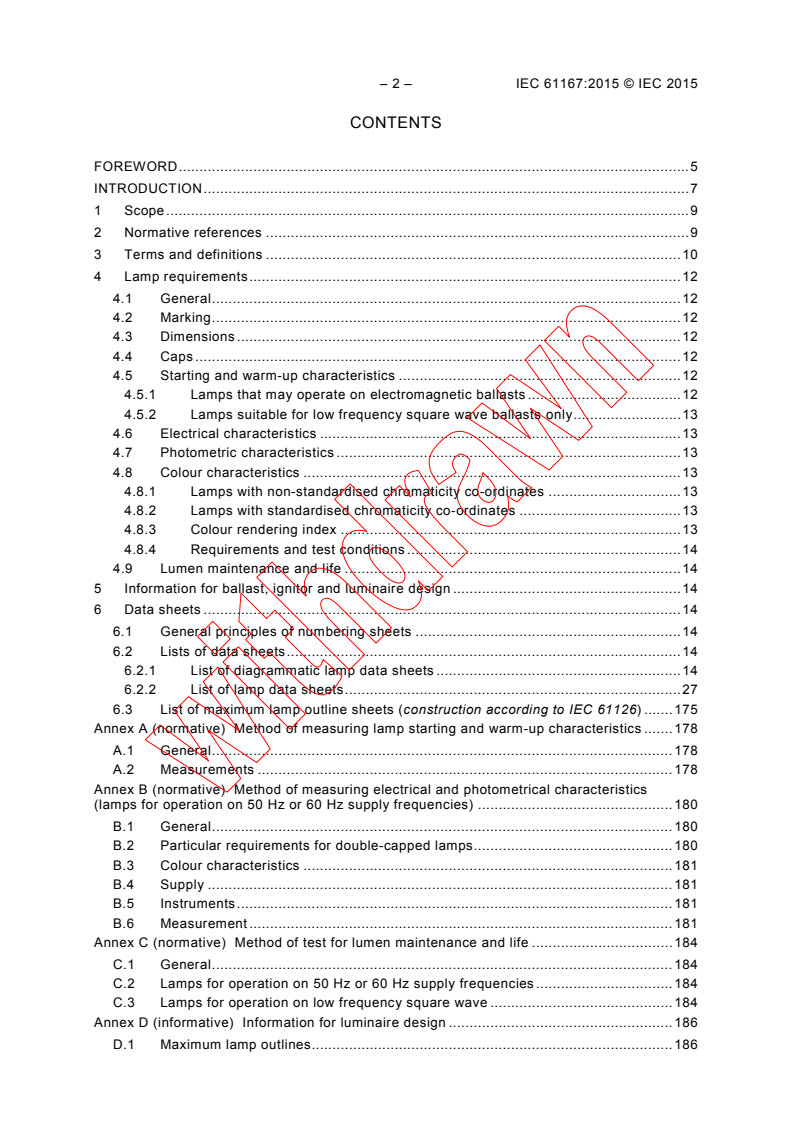
– 2 – IEC 61167:2015 © IEC 2015
CONTENTS
FOREWORD . 5
INTRODUCTION . 7
1 Scope . 9
2 Normative references . 9
3 Terms and definitions . 10
4 Lamp requirements . 12
4.1 General . 12
4.2 Marking . 12
4.3 Dimensions . 12
4.4 Caps . 12
4.5 Starting and warm-up characteristics . 12
4.5.1 Lamps that may operate on electromagnetic ballasts . 12
4.5.2 Lamps suitable for low frequency square wave ballasts only . 13
4.6 Electrical characteristics . 13
4.7 Photometric characteristics . 13
4.8 Colour characteristics . 13
4.8.1 Lamps with non-standardised chromaticity co-ordinates . 13
4.8.2 Lamps with standardised chromaticity co-ordinates . 13
4.8.3 Colour rendering index . 13
4.8.4 Requirements and test conditions . 14
4.9 Lumen maintenance and life . 14
5 Information for ballast, ignitor and luminaire design . 14
6 Data sheets . 14
6.1 General principles of numbering sheets . 14
6.2 Lists of data sheets . 14
6.2.1 List of diagrammatic lamp data sheets . 14
6.2.2 List of lamp data sheets . 27
6.3 List of maximum lamp outline sheets (construction according to IEC 61126) . 175
Annex A (normative) Method of measuring lamp starting and warm-up characteristics . 178
A.1 General . 178
A.2 Measurements . 178
Annex B (normative) Method of measuring electrical and photometrical characteristics
(lamps for operation on 50 Hz or 60 Hz supply frequencies) . 180
B.1 General . 180
B.2 Particular requirements for double-capped lamps . 180
B.3 Colour characteristics . 181
B.4 Supply . 181
B.5 Instruments . 181
B.6 Measurement . 181
Annex C (normative) Method of test for lumen maintenance and life . 184
C.1 General . 184
C.2 Lamps for operation on 50 Hz or 60 Hz supply frequencies . 184
C.3 Lamps for operation on low frequency square wave . 184
Annex D (informative) Information for luminaire design . 186
D.1 Maximum lamp outlines . 186
D.2 Replacement of lamps . 186
Annex E (normative) Method of measuring electrical and photometrical characteristics
on low frequency square wave reference ballast . 187
E.1 Purpose of this annex . 187
E.2 Characteristics . 187
E.3 Test procedure . 187
E.3.1 General . 187
E.3.2 Start-up . 188
E.3.3 Steady state . 188
Annex F (normative) Spectral analysis of power ripple: calculation procedure for
amplitude spectrum ratio and guidance . 189
F.1 General . 189
F.2 Mathematical background . 189
F.2.1 General . 189
F.2.2 Description of the algorithm . 189
F.3 Measurement procedure . 190
F.4 Test signal . 190
F.4.1 General . 190
F.4.2 Description of the test signal. 191
F.4.3 Outcome of the test signal . 191
Annex G (informative) Low frequency square wave operation . 192
G.1 General . 192
G.2 Information for square wave ballast design . 192
Annex H (informative) Information for ballast design . 198
H.1 General . 198
H.2 Explanation of the ignition schemes . 198
Annex I (informative) Information regarding lamp performance temperature limits for
luminaire design . 200
Annex J (informative) ILCOS codes . 202
Bibliography . 205
Figure A.1 – Circuit diagram for measurement of lamp starting and warm-up
characteristics . 179
Figure B.1 – Circuit diagram for measurement of lamp characteristics . 182
Figure B.2 – Luminaire simulator for use with double-capped lamps . 183
Figure E.1 – Circuit for lamp measurement under reference conditions . 188
Figure G.1 – DC current component . 195
Figure G.2 – HF ripple and fast Fourier transformation (power curve) . 196
Figure G.3 – Measurement of PCR during run-up and steady state . 196
Figure G.4 – Example of a measurement circuit of lamp potential against earth . 197
Figure G.5 – Commutation time, deviating waveform . 197
Figure H.1 – Example 1 for ignition scheme according to option (1) (see Annex G and
lamp data sheets) . 198
Figure H.2 – Example 2 for ignition scheme according to option (1) (see Annex G and
lamp data sheets) . 198
Figure H.3 – Example for ignition scheme according to option (2) (see Annex G and
lamp data sheets) . 199
Figure I.1 – Principle ways of heat transport in a lamp . 200
– 4 – IEC 61167:2015 © IEC 2015
Table 1 – List of diagrammatic lamp data sheets . 15
Table 2 – List of lamp data sheets . 27
Table 3 – List of maximum lamp outline sheets . 175
Table B.1 – Correlated colour temperature and chromaticity co-ordinates x and y . 181
Table E.1 – Characteristics of the reference ballast . 187
Table F.1 – Settings of the analysing oscilloscope . 190
Table G.1 – Requirements for square wave operation . 192
Table J.1 – Lamp coding . 202
INTERNATIONAL ELECTROTECHNICAL COMMISSION
____________
METAL HALIDE LAMPS –
PERFORMANCE SPECIFICATION
FOREWORD
1) The International Electrotechnical Commission (IEC) is a worldwide organization for standardization comprising
all national electrotechnical committees (IEC National Committees). The object of IEC is to promote
international co-operation on all questions concerning standardization in the electrical and electronic fields. To
this end and in addition to other activities, IEC publishes International Standards, Technical Specifications,
Technical Reports, Publicly Available Specifications (PAS) and Guides (hereafter referred to as “IEC
Publication(s)”). Their preparation is entrusted to technical committees; any IEC National Committee interested
in the subject dealt with may participate in this preparatory work. International, governmental and non-
governmental organizations liaising with the IEC also participate in this preparation. IEC collaborates closely
with the International Organization for Standardization (ISO) in accordance with conditions determined by
agreement between the two organizations.
2) The formal decisions or agreements of IEC on technical matters express, as nearly as possible, an international
consensus of opinion on the relevant subjects since each technical committee has representation from all
interested IEC National Committees.
3) IEC Publications have the form of recommendations for international use and are accepted by IEC National
Committees in that sense. While all reasonable efforts are made to ensure that the technical content of IEC
Publications is accurate, IEC cannot be held responsible for the way in which they are used or for any
misinterpretation by any end user.
4) In order to promote international uniformity, IEC National Committees undertake to apply IEC Publications
transparently to the maximum extent possible in their national and regional publications. Any divergence
between any IEC Publication and the corresponding national or regional publication shall be clearly indicated in
the latter.
5) IEC itself does not provide any attestation of conformity. Independent certification bodies provide conformity
assessment services and, in some areas, access to IEC marks of conformity. IEC is not responsible for any
services carried out by independent certification bodies.
6) All users should ensure that they have the latest edition of this publication.
7) No liability shall attach to IEC or its directors, employees, servants or agents including individual experts and
members of its technical committees and IEC National Committees for any personal injury, property damage or
other damage of any nature whatsoever, whether direct or indirect, or for costs (including legal fees) and
expenses arising out of the publication, use of, or reliance upon, this IEC Publication or any other IEC
Publications.
8) Attention is drawn to the Normative references cited in this publication. Use of the referenced publications is
indispensable for the correct application of this publication.
International Standard IEC 61167 has been prepared by subcommittee 34A: Lamps, of IEC
technical committee 34: Lamps and related equipment.
This third edition replaces the second edition published in 2011. This third edition constitutes
a technical revision.
This edition includes the following significant technical changes with respect to the previous
edition.
a) A set of new lamp data sheets (20 W, 35 W, 50 W, 100 W) is introduced.
b) Reference to ILCOS (International lamp coding system) is removed from the lamp data
sheets and now located in a new annex.
c) Information on outer bulb temperature (and in some cases also on pin temperature and
temperature adjacent to cap) is replaced with an explanation on differences in
manufacturers’ construction; this explanation is given in detail in a new annex.
– 6 – IEC 61167:2015 © IEC 2015
The text of this standard is based on the following documents:
FDIS Report on voting
34A/1809/FDIS 34A/1830/RVD
Full information on the voting for the approval of this standard can be found in the report on
voting indicated in the above table.
This publication has been drafted in accordance with the ISO/IEC Directives, Part 2.
NOTE In this standard, the following print types are used:
– Requirements proper: in roman type.
– Test specifications: in italic type.
– Explanatory matter: in smaller roman type.
The committee has decided that the contents of this publication will remain unchanged until
the stability date indicated on the IEC web site under "http://webstore.iec.ch" in the data
related to the specific publication. At this date, the publication will be
• reconfirmed,
• withdrawn,
• replaced by a revised edition, or
• amended.
IMPORTANT – The 'colour inside' logo on the cover page of this publication indicates
that it contains colours which are considered to be useful for the correct
understanding of its contents. Users should therefore print this document using a
colour printer.
INTRODUCTION
A big step forward when standardising metal halide lamps and their operation was made with
the second edition which was published in 2011. Meanwhile, agreements have been reached
for introduction of new lamp types and in aspects of operation which led to the third edition.
Major changes of the second edition are as follows. Since IEC 62035 Discharge lamps
(excluding fluorescent lamps) – Safety specifications was published in 1999, the related lamp
specific performance standards like IEC 61167 needed to be reviewed in an editorial action,
splitting performance and safety requirements, but also to include all items in abeyance,
stored for this occasion. The separation has already been carried out with other HID lamps.
So, in some instances, the “pilot” text of IEC 60188 has been used. Moreover, the
measurement part has been introduced with the assistance of IEC 60188 and IEC 60081.
It may also be noted that the colour coordinates for CCT 3 000 K and 4 200 K were adjusted
to a point two units below Planck in order to take account of the life time shift to higher y-
values.
Apart from these basic changes which were needed for long time, the new technique of low
frequency square wave (LFSW) operation was implemented. This has led to additional pages
to the existing lamp data sheets and several annexes describing and specifying the
requirements. Further, detailed requirements and measurement methods for the ignition
(break down/take-over/run-up) were introduced. Intense discussions took place on
measurement and specification of the peak-current ratio during ignition and steady state.
Workshops were held in order to come to a broad worldwide acceptance of the concepts. The
workshops were open for experts from lamp and control gear side in order to accommodate
the interface between control gear and lamp to these requirements.
IEC SC34A MT PRESCO took the opportunity to add further lamp types which were
considered of having market relevance and needing normative support.
The International Electrotechnical Commission (IEC) draws attention to the fact that it is
claimed that compliance with this document may involve the use of patents concerning the
lamp given in standard sheets 1039-1, 1041-1, 1080-1 and 1082-1.
IEC takes no position concerning the evidence, validity and scope of this patent right.
The holder of this patent has assured the IEC that he is willing to negotiate licences under
reasonable and non-discriminatory terms and conditions with applicants throughout the world.
In this respect, the statement of the holder of these patents is registered with the IEC.
Information may be obtained from:
Panasonic Corporation
1-1 Saiwai-cho,
Takatsuki City,
Osaka 569-1193,
Japan
Attention is drawn to the possibility that some of the elements of this document may be the
subject of patent rights other than those identified above. IEC shall not be held responsible for
identifying any or all such patent rights.
ISO (www.iso.org/patents) and IEC (http://www.iec.ch/tctools/patent_decl.htm) maintain on-
line data bases of patents relevant to their standards. Users are encouraged to consult the
data bases for the most up to date information concerning patents.
– 8 – IEC 61167:2015 © IEC 2015
nd
Major changes of the third edition are as follows. Compared to the 2 edition, a set of new
lamp data sheets (20 W, 35 W, 50 W, 100 W) is introduced. Reference to ILCOS
(International lamp coding system) is removed from the lamp data sheets and now located in
a new annex. Information on outer bulb temperature (and in some cases also on pin
temperature and temperature adjacent to cap) is replaced with an explanation on differences
in manufacturers’ construction; this explanation is given in detail in a new annex.
METAL HALIDE LAMPS –
PERFORMANCE SPECIFICATION
1 Scope
This International Standard specifies the performance requirements for metal halide lamps for
general lighting purposes.
For some of the requirements given in this standard, reference is made to “the relevant lamp
data sheet”. For some lamps, these data sheets are contained in this standard. For other
lamps, falling under the scope of this standard, the relevant data are supplied by the lamp
manufacturer or responsible vendor.
The requirements of this standard relate only to type testing.
The requirements and tolerances permitted by this standard correspond to testing of a type
test sample submitted by the manufacturer for that purpose. In principle this type test sample
should consist of units having characteristics typical of the manufacturer’s production and
being as close to the production centre point values as possible.
It may be expected that with the tolerances given in the standard, the product manufactured in
accordance with the type test sample will comply with the standard for the majority of
production. Due to the production spread however, it is inevitable that there will sometimes be
products outside the specified tolerances. For guidance on sampling plans and procedures for
inspection by attributes, see IEC 60410.
2 Normative references
The following documents, in whole or in part, are normatively referenced in this document and
are indispensable for its application. For dated references, only the edition cited applies. For
undated references, the latest edition of the referenced document (including any
amendments) applies.
IEC 60050-845:1987, International Electrotechnical Vocabulary – Chapter 845: Lighting
IEC 60061-1, Lamp caps and holders together with gauges for the control of
interchangeability and safety – Part 1: Lamp caps
IEC 60598-1, Luminaires – General requirements and tests
IEC 60923, Auxiliaries for lamps – Ballasts for discharge lamps (excluding tubular fluorescent
lamps) – Performance requirements
IEC 60927, Auxiliaries for lamps – Starting devices (other than glow starters) – Performance
requirements
IEC TR 61341, Method of measurement of centre beam intensity and beam angle(s) of
reflector lamps
IEC 62035, Discharge lamps (excluding fluorescent lamps) – Safety specifications
IEC 62471, Photobiological safety of lamp and lamp systems
– 10 – IEC 61167:2015 © IEC 2015
CIE 84, The measurement of luminous flux
3 Terms and definitions
For the purposes of this document, the terms and definitions in IEC 60050-845 and the
following apply.
3.1
metal halide lamp
high-intensity discharge lamp in which the major portion of the light is produced by the
radiation of a mixture of metallic vapour, metal halides and the products issued from the
dissociation of metal halides
Note 1 to entry: The definition covers clear and coated lamps.
[SOURCE: IEC 60050-845:1987, 845.07.25, modified]
3.2
nominal value
approximate quantity value used to designate or identify a lamp
[SOURCE: IEC 60081, 1.4.3]
3.3
rated value
quantity value for a characteristic of a lamp for specified operating conditions
The value and the conditions are specified in this standard, or assigned by the manufacturer
or responsible vendor.
[SOURCE: IEC 60081, 1.4.4]
3.4
lumen maintenance
ratio of the luminous flux of a lamp at a given time in its life to the initial reading of its
luminous flux, the lamp being operated under specific conditions
Note 1 to entry: The ratio is generally expressed as a percentage.
3.5
initial readings
starting characteristics of a lamp, measured before ageing, and the electrical and photometric
characteristics, measured at the end of the 100 h ageing period
3.6
reference ballast
special ballast complying with the requirements of IEC 60923, designed for the purpose of
providing comparison standards for use in testing ballasts, for the selection of reference
lamps and for testing regular production lamps under standardised conditions
Note 1 to entry: It is essentially characterised by the fact that, at its rated frequency, it has a stable
voltage/current ratio which is relatively uninfluenced by variations in current, temperature and electromagnetic
surroundings, as outlined in the relevant ballast standard.
[SOURCE: IEC 60662:2011, 3.4, modified]
3.7
calibration current
value of the current on which the calibration and control of the reference ballast are based
3.8
type test
test or a series of tests made on a type test sample for the purpose of checking compliance of
the design of a given product with the requirements of the relevant standard
[SOURCE: IEC 60081:1997, 1.4.10]
3.9
specific effective radiant UV power
effective power of the UV radiation of a lamp related to its luminous flux
Note 1 to entry: Specific effective radiant UV power is expressed in mW/klm
Note 2 to entry: The effective power of the UV radiation is obtained by weighting the spectral power distribution of
the lamp with the UV hazard function S (Λ). Information about the relevant UV hazard function is given in
UV
IEC 62471. It only relates to possible hazards regarding UV exposure of human beings. It does not deal with the
possible influence of optical radiation on materials, like mechanical damage or discoloration.
3.10
type test sample
sample consisting of one or more similar units submitted by the manufacturer or the
responsible vendor for the purpose of a type test
3.11
inrush current
short term high lamp current, totally or partially rectified, by the asymmetrical electrode
heating for some seconds during lamp ignition
3.12
warm-up current
increased lamp current after inrush phase which is due to the low initial lamp voltage
Note 1 to entry: It is in the limits of double rated lamp current down to a value corresponding to highest allowed
lamp voltage.
3.13
run-up time
after switching on a 100 h aged lamp at rated supply voltage, maximum time allowed to reach
90 % of the declared luminous flux
3.14
take-over
time between lamp being able to conduct current until electrodes are at thermionic emission
Note 1 to entry: At the end of the take-over phase, the lamp power factor is above 0,9 and the lamp voltage
stabilises and ramps up from about 20 V r.m.s.
3.15
peak current ratio
PCR
ratio between the peak currents and the r.m.s. currents
Note 1 to entry: For measurement procedure, see Annex G.
Note 2 to entry: This note applies to the French language only
3.16
typical lamp voltage
steady state lamp voltage expected for a lamp operating on low frequency square wave
ballast
– 12 – IEC 61167:2015 © IEC 2015
Note 1 to entry: Typical lamp current is derived from the lamp rated power and typical lamp voltage. In practice,
lamps for use on low frequency square wave ballasts may be targeted to a different voltage within the allowed
range for best performance, and the lamp current will be different accordingly. Typical lamp voltages and currents
have been used as a basis for assigning currents at take-over and run-up.
3.17
typical lamp current
steady state lamp current expected for a lamp operating on low frequency square wave
ballast
Note 1 to entry: Typical lamp current is derived from the lamp rated power and typical lamp voltage. In practice,
lamps for use on low frequency square wave ballasts may be targeted to a different voltage within the allowed
range for best performance, and the lamp current will be different accordingly. Typical lamp voltages and currents
have been used as a basis for assigning currents at take-over and run-up.
3.18
commutation time
fall and rise time
transition time of lamp current at half cycle polarity reversals
Note 1 to entry: It is measured using lamp current waveforms between 90 % of the r.m.s. value of one half cycle
to 90 % of the r.m.s. value of the opposite half cycle.
4 Lamp requirements
4.1 General
A lamp, on which compliance with this standard is claimed shall comply with the requirements
of IEC 62035.
Some lamps are specified on the data sheet or declared by the manufacturer as suitable for
operation on low frequency square wave ballasts only. For these lamps, separate
requirements are indicated where appropriate.
A lamp shall be so designed that its performance is reliable in normal and accepted use. In
general, this can be achieved by satisfying the requirements of the following subclauses.
The requirements given apply to 95 % of production.
4.2 Marking
A suitable advice on the colour appearance is required. It may preferably take the form of
ILCOS (see IEC 61231). Other options are the manufacturer’s code or the correlated colour
temperature. The information may be given either on the lamp or in the supplier’s catalogue.
4.3 Dimensions
The dimensions of a lamp shall comply with the values specified on the relevant lamp data
sheet.
4.4 Caps
The cap on a finished lamp shall comply with IEC 60061-1.
4.5 Starting and warm-up characteristics
4.5.1 Lamps that may operate on electromagnetic ballasts
A lamp shall start fully within the maximum run-up time specified on the relevant lamp data
sheet and remain alight. Conditions and method of test are given in Annex A.
The maximum inrush current as given on the lamp data sheet shall not be exceeded. For the
test circuit and procedure, see IEC 60923.
The lamp warm-up current shall be between the minimum and maximum values as given on
the lamp data sheet. Conditions and method of test are given in Annex A.
NOTE The maximum inrush current (peak) restricts the value of the current during rectification in the starting
phase in order to prevent performance damages of ballast and lamp (overheating and melting of the electrodes).
The minimum warm-up current is required in order to safeguard the transition from the glow phase to the arc
phase.
4.5.2 Lamps suitable for low frequency square wave ballasts only
A lamp shall start and run up fully within the time specified on the lamp data sheet, applying
the method of test given in E.3.1.
4.6 Electrical characteristics
The lamp electrical characteristics shall comply with the values given in the relevant lamp
data sheet. Conditions and method of test are given in Annex B.
For lamps suitable for operation on low frequency square wave ballasts only, conditions and
method of test are given in Annex E. Unless otherwise specified on the lamp data sheet the
lamp voltage shall comply with the limits of 75 V to 110 V.
NOTE For these lamps the power control of the ballast provides more freedom in the choice of lamp voltage to
optimise the light technical properties of the lamp.
4.7 Photometric characteristics
The photometric requirements are as follows.
a) The initial reading of the luminous flux shall be not less than 90 % of the rated value.
b) The initial reading of the centre beam intensity of a reflector lamp shall be not less than
75 % of the rated value.
c) The initial beam angle of a reflector lamp shall be within ±25 % of the rated value for all
beam angles.
d) Conditions and method of test are given in Annex B.
For lamps suitable for operation on low frequency square wave ballasts only, conditions and
method of test are given in Annex E.
4.8 Colour characteristics
4.8.1 Lamps with non-standardised chromaticity co-ordinates
The rated values and tolerance areas shall be assigned by the manufacturer or responsible
vendor.
4.8.2 Lamps with standardised chromaticity co-ordinates
The correlated colour temperature and chromaticity co-ordinates applicable to a certain lamp
are given on the relevant lamp data sheet. A collation is given in Table B.1.
4.8.3 Colour rendering index
The initial reading of the general colour rendering index (Ra) of a lamp shall not be less than
the nominal value decreased by 3.
– 14 – IEC 61167:2015 © IEC 2015
4.8.4 Requirements and test conditions
Under consideration.
4.9 Lumen maintenance and life
Lumen maintenance and life shall comply with the data provided by the lamp manufacturer.
For methods of test, see Annex C.
5 Information for ballast, ignitor and luminaire design
In order to ensure reliable starting and operating conditions, ballasts, ignitors and luminaires
should meet the requirements specified on the relevant lamp data sheet. For additional
information for luminaire design, see Annex D.
IEC 60682 provides information for the measurement of the pinch temperature. Advice
regarding the measurement of the bulb temperature can be taken from IEC 60357, Annex D.
These measurements should be taken account of, for performance criteria of the lamps.
For lamps with nominal power 35 W/70 W/150 W, rated power for electronic ballast design is
39 W/73 W/147 W respectively.
6 Data sheets
6.1 General principles of numbering sheets
The first number represents the number of this standard: 61167, followed by the letters “IEC”.
The second number represents the data sheet number.
The third number represents the edition of the page of the data sheet. In cases where a data
sheet has more than one page, it is possible for the pages to have different edition numbers,
with the data sheet number remaining the same.
6.2 Lists of data sheets
6.2.1 List of diagrammatic lamp data sheets
Table 1 represents the listing of diagrammatic data sheets, corresponding to lamp data
sheets.
Table 1 – List of diagrammatic lamp data sheets
Sheet number 61167-IEC- Description Cap
0010 Single-capped E27 and E40, tubular
0015 Single-capped E27 and E40, elliptical
0020 Single-capped GU6.5
0025 Single-capped G8.5
0030 Single-capped GU8.5
0035 Single-capped G12
0210 Reflector E27
0215 Reflector GX8.5
0220 Reflector GX10
0110 Double-capped RX7s
0120 Double-capped Fc2
– 16 – IEC 61167:2015 © IEC 2015
DIAGRAMMATIC DATA SHEET
FOR LOCATION OF SINGLE-CAPPED
Page 1
METAL HALIDE LAMP DIMENSIONS
E27/E40 cap*, tubular bulb
Reference plane is the bottom of the lamp.
A
D
B
C
Key
A Diameter
B Distance from reference plane to bulb top = total lamp length
C Light centre length
D Arc length
* See sheet 7004-21 (E27) or 7004-24 (E40) of IEC 60061-1
Publication CEI 61167
Texte français au
verso 61167-IEC-0010-1
IEC Publication 61167
French text overleaf
DIAGRAMMATIC DATA SHEET
FOR LOCATION OF SINGLE-CAPPED
Page 1
METAL HALIDE LAMP DIMENSIONS
E27/E40 cap*, elliptical bulb
Reference plane is the bottom of the lamp.
A
D
B
C
Key
A Diameter
B Distance from reference plane to bulb top = total lamp length
C Light centre length
D Arc length
* See sheet 7004-21-9 (E27) or 7004-24-6 (E40) of IEC 60061-1
Publication CEI 61167
Texte français au
verso
61167-IEC-0015-1
IEC Publication 61167
French text overleaf
– 18 – IEC 61167:2015 © IEC 2015
DIAGRAMMATIC DATA SHEET
FOR LOCATION OF SINGLE-CAPPED
Page 1
METAL HALIDE LAMP DIMENSIONS
GU6.5 cap*
Reference plane is the lower cap rim.
Key
A Diameter
B Distance from reference plane to bulb top
C Light centre length
D Arc length
* See sheet 7004-152 of IEC 60061-1
Publication CEI 61167
Texte français au
verso
61167-IEC-0020-1
IEC Publication 61167
French text overleaf
DIAGRAMMATIC DATA SHEET
FOR LOCATION OF SINGLE-CAPPED
Page 1
METAL HALIDE LAMP DIMENSIONS
G8.5 cap*
Reference plane is defined by the pin ends.
AA
D
D
B
B
C
C
Key
A Diameter
B Distance from reference plane to bulb top
C Light centre length
D Arc length
* See sheet 7004-122 of IEC 60061-1
Publication CEI 61167
Texte français au
verso 61167-IEC-0025-1
IEC Publication 61167
French text overleaf
– 20 – IEC 61167:2015 © I
...