

IEC 61210:2010
(Main)Connecting devices - Flat quick-connect terminations for electrical copper conductors - Safety requirements
General Information
- Abstract
IEC 61210:2010 applies to non-insulated flat quick-connect terminations consisting of a male tab of size 2,8 mm, 4,8 mm, 6,3 mm or 9,5 mm with hole or dimple detents and a mating female connector for use as either an incorporated or an integrated part of an equipment or of a component, or as a separate entity. This standard establishes uniform requirements for the dimensions, performance characteristics and test program. The connected electrical copper conductors shall be flexible or rigid stranded, having a cross-sectional area up to and including 6 mm2 or rigid solid having a cross-sectional area up to and including 2,5 mm2. This standard shall not be used for connecting aluminum conductors. The rated voltage shall not exceed 1 000 V a.c. with a frequency up to and including 1 000 Hz, and 1 500 V d.c., and having the temperature limits applicable to materials used within this standard. This second edition cancels and replaces the first edition published in 1993 and constitutes a merge between the first edition of IEC 61210 published by SC23F and IEC 60760 published in 1989 by SC48B. This second edition does not introduce major technical modifications.
- Status
- Published
- Publication Date
- 30-Aug-2010
- Technical Committee
- TC 23 - Electrical accessories
- Current Stage
- PPUB - Publication issued
- Start Date
- 31-Aug-2010
- Completion Date
- 30-Sep-2010


Overview
IEC 61210:2010 is an international standard developed by the International Electrotechnical Commission (IEC) that specifies safety requirements for non-insulated flat quick-connect terminations used with electrical copper conductors. These terminations consist of male tabs (sizes 2.8 mm, 4.8 mm, 6.3 mm, or 9.5 mm) featuring hole or dimple detents, and their mating female connectors. The standard applies to terminations used either as integrated parts of equipment, components, or as separate connecting devices.
This standard establishes uniform requirements concerning the dimensions, performance characteristics, and testing protocols for flat quick-connect terminations, ensuring reliable and safe electrical connections. It covers copper conductors-both flexible and rigid stranded up to 6 mm², and rigid solid conductors up to 2.5 mm². It explicitly excludes aluminum conductors. The rated voltage for compliant devices must not exceed 1000 V AC at frequencies up to 1000 Hz and up to 1500 V DC.
IEC 61210:2010 is the second edition, merging and updating the first edition of IEC 61210 and IEC 60760, without major technical changes.
Key Topics
Scope and Applicability
Defines the types of flat quick-connect terminations and compatible conductor sizes and types (copper only), including voltage and frequency limits.Dimensions and Construction
Specifies precise dimensions for male tabs and female connectors to ensure interchangeability and reliable electrical contact. Includes details on hole and dimple detent designs.Performance Characteristics
Covers critical function requirements such as insertion and withdrawal force, mechanical overload resistance, temperature rise during operation, cyclic current loading, and tensile strength for crimped connections.Safety Requirements
Ensures that quick-connect terminations meet strict safety criteria to prevent electrical hazards, secure connections, and mechanical durability.Test Methods and Procedures
Details a comprehensive test program, including type tests for mechanical and electrical performance under various operational conditions.Marking and Information
Requirements for clear marking on connectors to convey critical specifications and ensure traceability.Exclusions and Limitations
Aluminum conductors are not included in the standard, ensuring the guidance is specific to copper conductors and their electrical behaviors.
Applications
IEC 61210:2010 standards are widely applicable in industries and equipment sectors where safe, reliable flat quick-connect electrical terminations are essential:
Electrical Appliances
Ensures safety and consistent performance of internal wiring connections.Automotive Wiring Systems
Provides robust connectors capable of withstanding vibration and mechanical stresses.Industrial Equipment
Enables reliable power and signal connections in harsh operating environments.Consumer Electronics
Standardizes quick-connect interfaces for easy assembly and serviceability.Renewable Energy Systems
Facilitates safe interconnections in solar panels and other electrical modules.Electrical Maintenance and Repair
Guides manufacturers, engineers, and technicians in selecting compliant connectors for retrofitting and repairs.
Related Standards
IEC 60760
The predecessor standard on connecting devices incorporated into this edition, originally published in 1989.IEC 60204-1
Safety of machinery - Electrical equipment of machines - Part 1: General requirements, relevant for connected electrical components.IEC 60320
Appliance couplers for household and similar general purposes, related to connector safety and compatibility.IEC 60664
Insulation coordination for equipment within low-voltage systems, complementing voltage and insulation considerations.ISO/IEC Directives, Part 2
Governs the drafting rules for international standards like IEC 61210.
Practical Value
Implementing IEC 61210:2010 ensures safety and interoperability in electrical installation design, manufacturing, and maintenance. It helps organizations:
Reduce risks of electrical faults and accidents due to poor-fitting or incompatible connectors.
Ensure uniformity and compatibility of quick-connect devices across global markets.
Facilitate compliance with regulatory and customer safety requirements.
Promote durability and performance consistency under rated electrical loads and environmental conditions.
By adhering to IEC 61210:2010, manufacturers and engineers achieve high standards in electrical connection safety and functionality, enhancing overall product reliability and consumer confidence.
Keywords: IEC 61210:2010, flat quick-connect terminations, electrical copper conductors, safety requirements, male tab connectors, female connectors, connecting devices standards, electrical connector performance, copper conductor connections, IEC electrical standards.
Get Certified
Connect with accredited certification bodies for this standard

ECOCERT
Organic and sustainability certification.

IMQ S.p.A. (Certification)
Italian electrical product certification.

SLG Prüf- und Zertifizierungs GmbH
German testing and certification body.
Sponsored listings
Frequently Asked Questions
IEC 61210:2010 is a standard published by the International Electrotechnical Commission (IEC). Its full title is "Connecting devices - Flat quick-connect terminations for electrical copper conductors - Safety requirements". This standard covers: IEC 61210:2010 applies to non-insulated flat quick-connect terminations consisting of a male tab of size 2,8 mm, 4,8 mm, 6,3 mm or 9,5 mm with hole or dimple detents and a mating female connector for use as either an incorporated or an integrated part of an equipment or of a component, or as a separate entity. This standard establishes uniform requirements for the dimensions, performance characteristics and test program. The connected electrical copper conductors shall be flexible or rigid stranded, having a cross-sectional area up to and including 6 mm2 or rigid solid having a cross-sectional area up to and including 2,5 mm2. This standard shall not be used for connecting aluminum conductors. The rated voltage shall not exceed 1 000 V a.c. with a frequency up to and including 1 000 Hz, and 1 500 V d.c., and having the temperature limits applicable to materials used within this standard. This second edition cancels and replaces the first edition published in 1993 and constitutes a merge between the first edition of IEC 61210 published by SC23F and IEC 60760 published in 1989 by SC48B. This second edition does not introduce major technical modifications.
IEC 61210:2010 applies to non-insulated flat quick-connect terminations consisting of a male tab of size 2,8 mm, 4,8 mm, 6,3 mm or 9,5 mm with hole or dimple detents and a mating female connector for use as either an incorporated or an integrated part of an equipment or of a component, or as a separate entity. This standard establishes uniform requirements for the dimensions, performance characteristics and test program. The connected electrical copper conductors shall be flexible or rigid stranded, having a cross-sectional area up to and including 6 mm2 or rigid solid having a cross-sectional area up to and including 2,5 mm2. This standard shall not be used for connecting aluminum conductors. The rated voltage shall not exceed 1 000 V a.c. with a frequency up to and including 1 000 Hz, and 1 500 V d.c., and having the temperature limits applicable to materials used within this standard. This second edition cancels and replaces the first edition published in 1993 and constitutes a merge between the first edition of IEC 61210 published by SC23F and IEC 60760 published in 1989 by SC48B. This second edition does not introduce major technical modifications.
IEC 61210:2010 is classified under the following ICS (International Classification for Standards) categories: 19.080 - Electrical and electronic testing; 29.120.20 - Connecting devices; 71.040.40 - Chemical analysis. The ICS classification helps identify the subject area and facilitates finding related standards.
IEC 61210:2010 is available in PDF format for immediate download after purchase. The document can be added to your cart and obtained through the secure checkout process. Digital delivery ensures instant access to the complete standard document.
Standards Content (Sample)
IEC 61210 ®
Edition 2.0 2010-08
INTERNATIONAL
STANDARD
NORME
INTERNATIONALE
Connecting devices – Flat quick-connect terminations for electrical copper
conductors – Safety requirements
Dispositifs de connexion – Bornes plates à connexion rapide pour conducteurs
électriques en cuivre – Exigences de sécurité
All rights reserved. Unless otherwise specified, no part of this publication may be reproduced or utilized in any form or by
any means, electronic or mechanical, including photocopying and microfilm, without permission in writing from either IEC or
IEC's member National Committee in the country of the requester.
If you have any questions about IEC copyright or have an enquiry about obtaining additional rights to this publication,
please contact the address below or your local IEC member National Committee for further information.
Droits de reproduction réservés. Sauf indication contraire, aucune partie de cette publication ne peut être reproduite
ni utilisée sous quelque forme que ce soit et par aucun procédé, électronique ou mécanique, y compris la photocopie
et les microfilms, sans l'accord écrit de la CEI ou du Comité national de la CEI du pays du demandeur.
Si vous avez des questions sur le copyright de la CEI ou si vous désirez obtenir des droits supplémentaires sur cette
publication, utilisez les coordonnées ci-après ou contactez le Comité national de la CEI de votre pays de résidence.
IEC Central Office
3, rue de Varembé
CH-1211 Geneva 20
Switzerland
Email: inmail@iec.ch
Web: www.iec.ch
About the IEC
The International Electrotechnical Commission (IEC) is the leading global organization that prepares and publishes
International Standards for all electrical, electronic and related technologies.
About IEC publications
The technical content of IEC publications is kept under constant review by the IEC. Please make sure that you have the
latest edition, a corrigenda or an amendment might have been published.
ƒ Catalogue of IEC publications: www.iec.ch/searchpub
The IEC on-line Catalogue enables you to search by a variety of criteria (reference number, text, technical committee,…).
It also gives information on projects, withdrawn and replaced publications.
ƒ IEC Just Published: www.iec.ch/online_news/justpub
Stay up to date on all new IEC publications. Just Published details twice a month all new publications released. Available
on-line and also by email.
ƒ Electropedia: www.electropedia.org
The world's leading online dictionary of electronic and electrical terms containing more than 20 000 terms and definitions
in English and French, with equivalent terms in additional languages. Also known as the International Electrotechnical
Vocabulary online.
ƒ Customer Service Centre: www.iec.ch/webstore/custserv
If you wish to give us your feedback on this publication or need further assistance, please visit the Customer Service
Centre FAQ or contact us:
Email: csc@iec.ch
Tel.: +41 22 919 02 11
Fax: +41 22 919 03 00
A propos de la CEI
La Commission Electrotechnique Internationale (CEI) est la première organisation mondiale qui élabore et publie des
normes internationales pour tout ce qui a trait à l'électricité, à l'électronique et aux technologies apparentées.
A propos des publications CEI
Le contenu technique des publications de la CEI est constamment revu. Veuillez vous assurer que vous possédez
l’édition la plus récente, un corrigendum ou amendement peut avoir été publié.
ƒ Catalogue des publications de la CEI: www.iec.ch/searchpub/cur_fut-f.htm
Le Catalogue en-ligne de la CEI vous permet d’effectuer des recherches en utilisant différents critères (numéro de référence,
texte, comité d’études,…). Il donne aussi des informations sur les projets et les publications retirées ou remplacées.
ƒ Just Published CEI: www.iec.ch/online_news/justpub
Restez informé sur les nouvelles publications de la CEI. Just Published détaille deux fois par mois les nouvelles
publications parues. Disponible en-ligne et aussi par email.
ƒ Electropedia: www.electropedia.org
Le premier dictionnaire en ligne au monde de termes électroniques et électriques. Il contient plus de 20 000 termes et
définitions en anglais et en français, ainsi que les termes équivalents dans les langues additionnelles. Egalement appelé
Vocabulaire Electrotechnique International en ligne.
ƒ Service Clients: www.iec.ch/webstore/custserv/custserv_entry-f.htm
Si vous désirez nous donner des commentaires sur cette publication ou si vous avez des questions, visitez le FAQ du
Service clients ou contactez-nous:
Email: csc@iec.ch
Tél.: +41 22 919 02 11
Fax: +41 22 919 03 00
IEC 61210 ®
Edition 2.0 2010-08
INTERNATIONAL
STANDARD
NORME
INTERNATIONALE
Connecting devices – Flat quick-connect terminations for electrical copper
conductors – Safety requirements
Dispositifs de connexion – Bornes plates à connexion rapide pour conducteurs
électriques en cuivre – Exigences de sécurité
INTERNATIONAL
ELECTROTECHNICAL
COMMISSION
COMMISSION
ELECTROTECHNIQUE
PRICE CODE
INTERNATIONALE
W
CODE PRIX
ICS 29.120.20 ISBN 978-2-88912-173-1
– 2 – 61210 © IEC:2010
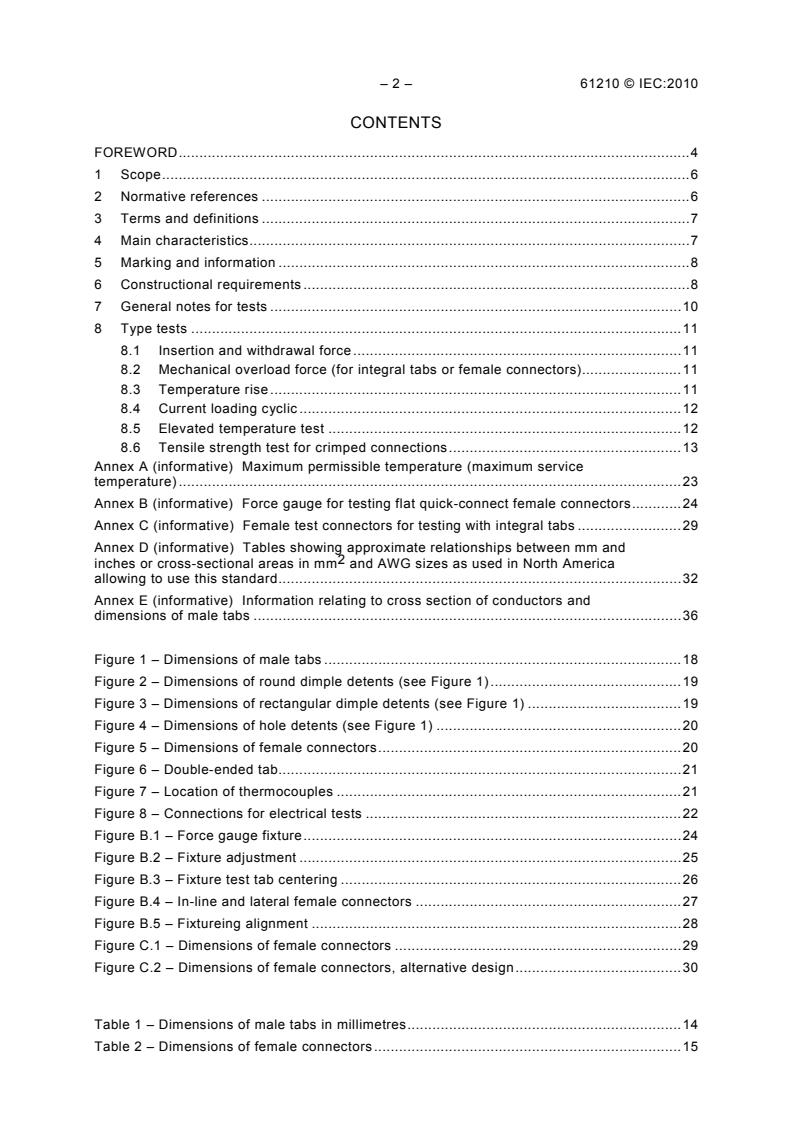
CONTENTS
FOREWORD.4
1 Scope.6
2 Normative references .6
3 Terms and definitions .7
4 Main characteristics.7
5 Marking and information .8
6 Constructional requirements .8
7 General notes for tests .10
8 Type tests .11
8.1 Insertion and withdrawal force .11
8.2 Mechanical overload force (for integral tabs or female connectors).11
8.3 Temperature rise.11
8.4 Current loading cyclic.12
8.5 Elevated temperature test .12
8.6 Tensile strength test for crimped connections.13
Annex A (informative) Maximum permissible temperature (maximum service
temperature) .23
Annex B (informative) Force gauge for testing flat quick-connect female connectors.24
Annex C (informative) Female test connectors for testing with integral tabs .29
Annex D (informative) Tables showing approximate relationships between mm and
inches or cross-sectional areas in mm and AWG sizes as used in North America
allowing to use this standard.32
Annex E (informative) Information relating to cross section of conductors and
dimensions of male tabs .36
Figure 1 – Dimensions of male tabs .18
Figure 2 – Dimensions of round dimple detents (see Figure 1).19
Figure 3 – Dimensions of rectangular dimple detents (see Figure 1) .19
Figure 4 – Dimensions of hole detents (see Figure 1) .20
Figure 5 – Dimensions of female connectors.20
Figure 6 – Double-ended tab.21
Figure 7 – Location of thermocouples .21
Figure 8 – Connections for electrical tests .22
Figure B.1 – Force gauge fixture.24
Figure B.2 – Fixture adjustment .25
Figure B.3 – Fixture test tab centering .26
Figure B.4 – In-line and lateral female connectors .27
Figure B.5 – Fixtureing alignment .28
Figure C.1 – Dimensions of female connectors .29
Figure C.2 – Dimensions of female connectors, alternative design.30
Table 1 – Dimensions of male tabs in millimetres.14
Table 2 – Dimensions of female connectors.15
61210 © IEC:2010 – 3 –
Table 3 – Test sequences and sets of samples .15
Table 4 – Tolerances of test tab thickness .15
Table 5 – Insertion and withdrawal forces .16
Table 6 – Retention force.16
Table 7 – Test current for temperature rise .16
Table 8 – Test current for current loading, cyclic.16
Table 9 – Pull force for testing the crimped connection .17
Table A.1 – Maximum permissible temperature (maximum service temperature).23
Table C.1 – Dimensions of female connectors in millimetres (see Figure C.1).29
Table C.2 – Dimensions of female connectors in inches (see Figure C.1) .30
Table C.3 – Dimensions of alternative design female connectors in millimetres (see
Figure C.2) .30
Table C.4 – Dimensions of alternative design female connectors in inches (see Figure
C.2) .31
Table D.1 – Relationship between mm and inches or mm and AWG within the scope.32
Table D.2 Relationship between mm and inches in Subclause 4.1 .32
Table D.3 – Approximate relationship between cross-sectional area in mm and AWG
sizes in Subclause 4.2 .32
Table D.4 – Dimensions of male tabs in inches applicable in Subclauses 6.3 and 8.1
(equivalent with Table 1).33
Table D.5 – Dimensions of female connectors applicable in Subclause 6.4 (equivalent
with Table 2).34
Table D.6 – Tolerances of test tab thickness applicable in Subclause 8.1 (equivalent
with Table 4).34
Table D.7 – Insertion and withdrawal forces applicable in Subclause 8.1 (equivalent
with Table 5).34
Table D.8 – Retention force applicable in Subclause 8.2 (equivalent with Table 6) .34
Table D.9 – Test current for temperature rise applicable in Subclauses 8.3 and 8.5
(equivalent with Table 7).35
Table D.10 – Test current for current loading, cyclic applicable in Subclause 8.4
(equivalent with Table 8).35
Table D.11 – Pull force for testing the crimped connection applicable in Subclause 8.6
(equivalent with Table 9).35
Table E.1 – Relationships between conductors and tabs.36
– 4 – 61210 © IEC:2010
INTERNATIONAL ELECTROTECHNICAL COMMISSION
____________
CONNECTING DEVICES –
FLAT QUICK-CONNECT TERMINATIONS
FOR ELECTRICAL COPPER CONDUCTORS –
SAFETY REQUIREMENTS
FOREWORD
1) The International Electrotechnical Commission (IEC) is a worldwide organization for standardization comprising
all national electrotechnical committees (IEC National Committees). The object of IEC is to promote
international co-operation on all questions concerning standardization in the electrical and electronic fields. To
this end and in addition to other activities, IEC publishes International Standards, Technical Specifications,
Technical Reports, Publicly Available Specifications (PAS) and Guides (hereafter referred to as “IEC
Publication(s)”). Their preparation is entrusted to technical committees; any IEC National Committee interested
in the subject dealt with may participate in this preparatory work. International, governmental and non-
governmental organizations liaising with the IEC also participate in this preparation. IEC collaborates closely
with the International Organization for Standardization (ISO) in accordance with conditions determined by
agreement between the two organizations.
2) The formal decisions or agreements of IEC on technical matters express, as nearly as possible, an international
consensus of opinion on the relevant subjects since each technical committee has representation from all
interested IEC National Committees.
3) IEC Publications have the form of recommendations for international use and are accepted by IEC National
Committees in that sense. While all reasonable efforts are made to ensure that the technical content of IEC
Publications is accurate, IEC cannot be held responsible for the way in which they are used or for any
misinterpretation by any end user.
4) In order to promote international uniformity, IEC National Committees undertake to apply IEC Publications
transparently to the maximum extent possible in their national and regional publications. Any divergence
between any IEC Publication and the corresponding national or regional publication shall be clearly indicated in
the latter.
5) IEC itself does not provide any attestation of conformity. Independent certification bodies provide conformity
assessment services and, in some areas, access to IEC marks of conformity. IEC is not responsible for any
services carried out by independent certification bodies.
6) All users should ensure that they have the latest edition of this publication.
7) No liability shall attach to IEC or its directors, employees, servants or agents including individual experts and
members of its technical committees and IEC National Committees for any personal injury, property damage or
other damage of any nature whatsoever, whether direct or indirect, or for costs (including legal fees) and
expenses arising out of the publication, use of, or reliance upon, this IEC Publication or any other IEC
Publications.
8) Attention is drawn to the Normative references cited in this publication. Use of the referenced publications is
indispensable for the correct application of this publication.
9) Attention is drawn to the possibility that some of the elements of this IEC Publication may be the subject of
patent rights. IEC shall not be held responsible for identifying any or all such patent rights.
International Standard IEC 61210 has been prepared by subcommittee 23F: Connecting
devices, of IEC technical committee 23: Electrical accessories.
This second edition cancels and replaces the first edition published in 1993 and constitutes a
merge between the first edition of IEC 61210 published by SC23F and IEC 60760 published in
1989 by SC48B. This second edition does not introduce major technical modifications.
The text of this standard is based on the following documents:
FDIS Report on voting
23F/200/FDIS 23F/202/RVD
Full information on the voting for the approval of this standard can be found in the report on
voting indicated in the above table.
61210 © IEC:2010 – 5 –
This publication has been drafted in accordance with the ISO/IEC Directives, Part 2.
The committee has decided that the contents of this publication will remain unchanged until
the stability date indicated on the IEC web site under "http://webstore.iec.ch" in the data
related to the specific publication. At this date, the publication will be
• reconfirmed,
• withdrawn,
• replaced by a revised edition, or
• amended.
– 6 – 61210 © IEC:2010
CONNECTING DEVICES –
FLAT QUICK-CONNECT TERMINATIONS
FOR ELECTRICAL COPPER CONDUCTORS –
SAFETY REQUIREMENTS
1 Scope
This International Standard applies to non-insulated flat quick-connect terminations consisting
of a male tab of size 2,8 mm, 4,8 mm, 6,3 mm or 9,5 mm with hole or dimple detents and a
mating female connector for use as either an incorporated or an integrated part of an
equipment or of a component, or as a separate entity. This standard establishes uniform
requirements for the dimensions, performance characteristics and test program.
The connected electrical copper conductors shall be flexible or rigid stranded, having a cross-
sectional area up to and including 6 mm or rigid solid having a cross-sectional area up to and
including 2,5 mm . This standard shall not be used for connecting aluminum conductors.
The rated voltage shall not exceed 1 000 V a.c. with a frequency up to and including
1 000 Hz, and 1 500 V d.c., and having the temperature limits applicable to materials used
within this standard.
NOTE 1 This standard, where applicable, may be used for conductors made of material other than copper.
NOTE 2 For reasons of safety, it is recommended that flat quick-connect terminations beyond the scope of this
standard should not be interchangeable with those of this standard.
NOTE 3 This standard does not apply to female connectors with positive locking means.
NOTE 4 The flat quick-connect terminations covered by this standard are not intended to be disconnected by
pulling on the cable.
NOTE 5 Annex D provides additional information on non international units.
2 Normative references
The following referenced documents are indispensable for the application of this document.
For dated references, only the edition cited applies. For undated references, the latest edition
of the referenced document (including any amendments) applies.
IEC 60068-1:1988, Environmental testing − Part 1: General and guidance
IEC 60352-2:2006, Solderless connections − Part 2: Crimped connections – General
requirements, test methods and practical guidance
ISO 1456:2009, Metallic and other inorganic coatings − Electrodeposited coatings of nickel,
nickel plus chromium, copper plus nickel and of copper plus nickel plus chromium
ISO 2081:2008, Metallic and other inorganic coatings – Electroplated coatings of zinc with
supplementary treatments on iron or steel
ISO 2093:1986, Electroplated coatings of tin − Specification and test methods
61210 © IEC:2010 – 7 –
3 Terms and definitions
For the purpose of this document the following terms and definitions apply:
3.1
flat quick-connect termination
electrical connection consisting of a male tab and a female connector which can be inserted
and withdrawn with or without the use of a tool
3.2
male tab
that portion of a flat quick-connect termination which receives the female connector
3.3
male test tab
male tab manufactured with tighter tolerances for the specific purpose of conducting
mechanical tests with production female connectors
3.4
female connector
that portion of a flat quick-connect termination which is pushed onto the male tab
3.5
detent
dimple (depression) or hole in the male tab which engages a raised portion on the female
connector to provide a latch for the mating parts
3.6
maximum permissible temperature
maximum service temperature
highest temperature which the flat quick-connect termination is allowed to attain in normal use
4 Main characteristics
4.1 Flat quick-connect terminations are classified into sizes according to the nominal width
and thickness of the male tabs. This standard covers the following nominal sizes:
– 2,8 mm × 0,5 mm
– 2,8 mm × 0,8 mm
– 4,8 mm × 0,5 mm
– 4,8 mm × 0,8 mm
– 6,3 mm × 0,8 mm
– 9,5 mm × 1,2 mm
NOTE Relationship between millimetres and inches is shown in Table D.2.
2 2 2
4.2 The preferred conductor cross-sectional areas shall be 0,2 mm , 0,34 mm , 0,5 mm ,
2 2 2 2 2 2
0,75 mm , 1,0 mm , 1,5 mm , 2,5 mm , 4,0 mm and 6,0 mm .
NOTE The approximate equivalent relationship between cross-sectional area in mm and AWG sizes is shown in
Table D.3.
– 8 – 61210 © IEC:2010
5 Marking and information
5.1 The manufacturer of male tabs and/or female connectors supplied separately and the
manufacturer of the component with integral tabs and/or female connectors shall provide
adequate information to ensure that the flat quick-connect termination can be applied in the
intended manner and that the testing authority can perform the relevant tests in accordance
with this standard.
5.2 This information shall be provided in the following methods, as detailed in 5.3:
– by marking (Ma)
The information shall be clearly and indelibly marked on the male tab and on the
female connector.
NOTE In the case of integral tabs (e.g. in switches for appliances) the marking may be located on the
switch itself.
– by documentation (Do)
The information shall be provided by a separate document, which may consist of a
leaflet, label or a specification sheet, supplied with the smallest package unit or
supplied separately. The content of the document shall be available to the end user or
to the component or equipment manufacturer and to the testing authority, as
appropriate, in any suitable format. The format in which this information is presented is
not within the scope of this standard.
– by declaration (De)
This information shall be provided to the testing authority for the purpose of testing
and in a manner agreed between the testing authority and the manufacturer.
5.3 The following information shall be supplied by the methods indicated.
a) Manufacturer's name or trade mark . Ma (see note 1)
b) Type reference. Do (see note 2)
c) Nominal series designation (size: width and thickness, see 4.1). Do (see note 2)
d) Maximum permissible temperature if higher than 85 °C . Do (see note 3)
e) The most onerous combination of the tab and the female connector .Do
f) Type of conductor(s) for which that part of the termination is suitable.Do
g) Conductor cross-sectional area for which that part of the termination
is suitable .Do
h) The recommended method of attaching the conductor to the termination
(i.e. tool, stripping length, any special preparation, etc.) .Do
i) The material(s) and type of coating .De
NOTE 1 The information for integrated tabs or female connectors may be given together with the equipment or
component.
NOTE 2 An appropriate code may be used for this information.
NOTE 3 The insulation of the cable and of the contact-carrying plastic parts should be compatible with the
declared maximum permissible temperature.
NOTE 4 In Japan, tab thickness marking on the female connector is 5 for 0,5 mm and 8 for 0,8 mm.
6 Constructional requirements
6.1 Flat quick-connect terminations shall be so designed and constructed that in normal use
their performance is reliable and without danger to the user or surroundings.
61210 © IEC:2010 – 9 –
Compliance is checked by the tests of 8.1 to 8.6.
6.2 Male tabs and female connectors shall be of a metal having mechanical strength,
electrical conductivity and resistance to corrosion adequate for their intended use.
Compliance is checked by inspection, by the tests of 8.1 to 8.6 and, if necessary, by chemical
analysis.
Examples of suitable metals, when used within the permissible temperature range and under
standard atmospheric conditions, are
– copper (for tabs only);
– an alloy containing at least 58 % copper for parts made from rolled sheet (in cold
condition) or at least 50 % copper for other parts;
– stainless steel containing at least 13 % chromium and not more than 0,09 % carbon;
– steel provided with an electroplated coating of zinc (for earthing conductors only),
according to ISO 2081;
– steel provided with an electroplated coating of nickel, according to ISO 1456;
– steel provided with an electroplated coating of tin, according to ISO 2093.
NOTE The choice of material and coating is left to the relevant product committees who should consider the
pollution conditions occurring in the equipment or component where the flat quick-connect termination is mounted.
6.3 The dimensions of male tabs shall comply with those specified in Table 1 and Figures 1,
2, 3 and 4 where the dimensions A, B, C, D, E, F, J, M, N and Q are mandatory.
NOTE 1 The shapes of the various parts may deviate from those given in the figures, provided that the specified
dimensions are not influenced and the test requirements are complied with, for example: corrugated tabs, folded
tabs, etc.
NOTE 2 Dimensions of male tabs in inches are shown in Table D.4.
Compliance is checked by inspection and measurement.
6.4 The dimensions of female connectors shall comply with those specified in Table 2 and
Figure 5 where L , B and 1,5 mm maximum are mandatory.
2 3
NOTE Dimensions of female connectors for tab size in inches are shown in Table D.5.
Compliance is checked by inspection and measurement.
6.5 Male tabs and female connectors shall be so designed and constructed as to allow the
correct insertion and withdrawal of either the female connector or the tab without damage or
loosening of other components.
Compliance is checked by the insertion and withdrawal force test of 8.1.
6.6 Male tabs and female connectors integral with equipment or components shall be
securely retained.
Compliance is checked by the mechanical overload force test of 8.2.
6.7 Male tabs and female connectors shall be so designed and constructed that the
temperature rise in normal use does not reach values likely to impair their further use.
Compliance is checked by the temperature rise test of 8.3.
– 10 – 61210 © IEC:2010
6.8 Male tabs and female connectors shall be so designed and constructed that their
electrical performances are reliable and their further use is not impaired.
Compliance is checked by the cyclic current loading test of 8.4.
6.9 Male tabs and female connectors having a maximum permissible temperature higher
than 85 °C shall be so designed and constructed that in normal use their electrical
performances are reliable and their further use is not impaired.
Compliance is checked by the elevated temperature test of 8.5.
Examples of maximum permissible temperatures of male tabs and female connectors,
depending on materials and/or coating, are given as a guide in Annex A.
6.10 Crimped connections shall be such that they withstand the mechanical stresses likely to
occur in normal use.
Compliance is checked by the tensile strength test of 8.6.
6.11 Male tabs and female connectors for solid conductors shall be so designed and
constructed that any disturbance does not affect the crimped connection and their further use
is not impaired.
Compliance is checked by the tests in 6.5 to 6.10.
7 General notes for tests
7.1 Tests according to this standard are type tests.
7.2 Unless otherwise specified, the samples shall be tested as delivered and connected as
for normal use, at an ambient temperature of 20 °C ± 5 °C.
7.3 Unless otherwise specified, all tests shall be carried out under standard atmospheric
conditions for testing as specified in IEC 60068-1.
7.4 Test specimens shall be preconditioned under standard atmospheric conditions for
testing for a time sufficient to allow the entire component to reach thermal stability.
7.5 Temperature rise and cyclic current loading tests shall be conducted in still air, i.e.
airflow less than 10 m/min at room temperature.
7.6 If samples are not delivered with conductors already assembled, the conductors shall be
connected to the associated parts in accordance with the manufacturer's instructions and
using the manufacturer’s recommended tooling. If no specific manufacturer’s instructions are
provided, then refer to IEC 60352-2 for proper assembly instructions.
7.7 The tests shall be carried out on each set in the sequence as specified in Table 3,
according to the most onerous combination of the tab and female connector according to item
e) of 5.3.
7.8 Testing for integral tabs (see item D of Table 3) shall be performed using the test
connectors in Annex C.
61210 © IEC:2010 – 11 –
8 Type tests
8.1 Insertion and withdrawal force
Ten male test tabs and ten female connectors are required. The male tabs shall be special
male test tabs manufactured to close tolerances for the specific purpose of conducting this
test.
Male test tabs shall be of half-hard brass, having a hardness of (62 ± 7) HR30T and shall
conform to Figures 1, 2, 3 and 4 and Table 1, except that the C dimension tolerance shall be
as indicated in Table 4, and any raised plateau around the detent shall be limited to a total of
0,025 mm over the stock thickness (see Figure 1).
NOTE 1 Tolerances of nominal test tab thickness expressed in inches are shown in Table D.6.
The male test tabs shall not be coated.
NOTE 2 A male tab from the production line that complies with the dimensions for test tabs may also be suitable.
A new male test tab shall be used for each female connector tested. For each combination of
male tab and female connector, the tab shall be slowly and steadily inserted and withdrawn
six times at a rate of travel of approximately 1 mm/s.
Insertion and withdrawal force measurements shall be made with any suitable testing device
providing accurate alignment and being capable of holding the reading. An example of a
suitable device is shown in Annex B.
Compliance is checked as follows:
The insertion and withdrawal forces shall be within the limits as specified in Table 5.
NOTE 3 The insertion and withdrawal forces for sizes expressed in AWG are shown in Table D.7.
8.2 Mechanical overload force (for integral tabs or female connectors)
An axial force, equal to that shown in Table 6, is applied smoothly once only with a suitable
test apparatus for a period of 1 min. No damage which could impair further use shall occur to
the tab or to the female connector or to the equipment in which the tab is integrated.
NOTE Retention force for sizes expressed in inches is shown in Table D.8.
Compliance is checked by inspection after completion of the test.
8.3 Temperature rise
The temperature rise test shall be conducted using six double ended male test tabs (see
Figure 6) and twelve female connectors connected to conductors of the same type and of the
largest cross-sectional area.
The test tab material shall be
– uncoated half-hard brass having a hardness of (62 ± 7) HR30T for female connectors
made from copper alloy (coated or bare);
– nickel coated steel for female connectors made of nickel coated steel or stainless steel.
The test shall be carried out with male tabs and female connectors as delivered. In no case
shall the test samples be cleaned or otherwise prepared prior to test, unless explicitly
required by the documentation.
– 12 – 61210 © IEC:2010
Crimp terminations shall be crimped within 1 h after the removal of the insulation from the
associated conductors. The terminations shall be crimped with an appropriate crimping tool
which has been adjusted in accordance with the manufacturer's instructions.
All test samples are subjected to visual examination and dimensional measurement prior to
connecting the conductor.
Test samples shall be connected on each end of 178 mm length of uncoated insulated copper
conductors. The insulation of the conductor shall be as specified by the flat quick-connect
termination manufacturer.
The test samples shall be fitted with fine wire thermocouples placed in such a way so as not
to influence the contact or the connection area of the test sample. An example of placement is
shown in Figure 7. A thermocouple shall be installed so as to obtain thermal and mechanical
bonding with the surface of a connector and without causing an appreciable change in the
temperature of the connector, for example by the use of small quantities of an adhesive.
During the test, the samples shall be arranged and connected as shown in Figure 8. The test
current as specified in Table 7 is passed through the samples until thermal equilibrium has
been established. The temperature of the samples and the ambient temperature are
measured and recorded.
NOTE 1 With agreement between the testing facility and the manufacturer, the test current may be increased.
NOTE 2 Test current for temperature rise for sizes expressed in AWG is shown in Table D.9.
Compliance is checked as follows:
The temperature rise of any individual connection shall not exceed 30 K.
8.4 Current loading cyclic
The test shall be carried out on the samples already subjected to the temperature rise test of
8.3.
Cross-sectional areas, insulation of conductors and the test arrangement shall be as for 8.3.
The twelve samples are subjected to 500 cycles. Each cycle consists of 45 min under the
overload test current as specified in Table 8 and 15 min without current.
NOTE Test current for current loading cyclic for sizes expressed in AWG is shown in Table D.10.
Compliance is checked as follows:
The temperature rise Δt of any individual connection shall be measured after the 24th cycle
and the temperature rise Δt of any individual connection shall be measured after the 500th
cycle. The Δt value shall not exceed the Δt value by more than 15 K. Neither individual
2 1
temperature rise, Δt or Δt , shall exceed 85 K.
1 2
8.5 Elevated temperature test
The test shall be performed in a heating cabinet at the declared maximum permissible
temperature, decreased by 45 K, on samples having a maximum permissible temperature
higher than 85 °C and already subjected to the tests of 8.3 and 8.4.
Cross-sectional areas, insulation of conductors and the test arrangement shall be as specified
in 8.3.
61210 © IEC:2010 – 13 –
Care shall be taken not to disturb the samples, the conductors or the test arrangement when
placing them in the heating cabinet.
The samples are subjected to eight cycles of elevated temperature. Each cycle consists of 23
h applying the test current as specified in Table 7 and 1 h without current. After the first hour,
the temperature of the heating cabinet is adjusted, if necessary, until the average temperature
using all the samples under test equals the maximum permissible temperature.
After the last heating cycle, the samples are allowed to cool down to ambient temperature.
Compliance is checked as follows:
The temperature rise test of 8.3 shall be repeated using the current from Table 7, and the
temperature rise for any connector shall not exceed 45 K.
NOTE Test current for temperature rise for sizes expressed in AWG is shown in Table D.9.
8.6 Tensile strength test for crimped connections
The test shall be conducted on 10 new samples, with any wire insulation support rendered
mechanically ineffective.
The conductor shall be assembled to the connector using the manufacturer's instructions and
with the specified crimping tool.
All declared cross-sectional areas of conductors shall be tested.
Additionally, when a combination of two or more conductors is declared, each conductor shall
be tested individually, in turn, and in accordance with the pull force value of its cross-
sectional area.
The pull force as specified in Table 9 shall be applied for 1 min without jerks, or applied with a
tensile machine with the head traveling at a speed of between 25 mm and 50 mm per min.
Compliance is checked as follows:
The force required to separate the crimping area from its attached conductor shall not be less
than the pull force of Table 9.
NOTE 1 Tensile strength values for other methods of connection of the conductor are under consideration.
NOTE 2 For conductor connection means other than crimping, a special test may be agreed upon between
manufacturers and testing stations.
NOTE 3 The pull force for sizes expressed in AWG is shown in Table D.11.
– 14 – 61210 © IEC:2010
Table 1 – Dimensions of male tabs in millimetres
(see 6.3)
Dimensions in millimetres
A B C D E F J M N P Q
Nominal size
min. min.
0,6 0,54 2,90 1,8 1,3 12° 1,7 1,4 1,4
dimple 7,0 8,1
0,3 0,47 2,70 1,3 1,1 8° 1,4 1,0 0,3
2,8 × 0,5
0,6 0,54 2,90 1,8 1,3 12° 1,4
hole 7,0 8,1
0,3 0,47 2,70 1,3 1,1 8° 0,3
0,6 0,84 2,90 1,8 1,3 12° 1,7 1,4 1,4
dimple 7,0 8,1
0,3 0,77 2,70 1,3 1,1 8° 1,4 1,0 0,3
2,8 × 0,8
0,6 0,84 2,90 1,8 1,3 12° 1,4
hole 7,0 8,1
0,3 0,77 2,70 1,3 1,1 8° 0,3
0,9 0,54 4,80 2,8 1,5 12° 1,7 1,5 1,7
dimple 6,2 7,3
0,6 0,47 4,60 2,3 1,3 8° 1,4 1,2 0,6
4,8 × 0,5
0,9 0,54 4,90 3,4 1,5 12° 1,7
hole 6,2 7,3
0,6 0,47 4,67 3,0 1,3 8° 0,6
1,0 0,84 4,80 2,8 1,5 12° 1,7 1,5 1,8
dimple 6,2 7,3
0,7 0,77 4,60 2,3 1,3 8° 1,4 1,2 0,7
4,8 × 0,8
1,0 0,84 4,90 3,4 1,5 12° 1,8
hole 6,2 7,3
0,6 0,77 4,67 3,0 1,3 8° 0,7
1,0 0,84 6,40 4,1 2,0 12° 2,5 2,0 1,8
dimple 7,8 8,9
0,7 0,77 6,20 3,6 1,6 8° 2,2 1,8 0,7
6,3 × 0,8
1,0 0,84 6,40 4,7 2,0 12° 1,8
hole 7,8 8,9
0,5 0,77 6,20 4,3 1,6 8° 0,7
1,3 1,23 9,60 5,5 2,0 14° 2,0
9,5 × 1,2 hole 12,0 13,1
0,7 1,17 9,40 4,5 1,7 6° 1,0
61210 © IEC:2010 – 15 –
Table 2 – Dimensions of female connectors
(see 6.4)
Tab size mm
mm
B max. L max.
3 2
2,8 × 0,5 3,8 2,3
3,8 2,3
2,8 × 0,8
6,2 2,9
4,8 × 0,5
6,2 2,9
4,8 × 0,8
7,8 3,5
6,3 × 0,8
11,1 4,0
9,5 × 1,2
Table 3 – Test sequences and sets of samples
(see 7.7)
Number of new samples
per set
Clauses and
Sets Test sequence
subclauses
Female
Tabs
connectors
6.3, 6.4 Measurement of dimensions
6.7, 8.3 Temperature rise test
A 6 double- 12
6.8, 8.4 Cyclic current loading
ended tabs
6.9, 8.5 Elevated temperature test
6.3, 6.4 Measurement of dimensions
10 6.5, 8.1 Insertion and withdrawal force
B 10
(male test tabs) 6.10, 8.6 Tensile strength test for crimped
connections
C 6.3 Measurement of dimensions
(tabs) 10 6.10, 8.6 Tensile strength test for crimped
connections
D 6.3, 6.4 Measurement of dimensions
(integral tabs and 12 12 6.6, 8.2 Mechanical overload force
female connectors)
E 6.4 Measurement of dimensions
(integral female 12 6.5, 8.1 Insertion/withdrawal force
(male test tabs)
connectors) 6.6, 8.2 Mechanical overload force
Table 4 – Tolerances of test tab thickness
(see 8.1)
Nominal test C Dimension
tab thickness Maximum and minimum values of thickness
mm mm
0,516
0,5
0,500
0,820
0,8
0,805
1,201
1,2
1,186
– 16 – 61210 © IEC:2010
Table 5 – Insertion and withdrawal forces
(see 8.1)
Insertion force Sixth withdrawal force
Size
N N
mm
Maximum Minimum
2,8 mm 53 5
4,8 mm 67 9
6,3 mm 80 18
9,5 mm 100 20
Table 6 – Retention force
(see 8.2)
Retention force
N
Size
Push Pull
2,8 mm 64 58
a
4,8 mm 80 98
6,3 mm 96 88
9,5 mm 120 110
NOTE The relevant product committee may consider increasing these values to allow a safety margin.
a
This is higher than that of the next larger size, due to existing designs.
Table 7 – Test current for temperature rise
(see 8.3 and 8.5)
mm 0,2 0,34 0,5 0,75 1 1,5 2,5 4 6
Test current
2 3 4 5,5 7,5 12 15 18 20
A
Table 8 – Test current for current loading, cyclic
(see 8.4)
mm 0,2 0,34 0,5 0,75 1 1,5 2,5 4 6
Test current
4 6 8 11 15 24 30 36 40
A
61210 © IEC:2010 – 17 –
Table 9 – Pull force for testing the crimped connection
(see 8.6)
mm 0,2 0,34 0,5 0,75 1 1,5 2,5 4 6
Pull force
28 40 56 84 108 150 230 310 360
N
– 18 – 61210 © IEC:2010
B
E E
A A
1,14 mm min.
45°(approx.) 45°(approx.)
Centre of detent
Q
Optional shoulder
Centre of detent
J
J
E
A
P
Alternative bevel
Centre of detent
Q
J
IEC 2043/10
NOTE 1 Bevel A × 45º need not be a straight line if it is within the confines shown, or it may be a segment of a
circle having a radius P and a segment altitude A.
NOTE 2 Dimension L is not specified and may vary by the application (e.g. fixing).
NOTE 3 Dimension C of tabs may be produced from more than one layer of material provided that the resulting
tab complies in all respects with the requirements of this standard. A radius on the longitudinal edge of the tab is
permissible.
NOTE 4 The sketches are not intended to govern the design except with regard to the dimensions shown.
NOTE 5 The thickness C of the male tab may vary beyond Q or beyond B + 1,14 mm.
NOTE 6 All portions of the tabs should be flat and free of burrs or raised plateau, except that there may be a
raised plateau over the stock thickness of 0,025 mm per side, in an area defined by a line surrounding the detent
and distant from it by 1,3 mm.
NOTE 7 For detent and hole dimensions ∅F, M and N, see Figures 2, 3 and 4.
Figure 1 – Dimensions of male tabs
(see 6.3 and 8.1)
D
C
D
D
C
C
L
61210 © IEC:2010 – 19 –
0,076 mm
...