

IEC 60601-2-31:2020
(Main)Medical electrical equipment - Part 2-31: Particular requirements for the basic safety and essential performance of external cardiac pacemakers with internal power source
General Information
- Abstract
IEC 60601-2-31:2020 applies to the BASIC SAFETY and ESSENTIAL PERFORMANCE of EXTERNAL PACEMAKERS powered by an INTERNAL ELECTRICAL POWER SOURCE, hereafter referred to as ME EQUIPMENT. This document applies to PATIENT CABLES as defined in 201.3.209, but does not apply to LEADS as defined in 201.3.206. HAZARDS inherent in the intended physiological function of ME EQUIPMENT within the scope of this document are not covered by specific requirements in this document except in 7.2.13 and 8.4.1 of the general standard. This document does not apply to the implantable parts of ACTIVE IMPLANTABLE MEDICAL DEVICES covered by ISO 14708-1. This document does not apply to EXTERNAL PACEMAKERS which can be connected directly or indirectly to a SUPPLY MAINS. This document does not apply to transthoracic and oesophageal pacing ME EQUIPMENT and antitachycardia ME EQUIPMENT. IEC 60601-2-31:2020 cancels and replaces the second edition published in 2008 and Amendment 1:2011. This edition constitutes a technical revision. This edition includes the following significant technical changes with respect to the previous edition:
a) The requirement for testing for energy reduction has been removed;
b) The test for exposure to external defibrillation has been completely revised;
c) The exclusion for testing ESD immunity only with respect to air discharges has been removed;
d) Alignment with the latest edition of ISO 14708-2 for pacemakers, as well as the associated EMC standard ISO 14117;
e) Additional rationale for all changes.
- Status
- Published
- Publication Date
- 16-Jan-2020
- Technical Committee
- SC 62D - Particular medical equipment, software, and systems
- Drafting Committee
- JWG 3 - TC 62/SC 62D/JWG 3
- Current Stage
- PPUB - Publication issued
- Start Date
- 17-Jan-2020
- Completion Date
- 03-Jan-2020
Buy Documents
IEC 60601-2-31:2020 RLV - Medical electrical equipment - Part 2-31: Particular requirements for the basic safety and essential performance of external cardiac pacemakers with internal power source Released:1/17/2020
IEC 60601-2-31:2020 - Medical electrical equipment - Part 2-31: Particular requirements for the basic safety and essential performance of external cardiac pacemakers with internal power source Released:1/17/2020
Overview
IEC 60601-2-31:2020 is an international standard published by the IEC (International Electrotechnical Commission). It specifies the particular requirements for basic safety and essential performance of external cardiac pacemakers with an internal power source. This standard ensures that manufacturers and users of medical electrical equipment-specifically, external pacemakers powered by internal batteries-meet stringent safety and performance criteria to protect patients and healthcare professionals.
The standard applies to external cardiac pacemakers with internal electrical power sources (also referred to as ME equipment). It covers equipment used for temporary cardiac pacing prior to implanting a permanent pacemaker, or for temporary use during and after certain medical procedures, such as open-heart surgery. The scope extends to associated patient cables, but excludes pacing leads, implantable devices (covered by ISO 14708-1), external pacemakers connected to a supply mains, transthoracic/oesophageal pacing equipment, and antitachycardia equipment.
Key Topics
IEC 60601-2-31:2020 includes several essential safety and performance topics:
- Basic Safety and Essential Performance: Outlines comprehensive requirements to minimize electrical, mechanical, thermal, and other hazards during operation.
- Testing and Marking Requirements: Details testing protocols and essential labeling, ensuring that pacemaker equipment, terminals, and battery compartments are clearly marked and traceable.
- Patient Cable Requirements: Defines specifications for cables connecting the pacemaker to the patient, ensuring reliability and minimizing the risk of electrical hazards.
- Electromagnetic Compatibility (EMC): Aligns requirements with the latest EMC standards (such as ISO 14117), including robust immunity to electromagnetic disturbances and revised defibrillation exposure tests.
- Battery Management: Establishes requirements for primary (non-rechargeable) battery use and mandatory battery depletion indicators to prevent device failure.
- Essential Performance Features: Includes parameters such as pulse amplitude stability, parameter retention at battery-depleted state, runaway protection, and deliberate action requirements for changing device settings.
- Updated Test Procedures: Reflects revisions in defibrillation tests, ESD immunity, and energy reduction requirements, harmonizing with ISO 14708-2 standards.
Applications
External cardiac pacemakers with internal power sources play a vital clinical role, providing temporary pacing for patients with arrhythmias or conduction disorders:
- Pre-implantation Support: Temporarily maintain cardiac rhythm in patients awaiting permanent pacemaker implantation.
- Open Heart Surgery: Used during and after surgery to support cardiac function during critical recovery periods.
- Emergency Care: Offers immediate, reliable pacing when internal or supply mains-powered devices are unsuitable.
- Clinical Trials & Device Development: Manufacturers and test facilities rely on this standard’s criteria to ensure devices meet international safety benchmarks before market release.
By adhering to IEC 60601-2-31:2020, manufacturers can demonstrate compliance with global regulatory requirements, support the safety of medical staff and patients, and facilitate cross-border equipment acceptance.
Related Standards
To achieve comprehensive compliance and compatibility in the design and use of external cardiac pacemakers, the following related standards should also be considered:
- IEC 60601-1: General requirements for basic safety and essential performance of medical electrical equipment.
- IEC 60601-1-2: Electromagnetic compatibility requirements.
- ISO 14708-1: Active implantable medical devices – General requirements for safety.
- ISO 14708-2: Cardiac pacemakers – Additional requirements for implantable pacemakers.
- ISO 14117: EMC test protocols for implantable cardiac pacemakers, defibrillators, and resynchronization devices.
- ANSI/AAMI PC69: EMC test protocols specifically for implantable pacemakers and ICDs.
IEC 60601-2-31:2020 is a critical document for all stakeholders involved in the design, testing, procurement, and clinical use of external cardiac pacemakers powered by internal batteries. Compliance ensures enhanced patient safety, facilitates global market access, and supports ongoing technological and clinical advancements in cardiac pacing.
Relations
- Effective Date
- 05-Sep-2023
- Effective Date
- 05-Sep-2023
Buy Documents
IEC 60601-2-31:2020 RLV - Medical electrical equipment - Part 2-31: Particular requirements for the basic safety and essential performance of external cardiac pacemakers with internal power source Released:1/17/2020
IEC 60601-2-31:2020 - Medical electrical equipment - Part 2-31: Particular requirements for the basic safety and essential performance of external cardiac pacemakers with internal power source Released:1/17/2020
Get Certified
Connect with accredited certification bodies for this standard

BSI Group
BSI (British Standards Institution) is the business standards company that helps organizations make excellence a habit.

TÜV Rheinland
TÜV Rheinland is a leading international provider of technical services.

TÜV SÜD
TÜV SÜD is a trusted partner of choice for safety, security and sustainability solutions.
Sponsored listings
Frequently Asked Questions
IEC 60601-2-31:2020 is a standard published by the International Electrotechnical Commission (IEC). Its full title is "Medical electrical equipment - Part 2-31: Particular requirements for the basic safety and essential performance of external cardiac pacemakers with internal power source". This standard covers: IEC 60601-2-31:2020 applies to the BASIC SAFETY and ESSENTIAL PERFORMANCE of EXTERNAL PACEMAKERS powered by an INTERNAL ELECTRICAL POWER SOURCE, hereafter referred to as ME EQUIPMENT. This document applies to PATIENT CABLES as defined in 201.3.209, but does not apply to LEADS as defined in 201.3.206. HAZARDS inherent in the intended physiological function of ME EQUIPMENT within the scope of this document are not covered by specific requirements in this document except in 7.2.13 and 8.4.1 of the general standard. This document does not apply to the implantable parts of ACTIVE IMPLANTABLE MEDICAL DEVICES covered by ISO 14708-1. This document does not apply to EXTERNAL PACEMAKERS which can be connected directly or indirectly to a SUPPLY MAINS. This document does not apply to transthoracic and oesophageal pacing ME EQUIPMENT and antitachycardia ME EQUIPMENT. IEC 60601-2-31:2020 cancels and replaces the second edition published in 2008 and Amendment 1:2011. This edition constitutes a technical revision. This edition includes the following significant technical changes with respect to the previous edition: a) The requirement for testing for energy reduction has been removed; b) The test for exposure to external defibrillation has been completely revised; c) The exclusion for testing ESD immunity only with respect to air discharges has been removed; d) Alignment with the latest edition of ISO 14708-2 for pacemakers, as well as the associated EMC standard ISO 14117; e) Additional rationale for all changes.
IEC 60601-2-31:2020 applies to the BASIC SAFETY and ESSENTIAL PERFORMANCE of EXTERNAL PACEMAKERS powered by an INTERNAL ELECTRICAL POWER SOURCE, hereafter referred to as ME EQUIPMENT. This document applies to PATIENT CABLES as defined in 201.3.209, but does not apply to LEADS as defined in 201.3.206. HAZARDS inherent in the intended physiological function of ME EQUIPMENT within the scope of this document are not covered by specific requirements in this document except in 7.2.13 and 8.4.1 of the general standard. This document does not apply to the implantable parts of ACTIVE IMPLANTABLE MEDICAL DEVICES covered by ISO 14708-1. This document does not apply to EXTERNAL PACEMAKERS which can be connected directly or indirectly to a SUPPLY MAINS. This document does not apply to transthoracic and oesophageal pacing ME EQUIPMENT and antitachycardia ME EQUIPMENT. IEC 60601-2-31:2020 cancels and replaces the second edition published in 2008 and Amendment 1:2011. This edition constitutes a technical revision. This edition includes the following significant technical changes with respect to the previous edition: a) The requirement for testing for energy reduction has been removed; b) The test for exposure to external defibrillation has been completely revised; c) The exclusion for testing ESD immunity only with respect to air discharges has been removed; d) Alignment with the latest edition of ISO 14708-2 for pacemakers, as well as the associated EMC standard ISO 14117; e) Additional rationale for all changes.
IEC 60601-2-31:2020 is classified under the following ICS (International Classification for Standards) categories: 01 - GENERALITIES. TERMINOLOGY. STANDARDIZATION. DOCUMENTATION; 11.040.01 - Medical equipment in general. The ICS classification helps identify the subject area and facilitates finding related standards.
IEC 60601-2-31:2020 has the following relationships with other standards: It is inter standard links to IEC 60601-2-31:2008/AMD1:2011, IEC 60601-2-31:2008. Understanding these relationships helps ensure you are using the most current and applicable version of the standard.
IEC 60601-2-31:2020 is available in PDF format for immediate download after purchase. The document can be added to your cart and obtained through the secure checkout process. Digital delivery ensures instant access to the complete standard document.
Standards Content (Sample)
IEC 60601-2-31
Edition 3.0 2020-01
REDLINE VERSION
INTERNATIONAL
STANDARD
colour
inside
Medical electrical equipment –
Part 2-31: Particular requirements for the basic safety and essential performance
of external cardiac pacemakers with internal power source
All rights reserved. Unless otherwise specified, no part of this publication may be reproduced or utilized in any form
or by any means, electronic or mechanical, including photocopying and microfilm, without permission in writing from
either IEC or IEC's member National Committee in the country of the requester. If you have any questions about IEC
copyright or have an enquiry about obtaining additional rights to this publication, please contact the address below or
your local IEC member National Committee for further information.
IEC Central Office Tel.: +41 22 919 02 11
3, rue de Varembé info@iec.ch
CH-1211 Geneva 20 www.iec.ch
Switzerland
About the IEC
The International Electrotechnical Commission (IEC) is the leading global organization that prepares and publishes
International Standards for all electrical, electronic and related technologies.
About IEC publications
The technical content of IEC publications is kept under constant review by the IEC. Please make sure that you have the
latest edition, a corrigendum or an amendment might have been published.
IEC publications search - webstore.iec.ch/advsearchform Electropedia - www.electropedia.org
The advanced search enables to find IEC publications by a The world's leading online dictionary on electrotechnology,
variety of criteria (reference number, text, technical containing more than 22 000 terminological entries in English
committee,…). It also gives information on projects, replaced and French, with equivalent terms in 16 additional languages.
and withdrawn publications. Also known as the International Electrotechnical Vocabulary
(IEV) online.
IEC Just Published - webstore.iec.ch/justpublished
Stay up to date on all new IEC publications. Just Published IEC Glossary - std.iec.ch/glossary
details all new publications released. Available online and 67 000 electrotechnical terminology entries in English and
once a month by email. French extracted from the Terms and definitions clause of
IEC publications issued between 2002 and 2015. Some
IEC Customer Service Centre - webstore.iec.ch/csc entries have been collected from earlier publications of IEC
If you wish to give us your feedback on this publication or TC 37, 77, 86 and CISPR.
need further assistance, please contact the Customer Service
Centre: sales@iec.ch.
IEC 60601-2-31
Edition 3.0 2020-01
REDLINE VERSION
INTERNATIONAL
STANDARD
colour
inside
Medical electrical equipment –
Part 2-31: Particular requirements for the basic safety and essential
performance of external cardiac pacemakers with internal power source
INTERNATIONAL
ELECTROTECHNICAL
COMMISSION
ICS 11.040.01 ISBN 978-2-8322-7781-2
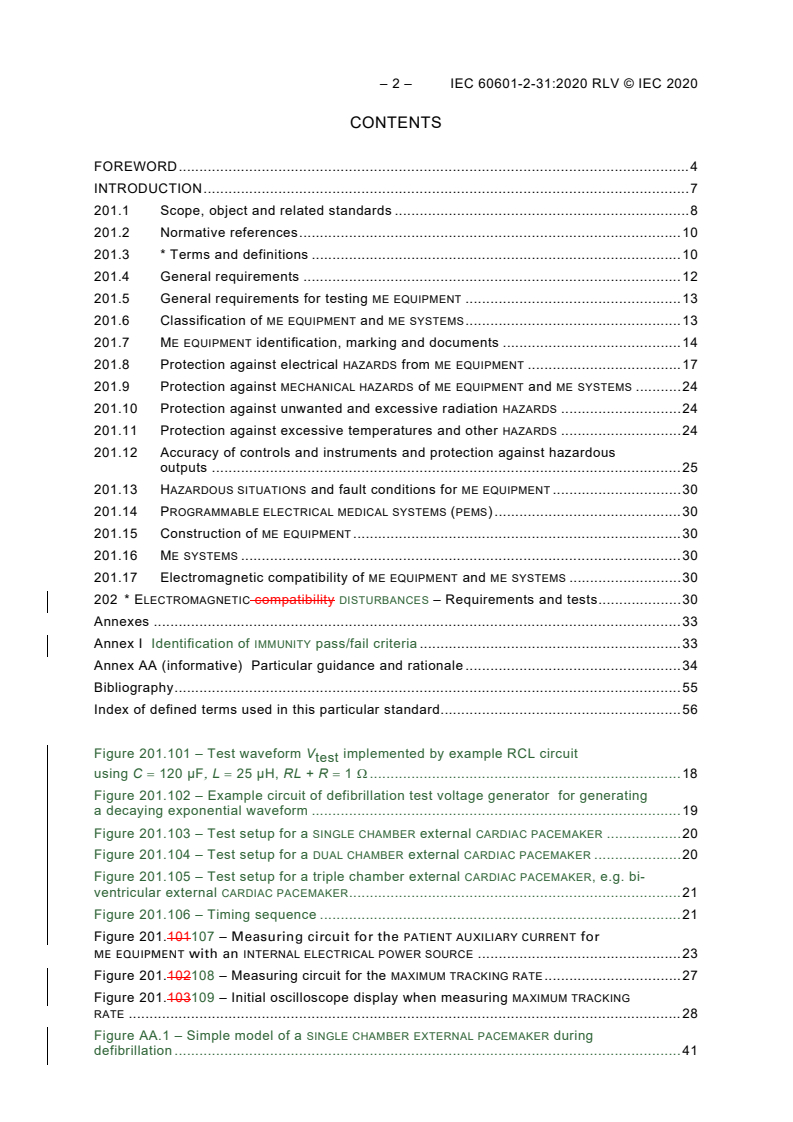
– 2 – IEC 60601-2-31:2020 RLV © IEC 2020
CONTENTS
FOREWORD . 4
INTRODUCTION . 7
201.1 Scope, object and related standards . 8
201.2 Normative references . 10
201.3 * Terms and definitions . 10
201.4 General requirements . 12
201.5 General requirements for testing ME EQUIPMENT . 13
201.6 Classification of ME EQUIPMENT and ME SYSTEMS . 13
201.7 ME EQUIPMENT identification, marking and documents . 14
201.8 Protection against electrical HAZARDS from ME EQUIPMENT . 17
201.9 Protection against MECHANICAL HAZARDS of ME EQUIPMENT and ME SYSTEMS . 24
201.10 Protection against unwanted and excessive radiation HAZARDS . 24
201.11 Protection against excessive temperatures and other HAZARDS . 24
201.12 Accuracy of controls and instruments and protection against hazardous
outputs . 25
201.13 HAZARDOUS SITUATIONS and fault conditions for ME EQUIPMENT . 30
201.14 PROGRAMMABLE ELECTRICAL MEDICAL SYSTEMS (PEMS) . 30
201.15 Construction of ME EQUIPMENT . 30
201.16 ME SYSTEMS . 30
201.17 Electromagnetic compatibility of ME EQUIPMENT and ME SYSTEMS . 30
202 * ELECTROMAGNETIC compatibility DISTURBANCES – Requirements and tests . 30
Annexes . 33
Annex I Identification of IMMUNITY pass/fail criteria . 33
Annex AA (informative) Particular guidance and rationale . 34
Bibliography . 55
Index of defined terms used in this particular standard . 56
Figure 201.101 – Test waveform V implemented by example RCL circuit
test
, L = 25 µH, RL + R = 1 Ω . 18
using C = 120 µF
Figure 201.102 – Example circuit of defibrillation test voltage generator for generating
a decaying exponential waveform . 19
Figure 201.103 – Test setup for a SINGLE CHAMBER external CARDIAC PACEMAKER . 20
Figure 201.104 – Test setup for a DUAL CHAMBER external CARDIAC PACEMAKER . 20
Figure 201.105 – Test setup for a triple chamber external CARDIAC PACEMAKER, e.g. bi-
ventricular external CARDIAC PACEMAKER . 21
Figure 201.106 – Timing sequence . 21
Figure 201.101107 – Measuring circuit for the PATIENT AUXILIARY CURRENT for
ME EQUIPMENT with an INTERNAL ELECTRICAL POWER SOURCE . 23
Figure 201.102108 – Measuring circuit for the MAXIMUM TRACKING RATE . 27
Figure 201.103109 – Initial oscilloscope display when measuring MAXIMUM TRACKING
RATE . 28
Figure AA.1 – Simple model of a SINGLE CHAMBER EXTERNAL PACEMAKER during
defibrillation . 41
Figure AA.2 – First proposal for a defib-protection test of SINGLE CHAMBER EXTERNAL
PACEMAKER . 44
Figure AA.3 – Circuit for a defibrillation test generator for defibrillation test according
to conditions during open heart surgery . 45
Figure AA.4 – Defibrillation PULSE generated by the defibrillation test generator from
Figure AA.3 . 46
Figure AA.5 – Rise times of a defibrillation PULSE according to the circuit proposed in
Figure AA.3 . 50
Table 201.101 – Distributed ESSENTIAL PERFORMANCE requirements . 13
Table 201.102 – DUAL CHAMBER connector terminal marking. 14
Table 201.103 – Measurement method accuracy ME EQUIPMENT parameters . 25
Table 202.101 – Static discharge requirements . 31
Table AA.1 – EXTERNAL PACEMAKER HAZARD inventory . 35
Table AA.2 – PULSE energies calculated for C = 120 µF ± 5 % . 47
Table AA.3 – PULSE energies calculated for C = 122 µF ± 5 % . 48
Table AA.4 – PULSE energies calculated for C = 126,32 µF ± 5 % . 49
– 4 – IEC 60601-2-31:2020 RLV © IEC 2020
INTERNATIONAL ELECTROTECHNICAL COMMISSION
____________
MEDICAL ELECTRICAL EQUIPMENT –
Part 2-31: Particular requirements for the basic safety and essential
performance of external cardiac pacemakers
with internal power source
FOREWORD
1) The International Electrotechnical Commission (IEC) is a worldwide organization for standardization comprising
all national electrotechnical committees (IEC National Committees). The object of IEC is to promote international
co-operation on all questions concerning standardization in the electrical and electronic fields. To this end and
in addition to other activities, IEC publishes International Standards, Technical Specifications, Technical Reports,
Publicly Available Specifications (PAS) and Guides (hereafter referred to as "IEC Publication(s)"). Their
preparation is entrusted to technical committees; any IEC National Committee interested in the subject dealt with
may participate in this preparatory work. International, governmental and non-governmental organizations liaising
with the IEC also participate in this preparation. IEC collaborates closely with the International Organization for
Standardization (ISO) in accordance with conditions determined by agreement between the two organizations.
2) The formal decisions or agreements of IEC on technical matters express, as nearly as possible, an international
consensus of opinion on the relevant subjects since each technical committee has representation from all
interested IEC National Committees.
3) IEC Publications have the form of recommendations for international use and are accepted by IEC National
Committees in that sense. While all reasonable efforts are made to ensure that the technical content of IEC
Publications is accurate, IEC cannot be held responsible for the way in which they are used or for any
misinterpretation by any end user.
4) In order to promote international uniformity, IEC National Committees undertake to apply IEC Publications
transparently to the maximum extent possible in their national and regional publications. Any divergence between
any IEC Publication and the corresponding national or regional publication shall be clearly indicated in the latter.
5) IEC itself does not provide any attestation of conformity. Independent certification bodies provide conformity
assessment services and, in some areas, access to IEC marks of conformity. IEC is not responsible for any
services carried out by independent certification bodies.
6) All users should ensure that they have the latest edition of this publication.
7) No liability shall attach to IEC or its directors, employees, servants or agents including individual experts and
members of its technical committees and IEC National Committees for any personal injury, property damage or
other damage of any nature whatsoever, whether direct or indirect, or for costs (including legal fees) and
expenses arising out of the publication, use of, or reliance upon, this IEC Publication or any other IEC
Publications.
8) Attention is drawn to the Normative references cited in this publication. Use of the referenced publications is
indispensable for the correct application of this publication.
9) Attention is drawn to the possibility that some of the elements of this IEC Publication may be the subject of patent
rights. IEC shall not be held responsible for identifying any or all such patent rights.
This redline version of the official IEC Standard allows the user to identify the changes
made to the previous edition. A vertical bar appears in the margin wherever a change has
been made. Additions are in green text, deletions are in strikethrough red text.
International standard IEC 60601-2-31 has been prepared by a Joint Working Group of IEC
subcommittee 62D: Electromedical equipment, of IEC technical committee 62: Electrical
equipment in medical practice, and ISO subcommittee SC6: Active implants, of ISO technical
committee 150: Implants for surgery.
This publication is published as a double logo standard.
This third edition cancels and replaces the second edition published in 2008 and
Amendment 1:2011. This edition constitutes a technical revision.
This edition includes the following significant technical changes with respect to the previous
edition:
The requirement for testing for energy reduction has been removed;
The test for exposure to external defibrillation has been completely revised;
The exclusion for testing ESD immunity only with respect to air discharges has been
removed;
Alignment with the latest edition of ISO 14708-2 for pacemakers, as well as the associated
EMC standard ISO 14117;
Additional rationale for all changes.
The text of this International Standard is based on the following documents of IEC:
FDIS Report on voting
62D/1719/FDIS 62D/1732A/RVD
Full information on the voting for the approval of this International Standard can be found in the
report on voting indicated in the above table. In ISO, the standard has been approved by 10
P members out of 10 having cast a vote.
This document has been drafted in accordance with the ISO/IEC Directives, Part 2.
In this document, the following print types are used:
– requirements and definitions: roman type;
– test specifications: italic type;
– informative material appearing outside of tables, such as notes, examples and references: in smaller type.
Normative text of tables is also in a smaller type;
– TERMS DEFINED IN CLAUSE 3 OF THE GENERAL STANDARD, IN THIS PARTICULAR STANDARD OR AS
NOTED: SMALL CAPITALS.
In referring to the structure of this document, the term
– "clause" means one of the seventeen numbered divisions within the table of contents,
inclusive of all subdivisions (e.g. Clause 7 includes subclauses 7.1, 7.2, etc.);
– "subclause" means a numbered subdivision of a clause (e.g. 7.1, 7.2 and 7.2.1 are all
subclauses of Clause 7).
References to clauses within this document are preceded by the term "Clause" followed by the
clause number. References to subclauses within this particular standard are by number only.
In this document, the conjunctive "or" is used as an "inclusive or" so a statement is true if any
combination of the conditions is true.
The verbal forms used in this document conform to usage described in Clause 7 of the ISO/IEC
Directives, Part 2. For the purposes of this document, the auxiliary verb:
– 6 – IEC 60601-2-31:2020 RLV © IEC 2020
– "shall" means that compliance with a requirement or a test is mandatory for compliance with
this document;
– "should" means that compliance with a requirement or a test is recommended but is not
mandatory for compliance with this document;
– "may" is used to describe a permissible way to achieve compliance with a requirement or
test.
An asterisk (*) as the first character of a title or at the beginning of a paragraph or table title
indicates that there is guidance or rationale related to that item in Annex AA.
A list of all parts of the IEC 60601 series, published under the general title Medical electrical
equipment, can be found on the IEC website.
The committee has decided that the contents of this document will remain unchanged until the
stability date indicated on the IEC website under "http://webstore.iec.ch" in the data related to
the specific document. At this date, the document will be
• reconfirmed,
• withdrawn,
• replaced by a revised edition, or
• amended.
NOTE The attention of users of this document is drawn to the fact that equipment manufacturers and testing
organizations may need a transitional period following publication of a new, amended or revised IEC publication in
which to make products in accordance with the new requirements and to equip themselves for conducting new or
revised tests. It is the recommendation of the committee that the content of this publication be adopted for
implementation nationally not earlier than 3 years from the date of publication.
IMPORTANT – The 'colour inside' logo on the cover page of this publication indicates
that it contains colours which are considered to be useful for the correct understanding
of its contents. Users should therefore print this document using a colour printer.
INTRODUCTION
The minimum safety requirements specified in this particular standard are considered to provide
for a practical degree of safety in the operation of EXTERNAL cardiac PACEMAKERS with an internal
power source.
Basically, CARDIAC PACEMAKERS treat cardiac arrhythmias. Such arrhythmias reduce cardiac
output and can lead to confusion, dizziness, loss of consciousness and death. The objective of
pacing is to restore cardiac rhythm and output appropriate to the PATIENT's physiological needs.
There are two distinct families of CARDIAC PACEMAKERS, implantable PACEMAKERS and EXTERNAL
PACEMAKERS. EXTERNAL PACEMAKERS are used to pace PATIENTS temporarily prior to implanting
an implantable PACEMAKER as well as for temporary pacing related to other medical
PROCEDURES, e.g. open heart surgery.
CARDIAC PACEMAKERS differ in the various ways in which they maintain and monitor cardiac
activity in different circumstances. The simplest model stimulates the atrium or ventricle
independently of the cardiac activity; others detect atrial or ventricular activity and stimulate the
atrium or ventricle as and when this is necessary; others, more complex, detect the
spontaneous heart activity and stimulate appropriately the atrium and/or the ventricle. Certain
PACEMAKERS work on preset frequency values, amplitudes and impulse duration. Others can
have several values for parameters.
Standards for EXTERNAL PACEMAKERS require attention to information which will aid in selecting
developing and applying these devices. It is through these aspects of standardization that the
central role of clinical experience should be, or has been, acknowledged. The ability to predict
how a PACEMAKER will perform in a specific PATIENT based on testing of a device to a set of
technical criteria is limited.
This particular standard does not take into consideration the specific safety aspects of EXTERNAL
PACEMAKERS that are connected to a SUPPLY MAINS while simultaneously connected to the
PATIENT.
This particular standard amends and supplements IEC 60601-1:2005 and
IEC 60601-1:2005/AMD1:2012, Medical electrical equipment – Part 1: General requirements
for basic safety and essential performance, hereinafter referred to as the general standard (see
1.4).
The requirements are followed by specifications for the relevant tests.
Following the decision taken by subcommittee 62D at the meeting in Washington in 1979, a
"General guidance and rationale" section giving some explanatory notes, where appropriate,
about the more important requirements is included in Annex AA.
Clauses or subclauses for which there are explanatory notes in Annex AA are marked with an
asterisk (*).
An inventory of the PATIENT's safety posed by EXTERNAL PACEMAKERS and a rationale for the
safety requirements contained in this particular standard are given in Annex AA. It is considered
that knowledge of the reasons for these requirements will not only facilitate the proper
application of the this particular standard but will, in due course, expedite any revision
necessitated by changes in clinical practice or as a result of developments in technology.
However, Annex AA does not form part of the requirements of this document.
– 8 – IEC 60601-2-31:2020 RLV © IEC 2020
MEDICAL ELECTRICAL EQUIPMENT –
Part 2-31: Particular requirements for the basic safety and essential
performance of external cardiac pacemakers
with internal power source
201.1 Scope, object and related standards
Clause 1 of the general standard applies, except as follows:
201.1.1 * Scope
Replacement:
This part of IEC 60601 applies to the BASIC SAFETY and ESSENTIAL PERFORMANCE of EXTERNAL
PACEMAKERS powered by an INTERNAL ELECTRICAL POWER SOURCE, hereafter referred to as
ME EQUIPMENT.
This document applies to PATIENT CABLES as defined in 201.3.109209, but does not apply to
LEADS as defined in 201.3.206.
If a clause or subclause is specifically intended to be applicable to ME EQUIPMENT only, or to ME
SYSTEMS only, the title and content of that clause or subclause will say so. If that is not the case,
the clause or subclause applies both to ME EQUIPMENT and to ME SYSTEMS, as relevant.
HAZARDS inherent in the intended physiological function of ME EQUIPMENT within the scope of
this document are not covered by specific requirements in this document except in 7.2.13 and
8.4.1 of the general standard.
NOTE See also 4.2 of the general standard.
This document does not apply to the implantable parts of ACTIVE IMPLANTABLE MEDICAL DEVICES
covered by ISO 14708-1. This document does not apply to EXTERNAL PACEMAKERS which can be
connected directly or indirectly to a SUPPLY MAINS.
This document does not apply to transthoracic and oesophageal pacing ME EQUIPMENT and
antitachycardia ME EQUIPMENT.
201.1.2 Object
Replacement:
The object of this particular standard is to establish particular BASIC SAFETY and ESSENTIAL
PERFORMANCE requirements for EXTERNAL PACEMAKERS as defined in 201.3.103 201.3.205.
201.1.3 Collateral standards
Addition:
___________
The general standard is IEC 60601-1:2005 and IEC 60601-1:2005/AMD1:2012, Medical electrical equipment –
Part 1: General requirements for basic safety and essential performance.
This particular standard refers to those applicable collateral standards that are listed in Clause
2 of the general standard and Clause 201.2 of this particular standard.
IEC 60601-1-2:2014 applies as modified in Clause 202. IEC 60601-1-3 does not apply. All other
published collateral standards in the IEC 60601-1 series apply as published.
201.1.4 Particular standards
Replacement:
In the IEC 60601 series, particular standards may modify, replace or delete requirements
contained in the general standard and collateral standards as appropriate for the particular
ME EQUIPMENT under consideration, and may add other BASIC SAFETY and ESSENTIAL
PERFORMANCE requirements.
A requirement of a particular standard takes priority over the general standard.
For brevity, IEC 60601-1:2005 and IEC 60601-1:2005/AMD1:2012 are referred to in this
particular standard as the general standard. Collateral standards are referred to by their
document number.
The numbering of clauses and subclauses of this particular standard corresponds to that of the
general standard with the prefix "201" (e.g. 201.1 in this document addresses the content of
Clause 1 of the general standard) or applicable collateral standard with the prefix "20x" where
x is the final digit(s) of the collateral standard document number (e.g. 202.4 in this particular
standard addresses the content of Clause 4 of the IEC 60601-1-2 collateral standard, 203.4 in
this particular standard addresses the content of Clause 4 of the IEC 60601-1-3 collateral
standard, etc.). The changes to the text of the general standard and applicable collateral
standards are specified by the use of the following words:
"Replacement" means that the clause or subclause of the general standard or applicable
collateral standard is replaced completely by the text of this particular standard.
"Addition" means that the text of this particular standard is additional to the requirements of the
general standard or applicable collateral standard.
"Amendment" means that the clause or subclause of the general standard or applicable
collateral standard is amended as indicated by the text of this particular standard.
Subclauses, figures or tables which are additional to those of the general standard are
numbered starting from 201.101. However, due to the fact that definitions in the general
standard are numbered 3.1 through 3.147, additional definitions in this document are numbered
beginning from 201.3.201. Additional annexes are lettered AA, BB, etc., and additional items
aa), bb), etc.
Subclauses, figures or tables which are additional to those of a collateral standard are
numbered starting from 20x, where "x" is the number of the collateral standard, e.g. 202 for
IEC 60601-1-2, 203 for IEC 60601-1-3, etc.
The term "this document" is used to make reference to the general standard, any applicable
collateral standards and this particular standard taken together.
Where there is no corresponding clause or subclause in this particular standard, the clause or
subclause of the general standard or applicable collateral standard, although possibly not
relevant, applies without modification; where it is intended that any part of the general standard
or applicable collateral standard, although possibly relevant, is not to be applied, a statement
to that effect is given in this particular standard.
– 10 – IEC 60601-2-31:2020 RLV © IEC 2020
201.2 Normative references
NOTE Informative references are listed in the Bibliography.
Clause 2 of the general standard applies, except as follows:
Replacement:
IEC 60601-1-2:20072014, Medical electrical equipment – Part 1-2: General requirements for
basic safety and essential performance – Collateral Standard: Electromagnetic compatibility
disturbances – Requirements and tests
Addition:
ANSI/AAMI PC69:2007, Active implantable medical devices – Electromagnetic compatibility –
EMC test protocols for implantable cardiac pacemakers and implantable cardioverter
defibrillators
NOTE Informative references are listed in the bibliography on page 34.
IEC 60601-1:2005, Medical electrical equipment – Part 1: General requirements for basic safety
and essential performance
IEC 60601-1:2005/AMD1:2012
ISO 14117:2019, Active implantable medical devices – Electromagnetic compatibility – EMC
test protocols for implantable cardiac pacemakers, implantable cardioverter defibrillators and
cardiac resynchronization devices
ISO 14708-2:20052019, Implants for surgery – Active implantable medical devices – Part 2:
Cardiac pacemakers
201.3 * Terms and definitions
For the purposes of this document, the terms and definitions given in IEC 60601-1:2005 and
ISO 14708-2:2005 apply, except as follows:
For the purposes of this document, the terms and definitions specified in IEC 60601-1:2005 and
IEC 60601-1:2005/AMD1:2012, ISO 14117:2019, and ISO 14708-2:2019 and the following
apply.
ISO and IEC maintain terminological databases for use in standardization at the following
addresses:
• IEC Electropedia: available at http://www.electropedia.org/
• ISO Online browsing platform: available at http://www.iso.org/obp
NOTE An index of defined terms is found beginning on page 56.
Addition:
201.3.101201
ACTIVE IMPLANTABLE MEDICAL DEVICE
active medical device which is intended to be totally or partially introduced, surgically or
medically, into the human body or by medical intervention into a natural orifice, and which is
intended to remain in place after the procedure
[SOURCE: ISO 14708-1:20002014, 3.2, modified – The words "in place" have been added to
the definition, and the note to entry has been deleted.]
201.3.102202
BATTERY DEPLETION INDICATOR
means of indicating when the battery should be replaced
201.3.103203
CARDIAC PACEMAKER
ME EQUIPMENT intended to treat bradyarrhythmias
201.3.104204
DUAL CHAMBER
relating to both atrium and ventricle
201.3.105205
EXTERNAL PACEMAKER
CARDIAC PACEMAKER with consisting of a NON-IMPLANTABLE PULSE GENERATOR and PATIENT
CABLE(S) (if used)
201.3.106206
LEAD
flexible tube enclosing one or more insulated electrical conductors, intended to transfer
electrical energy along its length between the EXTERNAL PACEMAKER and the PATIENT'S heart
[SOURCE: ISO 14708-1:20002014, definition 3.5 modified 3.13, modified – The words "between
the EXTERNAL PACEMAKER and the PATIENT'S heart" have been added to the definition, and the
note to entry has been deleted.]
201.3.107207
MAXIMUM TRACKING RATE
maximum PULSE RATE at which the multi-chamber NON-IMPLANTABLE PULSE GENERATOR will
respond on a 1:1 basis to a triggering sensed atrial signal
[SOURCE: ISO 14708-2:20052019, definition 3.3.18 3.30, modified – The word "
IMPLANTABLE " has been replaced by "multi-chamber NON-IMPLANTABLE" and the word
"triggering" by "sensed atrial".]
201.3.108208
NON-IMPLANTABLE PULSE GENERATOR
ME EQUIPMENT with an INTERNAL ELECTRICAL POWER SOURCE which is intended for use outside the
body and which produces a periodic electrical PULSE intended to stimulate the heart through a
LEAD (or combination of a LEAD and PATIENT CABLE)
201.3.109209
PATIENT CABLE
cable used to extend the distance between the NON-IMPLANTABLE PULSE GENERATOR and the
pacing LEAD
201.3.110210
POST-VENTRICULAR ATRIAL REFRACTORY PERIOD
PVARP
atrial refractory period minus the AV delay
refractory period in atrial channel after paced or sensed event in ventricular channel, used in
DUAL CHAMBER modes
Note 1 to entry: This note applies to the French language only.
– 12 – IEC 60601-2-31:2020 RLV © IEC 2020
201.3.111211
PRIMARY BATTERY
one or more cells, which are not designed to be electrically recharged, that are fitted with
devices necessary for use, for example case, terminals, marking and protective devices
[SOURCE: IEC 60050-482:2004, 482-01-04, modified – The word "primary" has been added to
the term, and the words "which are not designed to be electrically recharged" have been added
to the definition.]
201.3.112212
SINGLE CHAMBER
relating to either atrium or ventricle
201.3.213
BASIC RATE
PULSE RATE of a NON-IMPLANTABLE PULSE GENERATOR, either atrial or ventricular, unmodified by
sensed cardiac or other electrical influence
[SOURCE: ISO 14708-2:2019, 3.26, modified – The words "an implantable" have been replaced
by "a NON-IMPLANTABLE".]
201.3.214
ESCAPE INTERVAL
time elapsing between the sensing of a spontaneous BEAT and the succeeding non-triggered
PULSE of a NON-IMPLANTABLE PULSE GENERATOR
[SOURCE: ISO 14117:2019, 3.128, modified – The words "an implantable" have been replaced
by "a NON-IMPLANTABLE".]
201.3.215
INTERFERENCE PULSE RATE
PULSE RATE with which the NON-IMPLANTABLE PULSE GENERATOR responds when it senses
electrical activity that it recognizes as interference
[SOURCE: ISO 14117:2019, 3.129, modified – The words "an implantable" have been replaced
by "NON-IMPLANTABLE".]
201.4 General requirements
Clause 4 of the general standard applies, except as follows:
201.4.3 ESSENTIAL PERFORMANCE
Additional subclause:
201.4.3.101 Additional ESSENTIAL PERFORMANCE requirements
Additional ESSENTIAL PERFORMANCE requirements are found in the subclauses listed in
Table 201.101.
Table 201.101 – Distributed ESSENTIAL PERFORMANCE requirements
Requirement Subclause
BATTERY DEPLETION INDICATOR 201.11.8
ME EQUIPMENT parameter stability 201.12.1.101
PULSE AMPLITUDE stability 201.12.1.102
Disarming Disabling runaway rate protection 201.12.4.1
Deliberate action required to change settings 201.12.4.101
Parameter stability at onset of the BATTERY DEPLETION INDICATOR 201.12.4.102
Runaway protection 201.12.4.103
Interference reversion in the presence of sensed ELECTROMAGNETIC DISTURBANCE or electrical 201.12.4.104
interference energy sources
Limit at which the ventricle is paced in response to sensed atrial activity 201.12.4.105
201.4.10.1 Source of power for ME EQUIPMENT
Replacement:
ME EQUIPMENT shall be powered by a PRIMARY BATTERY.
Compliance is checked by inspection of the ACCOMPANYING DOCUMENTS.
201.4.10.2 SUPPLY MAINS for ME EQUIPMENT and ME SYSTEMS
This subclause of the general standard does not apply.
201.4.11 * Power input
This subclause of the general standard does not apply.
201.5 General requirements for testing ME EQUIPMENT
Clause 5 of the general standard applies.
201.6 Classification of ME EQUIPMENT and ME SYSTEMS
Clause 6 of the general standard applies, except as follows:
201.6.2 * Protection against electric shock
Replacement:
ME EQUIPMENT shall be classified as INTERNALLY POWERED ME EQUIPMENT.
ME EQUIPMENT shall be recognized as INTERNALLY POWERED only if no external connections to
an electrical power source are provided.
APPLIED PARTS shall be classified as TYPE CF APPLIED PARTS. APPLIED PARTS shall be classified
as DEFIBRILLATION-PROOF APPLIED PARTS.
– 14 – IEC 60601-2-31:2020 RLV © IEC 2020
201.7 ME EQUIPMENT identification, marking and documents
Clause 7 of the general standard applies, except as follows:
201.7.2 Marking on the outside of ME EQUIPMENT or ME EQUIPMENT parts
Additional subclauses:
201.7.2.101 ME EQUIPMENT intended for SINGLE CHAMBER application
ME EQUIPMENT is intended for SINGLE CHAMBER applications, the connector terminals (if
If the
used) shall be conspicuously marked positive (+) and negative (–).
201.7.2.102 * ME EQUIPMENT intended for DUAL CHAMBER application
If the ME EQUIPMENT is intended for DUAL CHAMBER application, the connector terminals (if used)
shall be marked according to Table 201.102. If colour is used to differentiate between channels
in a DUAL CHAMBER application, then the ventricular channel should be marked with the colour
white and the atrial channel should be marked with a contrasting colour.
Table 201.102 – DUAL CHAMBER connector terminal marking
Symbol
Channel Terminal label
Positive terminal Negative terminal
Atrial channel A+ A– ATRIUM
Ventricular channel V+ V– VENTRICLE
201.7.2.103 Bipolar connectors
When bipolar connectors are used, they shall have keyways that prevent inadvertent polarity
reversal.
201.7.2.104 * Battery compartment
The means of access to the battery compartment shall be easily identifiable. The battery
compartment shall be clearly and permanently marked with the IEC battery nomenclature, the
voltage and type. The battery compartment shall be clearly and permanently marked to show
the correct orientation of the battery or batteries.
201.7.4 Marking of controls and instruments
Additional subclauses:
201.7.4.101 * Control or indicator for pacing output
If constant current output is used, the control for selecting pacing output or the relevant
indicating means shall be marked in terms of current in milliamperes (mA) through a resistive
load of 500 Ω ± 1 %. If a constant voltage output is used, the pacing output or the relevant
indicating means shall be marked in terms of volts (V) across a resistive load of 500 Ω ± 1 %.
201.7.4.102 * Control or indicator for PULSE RATE
The control for selecting PULSE RATE or the relevant indicating means shall be marked in terms
of reciprocal minutes.
201.7.4.103 * Control for selecting pacing mode
If a means of selecting the pacing mode is provided, the ME EQUIPMENT shall indicate, as well
as the mode selected, the possible pacing modes using the codes described in Annex DD C of
ISO 14708-2:20052019.
201.7.9 ACCOMPANYING DOCUMENTS
201.7.9.2.2 * Warning and safety notices
Replacement:
The instructions for use shall include all warning and safety notices.
NOTE General warnings and safety notices should be placed in a specifically identified section
of the instructions for use. A warning or safety notice that applies only to a specific instruction
or action should precede the instruction to which it applies.
The instructions for use shall provide the OPERATOR or RESPONSIBLE ORGANIZATION with warnings
regarding any significant RISKS of reciprocal interference posed by the presence of the
ME EQUIPMENT during specific investigations or treatments.
The instructions for use shall include the following.
aa * Warnings regarding potential changes in the behaviour of the NON-IMPLANTABLE PULSE
GENERATOR caused by ELECTROMAGNETIC or other interference DISTURBANCE sources (e.g.
communication transmitters in hospitals, emergency transport vehicles, cellular telephones,
etc.) and the effects of therapeutic and diagnostic energy sources (e.g. external
cardioversion, diathermy, transcutaneous electrical nerve stimulators [TENS] devices, high-
frequency surgical equipment, magnetic resonance imaging or similar sources) on the NON-
IMPLANTABLE PULSE GENERATOR. This shall include advice on recognizing when the behaviour
of the NON-IMPLANTABLE PULSE GENERATOR is being influenced by external interference
ELECTROMAGNETIC DISTURBANCE or electrical energy sources and steps to be taken to avoid
such interference.
bb * A warning about the danger of inadvertently introducing LEAKAGE CURRENT into the
heart if SUPPLY MAINS-operated equipment is connected to the LEAD system.
cc * A warning that the PATIENT CABLE shall be connected to the NON-IMPLANTABLE PULSE
GENERATOR before the pacing LEADS are connected to the PATIENT CABLE.
dd * A warning that when handling indwelling LEADS, the terminal pins or exposed metal are
not to be touched nor be allowed to contact electrically conductive or wet surfaces.
ee * A warning regarding the HAZARDS of using PRIMARY BATTERIES other than those
recommended by the MANUFACTURER (for example, short BATTERY life after the indication of
low BATTERY condition, degraded ME EQUIPMENT performance, overall reduced BATTERY life,
and erratic or no pacing).
ff * A warning that, before handling the external NON-IMPLANTABLE PULSE GENERATOR, the
PATIENT CABLE or indwelling LEADS, steps shall be taken to equalize the electrostatic
potential between the user and the PATIENT, for example by touching the PATIENT at a site
remote from the pacing lead LEADS.
gg * A caution that, when clinically indicated, supplemental monitoring of the PATIENT
should be considered.
201.7.9.2.4 * Electrical power source
Replacement:
The instructions for use shall contain advice on removal of the PRIMARY BATTERY if the
ME EQUIPMENT is to be stored or when a long period of disuse is anticipated.
– 16 – IEC 60601-2-31:2020 RLV © IEC 2020
The instructions for use shall state the recommended PRIMARY BATTERY specification.
The instructions for use shall contain the estimated service time from a fully charged BATTERY
at 20 °C ambient temperature when operating under specified conditions.
The instructions for use shall contain the estimated service time following activation of the
BATTERY DEPLETION INDICATOR when operating under specified conditions.
The instructions for use shall contain the information (including a reference to the appropriate
PRIMARY BATTERY specified in IEC 60086-2 [1] giving the identity of the PRIMARY BATTERIES to
be used so that they may be obtained from local sources.
201.7.9.2.5 * ME EQUIPMENT description
Addition:
The instructions for use shall include the following.
aaa) * A general description, explanation of function available, and a description of each
heart/PULSE GENERATOR interaction for each available pacing mode. See Annex DD
Clause C.3 of ISO 14708-2:20052019 for a description of pacing modes.
bbb) * The connector configuration, the geometry and/or dimensions of the receiving
connectors and instructions for connecting the LEAD(S) or PATIENT CABLE(S) to the NON-
IMPLANTABLE PULSE GENERATOR.
ccc) * The electrical characteristics (including tolerances where applicable) at 20 °C ± 2 °C
with 500 Ω ± 1 % load, unless otherwise stated, as follows:
– ranges of BASIC RATE, ESCAPE INTERVAL, MAXIMUM TRACKING RATE and INTERFERENCE
PULSE RATES (as applicable);
– PULSE AMPLITUDE(S);
– PULSE DURATION(S);
– the SENSITIVITY range for both positive and negative polarities (if a sensing function is
provided);
– sensing amplifier blanking period(s) (if a sensing function is provided);
– the REFRACTORY PERIOD(S) (pacing and sensing) and A-V INTERVAL(S) (as applicable);
– mode of operation in the presence of sensed interference ELECTROMAGNETIC
DISTURBANCE or electrical energy sources;
– the rate limit (runaway protection), in reciprocal minutes.
ddd) * The electrical characteristics listed below and as reported in 201.7.9.2.5 c) upon
activation of the BATTERY DEPLETION INDICATOR (including tolerances where applicable,
and measured at 20 °C ± 2 °C with 500 Ω ± 1 % load), including as applicable, unless
these are unchanged from the values provided in 7.9.2.5 cc) previously reported:
– BASIC RATE or equivalent PULSE INTERVAL;
– PULSE AMPLITUDES(s);
– PULSE DURATION(s);
– SENSITIVITY (if a sensing function is provided);
– mode change (if applicable).
___________
Numbers in square brackets refer to the Bibliography.
201.7.9.2.8 * Start-up PROCEDURE
Addition:
The instructions for use shall contain any environmental limitations regarding storing the ME
EQUIPMENT immediately prior to use.
201.7.9.2.13 * Maintenance
Addition:
The instructions for use shall contain details for replacing the PRIMARY BATTERY and the means
of ascertaining when replacement is required.
The instructions for use shall contain information calling the RESPONSIBLE ORGANIZATION’S
attention to the need for periodic maintenance, as well as to the need for maintenance after any
malfunction or accident of the ME EQUIPMENT irrespective of usage, especially:
PATIENT CABLES;
– cleaning and disinfection of reusable
– cleaning and disinfection of the NON-IMPLANTABLE PULSE GENERATOR;
– inspection of cables and connections for possible defects, for example, loosening of
connections and other wear and tear from such causes as PATIENT movement;
– inspection of the NON-IMPLANTABLE PULSE GENERATOR and PATIENT CABLE for signs of physical
damage or contamination, in particular damage or contamination that can have a detrimental
ME EQUIPMENT;
effect on the electrical isolation properties of the
– functional che
...
IEC 60601-2-31
Edition 3.0 2020-01
INTERNATIONAL
STANDARD
NORME
INTERNATIONALE
colour
inside
Medical electrical equipment –
Part 2-31: Particular requirements for the basic safety and essential performance
of external cardiac pacemakers with internal power source
Appareils électromédicaux –
Partie 2-31: Exigences particulières pour la sécurité de base et les performances
essentielles des stimulateurs cardiaques externes à source d'énergie interne
All rights reserved. Unless otherwise specified, no part of this publication may be reproduced or utilized in any form
or by any means, electronic or mechanical, including photocopying and microfilm, without permission in writing from
either IEC or IEC's member National Committee in the country of the requester. If you have any questions about IEC
copyright or have an enquiry about obtaining additional rights to this publication, please contact the address below or
your local IEC member National Committee for further information.
Droits de reproduction réservés. Sauf indication contraire, aucune partie de cette publication ne peut être reproduite
ni utilisée sous quelque forme que ce soit et par aucun procédé, électronique ou mécanique, y compris la photocopie
et les microfilms, sans l'accord écrit de l'IEC ou du Comité national de l'IEC du pays du demandeur. Si vous avez des
questions sur le copyright de l'IEC ou si vous désirez obtenir des droits supplémentaires sur cette publication, utilisez
les coordonnées ci-après ou contactez le Comité national de l'IEC de votre pays de résidence.
IEC Central Office Tel.: +41 22 919 02 11
3, rue de Varembé info@iec.ch
CH-1211 Geneva 20 www.iec.ch
Switzerland
About the IEC
The International Electrotechnical Commission (IEC) is the leading global organization that prepares and publishes
International Standards for all electrical, electronic and related technologies.
About IEC publications
The technical content of IEC publications is kept under constant review by the IEC. Please make sure that you have the
latest edition, a corrigendum or an amendment might have been published.
IEC publications search - webstore.iec.ch/advsearchform Electropedia - www.electropedia.org
The advanced search enables to find IEC publications by a The world's leading online dictionary on electrotechnology,
variety of criteria (reference number, text, technical containing more than 22 000 terminological entries in English
committee,…). It also gives information on projects, replaced and French, with equivalent terms in 16 additional languages.
and withdrawn publications. Also known as the International Electrotechnical Vocabulary
(IEV) online.
IEC Just Published - webstore.iec.ch/justpublished
Stay up to date on all new IEC publications. Just Published IEC Glossary - std.iec.ch/glossary
details all new publications released. Available online and 67 000 electrotechnical terminology entries in English and
once a month by email. French extracted from the Terms and definitions clause of
IEC publications issued between 2002 and 2015. Some
IEC Customer Service Centre - webstore.iec.ch/csc entries have been collected from earlier publications of IEC
If you wish to give us your feedback on this publication or TC 37, 77, 86 and CISPR.
need further assistance, please contact the Customer Service
Centre: sales@iec.ch.
A propos de l'IEC
La Commission Electrotechnique Internationale (IEC) est la première organisation mondiale qui élabore et publie des
Normes internationales pour tout ce qui a trait à l'électricité, à l'électronique et aux technologies apparentées.
A propos des publications IEC
Le contenu technique des publications IEC est constamment revu. Veuillez vous assurer que vous possédez l’édition la
plus récente, un corrigendum ou amendement peut avoir été publié.
Recherche de publications IEC - Electropedia - www.electropedia.org
webstore.iec.ch/advsearchform Le premier dictionnaire d'électrotechnologie en ligne au
La recherche avancée permet de trouver des publications IEC monde, avec plus de 22 000 articles terminologiques en
en utilisant différents critères (numéro de référence, texte, anglais et en français, ainsi que les termes équivalents dans
comité d’études,…). Elle donne aussi des informations sur les 16 langues additionnelles. Egalement appelé Vocabulaire
projets et les publications remplacées ou retirées. Electrotechnique International (IEV) en ligne.
IEC Just Published - webstore.iec.ch/justpublished Glossaire IEC - std.iec.ch/glossary
Restez informé sur les nouvelles publications IEC. Just 67 000 entrées terminologiques électrotechniques, en anglais
Published détaille les nouvelles publications parues. et en français, extraites des articles Termes et définitions des
Disponible en ligne et une fois par mois par email. publications IEC parues entre 2002 et 2015. Plus certaines
entrées antérieures extraites des publications des CE 37, 77,
Service Clients - webstore.iec.ch/csc 86 et CISPR de l'IEC.
Si vous désirez nous donner des commentaires sur cette
publication ou si vous avez des questions contactez-nous:
sales@iec.ch.
IEC 60601-2-31
Edition 3.0 2020-01
INTERNATIONAL
STANDARD
NORME
INTERNATIONALE
colour
inside
Medical electrical equipment –
Part 2-31: Particular requirements for the basic safety and essential
performance of external cardiac pacemakers with internal power source
Appareils électromédicaux –
Partie 2-31: Exigences particulières pour la sécurité de base et les
performances essentielles des stimulateurs cardiaques externes à source
d'énergie interne
INTERNATIONAL
ELECTROTECHNICAL
COMMISSION
COMMISSION
ELECTROTECHNIQUE
INTERNATIONALE
ICS 11.040.01 ISBN 978-2-8322-7671-6
– 2 – IEC 60601-2-31:2020 © IEC 2020
CONTENTS
FOREWORD . 4
INTRODUCTION . 7
201.1 Scope, object and related standards . 8
201.2 Normative references . 10
201.3 * Terms and definitions . 10
201.4 General requirements . 12
201.5 General requirements for testing ME EQUIPMENT . 13
201.6 Classification of ME EQUIPMENT and ME SYSTEMS . 13
201.7 ME EQUIPMENT identification, marking and documents . 13
201.8 Protection against electrical HAZARDS from ME EQUIPMENT . 17
201.9 Protection against MECHANICAL HAZARDS of ME EQUIPMENT and ME SYSTEMS . 23
201.10 Protection against unwanted and excessive radiation HAZARDS . 23
201.11 Protection against excessive temperatures and other HAZARDS . 23
201.12 Accuracy of controls and instruments and protection against hazardous
outputs . 24
201.13 HAZARDOUS SITUATIONS and fault conditions for ME EQUIPMENT . 29
201.14 PROGRAMMABLE ELECTRICAL MEDICAL SYSTEMS (PEMS) . 29
201.15 Construction of ME EQUIPMENT . 29
201.16 ME SYSTEMS . 29
201.17 Electromagnetic compatibility of ME EQUIPMENT and ME SYSTEMS . 29
202 * ELECTROMAGNETIC DISTURBANCES – Requirements and tests . 29
Annexes . 31
Annex I Identification of IMMUNITY pass/fail criteria . 31
Annex AA (informative) Particular guidance and rationale . 32
Bibliography . 52
Index of defined terms used in this particular standard . 53
Figure 201.101 – Test waveform V implemented by example RCL circuit using
test
, L = 25 µH, RL + R = 1 Ω . 18
C = 120 µF
Figure 201.102 – Example circuit of defibrillation test voltage generator for generating
a decaying exponential waveform . 19
Figure 201.103 – Test setup for a SINGLE CHAMBER external CARDIAC PACEMAKER . 20
Figure 201.104 – Test setup for a DUAL CHAMBER external CARDIAC PACEMAKER . 20
Figure 201.105 – Test setup for a triple chamber external CARDIAC PACEMAKER, e.g. bi-
ventricular external CARDIAC PACEMAKER . 21
Figure 201.106 – Timing sequence . 21
Figure 201.107 – Measuring circuit for the PATIENT AUXILIARY CURRENT for
ME EQUIPMENT with an INTERNAL ELECTRICAL POWER SOURCE . 23
Figure 201.108 – Measuring circuit for the MAXIMUM TRACKING RATE . 26
Figure 201.109 – Initial oscilloscope display when measuring MAXIMUM TRACKING RATE . 27
Figure AA.1 – Simple model of a SINGLE CHAMBER EXTERNAL PACEMAKER during
defibrillation . 39
Figure AA.2 – First proposal for a defib-protection test of SINGLE CHAMBER EXTERNAL
PACEMAKER . 41
Figure AA.3 – Circuit for a defibrillation test generator for defibrillation test according
to conditions during open heart surgery . 42
Figure AA.4 – Defibrillation PULSE generated by the defibrillation test generator from
Figure AA.3 . 43
Figure AA.5 – Rise times of a defibrillation PULSE according to the circuit proposed in
Figure AA.3 . 47
Table 201.101 – Distributed ESSENTIAL PERFORMANCE requirements . 12
Table 201.102 – DUAL CHAMBER connector terminal marking. 14
Table 201.103 – ME EQUIPMENT parameters . 25
Table 202.101 – Static discharge requirements . 30
Table AA.1 – EXTERNAL PACEMAKER HAZARD inventory . 33
Table AA.2 – PULSE energies calculated for C = 120 µF ± 5 % . 44
Table AA.3 – PULSE energies calculated for C = 122 µF ± 5 % . 45
Table AA.4 – PULSE energies calculated for C = 126,32 µF ± 5 % . 46
– 4 – IEC 60601-2-31:2020 © IEC 2020
INTERNATIONAL ELECTROTECHNICAL COMMISSION
____________
MEDICAL ELECTRICAL EQUIPMENT –
Part 2-31: Particular requirements for the basic safety and essential
performance of external cardiac pacemakers
with internal power source
FOREWORD
1) The International Electrotechnical Commission (IEC) is a worldwide organization for standardization comprising
all national electrotechnical committees (IEC National Committees). The object of IEC is to promote international
co-operation on all questions concerning standardization in the electrical and electronic fields. To this end and
in addition to other activities, IEC publishes International Standards, Technical Specifications, Technical Reports,
Publicly Available Specifications (PAS) and Guides (hereafter referred to as "IEC Publication(s)"). Their
preparation is entrusted to technical committees; any IEC National Committee interested in the subject dealt with
may participate in this preparatory work. International, governmental and non-governmental organizations liaising
with the IEC also participate in this preparation. IEC collaborates closely with the International Organization for
Standardization (ISO) in accordance with conditions determined by agreement between the two organizations.
2) The formal decisions or agreements of IEC on technical matters express, as nearly as possible, an international
consensus of opinion on the relevant subjects since each technical committee has representation from all
interested IEC National Committees.
3) IEC Publications have the form of recommendations for international use and are accepted by IEC National
Committees in that sense. While all reasonable efforts are made to ensure that the technical content of IEC
Publications is accurate, IEC cannot be held responsible for the way in which they are used or for any
misinterpretation by any end user.
4) In order to promote international uniformity, IEC National Committees undertake to apply IEC Publications
transparently to the maximum extent possible in their national and regional publications. Any divergence between
any IEC Publication and the corresponding national or regional publication shall be clearly indicated in the latter.
5) IEC itself does not provide any attestation of conformity. Independent certification bodies provide conformity
assessment services and, in some areas, access to IEC marks of conformity. IEC is not responsible for any
services carried out by independent certification bodies.
6) All users should ensure that they have the latest edition of this publication.
7) No liability shall attach to IEC or its directors, employees, servants or agents including individual experts and
members of its technical committees and IEC National Committees for any personal injury, property damage or
other damage of any nature whatsoever, whether direct or indirect, or for costs (including legal fees) and
expenses arising out of the publication, use of, or reliance upon, this IEC Publication or any other IEC
Publications.
8) Attention is drawn to the Normative references cited in this publication. Use of the referenced publications is
indispensable for the correct application of this publication.
9) Attention is drawn to the possibility that some of the elements of this IEC Publication may be the subject of patent
rights. IEC shall not be held responsible for identifying any or all such patent rights.
International standard IEC 60601-2-31 has been prepared by a Joint Working Group of IEC
subcommittee 62D: Electromedical equipment, of IEC technical committee 62: Electrical
equipment in medical practice, and ISO subcommittee SC6: Active implants, of ISO technical
committee 150: Implants for surgery.
This publication is published as a double logo standard.
This third edition cancels and replaces the second edition published in 2008 and
Amendment 1:2011. This edition constitutes a technical revision.
This edition includes the following significant technical changes with respect to the previous
edition:
The requirement for testing for energy reduction has been removed;
The test for exposure to external defibrillation has been completely revised;
The exclusion for testing ESD immunity only with respect to air discharges has been
removed;
Alignment with the latest edition of ISO 14708-2 for pacemakers, as well as the associated
EMC standard ISO 14117;
Additional rationale for all changes.
The text of this International Standard is based on the following documents of IEC:
FDIS Report on voting
62D/1719/FDIS 62D/1732A/RVD
Full information on the voting for the approval of this International Standard can be found in the
report on voting indicated in the above table. In ISO, the standard has been approved by 10
P members out of 10 having cast a vote.
This document has been drafted in accordance with the ISO/IEC Directives, Part 2.
In this document, the following print types are used:
– requirements and definitions: roman type;
– test specifications: italic type;
– informative material appearing outside of tables, such as notes, examples and references: in smaller type.
Normative text of tables is also in a smaller type;
– TERMS DEFINED IN CLAUSE 3 OF THE GENERAL STANDARD, IN THIS PARTICULAR STANDARD OR AS
NOTED: SMALL CAPITALS.
In referring to the structure of this document, the term
– "clause" means one of the seventeen numbered divisions within the table of contents,
inclusive of all subdivisions (e.g. Clause 7 includes subclauses 7.1, 7.2, etc.);
– "subclause" means a numbered subdivision of a clause (e.g. 7.1, 7.2 and 7.2.1 are all
subclauses of Clause 7).
References to clauses within this document are preceded by the term "Clause" followed by the
clause number. References to subclauses within this particular standard are by number only.
In this document, the conjunctive "or" is used as an "inclusive or" so a statement is true if any
combination of the conditions is true.
The verbal forms used in this document conform to usage described in Clause 7 of the ISO/IEC
Directives, Part 2. For the purposes of this document, the auxiliary verb:
– "shall" means that compliance with a requirement or a test is mandatory for compliance with
this document;
– "should" means that compliance with a requirement or a test is recommended but is not
mandatory for compliance with this document;
– "may" is used to describe a permissible way to achieve compliance with a requirement or
test.
An asterisk (*) as the first character of a title or at the beginning of a paragraph or table title
indicates that there is guidance or rationale related to that item in Annex AA.
A list of all parts of the IEC 60601 series, published under the general title Medical electrical
equipment, can be found on the IEC website.
– 6 – IEC 60601-2-31:2020 © IEC 2020
The committee has decided that the contents of this document will remain unchanged until the
stability date indicated on the IEC website under "http://webstore.iec.ch" in the data related to
the specific document. At this date, the document will be
• reconfirmed,
• withdrawn,
• replaced by a revised edition, or
• amended.
NOTE The attention of users of this document is drawn to the fact that equipment manufacturers and testing
organizations may need a transitional period following publication of a new, amended or revised IEC publication in
which to make products in accordance with the new requirements and to equip themselves for conducting new or
revised tests. It is the recommendation of the committee that the content of this publication be adopted for
implementation nationally not earlier than 3 years from the date of publication.
IMPORTANT – The 'colour inside' logo on the cover page of this publication indicates
that it contains colours which are considered to be useful for the correct understanding
of its contents. Users should therefore print this document using a colour printer.
INTRODUCTION
The minimum safety requirements specified in this particular standard are considered to provide
for a practical degree of safety in the operation of EXTERNAL PACEMAKERS with an internal power
source.
Basically, CARDIAC PACEMAKERS treat cardiac arrhythmias. Such arrhythmias reduce cardiac
output and can lead to confusion, dizziness, loss of consciousness and death. The objective of
pacing is to restore cardiac rhythm and output appropriate to the PATIENT's physiological needs.
There are two distinct families of CARDIAC PACEMAKERS, implantable PACEMAKERS and EXTERNAL
PACEMAKERS. EXTERNAL PACEMAKERS are used to pace PATIENTS temporarily prior to implanting
an implantable PACEMAKER as well as for temporary pacing related to other medical
PROCEDURES, e.g. open heart surgery.
CARDIAC PACEMAKERS differ in the various ways in which they maintain and monitor cardiac
activity in different circumstances. The simplest model stimulates the atrium or ventricle
independently of the cardiac activity; others detect atrial or ventricular activity and stimulate the
atrium or ventricle as and when this is necessary; others, more complex, detect the
spontaneous heart activity and stimulate appropriately the atrium and/or the ventricle. Certain
PACEMAKERS work on preset frequency values, amplitudes and impulse duration. Others can
have several values for parameters.
Standards for EXTERNAL PACEMAKERS require attention to information which will aid in developing
and applying these devices. It is through these aspects of standardization that the central role
of clinical experience should be, or has been, acknowledged. The ability to predict how a
PACEMAKER will perform in a specific PATIENT based on testing of a device to a set of technical
criteria is limited.
This particular standard does not take into consideration the specific safety aspects of EXTERNAL
PACEMAKERS that are connected to a SUPPLY MAINS while simultaneously connected to the
PATIENT.
This particular standard amends and supplements IEC 60601-1:2005 and
IEC 60601-1:2005/AMD1:2012, Medical electrical equipment – Part 1: General requirements
for basic safety and essential performance, hereinafter referred to as the general standard.
The requirements are followed by specifications for the relevant tests.
Following the decision taken by subcommittee 62D at the meeting in Washington in 1979, a
"General guidance and rationale" section giving some explanatory notes, where appropriate,
about the more important requirements is included in Annex AA.
Clauses or subclauses for which there are explanatory notes in Annex AA are marked with an
asterisk (*).
An inventory of the PATIENT's safety posed by EXTERNAL PACEMAKERS and a rationale for the
safety requirements contained in this particular standard are given in Annex AA. It is considered
that knowledge of the reasons for these requirements will not only facilitate the proper
application of this particular standard but will, in due course, expedite any revision necessitated
by changes in clinical practice or as a result of developments in technology. However, Annex AA
does not form part of the requirements of this document.
– 8 – IEC 60601-2-31:2020 © IEC 2020
MEDICAL ELECTRICAL EQUIPMENT –
Part 2-31: Particular requirements for the basic safety and essential
performance of external cardiac pacemakers
with internal power source
201.1 Scope, object and related standards
Clause 1 of the general standard applies, except as follows:
201.1.1 * Scope
Replacement:
This part of IEC 60601 applies to the BASIC SAFETY and ESSENTIAL PERFORMANCE of EXTERNAL
PACEMAKERS powered by an INTERNAL ELECTRICAL POWER SOURCE, hereafter referred to as
ME EQUIPMENT.
This document applies to PATIENT CABLES as defined in 201.3.209, but does not apply to LEADS
as defined in 201.3.206.
HAZARDS inherent in the intended physiological function of ME EQUIPMENT within the scope of
this document are not covered by specific requirements in this document except in 7.2.13 and
8.4.1 of the general standard.
NOTE See also 4.2 of the general standard.
This document does not apply to the implantable parts of ACTIVE IMPLANTABLE MEDICAL DEVICES
covered by ISO 14708-1. This document does not apply to EXTERNAL PACEMAKERS which can be
connected directly or indirectly to a SUPPLY MAINS.
This document does not apply to transthoracic and oesophageal pacing ME EQUIPMENT and
antitachycardia ME EQUIPMENT.
201.1.2 Object
Replacement:
The object of this particular standard is to establish particular BASIC SAFETY and ESSENTIAL
PERFORMANCE requirements for EXTERNAL PACEMAKERS as defined in 201.3.205.
201.1.3 Collateral standards
Addition:
This particular standard refers to those applicable collateral standards that are listed in Clause
2 of the general standard and Clause 201.2 of this particular standard.
___________
The general standard is IEC 60601-1:2005 and IEC 60601-1:2005/AMD1:2012, Medical electrical equipment –
Part 1: General requirements for basic safety and essential performance.
IEC 60601-1-2:2014 applies as modified in Clause 202. IEC 60601-1-3 does not apply. All other
published collateral standards in the IEC 60601-1 series apply as published.
201.1.4 Particular standards
Replacement:
In the IEC 60601 series, particular standards may modify, replace or delete requirements
contained in the general standard and collateral standards as appropriate for the particular
ME EQUIPMENT under consideration, and may add other BASIC SAFETY and ESSENTIAL
requirements.
PERFORMANCE
A requirement of a particular standard takes priority over the general standard.
For brevity, IEC 60601-1:2005 and IEC 60601-1:2005/AMD1:2012 are referred to in this
particular standard as the general standard. Collateral standards are referred to by their
document number.
The numbering of clauses and subclauses of this particular standard corresponds to that of the
general standard with the prefix "201" (e.g. 201.1 in this document addresses the content of
Clause 1 of the general standard) or applicable collateral standard with the prefix "20x" where
x is the final digit(s) of the collateral standard document number (e.g. 202.4 in this particular
standard addresses the content of Clause 4 of the IEC 60601-1-2 collateral standard, 203.4 in
this particular standard addresses the content of Clause 4 of the IEC 60601-1-3 collateral
standard, etc.). The changes to the text of the general standard and applicable collateral
standards are specified by the use of the following words:
"Replacement" means that the clause or subclause of the general standard or applicable
collateral standard is replaced completely by the text of this particular standard.
"Addition" means that the text of this particular standard is additional to the requirements of the
general standard or applicable collateral standard.
"Amendment" means that the clause or subclause of the general standard or applicable
collateral standard is amended as indicated by the text of this particular standard.
Subclauses, figures or tables which are additional to those of the general standard are
numbered starting from 201.101. However, due to the fact that definitions in the general
standard are numbered 3.1 through 3.147, additional definitions in this document are numbered
beginning from 201.3.201. Additional annexes are lettered AA, BB, etc., and additional items
aa), bb), etc.
Subclauses, figures or tables which are additional to those of a collateral standard are
numbered starting from 20x, where "x" is the number of the collateral standard, e.g. 202 for
IEC 60601-1-2, 203 for IEC 60601-1-3, etc.
The term "this document" is used to make reference to the general standard, any applicable
collateral standards and this particular standard taken together.
Where there is no corresponding clause or subclause in this particular standard, the clause or
subclause of the general standard or applicable collateral standard, although possibly not
relevant, applies without modification; where it is intended that any part of the general standard
or applicable collateral standard, although possibly relevant, is not to be applied, a statement
to that effect is given in this particular standard.
– 10 – IEC 60601-2-31:2020 © IEC 2020
201.2 Normative references
NOTE Informative references are listed in the Bibliography.
Clause 2 of the general standard applies, except as follows:
Replacement:
IEC 60601-1-2:2014, Medical electrical equipment – Part 1-2: General requirements for basic
safety and essential performance – Collateral Standard: Electromagnetic disturbances –
Requirements and tests
Addition:
IEC 60601-1:2005, Medical electrical equipment – Part 1: General requirements for basic safety
and essential performance
IEC 60601-1:2005/AMD1:2012
ISO 14117:2019, Active implantable medical devices – Electromagnetic compatibility – EMC
test protocols for implantable cardiac pacemakers, implantable cardioverter defibrillators and
cardiac resynchronization devices
ISO 14708-2:2019, Implants for surgery – Active implantable medical devices – Part 2: Cardiac
pacemakers
201.3 * Terms and definitions
For the purposes of this document, the terms and definitions specified in IEC 60601-1:2005 and
IEC 60601-1:2005/AMD1:2012, ISO 14117:2019, and ISO 14708-2:2019 and the following
apply.
ISO and IEC maintain terminological databases for use in standardization at the following
addresses:
• IEC Electropedia: available at http://www.electropedia.org/
• ISO Online browsing platform: available at http://www.iso.org/obp
NOTE An index of defined terms is found beginning on page 53.
Addition:
201.3.201
ACTIVE IMPLANTABLE MEDICAL DEVICE
active medical device which is intended to be totally or partially introduced, surgically or
medically, into the human body or by medical intervention into a natural orifice, and which is
intended to remain in place after the procedure
[SOURCE: ISO 14708-1:2014, 3.2, modified – The words "in place" have been added to the
definition, and the note to entry has been deleted.]
201.3.202
BATTERY DEPLETION INDICATOR
means of indicating when the battery should be replaced
201.3.203
CARDIAC PACEMAKER
ME EQUIPMENT intended to treat bradyarrhythmias
201.3.204
DUAL CHAMBER
relating to both atrium and ventricle
201.3.205
EXTERNAL PACEMAKER
CARDIAC PACEMAKER consisting of a NON-IMPLANTABLE PULSE GENERATOR and PATIENT CABLE(S)
(if used)
201.3.206
LEAD
flexible tube enclosing one or more insulated electrical conductors, intended to transfer
electrical energy along its length between the EXTERNAL PACEMAKER and the PATIENT'S heart
[SOURCE: ISO 14708-1:2014, 3.13, modified – The words "between the EXTERNAL PACEMAKER
and the PATIENT'S heart" have been added to the definition, and the note to entry has been
deleted.]
201.3.207
MAXIMUM TRACKING RATE
maximum PULSE RATE at which the multi-chamber NON-IMPLANTABLE PULSE GENERATOR will
respond on a 1:1 basis to a sensed atrial signal
[SOURCE: ISO 14708-2:2019, 3.30, modified – The word " IMPLANTABLE " has been replaced by
"multi-chamber NON-IMPLANTABLE" and the word "triggering" by "sensed atrial".]
201.3.208
NON-IMPLANTABLE PULSE GENERATOR
ME EQUIPMENT with an INTERNAL ELECTRICAL POWER SOURCE which is intended for use outside the
PULSE intended to stimulate the heart through a
body and which produces a periodic electrical
LEAD (or combination of a LEAD and PATIENT CABLE)
201.3.209
PATIENT CABLE
cable used to extend the distance between the NON-IMPLANTABLE PULSE GENERATOR and the
pacing LEAD
201.3.210
POST-VENTRICULAR ATRIAL REFRACTORY PERIOD
PVARP
refractory period in atrial channel after paced or sensed event in ventricular channel, used in
DUAL CHAMBER modes
Note 1 to entry: This note applies to the French language only.
201.3.211
PRIMARY BATTERY
one or more cells, which are not designed to be electrically recharged, that are fitted with
devices necessary for use, for example case, terminals, marking and protective devices
[SOURCE: IEC 60050-482:2004, 482-01-04, modified – The word "primary" has been added to
the term, and the words "which are not designed to be electrically recharged" have been added
to the definition.]
201.3.212
SINGLE CHAMBER
relating to either atrium or ventricle
– 12 – IEC 60601-2-31:2020 © IEC 2020
201.3.213
BASIC RATE
PULSE RATE of a NON-IMPLANTABLE PULSE GENERATOR, either atrial or ventricular, unmodified by
sensed cardiac or other electrical influence
[SOURCE: ISO 14708-2:2019, 3.26, modified – The words "an implantable" have been replaced
NON-IMPLANTABLE".]
by "a
201.3.214
ESCAPE INTERVAL
time elapsing between the sensing of a spontaneous BEAT and the succeeding non-triggered
PULSE of a NON-IMPLANTABLE PULSE GENERATOR
[SOURCE: ISO 14117:2019, 3.128, modified – The words "an implantable" have been replaced
NON-IMPLANTABLE".]
by "a
201.3.215
INTERFERENCE PULSE RATE
PULSE RATE with which the NON-IMPLANTABLE PULSE GENERATOR responds when it senses
electrical activity that it recognizes as interference
[SOURCE: ISO 14117:2019, 3.129, modified – The words "an implantable" have been replaced
NON-IMPLANTABLE".]
by "
201.4 General requirements
Clause 4 of the general standard applies, except as follows:
201.4.3 ESSENTIAL PERFORMANCE
Additional subclause:
201.4.3.101 Additional ESSENTIAL PERFORMANCE requirements
Additional ESSENTIAL PERFORMANCE requirements are found in the subclauses listed in
Table 201.101.
Table 201.101 – Distributed ESSENTIAL PERFORMANCE requirements
Requirement Subclause
BATTERY DEPLETION INDICATOR 201.11.8
ME EQUIPMENT parameter stability 201.12.1.101
PULSE AMPLITUDE stability 201.12.1.102
Disabling runaway rate protection 201.12.4.1
Deliberate action required to change settings 201.12.4.101
Parameter stability at onset of the BATTERY DEPLETION INDICATOR 201.12.4.102
Runaway protection 201.12.4.103
Interference reversion in the presence of sensed ELECTROMAGNETIC DISTURBANCE or electrical 201.12.4.104
energy sources
Limit at which the ventricle is paced in response to sensed atrial activity 201.12.4.105
201.4.10.1 Source of power for ME EQUIPMENT
Replacement:
ME EQUIPMENT shall be powered by a PRIMARY BATTERY.
Compliance is checked by inspection of the ACCOMPANYING DOCUMENTS.
201.4.10.2 SUPPLY MAINS for ME EQUIPMENT and ME SYSTEMS
This subclause of the general standard does not apply.
201.4.11 * Power input
This subclause of the general standard does not apply.
201.5 General requirements for testing ME EQUIPMENT
Clause 5 of the general standard applies.
201.6 Classification of ME EQUIPMENT and ME SYSTEMS
Clause 6 of the general standard applies, except as follows:
201.6.2 * Protection against electric shock
Replacement:
ME EQUIPMENT shall be classified as INTERNALLY POWERED ME EQUIPMENT.
ME EQUIPMENT shall be recognized as INTERNALLY POWERED only if no external connections to
an electrical power source are provided.
APPLIED PARTS shall be classified as TYPE CF APPLIED PARTS. APPLIED PARTS shall be classified
as DEFIBRILLATION-PROOF APPLIED PARTS.
201.7 ME EQUIPMENT identification, marking and documents
Clause 7 of the general standard applies, except as follows:
201.7.2 Marking on the outside of ME EQUIPMENT or ME EQUIPMENT parts
Additional subclauses:
201.7.2.101 ME EQUIPMENT intended for SINGLE CHAMBER application
If the ME EQUIPMENT is intended for SINGLE CHAMBER applications, the connector terminals (if
used) shall be conspicuously marked positive (+) and negative (–).
201.7.2.102 * ME EQUIPMENT intended for DUAL CHAMBER application
If the ME EQUIPMENT is intended for DUAL CHAMBER application, the connector terminals (if used)
shall be marked according to Table 201.102. If colour is used to differentiate between channels
in a DUAL CHAMBER application, then the ventricular channel should be marked with the colour
white and the atrial channel should be marked with a contrasting colour.
– 14 – IEC 60601-2-31:2020 © IEC 2020
Table 201.102 – DUAL CHAMBER connector terminal marking
Symbol
Channel Terminal label
Positive terminal Negative terminal
Atrial channel A+ A– ATRIUM
Ventricular channel V+ V– VENTRICLE
201.7.2.103 Bipolar connectors
When bipolar connectors are used, they shall have keyways that prevent inadvertent polarity
reversal.
201.7.2.104 * Battery compartment
The means of access to the battery compartment shall be easily identifiable. The battery
compartment shall be clearly and permanently marked with the IEC battery nomenclature, the
voltage and type. The battery compartment shall be clearly and permanently marked to show
the correct orientation of the battery or batteries.
201.7.4 Marking of controls and instruments
Additional subclauses:
201.7.4.101 * Control or indicator for pacing output
If constant current output is used, the control for selecting pacing output or the relevant
indicating means shall be marked in terms of current in milliamperes (mA) through a resistive
load of 500 Ω ± 1 %. If a constant voltage output is used, the pacing output or the relevant
indicating means shall be marked in terms of volts (V) across a resistive load of 500 Ω ± 1 %.
201.7.4.102 * Control or indicator for PULSE RATE
The control for selecting PULSE RATE or the relevant indicating means shall be marked in terms
of reciprocal minutes.
201.7.4.103 * Control for selecting pacing mode
If a means of selecting the pacing mode is provided, the ME EQUIPMENT shall indicate, as well
as the mode selected, the possible pacing modes using the codes described in Annex C of
ISO 14708-2:2019.
201.7.9 ACCOMPANYING DOCUMENTS
201.7.9.2.2 * Warning and safety notices
Replacement:
The instructions for use shall include all warning and safety notices.
General warnings and safety notices should be placed in a specifically identified section of the
instructions for use. A warning or safety notice that applies only to a specific instruction or
action should precede the instruction to which it applies.
The instructions for use shall provide the OPERATOR or RESPONSIBLE ORGANIZATION with warnings
regarding any significant RISKS of reciprocal interference posed by the presence of the
ME EQUIPMENT during specific investigations or treatments.
The instructions for use shall include the following.
* Warnings regarding potential changes in the behaviour of the NON-IMPLANTABLE PULSE
GENERATOR caused by ELECTROMAGNETIC DISTURBANCE sources (e.g. communication
transmitters in hospitals, emergency transport vehicles, cellular telephones, etc.) and the
effects of therapeutic and diagnostic energy sources (e.g. external cardioversion,
diathermy, transcutaneous electrical nerve stimulators [TENS] devices, high-frequency
surgical equipment, magnetic resonance imaging or similar sources) on the NON-
IMPLANTABLE PULSE GENERATOR. This shall include advice on recognizing when the behaviour
of the NON-IMPLANTABLE PULSE GENERATOR is being influenced by external ELECTROMAGNETIC
DISTURBANCE or electrical energy sources and steps to be taken to avoid interference.
* A warning about the danger of inadvertently introducing LEAKAGE CURRENT into the heart if
SUPPLY MAINS-operated equipment is connected to the LEAD system.
* A warning that the PATIENT CABLE shall be connected to the NON-IMPLANTABLE PULSE
GENERATOR before the pacing LEADS are connected to the PATIENT CABLE.
* A warning that when handling indwelling LEADS, the terminal pins or exposed metal are
not to be touched nor be allowed to contact electrically conductive or wet surfaces.
* A warning regarding the HAZARDS of using PRIMARY BATTERIES other than those
MANUFACTURER (for example, short BATTERY life after the indication of
recommended by the
low BATTERY condition, degraded ME EQUIPMENT performance, overall reduced BATTERY life,
and erratic or no pacing).
* A warning that, before handling the NON-IMPLANTABLE PULSE GENERATOR, the PATIENT CABLE
LEADS, steps shall be taken to equalize the electrostatic potential between the
or indwelling
user and the PATIENT, for example by touching the PATIENT at a site remote from the pacing
LEADS.
* A caution that, when clinically indicated, supplemental monitoring of the PATIENT should
be considered.
201.7.9.2.4 * Electrical power source
Replacement:
The instructions for use shall contain advice on removal of the PRIMARY BATTERY if the
ME EQUIPMENT is to be stored or when a long period of disuse is anticipated.
The instructions for use shall state the recommended PRIMARY BATTERY specification.
The instructions for use shall contain the estimated service time from a fully charged BATTERY
at 20 °C ambient temperature when operating under specified conditions.
The instructions for use shall contain the estimated service time following activation of the
BATTERY DEPLETION INDICATOR when operating under specified conditions.
The instructions for use shall contain the information (including a reference to the appropriate
PRIMARY BATTERY specified in IEC 60086-2 [1] giving the identity of the PRIMARY BATTERIES to
be used.
201.7.9.2.5 * ME EQUIPMENT description
Addition:
The instructions for use shall include the following.
___________
Numbers in square brackets refer to the Bibliography.
– 16 – IEC 60601-2-31:2020 © IEC 2020
a) * A general description, explanation of function available, and a description of each
heart/PULSE GENERATOR interaction for each available pacing mode. See Clause C.3 of
ISO 14708-2:2019 for a description of pacing modes.
b) * The connector configuration, the geometry and/or dimensions of the receiving
connectors and instructions for connecting the LEAD(S) or PATIENT CABLE(S) to the NON-
IMPLANTABLE PULSE GENERATOR.
c) * The electrical characteristics (including tolerances where applicable) with 500 Ω ± 1 %
load, unless otherwise stated, as follows:
– ranges of BASIC RATE, ESCAPE INTERVAL, MAXIMUM TRACKING RATE and INTERFERENCE
PULSE RATES (as applicable);
– PULSE AMPLITUDE(S);
– PULSE DURATION(S);
– the SENSITIVITY range for both positive and negative polarities (if a sensing function is
provided);
– sensing amplifier blanking period(s) (if a sensing function is provided);
– the REFRACTORY PERIOD(S) (pacing and sensing) and A-V INTERVAL(S) (as applicable);
– mode of operation in the presence of sensed ELECTROMAGNETIC DISTURBANCE or
electrical energy sources;
– the rate limit (runaway protection), in reciprocal minutes.
d) * The electrical characteristics listed below and as reported in 201.7.9.2.5 c) upon
activation of the BATTERY DEPLETION INDICATOR, unless these are unchanged from the
values previously reported:
– BASIC RATE or equivalent PULSE INTERVAL;
– PULSE AMPLITUDES(s);
– PULSE DURATION(s);
– SENSITIVITY (if a sensing function is provided);
– mode change (if applicable).
201.7.9.2.8 * Start-up PROCEDURE
Addition:
The instructio
...