

IEC TR 62366-2:2016
(Main)Medical devices - Part 2: Guidance on the application of usability engineering to medical devices
General Information
- Abstract
IEC TR 62366-2:2016(E), which is a Technical Report, contains background information and provides guidance that addresses specific areas that experience suggests can be helpful for those implementing a USABILITY ENGINEERING (HUMAN FACTORS ENGINEERING) PROCESS both as defined in IEC 62366-1:2015 and as supporting goals other than SAFETY. This technical report is not intended to be used for regulatory purposes. It contains no requirements and only provides guidance and tutorial information.
This publication is to be read in conjunction with IEC 62366-1:2015.
- Status
- Published
- Publication Date
- 26-Apr-2016
- Technical Committee
- SC 62A - Common aspects of medical equipment, software, and systems
- Drafting Committee
- JWG 4 - TC 62/SC 62A/JWG 4
- Current Stage
- PPUB - Publication issued
- Start Date
- 27-Apr-2016
- Completion Date
- 31-Jul-2016
Overview
IEC TR 62366-2:2016 is a Technical Report from the IEC that provides guidance and tutorial information on applying usability engineering (human factors engineering) to medical devices. It is intended to support implementation of the usability engineering process as defined in IEC 62366-1:2015, and to help meet goals beyond safety (for example, effectiveness and efficiency). This TR contains no regulatory requirements - it is informative, not normative - and should be read in conjunction with IEC 62366-1:2015.
Key topics and guidance
Although IEC TR 62366-2 is not a requirements document, it thoroughly addresses practical aspects of usability engineering. Key technical topics include:
- Mapping to IEC 62366-1: guidance on how the TR complements the normative Part 1 standard.
- Usability engineering program implementation: building effective programs, assigning expertise, resourcing, and maintaining a usability engineering file.
- Use specification development: defining intended users, user tasks and use environments.
- Task and function analysis: techniques to identify user interface elements related to safety and potential use errors.
- Hazard-related use scenarios: identifying, analyzing and selecting scenarios for evaluation, including severity-based selection.
- Risk management integration: how usability activities link to risk analysis, risk control and residual risk evaluation.
- User interface (UI) specification and design: guidance for hardware and software UI concepts, wireframes, templates and training materials.
- Evaluation methods: planning and conducting formative and summative usability evaluations, including usability test planning, data collection and analysis.
- Post-production review: monitoring and analyzing real-world use after product release.
- Annexes with methods and resources: recommended reading, external problem sources and a wide range of human factors methods (heuristic analysis, cognitive walkthrough, FMEA/FTA, contextual inquiry, simulations, etc.).
Practical applications - who should use it
IEC TR 62366-2 is practical guidance for:
- Medical device manufacturers and product teams
- Human factors / usability engineers and UX designers
- Risk managers and clinical engineers
- Regulatory and quality assurance teams seeking best-practice human factors workflows
- Contract developers and testing labs conducting usability studies
Use this TR to design safer, more effective and user-centered medical devices, to plan formative and summative usability testing, and to integrate human factors into risk management and post-market surveillance.
Related standards
- IEC 62366-1:2015 - normative companion for the usability engineering process (read together with TR 62366-2)
- Usability work is commonly aligned with device risk management standards (e.g., ISO 14971) and other human factors guidance; consult applicable normative standards and regulatory guidance for compliance requirements.
Keywords: IEC TR 62366-2, usability engineering, human factors, medical devices, IEC 62366-1, usability testing, summative evaluation, formative evaluation, risk management, user interface specification.
Related Packages
Get Certified
Connect with accredited certification bodies for this standard

BSI Group
BSI (British Standards Institution) is the business standards company that helps organizations make excellence a habit.

TÜV Rheinland
TÜV Rheinland is a leading international provider of technical services.

TÜV SÜD
TÜV SÜD is a trusted partner of choice for safety, security and sustainability solutions.
Sponsored listings
Frequently Asked Questions
IEC TR 62366-2:2016 is a technical report published by the International Electrotechnical Commission (IEC). Its full title is "Medical devices - Part 2: Guidance on the application of usability engineering to medical devices". This standard covers: IEC TR 62366-2:2016(E), which is a Technical Report, contains background information and provides guidance that addresses specific areas that experience suggests can be helpful for those implementing a USABILITY ENGINEERING (HUMAN FACTORS ENGINEERING) PROCESS both as defined in IEC 62366-1:2015 and as supporting goals other than SAFETY. This technical report is not intended to be used for regulatory purposes. It contains no requirements and only provides guidance and tutorial information. This publication is to be read in conjunction with IEC 62366-1:2015.
IEC TR 62366-2:2016(E), which is a Technical Report, contains background information and provides guidance that addresses specific areas that experience suggests can be helpful for those implementing a USABILITY ENGINEERING (HUMAN FACTORS ENGINEERING) PROCESS both as defined in IEC 62366-1:2015 and as supporting goals other than SAFETY. This technical report is not intended to be used for regulatory purposes. It contains no requirements and only provides guidance and tutorial information. This publication is to be read in conjunction with IEC 62366-1:2015.
IEC TR 62366-2:2016 is classified under the following ICS (International Classification for Standards) categories: 01 - GENERALITIES. TERMINOLOGY. STANDARDIZATION. DOCUMENTATION; 11.040.01 - Medical equipment in general. The ICS classification helps identify the subject area and facilitates finding related standards.
IEC TR 62366-2:2016 is available in PDF format for immediate download after purchase. The document can be added to your cart and obtained through the secure checkout process. Digital delivery ensures instant access to the complete standard document.
Standards Content (Sample)
IEC TR 62366-2
Edition 1.0 2016-04
TECHNICAL
REPORT
colour
inside
Medical devices –
Part 2: Guidance on the application of usability engineering to medical devices
All rights reserved. Unless otherwise specified, no part of this publication may be reproduced or utilized in any form
or by any means, electronic or mechanical, including photocopying and microfilm, without permission in writing from
either IEC or IEC's member National Committee in the country of the requester. If you have any questions about IEC
copyright or have an enquiry about obtaining additional rights to this publication, please contact the address below or
your local IEC member National Committee for further information.
IEC Central Office Tel.: +41 22 919 02 11
3, rue de Varembé Fax: +41 22 919 03 00
CH-1211 Geneva 20 info@iec.ch
Switzerland www.iec.ch
About the IEC
The International Electrotechnical Commission (IEC) is the leading global organization that prepares and publishes
International Standards for all electrical, electronic and related technologies.
About IEC publications
The technical content of IEC publications is kept under constant review by the IEC. Please make sure that you have the
latest edition, a corrigenda or an amendment might have been published.
IEC Catalogue - webstore.iec.ch/catalogue Electropedia - www.electropedia.org
The stand-alone application for consulting the entire The world's leading online dictionary of electronic and
bi bliographical information on IEC International Standards, electrical terms containing more than 30 000 terms and
Technical Specifications, Technical Reports and other definitions in English and French, with equivalent terms in 15
documents. Available for PC, Mac OS, Android Tablets and additional languages. Also known as the International
iPad. Electrotechnical Vocabulary (IEV) online.
IEC publications search - www.iec.ch/searchpub IEC Glossary - std.iec.ch/glossary
The advanced search enables to find IEC publications by a More than 60 000 electrotechnical terminology entries in
variety of criteria (reference number, text, technical English and French extracted from the Terms and Definitions
committee,…). It also gives information on projects, replaced clause of IEC publications issued since 2002. Some entries
and withdrawn publications. have been collected from earlier publications of IEC TC 37,
77, 86 and CISPR.
IEC Just Published - webstore.iec.ch/justpublished
Stay up to date on all new IEC publications. Just Published IEC Customer Service Centre - webstore.iec.ch/csc
details all new publications released. Available online and If you wish to give us your feedback on this publication or
also once a month by email. need further assistance, please contact the Customer Service
Centre: csc@iec.ch.
IEC TR 62366-2
Edition 1.0 2016-04
TECHNICAL
REPORT
colour
inside
Medical devices –
Part 2: Guidance on the application of usability engineering to medical devices
INTERNATIONAL
ELECTROTECHNICAL
COMMISSION
ICS 11.040.01 ISBN 978-2-8322-3346-7
– 2 – IEC TR 62366-2:2016 © IEC 2016
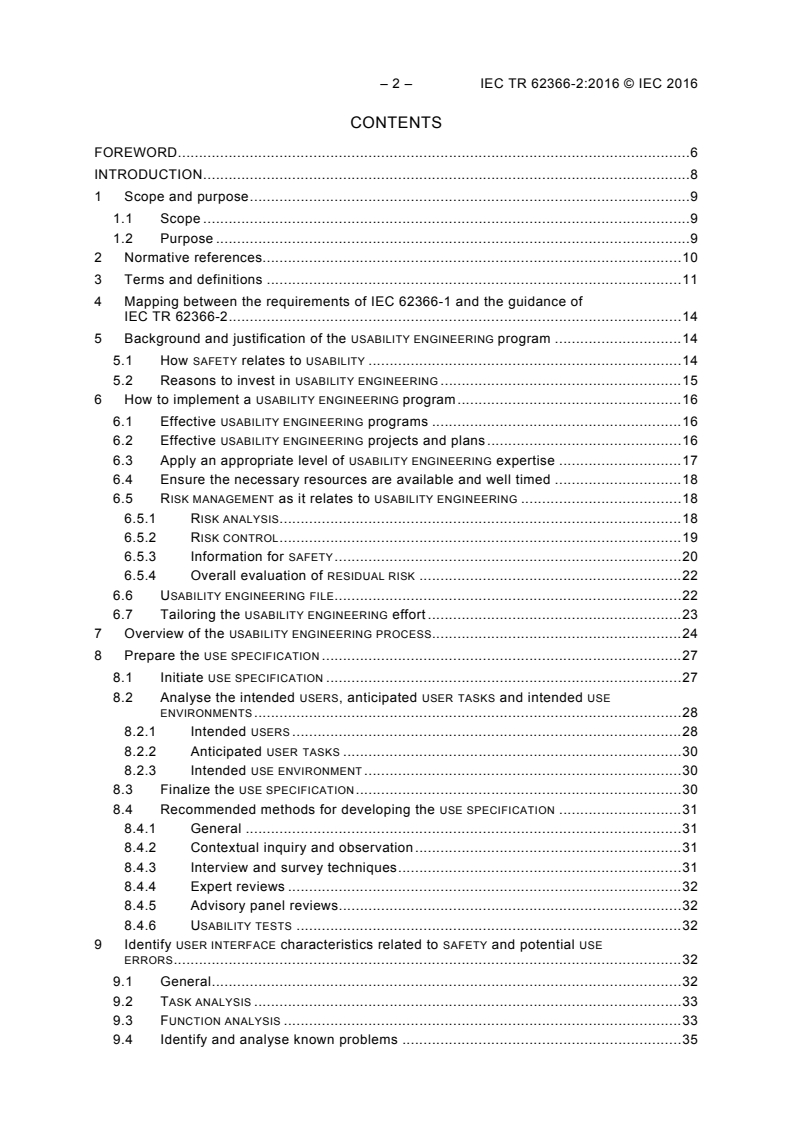
CONTENTS
FOREWORD . 6
INTRODUCTION . 8
1 Scope and purpose . 9
1.1 Scope . 9
1.2 Purpose . 9
2 Normative references. 10
3 Terms and definitions . 11
4 Mapping between the requirements of IEC 62366-1 and the guidance of
IEC TR 62366-2 . 14
5 Background and justification of the USABILITY ENGINEERING program . 14
5.1 How SAFETY relates to USABILITY . 14
5.2 Reasons to invest in USABILITY ENGINEERING . 15
6 How to implement a USABILITY ENGINEERING program . 16
6.1 Effective USABILITY ENGINEERING programs . 16
6.2 Effective USABILITY ENGINEERING projects and plans . 16
6.3 Apply an appropriate level of USABILITY ENGINEERING expertise . 17
6.4 Ensure the necessary resources are available and well timed . 18
6.5 RISK MANAGEMENT as it relates to USABILITY ENGINEERING . 18
6.5.1 RISK ANALYSIS . 18
6.5.2 RISK CONTROL . 19
6.5.3 Information for SAFETY . 20
6.5.4 Overall evaluation of RESIDUAL RISK . 22
6.6 USABILITY ENGINEERING FILE . 22
6.7 Tailoring the USABILITY ENGINEERING effort . 23
7 Overview of the USABILITY ENGINEERING PROCESS . 24
8 Prepare the USE SPECIFICATION . 27
8.1 Initiate USE SPECIFICATION . 27
8.2 Analyse the intended USERS, anticipated USER TASKS and intended USE
ENVIRONMENTS . 28
8.2.1 Intended USERS . 28
8.2.2 Anticipated USER TASKS . 30
8.2.3 Intended USE ENVIRONMENT . 30
8.3 Finalize the USE SPECIFICATION . 30
8.4 Recommended methods for developing the USE SPECIFICATION . 31
8.4.1 General . 31
8.4.2 Contextual inquiry and observation . 31
8.4.3 Interview and survey techniques . 31
8.4.4 Expert reviews . 32
8.4.5 Advisory panel reviews . 32
8.4.6 USABILITY TESTS . 32
9 Identify USER INTERFACE characteristics related to SAFETY and potential USE
ERRORS . 32
9.1 General . 32
9.2 TASK ANALYSIS . 33
9.3 FUNCTION ANALYSIS . 33
9.4 Identify and analyse known problems . 35
10 Identify known or foreseeable HAZARDS and HAZARDOUS SITUATIONS . 35
11 Identify and describe HAZARD-RELATED USE SCENARIOS . 36
11.1 Define USE SCENARIOS . 36
11.2 USE SCENARIOS as they relate to RISK MANAGEMENT . 36
11.3 Identify HAZARD-RELATED USE SCENARIOS . 37
11.4 Methods to define and analyse HAZARD-RELATED USE SCENARIOS . 37
12 Select the HAZARD-RELATED USE SCENARIOS for SUMMATIVE EVALUATION . 38
12.1 General . 38
12.2 Selection of the HAZARD-RELATED USE SCENARIOS based on SEVERITY . 39
12.3 Selection of HAZARD-RELATED USE SCENARIOS based on other circumstances . 39
13 Establish USER INTERFACE SPECIFICATION . 40
13.1 Development of the USER INTERFACE SPECIFICATION . 40
13.2 ACCOMPANYING DOCUMENTATION and training . 40
14 Establish USER INTERFACE EVALUATION plan . 41
14.1 Specify how the USER INTERFACE design will be explored and evaluated . 41
14.2 FORMATIVE EVALUATION planning . 42
14.3 SUMMATIVE EVALUATION planning . 42
14.4 USABILITY TEST planning . 43
14.5 Example USABILITY TEST protocol and report . 43
15 Design and implement the USER INTERFACE and training . 44
15.1 General . 44
15.2 Develop conceptual model(s). 46
15.3 Design software USER INTERFACES (if applicable) . 47
15.3.1 General . 47
15.3.2 Review USER INTERFACE REQUIREMENTS and constraints . 47
15.3.3 Develop software USER INTERFACE structure(s) . 47
15.3.4 Design wireframes . 48
15.3.5 Design screen templates . 48
15.4 Design hardware USER INTERFACES (if applicable) . 48
15.4.1 General . 48
15.4.2 Review USER INTERFACE REQUIREMENTS and constraints . 49
15.4.3 Develop concept sketches . 49
15.5 Design materials necessary for training and training . 49
15.5.1 General . 49
15.5.2 Training materials . 49
15.5.3 Training . 51
15.6 Develop detailed designs . 52
15.7 Verify the design of the USER INTERFACE . 52
16 Perform FORMATIVE EVALUATIONS . 52
16.1 Conduct multiple FORMATIVE EVALUATIONS . 52
16.2 Recommended methods for FORMATIVE EVALUATION . 53
16.2.1 General . 53
16.2.2 Conduct heuristic analysis . 54
16.2.3 Conduct cognitive walkthrough . 54
16.2.4 Conduct USABILITY TESTS . 54
16.3 Analysis of FORMATIVE EVALUATION results . 55
17 Perform SUMMATIVE EVALUATION . 55
17.1 General . 55
– 4 – IEC TR 62366-2:2016 © IEC 2016
17.2 Conduct a SUMMATIVE EVALUATION . 56
17.3 Data collection . 57
17.3.1 General . 57
17.3.2 Observational data . 57
17.3.3 Subjective data . 58
17.4 Data analysis . 59
18 Document the USABILITY ENGINEERING project . 61
19 POST-PRODUCTION review and analysis . 61
Annex A (informative) Recommended reading list . 64
Annex B (informative) External resources to identify known problems . 66
B.1 General . 66
B.2 Austria . 66
B.3 Germany . 66
B.4 Sweden. 67
B.5 Switzerland . 67
B.6 United Kingdom . 67
B.7 United States . 67
Annex C (informative) Developing USABILITY GOALS for commercial purposes . 68
C.1 General . 68
C.2 Objective goals . 68
C.3 Subjective goals . 69
Annex D (informative) USABILITY ENGINEERING project end products . 71
Annex E (informative) USABILITY ENGINEERING methods . 73
E.1 General . 73
E.2 Advisory panel reviews . 74
E.3 Brainstorm USE SCENARIOS . 75
E.4 Cognitive walkthrough . 75
E.5 Contextual inquiry . 75
E.6 Day-in-the-life analysis . 76
E.7 Expert reviews . 77
E.8 FMEA and FTA . 77
E.9 Focus groups . 78
E.10 FUNCTION ANALYSIS . 78
E.11 Heuristic analysis . 79
E.12 Observation . 79
E.13 One-on-one interviews . 79
E.14 Participatory design . 80
E.15 PCA analysis . 80
E.16 SIMULATION . 82
E.17 Standards reviews . 82
E.18 Surveys . 83
E.19 TASK ANALYSIS . 83
E.20 Time-and-motion studies . 84
E.21 Workload assessment . 84
Annex F (informative) USABILITY ENGINEERING studies in clinical settings . 85
F.1 General . 85
F.2 Sample study in the clinical environment . 85
Annex G (informative) USER PROFILE . 87
Annex H (informative) USE ENVIRONMENT descriptions . 89
Annex I (informative) USER INTERFACE REQUIREMENTS . 91
Annex J (informative) Model the USER INTERFACE . 92
J.1 General . 92
J.2 Develop preliminary prototype(s) . 92
J.3 Develop a refined prototype . 92
J.4 Develop a specification prototype . 93
J.5 Prepare a style guide . 93
Annex K (informative) USABILITY TEST sample size . 94
Annex L (informative) Identifying distinct USER groups . 97
Bibliography . 98
Index of defined terms . 101
Figure 1 – Example of a USABILITY ENGINEERING project for a graphical USER INTERFACE . 26
Figure 2 – Progression of a USER INTERFACE design from multiple concepts to a few
concepts to a preferred concept . 46
Figure 3 – Progression of concepts from multiple concepts to a few concepts to a
preferred concept . 50
Figure E.1 – Sample of a USE ENVIRONMENT within a hospital . 76
Figure E.2 – Model of USER-MEDICAL DEVICE interaction . 81
Figure E.3 – Infant manikin used in a neonatal care unit simulator (left), test
participant simulating an auto-injector (centre) and an adult manikin used in a surgery
SIMULATION (right) . 82
Figure E.4 – Example hierarchical TASK ANALYSIS . 84
Figure J.1 – USER INTERFACE designers using prototyping software to build and test a
USER INTERFACE . 93
Figure K.1 – Number of test participants needed in a USABILITY TEST for FORMATIVE
EVALUATION . 95
Table 1 – Mapping between the requirements of IEC 62366-1 and the guidance of
IEC TR 62366-2 . 14
Table 2 – Human versus machine capabilities . 34
Table 3 – Example of five qualitative SEVERITY levels (adapted from Table D.3 of
ISO 14971:2007) . 39
Table 4 – Example outline of a USABILITY TEST protocol . 44
Table 5 – Example outline of a USABILITY TEST report . 44
Table 6 – USE ERRORS caused by sample USER INTERFACE design shortcomings . 55
Table 7 – Sample USE ERRORS and their root causes . 60
Table D.1 – USABILITY ENGINEERING project end products . 71
Table E.1 – Recommended application of USABILITY methods . 74
Table G.1 – Sample USER PROFILE . 87
Table H.1 – Sample USE ENVIRONMENT . 89
Table I.1 – Sample USER INTERFACE REQUIREMENTS . 91
Table K.1 – Cumulative probability of detecting a USABILITY problem . 96
– 6 – IEC TR 62366-2:2016 © IEC 2016
INTERNATIONAL ELECTROTECHNICAL COMMISSION
____________
MEDICAL DEVICES –
Part 2: Guidance on the application of usability
engineering to medical devices
FOREWORD
1) The International Electrotechnical Commission (IEC) is a worldwide organization for standardization comprising
all national electrotechnical committees (IEC National Committees). The object of IEC is to promote
international co-operation on all questions concerning standardization in the electrical and electronic fields. To
this end and in addition to other activities, IEC publishes International Standards, Technical Specifications,
Technical Reports, Publicly Available Specifications (PAS) and Guides (hereafter referred to as “IEC
Publication(s)”). Their preparation is entrusted to technical committees; any IEC National Committee interested
in the subject dealt with may participate in this preparatory work. International, governmental and non-
governmental organizations liaising with the IEC also participate in this preparation. IEC collaborates closely
with the International Organization for Standardization (ISO) in accordance with conditions determined by
agreement between the two organizations.
2) The formal decisions or agreements of IEC on technical matters express, as nearly as possible, an international
consensus of opinion on the relevant subjects since each technical committee has representation from all
interested IEC National Committees.
3) IEC Publications have the form of recommendations for international use and are accepted by IEC National
Committees in that sense. While all reasonable efforts are made to ensure that the technical content of IEC
Publications is accurate, IEC cannot be held responsible for the way in which they are used or for any
misinterpretation by any end user.
4) In order to promote international uniformity, IEC National Committees undertake to apply IEC Publications
transparently to the maximum extent possible in their national and regional publications. Any divergence
between any IEC Publication and the corresponding national or regional publication shall be clearly indicated in
the latter.
5) IEC itself does not provide any attestation of conformity. Independent certification bodies provide conformity
assessment services and, in some areas, access to IEC marks of conformity. IEC is not responsible for any
services carried out by independent certification bodies.
6) All users should ensure that they have the latest edition of this publication.
7) No liability shall attach to IEC or its directors, employees, servants or agents including individual experts and
members of its technical committees and IEC National Committees for any personal injury, property damage or
other damage of any nature whatsoever, whether direct or indirect, or for costs (including legal fees) and
expenses arising out of the publication, use of, or reliance upon, this IEC Publication or any other IEC
Publications.
8) Attention is drawn to the Normative references cited in this publication. Use of the referenced publications is
indispensable for the correct application of this publication.
9) Attention is drawn to the possibility that some of the elements of this IEC Publication may be the subject of
patent rights. IEC shall not be held responsible for identifying any or all such patent rights.
The main task of IEC technical committees is to prepare International Standards. However, a
technical committee may propose the publication of a technical report when it has collected
data of a different kind from that which is normally published as an International Standard, for
example "state of the art".
IEC 62366-2, which is a technical report, has been prepared by a joint working group of
subcommittee 62A: Common aspects of electrical equipment used in medical practice, of IEC
technical committee 62: Electrical equipment in medical practice, and technical committee
ISO/TC 210: Quality management and corresponding general aspects for medical devices.
It is published as a double logo standard.
The text of this technical report is based on the following documents:
Enquiry draft Report on voting
62A/1015/DTR 62A/1040A/RVC
Full information on the voting for the approval of this technical report can be found in the
report on voting indicated in the above table. In ISO, the standard has been approved by
23 P-members out of 36 having cast a vote.
This publication has been drafted in accordance with the ISO/IEC Directives, Part 2.
In this Technical Report, the following print types are used.
– Guidance for the implementation of a USABILITY ENGINEERING (HUMAN FACTORS ENGINEERING)
PROCESS required by IEC 62366-1:2015 and definitions): roman type.
– Additional information about USABILITY ENGINEERING best practices: italic type.
– Informative material appearing outside of tables, such as notes, examples and references: in smaller type.
Text of tables is also in a smaller type.
– TERMS DEFINED IN CLAUSE 3 OR AS NOTED: SMALL CAPITALS.
A list of all parts in the IEC 62366, published under the general title Medical devices, can be
found on the IEC website.
This technical report is to be read in conjunction with IEC 62366-1:2015.
The committee has decided that the contents of this publication will remain unchanged until
the stability date indicated on the IEC website under "http://webstore.iec.ch" in the data
related to the specific publication. At this date, the publication will be
• reconfirmed,
• withdrawn,
• replaced by a revised edition, or
• amended.
A bilingual version of this publication may be issued at a later date.
IMPORTANT – The 'colour inside' logo on the cover page of this publication indicates
that it contains colours which are considered to be useful for the correct
understanding of its contents. Users should therefore print this document using a
colour printer.
– 8 – IEC TR 62366-2:2016 © IEC 2016
INTRODUCTION
This technical report provides MEDICAL DEVICE MANUFACTURERS with guidance on how to
integrate USABILITY ENGINEERING (also called HUMAN FACTORS ENGINEERING) principles and
USER INTERFACE design practices into their overall MEDICAL DEVICE development PROCESSES.
The technical report recognizes that all MEDICAL DEVICES involving human interaction present
opportunities for optimization through the application of USABILITY ENGINEERING and seeks to
guide the MEDICAL DEVICE MANUFACTURERS efforts.
This report concerns the quality of USER interactions with MEDICAL DEVICES that are as varied
as acquiring information on a display, pressing a physical button or on-screen touch target
button, selecting items on a software menu, attaching ACCESSORIES to a MEDICAL DEVICE and
interpreting warnings as well as understanding relevant aspects for the proper use of the
MEDICAL DEVICE by reading the ACCOMPANYING DOCUMENTATION. USABILITY ENGINEERING
programs, if properly implemented, can increase the likelihood that USERS are able to perform
such actions correctly and without hindrance.
Medical practice is increasingly using MEDICAL DEVICES for observation and treatment of
PATIENTS. USE ERRORS caused by inadequate MEDICAL DEVICE USABILITY have become an
increasing cause for concern. Many of the MEDICAL DEVICES developed without applying a
USABILITY ENGINEERING PROCESS are non-intuitive, difficult to learn and difficult to use. In
addition, MEDICAL DEVICES developed without applying USABILITY ENGINEERING or developed
with incomplete or inadequate application of USABILITY ENGINEERING can include design
shortcomings that can lead to USE ERRORS, particularly with varied USERS and USE
ENVIRONMENTS, which can lead to HARM.
As healthcare evolves, less skilled USERS including PATIENTS themselves are now using
MEDICAL DEVICES and MEDICAL DEVICES are becoming more complicated. While MEDICAL
DEVICES become increasingly sophisticated, they can be more likely to induce USE ERRORS. If
not properly designed or safeguarded, MEDICAL DEVICES could contribute to HAZARDOUS
SITUATIONS and can be a source of HARM. An appropriate-tailored investment in USABILITY
ENGINEERING ensures that MEDICAL DEVICES will have acceptable RISK and USABILITY and that
design shortcomings are identified and removed from the USER INTERFACE. Accordingly, this
technical report emphasizes the importance of designing for USABILITY, with an emphasis
placed on ensuring SAFETY.
Ascribing to this report helps MANUFACTURERS respond effectively to regulatory expectations
that call for the application of USABILITY ENGINEERING during the MEDICAL DEVICE development
PROCESS. It also helps MANUFACTURERS produce MEDICAL DEVICES that have well designed
USER INTERFACES that satisfy USERS. As such, it can propel a MANUFACTURER beyond a
common sense approach to USER INTERFACE design to an approach that fully embraces
USABILITY ENGINEERING as an essential step toward design excellence. Other beneficiaries of
this document's guidance include authorities having jurisdiction (AHJ) and MEDICAL DEVICE
consumers who share a common interest in safe and effective MEDICAL DEVICES.
The guidance provided in this report applies to all MEDICAL DEVICES, including those used by
laypersons and/or healthcare professionals; MEDICAL DEVICES that perform just one function
and those that perform many functions; USER INTERFACES in the form of hardware, software,
documentation, and packaging; MEDICAL DEVICES that fit in a pocket, sit on a table, ride on a
cart, or fill a room; and MEDICAL DEVICES that require no prior operational knowledge or call for
training before use. Accordingly, it applies to a pen injector, glucose meter, infusion pump,
PATIENT monitor, anaesthesia workstation, and radiation therapy system, just to name a few
MEDICAL DEVICES.
MEDICAL DEVICES –
Part 2: Guidance on the application of usability
engineering to medical devices
1 Scope and purpose
1.1 Scope
This Part of IEC 62366, which is a Technical Report, contains background information and
provides guidance that addresses specific areas that experience suggests can be helpful for
those implementing a USABILITY ENGINEERING (HUMAN FACTORS ENGINEERING) PROCESS both as
defined in IEC 62366-1:2015 and as supporting goals other than SAFETY. This technical report
is not intended to be used for regulatory purposes. It contains no requirements and only
provides guidance and tutorial information.
NOTE 1 SAFETY is freedom from unacceptable RISK, which is described in ISO 14971. Unacceptable RISK can
arise from USE ERROR, which can lead to exposure to direct physical HAZARDS or to loss or degradation of clinical
performance.
NOTE 2 The PROCESS for a MANUFACTURER to analyse, specify, develop and evaluate the USABILITY of a MEDICAL
DEVICE, as it relates to SAFETY is found in IEC 62366-1:2015.
This technical report has two main themes:
• information about efficient ways to implement elements required by IEC 62366-1:2015;
and
• additional information, in particular how USABILITY relates to attributes such as TASK
EFFICIENCY and USER satisfaction, which can enhance a MEDICAL DEVICE’S commercial
success.
This technical report discusses the business benefits of USABILITY ENGINEERING, the basics of
applicable analysis and design techniques, MEDICAL DEVICE USABILITY EVALUATION approaches,
efficient ways to address USABILITY ENGINEERING project implementation issues (e.g.
integration into a quality management system) and provides a list of useful USABILITY
ENGINEERING resources.
This technical report also can be useful for other healthcare products (e.g. drug packaging
and drug LABELLING, drug-MEDICAL DEVICE combination products and health IT software).
1.2 Purpose
The intent of this technical report is to provide guidance related to:
• the essential elements of a USABILITY ENGINEERING PROCESS as required by
IEC 62366-1:2015, including:
– USER research techniques,
– analysis techniques,
– design techniques, and
– MEDICAL DEVICE USABILITY EVALUATION approaches (e.g. USABILITY TESTING);
• the planning and implementation of the USABILITY ENGINEERING PROCESS;
• the benefits of applying USABILITY ENGINEERING; and
• improve USER satisfaction.
– 10 – IEC TR 62366-2:2016 © IEC 2016
This technical report is intended to be read in conjunction with IEC 62366-1:2015.
The intended reader for this technical report includes the people or organisations that are
involved with planning, funding, managing, and performing research, design, evaluation and
regulatory-related activities (i.e. approbation) related to MEDICAL DEVICES, including, but not
limited to:
• company, department, project, and product managers;
• design and engineering professionals (e.g. human factors engineers, industrial designers,
technical writers, information designers, software developers, mechanical engineers,
electrical engineers, packaging engineers);
• medical researchers and other interested clinicians;
• marketers and other business professionals in the MEDICAL DEVICE industry;
• quality or regulatory staffs of MEDICAL DEVICE MANUFACTURERS (for example, regulatory
affairs, RISK MANAGEMENT or quality management roles); and
• writers of product standards.
This technical report is neither intended as the sole source of USABILITY ENGINEERING guidance
for MEDICAL DEVICE MANUFACTURERS, nor a complete substitute for human factors expertise.
Rather, it is intended to provide readers with a general understanding of how to perform
USABILITY ENGINEERING in an economic manner. Readers are advised to supplement the
knowledge they gain from this report with knowledge acquired from complementary
documents including those specific to the MEDICAL DEVICE of interest. A list of useful USABILITY
ENGINEERING resources and further readings is provided in Annex A.
This report does not address detailed USABILITY ENGINEERING design guidance or requirements,
such as recommendations on the proper size of text on a computer screen, appropriate ways
to arrange a workstation's displays and controls, or characteristics of an appropriate ALARM
SIGNAL. Such information can be found in other documents, such as [1][2][3][4] .
USABILITY ENGINEERING activities that
This technical report does not describe a specific set of
suit all design projects. Instead, it gives guidance for a general USABILITY ENGINEERING
PROCESS requiring further shaping and tailoring to suit a given development project's needs.
USABILITY ENGINEERING practice varies widely throughout the world and even within specific
countries, companies, and company units. This variation is partly due to the diversity found
among USABILITY ENGINEERING practitioners who can have a background in one or more of
various professional fields, such as engineering, psychology, or design. Practice differences
also exist due to the wide variety of MEDICAL DEVICES, which range from seemingly simple
syringes to complex imaging systems, some of which are used in hospitals, clinics, and/or the
home by various types of medical professionals as well as laypersons (e.g. PATIENTS and
caregivers who take care of PATIENTS, such as a child or spouse).
2 Normative references
The following documents, in whole or in part, are normatively referenced in this document and
are indispensable for its application. For dated references, only the edition cited applies. For
undated references, the latest edition of the referenced document (including any
amendments) applies.
NOTE Informative references are listed in the bibliography beginning on page 98.
IEC 62366-1:2015, Medical devices – Part 1: Application of usability engineering to medical
devices
____________
1 Numbers in square brackets refer to the Bibliography.
ISO 14971:2007, Medical devices – Application of risk management to medical devices
3 Terms and definitions
For the purposes of this document, the terms given in IEC 62366-1, ISO 14971, as well as the
following apply.
NOTE An index of defined terms is found beginning on page 101.
3.1
ACCESSORY
additional part for use with MEDICAL DEVICE in order to:
– achieve the INTENDED USE,
– adapt it to some special use,
– facilitate its use,
– enhance its performance, or
– enable its functions to be integrated with those of other MEDICAL DEVICE
[SOURCE: IEC 60601-1:2005, 3.3, modified – ‘equipment’ is replaced by ‘MEDICAL DEVICE’] [5]
3.2
ADVERSE EVENT
event associated with a MEDICAL DEVICE that led to death or serious injury of a PATIENT, USER
or other person, or that might lead to death or serious injury of a PATIENT, USER or other
person if the event recurs
Note 1 to entry: This definition is consistent with guidance in GHTF/SG2/N54/R8:2006. [6]
Note 2 to entry: This definition includes malfunction or deterioration of a device which has not yet caused death
or serious injury, but which could lead to death or serious injury.
[SOURCE: ISO TS 19218-1:2011, 2.1] [7]
3.3
ALARM CONDITION
state of the ALARM SYSTEM when it has determined that a potential or actual HAZARDOUS
SITUATION exists for which OPERATOR awareness or response is required
Note 1 to entry: An ALARM CONDITION can be invalid, i.e. a false positive ALARM CONDITION.
Note 2 to entry: An ALARM CONDITION can be missed, i.e. a false negative ALARM CONDITION.
[SOURCE: IEC 60601-1-8:2006 and IEC 60601-1-8:2006/AMD1:2012, 3.1] [1]
3.4
ALARM LIMIT
threshold used by an ALARM SYSTEM to determine an ALARM CONDITION
[SOURCE: IEC 60601-1-8:2006, 3.3] [1]
3.5
ALARM SIGNAL
type of signal generated by the ALARM SYSTEM to indicate the presence (or occurrence) of an
ALARM CONDITION
[SOURCE: IEC 60601-1-8:2006, 3.9] [1]
– 12 – IEC TR 62366-2:2016 © IEC 2016
3.6
ALARM SYSTEM
parts of the MEDICAL DEVICE that detect ALARM CONDITIONS and, as appropriate, generate ALARM
SIGNALS
[SOURCE: IEC 60601-1-8:2006, 3.11, modified – ‘ME EQUIPMENT or a ME SYSTEM’ has been
replaced by ‘MEDICAL DEVICE’] [1]
3.7
CLOSE CALL
case in which a USER almost commits a USE ERROR while performing a TASK, but recovers in
time to avoid making the USE ERROR
EXAMPLE A USER might initially place his or her thumb on the wrong end of an injection pen, but then rotates the
pen into the proper position enabling a safe and effective injection.
Note 1 to entry: A CLOSE CALL does not include a case in which an initial USE ERROR evokes an ALARM CONDITION,
for example, leading the USER to correct the USE ERROR; this is a case of a RISK CONTROL working properly.
3.8
CONCEPTUAL MODEL DIAGRAM
graphical description of the underlying organization and relationships in a USER INTERFACE
design.
EXAMPLE A diagram that simply shows labelled circles – perhaps as few as three to five.
3.9
FIDELITY
degree to which a model or SIMULATION reproduces the state and behaviour of a real world
object or the perception of a real world object, feature or condition
Note 1 to entry: Low-FIDELITY models share only a limited number of common elements with the actual MEDICAL
DEVICE of interest.
Note 2 to entry: High-FIDELITY models share many common elements with the actual MEDICAL DEVICE of interest.
[SOURCE: ISO 16781:2013, 2.4, modified – deleted ‘, or chosen standard in a measurable or
...