

ISO/IEC TR 22417:2017
(Main)Information technology - Internet of things (IoT) - IoT use cases
General Information
- Abstract
ISO/IEC TR 22417:2017(E) This technical report identifies IoT scenarios and use cases based on real-world applications and requirements. The use cases provide a practical context for considerations on interoperability and standards based on user experience. They also clarify where existing standards can be applied and highlight where standardization work is needed.
- Status
- Published
- Publication Date
- 21-Nov-2017
- Technical Committee
- ISO/IEC JTC 1/SC 41 - Internet of Things and Digital Twin
- Drafting Committee
- WG 5 - ISO/IEC JTC 1/SC 41/WG 5
- Current Stage
- PPUB - Publication issued
- Start Date
- 22-Nov-2017
- Completion Date
- 01-Dec-2017
Overview
ISO/IEC TR 22417:2017 - Information technology - Internet of things (IoT) - IoT use cases is a technical report that documents real-world IoT scenarios and use cases. It provides practical context for interoperability, security, privacy, conformity and standardization needs based on user experience. The report maps where existing standards apply and identifies gaps where further standardization is required.
Key topics and technical focus
The report systematically covers:
- Use case scenarios across domains (transport infrastructure, home, public buildings, offices, factories, process plants, agriculture, forestry, fishing, body/personal, healthcare, vehicles, smart cities).
- Security and privacy considerations for each use case, including threat detection and network security.
- Interoperability and standardization implications: referenced standards/committees and where new work is needed.
- Operational elements: actors, data flows, diagrams and narratives that clarify system interactions.
- Legal, regulatory and contractual issues affecting IoT deployments.
- Conformity and critical requirements for deployment and testing.
These topics emphasize practical technical requirements such as secure device management, remote equipment control, tracking/monitoring systems and data flow integrity - framed as use-case narratives rather than prescriptive protocols.
Practical applications and who uses this standard
ISO/IEC TR 22417 is valuable to:
- Standards developers and technical committees assessing gaps and harmonizing IoT standards.
- System architects and solution designers who need real-world use cases to derive requirements for interoperability, security, and privacy.
- Product managers and integrators evaluating compliance, data flow, and lifecycle management across heterogeneous IoT ecosystems.
- Security engineers and compliance officers using the documented threat models and privacy considerations to inform mitigation strategies.
- Regulators and procurement teams seeking structured scenarios that highlight legal and contractual constraints for safe, interoperable IoT deployments.
Use the report to inform requirement specifications, risk assessments, test plans, and roadmap prioritization for IoT standardization work.
Related standards and next steps
ISO/IEC TR 22417 complements broader ISO/IEC IoT and security work by providing scenario-driven context. Organizations should consult this TR alongside existing ISO/IEC standards and domain-specific standards (healthcare, transport, industrial) to align technical implementations with interoperability, security and privacy best practices.
Keywords: ISO/IEC TR 22417:2017, IoT use cases, IoT interoperability, IoT security, IoT standardization, IoT scenarios, privacy, conformity.
Get Certified
Connect with accredited certification bodies for this standard

BSI Group
BSI (British Standards Institution) is the business standards company that helps organizations make excellence a habit.

NYCE
Mexican standards and certification body.
Sponsored listings
Frequently Asked Questions
ISO/IEC TR 22417:2017 is a technical report published by the International Electrotechnical Commission (IEC). Its full title is "Information technology - Internet of things (IoT) - IoT use cases". This standard covers: ISO/IEC TR 22417:2017(E) This technical report identifies IoT scenarios and use cases based on real-world applications and requirements. The use cases provide a practical context for considerations on interoperability and standards based on user experience. They also clarify where existing standards can be applied and highlight where standardization work is needed.
ISO/IEC TR 22417:2017(E) This technical report identifies IoT scenarios and use cases based on real-world applications and requirements. The use cases provide a practical context for considerations on interoperability and standards based on user experience. They also clarify where existing standards can be applied and highlight where standardization work is needed.
ISO/IEC TR 22417:2017 is classified under the following ICS (International Classification for Standards) categories: 35.020 - Information technology (IT) in general; 35.110 - Networking; 35.240 - Applications of information technology. The ICS classification helps identify the subject area and facilitates finding related standards.
ISO/IEC TR 22417:2017 is available in PDF format for immediate download after purchase. The document can be added to your cart and obtained through the secure checkout process. Digital delivery ensures instant access to the complete standard document.
Standards Content (Sample)
ISO/IEC TR 22417
Edition 1.0 2017-11
TECHNICAL
REPORT
colour
inside
Information technology – Internet of things (IOT) – IOT use cases
All rights reserved. Unless otherwise specified, no part of this publication may be reproduced or utilized in any form
or by any means, electronic or mechanical, including photocopying and microfilm, without permission in writing from
either IEC or IEC's member National Committee in the country of the requester. If you have any questions about
ISO/IEC copyright or have an enquiry about obtaining additional rights to this publication, please contact the address
below or your local IEC member National Committee for further information.
IEC Central Office Tel.: +41 22 919 02 11
3, rue de Varembé Fax: +41 22 919 03 00
CH-1211 Geneva 20 info@iec.ch
Switzerland www.iec.ch
About the IEC
The International Electrotechnical Commission (IEC) is the leading global organization that prepares and publishes
International Standards for all electrical, electronic and related technologies.
About IEC publications
The technical content of IEC publications is kept under constant review by the IEC. Please make sure that you have the
latest edition, a corrigenda or an amendment might have been published.
IEC Catalogue - webstore.iec.ch/catalogue Electropedia - www.electropedia.org
The stand-alone application for consulting the entire The world's leading online dictionary of electronic and
bibliographical information on IEC International Standards, electrical terms containing 20 000 terms and definitions in
Technical Specifications, Technical Reports and other English and French, with equivalent terms in 16 additional
documents. Available for PC, Mac OS, Android Tablets and languages. Also known as the International Electrotechnical
iPad. Vocabulary (IEV) online.
IEC publications search - www.iec.ch/searchpub IEC Glossary - std.iec.ch/glossary
The advanced search enables to find IEC publications by a 65 000 electrotechnical terminology entries in English and
variety of criteria (reference number, text, technical French extracted from the Terms and Definitions clause of
committee,…). It also gives information on projects, replaced IEC publications issued since 2002. Some entries have been
and withdrawn publications. collected from earlier publications of IEC TC 37, 77, 86 and
CISPR.
IEC Just Published - webstore.iec.ch/justpublished
Stay up to date on all new IEC publications. Just Published IEC Customer Service Centre - webstore.iec.ch/csc
details all new publications released. Available online and If you wish to give us your feedback on this publication or
also once a month by email. need further assistance, please contact the Customer Service
Centre: csc@iec.ch.
ISO/IEC TR 22417
Edition 1.0 2017-11
TECHNICAL
REPORT
colour
inside
Information technology – Internet of things (IOT) – IOT use cases
INTERNATIONAL
ELECTROTECHNICAL
COMMISSION
ICS 35.020; 35.240; 35.110 ISBN 978-2-8322-4989-5
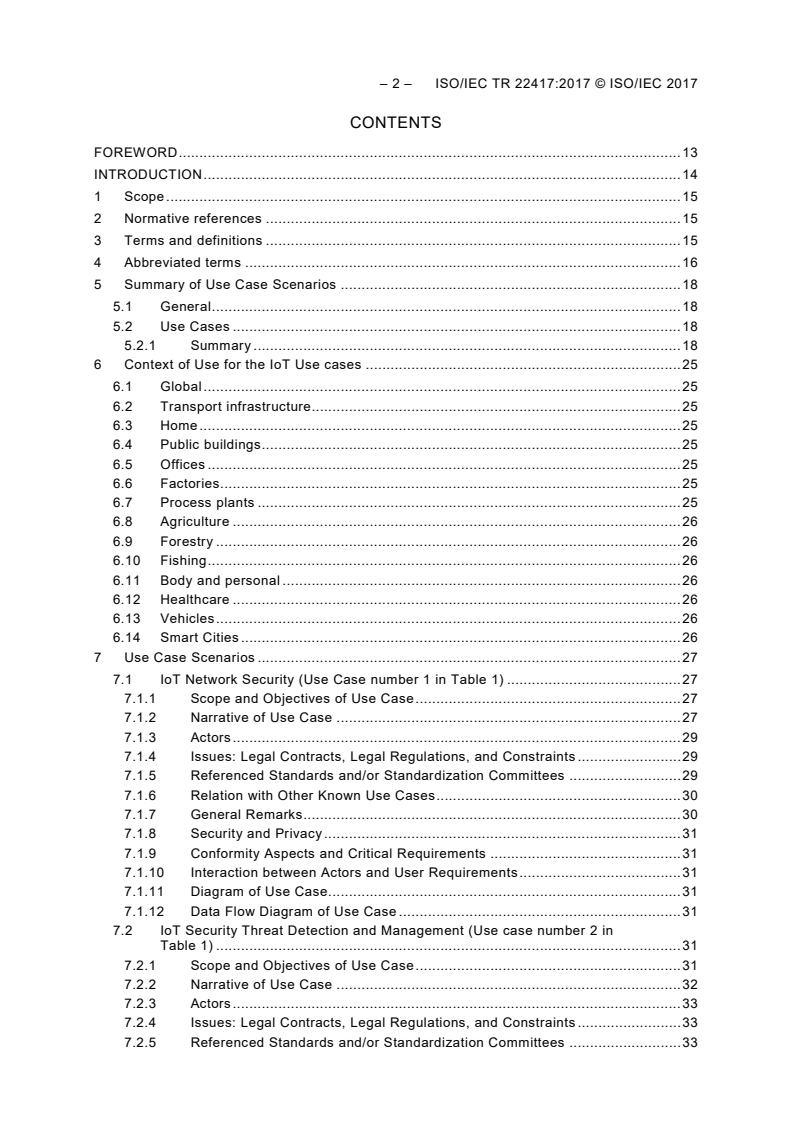
– 2 – ISO/IEC TR 22417:2017 © ISO/IEC 2017
CONTENTS
FOREWORD . 13
INTRODUCTION . 14
1 Scope . 15
2 Normative references . 15
3 Terms and definitions . 15
4 Abbreviated terms . 16
5 Summary of Use Case Scenarios . 18
5.1 General . 18
5.2 Use Cases . 18
5.2.1 Summary . 18
6 Context of Use for the IoT Use cases . 25
6.1 Global . 25
6.2 Transport infrastructure. 25
6.3 Home . 25
6.4 Public buildings . 25
6.5 Offices . 25
6.6 Factories . 25
6.7 Process plants . 25
6.8 Agriculture . 26
6.9 Forestry . 26
6.10 Fishing . 26
6.11 Body and personal . 26
6.12 Healthcare . 26
6.13 Vehicles . 26
6.14 Smart Cities . 26
7 Use Case Scenarios . 27
7.1 IoT Network Security (Use Case number 1 in Table 1) . 27
7.1.1 Scope and Objectives of Use Case . 27
7.1.2 Narrative of Use Case . 27
7.1.3 Actors . 29
7.1.4 Issues: Legal Contracts, Legal Regulations, and Constraints . 29
7.1.5 Referenced Standards and/or Standardization Committees . 29
7.1.6 Relation with Other Known Use Cases . 30
7.1.7 General Remarks . 30
7.1.8 Security and Privacy . 31
7.1.9 Conformity Aspects and Critical Requirements . 31
7.1.10 Interaction between Actors and User Requirements . 31
7.1.11 Diagram of Use Case . 31
7.1.12 Data Flow Diagram of Use Case . 31
7.2 IoT Security Threat Detection and Management (Use case number 2 in
Table 1) . 31
7.2.1 Scope and Objectives of Use Case . 31
7.2.2 Narrative of Use Case . 32
7.2.3 Actors . 33
7.2.4 Issues: Legal Contracts, Legal Regulations, and Constraints . 33
7.2.5 Referenced Standards and/or Standardization Committees . 33
7.2.6 Relation with Other Known Use Cases . 34
7.2.7 General Remarks . 34
7.2.8 Security and Privacy . 34
7.2.9 Conformity Aspects and Critical Requirements . 34
7.2.10 Interaction between Actors and User Requirements . 34
7.2.11 Diagram of Use Case . 35
7.2.12 Data Flow Diagram of Use Case . 35
7.3 Remote Management of Large Equipment in a Plant (Use case number 3 in
Table 1) . 36
7.3.1 Scope and Objectives of Use Case . 36
7.3.2 Narrative of Use Case . 36
7.3.3 Actors . 37
7.3.4 Issues: Legal Contracts, Legal Regulations, and Constraints . 37
7.3.5 Referenced Standards and/or Standardization Committees . 38
7.3.6 Relation with Other Known Use Cases . 38
7.3.7 General Remarks . 38
7.3.8 Security and Privacy . 38
7.3.9 Conformity Aspects and Critical Requirements . 38
7.3.10 Interaction between Actors and User Requirements . 38
7.3.11 Diagram of Use Case . 39
7.3.12 Data Flow Diagram of Use Case . 39
7.4 Automated ICC Profile Discovery (Use case number 4 in Table 1) . 39
7.4.1 Scope and Objectives of Use Case . 39
7.4.2 Narrative of Use Case . 39
7.4.3 Actors . 40
7.4.4 Issues: Legal Contracts, Legal Regulations, and Constraints . 41
7.4.5 Referenced Standards and/or Standardization Committees . 41
7.4.6 Relation with Other Known Use Cases . 41
7.4.7 General Remarks . 41
7.4.8 Security and Privacy . 41
7.4.9 Conformity Aspects and Critical Requirements . 41
7.4.10 Interaction between Actors and User Requirements . 42
7.4.11 Diagram of Use Case . 42
7.4.12 Data Flow Diagram of Use Case . 43
7.5 Tracking of Farm Products (Use case number 5 in Table 1) . 43
7.5.1 Scope and Objectives of Use Case . 43
7.5.2 Narrative of Use Case . 43
7.5.3 Actors . 44
7.5.4 Issues: Legal Contracts, Legal Regulations, Constraints . 45
7.5.5 Referenced Standards and/or Standardization Committees . 45
7.5.6 Relation with Other Known Use Cases . 45
7.5.7 General Remarks . 45
7.5.8 Security and Privacy . 46
7.5.9 Conformity Aspects and Critical Requirements . 46
7.5.10 Interaction between Actors and User Requirements . 46
7.5.11 Diagram of Use Case . 47
7.5.12 Data Flow Diagram of Use Case . 48
7.6 Warehouse Goods Monitoring (Use case number 6 in Table 1) . 48
7.6.1 Scope and Objectives of Use Case . 48
– 4 – ISO/IEC TR 22417:2017 © ISO/IEC 2017
7.6.2 Narrative of Use Case . 48
7.6.3 Actors . 49
7.6.4 Issues: Legal Contracts, Legal Regulations, Constraints . 51
7.6.5 Referenced Standards and/or Standardization Committees . 51
7.6.6 Relation with Other Known Use Cases . 51
7.6.7 General Remarks . 52
7.6.8 Security and Privacy . 52
7.6.9 Conformity Aspects and Critical Requirements . 52
7.6.10 Interaction between Actors and User Requirements . 52
7.6.11 Diagram of Use Case . 52
7.6.12 Data Flow Diagram of Use Case . 52
7.7 Cooperation between Factories and Remote Applications (Use case number
7 in Table 1) . 53
7.7.1 Scope and Objectives of Use Case . 53
7.7.2 Narrative of Use Case . 53
7.7.3 Actors . 55
7.7.4 Issues: Legal Contracts, Legal Regulations, Constraints . 56
7.7.5 Referenced Standards and/or Standardization Committees . 56
7.7.6 Relation with Other Known Use Cases . 56
7.7.7 General Remarks . 56
7.7.8 Security and Privacy . 56
7.7.9 Conformity aspects and Critical Requirements . 56
7.7.10 Interaction between Actors and User Requirements . 56
7.7.11 Diagram of Use Case . 57
7.7.12 Data Flow Diagram of Use Case . 57
7.8 Searching System for People with Cognitive Impairment (Use case number 8
in Table 1) . 58
7.8.1 Scope and Objectives of Use Case . 58
7.8.2 Narrative of Use Case . 58
7.8.3 Actors . 58
7.8.4 Issues: Legal Contracts, Legal Regulations, Constraints . 59
7.8.5 Referenced Standards and/or Standardization Committees . 59
7.8.6 Relation with Other Known Use Cases . 59
7.8.7 General Remarks . 59
7.8.8 Security and Privacy . 59
7.8.9 Conformity aspects and Critical Requirements . 59
7.8.10 Interaction between Actors and User Requirements . 59
7.8.11 Diagram of Use Case . 60
7.8.12 Data Flow Diagram of Use Case . 60
7.9 Sleep Monitoring System (Use case number 9 in Table 1) . 60
7.9.1 Scope and Objectives of Use Case . 60
7.9.2 Narrative of Use Case . 60
7.9.3 Actors . 61
7.9.4 Issues: Legal Contracts, Legal Regulations, Constraints . 61
7.9.5 Referenced Standards and/or Standardization Committees . 62
7.9.6 Relation with Other Known Use Cases . 62
7.9.7 General Remarks . 62
7.9.8 Security and Privacy . 62
7.9.9 Conformity Aspects and Critical Requirements . 62
7.9.10 Interaction between Actors and User Requirements . 62
7.9.11 Diagram of Use Case . 62
7.9.12 Data Flow Diagram of Use Case . 62
7.10 Smart Glasses (Use case number 10 in Table 1) . 62
7.10.1 Scope and Objectives of the Use case . 62
7.10.2 Narrative of Use Case . 63
7.10.3 Actors . 63
7.10.4 Issues: Legal Contracts, Legal Regulations, Constraints . 63
7.10.5 Referenced Standards and/or Standardization Committees . 64
7.10.6 Relation with Other Known Use Cases . 64
7.10.7 General Remarks . 64
7.10.8 Security and Privacy . 64
7.10.9 Conformity Aspects and Critical requirements . 64
7.10.10 Interaction between Actors and User Requirements . 64
7.10.11 Diagram of Use Case . 65
7.10.12 Data Flow Diagram of Use Case . 66
7.11 IoT Endpoint (Sensors and Actuators) Monitoring Systems (Use case
number 11 in Table 1) . 66
7.11.1 Scope and Objectives of Use Case . 66
7.11.2 Narrative of Use Case . 66
7.11.3 Actors . 67
7.11.4 Issues: Legal Contracts, Legal Regulations, Constraints . 68
7.11.5 Referenced Standards and/or Standardization Committees . 68
7.11.6 Relation with Other Known Use Cases . 68
7.11.7 General Remarks . 68
7.11.8 Security and Privacy . 68
7.11.9 Conformity aspects and Critical Requirements . 69
7.11.10 Interaction between Actors and User Requirements . 69
7.11.11 Diagram of Use Case . 69
7.11.12 Data Flow Diagram of Use Case . 69
7.12 Intelligent Assistive Parking in Urban Areas (Use case number 12 in Table
1) . 70
7.12.1 Scope and Objectives of Use Case . 70
7.12.2 Narrative of Use Case . 70
7.12.3 Actors . 71
7.12.4 Issues: Legal Contracts, Legal Regulations, Constraints . 72
7.12.5 Referenced Standards and/or Standardization Committees . 73
7.12.6 Relation with Other Known Use Cases . 73
7.12.7 General Remarks . 73
7.12.8 Security and Privacy . 74
7.12.9 Conformity Aspects and Critical Requirements . 74
7.12.10 Interaction between Actors and User Requirements . 74
7.12.11 Diagram of Use Case . 75
7.12.12 Data Flow Diagram of Use Case . 78
7.13 Integrated Smart Pump System (Use case number 13 in Table 1) . 79
7.13.1 Scope and Objectives . 79
7.13.2 Narrative of Use Case . 79
7.13.3 Actors . 81
7.13.4 Issues: Legal Contracts, Legal Regulations, Constraints . 81
– 6 – ISO/IEC TR 22417:2017 © ISO/IEC 2017
7.13.5 Referenced Standards and/or Standardization Committees . 81
7.13.6 Relation with Other Use Cases . 82
7.13.7 General remarks . 82
7.13.8 Security and Privacy . 83
7.13.9 Conformity Aspects and Critical Requirements . 83
7.13.10 Interaction between Actors and User Requirements . 83
7.13.11 Diagram of Use Case . 83
7.13.12 Data Flow Diagram of Use Case . 84
7.14 Remote Health Monitoring: Example of an AAL Use Case Relevant to IoT
(Use case number 14 in Table 1) . 84
7.14.1 Scope and Objectives of Use Case . 84
7.14.2 Narrative of Use Case . 84
7.14.3 Actors . 84
7.14.4 Issues: Legal Contracts, Legal Regulations, Constraints . 85
7.14.5 Referenced Standards and/or Standardization Committees . 85
7.14.6 Relation with Other Known Use Cases . 86
7.14.7 General Remarks . 86
7.14.8 Security and Privacy . 86
7.14.9 Conformity Aspects and Critical Requirements . 87
7.14.10 Interaction between stakeholders/devices/services/system including
user requirements . 87
7.14.11 Diagram of Use Case . 88
7.14.12 Data Flow Diagram of Use Case . 88
7.15 Connected Car Analytics (Use case number 15 in Table 1) . 88
7.15.1 Scope and Objectives of Use Case . 88
7.15.2 Narrative of Use Case . 89
7.15.3 Actors . 90
7.15.4 Issues: Legal Contracts, Legal Regulations, Constraints . 91
7.15.5 Referenced Standards and/or Standardization Committees . 91
7.15.6 Relation with Other Known Use Cases . 92
7.15.7 General Remarks . 92
7.15.8 Security and Privacy . 92
7.15.9 Conformity Aspects and Critical Requirements . 92
7.15.10 Interaction between Actors and User Requirements . 92
7.15.11 Diagram of Use Case . 93
7.15.12 Data Flow Diagram of Use Case . 93
7.16 Real Time Motor Monitor (Use case number 16 in Table 1) . 93
7.16.1 Scope and Objectives of Use Case . 93
7.16.2 Narrative of Use Case . 93
7.16.3 Actors . 94
7.16.4 Issues: Legal Contracts, Legal Regulations, Constraints . 95
7.16.5 Referenced Standards and/or Standardization Committees . 95
7.16.6 Relation with Other Known Use Cases . 95
7.16.7 General Remarks . 96
7.16.8 Security and Privacy . 96
7.16.9 Conformity aspects and Critical Requirements . 96
7.16.10 Interaction between Actors and User Requirements . 96
7.16.11 Diagram of Use Case . 96
7.16.12 Data Flow Diagram of Use Case . 96
7.17 Smart Home Appliances (Use case number 17 in Table 1) . 96
7.17.1 Scope and Objectives of Use Case . 96
7.17.2 Narrative of Use Case . 97
7.17.3 Actors . 98
7.17.4 Issues: Legal Contracts, Legal Regulations, Constraints . 99
7.17.5 Referenced Standards and/or Standardization Committees . 99
7.17.6 Relation with Other Known Use Cases . 99
7.17.7 General Remarks . 99
7.17.8 Security and Privacy . 99
7.17.9 Conformity aspects and Critical Requirements . 99
7.17.10 Interaction between Actors and User Requirements . 99
7.17.11 Diagram of Use Case . 100
7.17.12 Data Flow Diagram of Use Case . 100
7.18 Smart Home Insurance (Use case number 18 in Table 1) . 100
7.18.1 Scope and Objectives of Use Case . 100
7.18.2 Narrative of Use Case . 100
7.18.3 Actors . 102
7.18.4 Issues: Legal Contracts, Legal Regulations, Constraints . 103
7.18.5 Referenced Standards and/or Standardization Committees . 103
7.18.6 Relation with Other Known Use Cases . 103
7.18.7 General Remarks . 103
7.18.8 Security and Privacy . 103
7.18.9 Conformity Aspects and Critical Requirements . 103
7.18.10 Interaction between Actors and User Requirements . 103
7.18.11 Diagram of Use Case . 104
7.18.12 Data Flow Diagram of Use Case . 104
7.19 Machine Leasing (Use case number 19 in Table 1) . 104
7.19.1 Scope and Objectives of Use Case . 104
7.19.2 Narrative of Use Case . 104
7.19.3 Actors . 106
7.19.4 Issues: Legal Contracts, Legal Regulations, Constraints . 107
7.19.5 Referenced Standards and/or Standardization Committees . 107
7.19.6 Relation with Other Known Use Cases . 107
7.19.7 General Remarks . 107
7.19.8 Security and Privacy . 107
7.19.9 Conformity aspects and Critical Requirements . 107
7.19.10 Interaction between Actors and User Requirements . 107
7.19.11 Diagram of Use Case . 108
7.19.12 Data Flow Diagram of Use Case . 108
7.20 IoT–based Energy Management System for Industrial Facilities (Use case
number 20 in Table 1) . 108
7.20.1 Scope and Objectives of Use Case . 108
7.20.2 Narrative of Use Case . 108
7.20.3 Actors . 109
7.20.4 Issues: Legal Contracts, Legal Regulations, Constraints . 110
7.20.5 Referenced Standards and/or Standardization Committees . 110
7.20.6 Relation with Other Known Use Cases . 111
7.20.7 General Remarks . 111
7.20.8 Security and Privacy . 111
– 8 – ISO/IEC TR 22417:2017 © ISO/IEC 2017
7.20.9 Conformity Aspects and Critical Requirements . 111
7.20.10 Interaction between Actors and User Requirements . 111
7.20.11 Diagram of Use Case . 111
7.20.12 Data Flow Diagram of Use Case . 113
7.21 Water Plant Management (Use case number 21 in Table 1) . 113
7.21.1 Scope and Objectives of Use Case . 113
7.21.2 Narrative of Use Case . 113
7.21.3 Actors . 114
7.21.4 Issues: Legal Contracts, Legal Regulations, Constraints . 116
7.21.5 Referenced Standards and/or Standardization Committees . 116
7.21.6 Relation with Other Known Use Cases . 116
7.21.7 General Remarks . 116
7.21.8 Security and Privacy . 117
7.21.9 Conformity Aspects and Critical Requirements . 117
7.21.10 Interaction between Actors and User Requirements . 117
7.21.11 Diagram of Use Case . 117
7.21.12 Data Flow Diagram of Use Case . 118
7.22 Smart Home Application (Use case number 22 in Table 1) . 118
7.22.1 Scope and Objectives of Use Case . 118
7.22.2 Narrative of Use Case . 119
7.22.3 Actors . 120
7.22.4 Issues: Legal Contracts, Legal Regulations, Constraints . 121
7.22.5 Referenced Standards and/or Standardization Committees . 121
7.22.6 Relation with Other Known Use Cases . 122
7.22.7 General Remarks . 122
7.22.8 Security and Privacy . 122
7.22.9 Conformity Aspects and Critical Requirements . 122
7.22.10 Interaction between Actors and User Requirements . 122
7.22.11 Diagram of Use Case . 123
7.22.12 Data Flow Diagram of Use Case . 123
7.23 Field Gateway Bridging IoT to Legacy Devices in Factories and Plants (Use
case number 23 in Table 1) . 123
7.23.1 Scope and Objectives of Use Case . 123
7.23.2 Narrative of Use Case . 123
7.23.3 Actors . 124
7.23.4 Issues: Legal Contracts, Legal Regulations, Constraints . 124
7.23.5 Referenced Standards and/or Standardization Committees . 124
7.23.6 Relation with Other Known Use Cases . 124
7.23.7 General Remarks . 124
7.23.8 Security and Privacy . 125
7.23.9 Conformity Aspects and Critical Requirements . 125
7.23.10 Interaction between Actors and User Requirements . 125
7.23.11 Diagram of Use Case . 127
7.23.12 Data Flow Diagram of Use Case . 127
7.24 Production Monitoring of Textile Equipment (Use case number 24 in Table 1) . 128
7.24.1 Scope and Objectives of Use Case . 128
7.24.2 Narrative of Use Case . 128
7.24.3 Actors . 129
7.24.4 Issues: Legal Contracts, Legal Regulations, Constraints . 129
7.24.5 Referenced Standards and/or Standardization Committees . 130
7.24.6 Relation with Other Known Use Cases . 130
7.24.7 General Remarks . 130
7.24.8 Security and Privacy . 131
7.24.9 Conformity aspects and Critical Requirements . 131
7.24.10 Interaction between Actors and User Requirements . 131
7.24.11 Diagram of Use Case . 134
7.24.12 Data Flow Diagram of Use Case . 134
7.25 Remote Management of Agricultural Greenhouses (Use case number 25 in
Table 1) . 134
7.25.1 Scope and Objectives of Use Case . 134
7.25.2 Narrative of Use Case . 134
7.25.3 Actors . 138
7.25.4 Issues: Legal Contracts, Legal Regulations, Constraints . 138
7.25.5 Referenced Standards and/or Standardization Committees . 138
7.25.6 Relation with Other Known Use Cases . 138
7.25.7 General Remarks . 138
7.25.8 Security and Privacy . 139
7.25.9 Conformity aspects and Critical Requirements . 139
7.25.10 Interaction between Actors and User Requirements . 139
7.25.11 Diagram of Use Case . 143
7.25.12 Data Flow Diagram of Use Case . 143
Annex A (informative) Actors identified in Use Cases . 144
A.1 IoT devices: . 144
A.2 IoT gateway . 144
A.3 Communications networks: . 145
A.4 Applications: . 145
A.5 Systems implementing services across IoT networks . 145
A.6 Databases . 146
A.7 Users .
...