


IEC 60050-394:2007
(Main)International Electrotechnical Vocabulary (IEV) - Part 394: Nuclear instrumentation - Instruments, systems, equipment and detectors
General Information
- Abstract
This part of IEC 60050 gives the general terminology used for instruments (in nuclear instrumentation). The terminology related to physical phenomena and basic concepts of nuclear instrumentation is developed in another part of IEV. It has the status of a horizontal standard in accordance with IEC Guide 108.
- Status
- Replaced
- Publication Date
- 23-Apr-2007
- Technical Committee
- TC 1 - Terminology
- Drafting Committee
- AG 1 - TC 1/AG 1
- Current Stage
- DELPUB - Deleted Publication
- Start Date
- 31-Mar-2014
- Completion Date
- 28-Aug-2026
Relations
- Effective Date
- 05-Sep-2023
- Effective Date
- 25-Aug-2026
- Effective Date
- 10-Feb-2026
- Effective Date
- 10-Feb-2026
- Effective Date
- 10-Feb-2026
- Effective Date
- 10-Feb-2026
- Effective Date
- 10-Feb-2026
- Effective Date
- 10-Feb-2026
- Effective Date
- 10-Feb-2026
- Effective Date
- 10-Feb-2026
- Effective Date
- 10-Feb-2026
- Effective Date
- 10-Feb-2026
- Effective Date
- 10-Feb-2026
- Effective Date
- 10-Feb-2026
- Effective Date
- 05-Sep-2023
Get Certified
Connect with accredited certification bodies for this standard

DNV
DNV is an independent assurance and risk management provider.

Lloyd's Register
Lloyd's Register is a global professional services organisation specialising in engineering and technology.
DNV Energy Systems
Energy and renewable energy certification.
Sponsored listings
Frequently Asked Questions
IEC 60050-394:2007 is a standard published by the International Electrotechnical Commission (IEC). Its full title is "International Electrotechnical Vocabulary (IEV) - Part 394: Nuclear instrumentation - Instruments, systems, equipment and detectors". This standard covers: This part of IEC 60050 gives the general terminology used for instruments (in nuclear instrumentation). The terminology related to physical phenomena and basic concepts of nuclear instrumentation is developed in another part of IEV. It has the status of a horizontal standard in accordance with IEC Guide 108.
This part of IEC 60050 gives the general terminology used for instruments (in nuclear instrumentation). The terminology related to physical phenomena and basic concepts of nuclear instrumentation is developed in another part of IEV. It has the status of a horizontal standard in accordance with IEC Guide 108.
IEC 60050-394:2007 is classified under the following ICS (International Classification for Standards) categories: 01.040.17 - Metrology and measurement. Physical phenomena (Vocabularies); 27.120.01 - Nuclear energy in general. The ICS classification helps identify the subject area and facilitates finding related standards.
IEC 60050-394:2007 has the following relationships with other standards: It is inter standard links to IEC 60050-395:2014, EN 13477-2:2010, EN 60846-1:2014, EN 62533:2016, EN 61577-4:2014, EN 62694:2016, EN 61000-4-22:2011, EN 62618:2016, EN 62534:2015, EN 61526:2013, EN 62363:2011, EN 62598:2013, EN 62484:2015, EN 61577-3:2014, IEC 60050-394:1995. Understanding these relationships helps ensure you are using the most current and applicable version of the standard.
IEC 60050-394:2007 is available in PDF format for immediate download after purchase. The document can be added to your cart and obtained through the secure checkout process. Digital delivery ensures instant access to the complete standard document.
Standards Content (Sample)
INTERNATIONAL IEC
STANDARD CEI
60050-394
NORME
Second edition
INTERNATIONALE
Deuxième édition
2007-04
International Electrotechnical Vocabulary
Part 394:
Nuclear instrumentation –
Instruments, systems, equipment
and detectors
Vocabulaire Electrotechnique International
Partie 394:
Instrumentation nucléaire –
Instruments, systèmes, équipements
et détecteurs
Reference number
Numéro de référence
IEC/CEI 60050-394:2007
All rights reserved. Unless otherwise specified, no part of this publication may be reproduced or utilized in any form
or by any means, electronic or mechanical, including photocopying and microfilm, without permission in writing from
either IEC or IEC's member National Committee in the country of the requester.
If you have any questions about IEC copyright or have an enquiry about obtaining additional rights to this publication,
please contact the address below or your local IEC member National Committee for further information.
Droits de reproduction réservés. Sauf indication contraire, aucune partie de cette publication ne peut être reproduite
ni utilisée sous quelque forme que ce soit et par aucun procédé, électronique ou mécanique, y compris la photocopie
et les microfilms, sans l'accord écrit de la CEI ou du Comité national de la CEI du pays du demandeur.
Si vous avez des questions sur le copyright de la CEI ou si vous désirez obtenir des droits supplémentaires sur cette
publication, utilisez les coordonnées ci-après ou contactez le Comité national de la CEI de votre pays de résidence.
IEC Central Office
3, rue de Varembé
CH-1211 Geneva 20
Switzerland
Email: inmail@iec.ch
Web: www.iec.ch
About the IEC
The International Electrotechnical Commission (IEC) is the leading global organization that prepares and publishes
International Standards for all electrical, electronic and related technologies.
About IEC publications
The technical content of IEC publications is kept under constant review by the IEC. Please make sure that you have the
latest edition, a corrigenda or an amendment might have been published.
ƒ Catalogue of IEC publications: www.iec.ch/searchpub
The IEC on-line Catalogue enables you to search by a variety of criteria (reference number, text, technical committee,…).
It also gives information on projects, withdrawn and replaced publications.
ƒ IEC Just Published: www.iec.ch/online_news/justpub
Stay up to date on all new IEC publications. Just Published details twice a month all new publications released. Available
on-line and also by email.
ƒ Customer Service Centre: www.iec.ch/webstore/custserv
If you wish to give us your feedback on this publication or need further assistance, please visit the Customer Service
Centre FAQ or contact us:
Email: csc@iec.ch
Tel.: +41 22 919 02 11
Fax: +41 22 919 03 00
A propos de la CEI
La Commission Electrotechnique Internationale (CEI) est la première organisation mondiale qui élabore et publie des
normes internationales pour tout ce qui a trait à l'électricité, à l'électronique et aux technologies apparentées.
A propos des publications CEI
Le contenu technique des publications de la CEI est constamment revu. Veuillez vous assurer que vous possédez
l’édition la plus récente, un corrigendum ou amendement peut avoir été publié.
ƒ Catalogue des publications de la CEI: www.iec.ch/searchpub/cur_fut-f.htm
Le Catalogue en-ligne de la CEI vous permet d’effectuer des recherches en utilisant différents critères (numéro de
référence, texte, comité d’études,…). Il donne aussi des informations sur les projets et les publications retirées ou
remplacées.
ƒ Just Published CEI: www.iec.ch/online_news/justpub
Restez informé sur les nouvelles publications de la CEI. Just Published détaille deux fois par mois les nouvelles
publications parues. Disponible en-ligne et aussi par email.
ƒ Service Clients: www.iec.ch/webstore/custserv/custserv_entry-f.htm
Si vous désirez nous donner des commentaires sur cette publication ou si vous avez des questions, visitez le FAQ du
Service clients ou contactez-nous:
Email: csc@iec.ch
Tél.: +41 22 919 02 11
Fax: +41 22 919 03 00
INTERNATIONAL IEC
STANDARD CEI
60050-394
NORME
Second edition
INTERNATIONALE
Deuxième édition
2007-04
International Electrotechnical Vocabulary
Part 394:
Nuclear instrumentation –
Instruments, systems, equipment
and detectors
Vocabulaire Electrotechnique International
Partie 394:
Instrumentation nucléaire –
Instruments, systèmes, équipements
et détecteurs
PRICE CODE
Commission Electrotechnique Internationale CODE PRIX XF
International Electrotechnical Commission
Международная Электротехническая Комиссия
For price, see current catalogue
Pour prix, voir catalogue en vigueur
60050-394 CEI:2007 – II –
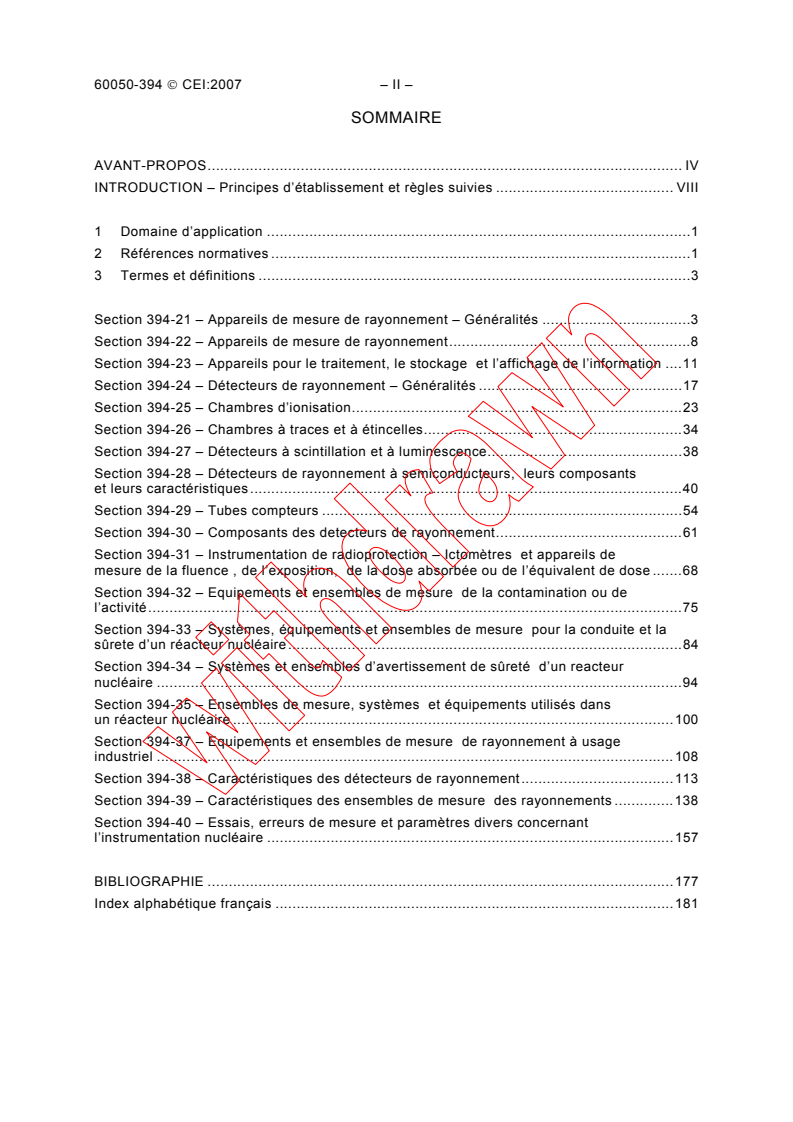
SOMMAIRE
AVANT-PROPOS. IV
INTRODUCTION – Principes d’établissement et règles suivies . VIII
1 Domaine d’application .1
2 Références normatives .1
3 Termes et définitions .3
Section 394-21 – Appareils de mesure de rayonnement – Généralités .3
Section 394-22 – Appareils de mesure de rayonnement.8
Section 394-23 – Appareils pour le traitement, le stockage et l’affichage de l’information .11
Section 394-24 – Détecteurs de rayonnement – Généralités .17
Section 394-25 – Chambres d’ionisation.23
Section 394-26 – Chambres à traces et à étincelles.34
Section 394-27 – Détecteurs à scintillation et à luminescence.38
Section 394-28 – Détecteurs de rayonnement à semiconducteurs, leurs composants
et leurs caractéristiques.40
Section 394-29 – Tubes compteurs .54
Section 394-30 – Composants des detecteurs de rayonnement.61
Section 394-31 – Instrumentation de radioprotection – Ictomètres et appareils de
mesure de la fluence , de l’exposition, de la dose absorbée ou de l’équivalent de dose .68
Section 394-32 – Equipements et ensembles de mesure de la contamination ou de
l’activité.75
Section 394-33 – Systèmes, équipements et ensembles de mesure pour la conduite et la
sûrete d’un réacteur nucléaire.84
Section 394-34 – Systèmes et ensembles d’avertissement de sûreté d’un reacteur
nucléaire .94
Section 394-35 – Ensembles de mesure, systèmes et équipements utilisés dans
un réacteur nucléaire .100
Section 394-37 – Equipements et ensembles de mesure de rayonnement à usage
industriel .108
Section 394-38 – Caractéristiques des détecteurs de rayonnement.113
Section 394-39 – Caractéristiques des ensembles de mesure des rayonnements .138
Section 394-40 – Essais, erreurs de mesure et paramètres divers concernant
l’instrumentation nucléaire .157
BIBLIOGRAPHIE .177
Index alphabétique français .181
– III – 60050-394 IEC:2007
CONTENTS
FOREWORD. VI
INTRODUCTION – Principles and rules followed . IX
1 Scope .2
2 Normative references .2
3 Terms and definitions .3
Section 394-21 – Radiation measuring apparatus – General .3
Section 394-22 – Radiation measuring apparatus .8
Section 394-23 – Apparatus for processing, storage and display of the information .11
Section 394-24 – Radiation detectors – general.17
Section 394-25 – Ionization chambers .23
Section 394-26 – Track and spark chambers .35
Section 394-27 – Scintillation and luminescence detectors .38
Section 394-28 – Semiconductor radiation detectors, their components and characteristics.40
Section 394-29 – Counter tubes .54
Section 394-30 – Components of radiation detectors .61
Section 394-31 – Radiation protection instrumentation – Fluence, exposure, absorbed
dose, or dose equivalent meters and ratemeters.68
Section 394-32 – contamination or activity measuring equipment or assemblies.75
Section 394-33 – Systems , equipment and assemblies for operation and safety of
nuclear reactors.84
Section 394-34 – Warning, safety and protection systems and assemblies of a nuclear
reactor.94
Section 394-35 – Various measuring assemblies and equipment used in a nuclear
reactor.100
Section 394-37 – Radiation measuring equipment and assemblies for industrial use .108
Section 394-38 – Characteristics of radiation detectors.113
Section 394-39 – Characteristics of radiation measuring assemblies.138
Section 394-40 – Tests, errors of measurements and various parameters concerning nuclear
instrumentation.157
BIBLIOGRAPHY .177
English alphabetical index.203
60050-394 CEI:2007 – IV –
COMMISSION ÉLECTROTECHNIQUE INTERNATIONALE
____________
VOCABULAIRE ÉLECTROTECHNIQUE INTERNATIONAL
Partie 394: INSTRUMENTATION NUCLÉAIRE – INSTRUMENTS,
SYSTÈMES, ÉQUIPEMENTS ET DÉTECTEURS
AVANT-PROPOS
1) La Commission Electrotechnique Internationale (CEI) est une organisation mondiale de normalisation
composée de l'ensemble des comités électrotechniques nationaux (Comités nationaux de la CEI). La CEI a
pour objet de favoriser la coopération internationale pour toutes les questions de normalisation dans les
domaines de l'électricité et de l'électronique. A cet effet, la CEI – entre autres activités – publie des Normes
internationales, des Spécifications techniques, des Rapports techniques, des Spécifications accessibles au
public (PAS) et des Guides (ci-après dénommés "Publication(s) de la CEI"). Leur élaboration est confiée à des
comités d'études, aux travaux desquels tout Comité national intéressé par le sujet traité peut participer. Les
organisations internationales, gouvernementales et non gouvernementales, en liaison avec la CEI, participent
également aux travaux. La CEI collabore étroitement avec l'Organisation Internationale de Normalisation (ISO),
selon des conditions fixées par accord entre les deux organisations.
2) Les décisions ou accords officiels de la CEI concernant les questions techniques représentent, dans la mesure
du possible, un accord international sur les sujets étudiés, étant donné que les Comités nationaux de la CEI
intéressés sont représentés dans chaque comité d’études.
3) Les Publications de la CEI se présentent sous la forme de recommandations internationales et sont agréées
comme telles par les Comités nationaux de la CEI. Tous les efforts raisonnables sont entrepris afin que la CEI
s'assure de l'exactitude du contenu technique de ses publications; la CEI ne peut pas être tenue responsable
de l'éventuelle mauvaise utilisation ou interprétation qui en est faite par un quelconque utilisateur final.
4) Dans le but d'encourager l'uniformité internationale, les Comités nationaux de la CEI s'engagent, dans toute la
mesure possible, à appliquer de façon transparente les Publications de la CEI dans leurs publications
nationales et régionales. Toutes divergences entre toutes Publications de la CEI et toutes publications
nationales ou régionales correspondantes doivent être indiquées en termes clairs dans ces dernières.
5) La CEI n’a prévu aucune procédure de marquage valant indication d’approbation et n'engage pas sa
responsabilité pour les équipements déclarés conformes à une de ses Publications.
6) Tous les utilisateurs doivent s'assurer qu'ils sont en possession de la dernière édition de cette publication.
7) Aucune responsabilité ne doit être imputée à la CEI, à ses administrateurs, employés, auxiliaires ou
mandataires, y compris ses experts particuliers et les membres de ses comités d'études et des Comités
nationaux de la CEI, pour tout préjudice causé en cas de dommages corporels et matériels, ou de tout autre
dommage de quelque nature que ce soit, directe ou indirecte, ou pour supporter les coûts (y compris les frais
de justice) et les dépenses découlant de la publication ou de l'utilisation de cette Publication de la CEI ou de
toute autre Publication de la CEI, ou au crédit qui lui est accordé.
8) L'attention est attirée sur les références normatives citées dans cette publication. L'utilisation de publications
référencées est obligatoire pour une application correcte de la présente publication.
9) L’attention est attirée sur le fait que certains des éléments de la présente Publication de la CEI peuvent faire
l’objet de droits de propriété intellectuelle ou de droits analogues. La CEI ne saurait être tenue pour
responsable de ne pas avoir identifié de tels droits de propriété et de ne pas avoir signalé leur existence.
La Norme internationale CEI 60050-394 a été établie par le groupe de travail 1: Terminologie
- Classification du comité d'études 45 de la CEI, sous la responsabilité du comité d'études 1
de la CEI: Terminologie.
Cette deuxième édition annule et remplace la première édition parue en 1996, amendement 1
(1996) et amendement 2 (2000). Cette deuxième édition constitue un révision technique.
Cette edition comprend les changements techniques significatifs suivants par rapport à
l’édition précédente: de nombreuses entrées ont été supprimées, ou modifiées, et un effort
d’harmonisation avec l’ISO 921 a été effectué.
– V – 60050-394 © IEC:2007
Le texte de cette norme est issu des documents suivants:
FDIS Rapport de vote
1/1980A/FDIS 1/1989/RVD
Le rapport de vote indiqué dans le tableau ci-dessus donne toute information sur le vote ayant
abouti à l'approbation de cette norme.
Cette publication a été rédigée selon les Directives ISO/CEI, Partie 2.
Dans la présente partie du VEI les termes et définitions sont donnés en français et en anglais:
de plus, les termes sont indiqués en allemand (de), espagnol (es), italien (it), japonais (ja),
polonais (pl), portugais (pt) et chinois (zh).
Le comité a décidé que le contenu de cette publication ne sera pas modifié avant la date de
maintenance indiquée sur le site web de la CEI sous "http://webstore.iec.ch" dans les
données relatives à la publication recherchée. A cette date, la publication sera
• reconduite,
• supprimée,
• remplacée par une édition révisée, ou
• amendée.
60050-394 CEI:2007 – VI –
INTERNATIONAL ELECTROTECHNICAL COMMISSION
____________
INTERNATIONAL ELECTROTECHNICAL VOCABULARY
Part 394: NUCLEAR INSTRUMENTATION – INSTRUMENTS, SYSTEMS,
EQUIPMENT AND DETECTORS
FOREWORD
1) The International Electrotechnical Commission (IEC) is a worldwide organization for standardization comprising
all national electrotechnical committees (IEC National Committees). The object of IEC is to promote
international co-operation on all questions concerning standardization in the electrical and electronic fields. To
this end and in addition to other activities, IEC publishes International Standards, Technical Specifications,
Technical Reports, Publicly Available Specifications (PAS) and Guides (hereafter referred to as “IEC
Publication(s)”). Their preparation is entrusted to technical committees; any IEC National Committee interested
in the subject dealt with may participate in this preparatory work. International, governmental and non-
governmental organizations liaising with the IEC also participate in this preparation. IEC collaborates closely
with the International Organization for Standardization (ISO) in accordance with conditions determined by
agreement between the two organizations.
2) The formal decisions or agreements of IEC on technical matters express, as nearly as possible, an international
consensus of opinion on the relevant subjects since each technical committee has representation from all
interested IEC National Committees.
3) IEC Publications have the form of recommendations for international use and are accepted by IEC National
Committees in that sense. While all reasonable efforts are made to ensure that the technical content of IEC
Publications is accurate, IEC cannot be held responsible for the way in which they are used or for any
misinterpretation by any end user.
4) In order to promote international uniformity, IEC National Committees undertake to apply IEC Publications
transparently to the maximum extent possible in their national and regional publications. Any divergence
between any IEC Publication and the corresponding national or regional publication shall be clearly indicated in
the latter.
5) IEC provides no marking procedure to indicate its approval and cannot be rendered responsible for any
equipment declared to be in conformity with an IEC Publication.
6) All users should ensure that they have the latest edition of this publication.
7) No liability shall attach to IEC or its directors, employees, servants or agents including individual experts and
members of its technical committees and IEC National Committees for any personal injury, property damage or
other damage of any nature whatsoever, whether direct or indirect, or for costs (including legal fees) and
expenses arising out of the publication, use of, or reliance upon, this IEC Publication or any other IEC
Publications.
8) Attention is drawn to the Normative references cited in this publication. Use of the referenced publications is
indispensable for the correct application of this publication.
9) Attention is drawn to the possibility that some of the elements of this IEC Publication may be the subject of
patent rights. IEC shall not be held responsible for identifying any or all such patent rights.
International Standard IEC 60050-394 has been prepared by working group 1: Classification -
Terminology, of IEC technical committee 45, under the responsibility of IEC technical
committee 1: Terminology.
This second edition cancels and replaces the first edition published in 1996, amendment 1
(1996) and amendment 2 (2000). This second edition constitutes a technical revision.
This edition included the following significant technical changes with respect to the previous
edition: many entries have been deleted, or modified and an effort of harmonization with
ISO 921 has been made.
– VII – 60050-394 IEC:2007
The text of this standard is based on the following documents:
FDIS Report on voting
1/1980A/FDIS 1/1989/RVD
Full information on the voting for the approval of this standard can be found in the report on
voting indicated in the above table.
This publication has been drafted in accordance with the ISO/IEC Directives, Part 2.
In this part of IEV, the terms and definitions are written in French and English; in addition the
terms are given in Chinese (cn), German (de), Spanish (es), Italian (it), Japanese (ja), Polish
(pl) and Portuguese (pt).
The committee has decided that the contents of this publication will remain unchanged until
the maintenance result date indicated on the IEC web site under "http://webstore.iec.ch" in
the data related to the specific publication. At this date, the publication will be
• reconfirmed,
• withdrawn,
• replaced by a revised edition, or
• amended.
60050-394 CEI:2007 – VIII –
INTRODUCTION
Principes d’établissement et règles suivies
Généralités
Le VEI (série de normes CEI 60050) est un vocabulaire multilingue à usage général couvrant
le champ de l’électrotechnique, de l’électronique et des télécommunications. Il comprend
environ 18 000 articles terminologiques correspondant chacune à une notion. Ces articles
sont répartis dans environ 80 parties, chacune correspondant à un domaine donné.
Exemples:
Partie 161 (CEI 60050-161): Compatibilité électromagnétique
Partie 411 (CEI 60050-411): Machines tournantes
Les articles suivent un schéma de classification hiérarchique Partie/Section/Notion, les
notions étant, au sein des sections, classées par ordre systématique.
Les termes, définitions et notes des articles sont donnés dans les trois langues de la CEI,
c’est à dire français, anglais et russe (langues principales du VEI).
Dans chaque article, les termes seuls sont également donnés dans les langues additionnelles
du VEI (arabe, chinois, allemand, grec, espagnol, italien, japonais, polonais, portugais et
suédois).
De plus, chaque partie comprend un index alphabétique des termes inclus dans cette partie,
et ce pour chacune des langues du VEI.
NOTE Certaines langues peuvent manquer.
Constitution d’un article terminologique
Chacun des articles correspond à une notion, et comprend:
- un numéro d’article,
- éventuellement un symbole littéral de grandeur ou d’unité,
puis, pour chaque langue principale du VEI:
- le terme désignant la notion, appelé « terme privilégié », éventuellement accompagné de
synonymes et d’abréviations,
- la définition de la notion,
- éventuellement la source,
- éventuellement des notes,
et enfin, pour les langues additionnelles du VEI, les termes seuls.
Numéro d’article
Le numéro d’article comprend trois éléments, séparés par des traits d’union:
- Numéro de partie: 3 chiffres,
- Numéro de section: 2 chiffres,
- Numéro de la notion: 2 chiffres (01 à 99).
Exemple: 131-13-22
– IX – 60050-394 IEC:2007
INTRODUCTION
Principles and rules followed
General
The IEV (IEC 60050 series) is a general purpose multilingual vocabulary covering the field of
electrotechnology, electronics and telecommunication. It comprises about 18 000
terminological entries, each corresponding to a concept. These entries are distributed among
about 80 parts, each part corresponding to a given field.
Examples:
Part 161 (IEC 60050-161): Electromagnetic compatibility
Part 411 (IEC 60050-411): Rotating machines
The entries follow a hierarchical classification scheme Part/Section/Concept, the concepts
being, within the sections, organized in a systematic order.
The terms, definitions and notes in the entries are given in the three IEC languages, that is
French, English and Russian (principal IEV languages).
In each entry the terms alone are also given in the additional IEV languages (Arabic, Chinese,
German, Greek, Spanish, Italian, Japanese, Polish, Portuguese, and Swedish).
In addition, each part comprises an alphabetical index of the terms included in that part, for
each of the IEV languages.
NOTE Some languages may be missing.
Organization of a terminological entry
Each of the entries corresponds to a concept, and comprises:
- an entry number,
- possibly a letter symbol for quantity or unit,
then, for each of the principal IEV languages:
- the term designating the concept, called «preferred term», possibly accompanied by
synonyms and abbreviations,
- the definition of the concept,
- possibly the source,
- possibly notes,
and finally, for the additional IEV languages, the terms alone.
Entry number
The entry number is comprised of three elements, separated by hyphens:
- Part number: 3 digits,
- Section number: 2 digits,
- Concept number: 2 digits (00 to 99).
Example: 131-13-22
60050-394 CEI:2007 – X –
Symboles littéraux de grandeurs et unités
Ces symboles, indépendants de la langue, sont donnés sur une ligne séparée suivant le
numéro d’article.
Exemple:
131-12-04
symb.: R
résistance, f
Terme privilégié et synonymes
Le terme privilégié est le terme qui figure en tête d’un article ; il peut être suivi par des
synonymes. Il est imprimé en gras.
Synonymes:
Les synonymes sont imprimés sur des lignes séparées sous le terme privilégié: ils sont
également imprimés en gras, sauf les synonymes déconseillés, qui sont imprimés en maigre,
et suivis par l’attribut « (déconseillé) ».
Parties pouvant être omises:
Certaines parties d’un terme peuvent être omises, soit dans le domaine considéré, soit dans
un contexte approprié. Ces parties sont alors imprimées en gras, entre parenthèses:
Exemple: émission (électromagnétique)
Absence de terme approprié:
Lorsqu’il n’existe pas de terme approprié dans une langue, le terme privilégié est remplacé
par cinq points, comme ceci:
« . » (et il n’y a alors bien entendu pas de synonymes).
Attributs
Chaque terme (ou synonyme) peut être suivi d’attributs donnant des informations supplé-
mentaires; ces attributs sont imprimés en maigre, à la suite de ce terme, et sur la même ligne.
Exemples d’attributs:
- spécificité d’utilisation du terme:
rang (d’un harmonique)
- variante nationale:
unité de traitement CA
- catégorie grammaticale:
électronique, adj
électronique, f
- abréviation:
CEM (abréviation)
- déconseillé:
déplacement (terme déconseillé)
– XI – 60050-394 IEC:2007
Letter symbols for quantities and units
These symbols, which are language independent, are given on a separate line following the
entry number.
Example:
131-12-04
symb.: R
resistance
Preferred term and synonyms
The preferred term is the term that heads a terminological entry; it may be followed by
synonyms. It is printed in boldface.
Synonyms:
The synonyms are printed on separate lines under the preferred term: they are also printed in
boldface, excepted for deprecated synonyms, which are printed in lightface, and followed by
the attribute "(deprecated)".
Parts that may be omitted:
Some parts of a term may be omitted, either in the field under consideration or in an
appropriate context. Such parts are printed in boldface type, and placed in parentheses:
Example: (electromagnetic) emission
Absence of an appropriate term:
When no adequate term exists in a given language, the preferred term is replaced by five
dots, like this:
" . " (and there are of course no synonyms).
Attributes
Each term (or synonym) may be followed by attributes giving additional information, and
printed in lightface on the same line as the corresponding term, following this term.
Examples of attributes:
- specific use of the term:
transmission line (in electric power systems)
- national variant:
lift GB
- grammatical information:
thermoplastic, noun
AC, qualifier
- abbreviation:
EMC (abbreviation)
- deprecated:
choke (deprecated)
60050-394 CEI:2007 – XII –
Source
Dans certains cas, il a été nécessaire d’inclure dans une partie du VEI une notion prise dans
une autre partie du VEI, ou dans un autre document de terminologie faisant autorité (VIM,
ISO/CEI 2382, etc.), dans les deux cas avec ou sans modification de la définition (ou
éventuellement du terme).
Ceci est indiqué par la mention de cette source, imprimée en maigre et placée entre crochets
à la fin de la définition:
Exemple: [131-03-13 MOD]
(MOD indique que la définition a été modifiée)
Termes dans les langues additionnelles du VEI
Ces termes sont placés à la fin de l’article, sur des lignes séparées (une ligne par langue),
précédés par le code alpha-2 de la langue, défini dans l’ISO 639, et dans l’ordre alphabétique
de ce code. Les synonymes sont séparés par des points-virgules.
– XIII – 60050-394 IEC:2007
Source
In some cases, it has been necessary to include in an IEV part a concept taken from another
IEV part, or from another authoritative terminology document (IVM, ISO/IEC 2382, etc.), in
both cases with or without modification to the definition (and possibly to the term).
This is indicated by the mention of this source, printed in lightface, and placed between
square brackets at the end of the definition.
Example: [131-03-13 MOD]
(MOD indicates that the definition has been modified)
Terms in additional IEV languages
These terms are placed at the end of the entry, on separate lines (one single line for each
language), preceded by the alpha-2 code for the language defined in ISO 639, and in the
alphabetic order of this code. Synonyms are separated by semicolons.
– 1 – 60050-394 IEC:2007
VOCABULAIRE ÉLECTROTECHNIQUE INTERNATIONAL
Partie 394: INSTRUMENTATION NUCLÉAIRE – INSTRUMENTS,
SYSTÈMES, ÉQUIPEMENTS ET DÉTECTEURS
1 Domaine d’application
Cette partie de la CEI 60050 donne la terminologie générale utilisée dans le domaine des
instruments (en instrumentation nucléaire). La terminologie relative aux phénomènes
physiques et notions fondamentales en instrumentation nucléaire est développée dans une
autre partie du VEI.
Cette terminologie est naturellement en accord avec la terminologie figurant dans les autres
parties spécialisées du VEI.
2 Références normatives
Les documents de référence suivants sont indispensables pour l'application du présent
document. Pour les références datées, seule l'édition citée s'applique. Pour les références
non datées, la dernière édition du document de référence s'applique (y compris les éventuels
amendements).
CEI 60050-151:2001, Vocabulaire Électrotechnique International – Partie 151: Dispositifs
électriques et magnétiques
CEI 60050-311:2001, Vocabulaire Électrotechnique International – Partie 311: Termes
généraux concernant les mesures
CEI 60050-351:1998, Vocabulaire Électrotechnique International – Partie 351: Commande et
régulation automatiques
CEI 60050-521:2002, Vocabulaire Électrotechnique International – Partie 521: Dispositifs à
semiconducteurs et circuits intégrés
CEI 60050-845:1987, Vocabulaire Électrotechnique International – Partie 845: Eclairage
ISO 921:1997, Energie nucléaire – Vocabulaire
IAEA 2, Instrumentation and control systems important to safety in NPP. Working ID NS 252 –
November 1999
IAEA 3, Safety glossary - Terminology used in Nuclear, Radiation, Radioactive Waste and
Transport Safety Version 1.0 – April 2000
IAEA Safety Guide NS-G-1.3, Instrumentation and control systems important to safety in
nuclear power plants – March 2002
VIM: Vocabulaire international des termes fondamentaux et généraux de métrologie:
Deuxième édition, 1993
GUM: Guide pour l’expression de l’incertitude de mesure, 1995
60050-394 CEI:2007 – 2 –
INTERNATIONAL ELECTROTECHNICAL VOCABULARY
Part 394: NUCLEAR INSTRUMENTATION – INSTRUMENTS, SYSTEMS,
EQUIPMENT AND DETECTORS
1 Scope
This part of IEC 60050 gives the general terminology used for instruments (in nuclear
instrumentation). The terminology related to physical phenomena and basic concepts of
nuclear instrumentation is developed in another part of IEV.
This terminology is consistent with the terminology developed in the other specialized parts of
the IEV.
2 Normative references
The following referenced documents are indispensable for the application of this document.
For dated references, only the edition cited applies. For undated references, the latest edition
of the referenced document (including any amendments) applies.
IEC 60050-151:2001, International Electrotechnical Vocabulary – Part 151: Electrical and
magnetic devices
IEC 60050-311:2001, International Electrotechnical Vocabulary – Part 311: General terms
relating to measurements
IEC 60050-351:1998, International Electrotechnical Vocabulary – Part 351: Automatic control
IEC 60050-521:2002, International Electrotechnical Vocabulary – Part 521: Semiconductor
devices and integrated circuits
IEC 60050-845:1987, International Electrotechnical Vocabulary – Part 845: Lighting
ISO 921:1997, Nuclear energy
IAEA 2, Instrumentation and control systems important to safety in NPP. Working ID NS 252 –
November 1999
IAEA 3, Safety glossary – Terminology used in Nuclear, Radiation, Radioactive Waste and
Transport Safety Version 1.0 - April 2000
IAEA Safety Guide NS-G-1.3, Instrumentation and control systems important to safety in
nuclear power plants – March 2002
IVM: International vocabulary of basic and general terms in Metrology: Second edition, 1993
GUM: Guide to the expression of uncertainty in measurement, 1995
– 3 – 60050-394 IEC:2007
3 Termes et définitions
3 Terms and definitions
SECTION 394-21 – APPAREILS DE MESURE DE RAYONNEMENT – GÉNÉRALITÉS
SECTION 394-21 – RADIATION MEASURING APPARATUS – GENERAL
394-21-01
instrumentation nucléaire, f
ensemble des appareils et d’instrumentation destinés à mesurer des grandeurs liées aux
rayonnements ionisants et à contrôler des équipements et processus mettant en jeu des
rayonnements ionisants
nuclear instrumentation
equipment or instruments designed to measure quantities of ionizing radiation, and to control
equipment or processes involving ionizing radiation
de nukleare Instrumentierung, f
es instrumentación nuclear
it Strumentazione nucleare
ja 原子力計装; 原子力計測
pl aparatura jądrowa
pt instrumentação nuclear
zh 核仪器
394-21-02
unité fonctionnelle, f
composant ou groupe de composants qui effectue une ou éventuellement plusieurs fonctions
élémentaires
NOTE Dans une ‘échelle de comptage’ par exemple, le module de mise en forme, le module
discriminateur et le module échelle sont des unités fonctionnelles.
functionnal unit
component or a set of components which perform one, or possibly more than one, elementary
function
NOTE In a ‘scaler’, for instance, the ‘shaping unit’, the ‘pulse amplitude discriminator unit’
and the ‘scaling unit’ are functional units.
de Funktionseinheit, f
es unidad funcional
it Unità funzionale
ja 機能ユニット
pl układ funkcjonalny
pt elemento funcional
zh 功能单元
60050-394 CEI:2007 – 4 –
394-21-03
châssis (en instrumentation nucléaire), m
unité de montage mécanique destiné à recevoir des tiroirs amovibles avec en général des
interconnections à l’arrière afin de relier les connecteurs aux modules pour les besoins en
alimentation électrique et en transmission de signaux
NOTE Système CAMAC, NIM ou FASTBUS.
crate (for nuclear instrumentation)
mechanical mounting unit intended to receive removable plug-in-units usually with bussed
connections at the rear for mating connectors to the modules to provide power and signal
connections
NOTE CAMAC, NIM or FASTBUS system.
de Überrahmen (für nukleare Instrumentierung), m
es chasis (para instrumentación nuclear)
it Chassis (per strumentazioni nucleare)
ja (原子力計装用)クレート
pl kaseta (dla aparatury jądrowej)
pt bastidor (em instrumentação nuclear)
zh 机箱(核仪器的)
394-21-04
châssis NIM, m
châssis utilisé pour recevoir les modules NIM
bin
crate designed to accommodate NIM modules
de NIM-Überrahmen, m
es chasis de módulo de instrumentación nuclear (MIN)
it Chassis NIM
ja ビン
pl kaseta systemu NIM
pt bastidor NIM
zh NIM机箱
394-21-05
Nuclear Instrumentation Module
NIM
système d’instrumentation nucléaire modulaire normalisé utilisé dans les applications
scientifiques et industrielles
Nuclear Instrumentation Module
NIM
standardized modular nuclear instrumentation system used in scientific and industrial
applications
de NIM
es módulo de instrumentación nuclear (MIN)
it Modulo (per) Strumentazione Nucleare; NIM
ja NIM
pl NIM (akronim)
pt módulo de instrumentação nuclear; NIM (abreviatura)
zh 核仪器插件; NIM
– 5 – 60050-394 IEC:2007
394-21-06
module, m
tiroir amovible comprenant en général un panneau avant, et destiné à être introduit seul ou
avec d'autres dans un châssis, par exemple module NIM
module
removable plug-in-unit generally with a front panel and designed to be introduced into a crate
alone or with others, for example NIM module
de Modul, n
es módulo
it Modulo
ja モジュール
pl blok wykonawczy
pt módulo
zh 插件
394-21-07
Commande et Acquisition de Mesures Automatisées par Calculateur
CAMAC
système modulaire normalisé d'instrumentation et d'interface numérique utilisé dans les
applications scientifiques et industrielles
Computer Automated Measurement and Control
CAMAC
standardized modular instrumentation and digital interface system used in scientific and
industrial applications
de CAMAC (Abkürzung)
es computador de medida y control automático (CMCA)
it Sistema Automatico di Misure di Controllo; CAMAC
ja CAMAC
pl automatyka komputerowa pomiarów i sterowania; CAMAC (akronim)
pt controlo de medição automatizada por computador; CAMAC (abreviatura)
zh 计算机自动测量和控制插件; CAMAC
394-21-08
contrôleur de châssis CAMAC, m
unité fonctionnelle qui se place dans le logement de contrôle ou dans un ou plusieurs
logements normaux d’un châssis CAMAC et qui contrôle le fonctionnement de
l’interconnexion
NOTE 1 Le logement normal est une des positions prévues pour les tiroirs enfichables dans le châssis
CAMAC donnant accès à l’interconnexion.
NOTE 2 Le logement de contrôle est la seule position prévue dans le châssis CAMAC réservée pour
le contrôleur de châssis, et donnant accès aux numéros de logement et aux lignes LAM (lignes de
lancement d’appel).
CAMAC crate-controller
functional unit that is mounted in the control station or in one or more normal stations of a
CAMAC crate and controls data way operations
NOTE 1 Normal stations are mounting positions for plug-in units in a CAMAC crate giving access to
the data way.
60050-394 CEI:2007 – 6 –
NOTE 2 The control station is the single mounting position in a CAMAC crate reserved for the crate
controller and giving access to all station numbers and "LAM" (look-at-me) lines.
de CAMAC-Rahmensteuerung, f
es controlador de chasis de CMCA
it Unità di controllo CAMAC
ja CAMACクレート・コントローラ
pl sterownik kasety CAMAC
pt controlador de bastidor CAMAC
zh CAMAC机箱控制器
394-21-09
bus
connexion électrique entre les composants d’un ordinateur ou d’une instrumentation
programmable, le long de laquelle les informations sont transmises à partir de plusieurs
sources vers plusieurs destinations
bus
electrical connection between the components of a computer, or programmable
instrumentation, along which information is transmitted from any of several sources to any of
several destinations
de Bus, m
es conexión eléctrica
it Bus
ja バス
pl bus
pt barramento
zh 总线
394-21-10
FASTBUS
système modulaire normalisé d’acquisition et de contrôle de données numériques à grande
vitesse, possédant un grand champ d’adresses et qui peut être configuré en un système à un
seul châssis ou en un système à plusieurs châssis dans lequel les châssis peuvent
fonctionner d’une façon autonome avec de multiples processeurs, et aussi être interconnectés
pour le transfert de données ainsi que pour le contrôle et l’adressage d’informations à travers
le système
FASTBUS
standardized modular high speed digital data acquisition and control system that has a large
address field and that can be configured as a single crate system or as a multicrate system in
which crates can operate autonomously with multiple processors and also interconnect to
transfer data and control and address information throughout the system
de FASTBUS (Abkürzung)
es conexión eléctrica rápida (FASTBUS
it FASTBUS
ja FASTBUS
pl FASTBUS (akronim)
pt FASTBUS
zh 快总线
– 7 – 60050-394 IEC:2007
394-21-11
ensemble de détection de rayonnement, m
ensemble destiné à produire un signal en réponse à un rayonnement ionisant incident
NOTE 1 Ce signal transporte l'information relative aux propriétés physiques du rayonnement.
NOTE 2 Un ou plusieurs ensembles peuvent être inclus dans la même unité.
radiation detection assembly
assembly designed to produce a signal in response to incident ionizing radiation
NOTE 1 This signal carries information about physical properties of the radiation.
NOTE 2 One or more sub-assemblies may be included in the same unit.
de Anordnung für den Strahlungsnachweis, f
es conjunto de detección de radiación
it Complesso di rivelazione di radiazione
ja 放射線検出装置
pl urządzenie detekcji promieniowania
pt conjunto de detecção de radiação
zh 辐射探测装置
394-21-12
voie de mesure, f
chaîne de mesure, f
ensemble d'un ou plusieurs détecteurs et de l'électronique associée, destiné à produire une
information pertinente
measuring channel
one or more detectors with associated electronics to produce relevant information
de Messkanal, m
es canal de medida
it Canale di misura
ja 測定系
pl kanał pomiarowy
pt canal de medição
zh 测量通道
60050-394 CEI:2007 – 8 –
SECTION 394-22 – APPAREILS DE MESURE DE RAYONNEMENT
SECTION 394-22 – RADIATION MEASURING APPARATUS
394-22-01
radiamètre, m
appareil destiné à la mesure des rayonnements ionisants
radiation meter
instrument designed to measure ionizing radiation
de Strahlungsmessgerät, n
es medidor de radiación
it Radiametro
ja 放射線計器
pl
...