

IEC 63203-204-2:2025
(Main)Wearable electronic devices and technologies - Part 204-2: Electronic textile - Test method to characterize electrical resistance change in knee and elbow bending test of e-textiles
General Information
- Abstract
IEC 63203-204-2:2025 specifies a test method for e-textiles for measuring the change of electrical resistance during bending of the knee and elbow joints. It uses a dynamic method. This document is applicable to e-textiles.
- Status
- Published
- Publication Date
- 13-Feb-2025
- Technical Committee
- TC 124 - Wearable electronic devices and technologies
- Drafting Committee
- WG 2 - TC 124/WG 2
- Current Stage
- PPUB - Publication issued
- Start Date
- 14-Feb-2025
- Completion Date
- 28-Feb-2025
Buy Documents
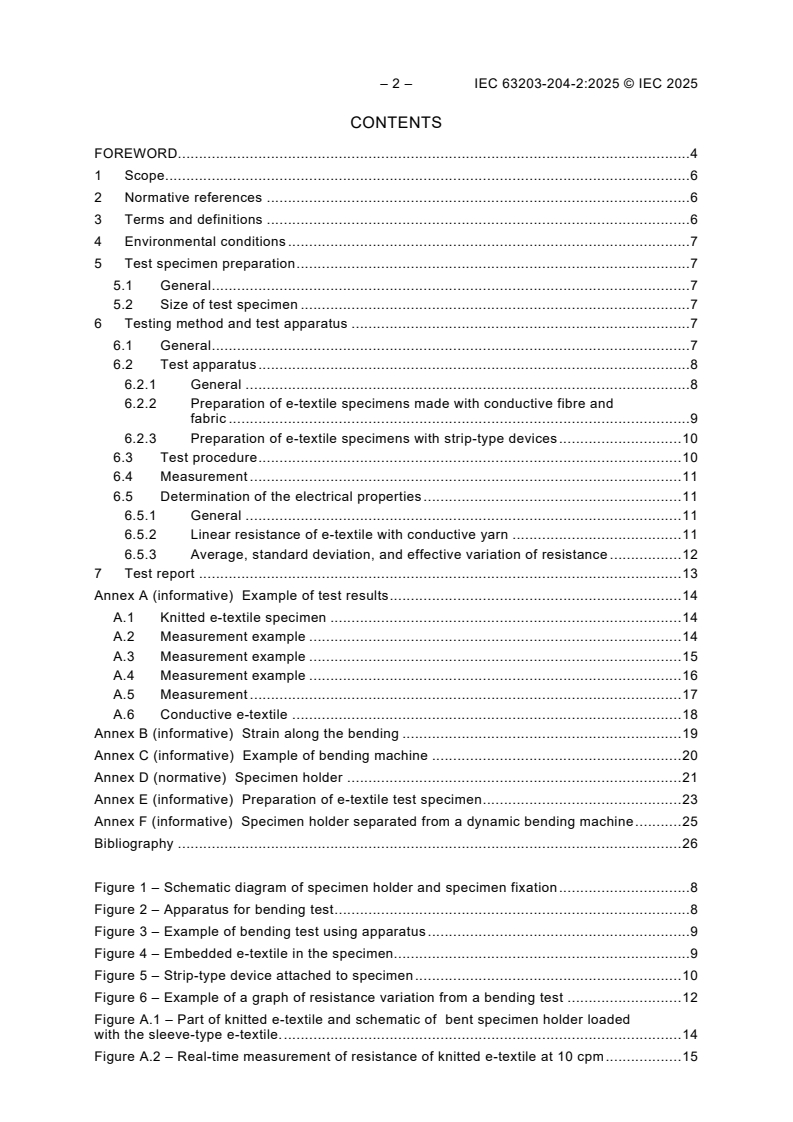
IEC 63203-204-2:2025 - Wearable electronic devices and technologies - Part 204-2: Electronic textile - Test method to characterize electrical resistance change in knee and elbow bending test of e-textiles Released:2/14/2025
Overview
IEC 63203-204-2:2025 is an international standard developed by the International Electrotechnical Commission (IEC) for the assessment of wearable electronic devices with a focus on electronic textiles (e-textiles). This standard specifies a test method to characterize the change in electrical resistance of e-textiles during dynamic bending at the knee and elbow joints. By establishing a consistent test approach, the standard supports developers, manufacturers, and test laboratories in evaluating the mechanical durability and electrical performance of e-textile products under realistic movement conditions.
Key Topics
- Dynamic Bending Test: Outlines a procedure where e-textile specimens are subjected to repeated, controlled bending cycles mimicking knee and elbow motions.
- Specimen Preparation: Provides guidance for preparing cylindrical and strip-type e-textile samples, including sizing and attachment methods, ensuring tests are reproducible and simulate real-world use.
- Test Apparatus Requirements: Details on the design of specimen holders, use of insulating materials, and the necessity for smooth, silicone-covered grips to mimic skin and avoid specimen damage.
- Measurement Conditions: Specifies environmental conditions, bending angles (45°, 90°, 135°), bending rates (10, 30, 50 cycles/min), and categories for the number of cycles (≤100, 101–999, ≥1000).
- Data Collection and Analysis: Incorporates in-situ real-time measurement of resistance, calculation of average, standard deviation, and effective variation of resistance in both bent and straight states to evaluate stability.
- Reporting Requirements: Lists the mandatory elements for a compliant test report, aiding traceability and repeatability.
Applications
IEC 63203-204-2:2025 is applicable across a wide range of sectors involved in the design, production, and quality assurance of wearable electronic devices and e-textiles, such as:
- Smart Garments: Performance evaluation of conductive yarns, fabrics, or embedded circuits in smart clothing for sports, health monitoring, or occupational safety.
- Medical Textiles: Durability analysis of sensor-embedded textiles for patient monitoring, rehabilitation, or wearable health devices.
- Consumer Electronics: Quality benchmarking for e-textile integrations in wearable technology, including fitness trackers, posture monitors, and heated apparel.
- Automotive and Military: Testing the reliability of e-textile components in protective gear and uniforms subjected to repeated joint movement.
- R&D and Certification: Offers a standardized procedure for laboratories and certification bodies to validate the performance of new e-textile materials and devices.
Related Standards
For comprehensive testing and compatibility, IEC 63203-204-2:2025 references and aligns with several other key international standards:
- ISO 139 – Textiles – Standard atmospheres for conditioning and testing: Ensures standardized environmental testing conditions.
- ISO 5084 – Textiles – Determination of thickness of textiles and textile products: Used for thickness measurement of textile specimens.
- EN 16812:2016 – Electrically conductive textiles – Determination of the linear electrical resistance of conductive tracks: Outlines procedures for resistance measurement.
- IEC 62899-202-4 – Printed electronics – Useful for guidance on electrical contacts and measurement setups.
Practical Value
Implementing IEC 63203-204-2:2025 brings practical benefits:
- Quality Assurance: Enables objective comparisons and repeatable evaluation of e-textile durability under mechanical stress.
- Product Development: Assists engineers and designers in improving the mechanical and electrical reliability of wearable products.
- Market Access: Supports compliance with international requirements, helping products reach broader markets.
- Innovation: Facilitates research and benchmarking for novel smart textile solutions.
By providing a robust, internationally recognized test method, this IEC standard promotes innovation, reliability, and trust in the rapidly growing domain of e-textiles and wearable electronics.
Buy Documents
IEC 63203-204-2:2025 - Wearable electronic devices and technologies - Part 204-2: Electronic textile - Test method to characterize electrical resistance change in knee and elbow bending test of e-textiles Released:2/14/2025
Get Certified
Connect with accredited certification bodies for this standard

Control Union Certifications
Global certification for agriculture and sustainability.

Hohenstein Institut
Textile testing and certification.

Bureau Veritas Bangladesh
Bureau Veritas certification services in Bangladesh.
Sponsored listings
Frequently Asked Questions
IEC 63203-204-2:2025 is a standard published by the International Electrotechnical Commission (IEC). Its full title is "Wearable electronic devices and technologies - Part 204-2: Electronic textile - Test method to characterize electrical resistance change in knee and elbow bending test of e-textiles". This standard covers: IEC 63203-204-2:2025 specifies a test method for e-textiles for measuring the change of electrical resistance during bending of the knee and elbow joints. It uses a dynamic method. This document is applicable to e-textiles.
IEC 63203-204-2:2025 specifies a test method for e-textiles for measuring the change of electrical resistance during bending of the knee and elbow joints. It uses a dynamic method. This document is applicable to e-textiles.
IEC 63203-204-2:2025 is classified under the following ICS (International Classification for Standards) categories: 59.080.01 - Textiles in general; 59.080.80 - Smart textiles. The ICS classification helps identify the subject area and facilitates finding related standards.
IEC 63203-204-2:2025 is available in PDF format for immediate download after purchase. The document can be added to your cart and obtained through the secure checkout process. Digital delivery ensures instant access to the complete standard document.
Standards Content (Sample)
IEC 63203-204-2 ®
Edition 1.0 2025-02
INTERNATIONAL
STANDARD
NORME
INTERNATIONALE
Wearable electronic devices and technologies –
Part 204-2: Electronic textile – Test method to characterize electrical resistance
change in knee and elbow bending test of e-textiles
Technologies et dispositifs électroniques prêts-à-porter –
Partie 204-2: Textile électronique – Méthode d'essai pour caractériser la
variation de la résistance électrique lors de l’essai de flexion du genou et du
coude des textiles électroniques
All rights reserved. Unless otherwise specified, no part of this publication may be reproduced or utilized in any form
or by any means, electronic or mechanical, including photocopying and microfilm, without permission in writing from
either IEC or IEC's member National Committee in the country of the requester. If you have any questions about IEC
copyright or have an enquiry about obtaining additional rights to this publication, please contact the address below or
your local IEC member National Committee for further information.
Droits de reproduction réservés. Sauf indication contraire, aucune partie de cette publication ne peut être reproduite ni
utilisée sous quelque forme que ce soit et par aucun procédé, électronique ou mécanique, y compris la photocopie et
les microfilms, sans l'accord écrit de l'IEC ou du Comité national de l'IEC du pays du demandeur. Si vous avez des
questions sur le copyright de l'IEC ou si vous désirez obtenir des droits supplémentaires sur cette publication, utilisez
les coordonnées ci-après ou contactez le Comité national de l'IEC de votre pays de résidence.
IEC Secretariat Tel.: +41 22 919 02 11
3, rue de Varembé info@iec.ch
CH-1211 Geneva 20 www.iec.ch
Switzerland
About the IEC
The International Electrotechnical Commission (IEC) is the leading global organization that prepares and publishes
International Standards for all electrical, electronic and related technologies.
About IEC publications
The technical content of IEC publications is kept under constant review by the IEC. Please make sure that you have the
latest edition, a corrigendum or an amendment might have been published.
IEC publications search - webstore.iec.ch/advsearchform IEC Products & Services Portal - products.iec.ch
The advanced search enables to find IEC publications by a Discover our powerful search engine and read freely all the
variety of criteria (reference number, text, technical publications previews, graphical symbols and the glossary.
committee, …). It also gives information on projects, replaced With a subscription you will always have access to up to date
and withdrawn publications. content tailored to your needs.
IEC Just Published - webstore.iec.ch/justpublished
Electropedia - www.electropedia.org
Stay up to date on all new IEC publications. Just Published
The world's leading online dictionary on electrotechnology,
details all new publications released. Available online and once
containing more than 22 500 terminological entries in English
a month by email.
and French, with equivalent terms in 25 additional languages.
Also known as the International Electrotechnical Vocabulary
IEC Customer Service Centre - webstore.iec.ch/csc
(IEV) online.
If you wish to give us your feedback on this publication or need
further assistance, please contact the Customer Service
Centre: sales@iec.ch.
A propos de l'IEC
La Commission Electrotechnique Internationale (IEC) est la première organisation mondiale qui élabore et publie des
Normes internationales pour tout ce qui a trait à l'électricité, à l'électronique et aux technologies apparentées.
A propos des publications IEC
Le contenu technique des publications IEC est constamment revu. Veuillez vous assurer que vous possédez l’édition la
plus récente, un corrigendum ou amendement peut avoir été publié.
Recherche de publications IEC - IEC Products & Services Portal - products.iec.ch
webstore.iec.ch/advsearchform Découvrez notre puissant moteur de recherche et consultez
La recherche avancée permet de trouver des publications IEC gratuitement tous les aperçus des publications, symboles
en utilisant différents critères (numéro de référence, texte, graphiques et le glossaire. Avec un abonnement, vous aurez
comité d’études, …). Elle donne aussi des informations sur les toujours accès à un contenu à jour adapté à vos besoins.
projets et les publications remplacées ou retirées.
Electropedia - www.electropedia.org
IEC Just Published - webstore.iec.ch/justpublished
Le premier dictionnaire d'électrotechnologie en ligne au monde,
Restez informé sur les nouvelles publications IEC. Just
avec plus de 22 500 articles terminologiques en anglais et en
Published détaille les nouvelles publications parues.
français, ainsi que les termes équivalents dans 25 langues
Disponible en ligne et une fois par mois par email.
additionnelles. Egalement appelé Vocabulaire
Electrotechnique International (IEV) en ligne.
Service Clients - webstore.iec.ch/csc
Si vous désirez nous donner des commentaires sur cette
publication ou si vous avez des questions contactez-nous:
sales@iec.ch.
IEC 63203-204-2 ®
Edition 1.0 2025-02
INTERNATIONAL
STANDARD
NORME
INTERNATIONALE
Wearable electronic devices and technologies –
Part 204-2: Electronic textile – Test method to characterize electrical resistance
change in knee and elbow bending test of e-textiles
Technologies et dispositifs électroniques prêts-à-porter –
Partie 204-2: Textile électronique – Méthode d'essai pour caractériser la
variation de la résistance électrique lors de l’essai de flexion du genou et du
coude des textiles électroniques
INTERNATIONAL
ELECTROTECHNICAL
COMMISSION
COMMISSION
ELECTROTECHNIQUE
INTERNATIONALE
ICS 59.080.80, 59.080.01 ISBN 978-2-8327-0158-4
– 2 – IEC 63203-204-2:2025 © IEC 2025
CONTENTS
FOREWORD. 4
1 Scope . 6
2 Normative references . 6
3 Terms and definitions . 6
4 Environmental conditions . 7
5 Test specimen preparation . 7
5.1 General . 7
5.2 Size of test specimen . 7
6 Testing method and test apparatus . 7
6.1 General . 7
6.2 Test apparatus . 8
6.2.1 General . 8
6.2.2 Preparation of e-textile specimens made with conductive fibre and
fabric . 9
6.2.3 Preparation of e-textile specimens with strip-type devices . 10
6.3 Test procedure . 10
6.4 Measurement . 11
6.5 Determination of the electrical properties . 11
6.5.1 General . 11
6.5.2 Linear resistance of e-textile with conductive yarn . 11
6.5.3 Average, standard deviation, and effective variation of resistance . 12
7 Test report . 13
Annex A (informative) Example of test results . 14
A.1 Knitted e-textile specimen . 14
A.2 Measurement example . 14
A.3 Measurement example . 15
A.4 Measurement example . 16
A.5 Measurement . 17
A.6 Conductive e-textile . 18
Annex B (informative) Strain along the bending . 19
Annex C (informative) Example of bending machine . 20
Annex D (normative) Specimen holder . 21
Annex E (informative) Preparation of e-textile test specimen . 23
Annex F (informative) Specimen holder separated from a dynamic bending machine . 25
Bibliography . 26
Figure 1 – Schematic diagram of specimen holder and specimen fixation . 8
Figure 2 – Apparatus for bending test . 8
Figure 3 – Example of bending test using apparatus . 9
Figure 4 – Embedded e-textile in the specimen. 9
Figure 5 – Strip-type device attached to specimen . 10
Figure 6 – Example of a graph of resistance variation from a bending test . 12
Figure A.1 – Part of knitted e-textile and schematic of bent specimen holder loaded
with the sleeve-type e-textile. . 14
Figure A.2 – Real-time measurement of resistance of knitted e-textile at 10 cpm . 15
Figure A.3 – Real-time measurement of resistance of knitted e-textile at 30 cpm . 16
Figure A.4 – Real-time measurement of resistance of knitted e-textile at 30 cpm . 16
Figure A.5 – Real-time measured change value of resistance of knitted e-textile
sensor at 50 cpm . 17
Figure A.6 – Real-time measured change value of resistance of electrical
interconnection using conductive e-textile embedded in fabric . 18
Figure B.1 – Bending strain between grips . 19
Figure D.1 – Blueprint of specimen holder at top . 21
Figure D.2 – Blueprint of specimen holder at front . 21
Figure D.3 – Blueprint of specimen holder at side . 22
Figure D.4 – Three-dimensional picture of the specimen holder . 22
Figure E.1 – E-textile test specimen before sewing . 23
Figure E.2 – E-textile test specimen after sewing . 23
Figure E.3 – Specimen holder covered with silicone . 24
Figure E.4 – E-textile loaded on a specimen holder covered with silicone . 24
Table 1 – List of the size of the specimen . 7
Table 2 – Combination of parameters for measurement . 10
Table 3 – Categories of number of bending cycles . 11
Table D.1 – Length of blueprint of specimen holder at top . 21
Table D.2 – Length of blueprint of specimen holder at front . 22
Table D.3 – Length of blueprint of specimen holder at side . 22
Table E.1 – Length of e-textile test specimen . 23
– 4 – IEC 63203-204-2:2025 © IEC 2025
INTERNATIONAL ELECTROTECHNICAL COMMISSION
____________
WEARABLE ELECTRONIC DEVICES AND TECHNOLOGIES –
Part 204-2: Electronic textile – Test method to characterize electrical
resistance change in knee and elbow bending test of e-textiles
FOREWORD
1) The International Electrotechnical Commission (IEC) is a worldwide organization for standardization comprising
all national electrotechnical committees (IEC National Committees). The object of IEC is to promote international
co-operation on all questions concerning standardization in the electrical and electronic fields. To this end and
in addition to other activities, IEC publishes International Standards, Technical Specifications, Technical Reports,
Publicly Available Specifications (PAS) and Guides (hereafter referred to as "IEC Publication(s)"). Their
preparation is entrusted to technical committees; any IEC National Committee interested in the subject dealt with
may participate in this preparatory work. International, governmental and non-governmental organizations liaising
with the IEC also participate in this preparation. IEC collaborates closely with the International Organization for
Standardization (ISO) in accordance with conditions determined by agreement between the two organizations.
2) The formal decisions or agreements of IEC on technical matters express, as nearly as possible, an international
consensus of opinion on the relevant subjects since each technical committee has representation from all
interested IEC National Committees.
3) IEC Publications have the form of recommendations for international use and are accepted by IEC National
Committees in that sense. While all reasonable efforts are made to ensure that the technical content of IEC
Publications is accurate, IEC cannot be held responsible for the way in which they are used or for any
misinterpretation by any end user.
4) In order to promote international uniformity, IEC National Committees undertake to apply IEC Publications
transparently to the maximum extent possible in their national and regional publications. Any divergence between
any IEC Publication and the corresponding national or regional publication shall be clearly indicated in the latter.
5) IEC itself does not provide any attestation of conformity. Independent certification bodies provide conformity
assessment services and, in some areas, access to IEC marks of conformity. IEC is not responsible for any
services carried out by independent certification bodies.
6) All users should ensure that they have the latest edition of this publication.
7) No liability shall attach to IEC or its directors, employees, servants or agents including individual experts and
members of its technical committees and IEC National Committees for any personal injury, property damage or
other damage of any nature whatsoever, whether direct or indirect, or for costs (including legal fees) and
expenses arising out of the publication, use of, or reliance upon, this IEC Publication or any other IEC
Publications.
8) Attention is drawn to the Normative references cited in this publication. Use of the referenced publications is
indispensable for the correct application of this publication.
9) IEC draws attention to the possibility that the implementation of this document may involve the use of (a)
patent(s). IEC takes no position concerning the evidence, validity or applicability of any claimed patent rights in
respect thereof. As of the date of publication of this document, IEC had not received notice of (a) patent(s), which
may be required to implement this document. However, implementers are cautioned that this may not represent
the latest information, which may be obtained from the patent database available at https://patents.iec.ch. IEC
shall not be held responsible for identifying any or all such patent rights.
IEC 63203-204-2 has been prepared by IEC technical committee 124: Wearable electronic
devices and technologies. It is an International Standard.
The text of this International Standard is based on the following documents:
Draft Report on voting
124/299/FDIS 124/306/RVD
Full information on the voting for its approval can be found in the report on voting indicated in
the above table.
The language used for the development of this International Standard is English.
This document was drafted in accordance with ISO/IEC Directives, Part 2, and developed in
accordance with ISO/IEC Directives, Part 1 and ISO/IEC Directives, IEC Supplement, available
at www.iec.ch/members_experts/refdocs. The main document types developed by IEC are
described in greater detail at www.iec.ch/publications.
A list of all parts in the IEC 63203 series, published under the general title Wearable electronic
devices and technologies, can be found on the IEC website.
The committee has decided that the contents of this document will remain unchanged until the
stability date indicated on the IEC website under webstore.iec.ch in the data related to the
specific document. At this date, the document will be
• reconfirmed,
• withdrawn, or
• revised.
– 6 – IEC 63203-204-2:2025 © IEC 2025
WEARABLE ELECTRONIC DEVICES AND TECHNOLOGIES –
Part 204-2: Electronic textile – Test method to characterize electrical
resistance change in knee and elbow bending test of e-textiles
1 Scope
This part of IEC 63203 specifies a test method for e-textiles for measuring the change of
electrical resistance during bending of the knee and elbow joints. It uses a dynamic method.
This document is applicable to e-textiles.
2 Normative references
The following documents are referred to in the text in such a way that some or all of their content
constitutes requirements of this document. For dated references, only the edition cited applies.
For undated references, the latest edition of the referenced document (including any
amendments) applies.
ISO 139, Textiles – Standard atmospheres for conditioning and testing
ISO 5084, Textiles – Determination of thickness of textiles and textile products
EN 16812:2016, Textiles and textile products. Electrically conductive textiles. Determination of
the linear electrical resistance of conductive tracks
3 Terms and definitions
For the purposes of this document, the following terms and definitions apply.
ISO and IEC maintain terminology databases for use in standardization at the following
addresses:
• IEC Electropedia: available at https://www.electropedia.org/
• ISO Online browsing platform: available at https://www.iso.org/obp
3.1
electrode
contact between the measurement wire and the specimen
[SOURCE: EN 16812:2016, 3.5]
3.2
bending rate
number of bending cycles per minute, with one cycle comprising one bending/unbending
Note 1 to entry: The bending rate is expressed in cpm (cycles per minute).
3.3
R
L
linear electrical resistance
electrical resistance per unit length of a track
Note 1 to entry: Linear electrical resistance is expressed in Ω/m (ohms per metre).
[SOURCE: EN 16812:2016, 3.3, modified – Note 1 to entry has been added.]
4 Environmental conditions
Standard atmospheric conditions for measurement shall apply, as specified in ISO 139.
5 Test specimen preparation
5.1 General
The specimen for mechanical tests shall be e-textile made of conductive yarn or fabric in a
cylindrical shape. A measurement of the specimen shall be prepared by placing a cylindrical
type of e-textile on a specimen holder. A strip-type e-textile shall be attached to a fabric with a
cylindrical shape.
5.2 Size of test specimen
For the mechanical bending test of joint movement of e-textile, a specimen with a cylindrical
shape shall be used. The specimen size of a cylindrical shape shall be selected from Table 1.
The specimen shall be attached to the cylindrical shape with two grips, which are illustrated in
Figure 3. The effective specimen length shall be the length of the specimen between the inner
edges of the two grips (the grips are excluded from the effective specimen length). The two
types of specimen circumference were set based on the average circumference of elbows and
knees. The diameter of the specimen holder is 80 mm for type A (elbow) and 110 mm for type
B (knee).
Table 1 – List of the size of the specimen
Type Effective specimen length Diameter
mm mm
A (elbow) 200 ± 2 86 ± 4
B (knee) 200 ± 2 118 ± 5
The thickness of the e-textile shall be measured in accordance with ISO 5084.
6 Testing method and test apparatus
6.1 General
A prepared e-textile specimen shall be placed on the cylindrical specimen holder as shown in
Figure 1, wrapping around the holder. To measure e-textile on skin-like conditions, the
specimen holder shall be covered with silicone. The thickness of the silicone layer is 3 mm for
type A and 4 mm for type B. The diameter of the specimens to be measured shall be prepared
in order to fit the specimen holder. Examples of specimen preparation are described in Annex D
and Annex E.
– 8 – IEC 63203-204-2:2025 © IEC 2025
Both ends of the specimen shall be secured with a cylindrical circumferential grip for tight
fixation. The specimen shall be fixed so that the location of the specimen cannot move during
the measurement. When the middle portion of the cylindrical specimen holder moves as the
joint bends, the specimen surrounding the specimen holder shall be bent together with the joint.
The electrical property of the e-textile shall be evaluated by electrodes of electrical connection.
a) b)
Figure 1 – Schematic diagram of specimen holder and specimen fixation
6.2 Test apparatus
6.2.1 General
Key
1 diameter = elbow (86 ± 5) mm, knee (118 ± 5) mm
2 bending angle 45°, 90°, 135°
Figure 2 – Apparatus for bending test
A bending tester is used to apply a repeated bending motion on specimens. The bending angle,
as defined in Figure 2, shall be adjustable to the target value and shall be variable from 0° to
135°. Details of specimen holder are described in Annex D. Figure D.1 shows a top view of the
specimen holder and Table D.1 defines the dimensions of it. Figure D.2 shows a front view of
the specimen holder and Table D.2 defines the dimensions of it. Figure D.3 shows a side view
of the specimen holder and Table D.3 defines the dimensions of it. A three-dimensional view of
the specimen holder is shown in Figure D.4.
The grips shall be shaped like a circumference of the specimen holder to hold the cylindrical
specimen perfectly as shown in Figure 3. The specimen holder and grips shall be clean and
smooth to avoid mechanical damage on specimens. The specimen holder shall be made from
insulating materials such as resin-based materials, polycarbonate, mono-cast polyamide, or
paper.
The middle portion of the specimen holder shall repeat the reciprocating bending motion while
both ends of the specimen are stationary/fixed. An example of the bending machine with the
specimen holder attached is shown in Annex C and an example of the bending machine with
the specimen holder detached is shown in Annex F.
The direction of the specimen can be both directions (course/wale direction for knit specimens,
warp/weft direction for woven specimens), but it should be specified in the result.
Bending deformation accompanied with stretching shall be applied to the specimen as explained
in Annex B.
Figure 3 – Example of bending test using apparatus
6.2.2 Preparation of e-textile specimens made with conductive fibre and fabric
If a cylindrical fabric specimen is made by knitting, weaving or any other textile, and the
conductive fibre or fabric is embedded in the middle, the specimen shall be produced as follows.
The conductive fabric undergoing bending shall be centrally positioned on the outer side of the
specimen over the joint in the longitudinal direction, as shown in Figure 4. In the case of tubular
knitting that partially uses conductive yarn, as shown in Figure A.1, the conductive yarn shall
be centrally positioned on the outer side of the specimen above the joint, where maximum
bending is achieved. EN 16812:2016 shall be followed to make electrical contact.
When the bending motion is repeated, the specimen shall remain at the centre of the
longitudinal direction of the specimen so that electrical measurements can be performed
reproducibly when comparing multiple specimens.
a) b)
Figure 4 – Embedded e-textile in the specimen
– 10 – IEC 63203-204-2:2025 © IEC 2025
6.2.3 Preparation of e-textile specimens with strip-type devices
When a strip-type device is attached to a cylindrical fabric, a specimen shall be prepared as
follows.
The strip-type device undergoing bending shall be located in the centre of the longitudinal
direction of the cylindrical specimen and be positioned on the outer side of the specimen in the
longitudinal direction, as shown in Figure 5.
When a strip-type device is attached to a cylindrical fabric, an adhesive for textiles or sewing
shall be used as the attaching method. When attaching using sewing, the entire border of the
strip-type device shall be stitched. When using adhesive, the entire surface of the strip-type
device shall be attached on fabric with adhesive.
Electrical contacts shall be made by following EN 16812:2016.
a) b)
Figure 5 – Strip-type device attached to specimen
6.3 Test procedure
The test procedure is as follows.
a) The specimen shall be put on a cylindrical specimen holder in the same way as a garment,
and the ends shall be gripped firmly. The specimen shall be spread evenly and tightly on
the specimen holder, and not concentrated on one side.
b) Set the bending angle to be repeated, and check whether the specimen is bent according
to the bending of the specimen holder by manual operation.
c) Fix the angle as a proper bending angle and measure the initial electrical resistance of the
specimen before the bending test. Start the repeated bending motions.
d) Real-time electrical resistance is measured while the bending operation is repeated, and
resistance after the set cycle is completed is also measured.
e) At least three specimens shall be measured to acquire the result for a test result.
For mechanical tests of e-textile, the bending angle and the bending rate of one
bending/unbending (measured in cpm) shall be selected from a combination of parameters in
Table 2.
Table 2 – Combination of parameters for measurement
Type Specimen holder diameter Bending angle Bending rate
mm °(degree) cpm
A 86 ± 5 45, 90, 135 10, 30, 50
B 118 ± 5 45, 90, 135 10, 30, 50
For the number of bending cycles, three categories are specified in Table 3. Category I is when
the number of bending cycles is 100 or less, category II is when the number of bending cycles
is more than 100 and less than 1 000, and category III is when the number of bending cycles is
1 000 or more.
Table 3 – Categories of number of bending cycles
Category Number of bending cycles
I ≤ 100
II 100 < x < 1 000
III ≥ 1 000
6.4 Measurement
The electrical resistance change of an e-textile shall be measured before, after and during the
cyclic bending test. The electrical resistance of e-textile shall be measured in-situ, during
mechanical deformations.
To measure the variation of resistance, either a two-wire or a four-wire measurement can be
used. For a specimen that has too little variation to be detected by a two-wire method with the
electrical resistance measurement device being used in the test, the four-wire method shall be
used to eliminate contact-wire and lead-wire resistance.
To measure the variation of resistance of conductive fabric of e-textile, a grip with electrical
contacts in accordance with IEC 62899-202-4 can be used. A metallic grip can also be used,
and its surface shall be coated with conductive materials such as gold, silver and copper in
order to reduce the contact resistance.
The electrical resistance of conductive yarns of e-textile can be measured in-situ during
mechanical deformations. For the exact electrical resistance measurement, both electrodes of
the specimen shall be held as tightly as possible using grips. For e-textile specimens with
conductive yarn, which is not strong enough to be gripped tightly by the electrodes, a metal
tape or conducting paste with a lower resistance than the conductive yarn may be coated on
each end of the electrodes of the e-textile in accordance with EN 16812:2016.
6.5 Determination of the electrical properties
6.5.1 General
In order to measure resistance change due to mechanical deformation of e-textile, electrical
resistance shall be collected in real time while the bending motion cycles are in progress.
6.5.2 Linear resistance of e-textile with conductive yarn
Linear resistance (R ) shall be measured to test e-textiles made of conductive yarn. The initial
L
value (R ) and the relative ratio of resistance change (∆R / R ) of electrical resistance shall
L,0 L L,0
be reported, as shown in Formula (1):
R − R
∆R
LL,0
L
=
(1)
RR
LL,0 ,0
– 12 – IEC 63203-204-2:2025 © IEC 2025
where
∆R is the change in the electrical linear resistance;
L
R is the linear resistance under mechanical test;
L
R is the initial linear resistance before mechanical test.
L,0
6.5.3 Average, standard deviation, and effective variation of resistance
Figure 6 – Example of a graph of resistance variation from a bending test
The measurement condition shall be decided by choosing the speed among 10 cpm, 30 cpm
and 50 cpm, the bending angle among 45°, 90° and 135°, and the number of bending cycles
among category I, II and III, which are described in Table 2 and Table 3. Figure 6 demonstrates
the exemplary measurement result of the change in resistance along the test.
In order to verify whether the resistance change remains stable during the cycles of bending
test, the average and standard deviation of R and R shall be presented. In addition,
bent straight
effective variation of R and effective variation of R considering the influence of the
bent straight
standard deviation according to the bent/straight resistance ratio shall be indicated.
• R : average of resistance in bent state.
bent
• σ : standard deviation of resistance in bent state.
bent
• R : average of resistance in straight state.
straight
• σ : standard deviation of resistance in straight state.
straight
R and R values should be calculated using Formula (2):
bent straight
RR+ ++ R
RR+ ++ R
straight,1 straight,2 straight,n
bent,1 bent,2 bent,n
(2)
RR ,
bent straight
n n
It shall be shown in the following equations that the resistance has a stable and repeatable
value in the bent and straight states along the bending cycles.
• Resistance in bent state: R R ± σ [Ω]
bent bent bent
• Resistance in straight state: RR ± σ [Ω]
straight straight straight
=
=
==
It can be evaluated that the smaller the values of σ and σ , the more stable the device
bent straight
is. However, the absolute value of bent/straight resistance is varied depending on the type of
e-textile, and the influence on σ and σ is different depending on the difference of
bent straight
bent/straight resistance. Effective variation of R and R can be presented to introduce
bent straight
a fair criterion for e-textiles with different bent/straight resistance ratio.
• ρ : effective variation of R
bent bent
• ρ : effective variation of R
straight straight
σ
bent
ρ ×100 (%)
bent
(3)
R − R
bent straight
σ
straight
ρ ×100 (%)
straight
(4)
R − R
bent straight
Examples of test results are shown in Annex A.
7 Test report
The report shall include the following items:
a) the date of this document;
b) specimen identification (including specimen size, initial value of electrical resistance,
specimen material);
c) bending angle;
d) number of bending cycles, category;
e) bending rate;
f) final value of electrical resistance;
g) real-time measurement of change of resistance according to bending cycles;
h) average, standard deviation, and effective variation of resistance;
i) thickness of the e-textile;
j) any deviation from this document;
k) date of test;
l) other remarks and observations (i.e. optional images of the e-textile after the test).
=
=
– 14 – IEC 63203-204-2:2025 © IEC 2025
Annex A
(informative)
Example of test results
A.1 Knitted e-textile specimen
A textile-type strain sensor shall be made of the fabric with conductive fibre yarns by knitting
method. The structure and specimen identifications are as follows:
Dimensions in millimetres
Figure A.1 – Part of knitted e-textile and schematic of
bent specimen holder loaded with the sleeve-type e-textile
A.2 Measurement example
a) Specimen identification
• Effective specimen length: 200 mm
• Specimen circumference: 270 mm
• Initial value of electrical resistance: 592,90 Ω
• Specimen material: knitted fabric with polyester yarn
b) Bending angle: 90°
c) Number of cycles: 100 cycles, category I
d) Bending rate: 10 cpm
e) Final value of the electrical resistance: 692,82 Ω;
f) Real-time measurement of change of resistance according to bending cycles: see
Figure A.2.
Figure A.2 – Real-time measurement of resistance of knitted e-textile at 10 cpm
g) Average, standard deviation, and effective variation of resistance are as follows:
RR+ ++ R
bent,1 bent,2 bent,n
R 39,80
bent
n
[Ω]
RR+ ++ R
straight,1 straight,2 straight,n
R 732, 62
straight
n
[Ω]
• Resistance in bent state: R = R ±= σ 39,80 ±3,92 [Ω]
bent bent bent
• Resistance in straight state: RR= ± σ =732,62 ±33,06 [Ω]
straight straight straight
• Effective variation of R
on
σ
148,91
bent
R ×100 ×100 0,57 %
( )
on
2 286, 51− 7 552, 04
R − R
bent straight
• Effective variation of R
off
σ
straight 305,86
R : ρ ×100 ×100 4,77 %
( )
off straight
2 286, 51− 7 552, 04
R − R
bent straight
h) Thickness of specimen: 0,62 mm
A.3 Measurement example
a) Specimen identification
• Effective specimen length: 200 mm
• Specimen circumference: 270 mm
• Initial value of electrical resistance: 592,90 Ω
• Specimen material: knitted fabric
b) Bending angle: 90°
c) Number of cycles: 100 cycles, category I
d) Bending rate: 30 cpm
e) Final value of the electrical resistance: 688,04 Ω
f) Real-time measurement of change of resistance according to bending cycles: see Figure A.3.
= = =
= = =
==
==
– 16 – IEC 63203-204-2:2025 © IEC 2025
Figure A.3 – Real-time measurement of resistance of knitted e-textile at 30 cpm
g) Average, standard deviation, and effective variation of resistance are as follows:
• Average: R = 40,36 [Ω] / R = 728,40 [Ω]
bent streched
• Standard deviation: σ = 1,27 [Ω] / σ = 37,79 [Ω]
bent straight
• Effective variation of resistance: ρ = 0,18 (%) / ρ = 5,49 (%)
bent straight
h) Thickness of specimen: 0,62 mm
A.4 Measurement example
a) Specimen identification
• Specimen length: 200 mm
• Initial value of electrical resistance: 725,60 Ω
• Specimen material: knitted fabric
b) Bending angle: 45°
c) Number of cycles: 100 cycles, category I
d) Bending rate: 30 cpm
e) Final value of the electrical resistance: 624,90 Ω
f) Real-time measurement of change of resistance according to bending cycles: see Figure A.4:
Figure A.4 – Real-time measurement of resistance of knitted e-textile at 30 cpm
g) Average, standard deviation, and effective variation of resistance are as follows:
• Average: R = 86,00 [Ω] / R = 710,90 [Ω]
bent streched
• Standard deviation: σ = 2,36 [Ω] / σ = 18,04 [Ω]
bent straight
• Effective variation of resistance: ρ = 0,38 (%) / ρ = 2,89 (%)
bent straight
h) Thickness of specimen: 0,62 mm
A.5 Measurement
a) Specimen identification
• Specimen length: 200 mm
• Initial value of electrical resistance: 675,58 Ω
• Specimen material: knitted fabric
b) Bending angle: 90°
c) Number of cycle: 1 000 cycles, category III
d) Bending rate: 50 cpm
e) Final value of the electrical resistance: 689,89 Ω
f) Real-time measurement of change of resistance according to bending cycles: see Figure A.5.
Figure A.5 – Real-time measured change value of
resistance of knitted e-textile sensor at 50 cpm
g) Average, standard deviation, and effective variation of resistance are as follows:
• Average: R = 49,18 [Ω] / R = 739,06 [Ω]
bent streched
• Standard deviation: σ = 2,08 [Ω] / σ = 43,31 [Ω]
bent straight
• Effective variation of resistance: ρ = 0,30 (%) / ρ = 6,42 (%)
bent straight
h) Thickness of specimen: 0,62 mm
– 18 – IEC 63203-204-2:2025 © IEC 2025
A.6 Conductive e-textile
a) Specimen identification
• Effective specimen length: 200 mm
• Specimen circumference: 270 mm
• Initial value of electrical resistance: 5,35 Ω
• Specimen material: woven fabric
b) Bending angle: 90°
c) Number of cycles: 1 000 cycles, Category III
d) Bending rate: 10 cpm
e) Final value of the electrical resistance: 1,4 Ω
f) Real-time measurement of change of resistance according to bending cycles: see
Figure A.6.
Figure A.6 – Real-time measured change value of resistance of electrical
interconnection using conductive e-textile embedded in fabric
g) Average, standard deviation, and effective variation of resistance are as follows:
• Average: R = 3,98 [Ω] / R = 5,38 [Ω]
bent streched
• Standard deviation: σ = 0,06 [Ω] / σ = 0,12 [Ω]
bent straight
• Effective variation of resistance: ρ = 4,29 (%) / ρ = 8,52 (%)
bent straight
h) Thickness of specimen: 0,62 mm
Annex B
(informative)
Strain along the bending
Figure B.1 shows that the specimen is stretched along the bending of the joint by the length of
∆l.
Figure B.1 – Bending strain between grips
elongated length ∆lrθ
ε
length of sample LL
where
r is the bending radius
L is the length of specimen (distance between grips)
∆l = rθ is the elongated length at bending of θ
L = L + ∆l
== =
– 20 – IEC 63203-204-2:2025 © IEC 2025
Annex C
(informative)
Example of bending machine
Annex D
(normative)
Specimen holder
Figure D.1 – Blueprint of specimen holder at top
Table D.1 – Length of blueprint of specimen holder at top
Type A Type B
mm mm
øa
80±2 110±2
b 160±2 145±2
c 255±2 270±2
d
30±2 45±2
e 20±2 20±2
f 35±2 50±2
g
10±2 10±2
h 95±2 125±2
i 35±2 50±2
øj
10±2 10±2
k 15±2 15±2
l 95±2 125±2
Figure D.2 – Blueprint of specimen holder at front
– 22 – IEC 63203-204-2:2025 © IEC 2025
Table D.2 – Length of blueprint of specimen holder at front
Type A Type B
mm mm
øa 80±2 110±2
øb
10±2 10±2
c
110±2 95±2
d 40±2 55±2
øe
80±2 110±2
Figure D.3 – Blueprint of specimen holder at side
Table D.3 – Length of blueprint of specimen holder at side
Type A Type B
mm mm
øa
80±2 110±2
Figure D.4 – Three-dimensional picture of the specimen holder
Annex E
(informative)
Preparation of e-textile test specimen
Figure E.1 shows the flat e-textile to be prepared as a cylindrical specimen by sewing, as shown
in Figure E.2, with the dimension described in Table E.1. A silicone layer covers the specimen
holder as shown in Figure E.3 and the specimen is placed on top of the silicone layer as shown
in Figure E.4.
Figure E.1 – E-textile test specimen before sewing
Table E.1 – Length of e-textile test specimen
Type A Type B
mm mm
a
270±2 370±2
b 230±2 230±2
c 10±2 10±2
Figure E.2 – E-textile test specimen after sewing
– 24 – IEC 63203-204-2:2025 © IEC 2025
Figure E.3 – Specimen holder covered with silicone
Dimensions in millimetres
Figure E.4 – E-textile loaded on a specimen holder covered with silicone
Annex F
(informative)
Specimen holder separated from a dynamic bending machine
– 26 – IEC 63203-204-2:2025 © IEC 2025
Bibliography
IEC 62899-202 (all parts), Printed electronics – Part 202: Materials – Conductive ink
IEC 62899-202-4, Printed electronics – Part 202-4: Materials – Conductive ink – Measurement
methods for properties of stretchable printed layers (conductive and insulating)
IEC 63203-101-1, Wearable electronic devices and technologies – Part 101-1: Terminology
Size Korea, Korean Human Dimension Survey [viewed 2024-08-14]. Available at
https://sizekorea.kr/
___________
– 28 – IEC 63203-204-2:2025 © IEC 2025
SOMMAIRE
AVANT-PROPOS . 30
1 Domaine d’application . 32
2 Références normatives . 32
3 Termes et définitions .
...