

IEC 60068-2-18:2017
(Main)Environmental testing - Part 2-18: Tests - Test R and guidance: Water
General Information
- Abstract
IEC 60068-2-18:2017 provides methods of test applicable to products which, during transportation, storage or in service, can be subjected to falling water drops, impacting water, immersion or high pressure water impact. The primary purpose of water tests is to verify the ability of enclosures, covers and seals to maintain components and equipment in good working order after and, when necessary, under a standardized drop field or immersion in water.
These tests are not corrosion tests and cannot be considered and used as such.
Established water tests in other standards are not intended to simulate natural rainfall and their quoted intensities are too high to be adopted for that purpose. Therefore, in addition to the high-intensity severities, test R includes an artificial rain test based upon natural conditions but not taking into account high wind speeds generally associated with natural rain.
Guidance is given on the applicability of the tests and the severities to be selected.
This third edition cancels and replaces the second edition published in 2000. This edition constitutes a technical revision.
This edition includes the following significant technical changes with respect to the previous edition:
a. addition of the new test method Rb 3.
- Status
- Published
- Publication Date
- 09-Mar-2017
- Technical Committee
- TC 104 - Environmental conditions, classification and methods of test
- Drafting Committee
- MT 18 - TC 104/MT 18
- Current Stage
- PPUB - Publication issued
- Start Date
- 10-Mar-2017
- Completion Date
- 17-Mar-2017
Buy Documents
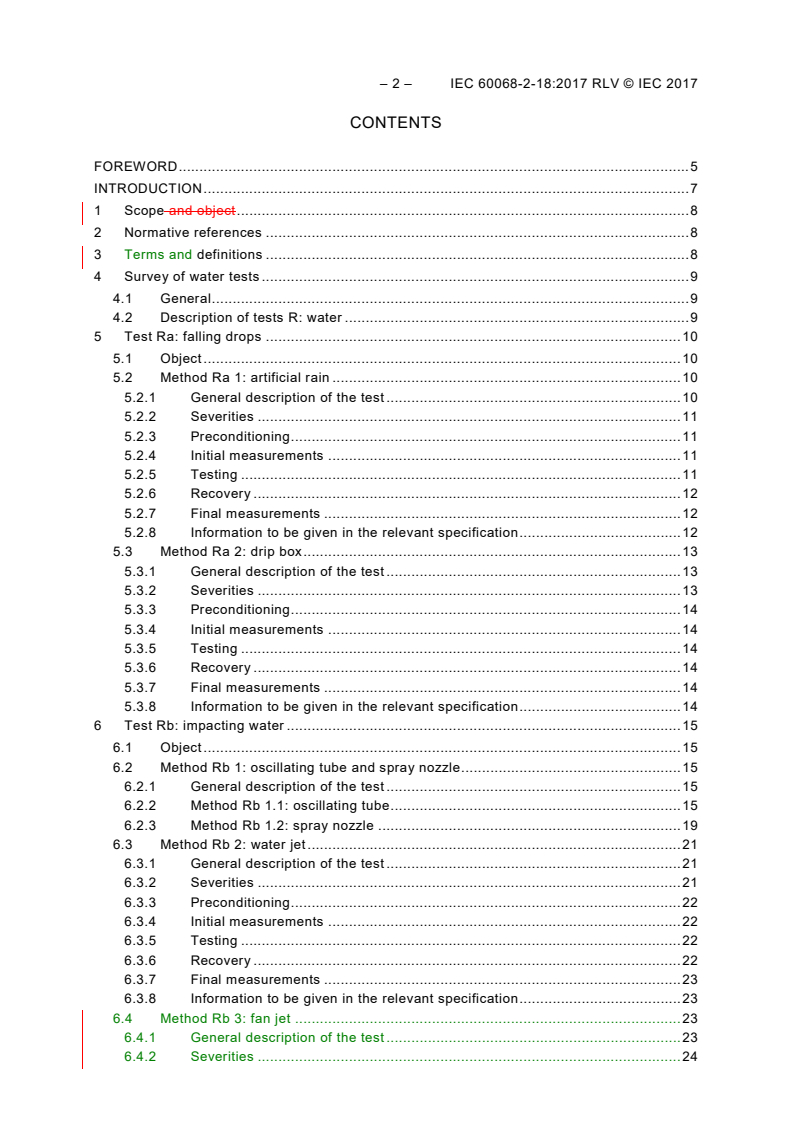
IEC 60068-2-18:2017 RLV - Environmental testing - Part 2-18: Tests - Test R and guidance: Water Released:3/10/2017
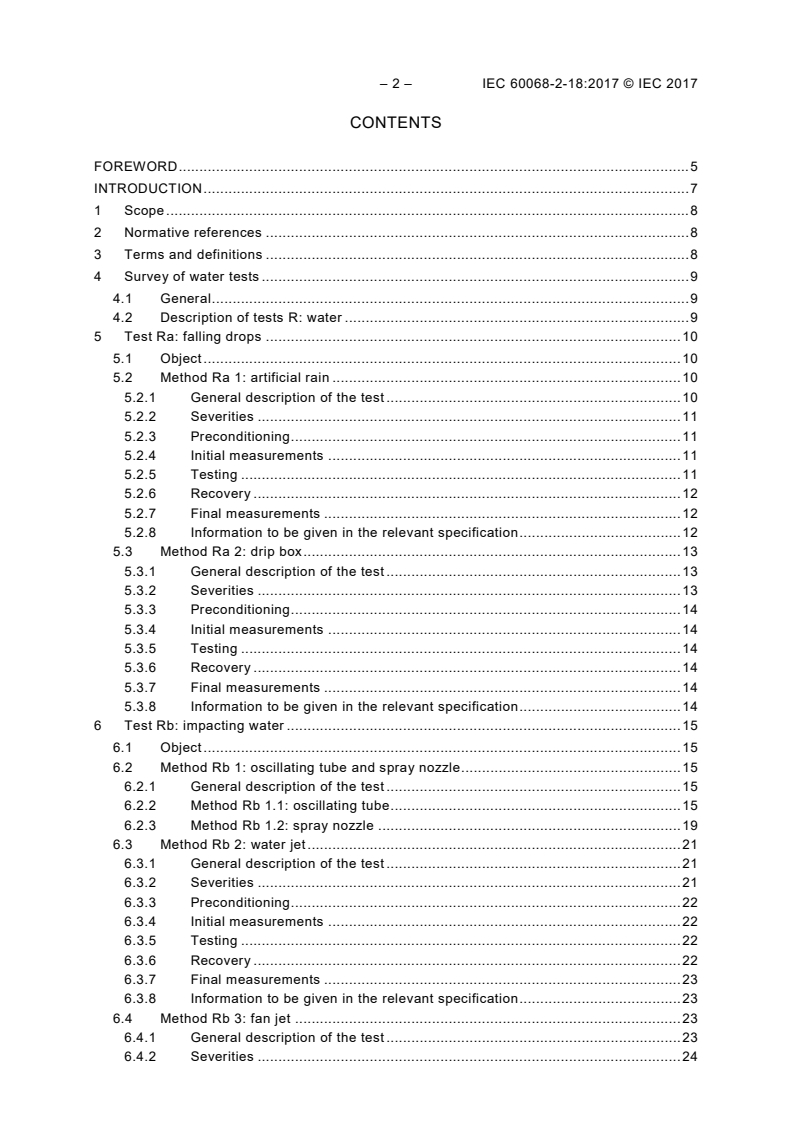
IEC 60068-2-18:2017 - Environmental testing - Part 2-18: Tests - Test R and guidance: Water Released:3/10/2017
Overview
IEC 60068-2-18:2017 is an International Electrotechnical Commission (IEC) environmental testing standard that defines Test R - Water and guidance for evaluating equipment exposed to falling drops, impacting water and immersion. The standard specifies laboratory methods to verify that enclosures, covers and seals preserve the functioning of components and equipment during transportation, storage and in-service exposure to water. This third edition (2017) is a technical revision of the 2000 edition and introduces a new method (Rb 3 - fan jet).
Key topics and technical requirements
- Scope and objective: Confirm water ingress protection for enclosures and seals under standardized water exposures; explicitly not a corrosion test.
- Structured test families:
- Ra - Falling drops:
- Ra1: Artificial rain (based on natural conditions but limited wind effects)
- Ra2: Drip box
- Rb - Impacting water:
- Rb1: Oscillating tube and spray nozzle (two variants)
- Rb2: Water jet (hose/nozzle)
- Rb3: Fan jet (new in 2017)
- Rc - Immersion:
- Rc1: Water tank immersion
- Rc2: Pressurized water chamber immersion
- Ra - Falling drops:
- Test sequence elements: preconditioning, initial measurements, controlled exposure (severity selection), recovery, and final measurements - with guidance on what information must be specified for reproducible testing.
- Severities and applicability: Guidance is provided for selecting appropriate severities for product use-cases; many test severities are higher than natural rainfall and are intended to stress enclosures, not to simulate weather exactly.
- Test apparatus and verification: Annexes include recommended apparatus (oscillating tubes, spray/fan nozzles, pressurized chambers), measurement and verification guidance for intensity, drop size, water quality, and impact force.
- Relationship to IP codes: The standard maps test methods to enclosure protection levels and provides equivalence guidance with the IP Code (IEC 60529).
Practical applications - who uses this standard
- Product designers and enclosure manufacturers - to validate sealing designs and select gasket or enclosure classes.
- Test laboratories and QA teams - to perform repeatable water ingress tests for shipping/storage and field-exposure claims.
- Specification writers and procurement - to define contractual test requirements and severities for outdoor or transportable equipment.
- Regulatory and certification bodies - to harmonize test protocols and evidence for water resistance claims.
Related standards
- IEC 60529 (IP Code) - for degrees of protection against ingress of water/solids.
- Other IEC environmental test parts (60068 series) - complementary tests for mechanical, thermal and climatic stresses.
Keywords: IEC 60068-2-18, environmental testing, water tests, artificial rain, drip box, impacting water, immersion, water jet, fan jet, enclosure sealing, ingress protection, IEC 60529.
Relations
- Effective Date
- 25-Aug-2026
- Effective Date
- 05-Sep-2023
Buy Documents
IEC 60068-2-18:2017 RLV - Environmental testing - Part 2-18: Tests - Test R and guidance: Water Released:3/10/2017
IEC 60068-2-18:2017 - Environmental testing - Part 2-18: Tests - Test R and guidance: Water Released:3/10/2017
Get Certified
Connect with accredited certification bodies for this standard

IMQ S.p.A. (Certification)
Italian electrical product certification.

SLG Prüf- und Zertifizierungs GmbH
German testing and certification body.

UL Solutions
Global safety science company with testing, inspection and certification.
Sponsored listings
Frequently Asked Questions
IEC 60068-2-18:2017 is a standard published by the International Electrotechnical Commission (IEC). Its full title is "Environmental testing - Part 2-18: Tests - Test R and guidance: Water". This standard covers: IEC 60068-2-18:2017 provides methods of test applicable to products which, during transportation, storage or in service, can be subjected to falling water drops, impacting water, immersion or high pressure water impact. The primary purpose of water tests is to verify the ability of enclosures, covers and seals to maintain components and equipment in good working order after and, when necessary, under a standardized drop field or immersion in water. These tests are not corrosion tests and cannot be considered and used as such. Established water tests in other standards are not intended to simulate natural rainfall and their quoted intensities are too high to be adopted for that purpose. Therefore, in addition to the high-intensity severities, test R includes an artificial rain test based upon natural conditions but not taking into account high wind speeds generally associated with natural rain. Guidance is given on the applicability of the tests and the severities to be selected. This third edition cancels and replaces the second edition published in 2000. This edition constitutes a technical revision. This edition includes the following significant technical changes with respect to the previous edition: a. addition of the new test method Rb 3.
IEC 60068-2-18:2017 provides methods of test applicable to products which, during transportation, storage or in service, can be subjected to falling water drops, impacting water, immersion or high pressure water impact. The primary purpose of water tests is to verify the ability of enclosures, covers and seals to maintain components and equipment in good working order after and, when necessary, under a standardized drop field or immersion in water. These tests are not corrosion tests and cannot be considered and used as such. Established water tests in other standards are not intended to simulate natural rainfall and their quoted intensities are too high to be adopted for that purpose. Therefore, in addition to the high-intensity severities, test R includes an artificial rain test based upon natural conditions but not taking into account high wind speeds generally associated with natural rain. Guidance is given on the applicability of the tests and the severities to be selected. This third edition cancels and replaces the second edition published in 2000. This edition constitutes a technical revision. This edition includes the following significant technical changes with respect to the previous edition: a. addition of the new test method Rb 3.
IEC 60068-2-18:2017 is classified under the following ICS (International Classification for Standards) categories: 19.040 - Environmental testing; 29.060.10 - Wires. The ICS classification helps identify the subject area and facilitates finding related standards.
IEC 60068-2-18:2017 has the following relationships with other standards: It is inter standard links to EN ISO 22734-1:2025, IEC 60068-2-18:2000. Understanding these relationships helps ensure you are using the most current and applicable version of the standard.
IEC 60068-2-18:2017 is available in PDF format for immediate download after purchase. The document can be added to your cart and obtained through the secure checkout process. Digital delivery ensures instant access to the complete standard document.
Standards Content (Sample)
IEC 60068-2-18 ®
Edition 3.0 2017-03
REDLINE VERSION
INTERNATIONAL
STANDARD
colour
inside
Environmental testing –
Part 2-18: Tests – Test R and guidance: Water
All rights reserved. Unless otherwise specified, no part of this publication may be reproduced or utilized in any form
or by any means, electronic or mechanical, including photocopying and microfilm, without permission in writing from
either IEC or IEC's member National Committee in the country of the requester. If you have any questions about IEC
copyright or have an enquiry about obtaining additional rights to this publication, please contact the address below or
your local IEC member National Committee for further information.
IEC Central Office Tel.: +41 22 919 02 11
3, rue de Varembé info@iec.ch
CH-1211 Geneva 20 www.iec.ch
Switzerland
About the IEC
The International Electrotechnical Commission (IEC) is the leading global organization that prepares and publishes
International Standards for all electrical, electronic and related technologies.
About IEC publications
The technical content of IEC publications is kept under constant review by the IEC. Please make sure that you have the
latest edition, a corrigenda or an amendment might have been published.
IEC Catalogue - webstore.iec.ch/catalogue Electropedia - www.electropedia.org
The stand-alone application for consulting the entire The world's leading online dictionary of electronic and
bibliographical information on IEC International Standards, electrical terms containing 21 000 terms and definitions in
Technical Specifications, Technical Reports and other English and French, with equivalent terms in 16 additional
documents. Available for PC, Mac OS, Android Tablets and languages. Also known as the International Electrotechnical
iPad. Vocabulary (IEV) online.
IEC publications search - webstore.iec.ch/advsearchform IEC Glossary - std.iec.ch/glossary
The advanced search enables to find IEC publications by a 67 000 electrotechnical terminology entries in English and
variety of criteria (reference number, text, technical French extracted from the Terms and Definitions clause of
committee,…). It also gives information on projects, replaced IEC publications issued since 2002. Some entries have been
and withdrawn publications. collected from earlier publications of IEC TC 37, 77, 86 and
CISPR.
IEC Just Published - webstore.iec.ch/justpublished
Stay up to date on all new IEC publications. Just Published IEC Customer Service Centre - webstore.iec.ch/csc
details all new publications released. Available online and If you wish to give us your feedback on this publication or
also once a month by email. need further assistance, please contact the Customer Service
Centre: sales@iec.ch.
IEC 60068-2-18 ®
Edition 3.0 2017-03
REDLINE VERSION
INTERNATIONAL
STANDARD
colour
inside
Environmental testing –
Part 2-18: Tests – Test R and guidance: Water
INTERNATIONAL
ELECTROTECHNICAL
COMMISSION
ICS 19.040 ISBN 978-2-8322-4106-6
– 2 – IEC 60068-2-18:2017 RLV © IEC 2017
CONTENTS
FOREWORD . 5
INTRODUCTION . 7
1 Scope and object . 8
2 Normative references . 8
3 Terms and definitions . 8
4 Survey of water tests . 9
4.1 General . 9
4.2 Description of tests R: water . 9
5 Test Ra: falling drops . 10
5.1 Object . 10
5.2 Method Ra 1: artificial rain . 10
5.2.1 General description of the test . 10
5.2.2 Severities . 11
5.2.3 Preconditioning . 11
5.2.4 Initial measurements . 11
5.2.5 Testing . 11
5.2.6 Recovery . 12
5.2.7 Final measurements . 12
5.2.8 Information to be given in the relevant specification . 12
5.3 Method Ra 2: drip box . 13
5.3.1 General description of the test . 13
5.3.2 Severities . 13
5.3.3 Preconditioning . 14
5.3.4 Initial measurements . 14
5.3.5 Testing . 14
5.3.6 Recovery . 14
5.3.7 Final measurements . 14
5.3.8 Information to be given in the relevant specification . 14
6 Test Rb: impacting water . 15
6.1 Object . 15
6.2 Method Rb 1: oscillating tube and spray nozzle . 15
6.2.1 General description of the test . 15
6.2.2 Method Rb 1.1: oscillating tube . 15
6.2.3 Method Rb 1.2: spray nozzle . 19
6.3 Method Rb 2: water jet . 21
6.3.1 General description of the test . 21
6.3.2 Severities . 21
6.3.3 Preconditioning . 22
6.3.4 Initial measurements . 22
6.3.5 Testing . 22
6.3.6 Recovery . 22
6.3.7 Final measurements . 23
6.3.8 Information to be given in the relevant specification . 23
6.4 Method Rb 3: fan jet . 23
6.4.1 General description of the test . 23
6.4.2 Severities . 24
6.4.3 Preconditioning . 24
6.4.4 Initial measurements . 24
6.4.5 Testing . 24
6.4.6 Recovery . 24
6.4.7 Final measurements . 24
6.4.8 Information to be given in the relevant specification . 25
7 Test Rc: immersion . 25
7.1 Object . 25
7.2 Method Rc 1: water tank . 25
7.2.1 General description . 25
7.2.2 Severities . 25
7.2.3 Preconditioning . 26
7.2.4 Initial measurements . 26
7.2.5 Testing . 26
7.2.6 Recovery . 26
7.2.7 Final measurements . 26
7.2.8 Information to be given in the relevant specification . 26
7.3 Method Rc 2: pressurized water chamber . 27
7.3.1 General description of the test . 27
7.3.2 Severities . 27
7.3.3 Preconditioning . 27
7.3.4 Initial measurements . 27
7.3.5 Testing . 27
7.3.6 Recovery . 28
7.3.7 Final measurements . 28
7.3.8 Information to be given in the relevant specification . 28
Annex A (informative) Water characteristics to be considered when writing the
relevant specification . 29
A.1 General . 29
A.2 Purity . 29
A.2.1 General . 29
A.2.2 Effect on test specimen . 29
A.2.3 Effect on test apparatus . 29
A.2.4 Ingress of water into the specimen . 30
A.3 Water quality for tests R . 30
A.3.1 Test Ra: falling drops. 30
A.3.2 Test Rb: impacting water . 30
A.3.3 Test Rc: immersion . 30
Annex B (informative) General guidance . 31
B.1 General . 31
B.2 Factors affecting the test severity . 31
Annex C (informative) Guidance for test Ra . 32
C.1 General . 32
C.2 Example of test apparatus . 32
C.2.1 Method Ra 1: artificial rain . 32
C.2.2 Method Ra 2: drip box . 33
C.3 Verification of test apparatus . 34
C.3.1 Intensity . 34
C.3.2 Drop size . 34
– 4 – IEC 60068-2-18:2017 RLV © IEC 2017
C.3.3 Resistivity and pH value . 34
Annex D (informative) Guidance for test Rb . 36
D.1 General . 36
D.2 Example of test apparatus . 36
D.2.1 Method Rb 1: oscillating tube and spray nozzle . 36
D.2.2 Method Rb 2: water jet . 37
D.2.3 Method Rb 3: fan jet nozzle . 38
Annex E (informative) Guidance for test Rc. 45
E.1 General . 45
E.2 Example of test apparatus . 45
E.2.1 Method Rc 1: water tank . 45
E.2.2 Method Rc 2: pressurized water chamber . 45
E.3 Verification of test apparatus . 45
Bibliography . 46
Figure 1 – Structuring of test methods and equivalence with the IP Code of IEC 60529 . 10
Figure 2 – Test Ra, definitions of angles and axes . 12
Figure C.1 – Test Ra 1, test apparatus and measurement setup for drop sizes and
intensity for artificial rain method . 33
Figure C.2 – Test Ra 2, recommended test apparatus for the drip box method . 35
Figure D.1 – Test Rb 1.1, recommended test apparatus for the oscillating tube method . 37
Figure D.2 – Distribution of mean value of precipitation intensity in the oscillating tube
area for the above-specified measurement conditions . 39
Figure D.3 – Test Rb 1.2, recommended test apparatus for the spray nozzle method . 40
Figure D.4 – Standard test nozzle for the water jet method (hose nozzle) . 40
Figure D.5 – Standard test nozzle for the fan jet method . 41
Figure D.6 – Fan jet nozzle resulting dimensions of spraying hole for checking purpose . 41
Figure D.7 – Example of different quality achievements of the surface finish of the fan
jet nozzle . 42
Figure D.8 – Set-up for measuring the impact force of the water jet for determining the
protection against high-pressure and high-temperature water jets . 43
Figure D.9 – Impact force distribution . 43
Figure D.10 – Test setup for determining the protection against high-pressure and
high-temperature water jet for small enclosures . 44
Table 1 – Oscillating tube – Relationship of number of nozzles and total water flow to
tube radius . 17
Table A.1 – Typical characteristics of water with approximate values . 30
INTERNATIONAL ELECTROTECHNICAL COMMISSION
____________
ENVIRONMENTAL TESTING –
Part 2-18: Tests – Test R and guidance: Water
FOREWORD
1) The International Electrotechnical Commission (IEC) is a worldwide organization for standardization comprising
all national electrotechnical committees (IEC National Committees). The object of IEC is to promote
international co-operation on all questions concerning standardization in the electrical and electronic fields. To
this end and in addition to other activities, IEC publishes International Standards, Technical Specifications,
Technical Reports, Publicly Available Specifications (PAS) and Guides (hereafter referred to as “IEC
Publication(s)”). Their preparation is entrusted to technical committees; any IEC National Committee interested
in the subject dealt with may participate in this preparatory work. International, governmental and non-
governmental organizations liaising with the IEC also participate in this preparation. IEC collaborates closely
with the International Organization for Standardization (ISO) in accordance with conditions determined by
agreement between the two organizations.
2) The formal decisions or agreements of IEC on technical matters express, as nearly as possible, an international
consensus of opinion on the relevant subjects since each technical committee has representation from all
interested IEC National Committees.
3) IEC Publications have the form of recommendations for international use and are accepted by IEC National
Committees in that sense. While all reasonable efforts are made to ensure that the technical content of IEC
Publications is accurate, IEC cannot be held responsible for the way in which they are used or for any
misinterpretation by any end user.
4) In order to promote international uniformity, IEC National Committees undertake to apply IEC Publications
transparently to the maximum extent possible in their national and regional publications. Any divergence
between any IEC Publication and the corresponding national or regional publication shall be clearly indicated in
the latter.
5) IEC itself does not provide any attestation of conformity. Independent certification bodies provide conformity
assessment services and, in some areas, access to IEC marks of conformity. IEC is not responsible for any
services carried out by independent certification bodies.
6) All users should ensure that they have the latest edition of this publication.
7) No liability shall attach to IEC or its directors, employees, servants or agents including individual experts and
members of its technical committees and IEC National Committees for any personal injury, property damage or
other damage of any nature whatsoever, whether direct or indirect, or for costs (including legal fees) and
expenses arising out of the publication, use of, or reliance upon, this IEC Publication or any other IEC
Publications.
8) Attention is drawn to the Normative references cited in this publication. Use of the referenced publications is
indispensable for the correct application of this publication.
9) Attention is drawn to the possibility that some of the elements of this IEC Publication may be the subject of
patent rights. IEC shall not be held responsible for identifying any or all such patent rights.
This redline version of the official IEC Standard allows the user to identify the changes
made to the previous edition. A vertical bar appears in the margin wherever a change
has been made. Additions are in green text, deletions are in strikethrough red text.
– 6 – IEC 60068-2-18:2017 RLV © IEC 2017
International Standard IEC 60068-2-18 has been prepared by IEC technical committee 104:
Environmental conditions, classification and methods of test.
This third edition cancels and replaces the second edition published in 2000. This edition
constitutes a technical revision.
This edition includes the following significant technical changes with respect to the previous
edition:
a) addition of the new test method Rb 3.
The text of this standard is based on the following documents:
FDIS Report on voting
104/719/FDIS 104/722/RVD
Full information on the voting for the approval of this standard can be found in the report on
voting indicated in the above table.
This publication has been drafted in accordance with the ISO/IEC Directives, Part 2.
A list of all parts in the IEC 60068 series, published under the general title Environmental
testing, can be found on the IEC website.
The committee has decided that the contents of this publication will remain unchanged until
the stability date indicated on the IEC website under "http://webstore.iec.ch" in the data
related to the specific publication. At this date, the publication will be
• reconfirmed,
• withdrawn,
• replaced by a revised edition, or
• amended.
IMPORTANT – The 'colour inside' logo on the cover page of this publication indicates
that it contains colours which are considered to be useful for the correct
understanding of its contents. Users should therefore print this document using a
colour printer.
INTRODUCTION
1)
It is the intention of this part of IEC 60068 to fulfil the function of a basic publication by
making water tests available to product committees.
A number of water tests are described in other IEC publications. Some of them are well
established, for example, the test for classification of the second characteristic numeral of the
IP Code, of IEC 60529.
This document incorporates the majority of the most widely used tests, as well as making
available further methods and increasing the number of severities.
________
1)
IEC Guide 108:1994, The relationship between technical committees with horizontal functions and product
committees and the use of basic publications
– 8 – IEC 60068-2-18:2017 RLV © IEC 2017
ENVIRONMENTAL TESTING –
Part 2-18: Tests – Test R and guidance: Water
1 Scope and object
This part of IEC 60068 provides methods of test applicable to products which, during
transportation, storage or in service, may can be subjected to falling water drops, impacting
water, immersion or high pressure water impact. The primary purpose of water tests is to
verify the ability of enclosures, covers and seals to maintain components and equipment in
good working order after and, when necessary, under a standardized drop field or immersion
in water.
These tests are not corrosion tests and should not cannot be considered and used as such.
The effects of a large temperature difference between the water and the specimen, such as
increased water ingress resulting from pressure changes, as well as thermal shock, are not
simulated.
Established water tests in other standards are not intended to simulate natural rainfall and
their quoted intensities are too high to be adopted for that purpose. Therefore, in addition to
the high-intensity severities, test R includes an artificial rain test based upon natural
conditions but not taking into account high wind speeds generally associated with natural rain.
Guidance is given on the applicability of the tests and the severities to be selected.
2 Normative references
The following normative documents contain provisions which, through reference in this text,
constitute provisions of this part of IEC 60068. For dated references, subsequent
amendments to, or revisions of, these publications do not apply. However, parties to
agreements based on this part of IEC 60068 are encouraged to investigate the possibility of
applying the most recent edition of the normative documents indicated below. For undated
references, the latest edition of the normative documents referred to applies. Members of IEC
and ISO maintain registers of currently valid International Standards
IEC 60529:1989, Degrees of protection provided by enclosures (IP Code)
There are no normative references in this document.
3 Terms and definitions
For the purposes of this document, the following terms and definitions apply.
ISO and IEC maintain terminological databases for use in standardisation at the following
addresses:
• IEC Electropedia: available at http://www.electropedia.org/
• ISO Online browsing platform: available at http://www.iso.org/obp
3.1
rain
precipitation in the form of water drops
Note 1 to entry: Both the amount that falls and the actual falling action of the water drops are often called rainfall.
3.2
drizzle
precipitation in the form of very small, numerous and uniformly dispersed water drops that
may appear to float while following air currents
3.3
raindrop
drop of water having a diameter greater than 0,5 mm falling through the atmosphere
3.4
drizzledrop
drop of water having a diameter of 0,2 mm to 0,5 mm falling through the atmosphere
3.5
R
rainfall or drizzle intensity
amount that falls per unit of time
Note 1 to entry: Rainfall intensity (R) is given in millimetres per hour (mm/h) where 1 l/(m · h) equals 1 mm/h.
3.6
D
median volume diameter
diameter of a drop whose size is such that 50 % of the volume of water reaching the ground is
comprised of smaller (or larger) drops
Note 1 to entry: Median volume diameter can be calculated using the formula:
0,19
D = 1,21 R (mm)
where R is the rainfall intensity (see 3.5).
4 Survey of water tests
4.1 General
This survey indicates the general structure of the various tests included in this document.
The structuring of the different tests is given in Figure 1.
4.2 Description of tests R: water
The water tests are structured into three groups.
• Ra: "falling drops" which, in principle, is a test with artificial rain and a test simulating
falling drops from condensation or leakage.
• Rb: "impacting water" where water jets impinge upon the test specimen with a certain
force and may assume any angle towards the test specimen.
• Rc: "immersion" where the test specimen is immersed in water to specified depths or
equivalent pressures.
– 10 – IEC 60068-2-18:2017 RLV © IEC 2017
Water tests
R
Falling drops Impacting water Immersion
Ra Rb Rc
Method Rc 1
Method Ra 1 Method Rb 1
Water tank
Artificial rain
– Method Rb 1.1
IPX7
Oscillating tube
IPX3 and IPX4
or
– Method Rb 1.2
Spray nozzle
(Hand-held shower)
IPX3 and IPX4
Method Ra 2
Method Rb 2
Method Rc 2
Drip box Water jet
Pressurized water
IPX1 and IPX2 IPX5 and IPX6
chamber
Method Rb 3
Fan jet
IPX9
IEC
Figure 1 – Structuring of test methods and equivalence with the IP Code of IEC 60529
5 Test Ra: falling drops
5.1 Object
This test is applicable to products which, during transportation, storage or in service may be
exposed to vertical falling drops, the origin of these being, for example, natural rain, seepage
or condensation. It shall be clearly stated in the relevant specification whether a product
hereinafter referred to as a specimen has to function during testing or merely to survive
conditions of falling drops. In either case, the relevant specification shall always prescribe
specify the acceptable tolerances in performance.
5.2 Method Ra 1: artificial rain
5.2.1 General description of the test
The test specimen is mounted on an appropriate fixture or base support. It is then subjected
to falling waterdrops, which simulate natural rain.
The basic requirements for the test apparatus are as follows.
• Drop-generating nozzle or nozzles (see C.2.1 and Figure C.1).
• Fixture for the specimen
The fixture shall simulate as far as possible the mounting of the specimen when in service;
for example, for wall-mounted equipment the fixture shall simulate a wall.
• Support of the test specimen
The support shall have a base area which is smaller than the base area of the specimen.
The support shall be either a turntable which has a rotation speed of 1 r/min and the
eccentricity (distance between turntable axis and specimen axis) is approximately
100 mm, or a table which does not turn. The support shall be able to hold the specimen in
any test position and, if necessary, be tilted to a maximum of 90° from the vertical plane.
• Water supply with controls
The water used for the test shall be fresh tap water of good quality. In order to avoid
clogging of the nozzles, the water shall be filtered and may be demineralized. Details of
the characteristics of the water are given in Annex A. During the test, the water
temperature shall not differ by more than 5 K from the temperature of the specimen under
test. If the water temperature is more than 5 K below the temperature of the specimen, a
pressure balance shall be provided for the specimen.
5.2.2 Severities
The severities, as indicated by intensity (and associated drop-size distribution), duration and
tilt angle of specimen shall be prescribed specified in the relevant specification. The values
shall be selected from those given below, a longer duration may be specified in the relevant
specification. Wind-driven rain is not simulated by this test as the wind velocity is not a
parameter of test.
• Intensity, mm/h and (associated drop-size distribution, mm):
10 ± 5 (D = 1,9 ± 0,2); 100 ± 20 (D = 2,9 ± 0,3); 400 ± 50 (D = 3,8 ± 0,4).
50 50 50
• Duration, min:
10, 30, 60, 120.
• Tilt angle α, degrees:
0, 15, 30, 60, 90.
NOTE The relevant specification may prescribe a longer duration.
5.2.3 Preconditioning
Preconditioning of the specimen and seals shall be carried out if prescribed specified in the
relevant specification.
5.2.4 Initial measurements
The specimen shall be submitted to the visual, dimensional and functional checks prescribed
by specified in the relevant specification. All features of the specimen likely to affect the test
result, for example surface treatment, enclosures, covers or seals, shall be inspected to
ensure that the instructions of the relevant specification have been followed.
5.2.5 Testing
The specimen shall be mounted on the support either
• in its normal operating position, as prescribed specified in the relevant specification; or
• tilted from the normal operating position and provision made for rotating the specimen in a
plane perpendicular to the tilted axis. The rotation may be achieved by a rotating support
table or by repositioning the specimen at regular intervals during the test. Alternatively,
the specimen can be oscillated through an arc of 270° to avoid the need for slip-ring
contacts.
– 12 – IEC 60068-2-18:2017 RLV © IEC 2017
The relevant specification shall specify the tilt angle or angles, the face or faces to be
exposed to the drop field and the duration of exposure for each side, or whether the specimen
shall be continuously rotated or oscillated through 270°. See also Figure 2.
The specimen shall be subjected to artificial rain with severities selected from 5.2.2 and
prescribed by specified in the relevant specification.
The relevant specification shall state whether the specimen shall be operated during testing
and if intermediate measurements shall be made.
Appropriate safety precautions shall be taken when testing the specimen in the energized
condition.
5.2.6 Recovery
Unless otherwise required in the relevant specification, the specimen shall be thoroughly
dried externally by wiping or by applying low-velocity forced air at room temperature.
Z
Z
α
Tilt angle
X
Y
Gimballed and rotatable table
IEC
Figure 2 – Test Ra, definitions of angles and axes
5.2.7 Final measurements
The specimen shall be examined for ingress of water and submitted to visual, dimensional
and functional checks prescribed by specified in the relevant specification.
Any ingress of water should be quantified if possible and reported.
5.2.8 Information to be given in the relevant specification
Where this test is included in the relevant specification, the following details shall be given in
so far as they are applicable. The relevant specification shall supply information as required in
the subclauses listed below, paying particular attention to the items marked with an asterisk
(*) as this information is always required.
Subclause
a) Severities* 5.2.2
b) Preconditioning 5.2.3
c) Initial measurements* 5.2.4
d) Mounting of specimen* 5.2.5
e) Specimen position or positions during testing* 5.2.5
f) State of the specimen during testing* 5.2.5
g) Intermediate measurements 5.2.5
h) Recovery 5.2.6
i) Final measurements* 5.2.7
5.3 Method Ra 2: drip box
5.3.1 General description of the test
The test specimen is mounted on an appropriate fixture placed under the drip box. The test
specimen is subjected to water drops, which simulate water falling as a result of condensation
or leakage.
The basic requirements for the test apparatus are as follows.
• Drip box
The drip box shall normally have a base area larger than the projected area of the
specimen. If the base of the drip box is smaller than that of the specimen under test, the
latter may be divided into several sections, the area of each section being large enough to
be covered by the dripping water. The test is continued until the whole area of the
specimen has been sprinkled for the specified time. The drip box shall be capable of
providing a uniform drop field with a precipitation of the specified intensity.
The grid pattern of the nozzles shall be 20 mm (for IP Code tests) or 25 mm. The distance
from the bottom of the drip box to the highest point of the specimen shall be adjustable to
either 0,2 m or 2 m. A suitable drip-box layout is described in C.2.2 and in Figure C.2.
• Fixture for the specimen
The fixture shall simulate as far as possible the mounting of the specimen when in service;
for example, for wall-mounted equipment the fixture shall simulate a wall.
• Support of the test specimen
The support shall have a base area which is smaller than the base area of the specimen.
The support shall either be a turntable which has a rotation speed of 1 r/min and an
eccentricity (distance between turntable axis and specimen axis) of approximately
100 mm, or a table which does not turn. The support shall be able to hold the specimen in
any test position and, if necessary, be tilted to a maximum of 45° from the vertical plane.
• Water supply with controls
The water used for the test shall be fresh tap water of good quality. In order to avoid
clogging of the nozzles, the water shall be filtered and may be demineralized. Details of
the characteristics of the water are given in annex A. During the test, the water
temperature shall not differ by more than 5 K from the temperature of the specimen under
test. If the water temperature is more than 5 K below the temperature of the specimen, a
pressure balance shall be provided for the specimen.
5.3.2 Severities
The severities, as indicated by drop falling height, tilt angle of specimen, duration and water
intensity, shall be prescribed specified in the relevant specification. The values shall be
selected from the following:
– 14 – IEC 60068-2-18:2017 RLV © IEC 2017
• Drop falling height, (h), m: 0,2; 2
• Tilt angle α, degrees: 0; 15; 30; 45
• Duration, min: 3; 10; 30; 60
NOTE The 3 min duration applies only when a tilt angle of 0° is specified.
+30 +30
• Water intensity, mm/h: 60 ; 180
0 0
5.3.3 Preconditioning
Preconditioning of the specimen and seals shall be carried out if prescribed specified in the
relevant specification.
5.3.4 Initial measurements
The specimen shall be submitted to the visual, dimensional and functional checks prescribed
by specified in the relevant specification. All the features of the specimen likely to affect the
test result, for example, surface treatment, covers or seals, shall be inspected to ensure that
the instructions of the relevant specification have been followed.
5.3.5 Testing
The specimen shall be mounted on the support in its normal operating position under the drip
box. The support shall then either be rotated or tilted to the specified angle in each of the four
positions of tilt. These positions are on either side of the vertical in two mutually perpendicular
planes. If a special mounting condition is required (for example, wall or ceiling), it shall be
prescribed by specified in the relevant specification.
In both cases, the test shall be carried out in the conditions specified in 5.3.1 and the severity
selected from 5.3.2.
In the case of tilted support, the duration shall be divided equally between the four positions.
The relevant specification shall state whether the specimen shall be operated during testing
and if intermediate measurements shall be made. Appropriate safety precautions shall be
taken when testing the specimen in the energized condition.
5.3.6 Recovery
Unless otherwise required in the relevant specification, the specimen shall be thoroughly
dried externally by wiping or by applying low-velocity forced air at room temperature.
5.3.7 Final measurements
The specimen shall be examined for ingress of water and submitted to visual, dimensional
and functional checks prescribed by specified in the relevant specification.
Any ingress of water should be quantified if possible and reported.
5.3.8 Information to be given in the relevant specification
Where this test is included in the relevant specification, the following details shall be given in
so far as they are applicable. The relevant specification shall supply information as required
in the subclauses listed below, paying particular attention to the items marked with an asterisk
(*) as this information is always required.
Subclause
a) Severities* 5.3.2
b) Preconditioning 5.3.3
c) Initial measurements* 5.3.4
d) Mounting of specimen* 5.3.5
e) Specimen position or positions during testing* 5.3.5
f) State of the specimen during testing* 5.3.5
g) Intermediate measurements 5.3.5
h) Recovery 5.3.6
i) Final measurements* 5.3.7
6 Test Rb: impacting water
6.1 Object
This test is applicable to products which, during transportation, storage or in service may be
subjected to impacting water. The origin for this can be water from cloudbursts, heavy driving
rain, sprinkler systems, pressure cleaning, spray from wheels, sluicing or breaking seas. The
relevant specification should clearly prescribe specify whether a product tested separately,
hereinafter referred to as a specimen, has to function during testing or merely survive
conditions of impacting water. In either case, the relevant specification shall always prescribe
specify the acceptable tolerances in performance.
6.2 Method Rb 1: oscillating tube and spray nozzle
6.2.1 General description of the test
The tests are intended to simulate spraying or splashing water, for example, the results of
water action of sprinkler systems. Guidance for this test is given in Annex D. The test is made
using either the test device described in Figure D.1 or the test device described in Figure D.3
in accordance with the relevant specification. The test specimen is mounted on an appropriate
fixture and is subjected to impacting water generated from either a semicircular tube or a
spray nozzle.
6.2.2 Method Rb 1.1: oscillating tube
6.2.2.1 Test apparatus
The basic requirements for the test apparatus are as follows.
• Oscillating tubes
Three types of tube may be used. The tube shall be provided with nozzles of either
0,4 mm diameter for type 1 and type 2 or 0,8 mm diameter for type 3, at a 50 mm
centre-to-centre distance over an arc of 60° on either side of the vertical for type 1 or 90°
on either side of the vertical for type 2 and type 3. The tube shall be able to oscillate
through an angle of 60° on either side of the vertical for type 1 or 180° on either side of
the vertical for type 2 and type 3.
The maximum acceptable radius of the oscillating tubes, type 1 and type 2 is 1 600 mm.
For oscillating tube type 3, the radius shall not exceed 800 mm. The radius shall be
selected in such a way that the clearance between the specimen and the inside of the tube
does not exceed 200 mm.
The relationship between the number of nozzles, each having a mean flow rate of
0,07 l/min or 0,6 l/min and the total flow rate is given in Table 2.
A suitable apparatus is shown in Figure D.1.
– 16 – IEC 60068-2-18:2017 RLV © IEC 2017
• Fixture for the specimen
The fixture shall simulate as far as possible the mounting structure to be used in the real
use of products; for example, for wall-mounted equipment, the fixture shall simulate a wall.
• Support for the specimen
The support for the specimen shall not be perforated for type 1 and shall
...
IEC 60068-2-18 ®
Edition 3.0 2017-03
INTERNATIONAL
STANDARD
NORME
INTERNATIONALE
colour
inside
Environmental testing –
Part 2-18: Tests – Test R and guidance: Water
Essais d’environnement –
Partie 2-18: Essais – Essai R et guide: Eau
All rights reserved. Unless otherwise specified, no part of this publication may be reproduced or utilized in any form
or by any means, electronic or mechanical, including photocopying and microfilm, without permission in writing from
either IEC or IEC's member National Committee in the country of the requester. If you have any questions about IEC
copyright or have an enquiry about obtaining additional rights to this publication, please contact the address below or
your local IEC member National Committee for further information.
Droits de reproduction réservés. Sauf indication contraire, aucune partie de cette publication ne peut être reproduite
ni utilisée sous quelque forme que ce soit et par aucun procédé, électronique ou mécanique, y compris la photocopie
et les microfilms, sans l'accord écrit de l'IEC ou du Comité national de l'IEC du pays du demandeur. Si vous avez des
questions sur le copyright de l'IEC ou si vous désirez obtenir des droits supplémentaires sur cette publication, utilisez
les coordonnées ci-après ou contactez le Comité national de l'IEC de votre pays de résidence.
IEC Central Office Tel.: +41 22 919 02 11
3, rue de Varembé Fax: +41 22 919 03 00
CH-1211 Geneva 20 info@iec.ch
Switzerland www.iec.ch
About the IEC
The International Electrotechnical Commission (IEC) is the leading global organization that prepares and publishes
International Standards for all electrical, electronic and related technologies.
About IEC publications
The technical content of IEC publications is kept under constant review by the IEC. Please make sure that you have the
latest edition, a corrigenda or an amendment might have been published.
IEC Catalogue - webstore.iec.ch/catalogue Electropedia - www.electropedia.org
The stand-alone application for consulting the entire The world's leading online dictionary of electronic and
bibliographical information on IEC International Standards, electrical terms containing 20 000 terms and definitions in
Technical Specifications, Technical Reports and other English and French, with equivalent terms in 16 additional
documents. Available for PC, Mac OS, Android Tablets and languages. Also known as the International Electrotechnical
iPad. Vocabulary (IEV) online.
IEC publications search - www.iec.ch/searchpub IEC Glossary - std.iec.ch/glossary
The advanced search enables to find IEC publications by a 65 000 electrotechnical terminology entries in English and
variety of criteria (reference number, text, technical French extracted from the Terms and Definitions clause of
committee,…). It also gives information on projects, replaced IEC publications issued since 2002. Some entries have been
and withdrawn publications. collected from earlier publications of IEC TC 37, 77, 86 and
CISPR.
IEC Just Published - webstore.iec.ch/justpublished
Stay up to date on all new IEC publications. Just Published IEC Customer Service Centre - webstore.iec.ch/csc
details all new publications released. Available online and If you wish to give us your feedback on this publication or
also once a month by email. need further assistance, please contact the Customer Service
Centre: csc@iec.ch.
A propos de l'IEC
La Commission Electrotechnique Internationale (IEC) est la première organisation mondiale qui élabore et publie des
Normes internationales pour tout ce qui a trait à l'électricité, à l'électronique et aux technologies apparentées.
A propos des publications IEC
Le contenu technique des publications IEC est constamment revu. Veuillez vous assurer que vous possédez l’édition la
plus récente, un corrigendum ou amendement peut avoir été publié.
Catalogue IEC - webstore.iec.ch/catalogue Electropedia - www.electropedia.org
Application autonome pour consulter tous les renseignements
Le premier dictionnaire en ligne de termes électroniques et
bibliographiques sur les Normes internationales,
électriques. Il contient 20 000 termes et définitions en anglais
Spécifications techniques, Rapports techniques et autres
et en français, ainsi que les termes équivalents dans 16
documents de l'IEC. Disponible pour PC, Mac OS, tablettes
langues additionnelles. Egalement appelé Vocabulaire
Android et iPad.
Electrotechnique International (IEV) en ligne.
Recherche de publications IEC - www.iec.ch/searchpub
Glossaire IEC - std.iec.ch/glossary
65 000 entrées terminologiques électrotechniques, en anglais
La recherche avancée permet de trouver des publications IEC
en utilisant différents critères (numéro de référence, texte, et en français, extraites des articles Termes et Définitions des
comité d’études,…). Elle donne aussi des informations sur les publications IEC parues depuis 2002. Plus certaines entrées
projets et les publications remplacées ou retirées. antérieures extraites des publications des CE 37, 77, 86 et
CISPR de l'IEC.
IEC Just Published - webstore.iec.ch/justpublished
Service Clients - webstore.iec.ch/csc
Restez informé sur les nouvelles publications IEC. Just
Published détaille les nouvelles publications parues. Si vous désirez nous donner des commentaires sur cette
Disponible en ligne et aussi une fois par mois par email. publication ou si vous avez des questions contactez-nous:
csc@iec.ch.
IEC 60068-2-18 ®
Edition 3.0 2017-03
INTERNATIONAL
STANDARD
NORME
INTERNATIONALE
colour
inside
Environmental testing –
Part 2-18: Tests – Test R and guidance: Water
Essais d’environnement –
Partie 2-18: Essais – Essai R et guide: Eau
INTERNATIONAL
ELECTROTECHNICAL
COMMISSION
COMMISSION
ELECTROTECHNIQUE
INTERNATIONALE
ICS 19.040 ISBN 978-2-8322-4019-9
– 2 – IEC 60068-2-18:2017 © IEC 2017
CONTENTS
FOREWORD . 5
INTRODUCTION . 7
1 Scope . 8
2 Normative references . 8
3 Terms and definitions . 8
4 Survey of water tests . 9
4.1 General . 9
4.2 Description of tests R: water . 9
5 Test Ra: falling drops . 10
5.1 Object . 10
5.2 Method Ra 1: artificial rain . 10
5.2.1 General description of the test . 10
5.2.2 Severities . 11
5.2.3 Preconditioning . 11
5.2.4 Initial measurements . 11
5.2.5 Testing . 11
5.2.6 Recovery . 12
5.2.7 Final measurements . 12
5.2.8 Information to be given in the relevant specification . 12
5.3 Method Ra 2: drip box . 13
5.3.1 General description of the test . 13
5.3.2 Severities . 13
5.3.3 Preconditioning . 14
5.3.4 Initial measurements . 14
5.3.5 Testing . 14
5.3.6 Recovery . 14
5.3.7 Final measurements . 14
5.3.8 Information to be given in the relevant specification . 14
6 Test Rb: impacting water . 15
6.1 Object . 15
6.2 Method Rb 1: oscillating tube and spray nozzle . 15
6.2.1 General description of the test . 15
6.2.2 Method Rb 1.1: oscillating tube . 15
6.2.3 Method Rb 1.2: spray nozzle . 19
6.3 Method Rb 2: water jet . 21
6.3.1 General description of the test . 21
6.3.2 Severities . 21
6.3.3 Preconditioning . 22
6.3.4 Initial measurements . 22
6.3.5 Testing . 22
6.3.6 Recovery . 22
6.3.7 Final measurements . 23
6.3.8 Information to be given in the relevant specification . 23
6.4 Method Rb 3: fan jet . 23
6.4.1 General description of the test . 23
6.4.2 Severities . 24
6.4.3 Preconditioning . 24
6.4.4 Initial measurements . 24
6.4.5 Testing . 24
6.4.6 Recovery . 24
6.4.7 Final measurements . 24
6.4.8 Information to be given in the relevant specification . 25
7 Test Rc: immersion . 25
7.1 Object . 25
7.2 Method Rc 1: water tank . 25
7.2.1 General description . 25
7.2.2 Severities . 25
7.2.3 Preconditioning . 26
7.2.4 Initial measurements . 26
7.2.5 Testing . 26
7.2.6 Recovery . 26
7.2.7 Final measurements . 26
7.2.8 Information to be given in the relevant specification . 26
7.3 Method Rc 2: pressurized water chamber . 27
7.3.1 General description of the test . 27
7.3.2 Severities . 27
7.3.3 Preconditioning . 27
7.3.4 Initial measurements . 27
7.3.5 Testing . 27
7.3.6 Recovery . 28
7.3.7 Final measurements . 28
7.3.8 Information to be given in the relevant specification . 28
Annex A (informative) Water characteristics to be considered when writing the
relevant specification . 29
A.1 General . 29
A.2 Purity . 29
A.2.1 General . 29
A.2.2 Effect on test specimen . 29
A.2.3 Effect on test apparatus . 29
A.2.4 Ingress of water into the specimen . 30
A.3 Water quality for tests R . 30
A.3.1 Test Ra: falling drops. 30
A.3.2 Test Rb: impacting water . 30
A.3.3 Test Rc: immersion . 30
Annex B (informative) General guidance . 31
B.1 General . 31
B.2 Factors affecting the test severity . 31
Annex C (informative) Guidance for test Ra . 32
C.1 General . 32
C.2 Example of test apparatus . 32
C.2.1 Method Ra 1: artificial rain . 32
C.2.2 Method Ra 2: drip box . 33
C.3 Verification of test apparatus . 34
C.3.1 Intensity . 34
C.3.2 Drop size . 34
– 4 – IEC 60068-2-18:2017 © IEC 2017
C.3.3 Resistivity and pH value . 34
Annex D (informative) Guidance for test Rb . 36
D.1 General . 36
D.2 Example of test apparatus . 36
D.2.1 Method Rb 1: oscillating tube and spray nozzle . 36
D.2.2 Method Rb 2: water jet . 37
D.2.3 Method Rb 3: fan jet nozzle . 38
Annex E (informative) Guidance for test Rc. 45
E.1 General . 45
E.2 Example of test apparatus . 45
E.2.1 Method Rc 1: water tank . 45
E.2.2 Method Rc 2: pressurized water chamber . 45
E.3 Verification of test apparatus . 45
Bibliography . 46
Figure 1 – Structuring of test methods and equivalence with the IP Code of IEC 60529 . 10
Figure 2 – Test Ra, definitions of angles and axes . 12
Figure C.1 – Test Ra 1, test apparatus and measurement setup for drop sizes and
intensity for artificial rain method . 33
Figure C.2 – Test Ra 2, recommended test apparatus for the drip box method . 35
Figure D.1 – Test Rb 1.1, recommended test apparatus for the oscillating tube method . 37
Figure D.2 – Distribution of mean value of precipitation intensity in the oscillating tube
area . 39
Figure D.3 – Test Rb 1.2, recommended test apparatus for the spray nozzle method . 40
Figure D.4 – Standard test nozzle for the water jet method (hose nozzle) . 40
Figure D.5 – Standard test nozzle for the fan jet method . 41
Figure D.6 – Fan jet nozzle resulting dimensions of spraying hole for checking purpose . 41
Figure D.7 – Example of different quality achievements of the surface finish of the fan
jet nozzle . 42
Figure D.8 – Set-up for measuring the impact force of the water jet for determining the
protection against high-pressure and high-temperature water jets . 43
Figure D.9 – Impact force distribution . 43
Figure D.10 – Test setup for determining the protection against high-pressure and
high-temperature water jet for small enclosures . 44
Table 1 – Oscillating tube – Relationship of number of nozzles and total water flow to
tube radius . 17
Table A.1 – Typical characteristics of water with approximate values . 30
INTERNATIONAL ELECTROTECHNICAL COMMISSION
____________
ENVIRONMENTAL TESTING –
Part 2-18: Tests – Test R and guidance: Water
FOREWORD
1) The International Electrotechnical Commission (IEC) is a worldwide organization for standardization comprising
all national electrotechnical committees (IEC National Committees). The object of IEC is to promote
international co-operation on all questions concerning standardization in the electrical and electronic fields. To
this end and in addition to other activities, IEC publishes International Standards, Technical Specifications,
Technical Reports, Publicly Available Specifications (PAS) and Guides (hereafter referred to as “IEC
Publication(s)”). Their preparation is entrusted to technical committees; any IEC National Committee interested
in the subject dealt with may participate in this preparatory work. International, governmental and non-
governmental organizations liaising with the IEC also participate in this preparation. IEC collaborates closely
with the International Organization for Standardization (ISO) in accordance with conditions determined by
agreement between the two organizations.
2) The formal decisions or agreements of IEC on technical matters express, as nearly as possible, an international
consensus of opinion on the relevant subjects since each technical committee has representation from all
interested IEC National Committees.
3) IEC Publications have the form of recommendations for international use and are accepted by IEC National
Committees in that sense. While all reasonable efforts are made to ensure that the technical content of IEC
Publications is accurate, IEC cannot be held responsible for the way in which they are used or for any
misinterpretation by any end user.
4) In order to promote international uniformity, IEC National Committees undertake to apply IEC Publications
transparently to the maximum extent possible in their national and regional publications. Any divergence
between any IEC Publication and the corresponding national or regional publication shall be clearly indicated in
the latter.
5) IEC itself does not provide any attestation of conformity. Independent certification bodies provide conformity
assessment services and, in some areas, access to IEC marks of conformity. IEC is not responsible for any
services carried out by independent certification bodies.
6) All users should ensure that they have the latest edition of this publication.
7) No liability shall attach to IEC or its directors, employees, servants or agents including individual experts and
members of its technical committees and IEC National Committees for any personal injury, property damage or
other damage of any nature whatsoever, whether direct or indirect, or for costs (including legal fees) and
expenses arising out of the publication, use of, or reliance upon, this IEC Publication or any other IEC
Publications.
8) Attention is drawn to the Normative references cited in this publication. Use of the referenced publications is
indispensable for the correct application of this publication.
9) Attention is drawn to the possibility that some of the elements of this IEC Publication may be the subject of
patent rights. IEC shall not be held responsible for identifying any or all such patent rights.
International Standard IEC 60068-2-18 has been prepared by IEC technical committee 104:
Environmental conditions, classification and methods of test.
This third edition cancels and replaces the second edition published in 2000. This edition
constitutes a technical revision.
This edition includes the following significant technical changes with respect to the previous
edition:
a) addition of the new test method Rb 3.
– 6 – IEC 60068-2-18:2017 © IEC 2017
The text of this standard is based on the following documents:
FDIS Report on voting
104/719/FDIS 104/722/RVD
Full information on the voting for the approval of this standard can be found in the report on
voting indicated in the above table.
This publication has been drafted in accordance with the ISO/IEC Directives, Part 2.
A list of all parts in the IEC 60068 series, published under the general title Environmental
testing, can be found on the IEC website.
The committee has decided that the contents of this publication will remain unchanged until
the stability date indicated on the IEC website under "http://webstore.iec.ch" in the data
related to the specific publication. At this date, the publication will be
• reconfirmed,
• withdrawn,
• replaced by a revised edition, or
• amended.
IMPORTANT – The 'colour inside' logo on the cover page of this publication indicates
that it contains colours which are considered to be useful for the correct
understanding of its contents. Users should therefore print this document using a
colour printer.
INTRODUCTION
A number of water tests are described in other IEC publications. Some of them are well
established, for example, the test for classification of the second characteristic numeral of the
IP Code, of IEC 60529.
This document incorporates the majority of the most widely used tests, as well as making
available further methods and increasing the number of severities.
– 8 – IEC 60068-2-18:2017 © IEC 2017
ENVIRONMENTAL TESTING –
Part 2-18: Tests – Test R and guidance: Water
1 Scope
This part of IEC 60068 provides methods of test applicable to products which, during
transportation, storage or in service, can be subjected to falling water drops, impacting water,
immersion or high pressure water impact. The primary purpose of water tests is to verify the
ability of enclosures, covers and seals to maintain components and equipment in good
working order after and, when necessary, under a standardized drop field or immersion in
water.
These tests are not corrosion tests and cannot be considered and used as such.
Established water tests in other standards are not intended to simulate natural rainfall and
their quoted intensities are too high to be adopted for that purpose. Therefore, in addition to
the high-intensity severities, test R includes an artificial rain test based upon natural
conditions but not taking into account high wind speeds generally associated with natural rain.
Guidance is given on the applicability of the tests and the severities to be selected.
2 Normative references
There are no normative references in this document.
3 Terms and definitions
For the purposes of this document, the following terms and definitions apply.
ISO and IEC maintain terminological databases for use in standardisation at the following
addresses:
• IEC Electropedia: available at http://www.electropedia.org/
• ISO Online browsing platform: available at http://www.iso.org/obp
3.1
rain
precipitation in the form of water drops
Note 1 to entry: Both the amount that falls and the actual falling action of the water drops are often called rainfall.
3.2
drizzle
precipitation in the form of very small, numerous and uniformly dispersed water drops that
may appear to float while following air currents
3.3
raindrop
drop of water having a diameter greater than 0,5 mm falling through the atmosphere
3.4
drizzledrop
drop of water having a diameter of 0,2 mm to 0,5 mm falling through the atmosphere
3.5
R
rainfall or drizzle intensity
amount that falls per unit of time
Note 1 to entry: Rainfall intensity (R) is given in millimetres per hour (mm/h) where 1 l/(m · h) equals 1 mm/h.
3.6
D
median volume diameter
diameter of a drop whose size is such that 50 % of the volume of water reaching the ground is
comprised of smaller (or larger) drops
Note 1 to entry: Median volume diameter can be calculated using the formula:
0,19
D = 1,21 R (mm)
where R is the rainfall intensity (see 3.5).
4 Survey of water tests
4.1 General
This survey indicates the general structure of the various tests included in this document.
The structuring of the different tests is given in Figure 1.
4.2 Description of tests R: water
The water tests are structured into three groups.
• Ra: "falling drops" which, in principle, is a test with artificial rain and a test simulating
falling drops from condensation or leakage.
• Rb: "impacting water" where water jets impinge upon the test specimen with a certain
force and may assume any angle towards the test specimen.
• Rc: "immersion" where the test specimen is immersed in water to specified depths or
equivalent pressures.
– 10 – IEC 60068-2-18:2017 © IEC 2017
Water tests
R
Falling drops Impacting water Immersion
Ra Rb Rc
Method Rc 1
Method Ra 1 Method Rb 1
Water tank
Artificial rain
– Method Rb 1.1
IPX7
Oscillating tube
IPX3 and IPX4
or
– Method Rb 1.2
Spray nozzle
(Hand-held shower)
IPX3 and IPX4
Method Ra 2
Method Rb 2
Method Rc 2
Drip box Water jet
Pressurized water
IPX1 and IPX2
IPX5 and IPX6
chamber
Method Rb 3
Fan jet
IPX9
IEC
Figure 1 – Structuring of test methods and equivalence with the IP Code of IEC 60529
5 Test Ra: falling drops
5.1 Object
This test is applicable to products which, during transportation, storage or in service may be
exposed to vertical falling drops, the origin of these being, for example, natural rain, seepage
or condensation. It shall be clearly stated in the relevant specification whether a product
hereinafter referred to as a specimen has to function during testing or merely to survive
conditions of falling drops. In either case, the relevant specification shall always specify the
acceptable tolerances in performance.
5.2 Method Ra 1: artificial rain
5.2.1 General description of the test
The test specimen is mounted on an appropriate fixture or base support. It is then subjected
to falling waterdrops, which simulate natural rain.
The basic requirements for the test apparatus are as follows.
• Drop-generating nozzle or nozzles (see C.2.1 and Figure C.1).
• Fixture for the specimen
The fixture shall simulate as far as possible the mounting of the specimen when in service;
for example, for wall-mounted equipment the fixture shall simulate a wall.
• Support of the test specimen
The support shall have a base area which is smaller than the base area of the specimen.
The support shall be either a turntable which has a rotation speed of 1 r/min and the
eccentricity (distance between turntable axis and specimen axis) is approximately
100 mm, or a table which does not turn. The support shall be able to hold the specimen in
any test position and, if necessary, be tilted to a maximum of 90° from the vertical plane.
• Water supply with controls
The water used for the test shall be fresh tap water of good quality. In order to avoid
clogging of the nozzles, the water shall be filtered and may be demineralized. Details of
the characteristics of the water are given in Annex A. During the test, the water
temperature shall not differ by more than 5 K from the temperature of the specimen under
test. If the water temperature is more than 5 K below the temperature of the specimen, a
pressure balance shall be provided for the specimen.
5.2.2 Severities
The severities, as indicated by intensity (and associated drop-size distribution), duration and
tilt angle of specimen shall be specified in the relevant specification. The values shall be
selected from those given below, a longer duration may be specified in the relevant
specification. Wind-driven rain is not simulated by this test as the wind velocity is not a
parameter of test.
• Intensity, mm/h and (associated drop-size distribution, mm):
10 ± 5 (D = 1,9 ± 0,2); 100 ± 20 (D = 2,9 ± 0,3); 400 ± 50 (D = 3,8 ± 0,4).
50 50 50
• Duration, min:
10, 30, 60, 120.
• Tilt angle α, degrees:
0, 15, 30, 60, 90.
5.2.3 Preconditioning
Preconditioning of the specimen and seals shall be carried out if specified in the relevant
specification.
5.2.4 Initial measurements
The specimen shall be submitted to the visual, dimensional and functional checks specified in
the relevant specification. All features of the specimen likely to affect the test result, for
example surface treatment, enclosures, covers or seals, shall be inspected to ensure that the
instructions of the relevant specification have been followed.
5.2.5 Testing
The specimen shall be mounted on the support either
• in its normal operating position, as specified in the relevant specification; or
• tilted from the normal operating position and provision made for rotating the specimen in a
plane perpendicular to the tilted axis. The rotation may be achieved by a rotating support
table or by repositioning the specimen at regular intervals during the test. Alternatively,
the specimen can be oscillated through an arc of 270° to avoid the need for slip-ring
contacts.
The relevant specification shall specify the tilt angle or angles, the face or faces to be
exposed to the drop field and the duration of exposure for each side, or whether the specimen
shall be continuously rotated or oscillated through 270°. See also Figure 2.
– 12 – IEC 60068-2-18:2017 © IEC 2017
The specimen shall be subjected to artificial rain with severities selected from 5.2.2 and
specified in the relevant specification.
The relevant specification shall state whether the specimen shall be operated during testing
and if intermediate measurements shall be made.
Appropriate safety precautions shall be taken when testing the specimen in the energized
condition.
5.2.6 Recovery
Unless otherwise required in the relevant specification, the specimen shall be thoroughly
dried externally by wiping or by applying low-velocity forced air at room temperature.
Z
Z
α
Tilt angle
X
Y
Gimballed and rotatable table
IEC
Figure 2 – Test Ra, definitions of angles and axes
5.2.7 Final measurements
The specimen shall be examined for ingress of water and submitted to visual, dimensional
and functional checks specified in the relevant specification.
Any ingress of water should be quantified if possible and reported.
5.2.8 Information to be given in the relevant specification
Where this test is included in the relevant specification, the following details shall be given in
so far as they are applicable. The relevant specification shall supply information as required in
the subclauses listed below, paying particular attention to the items marked with an asterisk
(*) as this information is always required.
Subclause
a) Severities* 5.2.2
b) Preconditioning 5.2.3
c) Initial measurements* 5.2.4
d) Mounting of specimen* 5.2.5
e) Specimen position or positions during testing* 5.2.5
f) State of the specimen during testing* 5.2.5
g) Intermediate measurements 5.2.5
h) Recovery 5.2.6
i) Final measurements* 5.2.7
5.3 Method Ra 2: drip box
5.3.1 General description of the test
The test specimen is mounted on an appropriate fixture placed under the drip box. The test
specimen is subjected to water drops, which simulate water falling as a result of condensation
or leakage.
The basic requirements for the test apparatus are as follows.
• Drip box
The drip box shall normally have a base area larger than the projected area of the
specimen. If the base of the drip box is smaller than that of the specimen under test, the
latter may be divided into several sections, the area of each section being large enough to
be covered by the dripping water. The test is continued until the whole area of the
specimen has been sprinkled for the specified time. The drip box shall be capable of
providing a uniform drop field with a precipitation of the specified intensity.
The grid pattern of the nozzles shall be 20 mm (for IP Code tests) or 25 mm. The distance
from the bottom of the drip box to the highest point of the specimen shall be adjustable to
either 0,2 m or 2 m. A suitable drip-box layout is described in C.2.2 and in Figure C.2.
• Fixture for the specimen
The fixture shall simulate as far as possible the mounting of the specimen when in service;
for example, for wall-mounted equipment the fixture shall simulate a wall.
• Support of the test specimen
The support shall have a base area which is smaller than the base area of the specimen.
The support shall either be a turntable which has a rotation speed of 1 r/min and an
eccentricity (distance between turntable axis and specimen axis) of approximately
100 mm, or a table which does not turn. The support shall be able to hold the specimen in
any test position and, if necessary, be tilted to a maximum of 45° from the vertical plane.
• Water supply with controls
The water used for the test shall be fresh tap water of good quality. In order to avoid
clogging of the nozzles, the water shall be filtered and may be demineralized. Details of
the characteristics of the water are given in annex A. During the test, the water
temperature shall not differ by more than 5 K from the temperature of the specimen under
test. If the water temperature is more than 5 K below the temperature of the specimen, a
pressure balance shall be provided for the specimen.
5.3.2 Severities
The severities, as indicated by drop falling height, tilt angle of specimen, duration and water
intensity, shall be specified in the relevant specification. The values shall be selected from the
following:
– 14 – IEC 60068-2-18:2017 © IEC 2017
• Drop falling height, (h), m: 0,2; 2
• Tilt angle α, degrees: 0; 15; 30; 45
• Duration, min: 3; 10; 30; 60
NOTE The 3 min duration applies only when a tilt angle of 0° is specified.
+30 +30
• Water intensity, mm/h: 60 ; 180
0 0
5.3.3 Preconditioning
Preconditioning of the specimen and seals shall be carried out if specified in the relevant
specification.
5.3.4 Initial measurements
The specimen shall be submitted to the visual, dimensional and functional checks specified in
the relevant specification. All the features of the specimen likely to affect the test result, for
example, surface treatment, covers or seals, shall be inspected to ensure that the instructions
of the relevant specification have been followed.
5.3.5 Testing
The specimen shall be mounted on the support in its normal operating position under the drip
box. The support shall then either be rotated or tilted to the specified angle in each of the four
positions of tilt. These positions are on either side of the vertical in two mutually perpendicular
planes. If a special mounting condition is required (for example, wall or ceiling), it shall be
specified in the relevant specification.
In both cases, the test shall be carried out in the conditions specified in 5.3.1 and the severity
selected from 5.3.2.
In the case of tilted support, the duration shall be divided equally between the four positions.
The relevant specification shall state whether the specimen shall be operated during testing
and if intermediate measurements shall be made. Appropriate safety precautions shall be
taken when testing the specimen in the energized condition.
5.3.6 Recovery
Unless otherwise required in the relevant specification, the specimen shall be thoroughly
dried externally by wiping or by applying low-velocity forced air at room temperature.
5.3.7 Final measurements
The specimen shall be examined for ingress of water and submitted to visual, dimensional
and functional checks specified in the relevant specification.
Any ingress of water should be quantified if possible and reported.
5.3.8 Information to be given in the relevant specification
Where this test is included in the relevant specification, the following details shall be given in
so far as they are applicable. The relevant specification shall supply information as required
in the subclauses listed below, paying particular attention to the items marked with an asterisk
(*) as this information is always required.
Subclause
a) Severities* 5.3.2
b) Preconditioning 5.3.3
c) Initial measurements* 5.3.4
d) Mounting of specimen* 5.3.5
e) Specimen position or positions during testing* 5.3.5
f) State of the specimen during testing* 5.3.5
g) Intermediate measurements 5.3.5
h) Recovery 5.3.6
i) Final measurements* 5.3.7
6 Test Rb: impacting water
6.1 Object
This test is applicable to products which, during transportation, storage or in service may be
subjected to impacting water. The origin for this can be water from cloudbursts, heavy driving
rain, sprinkler systems, pressure cleaning, spray from wheels, sluicing or breaking seas. The
relevant specification should clearly specify whether a product tested separately, hereinafter
referred to as a specimen, has to function during testing or merely survive conditions of
impacting water. In either case, the relevant specification shall always specify the acceptable
tolerances in performance.
6.2 Method Rb 1: oscillating tube and spray nozzle
6.2.1 General description of the test
The tests are intended to simulate spraying or splashing water, for example, the results of
water action of sprinkler systems. Guidance for this test is given in Annex D. The test is made
using either the test device described in Figure D.1 or the test device described in Figure D.3
in accordance with the relevant specification. The test specimen is mounted on an appropriate
fixture and is subjected to impacting water generated from either a semicircular tube or a
spray nozzle.
6.2.2 Method Rb 1.1: oscillating tube
6.2.2.1 Test apparatus
The basic requirements for the test apparatus are as follows.
• Oscillating tubes
Three types of tube may be used. The tube shall be provided with nozzles of either
0,4 mm diameter
...