

IEC 61191-4:2017
(Main)Printed board assemblies - Part 4: Sectional specification - Requirements for terminal soldered assemblies
General Information
- Abstract
IEC 61191-4:2017 prescribes requirements for terminal soldered assemblies. The requirements pertain to those assemblies that are entirely terminal/wire interconnecting structures or to the terminal/wire portions of those assemblies that include other related technologies (i.e. surface mounting, through-hole mounting, chip mounting).
This edition includes the following significant technical changes with respect to the previous edition:
The requirements have been updated to be compliant with the acceptance criteria in IPC‑A-610F.
- Status
- Published
- Publication Date
- 25-Jul-2017
- Technical Committee
- TC 91 - Electronics assembly technology
- Drafting Committee
- WG 2 - TC 91/WG 2
- Current Stage
- PPUB - Publication issued
- Start Date
- 26-Jul-2017
- Completion Date
- 29-Aug-2017
Buy Documents
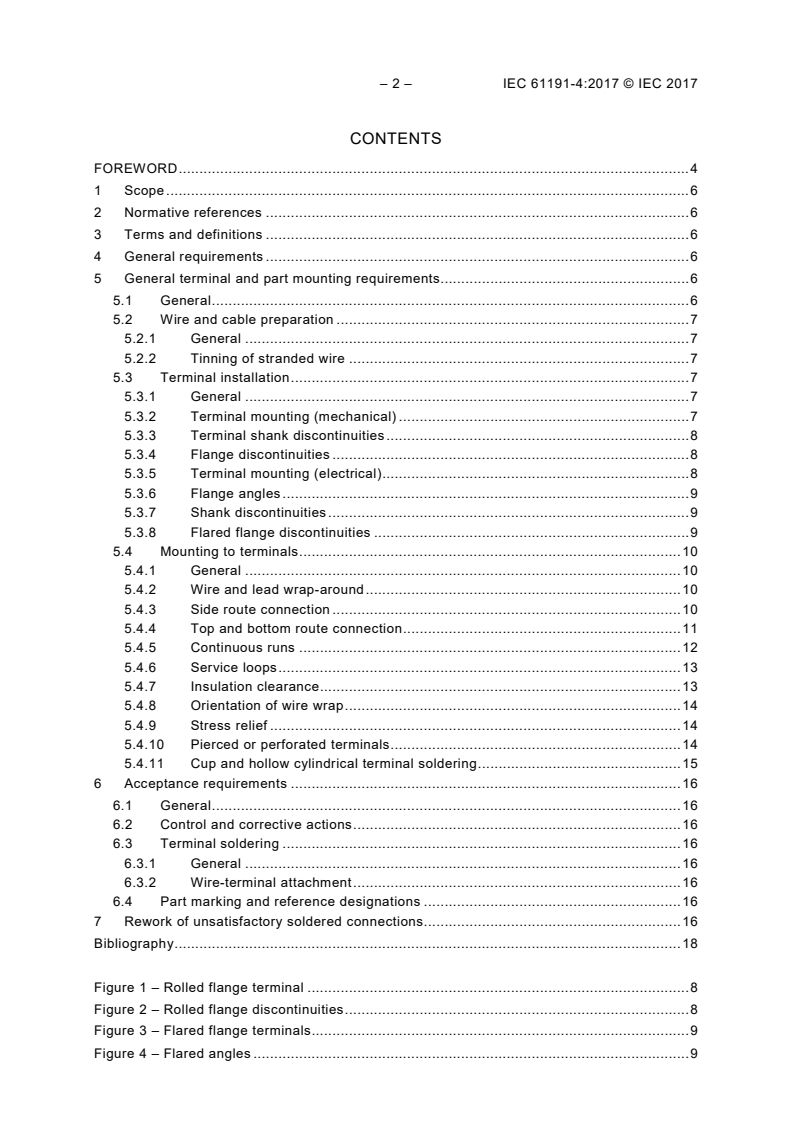
IEC 61191-4:2017 - Printed board assemblies - Part 4: Sectional specification - Requirements for terminal soldered assemblies Released:7/26/2017
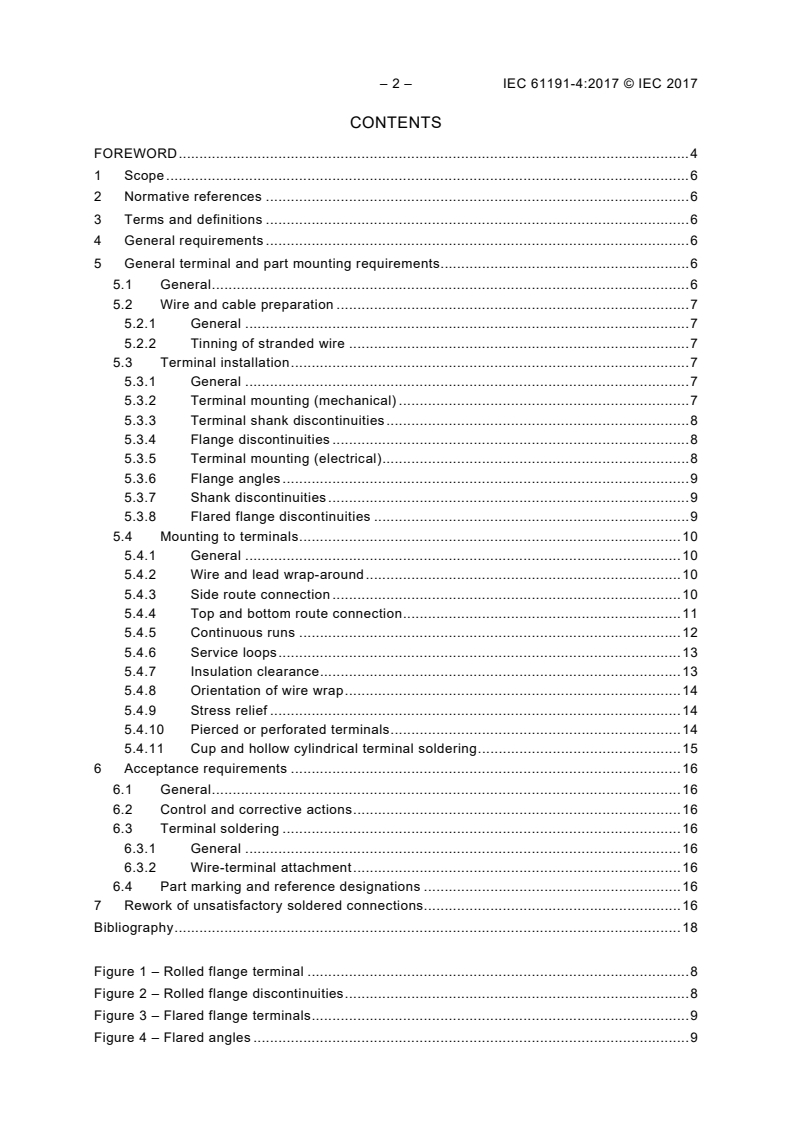
IEC 61191-4:2017 - Printed board assemblies - Part 4: Sectional specification - Requirements for terminal soldered assemblies Released:7/26/2017
Overview
IEC 61191-4:2017 - "Printed board assemblies - Part 4: Sectional specification - Requirements for terminal soldered assemblies" - is an IEC standard that prescribes workmanship and acceptance requirements specifically for terminal soldered assemblies. It applies to assemblies that are entirely terminal/wire interconnecting structures and to the terminal/wire portions of assemblies that also include other technologies (surface mounting, through‑hole mounting, chip mounting). Edition 2.0 (2017) was revised to align its acceptance criteria with IPC‑A‑610F.
Key topics and technical requirements
The standard complements the generic IEC 61191‑1 requirements and focuses on terminal and wire interconnection specifics. Major topics include:
- Normative references: IEC 61191‑1:2013 (generic soldered assembly requirements) and IEC 60194 (terms/definitions).
- Wire and cable preparation:
- Insulation stripping, avoiding nicks or strand breakage.
- Tinning requirements for stranded wire to ensure solder wetting and penetration.
- Table of allowable nicked/broken strand limits by assembly level (A, B, C) and strand count.
- Terminal installation (mechanical and electrical):
- Acceptable terminal configurations (e.g., rolled or flared flange) and seating criteria.
- Prohibitions on perforations, cracks, or discontinuities that trap flux or contaminants.
- Mounting practices:
- Wire and lead wrap‑around, side/top/bottom route connections, continuous runs, and service loops.
- Insulation clearance, orientation of wire wrap, and stress relief methods.
- Special cases (pierced/perforated terminals, cup/hollow cylindrical terminals).
- Acceptance and inspection:
- Acceptance requirements for terminal soldering and plated through‑holes.
- Control and corrective actions and guidance for rework of unsatisfactory soldered connections.
- Workmanship: Explicit alignment with IPC‑A‑610 workmanship classes and acceptance criteria.
Practical applications and who uses this standard
IEC 61191‑4:2017 is used by:
- PCB assemblers and contract manufacturers implementing reliable terminal soldering processes.
- Quality engineers and inspectors performing acceptance testing and production audits.
- Design and process engineers specifying terminal mounting, clearance, and wire routing to meet manufacturability and serviceability requirements.
- Procurement and compliance teams verifying supplier conformity to international acceptance criteria (including IPC‑A‑610F alignment).
Benefits include improved joint reliability, reduced rework, consistent inspection criteria, and clearer design-to-manufacture requirements for terminal/wire interconnections.
Related standards
- IEC 61191‑1:2013 - Generic specification for soldered electrical/electronic assemblies (mandatory part of IEC 61191‑4).
- IPC‑A‑610F - Industry acceptance standard whose criteria are adopted for workmanship and acceptance in this edition.
- IEC 60194 - Terms and definitions used in PCB design and assembly.
Keywords: IEC 61191-4:2017, terminal soldered assemblies, printed board assemblies, wire preparation, tinning, insulation clearance, IPC‑A‑610F, acceptance criteria, soldering workmanship.
Relations
- Effective Date
- 05-Sep-2023
Buy Documents
IEC 61191-4:2017 - Printed board assemblies - Part 4: Sectional specification - Requirements for terminal soldered assemblies Released:7/26/2017
IEC 61191-4:2017 - Printed board assemblies - Part 4: Sectional specification - Requirements for terminal soldered assemblies Released:7/26/2017
Frequently Asked Questions
IEC 61191-4:2017 is a standard published by the International Electrotechnical Commission (IEC). Its full title is "Printed board assemblies - Part 4: Sectional specification - Requirements for terminal soldered assemblies". This standard covers: IEC 61191-4:2017 prescribes requirements for terminal soldered assemblies. The requirements pertain to those assemblies that are entirely terminal/wire interconnecting structures or to the terminal/wire portions of those assemblies that include other related technologies (i.e. surface mounting, through-hole mounting, chip mounting). This edition includes the following significant technical changes with respect to the previous edition: The requirements have been updated to be compliant with the acceptance criteria in IPC‑A-610F.
IEC 61191-4:2017 prescribes requirements for terminal soldered assemblies. The requirements pertain to those assemblies that are entirely terminal/wire interconnecting structures or to the terminal/wire portions of those assemblies that include other related technologies (i.e. surface mounting, through-hole mounting, chip mounting). This edition includes the following significant technical changes with respect to the previous edition: The requirements have been updated to be compliant with the acceptance criteria in IPC‑A-610F.
IEC 61191-4:2017 is classified under the following ICS (International Classification for Standards) categories: 31.240 - Mechanical structures for electronic equipment. The ICS classification helps identify the subject area and facilitates finding related standards.
IEC 61191-4:2017 has the following relationships with other standards: It is inter standard links to IEC 61191-4:1998. Understanding these relationships helps ensure you are using the most current and applicable version of the standard.
IEC 61191-4:2017 is available in PDF format for immediate download after purchase. The document can be added to your cart and obtained through the secure checkout process. Digital delivery ensures instant access to the complete standard document.
Standards Content (Sample)
IEC 61191-4 ®
Edition 2.0 2017-07
INTERNATIONAL
STANDARD
Printed board assemblies –
Part 4: Sectional specification – Requirements for terminal soldered assemblies
All rights reserved. Unless otherwise specified, no part of this publication may be reproduced or utilized in any form
or by any means, electronic or mechanical, including photocopying and microfilm, without permission in writing from
either IEC or IEC's member National Committee in the country of the requester. If you have any questions about IEC
copyright or have an enquiry about obtaining additional rights to this publication, please contact the address below or
your local IEC member National Committee for further information.
IEC Central Office Tel.: +41 22 919 02 11
3, rue de Varembé Fax: +41 22 919 03 00
CH-1211 Geneva 20 info@iec.ch
Switzerland www.iec.ch
About the IEC
The International Electrotechnical Commission (IEC) is the leading global organization that prepares and publishes
International Standards for all electrical, electronic and related technologies.
About IEC publications
The technical content of IEC publications is kept under constant review by the IEC. Please make sure that you have the
latest edition, a corrigenda or an amendment might have been published.
IEC Catalogue - webstore.iec.ch/catalogue Electropedia - www.electropedia.org
The stand-alone application for consulting the entire The world's leading online dictionary of electronic and
bibliographical information on IEC International Standards, electrical terms containing 20 000 terms and definitions in
Technical Specifications, Technical Reports and other English and French, with equivalent terms in 16 additional
documents. Available for PC, Mac OS, Android Tablets and languages. Also known as the International Electrotechnical
iPad. Vocabulary (IEV) online.
IEC publications search - www.iec.ch/searchpub IEC Glossary - std.iec.ch/glossary
The advanced search enables to find IEC publications by a 65 000 electrotechnical terminology entries in English and
variety of criteria (reference number, text, technical French extracted from the Terms and Definitions clause of
committee,…). It also gives information on projects, replaced IEC publications issued since 2002. Some entries have been
and withdrawn publications. collected from earlier publications of IEC TC 37, 77, 86 and
CISPR.
IEC Just Published - webstore.iec.ch/justpublished
Stay up to date on all new IEC publications. Just Published IEC Customer Service Centre - webstore.iec.ch/csc
details all new publications released. Available online and If you wish to give us your feedback on this publication or
also once a month by email. need further assistance, please contact the Customer Service
Centre: csc@iec.ch.
IEC 61191-4 ®
Edition 2.0 2017-07
INTERNATIONAL
STANDARD
Printed board assemblies –
Part 4: Sectional specification – Requirements for terminal soldered assemblies
INTERNATIONAL
ELECTROTECHNICAL
COMMISSION
ICS 31.240 ISBN 978-2-8322-4657-3
– 2 – IEC 61191-4:2017 © IEC 2017
CONTENTS
FOREWORD . 4
1 Scope . 6
2 Normative references . 6
3 Terms and definitions . 6
4 General requirements . 6
5 General terminal and part mounting requirements. 6
5.1 General . 6
5.2 Wire and cable preparation . 7
5.2.1 General . 7
5.2.2 Tinning of stranded wire . 7
5.3 Terminal installation . 7
5.3.1 General . 7
5.3.2 Terminal mounting (mechanical) . 7
5.3.3 Terminal shank discontinuities . 8
5.3.4 Flange discontinuities . 8
5.3.5 Terminal mounting (electrical) . 8
5.3.6 Flange angles . 9
5.3.7 Shank discontinuities . 9
5.3.8 Flared flange discontinuities . 9
5.4 Mounting to terminals . 10
5.4.1 General . 10
5.4.2 Wire and lead wrap-around . 10
5.4.3 Side route connection . 10
5.4.4 Top and bottom route connection . 11
5.4.5 Continuous runs . 12
5.4.6 Service loops . 13
5.4.7 Insulation clearance . 13
5.4.8 Orientation of wire wrap . 14
5.4.9 Stress relief . 14
5.4.10 Pierced or perforated terminals . 14
5.4.11 Cup and hollow cylindrical terminal soldering . 15
6 Acceptance requirements . 16
6.1 General . 16
6.2 Control and corrective actions . 16
6.3 Terminal soldering . 16
6.3.1 General . 16
6.3.2 Wire-terminal attachment . 16
6.4 Part marking and reference designations . 16
7 Rework of unsatisfactory soldered connections. 16
Bibliography . 18
Figure 1 – Rolled flange terminal . 8
Figure 2 – Rolled flange discontinuities . 8
Figure 3 – Flared flange terminals. 9
Figure 4 – Flared angles . 9
Figure 5 – Wire and lead wrap around . 10
Figure 6 – Side route connections and wrap on bifurcated terminal . 11
Figure 7 – Top and bottom route terminal connection . 12
Figure 8 – Continuous run wire wraps . 13
Figure 9 – Service loop for lead wiring . 13
Figure 10 – Insulation clearance measurement (c) . 14
Figure 11 – Stress relief examples . 14
Figure 12 – Pierced or perforated terminal wire wrap . 15
Table 1 – Nicked or broken strand limits . 7
Table 2 – Plated through-holes with terminals, minimum acceptance conditions . 16
Table 3 – Defects for terminal attachment and soldering defects . 17
– 4 – IEC 61191-4:2017 © IEC 2017
INTERNATIONAL ELECTROTECHNICAL COMMISSION
____________
PRINTED BOARD ASSEMBLIES –
Part 4: Sectional specification –
Requirements for terminal soldered assemblies
FOREWORD
1) The International Electrotechnical Commission (IEC) is a worldwide organization for standardization comprising
all national electrotechnical committees (IEC National Committees). The object of IEC is to promote
international co-operation on all questions concerning standardization in the electrical and electronic fields. To
this end and in addition to other activities, IEC publishes International Standards, Technical Specifications,
Technical Reports, Publicly Available Specifications (PAS) and Guides (hereafter referred to as “IEC
Publication(s)”). Their preparation is entrusted to technical committees; any IEC National Committee interested
in the subject dealt with may participate in this preparatory work. International, governmental and non-
governmental organizations liaising with the IEC also participate in this preparation. IEC collaborates closely
with the International Organization for Standardization (ISO) in accordance with conditions determined by
agreement between the two organizations.
2) The formal decisions or agreements of IEC on technical matters express, as nearly as possible, an international
consensus of opinion on the relevant subjects since each technical committee has representation from all
interested IEC National Committees.
3) IEC Publications have the form of recommendations for international use and are accepted by IEC National
Committees in that sense. While all reasonable efforts are made to ensure that the technical content of IEC
Publications is accurate, IEC cannot be held responsible for the way in which they are used or for any
misinterpretation by any end user.
4) In order to promote international uniformity, IEC National Committees undertake to apply IEC Publications
transparently to the maximum extent possible in their national and regional publications. Any divergence
between any IEC Publication and the corresponding national or regional publication shall be clearly indicated in
the latter.
5) IEC itself does not provide any attestation of conformity. Independent certification bodies provide conformity
assessment services and, in some areas, access to IEC marks of conformity. IEC is not responsible for any
services carried out by independent certification bodies.
6) All users should ensure that they have the latest edition of this publication.
7) No liability shall attach to IEC or its directors, employees, servants or agents including individual experts and
members of its technical committees and IEC National Committees for any personal injury, property damage or
other damage of any nature whatsoever, whether direct or indirect, or for costs (including legal fees) and
expenses arising out of the publication, use of, or reliance upon, this IEC Publication or any other IEC
Publications.
8) Attention is drawn to the Normative references cited in this publication. Use of the referenced publications is
indispensable for the correct application of this publication.
9) Attention is drawn to the possibility that some of the elements of this IEC Publication may be the subject of
patent rights. IEC shall not be held responsible for identifying any or all such patent rights.
International Standard IEC 61191-4 has been prepared by IEC technical committee 91:
Electronics assembly technology.
This second edition cancels and replaces the first edition published in 1998. This edition
constitutes a technical revision.
This edition includes the following significant technical changes with respect to the previous
edition:
• The requirements have been updated to be compliant with the acceptance criteria in
IPC-A-610F.
The text of this International Standard is based on the following documents:
CDV Report on voting
91/1399/CDV 91/1434/RVC
Full information on the voting for the approval of this International Standard can be found in
the report on voting indicated in the above table.
This document has been drafted in accordance with the ISO/IEC Directives, Part 2.
A list of all parts in the IEC 61191 series, published under the general title Printed board
assemblies, can be found on the IEC website.
The committee has decided that the contents of this document will remain unchanged until the
stability date indicated on the IEC website under "http://webstore.iec.ch" in the data related to
the specific document. At this date, the document will be
• reconfirmed,
• withdrawn,
• replaced by a revised edition, or
• amended.
A bilingual version of this publication may be issued at a later date.
– 6 – IEC 61191-4:2017 © IEC 2017
PRINTED BOARD ASSEMBLIES –
Part 4: Sectional specification –
Requirements for terminal soldered assemblies
1 Scope
This part of IEC 61191 prescribes requirements for terminal soldered assemblies. The
requirements pertain to those assemblies that are entirely terminal/wire interconnecting
structures or to the terminal/wire portions of those assemblies that include other related
technologies (i.e. surface mounting, through-hole mounting, chip mounting).
2 Normative references
The following documents are referred to in the text in such a way that some or all of their
content constitutes requirements of this document. For dated references, only the edition
cited applies. For undated references, the latest edition of the referenced document (including
any amendments) applies.
IEC 60194, Printed board design, manufacture and assembly – Terms and definitions
IEC 61191-1:2013, Printed board assemblies – Part 1: Generic specification – Requirements
for soldered electrical and electronic assemblies using surface mount and related assembly
technologies
3 Terms and definitions
For the purposes of this document, the terms and definitions given in IEC 60194 apply.
ISO and IEC maintain terminological databases for use in standardization at the following
addresses:
• IEC Electropedia: available at http://www.electropedia.org/
• ISO Online browsing platform: available at http://www.iso.org/obp
4 General requirements
Requirements of IEC 61191-1 are a mandatory part of this specification.
Workmanship shall meet the requirements of IPC-A-610 in accordance with the classification
requirements of this document.
5 General terminal and part mounting requirements
5.1 General
The requirements of 5.2 are applicable to terminals and part mounting in all types of
assemblies.
5.2 Wire and cable preparation
5.2.1 General
Sufficient insulation cover shall be stripped from the wire or leads to provide for insulation
clearances as specified. Chemical stripping agents shall be used for solid wire only and shall
be neutralized or removed prior to soldering. In stripping insulation, care should be taken to
avoid nicking or otherwise damaging the wire or the remaining insulation. For level A or B
assemblies, the number of nicked or broken strands in a single wire shall not exceed the
limits given in Table 1. For wires used at a potential of 6 kV or greater, or for level C
assemblies, there shall be no broken strands. The number of nicked strands shall be in
accordance with Table 1. Insulation discolouration resulting from thermal stripping is
permissible.
Table 1 – Nicked or broken strand limits
Number of Maximum allowable scraped, nicked or broken strands
strands
Level A and B Level C not tinned Level C pretinned
1 (solid) No damage in excess of 10 % conductor diameter
2 to 6 0 0 0
7 to 15 1 0 1
16 to 25 3 0 2
26 to 40 4 3 3
41 to 60 5 4 4
61 to 120 6 5 5
121 or more 6 % of strands 5 % of strands 5 % of strands
5.2.2 Tinning of stranded wire
Portions of stranded wire to be soldered shall be tinned prior to mounting. The solder shall
wet the stranded wire and penetrate to the inner strands of the wire. Wicking of solder under
the insulation shall be minimized.
5.3 Terminal installation
5.3.1 General
The detailed requirements for installation of solder terminals are defined in 5
...
IEC 61191-4 ®
Edition 2.0 2017-07
INTERNATIONAL
STANDARD
NORME
INTERNATIONALE
Printed board assemblies –
Part 4: Sectional specification – Requirements for terminal soldered assemblies
Ensembles de cartes imprimées –
Partie 4: Spécification intermédiaire – Exigences relatives à l’assemblage de
bornes par brasage
All rights reserved. Unless otherwise specified, no part of this publication may be reproduced or utilized in any form
or by any means, electronic or mechanical, including photocopying and microfilm, without permission in writing from
either IEC or IEC's member National Committee in the country of the requester. If you have any questions about IEC
copyright or have an enquiry about obtaining additional rights to this publication, please contact the address below or
your local IEC member National Committee for further information.
Droits de reproduction réservés. Sauf indication contraire, aucune partie de cette publication ne peut être reproduite ni
utilisée sous quelque forme que ce soit et par aucun procédé, électronique ou mécanique, y compris la photocopie et
les microfilms, sans l'accord écrit de l'IEC ou du Comité national de l'IEC du pays du demandeur. Si vous avez des
questions sur le copyright de l'IEC ou si vous désirez obtenir des droits supplémentaires sur cette publication, utilisez
les coordonnées ci-après ou contactez le Comité national de l'IEC de votre pays de résidence.
IEC Secretariat Tel.: +41 22 919 02 11
3, rue de Varembé info@iec.ch
CH-1211 Geneva 20 www.iec.ch
Switzerland
About the IEC
The International Electrotechnical Commission (IEC) is the leading global organization that prepares and publishes
International Standards for all electrical, electronic and related technologies.
About IEC publications
The technical content of IEC publications is kept under constant review by the IEC. Please make sure that you have the
latest edition, a corrigendum or an amendment might have been published.
IEC publications search - webstore.iec.ch/advsearchform IEC Products & Services Portal - products.iec.ch
The advanced search enables to find IEC publications by a Discover our powerful search engine and read freely all the
variety of criteria (reference number, text, technical publications previews. With a subscription you will always have
committee, …). It also gives information on projects, replaced access to up to date content tailored to your needs.
and withdrawn publications.
Electropedia - www.electropedia.org
IEC Just Published - webstore.iec.ch/justpublished
The world's leading online dictionary on electrotechnology,
Stay up to date on all new IEC publications. Just Published
containing more than 22 300 terminological entries in English
details all new publications released. Available online and once
and French, with equivalent terms in 19 additional languages.
a month by email.
Also known as the International Electrotechnical Vocabulary
(IEV) online.
IEC Customer Service Centre - webstore.iec.ch/csc
If you wish to give us your feedback on this publication or need
further assistance, please contact the Customer Service
Centre: sales@iec.ch.
A propos de l'IEC
La Commission Electrotechnique Internationale (IEC) est la première organisation mondiale qui élabore et publie des
Normes internationales pour tout ce qui a trait à l'électricité, à l'électronique et aux technologies apparentées.
A propos des publications IEC
Le contenu technique des publications IEC est constamment revu. Veuillez vous assurer que vous possédez l’édition la
plus récente, un corrigendum ou amendement peut avoir été publié.
Recherche de publications IEC - Découvrez notre puissant moteur de recherche et consultez
webstore.iec.ch/advsearchform gratuitement tous les aperçus des publications. Avec un
La recherche avancée permet de trouver des publications IEC abonnement, vous aurez toujours accès à un contenu à jour
en utilisant différents critères (numéro de référence, texte, adapté à vos besoins.
comité d’études, …). Elle donne aussi des informations sur les
projets et les publications remplacées ou retirées. Electropedia - www.electropedia.org
Le premier dictionnaire d'électrotechnologie en ligne au monde,
IEC Just Published - webstore.iec.ch/justpublished
avec plus de 22 300 articles terminologiques en anglais et en
Restez informé sur les nouvelles publications IEC. Just
français, ainsi que les termes équivalents dans 19 langues
Published détaille les nouvelles publications parues.
additionnelles. Egalement appelé Vocabulaire
Disponible en ligne et une fois par mois par email.
Electrotechnique International (IEV) en ligne.
Service Clients - webstore.iec.ch/csc
Si vous désirez nous donner des commentaires sur cette
publication ou si vous avez des questions contactez-nous:
sales@iec.ch.
IEC Products & Services Portal - products.iec.ch
IEC 61191-4 ®
Edition 2.0 2017-07
INTERNATIONAL
STANDARD
NORME
INTERNATIONALE
Printed board assemblies –
Part 4: Sectional specification – Requirements for terminal soldered assemblies
Ensembles de cartes imprimées –
Partie 4: Spécification intermédiaire – Exigences relatives à l’assemblage de
bornes par brasage
INTERNATIONAL
ELECTROTECHNICAL
COMMISSION
COMMISSION
ELECTROTECHNIQUE
INTERNATIONALE
ICS 31.240 ISBN 978-2-8322-1099-6
– 2 – IEC 61191-4:2017 © IEC 2017
CONTENTS
FOREWORD . 4
1 Scope . 6
2 Normative references . 6
3 Terms and definitions . 6
4 General requirements . 6
5 General terminal and part mounting requirements. 6
5.1 General . 6
5.2 Wire and cable preparation . 7
5.2.1 General . 7
5.2.2 Tinning of stranded wire . 7
5.3 Terminal installation . 7
5.3.1 General . 7
5.3.2 Terminal mounting (mechanical) . 7
5.3.3 Terminal shank discontinuities . 8
5.3.4 Flange discontinuities . 8
5.3.5 Terminal mounting (electrical) . 8
5.3.6 Flange angles . 9
5.3.7 Shank discontinuities . 9
5.3.8 Flared flange discontinuities . 9
5.4 Mounting to terminals . 10
5.4.1 General . 10
5.4.2 Wire and lead wrap-around . 10
5.4.3 Side route connection . 10
5.4.4 Top and bottom route connection . 11
5.4.5 Continuous runs . 12
5.4.6 Service loops . 13
5.4.7 Insulation clearance . 13
5.4.8 Orientation of wire wrap . 14
5.4.9 Stress relief . 14
5.4.10 Pierced or perforated terminals . 14
5.4.11 Cup and hollow cylindrical terminal soldering . 15
6 Acceptance requirements . 16
6.1 General . 16
6.2 Control and corrective actions . 16
6.3 Terminal soldering . 16
6.3.1 General . 16
6.3.2 Wire-terminal attachment . 16
6.4 Part marking and reference designations . 16
7 Rework of unsatisfactory soldered connections. 16
Bibliography . 18
Figure 1 – Rolled flange terminal . 8
Figure 2 – Rolled flange discontinuities . 8
Figure 3 – Flared flange terminals. 9
Figure 4 – Flared angles . 9
Figure 5 – Wire and lead wrap around . 10
Figure 6 – Side route connections and wrap on bifurcated terminal . 11
Figure 7 – Top and bottom route terminal connection . 12
Figure 8 – Continuous run wire wraps . 13
Figure 9 – Service loop for lead wiring . 13
Figure 10 – Insulation clearance measurement (c) . 14
Figure 11 – Stress relief examples . 14
Figure 12 – Pierced or perforated terminal wire wrap . 15
Table 1 – Nicked or broken strand limits . 7
Table 2 – Plated through-holes with terminals, minimum acceptance conditions . 16
Table 3 – Defects for terminal attachment and soldering defects . 17
– 4 – IEC 61191-4:2017 © IEC 2017
INTERNATIONAL ELECTROTECHNICAL COMMISSION
____________
PRINTED BOARD ASSEMBLIES –
Part 4: Sectional specification –
Requirements for terminal soldered assemblies
FOREWORD
1) The International Electrotechnical Commission (IEC) is a worldwide organization for standardization comprising
all national electrotechnical committees (IEC National Committees). The object of IEC is to promote
international co-operation on all questions concerning standardization in the electrical and electronic fields. To
this end and in addition to other activities, IEC publishes International Standards, Technical Specifications,
Technical Reports, Publicly Available Specifications (PAS) and Guides (hereafter referred to as “IEC
Publication(s)”). Their preparation is entrusted to technical committees; any IEC National Committee interested
in the subject dealt with may participate in this preparatory work. International, governmental and non-
governmental organizations liaising with the IEC also participate in this preparation. IEC collaborates closely
with the International Organization for Standardization (ISO) in accordance with conditions determined by
agreement between the two organizations.
2) The formal decisions or agreements of IEC on technical matters express, as nearly as possible, an international
consensus of opinion on the relevant subjects since each technical committee has representation from all
interested IEC National Committees.
3) IEC Publications have the form of recommendations for international use and are accepted by IEC National
Committees in that sense. While all reasonable efforts are made to ensure that the technical content of IEC
Publications is accurate, IEC cannot be held responsible for the way in which they are used or for any
misinterpretation by any end user.
4) In order to promote international uniformity, IEC National Committees undertake to apply IEC Publications
transparently to the maximum extent possible in their national and regional publications. Any divergence
between any IEC Publication and the corresponding national or regional publication shall be clearly indicated in
the latter.
5) IEC itself does not provide any attestation of conformity. Independent certification bodies provide conformity
assessment services and, in some areas, access to IEC marks of conformity. IEC is not responsible for any
services carried out by independent certification bodies.
6) All users should ensure that they have the latest edition of this publication.
7) No liability shall attach to IEC or its directors, employees, servants or agents including individual experts and
members of its technical committees and IEC National Committees for any personal injury, property damage or
other damage of any nature whatsoever, whether direct or indirect, or for costs (including legal fees) and
expenses arising out of the publication, use of, or reliance upon, this IEC Publication or any other IEC
Publications.
8) Attention is drawn to the Normative references cited in this publication. Use of the referenced publications is
indispensable for the correct application of this publication.
9) Attention is drawn to the possibility that some of the elements of this IEC Publication may be the subject of
patent rights. IEC shall not be held responsible for identifying any or all such patent rights.
International Standard IEC 61191-4 has been prepared by IEC technical committee 91:
Electronics assembly technology.
This second edition cancels and replaces the first edition published in 1998. This edition
constitutes a technical revision.
This edition includes the following significant technical changes with respect to the previous
edition:
• The requirements have been updated to be compliant with the acceptance criteria in
IPC-A-610F.
The text of this International Standard is based on the following documents:
CDV Report on voting
91/1399/CDV 91/1434/RVC
Full information on the voting for the approval of this International Standard can be found in
the report on voting indicated in the above table.
This document has been drafted in accordance with the ISO/IEC Directives, Part 2.
A list of all parts in the IEC 61191 series, published under the general title Printed board
assemblies, can be found on the IEC website.
The committee has decided that the contents of this document will remain unchanged until the
stability date indicated on the IEC website under "http://webstore.iec.ch" in the data related to
the specific document. At this date, the document will be
• reconfirmed,
• withdrawn,
• replaced by a revised edition, or
• amended.
– 6 – IEC 61191-4:2017 © IEC 2017
PRINTED BOARD ASSEMBLIES –
Part 4: Sectional specification –
Requirements for terminal soldered assemblies
1 Scope
This part of IEC 61191 prescribes requirements for terminal soldered assemblies. The
requirements pertain to those assemblies that are entirely terminal/wire interconnecting
structures or to the terminal/wire portions of those assemblies that include other related
technologies (i.e. surface mounting, through-hole mounting, chip mounting).
2 Normative references
The following documents are referred to in the text in such a way that some or all of their
content constitutes requirements of this document. For dated references, only the edition
cited applies. For undated references, the latest edition of the referenced document (including
any amendments) applies.
IEC 60194, Printed board design, manufacture and assembly – Terms and definitions
IEC 61191-1:2013, Printed board assemblies – Part 1: Generic specification – Requirements
for soldered electrical and electronic assemblies using surface mount and related assembly
technologies
3 Terms and definitions
For the purposes of this document, the terms and definitions given in IEC 60194 apply.
ISO and IEC maintain terminological databases for use in standardization at the following
addresses:
• IEC Electropedia: available at http://www.electropedia.org/
• ISO Online browsing platform: available at http://www.iso.org/obp
4 General requirements
Requirements of IEC 61191-1 are a mandatory part of this specification.
Workmanship shall meet the requirements of IPC-A-610 in accordance with the classification
requirements of this document.
5 General terminal and part mounting requirements
5.1 General
The requirements of 5.2 are applicable to terminals and part mounting in all types of
assemblies.
5.2 Wire and cable preparation
5.2.1 General
Sufficient insulation cover shall be stripped from the wire or leads to provide for insulation
clearances as specified. Chemical stripping agents shall be used for solid wire only and shall
be neutralized or removed prior to soldering. In stripping insulation, care should be taken to
avoid nicking or otherwise damaging the wire or the remaining insulation. For level A or B
assemblies, the number of nicked or broken strands in a single wire shall not exceed the
limits given in Table 1. For wires used at a potential of 6 kV or greater, or for level C
assemblies, there shall be no broken strands. The number of nicked strands shall be in
accordance with Table 1. Insulation discolouration resulting from thermal stripping is
permissible.
Table 1 – Nicked or broken strand limits
Number of Maximum allowable scraped, nicked or broken strands
strands
Level A and B Level C not tinned Level C pretinned
1 (solid) No damage in excess of 10 % conductor diameter
2 to 6 0 0 0
7 to 15 1 0 1
16 to 25 3 0 2
26 to 40 4 3 3
41 to 60 5 4 4
61 to 120 6 5 5
121 or more 6 % of strands 5 % of strands 5 % of strands
5.2.2 Tinning of stranded wire
Portions of stranded wire to be soldered shall be tinned prior to mounting. The solder shall
wet the stranded wire and penetrate to the inner strands of the wire. Wicking of solder under
the insulation shall be minimized.
5.3 Terminal installation
5.3.1 General
The detailed requirements for installation of solder terminals are defined in 5.3.2 to 5.3.8.
5.3.2 Terminal mounting (mechanical)
Terminals not connected to printed wiring or ground planes shall be of the rolled flange
configuration (see Figure 1). A printed foil land may be used as a seating surface for a rolled
flange provided that the land is isolated and not connected to active printed wiring or ground
plane.
– 8 – IEC 61191-4:2017 © IEC 2017
Rolled flange acceptable
with no electrical connection
IEC
Figure 1 – Rolled flange terminal
5.3.3 Terminal shank discontinuities
The shank of the terminal shall not be perforated, split, cracked, and there shall not be
discontinuity to the extent that oils, flux, inks, or other substances used for processing the
printed board can be entrapped. Circumferential cracks or splits in the shank are not
acceptable regardless of the extent.
5.3.4 Flange discontinuities
The rolled flange shall not be split, cracked or otherwise discontinuous to the extent that flux,
oils, inks, or other liquid substances used for processing the printed board can be entrapped
within the mounting hole. After rolling, the rolled area shall be free of circumferential splits or
cracks, but may have a maximum of three radial splits or cracks provided that the splits or
cracks are separated by at least 90° and do not extend into the barrel of the terminal (see
Figure 2).
>90°
Radial split Split extends into barrel
(3 max.)
IEC
IEC
a) Acceptable b) Not acceptable
Figure 2 – Rolled flange discontinuities
5.3.5 Terminal mounting (electrical)
Flared flange terminals shall be mounted in non-interfacial plated through-holes provided the
mounting is in conjunction with a land or ground plane on the flared side as shown in
Figure 3a. They shall not be flared to the base material of the printed board. Funnel shoulder
terminals shall not be used (see Figure 3b). Terminals may be mounted in non-plated
through-holes with active circuitry on the top-side (or primary side) and a rolled flange on the
backside of the board (see Figure 3c).
Funnel
Flat
Non-functional
shoulder
shoulder
land
IEC
Plated-through
Flared flange
hole
IEC
a) Acceptable b) Not acceptable
Conductor
Board
Rolled flange
IEC
c) Acceptable
Figure 3 – Flared flange terminals
5.3.6 Flange angles
Flared flanges shall be formed to include an angle of between 35° and 120° and shall extend
between 0,4 mm and 1,5 mm beyond the surface of the land provided minimum electrical
spacing requirements are maintained (see Figure 4), and the flare diameter does not exceed
the diameter of the land.
Dimensions in millimetres
120°
35°
IEC
Figure 4 – Flared angles
5.3.7 Shank discontinuities
After installation, the shank of the terminal shall meet the requirements of 5.3.3.
5.3.8 Flared flange discontinuities
The flared flange of a terminal shall not be perforated, split, cracked, or otherwise
discontinuous to the extent that flux, oils, inks or other substances used for processing the
printed board can be entrapped. After flaring, the flange shall conform to 5.3.4.
1,5
0,4
– 10 – IEC 61191-4:2017 © IEC 2017
5.4 Mounting to terminals
5.4.1 General
The detailed requirements for the mounting of components and wires to terminals installed in
printed boards, terminal boards or chassis members are defined in 5.4.2 to 5.4.11.
5.4.2 Wire and lead wrap-around
Leads and wires should be mechanically secured to their terminals before soldering. Such
mechanical securing should prevent motion between the parts of the connection during the
soldering operation. Leads and wires shall be wrapped around turret and straight pin
terminals for a minimum of 180° and may overlap provided there is sufficient room on the
turret (see Figure 5).
The last wire on a straight pin terminal shall be at least one wire diameter from the top to
allow for an adequate solder fillet. Adequate service loops should be provided to allow for
field maintenance.
For wires with a diameter of less than 0,25 mm, a minimum of one turn and a maximum of
three turns shall be used. Exception is made in the case of those small parts used for
terminating wires where such mechanical securing would be impracticable, such as connector
solder cups, slotted terminal posts and heat shrinkable solder devices. Wires and leads shall
contact the post for at least 180° and shall not be wrapped on each other.
Insulation
clearance
Upper guide slot
Lower guide slot
Insulation
clearance
Base
IEC
Figure 5 – Wire and lead wrap around
5.4.3 Side route connection
If mechanically secured in accordance with 5.4.2 a 90° minimum wrap is acceptable (see
Figure 6d). Lead and wire ends may extend beyond the base of terminals provided the
minimum electrical spacing is maintained. When practicable, except for bus wires, wires shall
be placed in ascending order with the largest on the bottom.
The wire or component lead shall be dressed through the slot and wrapped to either post of
the terminal (see Figure 6a) ensuring positive contact of the wire with at least one corner of
the post (see Figure 6d). The wire or lead shall also be in firm contact with the base of the
terminal or the previously installed wire (see Figure 6c).
The attachments shall be maintained so that:
a) there is no overlapping of wraps and wires;
b) spacing between wires, and spacing between the wires and the terminal board or panel is
a minimum consistent with the thickness of the wire insulation;
c) the wraps are dressed in alternate rotations (see Figure 6b).
IEC
IEC IEC
a) Single wire wrap b) Multiple wire wrap c) Stacked wires
Terminal flange
≥90° wrap
Terminal post
Lead
IEC
d) Minimum wrap
Tine
Base
IEC IEC
e) Not acceptable f) Not acceptable
Figure 6 – Side route connections and wrap on bifurcated terminal
5.4.4 Top and bottom route connection
The wire shall be wrapped on the terminal base or post to ensure positive contact of the wire
or, if mechanically secured in accordance with 5.4.2, with a minimum bend of 90°
(see Figure 7a and 7b). The wire lead shall also be in contact with the base of the terminal or
the previously installed wire. When more than one wire shall be attached, they shall be
inserted at the same time, but shall be wrapped separately around alternate posts.
– 12 – IEC 61191-4:2017 © IEC 2017
The wire shall feed straight into the terminal between the tines when top routed wires to
bifurcated terminals are required by the design. The space between the tines shall be filled by
having the wire bent double or by using a separate filler wire, where space between the tines
permits it (see Figures 7c and 7d).
IEC IEC
a) Bottom route connection b) Bottom route connection
IEC IEC
c) Top route connection d) Top route connection
Figure 7 – Top and bottom route terminal connection
5.4.5 Continuous runs
If three or more terminals should be connected, a continuous solid bus wire may be run from
terminal to terminal (see Figure 8) provided that:
a) the connections to the first and last terminal meet the requirements of 5.4.2;
b) a curvature is included in the unwrapped wire portion of the jumper to provide relief of
tension from environmental loading;
c) in the case of pierced or perforated terminals, the wire shall contact at least two non-
adjacent contact surfaces of each intermediate terminal (see Figure 8e).
IEC IEC
a) Acceptable b) Acceptable
IEC
IEC
c) Acceptable d) Acceptable
IEC
IEC
e) Acceptable f) Acceptable
Figure 8 – Continuous run wire wraps
5.4.6 Service loops
Lead wires shall be dressed in the proper position with a slight loop or gradual bend as shown
in Figure 9. The bend shall be sufficient to allow field repair. After soldering, wires shall meet
the insulation clearance requirements of 5.4.7.
Not acceptable
(insufficient)
Acceptable
IEC
Figure 9 – Service loop for lead wiring
5.4.7 Insulation clearance
The clearance (c) between the end of wire insulation and the solder of the connection shall be
as follows (see Figure 10):
a) minimum clearance: the insulation may be in contact with the solder joint but not be
covered by solder. The contour of the wires shall not be obscured at the termination of the
insulation;
b) maximum clearance: clearance shall be less than two wire diameters including insulation
or 1,5 mm whichever is larger, but shall not permit shorting between adjacent conductors.
– 14 – IEC 61191-4:2017 © IEC 2017
C
C
IEC
Figure 10 – Insulation clearance measurement (c)
5.4.8 Orientation of wire wrap
Lead wires may be wrapped clockwise or anticlockwise (consistent with the direction of
potential stress application), but shall continue the curvature of the dress of the lead wires
and shall not interfere with the wrapping of other wires on the terminal.
5.4.9 Stress relief
Component leads and wires connected to terminals should have stress relief (see Figure 11).
Components shall not be rigidly connected between non-bondable terminals.
IEC IEC
a) Acceptable b) Acceptable
IEC
IEC
c) Acceptable d) Acceptable
Figure 11 – Stress relief examples
5.4.10 Pierced or perforated terminals
For wiring to a single terminal, the wire(s) shall pass through the eye and be wrapped around
the terminal (see Figure 12). When a continuous run is used, the wire shall be attached to the
end terminals (first and last) in the same manner that wires are attached to single terminals.
The jumper wire shall contact at least two non-adjacent contact surfaces of each intermediate
terminal (see Figure 8e).
C
For user-approved designs that incorporate staking/bonding of wires, the wire(s) attached to
pierced terminals shall contact at least two (adjacent or nonadjacent) surfaces of the terminal.
The wire winding shall be a minimum of 1/4 turn to a maximum of 3/4 turn. The lead and wire
ends may extend beyond the terminal a maximum of one (1) lead diameter (see Figures 12d
and 12e).
IEC IEC IEC
a) Acceptable wrap b) Acceptable wrap around c) Acceptable wrap around
around
IEC
IEC
d) Acceptable wire extension e) Acceptable wire extension
Figure 12 – Pierced or perforated terminal wire wrap
5.4.11 Cup and hollow cylindrical terminal soldering
5.4.11.1 General
Wires shall be soldered into solder cup terminals in a manner which ensures complete solder
fill of the cup and precludes entrapment of flux.
5.4.11.2 Soldering of wires and leads to solder cups
No more than three wires shall be installed in the cup. In no instance shall the lay of the
strands of any wire be disturbed, nor shall strands be moved. The wire or wires shall be
inserted for the full depth of the cup and a fillet shall be formed along the surfaces of contact.
Solder shall wet the entire inside of the cup and shall fill at least 75 % of the mouth of the cup.
Solder shall be visible in the inspection hole and may rise slightly above it. Solder may overfill
the cup. Any solder on the outside of the cup should be in the form of a thin film.
– 16 – IEC 61191-4:2017 © IEC 2017
6 Acceptance requirements
6.1 General
The use of the materials, processes and products described and specified in IEC 61191-1
results in soldered interconnections that are better than the minimum terminal soldering
acceptance requirements in Clause 6. Processes and their control should be capable of
producing products meeting or exceeding the acceptance criteria for a level C product.
6.2 Control and corrective actions
The detailed requirements for acceptance, corrective action limits, control limit determination,
and general assembly criteria described in IEC 61191-1 are a mandatory part of this
document. In addition, the requirements of 6.3 shall be met for all soldered terminals and
interconnecting acceptability.
6.3 Terminal soldering
6.3.1 General
Terminals mounted in plated through-holes should provide evidence of good wetting to both
the terminal flange and land or ground plane (see Table 2).
Table 2 – Plated through-holes with terminals,
1)
minimum acceptance conditions
Criteria Level A Level B Level C
A Circumferential fillet and wetting-solder source side
270° 270° 330°
B Percentage of original land area covered with wetted 2) 2) 2)
75 % 75 % 75 %
solder-solder source side
1)
Wetted solder refers to solder applied by the solder process.
2)
A total maximum of 25 % depression, including both solder source and destination sides, is permitted.
6.3.2 Wire-terminal attachment
For flat and cylindrical terminals, the solder quantity shall be adjusted so that the wire or
terminal outline is discernible through the solder hole in solder. The hole in the solder tab
does not need to be filled with solder.
6.4 Part marking and reference designations
Part markings and reference designations shall be legible and components should be
mounted in such a manner that markings are visible.
7 Rework of unsatisfactory soldered connections
Rework of unsatisfactory solder connections shall not be performed until the discrepancies
have been documented. This data shall be used to provide an indication as to possible
causes and to determine if corrective action is required (see IEC 61191-1). When rework is
performed, each rework connection shall be inspected to the requirements of 6.3 (see Table 3
for list of defects).
Table 3 – Defects for terminal attachment and soldering defects
No. Defects
1 Defects identified in Table 2 of IEC 61191-1:2013
2 Damage to wire in excess of that allowed in Table 1
3 Charred wiring insulation or components
4 Inadequate stress relief on leaded components and wires
NOTE Solder in the stress relief bend does not constitute elimination of stress relief.
– 18 – IEC 61191-4:2017 © IEC 2017
Bibliography
IEC and ISO references
IEC 60068-2-20:2008, Environmental testing – Part 2-20: Tests – Test T: Test methods for
solderability and resistance to soldering heat of devices with leads
IEC 60068-2-58:2015, Environmental testing – Part 2-58: Tests – Test Td: Test methods for
solderability, resistance to dissolution of metallization and to soldering heat of surface
mounting devices (SMD)
IEC 61188-5-1:2002, Printed boards and printed board assemblies – Design and use –
Part 5–1: Attachment (land/joint) considerations – Generic requirements
IEC 61188-5-2:2003, Printed boards and printed board assemblies – Design and use - Part 5-
2: Attachment (land/joint) considerations – Discrete components
IEC 61188-5-3:2007, Printed boards and printed board assemblies – Design and use –
Part 5-3: Attachment (land/joint) considerations – Components with gull-wing leads on two
sides
IEC 61188-5-4:2007, Printed boards and printed board assemblies – Design and use –
Part 5-4: – Attachment (land/joint) considerations – Components with J leads on two sides
IEC 61188-5-5:2007, Printed boards and printed board assemblies – Design and use –
Part 5-5: – Attachment (land/joint) considerations – Components with gull-wing leads on four
sides
IEC 61188-5-6:2003, Printed boards and printed board assemblies – Design and use –
Part 5-6:– Attachment (land/joint) considerations – Chip carriers with J leads on four sides
IEC 61188-7:2017, Printed boards and printed board assemblies – Design and use – Part 7:
Electronic component zero orientation for CAD library construction
IEC 61189-2:2006, Test methods for electrical materials, printed boards and other
interconnection structures and assemblies – Part 2: Test methods for materials for
interconnection structures
IEC 61190-1-2:2014, Attachment materials for electronic assembly – Part 1-2: Requirements
for soldering pastes for high-quality interconnects in electronics assembly
IEC 61193-1:2001, Quality assessment systems – Part 1: Registration and analysis of defects
on printed board assemblies
IEC 61193-3, Quality assessment systems – Part 3: Selection and use of sampling plans for
printed board and laminate end-product and in-process auditing
IEC 62326-1:2002, Printed boards – Part 1: Generic specification
IEC 62326-4:1996, Printed boards – Part 4: Rigid multilayer printed boards with interlayer
connections – Sectional specification
IEC 62326-4-1:1996, Printed boards – Part 4: Rigid multilayer printed boards with interlayer
connections – Sectional specification – Section 1: Capability detail specification –
Performance levels A, B and C
ISO 9001:2015, Quality management systems – Requirements
Other references
IPC-TM-650, Test Methods Manual
2.3.25 Detection and measurement of ionizable surface contaminants by resistivity of
solvent extract
2.3.25.1 Ionic Cleanliness Testing of Bare PWBs
2.3.27 Cleanliness test – residual rosin
2.3.38 Surface organic contamination detection test
2.4.22 Bow and twist (percentage)
2.6.3.3 Surface insulation resistance, fluxes
IPC-9191, General Requirements for Implementation of Statistical Process Control
IPC-OI-645, Standard for Visual Optical Inspection Aids
IPC-SM-817, General Requirements for Dielectric Surface Mounting Adhesives
IPC-A-610, Acceptability of Electronic Assemblies
J-STD-001, Requirements for Soldered Electrical and Electronic Assemblies
J-STD-002, Solderability Tests for Component Leads, Terminations, Lugs, Terminals and
Wires
J-STD-003, Solderability Tests for Printed Boards
J-STD-004, Requirements for Soldering Fluxes
J-STD-005, General Requirements and Test Methods for Electronic Grade Solder Paste
J-STD-006, General Requirements and Test Methods for Solder Alloys and Fluxed and Non-
Fluxed Solid Solders for Electronic Solder Applications
J-STD-020, Moisture/Reflow Sensitivity Classification for Nonhermetic Surface Mount Devices
___________
– 20 – IEC 61191-4:2017 © IEC 2017
SOMMAIRE
AVANT-PROPOS . 22
1 Domaine d’application . 24
2 Références normatives . 24
3 Termes et définitions . 24
4 Exigences générales . 24
5 Exigences générales relatives au montage de bornes et pièces . 24
5.1 Généralités . 24
5.2 Préparation des fils et câbles . 25
5.2.1 Généralités . 25
5.2.2 Etamage de fil câblé . 25
5.3 Installation d'une borne . 25
5.3.1 Généralités . 25
5.3.2 Montage de borne (mécanique) . 25
5.3.3 Discontinuités du fût de borne . 26
5.3.4 Discontinuités de la bride . 26
5.3.5 Montage de bornes (électriques) . 26
5.3.6 Angles de bride . 27
5.3.7 Discontinuités du fût . 27
5.3.8 Discontinuités de la bride évasée . 27
5.4 Montage sur les bornes . 28
5.4.1 Généralités . 28
5.4.2 Enroulement de fils et sorties . 28
5.4.3 Connexion à routage latéral . 28
5.4.4 Connexion à routage sur le haut ou sur le bas . 30
5.4.5 Cheminements continus . 31
5.4.6 Boucles de liaison . 31
5.4.7 Dégagement d'isolation . 32
5.4.8 Orientation de l'enroulement du fil . 32
5.4.9 Relâchement de contrainte . 32
5.4.10 Bornes percées ou perforées . 33
5.4.11 Brasage de borne en coupelle et de borne creuse cylindrique . 34
6 Exigences d'acceptation . 35
6.1 Généralités . 35
6.2 Contrôle et actions correctives . 35
6.3 Brasage de bornes . 35
6.3.1 Généralités . 35
6.3.2 Fixation du fil ou de la borne. 35
6.4 Marquage de pièces et désignations de référence . 35
7 Retouche de connexions brasées non satisfaisantes . 35
Bibliographie . 37
Figure 1 – Borne à bride laminée . 26
Figure 2
...