

IEC 61760-2:2021
(Main)Surface mounting technology - Part 2: Transportation and storage conditions of surface mounting devices (SMD) - Application guide
General Information
- Abstract
IEC 61760-2:2021 specifies the transportation and storage conditions for surface mounting devices (SMDs) that are fulfilled in order to enable trouble-free processing of surface mounting devices, both active and passive. (Conditions for printed boards are not taken into consideration.)
The object of this document is to ensure that users of SMDs receive and store products that can be further processed (e.g. positioned, soldered) without prejudice to quality and reliability. Improper transportation and storage of SMDs can cause deterioration and result in assembly problems such as poor solderability, delamination and "popcorning". Cross-references for references from this edition 3 to the previous edition 2 of this document are listed in Annex X of this document.
- Status
- Published
- Publication Date
- 15-Jul-2021
- Technical Committee
- TC 91 - Electronics assembly technology
- Drafting Committee
- WG 1 - TC 91/WG 1
- Current Stage
- PPUB - Publication issued
- Start Date
- 16-Jul-2021
- Completion Date
- 17-Aug-2021
Buy Documents
IEC 61760-2:2021 RLV - Surface mounting technology - Part 2: Transportation and storage conditions of surface mounting devices (SMD) - Application guide Released:7/16/2021
IEC 61760-2:2021 - Surface mounting technology - Part 2: Transportation and storage conditions of surface mounting devices (SMD) - Application guide Released:7/16/2021
Overview
IEC 61760-2:2021 is an IEC application guide that defines recommended transportation and storage conditions for surface mounting devices (SMDs). Its objective is to ensure SMDs - both active and passive - are received and stored so they can be processed (positioned, soldered) without degradation of quality or reliability. The standard focuses on environmental, mechanical and packaging considerations for SMD handling; printed circuit boards are explicitly excluded.
Key topics and technical requirements
- Climatic classifications: Transportation and storage climate conditions are referenced to IEC 60721 series. General transportation climate is aligned with IEC 60721-3-2 (class 2K12); storage with IEC 60721-3-1 (class 1K21).
- Specific limits called out:
- Low air temperature down to −40 °C; typical temperature change example −40 °C to +30 °C.
- Air pressure minima (e.g., 30 kPa) and rate of pressure change (e.g., 6 kPa/min).
- Relative humidity range guidance (low 10 % to high 75 %); avoid condensation and dripping water.
- Solar radiation guidance (table reference: 700 W/m²) - direct solar exposure should be avoided.
- Mechanical conditions: Transportation mechanical classes per IEC 60721-3-2 (e.g., 2M1 / 2M4) and guidance to prevent box deformation and direct transmission of forces to internal packaging.
- Time limits:
- Prefer transportation time ≤ 10 days (time outside controlled storage).
- Recommended storage time not to exceed two years (and preferably ≤ one year after customer receipt); requalification (at least solderability) required if exceeded.
- Packaging & dry-packing: Use appropriate packaging per IEC 60286 series (tape, magazines, trays, bulk) and consult IEC 61760-4, IEC 60749-20-1 or IPC/JEDEC J-STD-033 for dry-pack procedures and moisture control.
- Risks addressed: poor solderability, delamination, “popcorning”, solderability degradation and electrostatic/chemical exposures.
Practical applications
- Ensures components arrive and remain processable for automated surface-mount assembly lines.
- Guides selection of transport modes (conditioned air freight vs. rail/road) depending on SMD sensitivity.
- Informs incoming inspection, storage policies, shelf-life management, and supplier specifications.
- Reduces assembly failures caused by environmental or mechanical damage during logistics.
Who should use this standard
- Component manufacturers and packagers
- Electronics OEMs and contract manufacturers (CMs)
- Quality, logistics and supply-chain engineers handling SMD inventory
- Test and process engineers responsible for soldering qualification and requalification
Related standards
- IEC 60286-3/4/5/6 (packaging of SMDs)
- IEC 60721-3-1 / 60721-3-2 (environmental classification)
- IEC 60749 (semiconductor test methods)
- IEC 61760-4 (dry packing guidance)
- IEC/TS 61340-5-1 and IEC/TR 61340-5-2 (electrostatic protection)
- IPC/JEDEC J-STD-033 (moisture/dry-pack handling)
Keywords: IEC 61760-2:2021, SMD transportation, SMD storage, surface mounting devices, packaging, solderability, popcorning, environmental classification.
Relations
- Effective Date
- 05-Sep-2023
Buy Documents
IEC 61760-2:2021 RLV - Surface mounting technology - Part 2: Transportation and storage conditions of surface mounting devices (SMD) - Application guide Released:7/16/2021
IEC 61760-2:2021 - Surface mounting technology - Part 2: Transportation and storage conditions of surface mounting devices (SMD) - Application guide Released:7/16/2021
Frequently Asked Questions
IEC 61760-2:2021 is a standard published by the International Electrotechnical Commission (IEC). Its full title is "Surface mounting technology - Part 2: Transportation and storage conditions of surface mounting devices (SMD) - Application guide". This standard covers: IEC 61760-2:2021 specifies the transportation and storage conditions for surface mounting devices (SMDs) that are fulfilled in order to enable trouble-free processing of surface mounting devices, both active and passive. (Conditions for printed boards are not taken into consideration.) The object of this document is to ensure that users of SMDs receive and store products that can be further processed (e.g. positioned, soldered) without prejudice to quality and reliability. Improper transportation and storage of SMDs can cause deterioration and result in assembly problems such as poor solderability, delamination and "popcorning". Cross-references for references from this edition 3 to the previous edition 2 of this document are listed in Annex X of this document.
IEC 61760-2:2021 specifies the transportation and storage conditions for surface mounting devices (SMDs) that are fulfilled in order to enable trouble-free processing of surface mounting devices, both active and passive. (Conditions for printed boards are not taken into consideration.) The object of this document is to ensure that users of SMDs receive and store products that can be further processed (e.g. positioned, soldered) without prejudice to quality and reliability. Improper transportation and storage of SMDs can cause deterioration and result in assembly problems such as poor solderability, delamination and "popcorning". Cross-references for references from this edition 3 to the previous edition 2 of this document are listed in Annex X of this document.
IEC 61760-2:2021 is classified under the following ICS (International Classification for Standards) categories: 31.240 - Mechanical structures for electronic equipment. The ICS classification helps identify the subject area and facilitates finding related standards.
IEC 61760-2:2021 has the following relationships with other standards: It is inter standard links to IEC 61760-2:2007. Understanding these relationships helps ensure you are using the most current and applicable version of the standard.
IEC 61760-2:2021 is available in PDF format for immediate download after purchase. The document can be added to your cart and obtained through the secure checkout process. Digital delivery ensures instant access to the complete standard document.
Standards Content (Sample)
IEC 61760-2 ®
Edition 3.0 2021-07
REDLINE VERSION
INTERNATIONAL
STANDARD
colour
inside
Surface mounting technology –
Part 2: Transportation and storage conditions of surface mounting devices
(SMD) – Application guide
All rights reserved. Unless otherwise specified, no part of this publication may be reproduced or utilized in any form
or by any means, electronic or mechanical, including photocopying and microfilm, without permission in writing from
either IEC or IEC's member National Committee in the country of the requester. If you have any questions about IEC
copyright or have an enquiry about obtaining additional rights to this publication, please contact the address below or
your local IEC member National Committee for further information.
IEC Central Office Tel.: +41 22 919 02 11
3, rue de Varembé info@iec.ch
CH-1211 Geneva 20 www.iec.ch
Switzerland
About the IEC
The International Electrotechnical Commission (IEC) is the leading global organization that prepares and publishes
International Standards for all electrical, electronic and related technologies.
About IEC publications
The technical content of IEC publications is kept under constant review by the IEC. Please make sure that you have the
latest edition, a corrigendum or an amendment might have been published.
IEC publications search - webstore.iec.ch/advsearchform IEC online collection - oc.iec.ch
The advanced search enables to find IEC publications by a Discover our powerful search engine and read freely all the
variety of criteria (reference number, text, technical publications previews. With a subscription you will always
committee, …). It also gives information on projects, replaced have access to up to date content tailored to your needs.
and withdrawn publications.
Electropedia - www.electropedia.org
IEC Just Published - webstore.iec.ch/justpublished
The world's leading online dictionary on electrotechnology,
Stay up to date on all new IEC publications. Just Published
containing more than 22 000 terminological entries in English
details all new publications released. Available online and
and French, with equivalent terms in 18 additional languages.
once a month by email.
Also known as the International Electrotechnical Vocabulary
(IEV) online.
IEC Customer Service Centre - webstore.iec.ch/csc
If you wish to give us your feedback on this publication or
need further assistance, please contact the Customer Service
Centre: sales@iec.ch.
IEC 61760-2 ®
Edition 3.0 2021-07
REDLINE VERSION
INTERNATIONAL
STANDARD
colour
inside
Surface mounting technology –
Part 2: Transportation and storage conditions of surface mounting devices
(SMD) – Application guide
INTERNATIONAL
ELECTROTECHNICAL
COMMISSION
ICS 31.240 ISBN 978-2-8322-4950-5
– 2 – IEC 61760-2:2021 RLV © IEC 2021
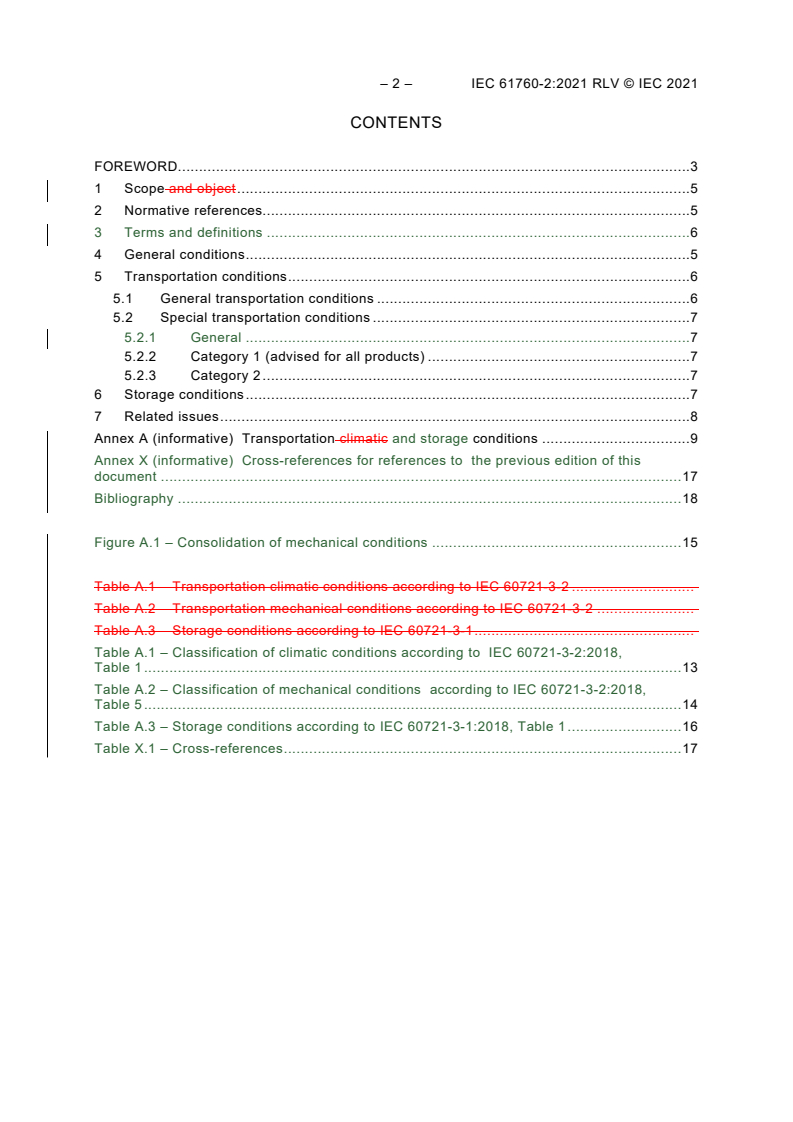
CONTENTS
FOREWORD . 3
1 Scope and object . 5
2 Normative references. 5
3 Terms and definitions . 6
4 General conditions . 5
5 Transportation conditions . 6
5.1 General transportation conditions . 6
5.2 Special transportation conditions . 7
5.2.1 General . 7
5.2.2 Category 1 (advised for all products) . 7
5.2.3 Category 2 . 7
6 Storage conditions . 7
7 Related issues . 8
Annex A (informative) Transportation climatic and storage conditions . 9
Annex X (informative) Cross-references for references to the previous edition of this
document . 17
Bibliography . 18
Figure A.1 – Consolidation of mechanical conditions . 15
Table A.1 – Transportation climatic conditions according to IEC 60721-3-2 .
Table A.2 – Transportation mechanical conditions according to IEC 60721-3-2 .
Table A.3 – Storage conditions according to IEC 60721-3-1 .
Table A.1 – Classification of climatic conditions according to IEC 60721-3-2:2018,
Table 1 . 13
Table A.2 – Classification of mechanical conditions according to IEC 60721-3-2:2018,
Table 5 . 14
Table A.3 – Storage conditions according to IEC 60721-3-1:2018, Table 1 . 16
Table X.1 – Cross-references . 17
INTERNATIONAL ELECTROTECHNICAL COMMISSION
____________
SURFACE MOUNTING TECHNOLOGY –
Part 2: Transportation and storage conditions
of surface mounting devices (SMD) –
Application guide
FOREWORD
1) The International Electrotechnical Commission (IEC) is a worldwide organization for standardization comprising
all national electrotechnical committees (IEC National Committees). The object of IEC is to promote international
co-operation on all questions concerning standardization in the electrical and electronic fields. To this end and
in addition to other activities, IEC publishes International Standards, Technical Specifications, Technical Reports,
Publicly Available Specifications (PAS) and Guides (hereafter referred to as “IEC Publication(s)”). Their
preparation is entrusted to technical committees; any IEC National Committee interested in the subject dealt with
may participate in this preparatory work. International, governmental and non-governmental organizations liaising
with the IEC also participate in this preparation. IEC collaborates closely with the International Organization for
Standardization (ISO) in accordance with conditions determined by agreement between the two organizations.
2) The formal decisions or agreements of IEC on technical matters express, as nearly as possible, an international
consensus of opinion on the relevant subjects since each technical committee has representation from all
interested IEC National Committees.
3) IEC Publications have the form of recommendations for international use and are accepted by IEC National
Committees in that sense. While all reasonable efforts are made to ensure that the technical content of IEC
Publications is accurate, IEC cannot be held responsible for the way in which they are used or for any
misinterpretation by any end user.
4) In order to promote international uniformity, IEC National Committees undertake to apply IEC Publications
transparently to the maximum extent possible in their national and regional publications. Any divergence between
any IEC Publication and the corresponding national or regional publication shall be clearly indicated in the latter.
5) IEC itself does not provide any attestation of conformity. Independent certification bodies provide conformity
assessment services and, in some areas, access to IEC marks of conformity. IEC is not responsible for any
services carried out by independent certification bodies.
6) All users should ensure that they have the latest edition of this publication.
7) No liability shall attach to IEC or its directors, employees, servants or agents including individual experts and
members of its technical committees and IEC National Committees for any personal injury, property damage or
other damage of any nature whatsoever, whether direct or indirect, or for costs (including legal fees) and
expenses arising out of the publication, use of, or reliance upon, this IEC Publication or any other IEC
Publications.
8) Attention is drawn to the Normative references cited in this publication. Use of the referenced publications is
indispensable for the correct application of this publication.
9) Attention is drawn to the possibility that some of the elements of this IEC Publication may be the subject of patent
rights. IEC shall not be held responsible for identifying any or all such patent rights.
This redline version of the official IEC Standard allows the user to identify the changes made to
the previous edition IEC 61760-2:2007. A vertical bar appears in the margin wherever a change
has been made. Additions are in green text, deletions are in strikethrough red text.
– 4 – IEC 61760-2:2021 RLV © IEC 2021
IEC 61760-2 has been prepared by IEC technical committee 91: Electronics assembly
technology. It is an International Standard.
The text of this International Standard is based on the following documents:
Draft Report on voting
91/1666/CDV 91/1708/RVC
Full information on the voting for its approval can be found in the report on voting indicated in
the above table.
The language used for the development of this International Standard is English.
This document was drafted in accordance with ISO/IEC Directives, Part 2, and developed in
accordance with ISO/IEC Directives, Part 1 and ISO/IEC Directives, IEC Supplement, available
at www.iec.ch/members_experts/refdocs. The main document types developed by IEC are
described in greater detail at www.iec.ch/standardsdev/publications.
Cross-references for references from this edition 3 to the previous edition 2 of this document
are listed in Annex X of this document.
A list of all parts in the IEC 61760 series, published under the general title Surface mounting
technology, can be found on the IEC website.
The committee has decided that the contents of this document will remain unchanged until the
stability date indicated on the IEC website under webstore.iec.ch in the data related to the
specific document. At this date, the document will be
• reconfirmed,
• withdrawn,
• replaced by a revised edition, or
• amended.
IMPORTANT – The 'colour inside' logo on the cover page of this publication indicates
that it contains colours which are considered to be useful for the correct understanding
of its contents. Users should therefore print this document using a colour printer.
SURFACE MOUNTING TECHNOLOGY –
Part 2: Transportation and storage conditions
of surface mounting devices (SMD) –
Application guide
1 Scope and object
This International Standard describes specifies the transportation and storage conditions for
surface mounting devices (SMDs) that are fulfilled in order to enable trouble-free processing of
surface mounting devices, both active and passive. (Conditions for printed boards are not taken
into consideration.)
The object of this document is to ensure that users of SMDs receive and store products that
can be further processed (e.g. positioned, soldered) without prejudice to quality and reliability.
Improper transportation and storage of SMDs may can cause deterioration and result in
assembly problems such as poor solderability, delamination and "popcorning".
2 Normative references
The following documents are referred to in the text in such a way that some or all of their content
constitutes requirements of this document. For dated references, only the edition cited applies.
For undated references, the latest edition of the referenced document (including any
amendments) applies.
IEC 60286-3, Packaging of components for automatic handling – Part 3: Packaging of surface
mount components on continuous tapes
IEC 60286-4, Packaging of components for automatic handling – Part 4: Stick magazines for
electronic components encapsulated in packages of form E and G
IEC 60286-5, Packaging of components for automatic handling – Part 5: Matrix trays
IEC 60286-6, Packaging of components for automatic handling – Part 6: Bulk case packaging
for surface mounting components
IEC 60721-3-1:2018, Classification of environmental conditions – Part 3-1: Classification of
groups of environmental parameters and their severities –: Storage
IEC 60721-3-2:2018, Classification of environmental conditions – Part 3-2: Classification of
groups of environmental parameters and their severities –: Transportation and handling
IEC 60749 (all parts), Semiconductor devices – Mechanical and climatic test methods
IEC/TS 61340-5-1, Electrostatics – Part 5-1: Protection of electronic devices from electrostatic
phenomena – General requirements
IEC/TR 61340-5-2, Electrostatics – Part 5-2: Protection of electronic devices from electrostatic
phenomena – User guide
– 6 – IEC 61760-2:2021 RLV © IEC 2021
3 Terms and definitions
ISO and IEC maintain terminological databases for use in standardization at the following
addresses:
• IEC Electropedia: available at http://www.electropedia.org/
• ISO Online browsing platform: available at http://www.iso.org/obp
No terms and definitions are listed in this document.
4 General conditions
Surface mounting devices shall be packed in such a way that products are protected during
transportation and storage without loss of their properties arising from mechanical,
environmental and electrical influences. Packing requirements as defined in various IEC
publications, such as IEC 60286-3, IEC 60286-4, IEC 60286-5, IEC 60286-6 and
IEC TR 61340-5-5 may can contribute to the protection of components during transportation
and storage.
If dry packing is specified and used, the IEC publications IEC 61760-4, IEC 60749-20-1 and
IPC/JEDEC J-STD-033 should be consulted.
Usually, transportation conditions are less controlled than storage conditions. Nevertheless,
conditions shall be controlled and deviations from the advised conditions in this document
should be reduced to as little time as possible.
5 Transportation conditions
5.1 General transportation conditions
During transportation, the SMDs, including their chosen style of tapes or stick magazines, etc.,
shall be protected against extreme temperature, humidity, and mechanical forces. Unless
otherwise specified by the component supplier, the following environmental conditions shall be
met:
Climatic condition are according to IEC 60721-3-2:2018, class 2K12, except Deviations from
these conditions are listed below:
– low air temperature: −40 °C;
– change of temperature air/air: –40 °C / +30 °C,
– low air pressure: 30 kPa,
– change of air pressure: 6 kPa/min; high relative humidity 75 %;
– no dripping water;
– no condensation is allowed.
The conditions are presented in tabular form in Annex A, Table A.1.
The total number of extreme temperature events (close to limits) should be limited to a minimum
during transportation and storage.
Mechanical condition is according to IEC 60721-3-2:2018, class 2M1 2M4. The condition is
presented in tabular form, including a figure, in Annex A, Table A.2 and Figure A.1.
Transportation shall be managed in such a way that boxes are not deformed and forces are not
directly passed on to the inner packaging.
Total transportation time shall be as short as possible, but preferably not exceeding 10 days.
(Total transportation time is time when products are not within controlled storage conditions.)
5.2 Special transportation conditions
5.2.1 General
Depending on the sensitivity of the products to be transported, a choice shall be made between
air transport, where conditions during flight are well controlled, or less controlled conditions,
e.g. during rail or road transportation.
5.2.2 Category 1 (advised for all products)
Air transport (conditions during flights with conditioned cargo room).
Climatic conditions are according to IEC 60721-3-2:2018, class 2K11. Deviations from these
conditions are listed below:
– low air temperature −40 °C;
– low relative humidity 10 %;
– high relative humidity 75 %;
– low air pressure 30 kPa.
The conditions are presented in tabular form in Annex A, Table A.1.
It should be realised that waiting time and loading operations at the airport are under less
controlled conditions. These shall at least fulfil the general transportation conditions stated
in 5.1.
5.2.3 Category 2
Rail, road, and unconditioned air transportation.
Only allowed for products and packaging systems that are not sensitive to the general
transportation conditions stated in 5.1.
Minimum air pressure: corresponding to an altitude of < 12 km (about 19,3 kPa).
6 Storage conditions
Well controlled storage conditions are a major factor in problem prevention. Do not store in
locations where the soldering properties can be deteriorated by harmful gases. Conditions that
may can expose products to detrimental electrical field strengths should be avoided. Exposure
of the products to direct solar radiation should be avoided.
The following conditions are advised:
Climatic conditions are according to IEC 60721-3-1:2018, class 1K21, except.
Deviations from these conditions are listed below:
– low relative humidity 10 %;
– high relative humidity 75 %;
– solar radiation 700 W/m , but direct solar radiation should be avoided.
The conditions are presented in tabular form in Annex A, Table A.3.
– 8 – IEC 61760-2:2021 RLV © IEC 2021
The storage time as given by the manufacturer specification shall not be exceeded. It is however
recommended that the total storage time should not exceed two years (manufacturer and
customer) but should be limited to one year after receipt of the products by the customer. In
specific cases, the exact storage time and the re-qualification rules, if the time is exceeded, are
given in the component specification. As a minimum, at least the solderability of the components
has to shall be re-qualified.
If longer storage times are needed, the manufacturer should be consulted to conclude
arrangements for suitable storage and packaging conditions.
During storage the original smallest packaging unit (SPU) shall not be opened, the SPU should
preferably remain in the original packaging.
Even though products are stored for a shorter period of time, it is advised to apply the
temperature and humidity conditions set out in this Clause 6.
For "last call" components, the storage conditions to conserve the component's properties shall
be agreed between the manufacturer and the user.
7 Related issues
If the products in standard packaging do not fulfil the required quality and reliability goals under
the shipment and storage conditions as described in Clause 5 and Clause 6, special actions
shall be considered as described in IEC 60749 (all parts), IEC/TS 61340-5-1 and
IEC TR 61340-5-2.
Considerations for risk mitigation, packaged component long-term storage and associated
traceability, can be found in IEC 62435 (all parts).
Annex A
(informative)
Transportation climatic and storage conditions
For easy and rapid reference, this Annex A shows the content of the quoted conditions from
IEC 60721-3-1:2018 and IEC 60721-3-2:2018.
The information is presented on following pages in tabular form in Table A.1, Table A.2 and
Table A.3. In each table the deviations given in this document from conditions provided in
IEC 60721-3-2 and from IEC 60721-3-1 are specified, if any.
Table A.1 – Classification of climatic conditions according to IEC 60721-3-2:2018, Table 1.
Table A.2 – Classification of mechanical conditions according to IEC 60721-3-2:2018, Table 5
and Figure 2.
Table A.3 – Storage conditions according to IEC 60721-3-1:2018, Table 1.
– 10 – IEC 61760-2:2021 RLV © IEC 2021
NOTE The footnote references can be found on the last page.
Table A.1 – Transportation climatic conditions according to IEC 60721-3-2
Class Conditions used in
this standard
Environmental parameter Unit
instead of 2K2
2K1 2K2
a) Low air temperature °C +5
−25 −40
b) High air temperature, air in unventilated °C No +60
1)
enclosures
c) High air temperature, air in ventilated °C +40 +40
2)
enclosures or outdoor air
3)
°C No
d) Change of temperature, air/air −25/+25 −40/+30
3)
e) Change of temperature, air/water °C No No
f) Relative humidity, not combined with rapid % 75 75
temperature changes
°C +30 +30
g) Relative humidity, combined with rapid % No No
temperature changes: air/air at high relative
°C
3)
humidity
h) Absolute humidity, combined with rapid g/m No No
temperature changes: air/air at high water
4)
°C
content
i) Low air pressure kPa 70 70 30
j) Change of air pressure kPa/min No No 6
k) Movement of surrounding medium, air m/s No No
l) Precipitation, rain mm/min No No
m) Radiation, solar W/m 700 700
n) Radiation, heat W/m No No
5)
m/s No No
o) Water from sources other than rain
p) Wetness None No No
1)
The high temperature of the surface of a product may be influenced by both the surrounding air temperature
given here and the solar radiation through a window or other opening.
2)
The high temperature of the surface of a product is influenced by the surrounding air temperature given here
and the solar radiation defined below.
3)
A direct transfer of the product between the two temperatures given is presumed.
4)
The product is assumed to be subject to a rapid decrease of temperature only (no rapid increase). The figures of
water content apply to temperatures down to the dew-point; at lower temperatures the relative humidity is
assumed to be approximately 100 %.
5)
The figure indicates the velocity of water and not the height of water accumulated.
Table A.2 – Transportation mechanical conditions according to IEC 60721-3-2
Class
Environmental parameter Unit
2M1
1)
a) Stationary vibration, sinusoidal :
displacement amplitude mm 3,5 - -
acceleration amplitude m/s - 10 15
frequency range Hz 2-9 9-200 200-500
1)
b) Stationary vibration, random
2 2
acceleration spectral density m /s 1 0,3
frequency range Hz 10-200 200-2 000
2)
c) Non-stationary vibration including shock :
shock response spectrum type I, peak acceleration m/s 100
shock response spectrum type II, peak m/s No
acceleration
d) Free fall:
Mass less than 20 kg m 0,25
Mass 20 kg to 100 kg m 0,25
Mass more than 100 kg m 0,1
e) Toppling:
Mass less than 20 kg None Toppling around any of the edges
Mass 20 kg to 100 kg None No
Mass more than 100 kg None No
f) Rolling, pitching:
3)
Angle Degree No
Period s No
g) Steady-state acceleration m/s 20
h) Static load kPa 5
1)
The frequency range may be limited to 200 Hz for transportation on parts of the vehicle with high internal
damping.
2)
See Figure 1 in IEC 60721-3-2.
3)
An angle of 35° only occurs temporarily, but angles up to 22,5° can be reached for long periods of time.
– 12 – IEC 61760-2:2021 RLV © IEC 2021
Table A.3 – Storage conditions according to IEC 60721-3-1
Class Conditions used in this
standard instead of 1K2
Environmental parameter Unit
1K2
a) Low air temperature °C +5
b) High air temperature °C +40
1)
c) Low relative humidity % 5 10
1)
% 85 75
d) High relative humidity
1) 3
e) Low absolute humidity g/m 1
1) 3
f) High absolute humidity g/m 25
2)
g) Rate of change of temperature °C/min 0,5
3)
h) Low air pressure kPa 70
3)
i) High air pressure kPa 106
2 6)
j) Solar radiation 700
W/m
7)
k) Heat radiation None
4) 8)
l) Movement of surrounding air m/s 1,0
m) Condensation None No
n) Precipitation (rain, snow, hail, etc.) None No
o) Rain intensity Mm/min None
5)
p) Low rain temperature °C None
q) Water from sources other than rain None No
r) Formation of ice and frost None No
1)
The low and high relative humidities are limited by the low and high absolute humidities, so that, for example, for
environmental parameters a) and c), or b) and d), the severities given in table do not occur simultaneously.
2)
Averaged over a period of time of 5 min.
3)
The value of 70 kPa represents a limit for open-air conditions, normally at an altitude of 3 000 m. In some
geographical areas, open-air conditions may occur at higher altitudes. Conditions in mines are not considered.
4)
A cooling system based on non-assisted convection may be disturbed by adverse movement of surrounding air.
5)
This rain temperature should be considered together with high air temperature b) and solar radiation j). The
cooling effect of the rain has to be considered in connection with the surface temperature of the product.
6)
Exposure of the products to direct solar radiation should be avoided.
7)
Conditions occurring at the location concerned to be selected: either 1Z1 = negligible, or 1Z2 = conditions of
heat radiation, e.g. in the vicinity of room heating systems.
8)
If applicable, a specific value may be selected either 1Z3 = 30 m/s or 1Z4 = 50 m/s.
Table A.1 – Classification of climatic conditions according to
IEC 60721-3-2:2018, Table 1
Classification
Conditions used in
this document
Environmental parameter Unit Weather-protected
instead of those of
IEC 60721-3-2
2K11 2K12 2K11 2K12
a) Low air temperature °C +5
−45 −40 −40
b) High air temperature °C +40 +70 +60 +60
1)
% 5 4 10 10
c) Low relative humidity
1)
% 85 100 75 75
d) High relative humidity
1) 3
1 0,5
e) Low absolute humidity g/m
1) 3
25 29
f) High absolute humidity g/m
2)
°C/min 0,5 1,0
g) Rate of change of temperature
3)
kPa 70 70 30 30
h) Low air pressure
3) 7) 7)
kPa 106 106
i) High air pressure
2 6)
j) Solar radiation No
W/m
k) Heat radiation Not specified None None
4)
m/s 1,0 1,0
l) Movement of surrounding air
m) Condensation Not specified No Yes No
n) Precipitation (rain, snow, hail, etc.) Not specified No No
o) Rain intensity mm/min None None
p) Driving rain m/s None None
q) Snow load None None
kg/m
5)
°C None None
r) Low rain temperature
s) Water from sources other than rain Not specified No Dripping No
Water
t) Formation of ice and frost (including freeze- Not specified No Yes
thaw)
u) Temperature shock Not specified No Yes
1)
The low and high relative humidity levels are limited by the low and high absolute humidity, so that, for
example, for environmental parameters a) and c), or b) and d), the severities given in Table A.1 do not occur
simultaneously.
2)
Averaged over a period of time of 5 min.
3)
The value of 70 kPa represents a limit for open-air conditions, normally at an altitude of 3 000 m. In some
geographical areas, open-air conditions can occur at higher altitudes. Conditions in mines are not considered.
4)
A cooling system based on non-assisted convection can be disturbed by adverse movement of surrounding
air.
5)
This rain temperature should be considered together with high air temperature b) and solar radiation j). The
cooling effect of the rain has to be considered in connection with the surface temperature of the product.
6)
Thermal effect of solar radiation is included in the temperature.
7)
Extra requirement in this document: change of air pressure 6 kPa/min.
– 14 – IEC 61760-2:2021 RLV © IEC 2021
Table A.2 – Classification of mechanical conditions
according to IEC 60721-3-2:2018, Table 5
Environmental Unit Class
parameter
2M4
a) Stationary vibration,
random:
2 2 2)
acceleration power 1,0 0,5
(m/s ) /Hz 10
spectral density
1)
Hz 2 to 3 10 to 20 50 to 2 000
frequency range
b) Non-stationary vibration Figure A.1 Curve 4
3)
including shock:
(equivalent to a half sine pulse of 100 m/s and 11 ms duration)
4)
Shock 1
4)
Figure A.1 Curve 2
Shock 2
(equivalent to a half sine pulse of 300 m/s and 6 ms duration)
c) Free fall:
mass less than 20 kg m 0,25
mass 20 kg to 100 kg m 0,25
mass more than 100 kg m 0,1
d) Toppling:
mass less than 20 kg None Toppling around any of the edges
mass 20 kg to 100 kg No
mass more than 100 kg No
e) Rolling, pitching: degrees No
5)
No
angle period
f) Steady-state 20
m/s
acceleration
g) Static load kPa 5
1)
When transport only occurs by rail, river, sea and road, the upper frequency considered may be reduced to
500 Hz for products that are not sensitive to vibration excitations above 500 Hz.
2)
The low frequency stationary vibration random component arises from the influence of land vehicle suspension
systems. The component is included for design purposes but is not always included in vibration test
specifications.
3)
For land vehicles, these shocks can occur simultaneously with the stationary vibration random conditions.
4)
Both shocks would normally be used to encompass different aspects of the shock environment.
5)
An angle of 35° may only occur temporarily. An angle of up to 22,5° can be reached for long periods of time.
SOURCE: IEC 60721-3-2:2018, Figure 2
Figure A.1 – Consolidation of mechanical conditions
– 16 – IEC 61760-2:2021 RLV © IEC 2021
Table A.3 – Storage conditions according to IEC 60721-3-1:2018, Table 1
Unit Conditions used in
Class
this document
Environmental Parameter
instead of those of
1K21
class 1K21
a) Low air temperature °C +5
b) High air temperature °C +40
1)
% 5 10
c) Low relative humidity
1)
% 85 75
d) High relative humidity
1) 3
e) Low absolute humidity g/m
1) 3
f) High absolute humidity g/m
2)
°C/min 0,5
g) Rate of change of temperature
3)
kPa 70
h) Low air pressure
3)
kPa 106
i) High air pressure
2 8)
j) Solar radiation 6)
W/m 700
k) Heat radiation Not specified 7)
4)
m/s 1,0
l) Movement of surrounding air
m) Condensation Not specified No
n) Precipitation (rain, snow, hail, etc.) Not specified No
o) Rain intensity mm/min None
p) Driving rain m/s None
q) Snow load None
kg/m
5)
°C None
r) Low rain temperature
s) Water from sources other than rain No
L/m /min
t) Formation of ice and frost (including Not specified No
freeze-thaw)
1) The low and high relative humidity levels are limited by the low and high absolute humidities, so that, for
example, for environmental parameters a) and c), or b) and d), the severities given in Table 1 do not occur
simultaneously.
2) Averaged over a period of time of 5 min.
3) The value of 70 kPa represents a limit for open-air conditions, normally at an altitude of 3 000 m. In some
geographical areas, open-air conditions can occur at higher altitudes. Conditions in mines are not considered.
4) A cooling system based on non-assisted convection can be disturbed by adverse movement of surrounding
air.
5) This rain temperature should be considered together with high air temperature b) and solar radiation j). The
cooling effect of the rain has to be considered in connection with the surface temperature of the product.
2 2
6) Either 500 W/m or 700 W/m .
7) Either 1Z1 = negligible or 1Z2 = conditions of heat radiation, e.g. in the vicinity of room heating system.
8) In this document: direct solar radiation should be avoided.
Annex X
(informative)
Cross-references for references to
the previous edition of this document
The revision of this document has resulted in a new structure. Table X.1 provides cross-
references for all references to specific elements of the previous edition.
Table X.1 – Cross-references
IEC 61760-2:2007 IEC 61760-2:2021 Notes
(Edition 2.0) (Edition 3.0)
Clause/subclause Clause/subclause
1 1
2 2
- 3
3 4
4 5
4.1 5.1
4.2 5.2
- 5.2.1
4.2.1 5.2.2
4.2.2 5.2.3
5 6
6 7
Annex A Annex A
- Annex X
Table A.1 Table A.1
Table A.2 Table A.2
Table A.3 Table A.3
– 18 – IEC 61760-2:2021 RLV © IEC 2021
Bibliography
IEC 60286-3, Packaging of components for automatic handling – Part 3: Packaging of surface
mount components on continuous tapes
IEC 60286-4, Packaging of components for automatic handling – Part 4: Stick magazines for
electronic components encapsulated in packages of different forms
IEC 60286-5, Packaging of components for automatic handling – Part 5: Matrix trays
IEC 60286-6, Packaging of components for automatic handling – Part 6: Bulk case packaging
for surface mounting components
IEC 60749 (all parts), Semiconductor devices – Mechanical and climatic test methods
IEC 60749-20-1:2019, Semiconductor devices – Mechanical and climatic test methods –
Part 20-1: Handling, packing, labelling and shipping of surface-mount devices sensitive to the
combined effect of moisture and soldering heat
IEC 61340-5-1, Electrostatics – Part 5-1: Protection of electronic devices from electrostatic
phenomena – General requirements
IEC TR 61340-5-2, Electrostatics – Part 5-2: Protection of electronic devices from electrostatic
phenomena – User guide
IEC TR 61340-5-5, Electrostatics – Part 5-5: Protection of electronic devices from electrostatic
phenomena – Packaging systems used in electronic manufacturing
IEC 61760-4:2015, Surface mounting technology – Part 4: Classification, packaging, labelling
and handling of moisture sensitive devices
IEC 61760-4:2015/AMD1:2018
IEC 62435 (all parts), Electronic components – Long-term storage of electronic semiconductor
devices
IPC/JEDEC J-STD-033D, 2018, Handling, Packing, Shipping and Use of Moisture/Reflow
Sensitive Surface-Mount Devices
___________
IEC 61760-2 ®
Edition 3.0 2021-07
INTERNATIONAL
STANDARD
NORME
INTERNATIONALE
colour
inside
Surface mounting technology –
Part 2: Transportation and storage conditions of surface mounting devices
(SMD) – Application guide
Technique du montage en surface –
Partie 2: Conditions de transport et de stockage des composants pour montage
en surface (CMS) – Guide d’application
– 2 – IEC 61760-2:2021 © IEC 2021
CONTENTS
FOREWORD . 3
1 Scope . 5
2 Normative references. 5
3 Terms and definitions . 5
4 General conditions . 5
5 Transportation conditions . 6
5.1 General transportation conditions . 6
5.2 Special transportation conditions . 6
5.2.1 General . 6
5.2.2 Category 1 (advised for all products) . 6
5.2.3 Category 2 . 7
6 Storage conditions . 7
7 Related issues . 8
Annex A (informative) Transportation and storage conditions . 9
Annex X (informative) Cross-references for references to the previous edition of this
document . 14
Bibliography . 15
Figure A.1 – Consolidation of mechanical conditions . 12
Table A.1 – Classification of climatic conditions according to IEC 60721-3-2:2018,
Table 1 . 10
Table A.2 – Classification of mechanical conditions according to IEC 60721-3-2:2018,
Table 5 . 11
Table A.3 – Storage conditions according to IEC 60721-3-1:2018, Table 1 . 13
Table X.1 – Cross-references . 14
INTERNATIONAL ELECTROTECHNICAL COMMISSION
____________
SURFACE MOUNTING TECHNOLOGY –
Part 2: Transportation and storage conditions
of surface mounting devices (SMD) –
Application guide
FOREWORD
1) The International Electrotechnical Commission (IEC) is a worldwide organization for standardization comprising
all national electrotechnical committees (IEC National Committees). The object of IEC is to promote international
co-operation on all questions concerning standardization in the electrical and electronic fields. To this end and
in addition to other activities, IEC publishes International Standards, Technical Specifications, Technical Reports,
Publicly Available Specifications (PAS) and Guides (hereafter referred to as “IEC Publication(s)”). Their
preparation is entrusted to technical committees; any IEC National Committee interested in the subject dealt with
may participate in this preparatory work. International, governmental and non-governmental organizations liaising
with the IEC also participate in this preparation. IEC collaborates closely with the International Organization for
Standardization (ISO) in accordance with conditions determined by agreement between the two organizations.
2) The formal decisions or agreements of IEC on technical matters express, as nearly as possible, an international
consensus of opinion on the relevant subjects since each technical committee has representation from all
interested IEC National Committees.
3) IEC Publications have the form of recommendations for international use and are accepted by IEC National
Committees in that sense. While all reasonable efforts are made to ensure that the technical content of IEC
Publications is accurate, IEC cannot be held responsible for the way in which they are used or for any
misinterpretation by any end user.
4) In order to promote international uniformity, IEC National Committees undertake to apply IEC Publications
transparently to the maximum extent possible in their national and regional publications. Any divergence between
any IEC Publication and the corresponding national or regional publication shall be clearly indicated in the latter.
5) IEC itself does not provide any attestation of conformity. Independent certification bodies provide conformity
assessment services and, in some areas, access to IEC marks of conformity. IEC is not responsible for any
services carried out by independent certification bodies.
6) All users should ensure that they have the latest edition of this publication.
7) No liability shall attach to IEC or its directors, employees, servants or agents including individual experts and
members of its technical committees and IEC National Committees for any personal injury, property damage or
other damage of any nature whatsoever, whether direct or indirect, or for costs (including legal fees) and
expenses arising out of the publication, use of, or reliance upon, this IEC Publication or any other IEC
Publications.
8) Attention is drawn to the Normative references cited in this publication. Use of the referenced publications is
indispensable for the correct application of this publication.
9) Attention is drawn to the possibility that some of the elements of this IEC Publication may be the subject of patent
rights. IEC shall not be held responsible for identifying any or all such patent rights.
IEC 61760-2 has been prepared by IEC technical committee 91: Electronics assembly
technology. It is an International Standard.
The text of this International Standard is based on the following documents:
Draft Report on voting
91/1666/CDV 91/1708/RVC
Full information on the voting for its approval can be found in the report on voting indicated in
the above table.
The language used for the development of this International Standard is English.
This document was drafted in accordance with ISO/IEC Directives, Part 2, and developed in
accordance with ISO/IEC Directives, Part 1 and ISO/IEC Directives, IEC Supplement, available
– 4 – IEC 61760-2:2021 © IEC 2021
at www.iec.ch/members_experts/refdocs. The main document types developed by IEC are
described in greater detail at www.iec.ch/standardsdev/publications.
Cross-references for references from this edition 3 to the previous edition 2 of this document
are listed in Annex X of this document.
A list of all parts in the IEC 61760 series, published under the general title Surface mounting
technology, can be found on the IEC website.
The committee has decided that the contents of this document will remain unchanged until the
stability date indicated on the IEC website under webstore.iec.ch in the data related to the
specific document. At this date, the document will be
• reconfirmed,
• withdrawn,
• replaced by a revised edition, or
• amended.
IMPORTANT – The 'colour inside' logo on the cover page of this publication indicates
that it contains colours which are considered to be useful for the correct understanding
of its contents. Users should therefore print this doc
...
IEC 61760-2 ®
Edition 3.0 2021-07
INTERNATIONAL
STANDARD
NORME
INTERNATIONALE
colour
inside
Surface mounting technology –
Part 2: Transportation and storage conditions of surface mounting devices
(SMD) – Application guide
Technique du montage en surface –
Partie 2: Conditions de transport et de stockage des composants pour montage
en surface (CMS) – Guide d’application
All rights reserved. Unless otherwise specified, no part of this publication may be reproduced or utilized in any form
or by any means, electronic or mechanical, including photocopying and microfilm, without permission in writing from
either IEC or IEC's member National Committee in the country of the requester. If you have any questions about IEC
copyright or have an enquiry about obtaining additional rights to this publication, please contact the address below or
your local IEC member National Committee for further information.
Droits de reproduction réservés. Sauf indication contraire, aucune partie de cette publication ne peut être reproduite
ni utilisée sous quelque forme que ce soit et par aucun procédé, électronique ou mécanique, y compris la photocopie
et les microfilms, sans l'accord écrit de l'IEC ou du Comité national de l'IEC du pays du demandeur. Si vous avez des
questions sur le copyright de l'IEC ou si vous désirez obtenir des droits supplémentaires sur cette publication, utilisez
les coordonnées ci-après ou contactez le Comité national de l'IEC de votre pays de résidence.
IEC Central Office Tel.: +41 22 919 02 11
3, rue de Varembé info@iec.ch
CH-1211 Geneva 20 www.iec.ch
Switzerland
About the IEC
The International Electrotechnical Commission (IEC) is the leading global organization that prepares and publishes
International Standards for all electrical, electronic and related technologies.
About IEC publications
The technical content of IEC publications is kept under constant review by the IEC. Please make sure that you have the
latest edition, a corrigendum or an amendment might have been published.
IEC publications search - webstore.iec.ch/advsearchform IEC online collection - oc.iec.ch
The advanced search enables to find IEC publications by a Discover our powerful search engine and read freely all the
variety of criteria (reference number, text, technical publications previews. With a subscription you will always
committee, …). It also gives information on projects, replaced have access to up to date content tailored to your needs.
and withdrawn publications.
Electropedia - www.electropedia.org
IEC Just Published - webstore.iec.ch/justpublished
The world's leading online dictionary on electrotechnology,
Stay up to date on all new IEC publications. Just Published
containing more than 22 000 terminological entries in English
details all new publications released. Available online and
and French, with equivalent terms in 18 additional languages.
once a month by email.
Also known as the International Electrotechnical Vocabulary
(IEV) online.
IEC Customer Service Centre - webstore.iec.ch/csc
If you wish to give us your feedback on this publication or
need further assistance, please contact the Customer Service
Centre: sales@iec.ch.
A propos de l'IEC
La Commission Electrotechnique Internationale (IEC) est la première organisation mondiale qui élabore et publie des
Normes internationales pour tout ce qui a trait à l'électricité, à l'électronique et aux technologies apparentées.
A propos des publications IEC
Le contenu technique des publications IEC est constamment revu. Veuillez vous assurer que vous possédez l’édition la
plus récente, un corrigendum ou amendement peut avoir été publié.
Recherche de publications IEC - IEC online collection - oc.iec.ch
webstore.iec.ch/advsearchform Découvrez notre puissant moteur de recherche et consultez
La recherche avancée permet de trouver des publications IEC gratuitement tous les aperçus des publications. Avec un
en utilisant différents critères (numéro de référence, texte, abonnement, vous aurez toujours accès à un contenu à jour
comité d’études, …). Elle donne aussi des informations sur adapté à vos besoins.
les projets et les publications remplacées ou retirées.
Electropedia - www.electropedia.org
IEC Just Published - webstore.iec.ch/justpublished
Le premier dictionnaire d'électrotechnologie en ligne au
Restez informé sur les nouvelles publications IEC. Just
monde, avec plus de 22 000 articles terminologiques en
Published détaille les nouvelles publications parues.
anglais et en français, ainsi que les termes équivalents dans
Disponible en ligne et une fois par mois par email.
16 langues additionnelles. Egalement appelé Vocabulaire
Electrotechnique International (IEV) en ligne.
Service Clients - webstore.iec.ch/csc
Si vous désirez nous donner des commentaires sur cette
publication ou si vous avez des questions contactez-nous:
sales@iec.ch.
IEC 61760-2 ®
Edition 3.0 2021-07
INTERNATIONAL
STANDARD
NORME
INTERNATIONALE
colour
inside
Surface mounting technology –
Part 2: Transportation and storage conditions of surface mounting devices
(SMD) – Application guide
Technique du montage en surface –
Partie 2: Conditions de transport et de stockage des composants pour montage
en surface (CMS) – Guide d’application
INTERNATIONAL
ELECTROTECHNICAL
COMMISSION
COMMISSION
ELECTROTECHNIQUE
INTERNATIONALE
ICS 31.240 ISBN 978-2-8322-1002-8
– 2 – IEC 61760-2:2021 © IEC 2021
CONTENTS
FOREWORD . 3
1 Scope . 5
2 Normative references. 5
3 Terms and definitions . 5
4 General conditions . 5
5 Transportation conditions . 6
5.1 General transportation conditions . 6
5.2 Special transportation conditions . 6
5.2.1 General . 6
5.2.2 Category 1 (advised for all products) . 6
5.2.3 Category 2 . 7
6 Storage conditions . 7
7 Related issues . 8
Annex A (informative) Transportation and storage conditions . 9
Annex X (informative) Cross-references for references to the previous edition of this
document . 14
Bibliography . 15
Figure A.1 – Consolidation of mechanical conditions . 12
Table A.1 – Classification of climatic conditions according to IEC 60721-3-2:2018,
Table 1 . 10
Table A.2 – Classification of mechanical conditions according to IEC 60721-3-2:2018,
Table 5 . 11
Table A.3 – Storage conditions according to IEC 60721-3-1:2018, Table 1 . 13
Table X.1 – Cross-references . 14
INTERNATIONAL ELECTROTECHNICAL COMMISSION
____________
SURFACE MOUNTING TECHNOLOGY –
Part 2: Transportation and storage conditions
of surface mounting devices (SMD) –
Application guide
FOREWORD
1) The International Electrotechnical Commission (IEC) is a worldwide organization for standardization comprising
all national electrotechnical committees (IEC National Committees). The object of IEC is to promote international
co-operation on all questions concerning standardization in the electrical and electronic fields. To this end and
in addition to other activities, IEC publishes International Standards, Technical Specifications, Technical Reports,
Publicly Available Specifications (PAS) and Guides (hereafter referred to as “IEC Publication(s)”). Their
preparation is entrusted to technical committees; any IEC National Committee interested in the subject dealt with
may participate in this preparatory work. International, governmental and non-governmental organizations liaising
with the IEC also participate in this preparation. IEC collaborates closely with the International Organization for
Standardization (ISO) in accordance with conditions determined by agreement between the two organizations.
2) The formal decisions or agreements of IEC on technical matters express, as nearly as possible, an international
consensus of opinion on the relevant subjects since each technical committee has representation from all
interested IEC National Committees.
3) IEC Publications have the form of recommendations for international use and are accepted by IEC National
Committees in that sense. While all reasonable efforts are made to ensure that the technical content of IEC
Publications is accurate, IEC cannot be held responsible for the way in which they are used or for any
misinterpretation by any end user.
4) In order to promote international uniformity, IEC National Committees undertake to apply IEC Publications
transparently to the maximum extent possible in their national and regional publications. Any divergence between
any IEC Publication and the corresponding national or regional publication shall be clearly indicated in the latter.
5) IEC itself does not provide any attestation of conformity. Independent certification bodies provide conformity
assessment services and, in some areas, access to IEC marks of conformity. IEC is not responsible for any
services carried out by independent certification bodies.
6) All users should ensure that they have the latest edition of this publication.
7) No liability shall attach to IEC or its directors, employees, servants or agents including individual experts and
members of its technical committees and IEC National Committees for any personal injury, property damage or
other damage of any nature whatsoever, whether direct or indirect, or for costs (including legal fees) and
expenses arising out of the publication, use of, or reliance upon, this IEC Publication or any other IEC
Publications.
8) Attention is drawn to the Normative references cited in this publication. Use of the referenced publications is
indispensable for the correct application of this publication.
9) Attention is drawn to the possibility that some of the elements of this IEC Publication may be the subject of patent
rights. IEC shall not be held responsible for identifying any or all such patent rights.
IEC 61760-2 has been prepared by IEC technical committee 91: Electronics assembly
technology. It is an International Standard.
The text of this International Standard is based on the following documents:
Draft Report on voting
91/1666/CDV 91/1708/RVC
Full information on the voting for its approval can be found in the report on voting indicated in
the above table.
The language used for the development of this International Standard is English.
This document was drafted in accordance with ISO/IEC Directives, Part 2, and developed in
accordance with ISO/IEC Directives, Part 1 and ISO/IEC Directives, IEC Supplement, available
– 4 – IEC 61760-2:2021 © IEC 2021
at www.iec.ch/members_experts/refdocs. The main document types developed by IEC are
described in greater detail at www.iec.ch/standardsdev/publications.
Cross-references for references from this edition 3 to the previous edition 2 of this document
are listed in Annex X of this document.
A list of all parts in the IEC 61760 series, published under the general title Surface mounting
technology, can be found on the IEC website.
The committee has decided that the contents of this document will remain unchanged until the
stability date indicated on the IEC website under webstore.iec.ch in the data related to the
specific document. At this date, the document will be
• reconfirmed,
• withdrawn,
• replaced by a revised edition, or
• amended.
IMPORTANT – The 'colour inside' logo on the cover page of this publication indicates
that it contains colours which are considered to be useful for the correct understanding
of its contents. Users should therefore print this document using a colour printer.
SURFACE MOUNTING TECHNOLOGY –
Part 2: Transportation and storage conditions
of surface mounting devices (SMD) –
Application guide
1 Scope
This International Standard specifies the transportation and storage conditions for surface
mounting devices (SMDs) that are fulfilled in order to enable trouble-free processing of surface
mounting devices, both active and passive. (Conditions for printed boards are not taken into
consideration.)
The object of this document is to ensure that users of SMDs receive and store products that
can be further processed (e.g. positioned, soldered) without prejudice to quality and reliability.
Improper transportation and storage of SMDs can cause deterioration and result in assembly
problems such as poor solderability, delamination and "popcorning".
2 Normative references
The following documents are referred to in the text in such a way that some or all of their content
constitutes requirements of this document. For dated references, only the edition cited applies.
For undated references, the latest edition of the referenced document (including any
amendments) applies.
IEC 60721-3-1:2018, Classification of environmental conditions – Part 3-1: Classification of
groups of environmental parameters and their severities – Storage
IEC 60721-3-2:2018, Classification of environmental conditions – Part 3-2: Classification of
groups of environmental parameters and their severities – Transportation and handling
3 Terms and definitions
ISO and IEC maintain terminological databases for use in standardization at the following
addresses:
• IEC Electropedia: available at http://www.electropedia.org/
• ISO Online browsing platform: available at http://www.iso.org/obp
No terms and definitions are listed in this document.
4 General conditions
Surface mounting devices shall be packed in such a way that products are protected during
transportation and storage without loss of their properties arising from mechanical,
environmental and electrical influences. Packing requirements as defined in various IEC
publications, such as IEC 60286-3, IEC 60286-4, IEC 60286-5, IEC 60286-6 and
IEC TR 61340-5-5 can contribute to the protection of components during transportation and
storage.
If dry packing is specified and used, the IEC publications IEC 61760-4, IEC 60749-20-1 and
IPC/JEDEC J-STD-033 should be consulted.
– 6 – IEC 61760-2:2021 © IEC 2021
Usually, transportation conditions are less controlled than storage conditions. Nevertheless,
conditions shall be controlled and deviations from the advised conditions in this document
should be reduced to as little time as possible.
5 Transportation conditions
5.1 General transportation conditions
During transportation, the SMDs, including their chosen style of tapes or stick magazines, etc.,
shall be protected against extreme temperature, humidity, and mechanical forces. Unless
otherwise specified by the component supplier, the following environmental conditions shall be
met:
Climatic condition are according to IEC 60721-3-2:2018, class 2K12. Deviations from these
conditions are listed below:
– low air temperature: −40 °C;
– low air pressure: 30 kPa;
– change of air pressure: 6 kPa/min; high relative humidity 75 %;
– no dripping water;
– no condensation is allowed.
The conditions are presented in tabular form in Annex A, Table A.1.
The total number of extreme temperature events (close to limits) should be limited to a minimum
during transportation and storage.
Mechanical condition is according to IEC 60721-3-2:2018, class 2M4. The condition is
presented in tabular form, including a figure, in Annex A, Table A.2 and Figure A.1.
Transportation shall be managed in such a way that boxes are not deformed and forces are not
directly passed on to the inner packaging.
Total transportation time shall be as short as possible, but preferably not exceeding 10 days.
(Total transportation time is time when products are not within controlled storage conditions.)
5.2 Special transportation conditions
5.2.1 General
Depending on the sensitivity of the products to be transported, a choice shall be made between
air transport, where conditions during flight are well controlled, or less controlled conditions,
e.g. during rail or road transportation.
5.2.2 Category 1 (advised for all products)
Air transport (conditions during flights with conditioned cargo room).
Climatic conditions are according to IEC 60721-3-2:2018, class 2K11. Deviations from these
conditions are listed below:
– low air temperature −40 °C;
– low relative humidity 10 %;
– high relative humidity 75 %;
– low air pressure 30 kPa.
The conditions are presented in tabular form in Annex A, Table A.1.
It should be realised that waiting time and loading operations at the airport are under less
controlled conditions. These shall at least fulfil the general transportation conditions stated
in 5.1.
5.2.3 Category 2
Rail, road, and unconditioned air transportation.
Only allowed for products and packaging systems that are not sensitive to the general
transportation conditions stated in 5.1.
Minimum air pressure: corresponding to an altitude of < 12 km (about 19,3 kPa).
6 Storage conditions
Well controlled storage conditions are a major factor in problem prevention. Do not store in
locations where the soldering properties can be deteriorated by harmful gases. Conditions that
can expose products to detrimental electrical field strengths should be avoided. Exposure of
the products to direct solar radiation should be avoided.
The following conditions are advised:
Climatic conditions are according to IEC 60721-3-1:2018, class 1K21. Deviations from these
conditions are listed below:
– low relative humidity 10 %;
– high relative humidity 75 %;
– solar radiation 700 W/m , but direct solar radiation should be avoided.
The conditions are presented in tabular form in Annex A, Table A.3.
The storage time as given by the manufacturer specification shall not be exceeded. It is however
recommended that the total storage time should not exceed two years (manufacturer and
customer) but should be limited to one year after receipt of the products by the customer. In
specific cases, the exact storage time and the re-qualification rules, if the time is exceeded, are
given in the component specification. As a minimum, at least the solderability of the components
shall be re-qualified.
If longer storage times are needed, the manufacturer should be consulted to conclude
arrangements for suitable storage and packaging conditions.
During storage the original smallest packaging unit (SPU) shall not be opened, the SPU should
preferably remain in the original packaging.
Even though products are stored for a shorter period of time, it is advised to apply the
temperature and humidity conditions set out in this Clause 6.
For "last call" components, the storage conditions to conserve the component's properties shall
be agreed between the manufacturer and the user.
– 8 – IEC 61760-2:2021 © IEC 2021
7 Related issues
If the products in standard packaging do not fulfil the required quality and reliability goals under
the shipment and storage conditions as described in Clause 5 and Clause 6, special actions
shall be considered as described in IEC 60749 (all parts), IEC 61340-5-1 and IEC TR 61340-5-2.
Considerations for risk mitigation, packaged component long-term storage and associated
traceability, can be found in IEC 62435 (all parts).
Annex A
(informative)
Transportation and storage conditions
For easy and rapid reference, this Annex A shows the content of the quoted conditions from
IEC 60721-3-1:2018 and IEC 60721-3-2:2018.
The information is presented on following pages in tabular form in Table A.1, Table A.2 and
Table A.3. In each table the deviations given in this document from conditions provided in
IEC 60721-3-2 and from IEC 60721-3-1 are specified, if any.
Table A.1 – Classification of climatic conditions according to IEC 60721-3-2:2018, Table 1.
Table A.2 – Classification of mechanical conditions according to IEC 60721-3-2:2018, Table 5
and Figure 2.
Table A.3 – Storage conditions according to IEC 60721-3-1:2018, Table 1.
– 10 – IEC 61760-2:2021 © IEC 2021
Table A.1 – Classification of climatic conditions according to
IEC 60721-3-2:2018, Table 1
Classification
Conditions used in
this document
Environmental parameter Unit Weather-protected
instead of those of
IEC 60721-3-2
2K11 2K12 2K11 2K12
a) Low air temperature °C +5
−45 −40 −40
b) High air temperature °C +40 +70 +60 +60
1)
% 5 4 10 10
c) Low relative humidity
1)
% 85 100 75 75
d) High relative humidity
1) 3
1 0,5
e) Low absolute humidity g/m
1) 3
25 29
f) High absolute humidity g/m
2)
°C/min 0,5 1,0
g) Rate of change of temperature
3)
kPa 70 70 30 30
h) Low air pressure
3) 7) 7)
kPa 106 106
i) High air pressure
2 6)
j) Solar radiation No
W/m
k) Heat radiation Not specified None None
4)
m/s 1,0 1,0
l) Movement of surrounding air
m) Condensation Not specified No Yes No
n) Precipitation (rain, snow, hail, etc.) Not specified No No
o) Rain intensity mm/min None None
p) Driving rain m/s None None
q) Snow load None None
kg/m
5)
°C None None
r) Low rain temperature
s) Water from sources other than rain Not specified No Dripping No
Water
t) Formation of ice and frost (including freeze- Not specified No Yes
thaw)
u) Temperature shock Not specified No Yes
1)
The low and high relative humidity levels are limited by the low and high absolute humidity, so that, for
example, for environmental parameters a) and c), or b) and d), the severities given in Table A.1 do not occur
simultaneously.
2)
Averaged over a period of time of 5 min.
3)
The value of 70 kPa represents a limit for open-air conditions, normally at an altitude of 3 000 m. In some
geographical areas, open-air conditions can occur at higher altitudes. Conditions in mines are not considered.
4)
A cooling system based on non-assisted convection can be disturbed by adverse movement of surrounding
air.
5)
This rain temperature should be considered together with high air temperature b) and solar radiation j). The
cooling effect of the rain has to be considered in connection with the surface temperature of the product.
6)
Thermal effect of solar radiation is included in the temperature.
7)
Extra requirement in this document: change of air pressure 6 kPa/min.
Table A.2 – Classification of mechanical conditions
according to IEC 60721-3-2:2018, Table 5
Environmental Unit Class
parameter
2M4
a) Stationary vibration,
random:
2 2 2)
acceleration power 1,0 0,5
(m/s ) /Hz 10
spectral density
1)
Hz 2 to 3 10 to 20 50 to 2 000
frequency range
b) Non-stationary vibration Figure A.1 Curve 4
3)
including shock:
(equivalent to a half sine pulse of 100 m/s and 11 ms duration)
4)
Shock 1
4)
Figure A.1 Curve 2
Shock 2
(equivalent to a half sine pulse of 300 m/s and 6 ms duration)
c) Free fall:
mass less than 20 kg m 0,25
mass 20 kg to 100 kg m 0,25
mass more than 100 kg m 0,1
d) Toppling:
mass less than 20 kg None Toppling around any of the edges
mass 20 kg to 100 kg No
mass more than 100 kg No
e) Rolling, pitching: degrees No
5)
No
angle period
f) Steady-state 20
m/s
acceleration
g) Static load kPa 5
1)
When transport only occurs by rail, river, sea and road, the upper frequency considered may be reduced to
500 Hz for products that are not sensitive to vibration excitations above 500 Hz.
2)
The low frequency stationary vibration random component arises from the influence of land vehicle suspension
systems. The component is included for design purposes but is not always included in vibration test
specifications.
3)
For land vehicles, these shocks can occur simultaneously with the stationary vibration random conditions.
4)
Both shocks would normally be used to encompass different aspects of the shock environment.
5)
An angle of 35° may only occur temporarily. An angle of up to 22,5° can be reached for long periods of time.
– 12 – IEC 61760-2:2021 © IEC 2021
SOURCE: IEC 60721-3-2:2018, Figure 2
Figure A.1 – Consolidation of mechanical conditions
Table A.3 – Storage conditions according to IEC 60721-3-1:2018, Table 1
Unit Conditions used in
Class
this document
Environmental Parameter
instead of those of
1K21
class 1K21
a) Low air temperature °C +5
b) High air temperature °C +40
1)
% 5 10
c) Low relative humidity
1)
% 85 75
d) High relative humidity
1) 3
e) Low absolute humidity g/m
1) 3
f) High absolute humidity g/m
2)
°C/min 0,5
g) Rate of change of temperature
3)
kPa 70
h) Low air pressure
3)
kPa 106
i) High air pressure
2 8)
j) Solar radiation 6)
W/m 700
k) Heat radiation Not specified 7)
4)
m/s 1,0
l) Movement of surrounding air
m) Condensation Not specified No
n) Precipitation (rain, snow, hail, etc.) Not specified No
o) Rain intensity mm/min None
p) Driving rain m/s None
q) Snow load None
kg/m
5)
°C None
r) Low rain temperature
s) Water from sources other than rain No
L/m /min
t) Formation of ice and frost (including Not specified No
freeze-thaw)
1) The low and high relative humidity levels are limited by the low and high absolute humidities, so that, for
example, for environmental parameters a) and c), or b) and d), the severities given in Table 1 do not occur
simultaneously.
2) Averaged over a period of time of 5 min.
3) The value of 70 kPa represents a limit for open-air conditions, normally at an altitude of 3 000 m. In some
geographical areas, open-air conditions can occur at higher altitudes. Conditions in mines are not considered.
4) A cooling system based on non-assisted convection can be disturbed by adverse movement of surrounding
air.
5) This rain temperature should be considered together with high air temperature b) and solar radiation j). The
cooling effect of the rain has to be considered in connection with the surface temperature of the product.
2 2
6) Either 500 W/m or 700 W/m .
7) Either 1Z1 = negligible or 1Z2 = conditions of heat radiation, e.g. in the vicinity of room heating system.
8) In this document: direct solar radiation should be avoided.
– 14 – IEC 61760-2:2021 © IEC 2021
Annex X
(informative)
Cross-references for references to
the previous edition of this document
The revision of this document has resulted in a new structure. Table X.1 provides cross-
references for all references to specific elements of the previous edition.
Table X.1 – Cross-references
IEC 61760-2:2007 IEC 61760-2:2021 Notes
(Edition 2.0) (Edition 3.0)
Clause/subclause Clause/subclause
1 1
2 2
- 3
3 4
4 5
4.1 5.1
4.2 5.2
- 5.2.1
4.2.1 5.2.2
4.2.2 5.2.3
5 6
6 7
Annex A Annex A
- Annex X
Table A.1 Table A.1
Table A.2 Table A.2
Table A.3 Table A.3
Bibliography
IEC 60286-3, Packaging of components for automatic handling – Part 3: Packaging of surface
mount components on continuous tapes
IEC 60286-4, Packaging of components for automatic handling – Part 4: Stick magazines for
electronic components encapsulated in packages of different forms
IEC 60286-5, Packaging of components for automatic handling – Part 5: Matrix trays
IEC 60286-6, Packaging of components for automatic handl
...