


IEC 61158-5:2003
(Main)Digital data communications for measurement and control - Fieldbus for use in industrial control systems - Part 5: Application layer service definition
General Information
- Abstract
This part of IEC 61158 is one of a series produced to facilitate the interconnection of automation system components. It is related to other standards in the set as defined by the three-layer fieldbus Reference Model, which is based in part on the Basic Reference Model for Open Systems Interconnection. Both Reference Models subdivide the area of standardization for interconnection into a series of layers of specification, each of manageable size. The Application Service is provided by the Application Protocol making use of the services available from the Data Link or other immediately lower layer. This part of the IEC 61158 series defines the Application Service characteristics that any immediately higher-level protocols may exploit. The contents of the corrigendum of July 2004 have been included in this copy.
- Status
- Replaced
- Publication Date
- 26-May-2003
- Technical Committee
- SC 65C - Industrial networks
- Drafting Committee
- WG 9 - TC 65/SC 65C/WG 9
- Current Stage
- DELPUB - Deleted Publication
- Start Date
- 14-Dec-2007
- Completion Date
- 28-Aug-2026
Relations
- Effective Date
- 05-Sep-2023
- Effective Date
- 05-Sep-2023
- Effective Date
- 05-Sep-2023
- Effective Date
- 05-Sep-2023
- Effective Date
- 05-Sep-2023
- Effective Date
- 05-Sep-2023
- Effective Date
- 05-Sep-2023
- Effective Date
- 05-Sep-2023
- Effective Date
- 05-Sep-2023
- Effective Date
- 05-Sep-2023
- Effective Date
- 05-Sep-2023
- Effective Date
- 05-Sep-2023
- Effective Date
- 05-Sep-2023
- Effective Date
- 05-Sep-2023
- Effective Date
- 05-Sep-2023
Get Certified
Connect with accredited certification bodies for this standard

BSI Group
BSI (British Standards Institution) is the business standards company that helps organizations make excellence a habit.

DVS-ZERT GmbH
German welding certification society.
CARES (UK Certification Authority for Reinforcing Steels)
UK certification for reinforcing steels and construction.
Sponsored listings
Frequently Asked Questions
IEC 61158-5:2003 is a standard published by the International Electrotechnical Commission (IEC). Its full title is "Digital data communications for measurement and control - Fieldbus for use in industrial control systems - Part 5: Application layer service definition". This standard covers: This part of IEC 61158 is one of a series produced to facilitate the interconnection of automation system components. It is related to other standards in the set as defined by the three-layer fieldbus Reference Model, which is based in part on the Basic Reference Model for Open Systems Interconnection. Both Reference Models subdivide the area of standardization for interconnection into a series of layers of specification, each of manageable size. The Application Service is provided by the Application Protocol making use of the services available from the Data Link or other immediately lower layer. This part of the IEC 61158 series defines the Application Service characteristics that any immediately higher-level protocols may exploit. The contents of the corrigendum of July 2004 have been included in this copy.
This part of IEC 61158 is one of a series produced to facilitate the interconnection of automation system components. It is related to other standards in the set as defined by the three-layer fieldbus Reference Model, which is based in part on the Basic Reference Model for Open Systems Interconnection. Both Reference Models subdivide the area of standardization for interconnection into a series of layers of specification, each of manageable size. The Application Service is provided by the Application Protocol making use of the services available from the Data Link or other immediately lower layer. This part of the IEC 61158 series defines the Application Service characteristics that any immediately higher-level protocols may exploit. The contents of the corrigendum of July 2004 have been included in this copy.
IEC 61158-5:2003 is classified under the following ICS (International Classification for Standards) categories: 25.040.40 - Industrial process measurement and control; 35.100.70 - Application layer; 35.240.50 - IT applications in industry. The ICS classification helps identify the subject area and facilitates finding related standards.
IEC 61158-5:2003 has the following relationships with other standards: It is inter standard links to IEC 61158-5-11:2007, IEC 61158-5-10:2007, IEC 61158-5-3:2007, IEC 61158-5-8:2007, IEC 61158-5-12:2007, IEC 61158-5-16:2007, IEC 61158-5-18:2007, IEC 61158-5-4:2007, IEC 61158-5-17:2007, IEC 61158-5-20:2007, IEC 61158-5-5:2007, IEC 61158-5-2:2007, IEC 61158-5-13:2007, IEC 61158-5-9:2007, IEC 61158-5-15:2007. Understanding these relationships helps ensure you are using the most current and applicable version of the standard.
IEC 61158-5:2003 is available in PDF format for immediate download after purchase. The document can be added to your cart and obtained through the secure checkout process. Digital delivery ensures instant access to the complete standard document.
Standards Content (Sample)
INTERNATIONAL IEC
STANDARD
61158-5
Third edition
2003-05
Digital data communications
for measurement and control –
Fieldbus for use in industrial
control systems –
Part 5:
Application layer service definition
Reference number
Publication numbering
As from 1 January 1997 all IEC publications are issued with a designation in the
60000 series. For example, IEC 34-1 is now referred to as IEC 60034-1.
Consolidated editions
The IEC is now publishing consolidated versions of its publications. For example,
edition numbers 1.0, 1.1 and 1.2 refer, respectively, to the base publication, the
base publication incorporating amendment 1 and the base publication incorporating
amendments 1 and 2.
Further information on IEC publications
The technical content of IEC publications is kept under constant review by the IEC,
thus ensuring that the content reflects current technology. Information relating to
this publication, including its validity, is available in the IEC Catalogue of
publications (see below) in addition to new editions, amendments and corrigenda.
Information on the subjects under consideration and work in progress undertaken
by the technical committee which has prepared this publication, as well as the list
of publications issued, is also available from the following:
• IEC Web Site (www.iec.ch)
• Catalogue of IEC publications
The on-line catalogue on the IEC web site (http://www.iec.ch/searchpub/cur_fut.htm)
enables you to search by a variety of criteria including text searches, technical
committees and date of publication. On-line information is also available on
recently issued publications, withdrawn and replaced publications, as well as
corrigenda.
• IEC Just Published
This summary of recently issued publications (http://www.iec.ch/online_news/
justpub/jp_entry.htm) is also available by email. Please contact the Customer
Service Centre (see below) for further information.
• Customer Service Centre
If you have any questions regarding this publication or need further assistance,
please contact the Customer Service Centre:
Email: custserv@iec.ch
Tel: +41 22 919 02 11
Fax: +41 22 919 03 00
INTERNATIONAL IEC
STANDARD 61158-5
Third edition
2003-05
Digital data communications
for measurement and control –
Fieldbus for use in industrial
control systems –
Part 5:
Application layer service definition
© IEC 2003 – Copyright - all rights reserved
No part of this publication may be reproduced or utilized in any form or by any means, electronic or
mechanical, including photocopying and microfilm, without permission in writing from the publisher.
International Electrotechnical Commission, 3, rue de Varembé, PO Box 131, CH-1211 Geneva 20, Switzerland
Telephone: +41 22 919 02 11 Telefax: +41 22 919 03 00 E-mail: inmail@iec.ch Web: www.iec.ch
PRICE CODE
Commission Electrotechnique Internationale
XH
International Electrotechnical Commission
Международная Электротехническая Комиссия
For price, see current catalogue
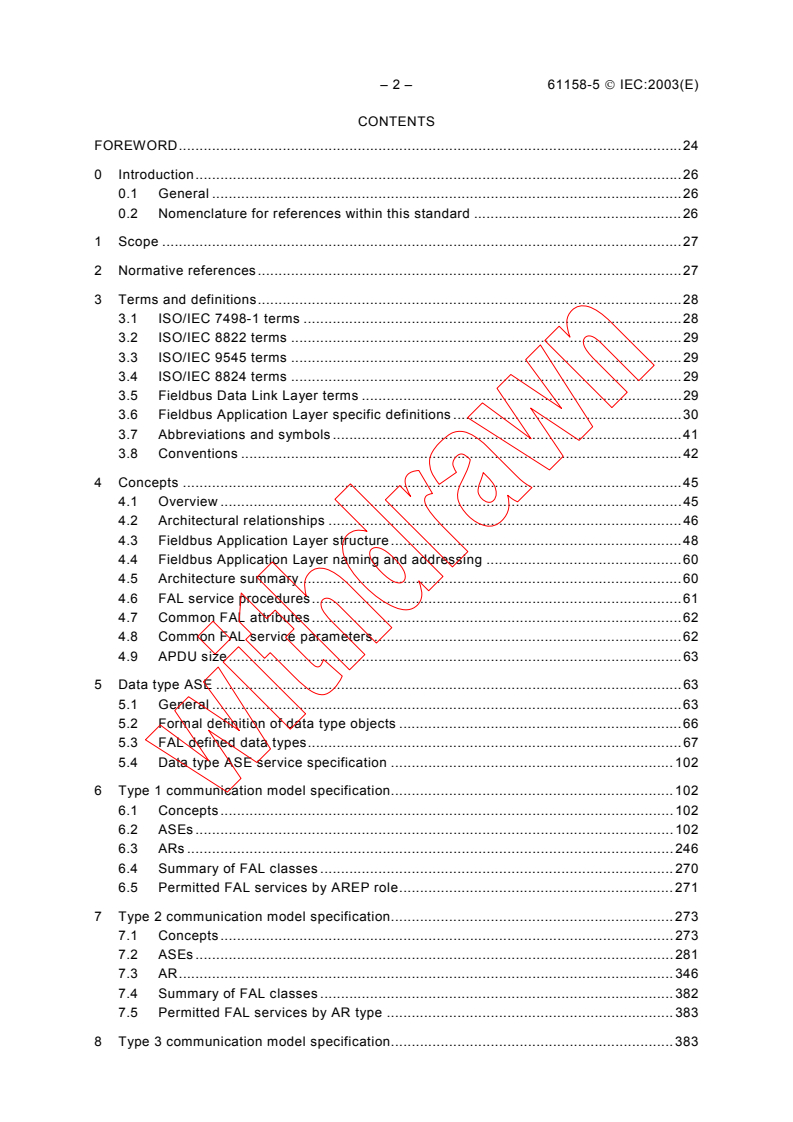
– 2 – 61158-5 IEC:2003(E)
CONTENTS
FOREWORD.24
0 Introduction.26
0.1 General .26
0.2 Nomenclature for references within this standard .26
1 Scope .27
2 Normative references.27
3 Terms and definitions.28
3.1 ISO/IEC 7498-1 terms .28
3.2 ISO/IEC 8822 terms .29
3.3 ISO/IEC 9545 terms .29
3.4 ISO/IEC 8824 terms .29
3.5 Fieldbus Data Link Layer terms .29
3.6 Fieldbus Application Layer specific definitions .30
3.7 Abbreviations and symbols .41
3.8 Conventions .42
4 Concepts .45
4.1 Overview .45
4.2 Architectural relationships .46
4.3 Fieldbus Application Layer structure.48
4.4 Fieldbus Application Layer naming and addressing .60
4.5 Architecture summary.60
4.6 FAL service procedures.61
4.7 Common FAL attributes .62
4.8 Common FAL service parameters.62
4.9 APDU size.63
5 Data type ASE .63
5.1 General .63
5.2 Formal definition of data type objects .66
5.3 FAL defined data types.67
5.4 Data type ASE service specification .102
6 Type 1 communication model specification.102
6.1 Concepts.102
6.2 ASEs .102
6.3 ARs .246
6.4 Summary of FAL classes .270
6.5 Permitted FAL services by AREP role.271
7 Type 2 communication model specification.273
7.1 Concepts.273
7.2 ASEs .281
7.3 AR.346
7.4 Summary of FAL classes .382
7.5 Permitted FAL services by AR type .383
8 Type 3 communication model specification.383
61158-5 IEC:2003(E) – 3 –
8.1 DP concepts.383
8.2 ASEs .401
8.3 Summary of AL classes .734
8.4 Permitted AL services by AREP role.735
8.5 Conformance classes .739
8.6 Application characteristics .739
9 Type 4 communication model specification.740
9.1 Concepts.740
9.2 Variable ASE.747
9.3 Application relationship ASE.766
10 Type 5 communication model specification.772
10.1 Concepts.772
10.2 ASEs .793
10.3 FDA sessions .828
10.4 Summary of FAL Type 9 and Type 5 classes .837
10.5 Permitted FAL Type 9 and Type 5 services by AREP role.838
11 Type 6 communication model specification.840
11.1 Application relationship (AR) and Application relationship endpoint (AREP)
characteristics .840
11.2 Relationship of Type 6 to Type 1 .842
11.3 Permitted services by AREP role .846
12 Type 7 communication model specification.848
12.1 Concepts.848
12.2 ASEs .864
12.3 ARs . 1033
13 Type 8 communication model specification. 1053
13.1 Concepts. 1053
13.2 ASEs . 1055
13.3 Application relationships. 1070
13.4 Permitted FAL services by AREP role. 1071
14 Type 9 communication model specification. 1072
14.1 Concepts. 1072
14.2 Common parameters . 1072
14.3 ASEs . 1073
14.4 ARs . 1163
14.5 Summary of classes . 1166
14.6 Permitted services by AREP role . 1166
15 Type 10 communication model specification. 1168
15.1 Type 10 Concepts . 1168
15.2 ASE Data Types . 1174
15.3 ASEs . 1175
15.4 ARs . 1289
15.5 Summary of FAL classes . 1292
15.6 Summary of FAL services. 1292
– 4 – 61158-5 IEC:2003(E)
Figure 1 – Relationship of IEC 61158-3 to other fieldbus layers and to users of the fieldbus
Application Service .26
Figure 2 – Relationship to the OSI basic reference model.46
Figure 3 – Architectural positioning of the fieldbus Application Layer .47
Figure 4 – Client/server interactions .49
Figure 5 – Pull model interactions.50
Figure 6 – Push model interactions .51
Figure 7 – APOs services conveyed by the FAL.52
Figure 8 – Application entity structure.54
Figure 9 – Example FAL ASEs.55
Figure 10 – FAL management of objects .56
Figure 11 – ASE service conveyance.57
Figure 12 – Defined and established AREPs.59
Figure 13 – FAL architectural components .61
Figure 14 – Data type class hierarchy example .64
Figure 15 – The AR ASE conveys APDUs between APs.133
Figure 16 – 1-to-1 AR establishment.145
Figure 17 – 1-to-many AR establishment .145
Figure 18 – Event model overview .185
Figure 19 – Residence timeliness .261
Figure 20 – Synchronized timeliness.262
Figure 21 – Residence timeliness .267
Figure 22 – Synchronized timeliness.268
Figure 23 – Overview of ASE's and object classes.275
Figure 24 – Addressing format using MAC, class, instance and attribute IDs .275
Figure 25 – Static Assembly state transition diagram .293
Figure 26 – Dynamic Assembly state transition diagram .294
Figure 27 – Example of Find_Next_Object_Instance service .323
Figure 28 – Context of transport services within the connection model.349
Figure 29 – Application–to–application view of data transfer .349
Figure 30 – Data flow diagram for a link producer .350
Figure 31 – Data flow diagram for a link consumer.351
Figure 32 – Triggers .352
Figure 33 – Binding transport instances to the producer and consumer of a transport
connection that does not have a reverse data path .353
Figure 34 – Binding transport instances to the producers and consumers of a transport
connection that does have a reverse data path .353
Figure 35 – Binding transport instances to the producer and consumers of a multipoint
connection when the transport connection does not have a reverse data path .354
Figure 36 – Binding transport instances to the producers and consumers of a multipoint
connection when the transport connection does have reverse data paths.354
Figure 37 – Example of DP communication with a single controlling device .386
Figure 38 – Example of DP communication with several controlling devices.386
Figure 39 – Example of DP communication between field devices.386
Figure 40 – DP-slave model (modular DP-slave).389
Figure 41 – DP-slave model (compact DP-slave) .389
Figure 42 – Overview of application processes .390
61158-5 IEC:2003(E) – 5 –
Figure 43 – DP-slave model (modular DP-slave).391
Figure 44 – Application Service Elements (ASEs) .393
Figure 45 – Application Process with application Objects (APOs).394
Figure 46 – Access to a remote APO .395
Figure 47 – Access to a remote APO for publisher/subscriber association .396
Figure 48 – Example of one AR with two AREPs.397
Figure 49 – Relation of a simple process data object to the real object .402
Figure 50 – Relation of a combined process data object to the real objects.405
Figure 51 – Sequence of an isochronous DP cycle with one DP-master (class 1).433
Figure 52 – Additional time relationships in a DP system operating in isochronous mode.434
Figure 53 – DP system with optimised isochronous DP cycle .436
Figure 54 – Buffered synchronised isochronous mode at the DP-master (class 1).437
Figure 55 – Enhanced synchronised isochronous mode at the DP-master (class 1) .438
Figure 56 – Input, output and PLL state machine interaction .438
Figure 57 – PLL state diagram .444
Figure 58 – OUTPUT state diagram .448
Figure 59 – INPUT state diagram.452
Figure 60 – Treatment of an alarm in the DP system.481
Figure 61 – Load Region state diagram for erasable memory.568
Figure 62 – Load region state diagram for non erasable memory .568
Figure 63 – Function invocation state diagram .595
Figure 64 – System architecture .605
Figure 65 – Assignment of communication relationship to application relationship .612
Figure 66 – MS0 application relationship .618
Figure 67 – Output buffer model of a DP-slave without sync functionality.619
Figure 68 – Output buffer model of a DP-slave with sync functionality.619
Figure 69 – Input buffer model of a DP-slave without freeze functionality.620
Figure 70 – Input buffer model of a DP-slave with freeze functionality.620
Figure 71 – MS1 application relationship .621
Figure 72 – MS2 application relationship .622
Figure 73 – Example of inter-network communication .623
Figure 74 – Example without inter-network addressing.623
Figure 75 – First example with inter-network addressing.624
Figure 76 – Second example with inter-network addressing .624
Figure 77 – MS3 application relationship .625
Figure 78 – MM1 application relationship .626
Figure 79 – MM2 application relationship .627
Figure 80 – Cycle time of the DP system .740
Figure 81 – FAL AE .741
Figure 82 – Summary of the FAL architecture .744
Figure 83 – FAL service procedure overview.745
Figure 84 – Time sequence diagram for the confirmed services .746
Figure 85 – Time sequence diagram for unconfirmed services .747
Figure 86 – VCR initiation .778
Figure 87 – Misordered message handling.784
Figure 88 – FF SM port message processing order .785
– 6 – 61158-5 IEC:2003(E)
Figure 89 – FF FDA port message processing order .785
Figure 90 – FF TCP connection message processing order .786
Figure 91 – Session endpoint message processing order.786
Figure 92 – FDA LAN redundancy port message processing order.786
Figure 93 – Message processing by receiving entity .787
Figure 94 – Organisation of the ASEs and ARs .848
Figure 95 – Object model of the MPS ASE.868
Figure 96 – Time-out evaluation net.881
Figure 97 – Asynchronous promptness status evaluation net .885
Figure 98 – Synchronous promptness status evaluation net.886
Figure 99 – Punctual promptness status evaluation net .888
Figure 100 – Asynchronous refreshment status evaluation net.891
Figure 101 – Synchronous refreshment status evaluation net.892
Figure 102 – Punctual refreshment status evaluation net .894
Figure 103 – A_Readloc service procedure.897
Figure 104 – A_Writeloc service procedure.898
Figure 105 – A_Update service procedure .900
Figure 106 – A_Readfar service procedure .902
Figure 107 – A_Writefar service procedure .904
Figure 108 – A_Sent service procedure .905
Figure 109 – A_Received service procedure .906
Figure 110 – A_Read service procedure .908
Figure 111 – A_Read service state machine .909
Figure 112 – A_Write service procedure .910
Figure 113 – A_Write service state machine .911
Figure 114 – Model of a resynchronised variable .914
Figure 115 – Principles for resynchronisation of a produced variable .915
Figure 116 – Resynchronisation mechanism state machine for a produced variable.917
Figure 117 – Asynchronous refreshment private mechanism evaluation net .918
Figure 118 – Asynchronous refreshment public mechanism evaluation net .919
Figure 119 – Synchronous refreshment private mechanism evaluation net.920
Figure 120 – Synchronous refreshment public mechanism evaluation net .921
Figure 121 – Punctual refreshment private mechanism evaluation net .922
Figure 122 – Punctual refreshment public mechanism evaluation net.923
Figure 123 – Principles for the resynchronisation of a consumed variable.924
Figure 124 – Resynchronisation mechanism state machine for consumed variable .926
Figure 125 – Asynchronous promptness public mechanism evaluation net.927
Figure 126 – Asynchronous promptness private mechanism evaluation net .928
Figure 127 – Synchronous promptness public mechanism evaluation net.929
Figure 128 – Synchronous promptness private mechanism evaluation net .931
Figure 129 – Punctual promptness public mechanism evaluation net .932
Figure 130 – Punctual promptness private mechanism evaluation net.933
Figure 131 – Spatial consistency list variables interchange mechanism .936
Figure 132 – Spatial consistency – consistency variable interchange mechanism .936
Figure 133 – Spatial consistency – list recovery mechanism .937
Figure 134 – Spatial consistency – validity of the spatial consistency status .937
61158-5 IEC:2003(E) – 7 –
Figure 135 – Object model of a variable list .938
Figure 136 – A_Readlist service procedure.943
Figure 137 – Consistency variable value evaluation net .949
Figure 138 – Consistency interchange timing diagram .950
Figure 139 – Recovery mechanism evaluation net .951
Figure 140 – Recovery interchange timing diagram.951
Figure 141 – Flowchart of the sub-MMS environment management state .958
Figure 142 – Domain management state chart .988
Figure 143 – Domain upload flowchart .991
Figure 144 – Domain download sequence diagram .992
Figure 145 – Domain upload sequence diagram.992
Figure 146 – Program invocation state chart . 1004
Figure 147 – A_Associate service procedure . 1042
Figure 148 – A_Release service procedure. 1045
Figure 149 – A_Abort service procedure . 1046
Figure 150 – A_Data service procedure . 1048
Figure 151 – A_Unidata service procedure . 1051
Figure 152 – Associated mode service state chart . 1052
Figure 153 – Non-associated mode service state chart . 1053
Figure 154 – Architectural positioning of the fieldbus Application Layer . 1053
Figure 155 – VFD model . 1073
Figure 156 – Abstract model of an automation system (VFD) . 1073
Figure 157 – Source OD/remote OD . 1080
Figure 158 – Put OD state machine . 1093
Figure 159 – Transaction object state machine . 1100
Figure 160 – Context test of two features-supported with different bitstring length . 1107
Figure 161 – Overview of event . 1127
Figure 162 – Event state machine. 1133
Figure 163 – Domain GenericDownload/Download state machine (server) . 1147
Figure 164 – Domain Upload state machine (server). 1149
Figure 165 – State diagram. 1161
Figure 166 — FAL ASEs Communication Architecture . 1170
Figure 167 — Runtime object model . 1171
Figure 168 — Relationship between Engineering and Runtime . 1172
Figure 169 — Navigation in the runtime object model . 1173
Figure 170 — Operating state block diagram . 1198
Figure 171 — Device status model for the common diagnosis. 1199
Figure 172 — ACCO ASE structure. 1223
Figure 173 — Productive operation of data connections. 1224
Figure 174 — Productive operation of event connections . 1225
Figure 175 — Quality Code transfer – standard behavior . 1233
Figure 176 — Quality Code with communication fault. 1234
Figure 177 — Quality Code when an connection is cleared . 1235
Figure 178 — Quality Code when an connection is deactivated. 1235
Figure 179 — Quality Code during the transfer of "incorrect“ connection data. 1236
Figure 180 — Quality Code for provider in "Ready“ state . 1236
– 8 – 61158-5 IEC:2003(E)
Figure 181 — Quality Code when clearing an object from the provider. 1237
Figure 182 — Quality Code when a connection is forced. 1237
Figure 183 — Quality Code at QoS violation . 1238
Figure 184 — Quality Code for initial value . 1238
Figure 185 — Productive operation of data connections. 1242
Figure 186 — Productive operation of event connections . 1243
Figure 187 — Failure of the provider in productive operation . 1246
Figure 188 — Failure of the consumer . 1247
Figure 189 — Failure of the provider when changing the connection status . 1248
Figure 190 – Failure of the provider when changing the interconnection status . 1249
Figure 191 — Failure of the provider when clearing connections. 1250
Figure 192 — Information levels . 1250
Figure 193 — ACCO ASE status model for the common diagnosis. 1251
Figure 194 — ACCO ASE status model for the detailed diagnosis . 1251
Figure 195 — Structure of the transmitted connection data . 1274
Table 1 – PERSISTDEF.72
Table 2 – VARTYPE .73
Table 3 – ITEMQUALITYDEF.74
Table 4 – STATEDEF .77
Table 5 – GROUPERRORDEF .77
Table 6 – ACCESSRIGHTSDEF.78
Table 7 – HRESULT .78
Table 8 – UUID .85
Table 9 – Data type names for value.100
Table 10 – UUID .102
Table 11 – Create service parameters .103
Table 12 – Delete service parameters.104
Table 13 – Get Attributes service parameters .106
Table 14 – Set Attributes service parameters.108
Table 15 – Begin Set Attributes .110
Table 16 – End Set Attributes .111
Table 17 – Subscribe service parameters .120
Table 18 – Identify .123
Table 19 – Get status .124
Table 20 – Status notification.125
Table 21 – Initiate.126
Table 22 – Terminate.129
Table 23 – Conclude.131
Table 24 – Reject .131
Table 25 – Conveyance of service primitives by AREP role.134
Table 26 – Valid combinations of AREP roles involved in an AR .134
Table 27 – AR-Unconfirmed Send.140
Table 28 – AR-Confirmed Send.142
Table 29 – AR-Establish service .144
Table 30 – Valid combinations of AREP classes to be related.146
61158-5 IEC:2003(E) – 9 –
Table 31 – AR-DeEstablish service.147
Table 32 – AR-Abort .148
Table 33 – AR-Compel service.149
Table 34 – AR-Get Buffered Message service.150
Table 35 – AR-Schedule Communication service .151
Table 36 – AR-Cancel Scheduled Sequence service.152
Table 37 – AR-Status.153
Table 38 – AR-XON-OFF .154
Table 39 – AR-Remote Read service .155
Table 40 – AR-Remote Write service .156
Table 41 – Read service parameters.165
Table 42 – Read List service parameters .168
Table 43 – Write service parameters.170
Table 44 – Write List service parameters .172
Table 45 – Information Report service .174
Table 46 – Information Report List service .176
Table 47 – Exchange service parameters .178
Table 48 – Exchange List service parameters .182
Table 49 – Acknowledge Event .194
Table 50 – Acknowledge Event List service parameters .195
Table 51 – Enable event .197
Table 52 – Event Notification service parameters.198
Table 53 – Enable Event List .200
Table 54 – Notification recovery service parameters .201
Table 55 – Get Event Summary service parameters.202
Table 56 – Get Event Summary List service parameters .204
Table 57 – Query Event Summary List service parameters .208
Table 58 – Initiate Load service parameters.216
Table 59 – Terminate Load service parameters.218
Table 60 – Push Segment service parameters .219
Table 61 – Pull Segment service parameters .220
Table 62 – Discard service parameters .221
Table 63 – Pull Upload Sequencing of service primitives .223
Table 64 – Pull Upload service parameter constraints.223
Table 65 – Pu
...