

IEC 61158-5-10:2007
(Main)Industrial communication networks - Fieldbus specifications - Part 5-10: Application layer service definition - Type 10 elements
General Information
- Abstract
It provides user programs with a means to access the fieldbus communication environment. In this respect, the FAL can be viewed as a "window between corresponding application programs." This standard provides common elements for basic time-critical and non-time-critical messaging communications between application programs in an automation environment and material specific to type 10 fieldbus. The term "time-critical" is used to represent the presence of a time-window, within which one or more specified actions are required0 to be completed with some defined level of certainty. Failure to complete specified actions within the time window risks failure of the applications requesting the actions, with attendant risk to equipment, plant and possibly human life. It includes the following significant changes with respect to the previous edition deletion of the former Type 6 fieldbus, and the placeholder for a Type 5 fieldbus data-link layer, for lack of market relevance; addition of new types of fieldbuses; division of this part into multiple parts numbered.
- Status
- Published
- Publication Date
- 13-Dec-2007
- Technical Committee
- SC 65C - Industrial networks
- Drafting Committee
- WG 9 - TC 65/SC 65C/WG 9
- Current Stage
- DELPUB - Deleted Publication
- Start Date
- 06-Aug-2010
- Completion Date
- 28-Aug-2026
Overview
IEC 61158-5-10:2007 is an international standard developed by the International Electrotechnical Commission (IEC). As part of the IEC 61158 family, this document focuses on the application layer service definitions for Type 10 fieldbus communication environments. Fieldbus systems are widely used in industrial automation for reliable communication between devices such as sensors, controllers, and actuators.
This part of the standard provides a framework for user programs to access the fieldbus environment, serving as a "window" between corresponding application programs in an automation setting. It addresses both time-critical (actions must be reliably completed within precise time windows) and non-time-critical messaging, ensuring that actions required by applications are completed within defined thresholds to maintain the safety and reliability of industrial facilities.
Key updates from previous editions include the removal of outdated fieldbus types and the addition of new communication types for enhanced market relevance. The standard divides its extensive scope across several parts, each focused on a specific fieldbus type.
Key Topics
Application Layer Services
Provides standardized ways for application programs to interact with the fieldbus, handling both real-time and non-real-time data exchanges.Time-Critical Messaging
Defines concepts and service models for deterministic communication, imperative for process automation, where delays or failures may lead to equipment damage or safety issues.Interoperability
Outlines common elements that ensure seamless communication between heterogeneous systems, supporting vendor-neutral integration.Communication Models
Details generic and specialized communication models, such as those for distributed automation and decentralized peripherals, including aspects like media redundancy and isochronous applications.Data Types and Quality
Specifies data type classes and mechanisms for monitoring connection quality, helping to maintain data integrity across the network.Conformance
Provides criteria and guidance to ensure that implementations satisfy the requirements necessary for interoperability and reliability.
Applications
IEC 61158-5-10:2007 is foundational in industrial automation and process control, including:
Factory Automation
Facilitates real-time control, data acquisition, and synchronization between programmable logic controllers (PLCs), sensors, and actuators.Process Industries
Vital for continuous operations in sectors like chemical processing, oil & gas, and pharmaceuticals, where reliable time-critical communication contributes to safe plant operation.Infrastructure Automation
Supports building and utility automation systems, enabling efficient operation and monitoring via robust fieldbus protocols.Machine Control Systems
Empowers distributed intelligence within machines for improved diagnostics, fault-tolerance, and flexible manufacturing processes.Safety-Critical Applications
Ensures that essential actions are reliably performed within required time frames, thereby protecting equipment and personnel.
Related Standards
To achieve comprehensive industrial communication solutions, IEC 61158-5-10:2007 is commonly used alongside other fieldbus standards, including:
- IEC 61158 series
Covers other types of fieldbus and layers (physical, data link, application) for a wide range of industrial needs. - IEC 61784 series
Details communication profiles that build on the IEC 61158 family for various industry sectors. - IEC 61508
Provides functional safety requirements applicable to safety-critical automation solutions. - IEC 62443
Addresses cybersecurity for industrial automation and control systems, complementing communication reliability.
Keywords: IEC 61158-5-10, industrial communication networks, fieldbus, application layer service, time-critical messaging, automation, process control, interoperability, PLC, distributed automation, decentralized peripherals, media redundancy.
For industrial stakeholders aiming to implement reliable, interoperable, and safe communication systems within automated environments, adherence to IEC 61158-5-10:2007 is essential.
Relations
- Effective Date
- 05-Sep-2023
- Effective Date
- 05-Sep-2023
- Effective Date
- 05-Sep-2023
- Effective Date
- 05-Sep-2023
Get Certified
Connect with accredited certification bodies for this standard

BSI Group
BSI (British Standards Institution) is the business standards company that helps organizations make excellence a habit.

DVS-ZERT GmbH
German welding certification society.
CARES (UK Certification Authority for Reinforcing Steels)
UK certification for reinforcing steels and construction.
Sponsored listings
Frequently Asked Questions
IEC 61158-5-10:2007 is a standard published by the International Electrotechnical Commission (IEC). Its full title is "Industrial communication networks - Fieldbus specifications - Part 5-10: Application layer service definition - Type 10 elements". This standard covers: It provides user programs with a means to access the fieldbus communication environment. In this respect, the FAL can be viewed as a "window between corresponding application programs." This standard provides common elements for basic time-critical and non-time-critical messaging communications between application programs in an automation environment and material specific to type 10 fieldbus. The term "time-critical" is used to represent the presence of a time-window, within which one or more specified actions are required0 to be completed with some defined level of certainty. Failure to complete specified actions within the time window risks failure of the applications requesting the actions, with attendant risk to equipment, plant and possibly human life. It includes the following significant changes with respect to the previous edition deletion of the former Type 6 fieldbus, and the placeholder for a Type 5 fieldbus data-link layer, for lack of market relevance; addition of new types of fieldbuses; division of this part into multiple parts numbered.
It provides user programs with a means to access the fieldbus communication environment. In this respect, the FAL can be viewed as a "window between corresponding application programs." This standard provides common elements for basic time-critical and non-time-critical messaging communications between application programs in an automation environment and material specific to type 10 fieldbus. The term "time-critical" is used to represent the presence of a time-window, within which one or more specified actions are required0 to be completed with some defined level of certainty. Failure to complete specified actions within the time window risks failure of the applications requesting the actions, with attendant risk to equipment, plant and possibly human life. It includes the following significant changes with respect to the previous edition deletion of the former Type 6 fieldbus, and the placeholder for a Type 5 fieldbus data-link layer, for lack of market relevance; addition of new types of fieldbuses; division of this part into multiple parts numbered.
IEC 61158-5-10:2007 is classified under the following ICS (International Classification for Standards) categories: 25.040.40 - Industrial process measurement and control; 35.100.20 - Data link layer. The ICS classification helps identify the subject area and facilitates finding related standards.
IEC 61158-5-10:2007 has the following relationships with other standards: It is inter standard links to IEC 61158-5:2003, IEC PAS 62411:2005, IEC 61158-5:2003/COR1:2004, IEC 61158-5-10:2010. Understanding these relationships helps ensure you are using the most current and applicable version of the standard.
IEC 61158-5-10:2007 is available in PDF format for immediate download after purchase. The document can be added to your cart and obtained through the secure checkout process. Digital delivery ensures instant access to the complete standard document.
Standards Content (Sample)
IEC 61158-5-10
Edition 1.0 2007-12
INTERNATIONAL
STANDARD
Industrial communication networks – Fieldbus specifications –
Part 5-10: Application layer service definition – Type 10 elements
All rights reserved. Unless otherwise specified, no part of this publication may be reproduced or utilized in any form
or by any means, electronic or mechanical, including photocopying and microfilm, without permission in writing from
either IEC or IEC's member National Committee in the country of the requester.
If you have any questions about IEC copyright or have an enquiry about obtaining additional rights to this publication,
please contact the address below or your local IEC member National Committee for further information.
IEC Central Office
3, rue de Varembé
CH-1211 Geneva 20
Switzerland
Email: inmail@iec.ch
Web: www.iec.ch
About the IEC
The International Electrotechnical Commission (IEC) is the leading global organization that prepares and publishes
International Standards for all electrical, electronic and related technologies.
About IEC publications
The technical content of IEC publications is kept under constant review by the IEC. Please make sure that you have the
latest edition, a corrigenda or an amendment might have been published.
ƒ Catalogue of IEC publications: www.iec.ch/searchpub
The IEC on-line Catalogue enables you to search by a variety of criteria (reference number, text, technical committee,…).
It also gives information on projects, withdrawn and replaced publications.
ƒ IEC Just Published: www.iec.ch/online_news/justpub
Stay up to date on all new IEC publications. Just Published details twice a month all new publications released. Available
on-line and also by email.
ƒ Electropedia: www.electropedia.org
The world's leading online dictionary of electronic and electrical terms containing more than 20 000 terms and definitions
in English and French, with equivalent terms in additional languages. Also known as the International Electrotechnical
Vocabulary online.
ƒ Customer Service Centre: www.iec.ch/webstore/custserv
If you wish to give us your feedback on this publication or need further assistance, please visit the Customer Service
Centre FAQ or contact us:
Email: csc@iec.ch
Tel.: +41 22 919 02 11
Fax: +41 22 919 03 00
IEC 61158-5-10
Edition 1.0 2007-12
INTERNATIONAL
STANDARD
Industrial communication networks – Fieldbus specifications –
Part 5-10: Application layer service definition – Type 10 elements
INTERNATIONAL
ELECTROTECHNICAL
COMMISSION
PRICE CODE
XH
ICS 35.100.70; 25.040.40 ISBN 2-8318-9459-X
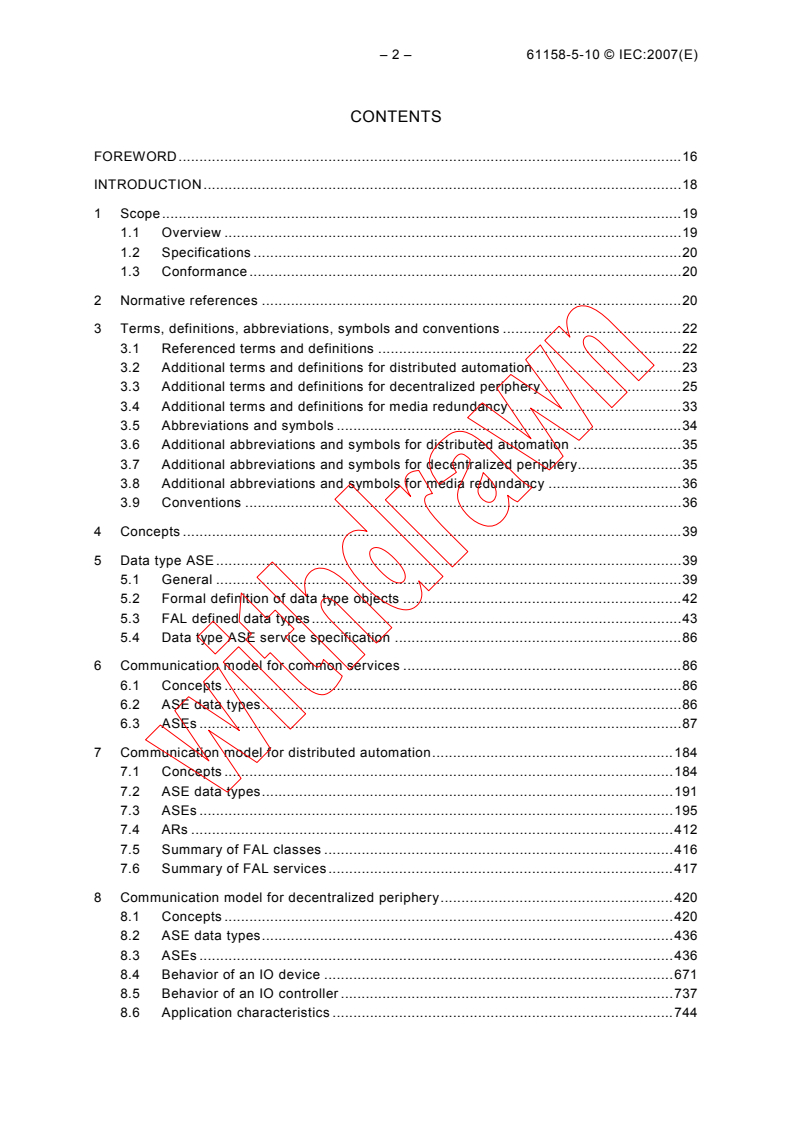
– 2 – 61158-5-10 © IEC:2007(E)
CONTENTS
FOREWORD.16H16
INTRODUCTION.17H18
1 Scope.18H19
1.1 Overview .19H19
1.2 Specifications .20H20
1.3 Conformance .21H20
2 Normative references .22H20
3 Terms, definitions, abbreviations, symbols and conventions .23H22
3.1 Referenced terms and definitions .24H22
3.2 Additional terms and definitions for distributed automation .25H23
3.3 Additional terms and definitions for decentralized periphery .26H25
3.4 Additional terms and definitions for media redundancy .27H33
3.5 Abbreviations and symbols .28H34
3.6 Additional abbreviations and symbols for distributed automation .29H35
3.7 Additional abbreviations and symbols for decentralized periphery.30H35
3.8 Additional abbreviations and symbols for media redundancy .31H36
3.9 Conventions .32H36
4 Concepts .33H39
5 Data type ASE.34H39
5.1 General .35H39
5.2 Formal definition of data type objects .36H42
5.3 FAL defined data types.37H43
5.4 Data type ASE service specification .38H86
6 Communication model for common services .39H86
6.1 Concepts .40H86
6.2 ASE data types.41H86
6.3 ASEs .42H87
7 Communication model for distributed automation.43H184
7.1 Concepts .44H184
7.2 ASE data types.45H191
7.3 ASEs .46H195
7.4 ARs .47H412
7.5 Summary of FAL classes .48H416
7.6 Summary of FAL services .49H417
8 Communication model for decentralized periphery.50H420
8.1 Concepts .51H420
8.2 ASE data types.52H436
8.3 ASEs .53H436
8.4 Behavior of an IO device .54H671
8.5 Behavior of an IO controller .55H737
8.6 Application characteristics .56H744
61158-5-10 © IEC:2007(E) – 3 –
Annex A (informative) Device instances .57H746
Annex B (informative) Components of an Ethernet interface .58H748
Annex C (informative) Scheme of MAC address assignment .59H752
Annex D (informative) Collection of objects.60H753
Annex E (informative) Measurement of the fast startup time.61H754
Bibliography.62H755
Figure 1 – Data type class hierarchy example .63H40
Figure 2 – NetworkTime date relation.64H63
Figure 3 – UTF-8 coding of four different characters .65H67
Figure 4 – PTCP applications.66H100
Figure 5 – Clock drift measurement .67H110
Figure 6 – Multiple synchronization.68H110
Figure 7 –MRP stack.69H112
Figure 8 – Ring topology with one manager and clients.70H123
Figure 9 – MRM in an open ring .71H123
Figure 10 – More than one MRM in the ring .72H125
Figure 11 – Media redundancy diagnosis dependencies.73H126
Figure 12 – Locating the destination for redundant RT frames .74H165
Figure 13 – Example of periods at a local port .75H172
Figure 14 – FAL ASEs communication architecture .76H187
Figure 15 – Runtime object model.77H188
Figure 16 – Relationship between engineering and runtime.78H189
Figure 17 – Navigation in the runtime object model.79H190
Figure 18 – Operating state block diagram.80H229
Figure 19 – Device status model for the common diagnosis .81H230
Figure 20 – ACCO ASE structure .82H261
Figure 21 – Productive operation of data connections .83H262
Figure 22 – Quality code transfer – standard behavior .84H274
Figure 23 – Startup of a connection .85H275
Figure 24 – Quality code with communication fault.86H275
Figure 25 – Quality code when an connection is cleared .87H276
Figure 26 – Quality code when an connection is deactivated.88H276
Figure 27 – Quality code during the transfer of "incorrect" connection data .89H277
Figure 28 – Quality code for provider in "CBAReady" state .90H278
Figure 29 – Quality code when clearing an object from the provider .91H278
Figure 30 – Quality code when a connection is forced.92H279
Figure 31 – Quality code at QoS violation .93H279
Figure 32 – Push mode .94H286
Figure 33 – Pull mode overview .95H287
– 4 – 61158-5-10 © IEC:2007(E)
Figure 34 – Detailed sequence chart of the pull mode.96H288
Figure 35 – QoS and ORPC communication channel.97H289
Figure 36 – QoS Violation within Pull Mode.98H290
Figure 37 – Monitoring the providers heartbeat .99H291
Figure 38 – State machine RemoteAcco .100H293
Figure 39 – State machine RemoteAccoProvider.101H293
Figure 40 – State machine RemoteAccoProvider .102H294
ORPC
Figure 41 – State machine AR – Provider .103H294
ORPC
Figure 42 – State machine GetConnectionData – Provider.104H295
Figure 43 – State machine ProviderConnection.105H295
Figure 44 – State machine ProvConnActivation.106H296
Figure 45 – State machine WorkerORPC .107H296
Figure 46 – Communication stack of distributed automation devices .108H297
Figure 47 – Application relations between devices .109H298
Figure 48 – Communication relations .110H298
Figure 49 – RT communication channel .111H300
Figure 50 – Interaction between provider and consumer .112H302
Figure 51 – State machine AR – Consumer .113H304
SRT
Figure 52 – State machine AR – Provider .114H304
SRT
Figure 53 – State machine AccoDataCR – Consumer.115H305
Figure 54 – State machine AccoDataCR – Provider .116H306
Figure 55 – RT frame layout.117H307
Figure 56 – Establishing an AccoDataCR.118H308
Figure 57 – Flowchart of the copy cycle for local connections .119H309
Figure 58 – State machine connect attempt .120H313
Figure 59 – Productive operation of data connections (ORPC channel).121H320
Figure 60 – Productive operation of data connections (RT channel) .122H321
Figure 61 – Productive operation of data connections (Local channel) .123H321
Figure 62 – Data flow for cyclic RT .124H322
Figure 63 – Failure of the provider in productive operation (ORPC push mode).125H324
Figure 64 – Failure of the provider in productive operation (ORPC pull mode) .126H325
Figure 65 – Scenario 1: Provider failure in productive operation (RT).127H326
Figure 66 – Scenario 2: Recovery from provider failure in productive operation (RT).128H327
Figure 67 – Failure of the consumer (push mode) .129H327
Figure 68 – Failure of the consumer (pull mode) .130H328
Figure 69 – Failure of the consumer.131H329
Figure 70 – Failure of the provider when setting up connections .132H331
Figure 71 – Information levels.133H332
Figure 72 – ACCO ASE status model for the common diagnosis .134H332
Figure 73 – ACCO ASE status model for the detailed diagnosis .135H333
Figure 74 – Structure of the transmitted connection data .136H375
61158-5-10 © IEC:2007(E) – 5 –
Figure 75 – Example of communication between controlling devices and field devices.137H421
Figure 76 – Example of communication between an engineering station and several
controlling and field devices .138H421
Figure 77 – Example of communication between field devices and a server station.139H422
Figure 78 – Example of communication between field devices .140H422
Figure 79 – Structural units of one arbitrary API of an IO device (general) .141H424
Figure 80 – Example 1 structural units for interfaces and ports within API 0.142H425
Figure 81 – Example 2 structural units for interfaces and ports within API 0.143H426
Figure 82 – Overview of application processes .144H428
Figure 83 – IO device with APs, slots and subslots .145H429
Figure 84 – Application Process with application objects (APOs) .146H432
Figure 85 – Access to a remote APO .147H433
Figure 86 – Access to a remote APO for provider/consumer association .148H434
Figure 87 – Example of one AR with two AREPs.149H435
Figure 88 – Relation of a record data object to one real object.150H437
Figure 89 – Relation of a record data object to two real objects .151H438
Figure 90 – Overview IO ASE service interactions .152H448
Figure 91 – Example of a resource model at the alarm source .153H525
Figure 92 – General isochronous application model (example).154H560
Figure 93 – ASE relations in an IO device operating in isochronous mode .155H566
Figure 94 – State machine relations in an IO device operating in isochronous mode .156H566
Figure 95 – SyncCtl state diagram .157H570
Figure 96 – Output state diagram.158H572
Figure 97 – Input state diagram .159H577
Figure 98 – Assignment of communication relationship to application relationship .160H650
Figure 99 – Implicit application relationship.161H653
Figure 100 – Example IO application relationship (one-to-one) .162H655
Figure 101 – Example IO application relationship one-to-many .163H656
Figure 102 – Overview ASE state machines for IO device .164H672
Figure 103 – State diagram application startup IO device.165H673
Figure 104 – State diagram startup manager IO device.166H681
Figure 105 – State diagram IRT port state IO device (standard) .167H684
Figure 106 – State diagram IRT port state IO device (optimized).168H696
Figure 107 – State diagram neighborhood check.169H703
Figure 108 – State diagram PD parameter check IO device .170H712
Figure 109 – State diagram for a submodule.171H722
Figure 110 – State diagram IO controller during startup .172H738
Figure 111 – State diagram startup manager IO controller .173H741
Figure 112 – Example of network topology including slower wireless segments .174H745
Figure 113 – Example of media redundancy including wireless segments .175H745
Figure A.1 – Instance model .176H746
– 6 – 61158-5-10 © IEC:2007(E)
Figure B.1 – Scheme of an Ethernet interface .177H748
Figure B.2 – Scheme of an Ethernet interface with bridging ability .178H749
Figure B.3 – Scheme of an Ethernet interface with optical ports.179H750
Figure B.4 – Scheme of an Ethernet interface with bridging ability using radio
communication .180H751
Figure B.5 – Scheme of an Ethernet interface with radio communication.181H751
Figure C.1 – Scheme of MAC address assignment.182H752
Figure D.1 – Example for an intersection of IO device, slot, and AR.183H753
Figure E-1 – Measurement of the fast startup time.184H754
Table 1 – PERSISTDEF .185H46
Table 2 – VARTYPE.186H47
Table 3 – ITEMQUALITYDEF.187H47
Table 4 – STATEDEF.188H51
Table 5 – GROUPERRORDEF .189H51
Table 6 – ACCESSRIGHTSDEF.190H51
Table 7 – HRESULT.191H52
Table 8 – N2 value range.192H56
Table 9 – N2 octets.193H56
Table 10 – N4 value range .194H57
Table 11 – N4 octets.195H57
Table 12 – X2 value range .196H58
Table 13 – X2 octets .197H58
Table 14 – X4 value range .198H58
Table 15 – X4 octets .199H58
Table 16 – Unipolar2.16 value range.200H59
Table 17 – Unipolar2.16 octets .201H59
Table 18 – E2 value range .202H59
Table 19 – E2 octets .203H59
Table 20 – C4 value range .204H60
Table 21 – V2 octets .205H60
Table 22 – L2 octets .206H60
Table 23 – UUID for decentralized peripherals .207H61
Table 24 – UUID for distributed automation.208H62
Table 25 – NetworkTime values .209H63
Table 26 – NetworkTime octets.210H63
Table 27 – T2 values .211H64
Table 28 – T4 values .212H64
Table 29 – D2 values .213H65
Table 30 – R2 values .214H65
Table 31 – UNICODEString values.215H66
61158-5-10 © IEC:2007(E) – 7 –
Table 32 – UTF-8 character encoding scheme .216H67
Table 33 – OctetString2+Unsigned8 octets .217H78
Table 34 – Float32+Unsigned8 octets .218H79
Table 35 – Unsigned8+Unsigned8 octets .219H79
Table 36 – Data Types for Value in a VARIANT .220H82
Table 37 – Unsigned16_S octets.221H83
Table 38 – Unsigned16_S meaning.222H83
Table 39 – Integer16_S octets .223H84
Table 40 – Integer16_S meaning .224H84
Table 41 – Unsigned8_S octets .225H84
Table 42 – Unsigned8_S meaning.226H84
Table 43 – OctetString_S octets .227H85
Table 44 – OctetString_S status bits .228H85
Table 45 – F message trailer with 4 octets .229H85
Table 46 – F message trailer with 5 octets .230H86
Table 47 – Get .231H92
Table 48 – Set .232H94
Table 49 – Identify .233H97
Table 50 – Hello.234H98
Table 51 – Clock stratum .235H102
Table 52 – Start bridge .236H104
Table 53 – Start slave .237H105
Table 54 – Start master .238H106
Table 55 – Stop bridge.239H107
Table 56 –Stop slave .240H107
Table 57 – Stop master.241H108
Table 58 – State change .242H109
Table 59 – Start MRM .243H117
Table 60 – Stop MRM .244H119
Table 61 – Change state.245H119
Table 62 – Start MRC .246H120
Table 63 – Stop MRC.247H121
Table 64 – Neighborhood changed.248H122
Table 65 – MRP network/connection parameters .249H127
Table 66 – MRM parameters .250H127
Table 67 – MRC parameters .251H127
Table 68 – Set prov data.252H128
Table 69 – Set prov status .253H129
Table 70 – PPM activate .254H130
Table 71 – Close.255H131
Table 72 – Start .256H131
– 8 – 61158-5-10 © IEC:2007(E)
Table 73 – Error.257H132
Table 74 – Get cons data.258H132
Table 75 – Get cons status .259H133
Table 76 – Set redRole .260H133
Table 77 – CPM activate.261H134
Table 78 – APMS activate.262H138
Table 79 – APMR activate.263H139
Table 80 – APMS A data.264H140
Table 81 – APMR A data.265H141
Table 82 – APMR ack .266H141
Table 83 – APMS error .267H142
Table 84 – APMS error ERRCLS/ERRCODE.268H142
Table 85 – APMR error .269H143
Table 86 – APMR error ERRCLS/ERRCODE.270H143
Table 87 – APMS_Close .271H143
Table 88 – APMR_Close .272H144
Table 89 – Connect.273H145
Table 90 – Release.274H146
Table 91 – Read .275H147
Table 92 – Write .276H148
Table 93 – Control .277H149
Table 94 – System capabilities.278H154
Table 95 – Auto negotiation support and status.279H155
Table 96 – MDI Power Support .280H156
Table 97 – Link aggregation status .281H156
Table 98 – Remote systems data change.282H159
Table 99 – Allowed values of ReductionRatio.283H162
Table 100 – Frame IDs for RT_CLASS_3.284H163
Table 101 – Sync Frame .285H163
Table 102 – FrameSendOffset .286H163
Table 103 – Tx Port Entry .287H164
Table 104 – Port state change .288H167
Table 105 – Set port state.289H167
Table 106 – Flush filtering data base .290H167
Table 107 – IFW IRT Schedule Add .291H168
Table 108 – IFW IRT Schedule Remove.292H168
Table 109 – IFW Schedule.293H169
Table 110 – MAU type change .294H173
Table 111 – Set MAU type .295H174
Table 112 – IP Multicast address .296H176
Table 113 – Set ARP cache .297H176
61158-5-10 © IEC:2007(E) – 9 –
Table 114 – Enterprise number .298H179
Table 115 – Vendor OUI .299H179
Table 116 – IRT schedule sdd.300H180
Table 117 – IRT schedule remove.301H181
Table 118 – Schedule .302H181
Table 119 – N data .303H182
Table 120 – A data.304H183
Table 121 – C data .305H184
Table 122 – Connectable data types .306H192
Table 123 – Supported data types according to the Base Object Version .307H193
Table 124 – Usage of character sets.308H195
Table 125 – QueryInterface (Unknown interface) .309H197
Table 126 – AddRef (Unknown interface) .310H198
Table 127 – Release (Unknown interface).311H199
Table 128 – GetTypeInfoCount (Dispatch interface) .312H200
Table 129 – GetTypeInfo (Dispatch interface) .313H201
Table 130 – GetIDsOfNames (Dispatch interface) .314H202
Table 131 – Invoke (Dispatch interface) .315H203
Table 132 – CRC table for the PDev stamp calculation (hexadecimal values) .316H208
Table 133 – get_Producer (Physical device interface) .317H209
Table 134 – get_Product (Physical device interface) .318H210
Table 135 – get_SerialNo (Physical device interface).319H211
Table 136 – get_ProductionDate (Physical device interface) .320H212
Table 137 – Revision (Physical device interface) .321H213
Table 138 – get_LogicalDevice (Physical device interface) .322H214
Table 139 – Type (Physical device interface) .323H215
Table 140 – PROFInetRevision (Physical device interface) .324H216
Table 141 – get_PDevStamp (Physical device interface).325H217
Table 142 – get_Count (Browse interface) .326H218
Table 143 – BrowseItems (Browse interface) .327H219
Table 144 – get_Count2 (Browse interface) .328H220
Table 145 – BrowseItems2 (Browse interface) .329H222
Table 146 – Save (Persist interface) .330H223
Table 147 – Save2 (Persist interface) .331H224
Table 148 – get_Name (Logical device interface).332H230
Table 149 – get_Producer (Logical device interface).333H231
Table 150 – get_Product (Logical device interface).334H232
Table 151 – get_SerialNo (Logical device interface).335H233
Table 152 – get_ProductionDate (Logical device interface) .336H234
Table 153 – Revision (Logical device interface) .337H235
Table 154 – get_ACCO (Logical device interface) .338H236
– 10 – 61158-5-10 © IEC:2007(E)
Table 155 – get_RTAuto (Logical device interface) .339H237
Table 156 – PROFInetRevision (Logical device interface) .340H238
Table 157 – ComponentInfo (Logical device interface) .341H239
Table 158 – get_State (State interface).342H240
Table 159 – Activate (State interface) .343H242
Table 160 – Deactivate (State interface) .344H243
Table 161 – Reset (State interface).
...