

IEC TS 62786-2:2026
(Main)Distributed energy resources connection with the grid - Part 2: Additional requirements for PV generation systems
General Information
- Abstract
IEC TS 62786-2:2026 supplements IEC TS 62786-1, and specifies requirements for the connection of the solar photovoltaic energy system or photovoltaic generating system (PV system) with an electric power network, or the network. This document covers all sizes of PV systems connected to low voltage or medium voltage power networks and gives typical requirements for various sizes of PV systems.
In this document, requirements for grid-connected PV systems are applied to those categorized as grid tied, grid tied with storage and grid tied with storage and back up. Mini-grid and Micro-grid are out of scope. Those types of PV systems with possible elements are described in 4.3.
This document specifies the following technical requirements for the PV system:
- reference points of requirements,
- elements and configuration,
- basic operation,
- protection and fault ride through function,
- power control and grid support function,
- electromagnetic compatibility for low frequency conducted disturbances,
- information exchange for remote monitoring, control, and configuration.
- Status
- Published
- Publication Date
- 25-Jan-2026
- Technical Committee
- TC 8 - System aspects of electrical energy supply
- Drafting Committee
- JWG 10 - TC 8/JWG 10
- Current Stage
- PPUB - Publication issued
- Start Date
- 26-Jan-2026
- Completion Date
- 09-Jan-2026
Overview
IEC TS 62786-2:2026, developed by the International Electrotechnical Commission (IEC), provides supplemental requirements for the connection of solar photovoltaic (PV) generation systems to electric power networks. Building on IEC TS 62786-1, this Technical Specification outlines essential criteria for integrating PV systems of all sizes into low and medium voltage power networks. Its scope is limited to grid-connected PV systems categorized as grid-tied, grid-tied with storage, and grid-tied with storage and backup. Mini-grid and micro-grid configurations are excluded.
The document establishes a harmonized approach to ensure safe, reliable, and efficient interconnection of PV systems, supporting both utility operators and system integrators in addressing modern grid requirements.
Key Topics
IEC TS 62786-2:2026 specifies several technical aspects for PV system grid integration, including:
- Reference Points of Requirements: Defines requirements at key locations-point of connection (POC), point of common coupling (PCC), and in-plant point of coupling (IPC).
- Elements and Configuration: Addresses system variants such as grid-tied and grid-tied with storage, and provides typical configurations for both single and multi-unit setups.
- Basic Operation: Sets accuracy and control requirements for output power, power factor, and the system’s response to voltage, frequency, and other grid events.
- Protection and Fault Ride Through: Outlines protection mechanisms for over/under voltage, frequency anomalies, and specifies ride-through capabilities allowing PV systems to remain connected during short-term faults.
- Power Control and Grid Support: Details control functions such as active and reactive power management, automatic connection/reconnection, and grid support functionalities.
- Electromagnetic Compatibility (EMC): Specifies requirements for managing low-frequency conducted disturbances and harmonics to maintain network power quality.
- Information Exchange: Defines provisions for remote monitoring, control, and configuration, including data exchange between the PV system and utility operators for operational status, performance, and protection features.
Applications
This standard is crucial for a range of stakeholders working with PV systems:
- System Integrators and Installers: Ensures correct configuration and compliance when connecting PV systems of any size to the utility grid, whether they are stand-alone grid-tied systems or feature integrated storage solutions.
- Utilities and Grid Operators: Provides a clear framework for assessing PV system connection requests, evaluating technical compliance, and facilitating active grid management.
- Manufacturers: Guides development of PV equipment-including inverters, switches, transformers, and communication interfaces-to guarantee compatibility and interoperability with network requirements.
- Regulatory Bodies: Supports the development and enforcement of national or regional grid codes related to renewable energy integration.
Practical value stems from standardized requirements that help maintain grid stability and safety while promoting the integration of solar power into existing infrastructures. The emphasis on information exchange paves the way for smarter grid monitoring and control, supporting the transition to distributed energy resources.
Related Standards
IEC TS 62786-2:2026 is designed to supplement and align with related international standards, including:
- IEC TS 62786-1: General requirements for distributed energy resources connection with the grid
- IEC 60255 series: Functional requirements for protection relays (over/under voltage and frequency)
- IEC 61000 series: Electromagnetic compatibility standards for power quality and conducted disturbances
- IEC TS 62910, IEC TS 63217: Test procedures for PV inverter ride-through capabilities
- IEC 61724-1: Monitoring and performance indices for PV systems
- IEC TS 62786-3: (when published) Grid connection requirements for electrical energy storage systems
By following IEC TS 62786-2:2026, stakeholders ensure that PV generation systems are grid-ready, meeting current and future demands for reliability, safety, and effective integration of renewable energy sources.
Get Certified
Connect with accredited certification bodies for this standard

DNV
DNV is an independent assurance and risk management provider.

Lloyd's Register
Lloyd's Register is a global professional services organisation specialising in engineering and technology.

DIBt (Deutsches Institut für Bautechnik)
German Institute for Building Technology.
Sponsored listings
Frequently Asked Questions
IEC TS 62786-2:2026 is a technical specification published by the International Electrotechnical Commission (IEC). Its full title is "Distributed energy resources connection with the grid - Part 2: Additional requirements for PV generation systems". This standard covers: IEC TS 62786-2:2026 supplements IEC TS 62786-1, and specifies requirements for the connection of the solar photovoltaic energy system or photovoltaic generating system (PV system) with an electric power network, or the network. This document covers all sizes of PV systems connected to low voltage or medium voltage power networks and gives typical requirements for various sizes of PV systems. In this document, requirements for grid-connected PV systems are applied to those categorized as grid tied, grid tied with storage and grid tied with storage and back up. Mini-grid and Micro-grid are out of scope. Those types of PV systems with possible elements are described in 4.3. This document specifies the following technical requirements for the PV system: - reference points of requirements, - elements and configuration, - basic operation, - protection and fault ride through function, - power control and grid support function, - electromagnetic compatibility for low frequency conducted disturbances, - information exchange for remote monitoring, control, and configuration.
IEC TS 62786-2:2026 supplements IEC TS 62786-1, and specifies requirements for the connection of the solar photovoltaic energy system or photovoltaic generating system (PV system) with an electric power network, or the network. This document covers all sizes of PV systems connected to low voltage or medium voltage power networks and gives typical requirements for various sizes of PV systems. In this document, requirements for grid-connected PV systems are applied to those categorized as grid tied, grid tied with storage and grid tied with storage and back up. Mini-grid and Micro-grid are out of scope. Those types of PV systems with possible elements are described in 4.3. This document specifies the following technical requirements for the PV system: - reference points of requirements, - elements and configuration, - basic operation, - protection and fault ride through function, - power control and grid support function, - electromagnetic compatibility for low frequency conducted disturbances, - information exchange for remote monitoring, control, and configuration.
IEC TS 62786-2:2026 is classified under the following ICS (International Classification for Standards) categories: 27.160 - Solar energy engineering; 91.140.50 - Electricity supply systems. The ICS classification helps identify the subject area and facilitates finding related standards.
IEC TS 62786-2:2026 is available in PDF format for immediate download after purchase. The document can be added to your cart and obtained through the secure checkout process. Digital delivery ensures instant access to the complete standard document.
Standards Content (Sample)
IEC TS 62786-2 ®
Edition 1.0 2026-01
TECHNICAL
SPECIFICATION
Distributed energy resources connection with the grid -
Part 2: Additional requirements for PV generation systems
ICS 91.140.50; 27.160 ISBN 978-2-8327-0979-5
All rights reserved. Unless otherwise specified, no part of this publication may be reproduced or utilized in any form or
by any means, electronic or mechanical, including photocopying and microfilm, without permission in writing from either
IEC or IEC's member National Committee in the country of the requester. If you have any questions about IEC copyright
or have an enquiry about obtaining additional rights to this publication, please contact the address below or your local
IEC member National Committee for further information.
IEC Secretariat Tel.: +41 22 919 02 11
3, rue de Varembé info@iec.ch
CH-1211 Geneva 20 www.iec.ch
Switzerland
About the IEC
The International Electrotechnical Commission (IEC) is the leading global organization that prepares and publishes
International Standards for all electrical, electronic and related technologies.
About IEC publications
The technical content of IEC publications is kept under constant review by the IEC. Please make sure that you have the
latest edition, a corrigendum or an amendment might have been published.
IEC publications search - IEC Products & Services Portal - products.iec.ch
webstore.iec.ch/advsearchform Discover our powerful search engine and read freely all the
The advanced search enables to find IEC publications by a publications previews, graphical symbols and the glossary.
variety of criteria (reference number, text, technical With a subscription you will always have access to up to date
committee, …). It also gives information on projects, content tailored to your needs.
replaced and withdrawn publications.
Electropedia - www.electropedia.org
The world's leading online dictionary on electrotechnology,
IEC Just Published - webstore.iec.ch/justpublished
Stay up to date on all new IEC publications. Just Published containing more than 22 500 terminological entries in English
details all new publications released. Available online and and French, with equivalent terms in 25 additional languages.
once a month by email. Also known as the International Electrotechnical Vocabulary
(IEV) online.
IEC Customer Service Centre - webstore.iec.ch/csc
If you wish to give us your feedback on this publication or
need further assistance, please contact the Customer
Service Centre: sales@iec.ch.
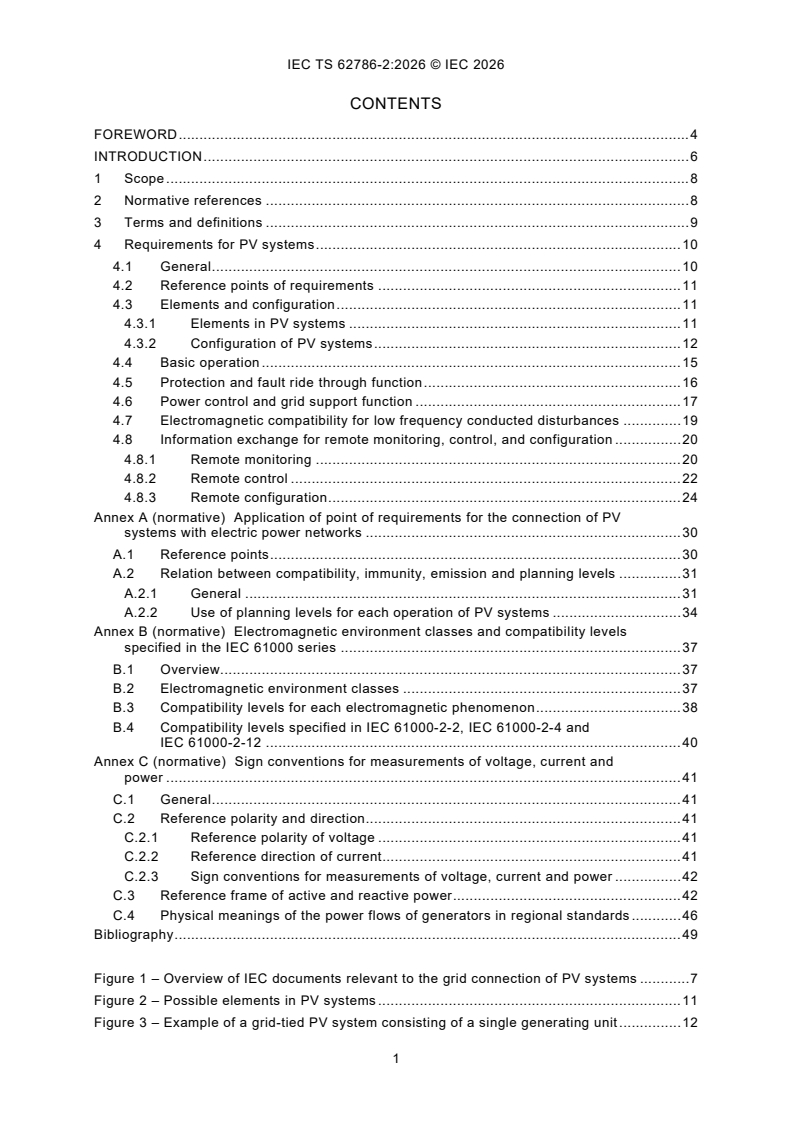
CONTENTS
FOREWORD . 4
INTRODUCTION . 6
1 Scope . 8
2 Normative references . 8
3 Terms and definitions . 9
4 Requirements for PV systems . 10
4.1 General . 10
4.2 Reference points of requirements . 11
4.3 Elements and configuration . 11
4.3.1 Elements in PV systems . 11
4.3.2 Configuration of PV systems . 12
4.4 Basic operation . 15
4.5 Protection and fault ride through function . 16
4.6 Power control and grid support function . 17
4.7 Electromagnetic compatibility for low frequency conducted disturbances . 19
4.8 Information exchange for remote monitoring, control, and configuration . 20
4.8.1 Remote monitoring . 20
4.8.2 Remote control . 22
4.8.3 Remote configuration . 24
Annex A (normative) Application of point of requirements for the connection of PV
systems with electric power networks . 30
A.1 Reference points . 30
A.2 Relation between compatibility, immunity, emission and planning levels . 31
A.2.1 General . 31
A.2.2 Use of planning levels for each operation of PV systems . 34
Annex B (normative) Electromagnetic environment classes and compatibility levels
specified in the IEC 61000 series . 37
B.1 Overview. 37
B.2 Electromagnetic environment classes . 37
B.3 Compatibility levels for each electromagnetic phenomenon . 38
B.4 Compatibility levels specified in IEC 61000-2-2, IEC 61000-2-4 and
IEC 61000-2-12 . 40
Annex C (normative) Sign conventions for measurements of voltage, current and
power . 41
C.1 General . 41
C.2 Reference polarity and direction . 41
C.2.1 Reference polarity of voltage . 41
C.2.2 Reference direction of current . 41
C.2.3 Sign conventions for measurements of voltage, current and power . 42
C.3 Reference frame of active and reactive power . 42
C.4 Physical meanings of the power flows of generators in regional standards . 46
Bibliography . 49
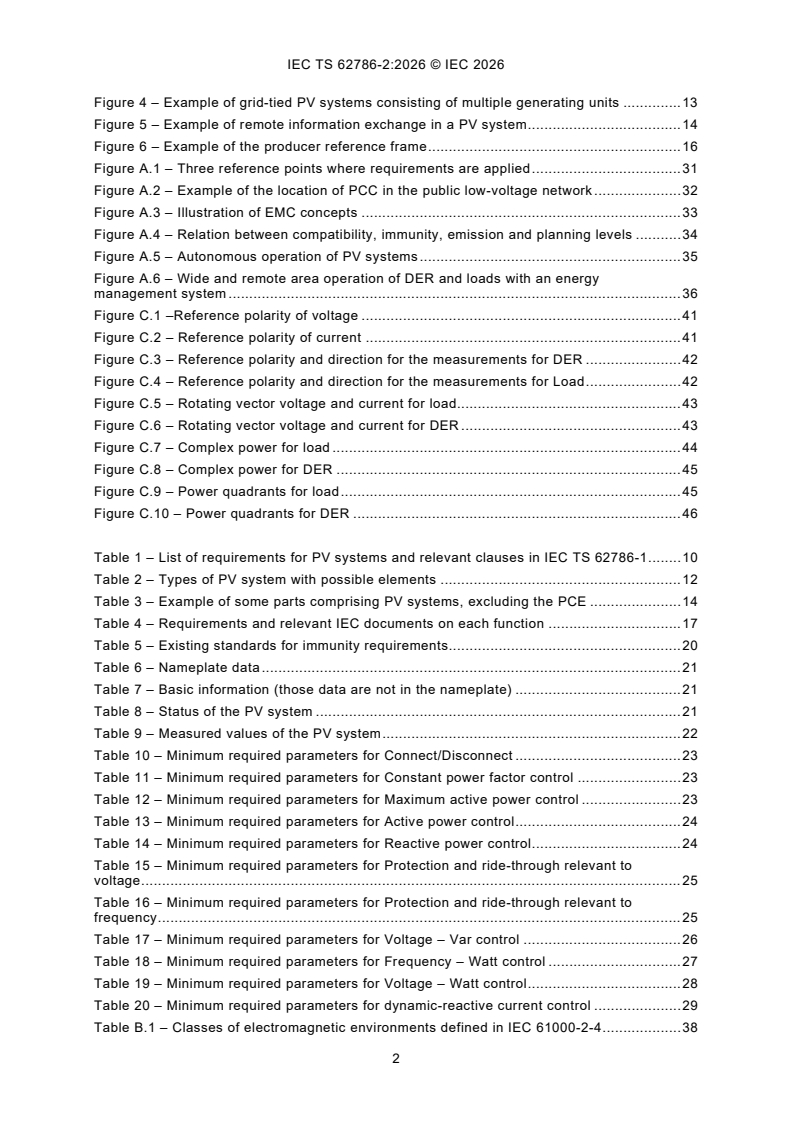
Figure 1 – Overview of IEC documents relevant to the grid connection of PV systems . 7
Figure 2 – Possible elements in PV systems . 11
Figure 3 – Example of a grid-tied PV system consisting of a single generating unit . 12
Figure 4 – Example of grid-tied PV systems consisting of multiple generating units . 13
Figure 5 – Example of remote information exchange in a PV system . 14
Figure 6 – Example of the producer reference frame . 16
Figure A.1 – Three reference points where requirements are applied . 31
Figure A.2 – Example of the location of PCC in the public low-voltage network . 32
Figure A.3 – Illustration of EMC concepts . 33
Figure A.4 – Relation between compatibility, immunity, emission and planning levels . 34
Figure A.5 – Autonomous operation of PV systems . 35
Figure A.6 – Wide and remote area operation of DER and loads with an energy
management system . 36
Figure C.1 –Reference polarity of voltage . 41
Figure C.2 – Reference polarity of current . 41
Figure C.3 – Reference polarity and direction for the measurements for DER . 42
Figure C.4 – Reference polarity and direction for the measurements for Load . 42
Figure C.5 – Rotating vector voltage and current for load. 43
Figure C.6 – Rotating vector voltage and current for DER . 43
Figure C.7 – Complex power for load . 44
Figure C.8 – Complex power for DER . 45
Figure C.9 – Power quadrants for load . 45
Figure C.10 – Power quadrants for DER . 46
Table 1 – List of requirements for PV systems and relevant clauses in IEC TS 62786-1 . 10
Table 2 – Types of PV system with possible elements . 12
Table 3 – Example of some parts comprising PV systems, excluding the PCE . 14
Table 4 – Requirements and relevant IEC documents on each function . 17
Table 5 – Existing standards for immunity requirements. 20
Table 6 – Nameplate data . 21
Table 7 – Basic information (those data are not in the nameplate) . 21
Table 8 – Status of the PV system . 21
Table 9 – Measured values of the PV system . 22
Table 10 – Minimum required parameters for Connect/Disconnect . 23
Table 11 – Minimum required parameters for Constant power factor control . 23
Table 12 – Minimum required parameters for Maximum active power control . 23
Table 13 – Minimum required parameters for Active power control . 24
Table 14 – Minimum required parameters for Reactive power control . 24
Table 15 – Minimum required parameters for Protection and ride-through relevant to
voltage . 25
Table 16 – Minimum required parameters for Protection and ride-through relevant to
frequency . 25
Table 17 – Minimum required parameters for Voltage – Var control . 26
Table 18 – Minimum required parameters for Frequency – Watt control . 27
Table 19 – Minimum required parameters for Voltage – Watt control . 28
Table 20 – Minimum required parameters for dynamic-reactive current control . 29
Table B.1 – Classes of electromagnetic environments defined in IEC 61000-2-4 . 38
Table B.2 – Total harmonic distortion . 38
Table B.3 – Power supply voltage amplitude variations . 38
Table B.4 – Power supply voltage unbalance . 38
Table B.5 – Power supply voltage frequency variations . 39
Table B.6 – Individual harmonic voltage . 39
Table B.7 – Compatibility levels specified in IEC 61000-2-2, IEC 61000-2-4 and IEC
61000-2-12 . 40
Table C.1 – Physical meanings of the power flows of loads . 46
Table C.2 – Physical meanings of the power flows of generators . 46
Table C.3 – Physical meanings of the power flows of generators in Japan . 47
Table C.4 – Physical meanings of the power flows of generators in IEEE 1547.1 . 47
Table C.5 – Physical meanings of the power flows of generators in EN 50549-10 . 47
Table C.6 – Physical meanings of the power flows of generators in AS/NZS 4777.2 . 48
INTERNATIONAL ELECTROTECHNICAL COMMISSION
____________
Distributed energy resources connection with the grid -
Part 2: Additional requirements for PV generation systems
FOREWORD
1) The International Electrotechnical Commission (IEC) is a worldwide organization for standardization comprising
all national electrotechnical committees (IEC National Committees). The object of IEC is to promote international
co-operation on all questions concerning standardization in the electrical and electronic fields. To this end and
in addition to other activities, IEC publishes International Standards, Technical Specifications, Technical Reports,
Publicly Available Specifications (PAS) and Guides (hereafter referred to as “IEC Publication(s)”). Their
preparation is entrusted to technical committees; any IEC National Committee interested in the subject dealt with
may participate in this preparatory work. International, governmental and non-governmental organizations liaising
with the IEC also participate in this preparation. IEC collaborates closely with the International Organization for
Standardization (ISO) in accordance with conditions determined by agreement between the two organizations.
2) The formal decisions or agreements of IEC on technical matters express, as nearly as possible, an international
consensus of opinion on the relevant subjects since each technical committee has representation from all
interested IEC National Committees.
3) IEC Publications have the form of recommendations for international use and are accepted by IEC National
Committees in that sense. While all reasonable efforts are made to ensure that the technical content of IEC
Publications is accurate, IEC cannot be held responsible for the way in which they are used or for any
misinterpretation by any end user.
4) In order to promote international uniformity, IEC National Committees undertake to apply IEC Publications
transparently to the maximum extent possible in their national and regional publications. Any divergence between
any IEC Publication and the corresponding national or regional publication shall be clearly indicated in the latter.
5) IEC itself does not provide any attestation of conformity. Independent certification bodies provide conformity
assessment services and, in some areas, access to IEC marks of conformity. IEC is not responsible for any
services carried out by independent certification bodies.
6) All users should ensure that they have the latest edition of this publication.
7) No liability shall attach to IEC or its directors, employees, servants or agents including individual experts and
members of its technical committees and IEC National Committees for any personal injury, property damage or
other damage of any nature whatsoever, whether direct or indirect, or for costs (including legal fees) and
expenses arising out of the publication, use of, or reliance upon, this IEC Publication or any other IEC
Publications.
8) Attention is drawn to the Normative references cited in this publication. Use of the referenced publications is
indispensable for the correct application of this publication.
9) IEC draws attention to the possibility that the implementation of this document may involve the use of (a)
patent(s). IEC takes no position concerning the evidence, validity or applicability of any claimed patent rights in
respect thereof. As of the date of publication of this document, IEC had not received notice of (a) patent(s), which
may be required to implement this document. However, implementers are cautioned that this may not represent
the latest information, which may be obtained from the patent database available at https://patents.iec.ch. IEC
shall not be held responsible for identifying any or all such patent rights.
IEC TS 62786-2 has been prepared by IEC technical committee 8: System aspects of electrical
energy supply. It is a Technical Specification.
The text of this Technical Specification is based on the following documents:
Draft Report on voting
8/1756/DTS 8/1790/RVDTS
Full information on the voting for its approval can be found in the report on voting indicated in
the above table.
The language used for the development of this Technical Specification is English.
This document was drafted in accordance with ISO/IEC Directives, Part 2, and developed in
accordance with ISO/IEC Directives, Part 1 and ISO/IEC Directives, IEC Supplement, available
at www.iec.ch/members_experts/refdocs. The main document types developed by IEC are
described in greater detail at www.iec.ch/publications.
A list of all parts in the IEC 62786 series, published under the general title Distributed energy
resources connection with the grid, can be found on the IEC website.
This document is to be read in conjunction with IEC TS 62786-1:2023
The committee has decided that the contents of this document will remain unchanged until the
stability date indicated on the IEC website under webstore.iec.ch in the data related to the
specific document. At this date, the document will be
– reconfirmed,
– withdrawn, or
– revised.
INTRODUCTION
The use of solar photovoltaic energy systems or photovoltaic generating systems (PV systems)
has been expanding rapidly around the world as one of distributed energy resources (DER).
While the growing adoption of PV systems has benefits such as CO reduction, the intermittent
power supply characteristic of PV systems raises concerns about the power imbalance in the
power network as well as about the instability of electric power networks showing up as voltage
fluctuations and frequency deviations.
However, not only can PV systems convert the solar power to electricity, which is fed into the
electric power networks, but PV systems can also provide operational functions which support
the stability, reliability, and efficiency of electric power networks. Moreover, PV systems can
also operate autonomously and are able to respond rapidly to the local conditions of the
electrical power network as well as effectively participate in the management of electrical power
networks by exchanging information with system operators and other DER.
In 2017, IEC TS 62786 Ed.1, which specified the general requirements for connecting DER to
the electrical power network networks, was published. During the development of IEC TS 62786
Ed. 1, it has been recognised that standardization should address the requirements for the
specific types of DER. That was because TC82 proposed in 2016 to develop a standard on grid
connection requirements for solar photovoltaic energy systems on the basis of IEC TS 62786
and to publish it as a sub-part of IEC TS 62786. Consequently, JWG10 was established under
TC8 in 2018, and JWG10 held a kick-off meeting with TC82 and TC120 in March 2018 and
agreed to start the development of the TS 62786 series.
In October 2018, JWG10 proposed a new standardization policy for the TS 62786 series so that
the TS 62786 series would have a hierarchical structure. The top layer is Part 1 of the TS 62786
series, which specifies general technical requirements for DER relevant to grid connection such
as power control and grid protection functions. Additionally, TS 62786-1 specifies new
requirements regarding interoperability to implement information exchange for remote
monitoring, control and configuration. In October 2021, TC8 CAG agreed on the hierarchical
structure of the TS 62786 series, and it was agreed that each technical committee can define
testing provisions for evaluating the performance of its own product by referring to the TS 62786
series.
As shown in Figure 1, consolidating other IEC documents which specify requirements relevant
to grid connection, Part 2 of TS 62786 supplements TS 62786-1. Moreover, Part 2 adds detailed
required specifications for PV systems to provide the bridge between requirements for PV
systems and power conversion equipment which constitutes these systems.
Figure 1 – Overview of IEC documents relevant to the grid connection of PV systems
1 Scope
This part of the IEC TS 62786 series supplements IEC TS 62786-1, and specifies requirements
for the connection of the solar photovoltaic energy system or photovoltaic generating system
(PV system) with an electric power network, or the network. This document covers all sizes of
PV systems connected to low voltage or medium voltage power networks and gives typical
requirements for various sizes of PV systems.
In this document, requirements for grid-connected PV systems are applied to those categorized
as grid tied, grid tied with storage and grid tied with storage and back up. Mini-grid and Micro-
grid are out of scope. Those types of PV systems with possible elements are described in 4.3.
This document specifies the following technical requirements for the PV system:
– reference points of requirements,
– elements and configuration,
– basic operation,
– protection and fault ride through function,
– power control and grid support function,
– electromagnetic compatibility for low frequency conducted disturbances,
– information exchange for remote monitoring, control, and configuration.
2 Normative references
The following documents are referred to in the text in such a way that some or all of their content
constitutes requirements of this document. For dated references, only the edition cited applies.
For undated references, the latest edition of the referenced document (including any
amendments) applies.
IEC 60050-901:2013, International Electrotechnical Vocabulary (IEV) – Part 901:
Standardization
IEC 60255-127, Measuring relays and protection equipment – Part 127: Functional
requirements for over/under voltage protection
IEC 60255-181, Measuring relays and protection equipment – Part 181: Functional
requirements for frequency protection
IEC 61000-2-2:2002, Electromagnetic compatibility (EMC) – Part 2-2: Environment –
Compatibility levels for low-frequency conducted disturbances and signalling in public low-
voltage power supply systems
IEC 61000-2-4:2024, Electromagnetic compatibility (EMC) – Part 2-4: Environment –
Compatibility levels in power distribution systems in industrial locations for low-frequency
conducted disturbances
IEC 61000-2-12, Electromagnetic compatibility (EMC) – Part 2-12: Environment – Compatibility
levels for low-frequency conducted disturbances and signalling in public medium-voltage power
supply systems
IEC 61000-4-27, Electromagnetic compatibility (EMC) – Part 4-27: Testing and measurement
techniques – Unbalance, immunity test for equipment with input current not exceeding 16 A per
phase
IEC TS 62786-1: 2023, Distributed energy resources connection with the grid – Part 1: General
requirements
IEC TS 62910, Utility-interconnected photovoltaic inverters – Test procedure for under voltage
ride-through measurements
IEC 62934:2021, Grid integration of renewable energy generation – Terms and definitions
IEC TS 63217, Utility-interconnected photovoltaic inverters – Test procedure for over voltage
ride-through measurements
3 Terms and definitions
For the purposes of this document, the terms and definitions given in IEC 62934,
IEC TS 62786-1, IEC 60050-901 and the following apply.
ISO and IEC maintain terminology databases for use in standardization at the following
addresses:
• IEC Electropedia: available at https://www.electropedia.org/
• ISO Online browsing platform: available at https://www.iso.org/obp
3.1
PV system
photovoltaic power generating system
electric power generating system which uses the photovoltaic effect to convert solar power into
electricity
3.2
power conversion equipment
PCE
electrical device converting one form of electrical power to another with respect to voltage,
current, frequency, phase and the number of phases
[SOURCE: IEC 62109-1:2010, 3.66, modified – The definition has been rephrased, and the note
has been deleted.]
3.3
point of connection
POC
reference point on the electric power system where the user’s electrical facility is connected
Note 1 to entry: Figure A.1 shows a location of POC in the grid where PV systems are connected.
[SOURCE: IEC 60050-617:2009, 617-04-01, modified – Note 1 to entry has been added.]
3.4
point of common coupling
PCC
point in an electric power system, electrically nearest to a particular load or the point of
connection (POC) of a power plant, at which other loads/power plants are, or may be, connected
Note 1 to entry: These loads can be either devices, equipment or systems, or distinct customer's installations.
Note 2 to entry: Figure A.1 shows a location of PCC in the grid where PV systems are connected.
[SOURCE: IEC 62934:2021, 3.1.11, modified – Note 2 to entry has been added.]
3.5
in-plant point of coupling
IPC
point inside a non-public power distribution system, electrically nearest to a given load or a
power plant, at which loads or power plants from other branches are, or could be, connected
Note 1 to entry: The IPC is usually the point for which electromagnetic compatibility in industrial networks is to be
considered.
Note 2 to entry: Figure A.1 shows a location of IPC in the grid where PV systems are connected.
[SOURCE: IEC 61000-2-4:2024, 3.1.10, modified – the definition has been rephrased.]
3.6
industrial power distribution system
power distribution systems in industrial locations
distribution network which is separated by at least one separation transformer from the public
power supply system to which other customer installations are connected
3.7
planning level
a level of a particular disturbance in a particular environment, adopted as a reference value for
the limits to be set for the emissions from large loads and installations, in order to co-ordinate
those limits with all the limits adopted for equipment intended to be connected to the power
supply system
Note 1 to entry: The planning level is locally specific and is adopted by those responsible for planning and operating
the power supply network in the relevant area. For further information, see IEC 61000-2-2, Annex A.
[SOURCE: IEC 61000-2-2:2018, 3.1.5]
4 Requirements for PV systems
4.1 General
Table 1 lists requirements for PV systems and shows relevant clauses of IEC TS 62786-1.
Table 1 – List of requirements for PV systems and relevant clauses in IEC TS 62786-1
Clauses in IEC TS 62786-2 Relevant clauses in IEC TS 62786-1
4.2 1 Scope and object
Reference points of requirements
4.2 Connection scheme
4.3 Elements and configuration 4.3 Choice of switchgear
4.4 Basic operation N/A N/A
4.4 Normal operating range
Protection and fault ride through
4.5 4.5 Immunity to disturbances
function
4.9 Interface protection
4.6 4.7.2 Voltage support by reactive power
4.7 Power response to voltage changes
Power control and grid support
4.10 Connection and starting to generate electrical
function
power
Ceasing and reduction of active power on set
4.11
point
4.7 Electromagnetic compatibility 4.8 EMC and power quality
4.8 Information exchange for remote
4.12 Remote information exchange
configuration, control and monitoring
4.2 Reference points of requirements
In this document, requirements shall be applied at the following three reference points:
– point of common coupling (PCC);
– in-plant point of coupling (IPC);
– point of connection (POC).
Annex A describes the application of requirements at the three reference points, and Figure A.1
shows locations of these three reference points in the grid where the PV system is connected.
4.3 Elements and configuration
4.3.1 Elements in PV systems
Figure 2 illustrates the major elements that possibly comprise PV systems, referring to
IEC 61724-1. Depending on the configuration of PV systems, IEC 61724-1 categorizes PV
systems as grid-tied, grid-tied with storage, grid-tied with storage and back-ups, mini-grid, or
micro-grid. Table 2 shows the types of PV systems with possible elements.
In this document, requirements for grid-connected PV systems are applied to those categorized
as grid-tied, grid-tied with storage and grid-tied with storage and back up. Mini-grid and Micro-
grid are out of scope.
Figure 2 – Possible elements in PV systems
Table 2 – Types of PV system with possible elements
System type
Grid-tied with
System element
Grid-tied
Grid-tied storage and back Mini-grid Micro-grid
with storage
up
Distribution network ―
Power conversion equipment (PCE)
PV array
Energy storage (DC) ―
Loads (DC) ―
Loads (AC) ―
Back up sources (DC) ― ―
Other renewable sources (DC) ― ― ―
Back up sources (AC) ― ―
Other renewable sources (AC) ― ― ―
4.3.2 Configuration of PV systems
Figure 3 illustrates an example of the configuration of a grid-tied PV system which consists of
a single power generating unit. The main switch should be a circuit breaker with leakage current
protection capability. The interface transformer should be installed to avoid the injection of the
DC component to the grid. The generating unit AC switch should be an electromagnetic or
electromechanical contactor. The generating unit DC switch shall be a circuit breaker able to
interrupt a short circuit and with leakage current protection capability.
Figure 4 illustrates an example of the configuration of a grid tied PV system which consists of
multiple power generating units. Each generating unit shall have an interface switch, and a
single interface switch shall be installed to disconnect all generating units.
Figure 3 – Example of a grid-tied PV system consisting of a single generating unit
Figure 4 – Example of grid-tied PV systems consisting of multiple generating units
IEC TS 62786-1 addresses the remote information exchange to realize monitoring and control
of distributed energy resources and communication between distributed energy resources and
system operators. Accordingly, PV systems should be equipped with a communication interface
which allows for remote monitoring, control and configuration managed by system operators.
Figure 5 illustrates an example of remote information exchange in a PV system, including local
loads and controllers.
Table 3 lists some possible parts comprising PV systems, excluding the power conversion
equipment (PCE), and Table 3 shows examples of information of switches and sensors to be
exchanged with system operators for remote monitoring, control, and configuration. The
nameplate data and basic information, operational status of the PV generating unit, the status
of all switches, and measured values such as voltage, current, and power of the PV system
should all be monitored by the PV system controller. The required information should be
transmitted to the system operator. Requirements for information exchange of PV systems are
given in 4.8.
Figure 5 – Example of remote information exchange in a PV system
Table 3 – Example of some parts comprising PV systems, excluding the PCE
Information for remote monitoring, control and
Parts comprising PV systems
configuration
Main switch Setting information:
Interface switch - installation point,
- type of switch (with short circuit breaking capability or
Generating unit AC switch
not),
- number of phases,
- physical capability, and
Switches
- level of short circuit current to be broken.
Status information:
Generating unit DC switch
- status of switch,
- opening/closing time (if circuit breaker), and
- switching operation in local or remote, internally or
externally.
Current transformer at main switch Setting information:
Sensors
Current transformer at unit AC switch - installation point,
Information for remote monitoring, control and
Parts comprising PV systems
configuration
- rated current,
- rated frequency,
- ratio between the primary and secondary value,
Current transformer at unit DC switch
- measuring accuracy class,
- protection accuracy class, and
- transient accuracy class.
Voltage transformer at main switch Setting information:
- installation point,
Voltage transducer at unit AC switch
- rated voltage,
- rated frequency,
Voltage transformer at unit DC switch - ratio between the primary and secondary value,
- measuring accuracy class, and
- protection accuracy class.
Electrical energy storage devices can be installed in parallel with PV power generating units.
Therefore, this document provides requirements for PV systems with or without the electrical
energy storage devices at the DC side of PCE. However, the local load units are out of scope.
Grid connection requirements for the electrical energy storage systems are specified by
IEC TS 62786-3.
4.4 Basic operation
Within the operating range of voltage and frequency, the PV control system shall be able to
control the output power within ±5 % of nominal power as accuracy. The following steady-state
and transient-response characteristics of the PV system shall be evaluated and declared with
test reports:
a) the steady-state characteristics: the operating range of apparent power, active and reactive
power, and power factor;
b) the transient-response characteristics: the response behaviour of the PV system against:
1) the set point of active and reactive power of the PV system,
2) the step change or gradient in voltage, frequency, and phase angle at the POC.
Requirements for the operating range of voltage and frequency are specified in 4.5.
The operating range of apparent, active, and reactive power should be reported with the
producer reference frame, or PRF, which shows the operable area of the PV system to control
active and reactive power as shown in Figure 6. Sign conventions of measurements of voltage,
current and power, which are used in this document, and the four-quadrant diagram of PRF
(see Figure C.10) shall be as defined in Annex C.
In case that the PV system includes electrical energy storage unites, the capability of active
power absorption of the PV system at the POC should be evaluated.
The steady-state and transient-response characteristics can be evaluated with the generating
unit. In case that the PV system consists of multiple generating units as shown in Figure 4, the
evaluation of characteristics can be performed with a representative generating unit.
Figure 6 – Example of the producer reference frame
4.5 Protection and fault ride through function
Referring to IEC TS 62786-1, the PV system shall have the following protection and fault ride
through functions:
– protection functions:
• over voltage protection,
• under voltage protection,
• over frequency protection,
• under frequency protection, and
• unintentional islanding prevention;
– fault ride-through functions:
• over voltage ride-through,
• under voltage ride-through,
• over frequency ride-through,
• under frequency ride-through, and
• voltage phase-jump ride-through.
The PV system shall comprise the over/under voltage protection function or equipment which
shall be consistent with IEC 60255-127. The PV system shall comprise the over/under
frequency protection function or equipment which shall be consistent with IEC 60255-181.
Referring to IEC TS 62910 and IEC TS 63217 as well as IEC 60255-127 and IEC 60255-181,
the following parameters shall be declared to specify the operating range of voltage and
frequency of the PV system. The following parameters can be declared with the generating unit.
In case that the PV system consists of multiple generating units as shown in Figure 4, the
declaration of parameters can be performed with a representative generating unit:
– voltage and frequency protection functions:
• setting value, and
• operation time;
– voltage, frequency, and phase-jump ride-through function:
• levels of ride-through, and
• time duration of ride-through.
4.6 Power control and grid support function
Referring to IEC TS 62786-1, the PV system should have the following functions:
– automatic connection and reconnection;
– power control functions:
• Constant active power control,
• Maximum active power control,
• Constant reactive power control, and
• Constant power factor control;
– Grid support functions:
• Voltage – Var control,
• Frequency – Watt control,
• Voltage – Watt control,
• Dynamic reactive current control,
• Active power – Reactive power control, and
• Active power – Power factor control.
Table 4 specifies requirements on each function and shows the relevant IEC documents. The
functionality of the listed functions is described in IEC 61850-7-420.
Table 4 – Requirements and relevant IEC documents on each function
IEC 61850-7-4,
Functions Requirements IEC TR 61850-90-7 IEC TS 62786-1
IEC 61850-7-420
IEC 61850-7-4
6.5.6 LN: Switch
PV systems should controller Name: 4.10 Connection
Automatic 6.1.2 Function INV1:
connect to the network CSWI and starting to
connection and connect / disconnect
after a period decided generate
reconnection from grid
6.5.7 LN:
by system operators. electrical power
Synchronizer
controller Name:
CSYN
PV systems should 6.1.5 Function INV4: IEC 61850-7-420 4.11 Ceasing and
have the capability to request active power reduction of
A.3.2.9.7 LN: Set
Constant active be curtailed or to (charge or discharge active power on
active power
power control reduce active power on storage) set point
Name: DWGC
set point locally or
remotely.
PV systems should 6.1.3 Function INV2: IEC 61850-7-420 4.11 Ceasing and
have the capability to adjust maximum reduction of
A.3.1.7.3 LN:
control both the generation level active power on
DER generating
maximum active power up/down set point
unit
output and the rate of
Maximum active
Name: DGEN.
active power change,
power control
ensuring they do not
A.3.2.9.9 LN:
exceed the value
Limit maximum
determined by system
active power
operators.
Name: DWMX
PV systems should be 6.2.4 Example IEC 61850-7-420 4.7.3 Dynamic
able to adjust reactive setting volt-var mode reactive power
A.3.2.11.4 LN:
Constant reactive
power output within VV13: static power support
Set reactive
control
their reactive power converter mode capabilities
power level
capability range. based on settings
Name: DVAR
IEC 61850-7-4,
Functions Requirements IEC TR 61850-90-7 IEC TS 62786-1
IEC 61850-7-420
PV systems should be 6.1.4 Function INV3: IEC 61850-7-420 4.7.3 Dynamic
able to adjust the reactive power
adjust power factor
A.3.2.10.3 LN:
Constant power
power factor within support
Set fixed power
factor
their capability range. capabilities
factor
Name: DFPF
PV systems should 6.2.2 Example A.3.2.11.3 LN: 4.7.2 Voltage
have the capability to setting volt-var mode Set reactive support by
vary the reactive power VV11: available var power based on reactive power
output of the support mode with no voltage
4.7.5 Voltage
generating unit in impact on watts Name: DVVR
related reactive
response to the voltage
6.2.3 Example power response
at its terminals.
Voltage – Var setting volt-var mode
control VV12: maximum var
support mode based
on WMax
6.2.5 Example
setting volt-var mode
VV14: passive mode
with no var support
PV systems should 6.3.2 Frequency-watt IEC 61850-7-420 4.6 Active power
have the capability to mode FW21: high response to
A.3.2.8.3 LN: Set
frequency
adjust the active power frequency reduces
active power level
output of the active power deviation
based on
generating unit in
6.3.3 Frequency-watt frequency using
response to frequency
mode FW22: curves, for high
(power frequency)
constraining frequency
deviation at its
generating/charging conditions
terminals.
Frequency – Watt
by frequency Name: DHFW
control
A.3.2.8.4 LN: Set
active power level
based on
frequency using
curves, for low
frequency
conditions
Name: DLFW
PV systems should 6.7.1 Voltage-watt IEC 61850-7-420 4.7.4 Voltage
have the capability to mode VW51: voltage- related active
A.3.2.9.5 LN: Set
reduce the active watt management: power control
active power level
power output in generating by voltage
Voltage – Watt
based on voltage
response to a rise in
control
6.7.2 Voltage-watt Name: DVWC
voltage.
mode VW52: voltage-
watt management:
charging by voltage
PV systems should be 6.4.2 Dynamic IEC 61850-7-420 4.7.6 Additional
capable of adjusting reactive current reactive current
A.3.2.11.6 LN:
reactive current support mode TV31: requirements on
Dynamic reactive
Provide dynamic
according to settings support during generating plants
current control
reactive current
provided by system abnormally high or
support
operators. low voltage levels
Name: DRGS
PV systems should be N/A IEC 61850-7-420 4.7.3 Dynamic
capable of adjusting reactive power
A.3.2.11.5 LN:
reactive power in support
Set reactive
response to active capabilities
Active power –
power based on
power according to
Reactive power
active power
settings concerning the
control
Nam
...