

IEC 60947-2:2016
(Main)Low-voltage switchgear and controlgear - Part 2: Circuit-breakers
General Information
- Abstract
IEC 60947-2:2016 applies to circuit-breakers, the main contacts of which are intended to be connected to circuits, the rated voltage of which does not exceed 1 000 V a.c. or 1 500 V d.c.; it also contains additional requirements for integrally fused circuit-breakers. This fifth edition cancels and replaces the fourth edition published in 2006, Amendment 1:2009 and Amendment 2:2013. This edition constitutes a technical revision. This edition includes the following significant additions with respect to the previous edition:
- tests for verification of selectivity in Annex A (see A.5.3);
- critical load current tests for d.c. circuit-breakers (see 8.3.9);
- new Annex P for circuit-breakers for use in photovoltaic applications;
- new Annex R for residual-current circuit-breakers with automatic reclosing functions. The contents of the corrigendum of November 2016 have been included in this copy.
- Status
- Published
- Publication Date
- 10-Oct-2019
- Technical Committee
- SC 121A - Low-voltage switchgear and controlgear
- Drafting Committee
- MT 9 - TC 121/SC 121A/MT 9
- Current Stage
- DELPUB - Deleted Publication
- Start Date
- 18-Sep-2024
- Completion Date
- 31-Dec-2019
Buy Documents
IEC 60947-2:2016 RLV - Low-voltage switchgear and controlgear - Part 2: Circuit-breakers Released:6/7/2016
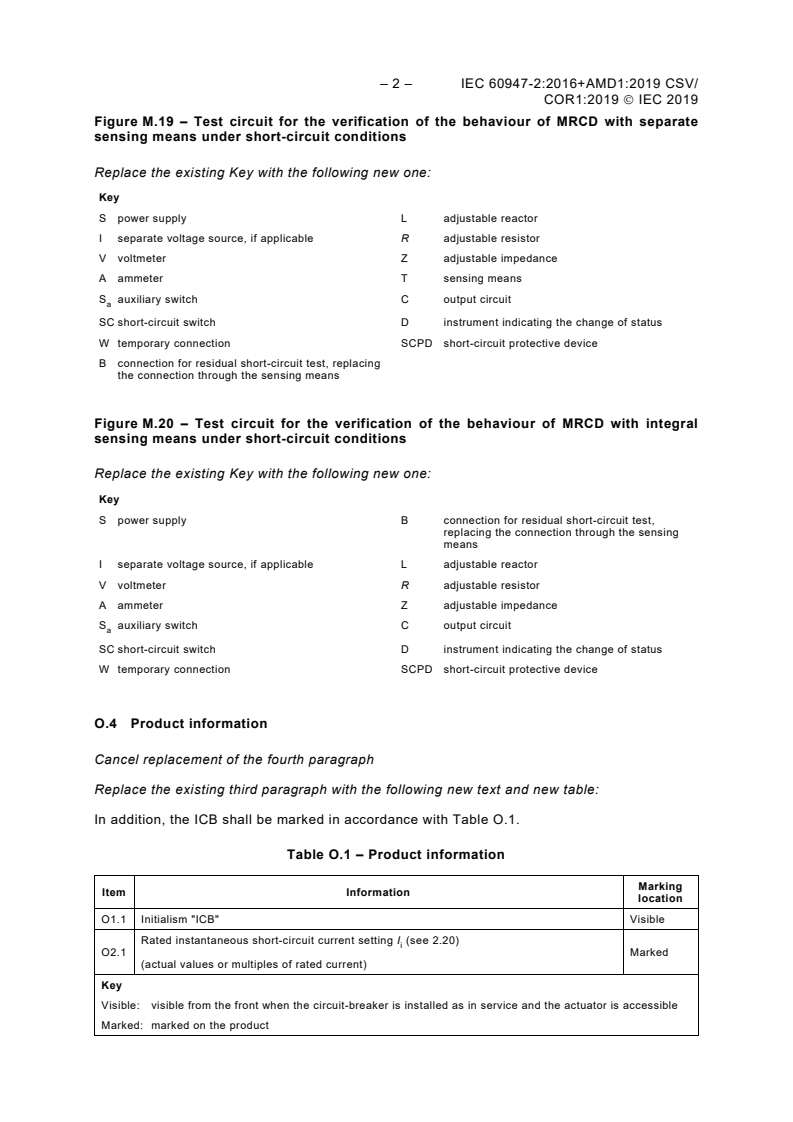


IEC 60947-2:2016+AMD1:2019 CSV/COR1:2019 - Corrigendum 1 - Low-voltage switchgear and controlgear - Part 2: Circuit-breakers Released:10/11/2019
IEC 60947-2:2016 - Low-voltage switchgear and controlgear - Part 2: Circuit-breakers Released:6/7/2016

IEC 60947-2:2016+AMD1:2019 CSV - Low-voltage switchgear and controlgear - Part 2: Circuit-breakers Released:7/8/2019
Overview
IEC 60947-2:2016 (Edition 5.0) is the International Electrotechnical Commission standard that specifies requirements for low-voltage circuit-breakers used in switchgear and controlgear. It applies to circuit-breakers with main contacts intended for circuits with rated voltages up to 1 000 V a.c. or 1 500 V d.c. and includes additional rules for integrally fused circuit‑breakers. This fifth edition is a technical revision (cancelling the 2006 edition and subsequent amendments) and adds new test and application annexes for modern uses such as photovoltaic systems and residual‑current devices with auto‑reclose.
Key Topics and Requirements
- Scope and classification: Types of circuit‑breakers, rated voltages, currents, frequency and duty, and utilization (selectivity) categories.
- Construction and safety: Mechanical and electrical design requirements including clearances, creepage, operator safety, isolation capability, withdrawable designs and provisions for neutral poles.
- Performance characteristics: Making, breaking and short‑circuit behaviour; rated service and ultimate breaking capacities; short‑time withstand; temperature rise; dielectric strength and EMC considerations.
- Releases and protection functions: Overcurrent, undervoltage, shunt and residual current functions, including marking and calibration checks.
- Testing regimes: Defined type tests, routine tests, mechanical operation, dielectric, temperature‑rise, short‑circuit breaking, short‑time withstand, and special tests (damp heat, salt mist, vibration, shock). New or highlighted tests include:
- Tests for verification of selectivity between upstream/downstream devices (Annex A, see A.5.3).
- Critical load current tests for d.c. circuit‑breakers (8.3.9).
- New Annex P covering circuit‑breakers for photovoltaic applications.
- New Annex R for residual‑current circuit‑breakers with automatic reclosing.
- Product information & documentation: Required marking, installation/operation/maintenance instructions and coordination data.
Applications and Who Uses It
IEC 60947-2 is essential for:
- Circuit‑breaker manufacturers designing and certifying low‑voltage breakers for AC and DC systems.
- Test laboratories and certification bodies performing type and routine testing to demonstrate compliance.
- Electrical designers and specifiers selecting breakers for industrial, commercial and renewable energy installations (notably photovoltaic systems).
- System integrators and plant engineers implementing short‑circuit coordination, selectivity and back‑up protection strategies.
- Installers and maintenance personnel using the standard’s marking, installation and safety requirements.
Keywords: IEC 60947-2, circuit‑breakers, low‑voltage switchgear, short‑circuit protection, selectivity tests, photovoltaic circuit‑breakers, DC circuit‑breaker testing, residual‑current breakers.
Related Standards
- IEC 60947-1 - Low‑voltage switchgear and controlgear: General rules (referenced throughout IEC 60947‑2).
- Other parts of the IEC 60947 series covering contactors, motor controllers and auxiliary devices.
Relations
- Effective Date
- 25-Aug-2026
- Effective Date
- 05-Sep-2023
- Effective Date
- 05-Sep-2023
- Effective Date
- 05-Sep-2023
- Effective Date
- 05-Sep-2023
- Effective Date
- 05-Sep-2023
- Effective Date
- 05-Sep-2023
Buy Documents
IEC 60947-2:2016 RLV - Low-voltage switchgear and controlgear - Part 2: Circuit-breakers Released:6/7/2016
IEC 60947-2:2016+AMD1:2019 CSV/COR1:2019 - Corrigendum 1 - Low-voltage switchgear and controlgear - Part 2: Circuit-breakers Released:10/11/2019
IEC 60947-2:2016 - Low-voltage switchgear and controlgear - Part 2: Circuit-breakers Released:6/7/2016
IEC 60947-2:2016+AMD1:2019 CSV - Low-voltage switchgear and controlgear - Part 2: Circuit-breakers Released:7/8/2019
Get Certified
Connect with accredited certification bodies for this standard

IMQ S.p.A. (Certification)
Italian electrical product certification.

SLG Prüf- und Zertifizierungs GmbH
German testing and certification body.

UL Solutions
Global safety science company with testing, inspection and certification.
Sponsored listings
Frequently Asked Questions
IEC 60947-2:2016 is a standard published by the International Electrotechnical Commission (IEC). Its full title is "Low-voltage switchgear and controlgear - Part 2: Circuit-breakers". This standard covers: IEC 60947-2:2016 applies to circuit-breakers, the main contacts of which are intended to be connected to circuits, the rated voltage of which does not exceed 1 000 V a.c. or 1 500 V d.c.; it also contains additional requirements for integrally fused circuit-breakers. This fifth edition cancels and replaces the fourth edition published in 2006, Amendment 1:2009 and Amendment 2:2013. This edition constitutes a technical revision. This edition includes the following significant additions with respect to the previous edition: - tests for verification of selectivity in Annex A (see A.5.3); - critical load current tests for d.c. circuit-breakers (see 8.3.9); - new Annex P for circuit-breakers for use in photovoltaic applications; - new Annex R for residual-current circuit-breakers with automatic reclosing functions. The contents of the corrigendum of November 2016 have been included in this copy.
IEC 60947-2:2016 applies to circuit-breakers, the main contacts of which are intended to be connected to circuits, the rated voltage of which does not exceed 1 000 V a.c. or 1 500 V d.c.; it also contains additional requirements for integrally fused circuit-breakers. This fifth edition cancels and replaces the fourth edition published in 2006, Amendment 1:2009 and Amendment 2:2013. This edition constitutes a technical revision. This edition includes the following significant additions with respect to the previous edition: - tests for verification of selectivity in Annex A (see A.5.3); - critical load current tests for d.c. circuit-breakers (see 8.3.9); - new Annex P for circuit-breakers for use in photovoltaic applications; - new Annex R for residual-current circuit-breakers with automatic reclosing functions. The contents of the corrigendum of November 2016 have been included in this copy.
IEC 60947-2:2016 is classified under the following ICS (International Classification for Standards) categories: 29.130.20 - Low voltage switchgear and controlgear; 33.060.30 - Radio relay and fixed satellite communications systems. The ICS classification helps identify the subject area and facilitates finding related standards.
IEC 60947-2:2016 has the following relationships with other standards: It is inter standard links to EN ISO 12643-1:2023, IEC 60947-2:2016/AMD1:2019, IEC 60947-2:2016/COR1:2016, IEC 60947-2:2024, IEC 60947-2:2006/AMD1:2009, IEC 60947-2:2006, IEC 60947-2:2006/AMD2:2013. Understanding these relationships helps ensure you are using the most current and applicable version of the standard.
IEC 60947-2:2016 is available in PDF format for immediate download after purchase. The document can be added to your cart and obtained through the secure checkout process. Digital delivery ensures instant access to the complete standard document.
Standards Content (Sample)
IEC 60947-2 ®
Edition 5.0 2016-06
REDLINE VERSION
INTERNATIONAL
STANDARD
colour
inside
Low-voltage switchgear and controlgear –
Part 2: Circuit-breakers
All rights reserved. Unless otherwise specified, no part of this publication may be reproduced or utilized in any form
or by any means, electronic or mechanical, including photocopying and microfilm, without permission in writing from
either IEC or IEC's member National Committee in the country of the requester. If you have any questions about IEC
copyright or have an enquiry about obtaining additional rights to this publication, please contact the address below or
your local IEC member National Committee for further information.
IEC Central Office Tel.: +41 22 919 02 11
3, rue de Varembé Fax: +41 22 919 03 00
CH-1211 Geneva 20 info@iec.ch
Switzerland www.iec.ch
About the IEC
The International Electrotechnical Commission (IEC) is the leading global organization that prepares and publishes
International Standards for all electrical, electronic and related technologies.
About IEC publications
The technical content of IEC publications is kept under constant review by the IEC. Please make sure that you have the
latest edition, a corrigenda or an amendment might have been published.
IEC Catalogue - webstore.iec.ch/catalogue Electropedia - www.electropedia.org
The stand-alone application for consulting the entire The world's leading online dictionary of electronic and
bibliographical information on IEC International Standards, electrical terms containing 20 000 terms and definitions in
Technical Specifications, Technical Reports and other English and French, with equivalent terms in 15 additional
documents. Available for PC, Mac OS, Android Tablets and languages. Also known as the International Electrotechnical
iPad. Vocabulary (IEV) online.
IEC publications search - www.iec.ch/searchpub IEC Glossary - std.iec.ch/glossary
The advanced search enables to find IEC publications by a 65 000 electrotechnical terminology entries in English and
variety of criteria (reference number, text, technical French extracted from the Terms and Definitions clause of
committee,…). It also gives information on projects, replaced IEC publications issued since 2002. Some entries have been
and withdrawn publications. collected from earlier publications of IEC TC 37, 77, 86 and
CISPR.
IEC Just Published - webstore.iec.ch/justpublished
Stay up to date on all new IEC publications. Just Published IEC Customer Service Centre - webstore.iec.ch/csc
details all new publications released. Available online and If you wish to give us your feedback on this publication or
also once a month by email. need further assistance, please contact the Customer Service
Centre: csc@iec.ch.
IEC 60947-2 ®
Edition 5.0 2016-06
REDLINE VERSION
INTERNATIONAL
STANDARD
colour
inside
Low-voltage switchgear and controlgear –
Part 2: Circuit-breakers
INTERNATIONAL
ELECTROTECHNICAL
COMMISSION
ICS 29.130.20 ISBN 978-2-8322-3456-3
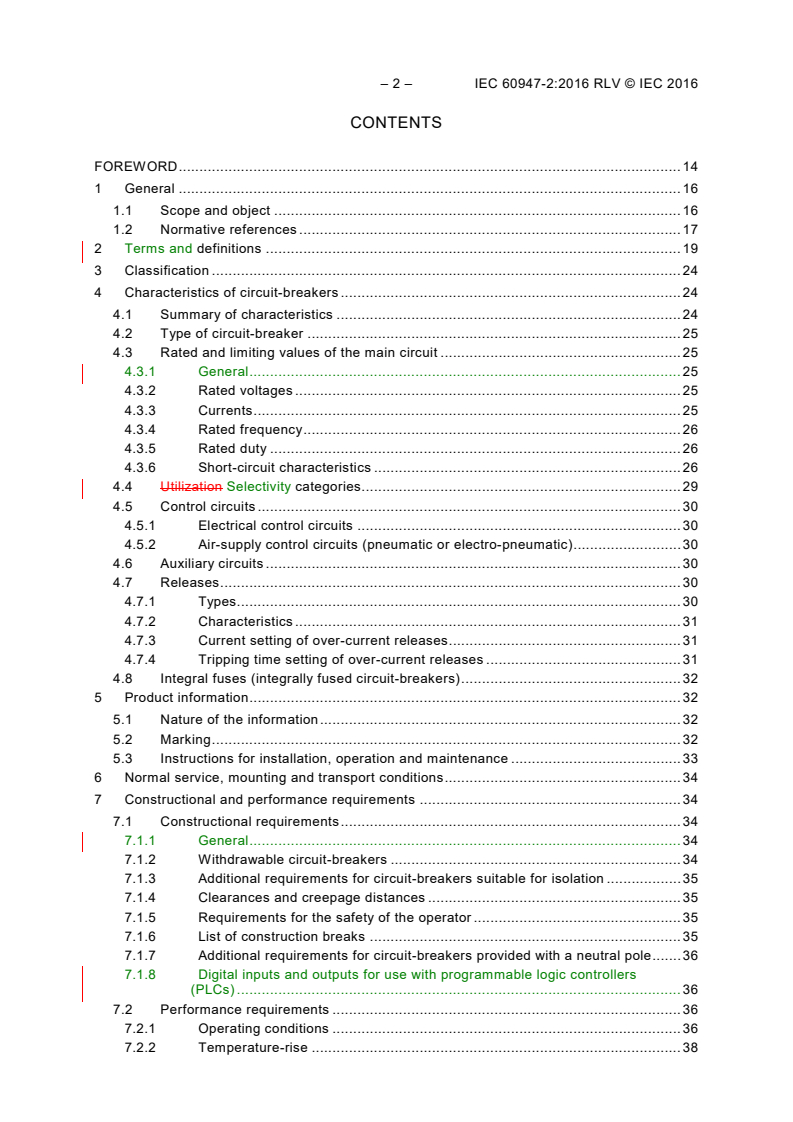
– 2 – IEC 60947-2:2016 RLV © IEC 2016
CONTENTS
FOREWORD . 14
1 General . 16
1.1 Scope and object . 16
1.2 Normative references . 17
2 Terms and definitions . 19
3 Classification . 24
4 Characteristics of circuit-breakers . 24
4.1 Summary of characteristics . 24
4.2 Type of circuit-breaker . 25
4.3 Rated and limiting values of the main circuit . 25
4.3.1 General . 25
4.3.2 Rated voltages . 25
4.3.3 Currents . 25
4.3.4 Rated frequency . 26
4.3.5 Rated duty . 26
4.3.6 Short-circuit characteristics . 26
4.4 Utilization Selectivity categories . 29
4.5 Control circuits . 30
4.5.1 Electrical control circuits . 30
4.5.2 Air-supply control circuits (pneumatic or electro-pneumatic) . 30
4.6 Auxiliary circuits . 30
4.7 Releases . 30
4.7.1 Types . 30
4.7.2 Characteristics . 31
4.7.3 Current setting of over-current releases . 31
4.7.4 Tripping time setting of over-current releases . 31
4.8 Integral fuses (integrally fused circuit-breakers) . 32
5 Product information . 32
5.1 Nature of the information . 32
5.2 Marking . 32
5.3 Instructions for installation, operation and maintenance . 33
6 Normal service, mounting and transport conditions . 34
7 Constructional and performance requirements . 34
7.1 Constructional requirements . 34
7.1.1 General . 34
7.1.2 Withdrawable circuit-breakers . 34
7.1.3 Additional requirements for circuit-breakers suitable for isolation . 35
7.1.4 Clearances and creepage distances . 35
7.1.5 Requirements for the safety of the operator . 35
7.1.6 List of construction breaks . 35
7.1.7 Additional requirements for circuit-breakers provided with a neutral pole . 36
7.1.8 Digital inputs and outputs for use with programmable logic controllers
(PLCs) . 36
7.2 Performance requirements . 36
7.2.1 Operating conditions . 36
7.2.2 Temperature-rise . 38
7.2.3 Dielectric properties . 39
7.2.4 Ability to make and break under no load, normal load and overload
conditions . 40
7.2.5 Ability to make and break under short-circuit conditions . 41
7.2.6 Vacant . 41
7.2.7 Additional requirements for circuit-breakers suitable for isolation . 41
7.2.8 Specific requirements for integrally fused circuit-breakers. 41
7.2.9 Co-ordination between a circuit-breaker and another short-circuit
protective device . 42
7.3 Electromagnetic compatibility (EMC) . 42
8 Tests . 42
8.1 Kind of tests . 42
8.1.1 General . 42
8.1.2 Type tests . 42
8.1.3 Routine tests . 42
8.2 Compliance with constructional requirements . 43
8.3 Type tests . 43
8.3.1 Test sequences . 43
8.3.2 General test conditions. 52
8.3.3 Test sequence I: General performance characteristics . 61
8.3.4 Test sequence II: Rated service short-circuit breaking capacity. 71
8.3.5 Test sequence III: Rated ultimate short-circuit breaking capacity . 72
8.3.6 Test sequence IV: Rated short-time withstand current . 74
8.3.7 Test sequence V: Performance of integrally fused circuit-breakers. 75
8.3.8 Test sequence VI: combined test sequence . 77
8.3.9 Critical d.c. load current test . 78
8.4 Routine tests . 79
8.4.1 General . 79
8.4.2 Mechanical operation tests . 80
8.4.3 Verification of the calibration of overcurrent releases . 80
8.4.4 Verification of the operation of undervoltage and shunt releases . 81
8.4.5 Additional tests for CBRs . 81
8.4.6 Dielectric tests . 81
8.4.7 Test for the verification of clearances less than those corresponding to
case A of Table 13 of IEC 60947-1:2007 . 82
8.5 Special tests – Damp heat, salt mist, vibration and shock . 82
Annex A (normative) Co-ordination under short circuit conditions between a circuit-
breaker and another short-circuit protective device associated in the same circuit . 85
A.1 Introduction General . 85
A.2 Scope and object . 86
A.3 General requirements for the co-ordination of a circuit-breaker with another
SCPD . 86
A.3.1 General considerations . 86
A.3.2 Take-over current. 86
A.3.3 Behaviour of C in association with another SCPD . 86
A.4 Type and characteristics of the associated SCPD . 86
A.5 Verification of discrimination selectivity . 87
A.5.1 General . 87
A.5.2 Consideration of selectivity by desk study . 88
A.5.3 Selectivity determined by test . 89
– 4 – IEC 60947-2:2016 RLV © IEC 2016
A.6 Verification of back-up protection . 89
A.6.1 Determination of the take-over current . 89
A.6.2 Verification of back-up protection . 89
A.6.3 Tests for verification of back-up protection . 90
A.6.4 Results to be obtained . 91
Annex B (normative) Circuit-breakers incorporating residual current protection . 97
B.1 General . 97
B.1.1 Preamble . 97
B.1.2 Scope and object . 97
B.2 Terms and definitions . 98
B.2.1 Terms and definitions relating to currents flowing from live parts to
earth . 98
B.2.2 Terms and definitions relating to the energization of a CBR . 98
B.2.3 Terms and definitions relating to the operation and the functions of a
CBR. 99
B.2.4 Terms and definitions relating to values and ranges of energizing
quantities . 100
B.3 Classification . 101
B.3.1 Classification according to the method of operation of the residual
current function . 101
B.3.2 Classification according to the possibility of adjusting the residual
operating current. 101
B.3.3 Classification according to time-delay of the residual current function . 101
B.3.4 Classification according to behaviour in presence of a d.c. component. 101
B.4 Characteristics of CBRs concerning their residual current function . 101
B.4.1 Rated values . 101
B.4.2 Preferred and limiting values . 102
B.4.3 Value of the rated residual short-circuit making and breaking capacity
(I ) . 103
∆m
B.4.4 Operating characteristics in case of an earth fault current in the
presence or absence of a d.c. component . 103
B.5 Marking . 103
B.6 Normal service, mounting and transport conditions . 104
B.7 Design and operating requirements . 105
B.7.1 Design requirements . 105
B.7.2 Operating requirements . 105
B.7.3 Electromagnetic compatibility . 107
B.8 Tests . 107
B.8.1 General . 107
B.8.2 Verification of the operating characteristic . 110
B.8.3 Verification of dielectric properties . 111
B.8.4 Verification of the operation of the test device at the limits of rated
voltage . 112
B.8.5 Verification of the limiting value of the non-operating current under
over-current conditions . 112
B.8.6 Verification of the resistance against unwanted tripping due to surge
currents resulting from impulse voltages . 113
B.8.7 Verification of the behaviour of CBRs of type A in the case of an earth
fault current comprising a d.c. component . 114
B.8.8 Verification of the behaviour of CBRs functionally dependent on line
voltage classified under B.3.1.2.1 . 115
B.8.9 Verification of the behaviour of CBRs functionally dependent on line
voltage as classified under B.3.1.2.2 in the case of failure of line voltage . 116
B.8.10 Verification of the residual short-circuit making and breaking capacity . 117
B.8.11 Verification of the effects of environmental conditions . 118
B.8.12 Verification of electromagnetic compatibility . 118
B.8.13 Test for variations or interruptions of voltage and for voltage dips . 120
Annex C (normative) Individual pole short-circuit test sequence . 128
C.1 General . 128
C.2 Test of individual pole short-circuit breaking capacity . 128
C.3 Verification of dielectric withstand . 128
C.4 Verification of overload releases . 128
Annex D Vacant . 129
Annex E (informative) Items subject to agreement between manufacturer and user. 130
Annex F (normative) Additional tests for circuit-breakers with electronic over-current
protection . 131
F.1 Scope General . 131
F.2 List of tests . 131
F.2.1 General . 131
F.2.2 Electromagnetic compatibility (EMC) tests . 131
F.2.3 Suitability for multiple frequencies . 132
F.2.4 Dry heat test . 132
F.2.5 Damp heat test . 132
F.2.6 Temperature variation cycles at a specified rate of change . 132
F.3 General test conditions . 132
F.3.1 General . 132
F.3.2 Electromagnetic compatibility tests . 132
F.4 Immunity tests . 133
F.4.1 Harmonic currents . 133
F.4.2 Electrostatic discharges . 134
F.4.3 Radiated radio-frequency RF electromagnetic fields . 134
F.4.4 Electrical fast transient/burst (EFT/B) . 134
F.4.5 Surges . 135
F.4.6 Conducted disturbances induced by radio-frequency RF fields (common
mode) . 135
F.4.7 Current dips . 135
F.5 Emission tests . 136
F.5.1 Harmonics . 136
F.5.2 Voltage fluctuations . 136
F.5.3 Conducted RF disturbances (150 kHz to 30 MHz) . 136
F.5.4 Radiated RF disturbances (30 MHz to 1 GHz) . 136
F.6 Suitability for multiple frequencies . 137
F.6.1 General . 137
F.6.2 Test conditions . 137
F.6.3 Test procedure . 137
F.6.4 Test results . 137
F.7 Dry heat test . 137
F.7.1 Test procedure . 137
F.7.2 Test results . 138
F.7.3 Verification of overload releases . 138
– 6 – IEC 60947-2:2016 RLV © IEC 2016
F.8 Damp heat test . 138
F.8.1 Test procedure . 138
F.8.2 Verification of overload releases . 138
F.9 Temperature variation cycles at a specified rate of change . 138
F.9.1 Test conditions . 138
F.9.2 Test procedure . 138
F.9.3 Test results . 139
F.9.4 Verification of overload releases . 139
Annex G (normative) Power loss . 153
G.1 General . 153
G.2 Test methods . 153
G.2.1 General case . 153
G.2.2 AC circuit-breakers of rated current not exceeding 400 A . 153
G.2.3 DC circuit-breakers . 154
G.3 Test procedure . 154
Annex H (normative) Test sequence for circuit-breakers for IT systems . 156
H.1 General . 156
H.2 Individual pole short-circuit . 156
H.3 Verification of dielectric withstand . 157
H.4 Verification of overload releases . 157
H.5 Marking . 157
Annex J (normative) Electromagnetic compatibility (EMC) – Requirements and test
methods for circuit-breakers . 158
J.1 General . 158
J.2 Immunity . 159
J.2.1 General . 159
J.2.2 Electrostatic discharges . 161
J.2.3 Radiated radio-frequency RF electromagnetic fields . 162
J.2.4 Electrical fast transients/bursts (EFT/B) . 162
J.2.5 Surges . 162
J.2.6 Conducted disturbances induced by radio-frequency RF fields (common
mode) . 163
J.3 Emission . 163
J.3.1 General . 163
J.3.2 Conducted RF disturbances (150 kHz to 30 MHz) . 164
J.3.3 Radiated RF disturbances (30 MHz to 1 000 MHz) . 164
Annex K (informative) Glossary of symbols related to products covered by this
standard and graphical representation of characteristics . 169
Annex L (normative) Circuit-breakers not fulfilling the requirements for overcurrent
protection . 178
L.1 Scope General . 178
L.2 Terms and definitions . 178
L.3 Classification . 178
L.4 Rated values . 178
L.4.1 Rated current (I ) . 178
n
L.4.2 Rated conditional short-circuit current (I ) . 179
cc
L.5 Product information . 179
L.6 Constructional and performance requirements . 179
L.7 Tests . 179
L.7.1 General . 179
L.7.2 Rated conditional short-circuit tests . 180
Annex M (normative) Modular residual current devices (without integral current
breaking device). 183
M.1 Scope and object General . 183
M.1.1 Field of application . 183
M.1.2 Field of application . 183
M.2 Terms and definitions . 183
M.2.1 Terms and definitions relating to the energization of an MRCD . 183
M.2.2 Terms and definitions relating to the operation and the functions of an
MRCD . 184
M.3 Classification . 184
M.3.1 Classification according to the configuration of the primary conductors . 184
M.3.2 Classification according to the method of operation . 185
M.3.3 Classification according to the possibility of adjusting the residual
operating current. 185
M.3.4 Classification according to time-delay of the residual current function . 185
M.3.5 Classification according to behaviour in presence of a d.c. component. 185
M.4 Characteristics of MRCDs . 185
M.4.1 General characteristics . 185
M.4.2 Characteristics of MRCDs concerning their residual current function . 186
M.4.3 Behaviour under short-circuit conditions . 187
M.4.4 Preferred and limiting values . 187
M.5 Product information . 188
M.6 Normal service, mounting and transport conditions . 190
M.7 Design and operating requirements . 190
M.7.1 Design requirements . 190
M.7.2 Operating requirements . 190
M.8 Tests . 192
M.8.1 General . 192
M.8.2 Compliance with constructional requirements . 193
M.8.3 Verification of the operating characteristics . 194
M.8.4 Verification of dielectric properties . 196
M.8.5 Verification of the operation of the test device at the limits of the rated
voltage . 196
M.8.6 Verification of the limiting value of non-operating current under
overcurrent conditions, in case of a single phase load . 197
M.8.7 Resistance against unwanted tripping due to surge currents resulting
from impulse voltages . 197
M.8.8 Verification of the behaviour in case of an earth fault current comprising
a d.c. component . 197
M.8.9 Verification of the behaviour of MRCDs with separate sensing means in
case of a failure of the sensing means connection . 200
M.8.10 Verification of temperature-rise of terminal type MRCDs . 200
M.8.11 Verification of mechanical and electrical endurance . 200
M.8.12 Verification of the behaviour of MRCDs in case of failure of the voltage
source for MRCDs classified under M.3.2.2.1 . 201
M.8.13 Verification of the behaviour of MRCDs with voltage source as
classified under M.3.2.2.2 in case of failure of the voltage source . 202
M.8.14 Verification of the behaviour of the MRCD under short-circuit conditions . 202
M.8.15 Verification of effects of environmental conditions . 204
– 8 – IEC 60947-2:2016 RLV © IEC 2016
M.8.16 Verification of electromagnetic compatibility . 204
Annex N (normative) Electromagnetic compatibility (EMC) – Additional requirements
and test methods for devices not covered by Annex B, Annex F and Annex M . 227
N.1 General . 227
N.1.1 Scope General . 227
N.1.2 General test conditions. 227
N.2 Immunity . 227
N.2.1 General . 227
N.2.2 Electrostatic discharges . 228
N.2.3 Radiated radio-frequency RF electromagnetic fields . 228
N.2.4 Electrical fast transients/bursts (EFT/B) . 228
N.2.5 Surges . 229
N.2.6 Conducted disturbances induced by radio-frequency RF fields (common
mode) . 229
N.2.7 Voltage dips and interruptions . 229
N.3 Emission . 229
N.3.1 General . 229
N.3.2 Conducted RF disturbances (150 kHz to 30 MHz) . 230
N.3.3 Radiated RF disturbances (30 MHz to 1 000 MHz) . 230
Annex O (normative) Instantaneous trip circuit-breakers (ICB) . 231
O.1 Scope General . 231
O.2 Terms and definitions . 231
O.3 Rated values . 231
O.3.1 General . 231
O.3.2 Rated current (I ) . 231
n
O.3.3 Rated short-circuit making capacity . 231
O.3.4 Rated short-circuit breaking capacities . 231
O.4 Product information . 232
O.5 Constructional and performance requirements . 232
O.6 Tests . 232
O.6.1 Test sequence of the ICB alone . 232
O.6.2 ICB associated with a specified protected device (i.e. motor-starter or
overload relay) . 233
Annex P (normative) DC circuit-breakers for use in photovoltaic (PV) applications . 234
P.1 Field of application . 234
P.2 Terms and definitions . 234
P.3 Classification . 234
P.4 Characteristics of PV circuit-breakers . 234
P.5 Product information . 235
P.6 Normal service, mounting and transport conditions . 235
P.7 Constructional and performance requirements . 235
P.7.1 Constructional requirements . 235
P.7.2 Performance requirements . 235
P.7.3 Electromagnetic compatibility (EMC) . 236
P.8 Tests . 236
P.8.1 Kind of tests . 236
P.8.2 Compliance with constructional requirements . 236
P.8.3 Type tests . 236
P.8.4 Routine tests . 238
P.8.5 Special tests . 238
Annex Q Vacant . 239
Annex R (normative) Circuit-breakers incorporating residual current protection with
automatic re-closing functions . 240
R.1 General . 240
R.1.1 Preamble . 240
R.1.2 Field of application . 240
R.2 Terms and definitions . 241
R.3 Classification . 242
R.3.1 According to the method of construction . 242
R.3.2 According to the method of automatic reclosing . 242
R.4 Characteristics . 242
R.4.1 Rated automatic reclosing operating residual current (I ) . 242
∆ar
R.4.2 Maximum number of consecutive reclosing operations . 242
R.5 Marking and instructions . 243
R.6 Normal service, mounting and transport conditions . 243
R.7 Design and operating requirements . 243
R.7.1 Design requirements . 243
R.7.2 Operating requirements . 244
R.8 Tests . 245
R.8.1 General conditions . 245
R.8.2 Verification of the non-reclosing afte
...
COR1:2019 IEC 2019
INTERNATIONAL ELECTROTECHNICAL COMMISSION
COMMISSION ÉLECTROTECHNIQUE INTERNATIONALE
____________
IEC 60947-2 IEC 60947-2
Edition 5.1 2019-07 Edition 5.1 2019-07
Low-voltage switchgear and controlgear – Appareillage à basse tension –
Part 2: Circuit-breakers Partie 2: Disjoncteurs
CO RRI G E NDUM 1
Corrections to the French version appear after the English text.
Les corrections à la version française sont données après le texte anglais.
8.3 Type tests
In the last paragraph, replace "in below" by "below".
8.3.2.1 General requirements
Cancel replacement of the second paragraph
Replace the existing second paragraph after the note by the following new paragraph:
For the tests in free air concerning overload performance, short-circuit, and short-time
withstand current where applicable, a metallic screen shall be placed on all sides of the
circuit-breaker in accordance with the manufacturer’s instructions. Details, including distances
of the metallic screen from the circuit-breaker, shall be stated in the test report.
Figure M.18 – Test circuit for the verification of the behaviour of MRCDs with separate
sensing means in the case of a failure of the connection of the sensing means
Replace the existing Key with the following new one:
Key
I separate voltage source, if applicable T sensing means
V voltmeter C output circuit
S multi-pole switch G , G generators
1 1 2
S auxiliary switch Osc oscilloscope
a
– 2 – IEC 60947-2:2016+AMD1:2019 CSV/
COR1:2019 IEC 2019
Figure M.19 – Test circuit for the verification of the behaviour of MRCD with separate
sensing means under short-circuit conditions
Replace the existing Key with the following new one:
Key
S power supply L adjustable reactor
I separate voltage source, if applicable R adjustable resistor
V voltmeter Z adjustable impedance
A ammeter T sensing means
S auxiliary switch C output circuit
a
SC short-circuit switch D instrument indicating the change of status
...
IEC 60947-2 ®
Edition 5.0 2016-06
INTERNATIONAL
STANDARD
NORME
INTERNATIONALE
colour
inside
Low-voltage switchgear and controlgear –
Part 2: Circuit-breakers
Appareillage à basse tension –
Partie 2: Disjoncteurs
All rights reserved. Unless otherwise specified, no part of this publication may be reproduced or utilized in any form
or by any means, electronic or mechanical, including photocopying and microfilm, without permission in writing from
either IEC or IEC's member National Committee in the country of the requester. If you have any questions about IEC
copyright or have an enquiry about obtaining additional rights to this publication, please contact the address below or
your local IEC member National Committee for further information.
Droits de reproduction réservés. Sauf indication contraire, aucune partie de cette publication ne peut être reproduite
ni utilisée sous quelque forme que ce soit et par aucun procédé, électronique ou mécanique, y compris la photocopie
et les microfilms, sans l'accord écrit de l'IEC ou du Comité national de l'IEC du pays du demandeur. Si vous avez des
questions sur le copyright de l'IEC ou si vous désirez obtenir des droits supplémentaires sur cette publication, utilisez
les coordonnées ci-après ou contactez le Comité national de l'IEC de votre pays de résidence.
IEC Central Office Tel.: +41 22 919 02 11
3, rue de Varembé Fax: +41 22 919 03 00
CH-1211 Geneva 20 info@iec.ch
Switzerland www.iec.ch
About the IEC
The International Electrotechnical Commission (IEC) is the leading global organization that prepares and publishes
International Standards for all electrical, electronic and related technologies.
About IEC publications
The technical content of IEC publications is kept under constant review by the IEC. Please make sure that you have the
latest edition, a corrigenda or an amendment might have been published.
IEC Catalogue - webstore.iec.ch/catalogue Electropedia - www.electropedia.org
The stand-alone application for consulting the entire The world's leading online dictionary of electronic and
bibliographical information on IEC International Standards, electrical terms containing 20 000 terms and definitions in
Technical Specifications, Technical Reports and other English and French, with equivalent terms in 15 additional
documents. Available for PC, Mac OS, Android Tablets and languages. Also known as the International Electrotechnical
iPad. Vocabulary (IEV) online.
IEC publications search - www.iec.ch/searchpub IEC Glossary - std.iec.ch/glossary
The advanced search enables to find IEC publications by a 65 000 electrotechnical terminology entries in English and
variety of criteria (reference number, text, technical French extracted from the Terms and Definitions clause of
committee,…). It also gives information on projects, replaced IEC publications issued since 2002. Some entries have been
and withdrawn publications. collected from earlier publications of IEC TC 37, 77, 86 and
CISPR.
IEC Just Published - webstore.iec.ch/justpublished
Stay up to date on all new IEC publications. Just Published IEC Customer Service Centre - webstore.iec.ch/csc
details all new publications released. Available online and If you wish to give us your feedback on this publication or
also once a month by email. need further assistance, please contact the Customer Service
Centre: csc@iec.ch.
A propos de l'IEC
La Commission Electrotechnique Internationale (IEC) est la première organisation mondiale qui élabore et publie des
Normes internationales pour tout ce qui a trait à l'électricité, à l'électronique et aux technologies apparentées.
A propos des publications IEC
Le contenu technique des publications IEC est constamment revu. Veuillez vous assurer que vous possédez l’édition la
plus récente, un corrigendum ou amendement peut avoir été publié.
Catalogue IEC - webstore.iec.ch/catalogue Electropedia - www.electropedia.org
Application autonome pour consulter tous les renseignements
Le premier dictionnaire en ligne de termes électroniques et
bibliographiques sur les Normes internationales,
électriques. Il contient 20 000 termes et définitions en anglais
Spécifications techniques, Rapports techniques et autres
et en français, ainsi que les termes équivalents dans 15
documents de l'IEC. Disponible pour PC, Mac OS, tablettes
langues additionnelles. Egalement appelé Vocabulaire
Android et iPad.
Electrotechnique International (IEV) en ligne.
Recherche de publications IEC - www.iec.ch/searchpub
Glossaire IEC - std.iec.ch/glossary
65 000 entrées terminologiques électrotechniques, en anglais
La recherche avancée permet de trouver des publications IEC
en utilisant différents critères (numéro de référence, texte, et en français, extraites des articles Termes et Définitions des
comité d’études,…). Elle donne aussi des informations sur les publications IEC parues depuis 2002. Plus certaines entrées
projets et les publications remplacées ou retirées. antérieures extraites des publications des CE 37, 77, 86 et
CISPR de l'IEC.
IEC Just Published - webstore.iec.ch/justpublished
Service Clients - webstore.iec.ch/csc
Restez informé sur les nouvelles publications IEC. Just
Published détaille les nouvelles publications parues. Si vous désirez nous donner des commentaires sur cette
Disponible en ligne et aussi une fois par mois par email. publication ou si vous avez des questions contactez-nous:
csc@iec.ch.
IEC 60947-2 ®
Edition 5.0 2016-06
INTERNATIONAL
STANDARD
NORME
INTERNATIONALE
colour
inside
Low-voltage switchgear and controlgear –
Part 2: Circuit-breakers
Appareillage à basse tension –
Partie 2: Disjoncteurs
INTERNATIONAL
ELECTROTECHNICAL
COMMISSION
COMMISSION
ELECTROTECHNIQUE
INTERNATIONALE
ICS 29.130.20 ISBN 978-2-8322-3355-9
– 2 – IEC 60947-2:2016 © IEC 2016
CONTENTS
FOREWORD . 14
1 General . 16
1.1 Scope and object . 16
1.2 Normative references . 17
2 Terms and definitions. 18
3 Classification . 22
4 Characteristics of circuit-breakers . 23
4.1 Summary of characteristics . 23
4.2 Type of circuit-breaker . 23
4.3 Rated and limiting values of the main circuit . 23
4.3.1 General . 23
4.3.2 Rated voltages . 23
4.3.3 Currents . 24
4.3.4 Rated frequency . 24
4.3.5 Rated duty . 24
4.3.6 Short-circuit characteristics . 24
4.4 Selectivity categories . 27
4.5 Control circuits . 27
4.5.1 Electrical control circuits . 27
4.5.2 Air-supply control circuits (pneumatic or electro-pneumatic) . 27
4.6 Auxiliary circuits . 27
4.7 Releases . 28
4.7.1 Types . 28
4.7.2 Characteristics . 28
4.7.3 Current setting of over-current releases . 28
4.7.4 Tripping time setting of over-current releases . 29
4.8 Integral fuses (integrally fused circuit-breakers) . 29
5 Product information . 29
5.1 Nature of the information . 29
5.2 Marking . 29
5.3 Instructions for installation, operation and maintenance . 31
6 Normal service, mounting and transport conditions . 31
7 Constructional and performance requirements. 31
7.1 Constructional requirements . 31
7.1.1 General . 31
7.1.2 Withdrawable circuit-breakers . 31
7.1.3 Additional requirements for circuit-breakers suitable for isolation . 32
7.1.4 Clearances and creepage distances . 32
7.1.5 Requirements for the safety of the operator . 32
7.1.6 List of construction breaks. 32
7.1.7 Additional requirements for circuit-breakers provided with a neutral pole . 33
7.1.8 Digital inputs and outputs for use with programmable logic controllers
(PLCs) . 33
7.2 Performance requirements . 33
7.2.1 Operating conditions . 33
7.2.2 Temperature-rise . 36
7.2.3 Dielectric properties . 37
7.2.4 Ability to make and break under no load, normal load and overload
conditions . 37
7.2.5 Ability to make and break under short-circuit conditions . 38
7.2.6 Vacant . 38
7.2.7 Additional requirements for circuit-breakers suitable for isolation . 38
7.2.8 Specific requirements for integrally fused circuit-breakers . 39
7.2.9 Co-ordination between a circuit-breaker and another short-circuit
protective device . 39
7.3 Electromagnetic compatibility (EMC) . 39
8 Tests . 39
8.1 Kind of tests . 39
8.1.1 General . 39
8.1.2 Type tests . 39
8.1.3 Routine tests . 40
8.2 Compliance with constructional requirements . 40
8.3 Type tests . 40
8.3.1 Test sequences . 40
8.3.2 General test conditions . 48
8.3.3 Test sequence I: General performance characteristics . 56
8.3.4 Test sequence II: Rated service short-circuit breaking capacity . 65
8.3.5 Test sequence III: Rated ultimate short-circuit breaking capacity . 66
8.3.6 Test sequence IV: Rated short-time withstand current . 68
8.3.7 Test sequence V: Performance of integrally fused circuit-breakers . 69
8.3.8 Test sequence VI: combined test sequence . 71
8.3.9 Critical d.c. load current test . 72
8.4 Routine tests . 73
8.4.1 General . 73
8.4.2 Mechanical operation tests . 74
8.4.3 Verification of the calibration of overcurrent releases . 74
8.4.4 Verification of the operation of undervoltage and shunt releases . 75
8.4.5 Additional tests for CBRs . 75
8.4.6 Dielectric tests . 75
8.4.7 Test for the verification of clearances less than those corresponding to
case A of Table 13 of IEC 60947-1:2007 . 76
8.5 Special tests – Damp heat, salt mist, vibration and shock . 76
Annex A (normative) Co-ordination between a circuit-breaker and another short-circuit
protective device associated in the same circuit . 79
A.1 General . 79
A.2 Scope and object . 79
A.3 General requirements for the co-ordination of a circuit-breaker with another
SCPD . 80
A.3.1 General considerations . 80
A.3.2 Take-over current . 80
A.3.3 Behaviour of C in association with another SCPD . 80
A.4 Type and characteristics of the associated SCPD . 80
A.5 Verification of selectivity . 81
A.5.1 General . 81
A.5.2 Consideration of selectivity by desk study . 81
A.5.3 Selectivity determined by test . 82
– 4 – IEC 60947-2:2016 © IEC 2016
A.6 Verification of back-up protection . 83
A.6.1 Determination of the take-over current . 83
A.6.2 Verification of back-up protection . 83
A.6.3 Tests for verification of back-up protection . 83
A.6.4 Results to be obtained . 84
Annex B (normative) Circuit-breakers incorporating residual current protection . 90
B.1 General . 90
B.1.1 Preamble . 90
B.1.2 Scope and object . 90
B.2 Terms and definitions . 91
B.2.1 Terms and definitions relating to currents flowing from live parts to
earth . 91
B.2.2 Terms and definitions relating to the energization of a CBR . 91
B.2.3 Terms and definitions relating to the operation and the functions of a
CBR . 92
B.2.4 Terms and definitions relating to values and ranges of energizing
quantities . 93
B.3 Classification . 94
B.3.1 Classification according to the method of operation of the residual
current function . 94
B.3.2 Classification according to the possibility of adjusting the residual
operating current . 94
B.3.3 Classification according to time-delay of the residual current function . 94
B.3.4 Classification according to behaviour in presence of a d.c. component . 94
B.4 Characteristics of CBRs concerning their residual current function . 94
B.4.1 Rated values . 94
B.4.2 Preferred and limiting values . 95
B.4.3 Value of the rated residual short-circuit making and breaking capacity
(I ) . 96
∆m
B.4.4 Operating characteristics in case of an earth fault current in the
presence or absence of a d.c. component . 96
B.5 Marking . 96
B.6 Normal service, mounting and transport conditions . 97
B.7 Design and operating requirements . 98
B.7.1 Design requirements . 98
B.7.2 Operating requirements . 98
B.7.3 Electromagnetic compatibility . 100
B.8 Tests . 100
B.8.1 General . 100
B.8.2 Verification of the operating characteristic . 103
B.8.3 Verification of dielectric properties . 104
B.8.4 Verification of the operation of the test device at the limits of rated
voltage . 105
B.8.5 Verification of the limiting value of the non-operating current under
over-current conditions. 105
B.8.6 Verification of the resistance against unwanted tripping due to surge
currents resulting from impulse voltages . 106
B.8.7 Verification of the behaviour of CBRs of type A in the case of an earth
fault current comprising a d.c. component . 107
B.8.8 Verification of the behaviour of CBRs functionally dependent on line
voltage classified under B.3.1.2.1 . 108
B.8.9 Verification of the behaviour of CBRs functionally dependent on line
voltage as classified under B.3.1.2.2 in the case of failure of line voltage . 109
B.8.10 Verification of the residual short-circuit making and breaking capacity . 110
B.8.11 Verification of the effects of environmental conditions . 111
B.8.12 Verification of electromagnetic compatibility . 111
B.8.13 Test for variations or interruptions of voltage and for voltage dips . 113
Annex C (normative) Individual pole short-circuit test sequence . 120
C.1 General . 120
C.2 Test of individual pole short-circuit breaking capacity . 120
C.3 Verification of dielectric withstand . 120
C.4 Verification of overload releases . 120
Annex D Vacant . 121
Annex E (informative) Items subject to agreement between manufacturer and user . 122
Annex F (normative) Additional tests for circuit-breakers with electronic over-current
protection . 123
F.1 General . 123
F.2 List of tests . 123
F.2.1 General . 123
F.2.2 Electromagnetic compatibility (EMC) tests . 123
F.2.3 Suitability for multiple frequencies . 124
F.2.4 Dry heat test . 124
F.2.5 Damp heat test. 124
F.2.6 Temperature variation cycles at a specified rate of change . 124
F.3 General test conditions . 124
F.3.1 General . 124
F.3.2 Electromagnetic compatibility tests . 124
F.4 Immunity tests . 125
F.4.1 Harmonic currents . 125
F.4.2 Electrostatic discharges . 126
F.4.3 Radiated RF electromagnetic fields . 126
F.4.4 Electrical fast transient/burst (EFT/B) . 126
F.4.5 Surges . 127
F.4.6 Conducted disturbances induced by RF fields (common mode) . 127
F.4.7 Current dips . 127
F.5 Emission tests . 128
F.5.1 Harmonics . 128
F.5.2 Voltage fluctuations . 128
F.5.3 Conducted RF disturbances (150 kHz to 30 MHz) . 128
F.5.4 Radiated RF disturbances (30 MHz to 1 GHz) . 128
F.6 Suitability for multiple frequencies . 129
F.6.1 General . 129
F.6.2 Test conditions . 129
F.6.3 Test procedure . 129
F.6.4 Test results . 129
F.7 Dry heat test . 129
F.7.1 Test procedure . 129
F.7.2 Test results . 130
F.7.3 Verification of overload releases . 130
F.8 Damp heat test . 130
– 6 – IEC 60947-2:2016 © IEC 2016
F.8.1 Test procedure . 130
F.8.2 Verification of overload releases . 130
F.9 Temperature variation cycles at a specified rate of change . 130
F.9.1 Test conditions . 130
F.9.2 Test procedure . 130
F.9.3 Test results . 131
F.9.4 Verification of overload releases . 131
Annex G (normative) Power loss . 144
G.1 General . 144
G.2 Test methods . 144
G.2.1 General case . 144
G.2.2 AC circuit-breakers of rated current not exceeding 400 A . 144
G.2.3 DC circuit-breakers . 145
G.3 Test procedure . 145
Annex H (normative) Test sequence for circuit-breakers for IT systems . 147
H.1 General . 147
H.2 Individual pole short-circuit . 147
H.3 Verification of dielectric withstand . 148
H.4 Verification of overload releases . 148
H.5 Marking . 148
Annex J (normative) Electromagnetic compatibility (EMC) – Requirements and test
methods for circuit-breakers . 149
J.1 General . 149
J.2 Immunity . 150
J.2.1 General . 150
J.2.2 Electrostatic discharges . 152
J.2.3 Radiated RF electromagnetic fields . 153
J.2.4 Electrical fast transients/bursts (EFT/B) . 153
J.2.5 Surges . 153
J.2.6 Conducted disturbances induced by RF fields (common mode) . 154
J.3 Emission . 154
J.3.1 General . 154
J.3.2 Conducted RF disturbances (150 kHz to 30 MHz) . 155
J.3.3 Radiated RF disturbances (30 MHz to 1 000 MHz) . 155
Annex K (informative) Glossary of symbols and graphical representation of
characteristics . 160
Annex L (normative) Circuit-breakers not fulfilling the requirements for overcurrent
protection . 169
L.1 General . 169
L.2 Terms and definitions . 169
L.3 Classification . 169
L.4 Rated values . 169
L.4.1 Rated current (I ) . 169
n
L.4.2 Rated conditional short-circuit current (I ) . 170
cc
L.5 Product information . 170
L.6 Constructional and performance requirements . 170
L.7 Tests . 170
L.7.1 General . 170
L.7.2 Rated conditional short-circuit tests . 171
Annex M (normative) Modular residual current devices (without integral current
breaking device) . 174
M.1 General . 174
M.1.1 Field of application . 174
M.1.2 Field of application . 174
M.2 Terms and definitions . 174
M.2.1 Terms and definitions relating to the energization of an MRCD . 174
M.2.2 Terms and definitions relating to the operation and the functions of an
MRCD . 175
M.3 Classification . 175
M.3.1 Classification according to the configuration of the primary conductors . 175
M.3.2 Classification according to the method of operation . 176
M.3.3 Classification according to the possibility of adjusting the residual
operating current . 176
M.3.4 Classification according to time-delay of the residual current function . 176
M.3.5 Classification according to behaviour in presence of a d.c. component . 176
M.4 Characteristics of MRCDs . 176
M.4.1 General characteristics . 176
M.4.2 Characteristics of MRCDs concerning their residual current function . 177
M.4.3 Behaviour under short-circuit conditions . 178
M.4.4 Preferred and limiting values . 178
M.5 Product information . 179
M.6 Normal service, mounting and transport conditions . 181
M.7 Design and operating requirements . 181
M.7.1 Design requirements . 181
M.7.2 Operating requirements . 181
M.8 Tests . 183
M.8.1 General . 183
M.8.2 Compliance with constructional requirements . 184
M.8.3 Verification of the operating characteristics . 185
M.8.4 Verification of dielectric properties . 187
M.8.5 Verification of the operation of the test device at the limits of the rated
voltage . 187
M.8.6 Verification of the limiting value of non-operating current under
overcurrent conditions, in case of a single phase load . 188
M.8.7 Resistance against unwanted tripping due to surge currents resulting
from impulse voltages . 188
M.8.8 Verification of the behaviour in case of an earth fault current comprising
a d.c. component . 188
M.8.9 Verification of the behaviour of MRCDs with separate sensing means in
case of a failure of the sensing means connection . 191
M.8.10 Verification of temperature-rise of terminal type MRCDs . 191
M.8.11 Verification of mechanical and electrical endurance . 191
M.8.12 Verification of the behaviour of MRCDs in case of failure of the voltage
source for MRCDs classified under M.3.2.2.1 . 192
M.8.13 Verification of the behaviour of MRCDs with voltage source as
classified under M.3.2.2.2 in case of failure of the voltage source . 193
M.8.14 Verification of the behaviour of the MRCD under short-circuit conditions . 193
M.8.15 Verification of effects of environmental conditions . 195
M.8.16 Verification of electromagnetic compatibility . 195
– 8 – IEC 60947-2:2016 © IEC 2016
Annex N (normative) Electromagnetic compatibility (EMC) – Additional requirements
and test methods for devices not covered by Annex B, Annex F and Annex M . 218
N.1 General . 218
N.1.1 General . 218
N.1.2 General test conditions . 218
N.2 Immunity . 218
N.2.1 General . 218
N.2.2 Electrostatic discharges . 219
N.2.3 Radiated RF electromagnetic fields . 219
N.2.4 Electrical fast transients/bursts (EFT/B) . 219
N.2.5 Surges . 220
N.2.6 Conducted disturbances induced by RF fields (common mode) . 220
N.2.7 Voltage dips and interruptions . 220
N.3 Emission . 220
N.3.1 General . 220
N.3.2 Conducted RF disturbances (150 kHz to 30 MHz) . 221
N.3.3 Radiated RF disturbances (30 MHz to 1 000 MHz) . 221
Annex O (normative) Instantaneous trip circuit-breakers (ICB) . 222
O.1 General . 222
O.2 Terms and definitions . 222
O.3 Rated values . 222
O.3.1 General . 222
O.3.2 Rated current (I ) . 222
n
O.3.3 Rated short-circuit making capacity . 222
O.3.4 Rated short-circuit breaking capacities . 222
O.4 Product information . 223
O.5 Constructional and performance requirements . 223
O.6 Tests . 223
O.6.1 Test sequence of the ICB alone . 223
O.6.2 ICB associated with a specified protected device (i.e. motor-starter or
overload relay) . 224
Annex P (normative) DC circuit-breakers for use in photovoltaic (PV) applications . 225
P.1 Field of application . 225
P.2 Terms and definitions . 225
P.3 Classification . 225
P.4 Characteristics of PV circuit-breakers . 225
P.5 Product information . 226
P.6 Normal service, mounting and transport conditions . 226
P.7 Constructional and performance requirements . 226
P.7.1 Constructional requirements . 226
P.7.2 Performance requirements . 226
P.7.3 Electromagnetic compatibility (EMC) . 227
P.8 Tests . 227
P.8.1 Kind of tests . 227
P.8.2 Compliance with constructional requirements . 227
P.8.3 Type tests .
...
IEC 60947-2 ®
Edition 5.1 2019-07
CONSOLIDATED VERSION
INTERNATIONAL
STANDARD
NORME
INTERNATIONALE
Low-voltage switchgear and controlgear –
Part 2: Circuit-breakers
Appareillage à basse tension –
Partie 2: Disjoncteurs
All rights reserved. Unless otherwise specified, no part of this publication may be reproduced or utilized in any form
or by any means, electronic or mechanical, including photocopying and microfilm, without permission in writing from
either IEC or IEC's member National Committee in the country of the requester. If you have any questions about IEC
copyright or have an enquiry about obtaining additional rights to this publication, please contact the address below or
your local IEC member National Committee for further information.
Droits de reproduction réservés. Sauf indication contraire, aucune partie de cette publication ne peut être reproduite
ni utilisée sous quelque forme que ce soit et par aucun procédé, électronique ou mécanique, y compris la photocopie
et les microfilms, sans l'accord écrit de l'IEC ou du Comité national de l'IEC du pays du demandeur. Si vous avez des
questions sur le copyright de l'IEC ou si vous désirez obtenir des droits supplémentaires sur cette publication, utilisez
les coordonnées ci-après ou contactez le Comité national de l'IEC de votre pays de résidence.
IEC Central Office Tel.: +41 22 919 02 11
3, rue de Varembé info@iec.ch
CH-1211 Geneva 20 www.iec.ch
Switzerland
About the IEC
The International Electrotechnical Commission (IEC) is the leading global organization that prepares and publishes
International Standards for all electrical, electronic and related technologies.
About IEC publications
The technical content of IEC publications is kept under constant review by the IEC. Please make sure that you have the
latest edition, a corrigendum or an amendment might have been published.
IEC publications search - webstore.iec.ch/advsearchform Electropedia - www.electropedia.org
The advanced search enables to find IEC publications by a The world's leading online dictionary on electrotechnology,
variety of criteria (reference number, text, technical containing more than 22 000 terminological entries in English
committee,…). It also gives information on projects, replaced and French, with equivalent terms in 16 additional languages.
and withdrawn publications. Also known as the International Electrotechnical Vocabulary
(IEV) online.
IEC Just Published - webstore.iec.ch/justpublished
Stay up to date on all new IEC publications. Just Published IEC Glossary - std.iec.ch/glossary
details all new publications released. Available online and 67 000 electrotechnical terminology entries in English and
once a month by email. French extracted from the Terms and Definitions clause of
IEC publications issued since 2002. Some entries have been
IEC Customer Service Centre - webstore.iec.ch/csc collected from earlier publications of IEC TC 37, 77, 86 and
If you wish to give us your feedback on this publication or CISPR.
need further assistance, please contact the Customer Service
Centre: sales@iec.ch.
A propos de l'IEC
La Commission Electrotechnique Internationale (IEC) est la première organisation mondiale qui élabore et publie des
Normes internationales pour tout ce qui a trait à l'électricité, à l'électronique et aux technologies apparentées.
A propos des publications IEC
Le contenu technique des publications IEC est constamment revu. Veuillez vous assurer que vous possédez l’édition la
plus récente, un corrigendum ou amendement peut avoir été publié.
Recherche de publications IEC - Electropedia - www.electropedia.org
webstore.iec.ch/advsearchform Le premier dictionnaire d'électrotechnologie en ligne au
La recherche avancée permet de trouver des publications IEC monde, avec plus de 22 000 articles terminologiques en
en utilisant différents critères (numéro de référence, texte, anglais et en français, ainsi que les termes équivalents dans
comité d’études,…). Elle donne aussi des informations sur les 16 langues additionnelles. Egalement appelé Vocabulaire
projets et les publications remplacées ou retirées. Electrotechnique International (IEV) en ligne.
IEC Just Published - webstore.iec.ch/justpublished Glossaire IEC - std.iec.ch/glossary
Restez informé sur les nouvelles publications IEC. Just 67 000 entrées terminologiques électrotechniques, en anglais
Published détaille les nouvelles publications parues. et en français, extraites des articles Termes et Définitions des
Disponible en ligne et une fois par mois par email. publications IEC parues depuis 2002. Plus certaines entrées
antérieures extraites des publications des CE 37, 77, 86 et
Service Clients - webstore.iec.ch/csc CISPR de l'IEC.
Si vous désirez nous donner des commentaires sur cette
publication ou si vous avez des questions contactez-nous:
sales@iec.ch.
IEC 60947-2 ®
Edition 5.1 2019-07
CONSOLIDATED VERSION
INTERNATIONAL
STANDARD
NORME
INTERNATIONALE
Low-voltage switchgear and controlgear –
Part 2: Circuit-breakers
Appareillage à basse tension –
Partie 2: Disjoncteurs
INTERNATIONAL
ELECTROTECHNICAL
COMMISSION
COMMISSION
ELECTROTECHNIQUE
INTERNATIONALE
ICS 29.130.20 ISBN 978-2-8322-7150-6
IEC 60947-2 ®
Edition 5.1 2019-07
CONSOLIDATED VERSION
REDLINE VERSION
VERSION REDLINE
Low-voltage switchgear and controlgear –
Part 2: Circuit-breakers
Appareillage à basse tension –
Partie 2: Disjoncteurs
– 2 – IEC 60947-2:2016+AMD1:2019 CSV
© IEC 2019
CONTENTS
FOREWORD . 15
1 General . 17
1.1 Scope and object . 17
1.2 Normative references . 18
2 Terms and definitions . 19
3 Classification . 23
4 Characteristics of circuit-breakers. 24
4.1 Summary of characteristics . 24
4.2 Type of circuit-breaker . 24
4.3 Rated and limiting values of the main circuit . 25
4.3.1 General. 25
4.3.2 Rated voltages . 25
4.3.3 Currents. 25
4.3.4 Rated frequency . 26
4.3.5 Rated duty . 26
4.3.6 Short-circuit characteristics . 26
4.4 Selectivity categories . 28
4.5 Control circuits . 28
4.5.1 Electrical control circuits . 28
4.5.2 Air-supply control circuits (pneumatic or electro-pneumatic) . 29
4.6 Auxiliary circuits . 29
4.7 Releases. 29
4.7.1 Types . 29
4.7.2 Characteristics . 29
4.7.3 Current setting of over-current releases . 30
4.7.4 Tripping time setting of over-current releases . 30
4.8 Integral fuses (integrally fused circuit-breakers) . 30
5 Product information . 31
5.1 Nature of the information . 31
5.2 Marking . 31
5.3 Instructions for installation, operation and maintenance . 34
6 Normal service, mounting and transport conditions . 34
7 Constructional and performance requirements . 34
7.1 Constructional requirements . 34
7.1.1 General. 34
7.1.2 Withdrawable circuit-breakers . 35
7.1.3 Additional requirements for circuit-breakers suitable for isolation . 35
7.1.4 Clearances and creepage distances . 35
7.1.5 Requirements for the safety of the operator . 35
7.1.6 List of construction breaks . 35
7.1.7 Additional requirements for circuit-breakers provided with a neutral
pole . 36
7.1.8 Digital inputs and outputs for use with programmable logic controllers
(PLCs) . 36
7.2 Performance requirements . 36
7.2.1 Operating conditions . 36
© IEC 2019
7.2.2 Temperature-rise . 39
7.2.3 Dielectric properties . 40
7.2.4 Ability to make and break under no load, normal load and overload
conditions . 41
7.2.5 Ability to make and break under short-circuit conditions . 42
7.2.6 Vacant . 42
7.2.7 Additional requirements for circuit-breakers suitable for isolation . 42
7.2.8 Specific requirements for integrally fused circuit-breakers . 42
7.2.9 Co-ordination between a circuit-breaker and another short-circuit
protective device . 42
7.3 Electromagnetic compatibility (EMC) . 42
8 Tests . 42
8.1 Kind of tests . 42
8.1.1 General. 42
8.1.2 Type tests . 43
8.1.3 Routine tests . 43
8.2 Compliance with constructional requirements . 43
8.3 Type tests . 43
8.3.1 Test sequences . 44
8.3.2 General test conditions . 51
8.3.3 Test sequence I: General performance characteristics . 60
8.3.4 Test sequence II: Rated service short-circuit breaking capacity . 69
8.3.5 Test sequence III: Rated ultimate short-circuit breaking capacity . 71
8.3.6 Test sequence IV: Rated short-time withstand current . 72
8.3.7 Test sequence V: Performance of integrally fused circuit-breakers. 73
8.3.8 Test sequence VI: combined test sequence . 75
8.3.9 Critical d.c. load current test . 77
8.4 Routine tests. 78
8.4.1 General. 78
8.4.2 Mechanical operation tests . 78
8.4.3 Verification of the calibration of overcurrent releases . 79
8.4.4 Verification of the operation of undervoltage and shunt releases . 79
8.4.5 Additional tests for CBRs . 79
8.4.6 Dielectric tests . 80
8.4.7 Test for the verification of clearances less than those corresponding to
case A of Table 13 of IEC 60947-1:2007 . 81
8.5 Special tests – Damp heat, salt mist, vibration and shock . 81
Annex A (normative) Co-ordination between a circuit-breaker and another short-
circuit protective device associated in the same circuit . 83
A.1 General . 83
A.2 Scope and object . 83
A.3 General requirements for the co-ordination of a circuit-breaker with another
SCPD . 84
A.3.1 General considerations . 84
A.3.2 Take-over current . 84
A.3.3 Behaviour of C in association with another SCPD . 84
A.4 Type and characteristics of the associated SCPD . 84
A.5 Verification of selectivity . 85
A.5.1 General. 85
A.5.2 Consideration of selectivity by desk study . 85
– 4 – IEC 60947-2:2016+AMD1:2019 CSV
© IEC 2019
A.5.3 Selectivity determined by test . 86
A.6 Verification of back-up protection . 87
A.6.1 Determination of the take-over current . 87
A.6.2 Verification of back-up protection . 87
A.6.3 Tests for verification of back-up protection . 87
A.6.4 Results to be obtained . 88
Annex B (normative) Circuit-breakers incorporating residual current protection . 95
B.1 General . 126
B.1.1 Preamble . 126
B.1.2 Scope and object . 126
B.2 Terms and definitions . 127
B.2.1 Terms and definitions relating to currents flowing from live parts to
earth . 127
B.2.2 Terms and definitions relating to the energization of a CBR . 127
B.2.3 Terms and definitions relating to the operation and the functions of a
CBR . 128
B.2.4 Terms and definitions relating to values and ranges of energizing
quantities . 129
B.3 Classification . 130
B.3.1 Classification according to the method of operation of the residual
current function . 130
B.3.2 Classification according to the possibility of adjusting the residual
operating current . 130
B.3.3 Classification according to time delay of the residual current function . 130
B.3.4 Classification according to behaviour in presence of a d.c. component . 130
B.4 Characteristics of CBRs concerning their residual current function . 130
B.4.1 Rated values . 130
B.4.2 Preferred and limiting values. 131
B.4.3 Value of the rated residual short-circuit making and breaking capacity
(I∆ ) . 132
m
B.4.4 Operating characteristics in the case of an earth fault current in the
presence or absence of a d.c. component . 133
B.5 Marking . 133
B.6 Normal service, mounting and transport conditions . 134
B.7 Design and operating requirements . 135
B.7.1 Design requirements . 135
B.7.2 Operating requirements . 135
B.7.3 Electromagnetic compatibility . 139
B.8 Tests . 139
B.8.1 Test sequences . 139
B.8.2 Verification of the operating characteristics . 142
B.8.3 Verification of dielectric properties . 144
B.8.4 Verification of the operation of the test device at the limits of rated
voltage . 144
B.8.5 Verification of the limiting value of the non-operating current under
over-current conditions . 145
B.8.6 Verification of the resistance against unwanted tripping due to surge
currents resulting from impulse voltages . 146
B.8.7 Additional verifications for CBRs of types A and B . 147
B.8.8 Additional verifications for CBRs of type B . 148
© IEC 2019
B.8.9 Verification of the behaviour of CBRs functionally dependent on line
voltage classified under B.3.1.2.1 . 153
B.8.10 Verification of the behaviour of CBRs functionally dependent on line
voltage classified under B.3.1.2.2 . 153
B.8.11 Verification of the residual short-circuit making and breaking capacity . 154
B.8.12 Verification of the effects of environmental conditions . 155
B.8.13 Verification of electromagnetic compatibility . 156
B.8.14 Test for variations or interruptions of voltage and for voltage dips . 158
Annex C (normative) Individual pole short-circuit test sequence . 171
C.1 General . 171
C.2 Test of individual pole short-circuit breaking capacity . 171
C.3 Verification of dielectric withstand . 171
C.4 Verification of overload releases . 171
Annex D (normative) Vacant Additional requirements for circuit-breakers intended for
connection of aluminium conductors . 172
D.1 General . 172
D.2 Terms and definitions . 172
D.3 Classification . 173
D.4 Characteristics . 173
D.5 Product information . 173
D.5.1 Nature of information . 173
D.5.2 Marking. 173
D.5.3 Instructions for installation, operation and maintenance . 173
D.6 Normal service, mounting and transport conditions . 173
D.7 Constructional and performance requirements . 174
D.8 Tests . 174
D.8.1 General. 174
D.8.2 Current cycling test . 175
D.8.3 Mechanical properties of terminals . 177
D.8.4 Test for insertability of unprepared round aluminium conductors
having the maximum cross-section . 178
Annex E (informative) Items subject to agreement between manufacturer and user . 184
Annex F (normative) Additional tests for circuit-breakers with electronic over-current
protection . 185
F.1 General . 185
F.2 List of tests . 185
F.2.1 General. 185
F.2.2 Electromagnetic compatibility (EMC) tests . 185
F.2.3 Suitability for multiple frequencies . 186
F.2.4 Dry heat test . 186
F.2.5 Damp heat test . 186
F.2.6 Temperature variation cycles at a specified rate of change . 186
F.3 General test conditions . 186
F.3.1 General. 186
F.3.2 Electromagnetic compatibility tests . 186
F.4 Immunity tests . 187
F.4.1 Harmonic currents . 187
F.4.2 Electrostatic discharges . 188
F.4.3 Radiated RF electromagnetic fields . 188
– 6 – IEC 60947-2:2016+AMD1:2019 CSV
© IEC 2019
F.4.4 Electrical fast transient/burst (EFT/B) . 188
F.4.5 Surges . 189
F.4.6 Conducted disturbances induced by RF fields (common mode) . 189
F.4.7 Current dips . 189
F.5 Emission tests . 190
F.5.1 Harmonics . 190
F.5.2 Voltage fluctuations . 190
F.5.3 Conducted RF disturbances (150 kHz to 30 MHz) . 190
F.5.4 Radiated RF disturbances (30 MHz to 1 GHz) . 190
F.6 Suitability for multiple frequencies . 191
F.6.1 General. 191
F.6.2 Test conditions . 191
F.6.3 Test procedure . 191
F.6.4 Test results . 191
F.7 Dry heat test . 192
F.7.1 Test procedure . 192
F.7.2 Test results . 192
F.7.3 Verification of overload releases . 192
F.8 Damp heat test . 192
F.8.1 Test procedure . 192
F.8.2 Verification of overload releases . 192
F.9 Temperature variation cycles at a specified rate of change . 192
F.9.1 Test conditions . 192
F.9.2 Test procedure . 193
F.9.3 Test results . 193
F.9.4 Verification of overload releases . 193
Annex G (normative) Power loss . 207
G.1 General . 207
G.2 Test methods . 207
G.2.1 General case . 207
G.2.2 AC circuit-breakers of rated current not exceeding 400 A . 207
G.2.3 DC circuit-breakers . 208
G.3 Test procedure . 208
Annex H (normative) Test sequence for circuit-breakers for IT systems . 210
H.1 General . 210
H.2 Individual pole short-circuit . 210
H.3 Verification of dielectric withstand . 211
H.4 Verification of overload releases . 211
H.5 Marking . 211
Annex J (normative) Electromagnetic compatibility (EMC) – Requirements and test
methods for circuit-breakers. 212
J.1 General . 212
J.2 Immunity . 213
J.2.1 General. 213
J.2.2 Electrostatic discharges . 217
J.2.3 Radiated RF electromagnetic fields . 218
J.2.4 Electrical fast transients/bursts (EFT/B) . 218
J.2.5 Surges . 218
J.2.6 Conducted disturbances induced by RF fields (common mode) . 219
© IEC 2019
J.3 Emission . 219
J.3.1 General. 219
J.3.2 Conducted RF disturbances (150 kHz to 30 MHz) . 220
J.3.3 Radiated RF disturbances (30 MHz to 1 000 MHz) . 220
Annex K (informative) Glossary of symbols and graphical representation of
characteristics . 225
Annex L (normative) Circuit-breakers not fulfilling the requirements for overcurrent
protection . 235
L.1 General . 235
L.2 Terms and definitions . 235
L.3 Classification . 235
L.4 Rated values . 235
L.4.1 Rated current (I ) . 235
n
L.4.2 Rated conditional short-circuit current (I ) . 236
cc
L.5 Product information . 236
L.6 Constructional and performance requirements . 236
L.7 Tests . 237
L.7.1 General. 237
L.7.2 Rated conditional short-circuit tests . 238
Annex M (normative) Modular residual current devices (without integral current
breaking device) . 240
M.1 General . 284
M.1.1 Preamble . 284
M.1.2 Scope and object . 284
M.2 Terms and definitions . 284
M.2.1 Terms and definitions relating to the energization of an MRCD . 284
M.2.2 Terms and definitions relating to the operation and the functions of an
MRCD. 285
M.3 Classification . 285
M.3.1 Classification according to the configuration of the primary conductors . 285
M.3.2 Classification according to the method of operation . 285
M.3.3 Classification according to the possibility of adjusting the residual
operating current . 286
M.3.4 Classification according to time delay of the residual current function . 286
M.3.5 Classification according to behaviour in presence of a d.c. component . 286
M.4 Characteristics of MRCDs . 286
M.4.1 General characteristics . 286
M.4.2 Characteristics of MRCDs concerning their residual current function . 287
M.4.3 Behaviour under short-circuit conditions . 287
M.4.4 Preferred and limiting values. 288
M.5 Product information . 288
M.6 Normal service, mounting and transport conditions . 290
M.7 Design and operating requirements . 290
M.7.1 Design requirements . 290
M.7.2 Operating requirements . 290
M.8 Tests . 293
M.8.1 General. 293
M.8.2 Compliance with constructional requirements. 294
M.8.3 Verification of the operating characteristics . 294
M.8.4 Verification of dielectric properties . 296
– 8 – IEC 60947-2:2016+AMD1:2019 CSV
© IEC 2019
M.8.5 Verification of the operation of the test device at the limits of the rated
voltage . 297
M.8.6 Verification of the limiting value of non-operating current under
overcurrent conditions, in the case of a single phase load . 297
M.8.7 Verification of the resistance against unwanted tripping due to surge
currents resulting from impulse voltages . 297
M.8.8 Verification of the behaviour in the case of an earth fault current
comprising a d.c. component . 298
M.8.9 Verification of the behaviour of MRCDs with separate sensing means
in the case of a failure of the sensing means connection . 301
M.8.10 Verification of temperature-rise of terminal type MRCDs . 302
M.8.11 Verification of mechanical and electrical endurance . 302
M.8.12 Verification of the behaviour of MRCDs classified under M.3.2.2.1 in
the case of failure of the voltage source . 303
M.8.13 Verification of the behaviour of MRCDs classified under M.3.2.2.2 in
the case of failure of the voltage source . 303
M.8.14 Verification of the behaviour of MRCDs under short-circuit conditions . 304
M.8.15 Verification of the effects of environmental conditions . 306
M.8.16 Verification of electromagnetic compatibility . 306
Annex N (normative) Electromagnetic compatibility (EMC) – Additional requirements
and test methods for devices not covered by Annex B, Annex F and Annex M . 330
N.1 General . 330
N.1.1 General. 330
N.1.2 General test conditions . 330
N.2 Immunity . 330
N.2.1 General. 330
N.2.2 Electrostatic discharges . 331
N.2.3 Radiated RF electromagnetic fields . 331
N.2.4 Electrical fast transients/bursts (EFT/B) . 331
N.2.5 Surges . 332
N.2.6 Conducted disturbances induced by RF fields (common mode) . 332
N.2.7 Voltage dips and interruptions . 332
N.3 Emission . 332
N.3.1 General. 332
N.3.2 Conducted RF disturbances (150 kHz to 30 MHz) . 333
N.3.3 Radiated RF disturbances (30 MHz to 1 000 MHz) . 333
Annex O (normative) Instantaneous trip circuit-breakers (ICB) . 334
O.1 General . 334
O.2 Terms and definitions . 334
O.3 Rated values . 334
O.3.1 General. 334
O.3.2 Rated current (I ) . 334
n
O.3.3 Rated short-circuit making capacity . 334
O.3.4 Rated short-circuit breaking capacities . 334
O.4 Product information . 335
O.5 Constructional and performance requirements . 335
O.6 Tests . 335
O.6.1 Test sequence of the ICB alone . 335
O.6.2 ICB associated with a specified protected device (i.e. motor-starter or
overload relay).
...