

IEC 60947-2:2006/AMD1:2009
(Amendment)Amendment 1 - Low-voltage switchgear and controlgear - Part 2: Circuit-breakers
General Information
- Abstract
- Status
- Published
- Publication Date
- 25-Jan-2009
- Technical Committee
- SC 121A - Low-voltage switchgear and controlgear
- Drafting Committee
- MT 9 - TC 121/SC 121A/MT 9
- Current Stage
- DELPUB - Deleted Publication
- Start Date
- 07-Jun-2016
- Completion Date
- 28-Aug-2026
Overview
IEC 60947-2:2006/AMD1:2009 is Amendment 1 to IEC 60947-2:2006, a core international standard from the International Electrotechnical Commission (IEC) focused on low-voltage switchgear and controlgear, specifically circuit-breakers. This amendment introduces updates that address technical changes, standard references, testing methods, and definitions pertinent to circuit-breakers used in industrial and commercial power distribution systems. The aim is to align with technological advancements and harmonize with related equipment and testing standards, ensuring the highest level of safety and performance in electrical installations.
Key Topics
- Terminology Updates: The amendment replaces certain terms, such as “Utilization category” with “Selectivity category,” refining language for clarity and alignment with current engineering practice.
- Expanded Test Regimes: Inclusion of new and alternative test programs for both three-pole and four-pole circuit-breakers, accommodating different construction variants and ensuring comprehensive performance evaluation.
- Special Tests: Provides guidance for additional optional tests on damp heat, salt mist, vibration, and shock, supporting enhanced reliability in challenging environments.
- Enhanced Definitions: Adds and clarifies definitions, such as "current-limiting circuit-breaker" and "programmable logic controller (PLC)," to reflect current usage and integration in modern systems.
- Updated Normative References: Revises references to other IEC documents regarding graphical symbols, EMC testing, and programmable controllers, ensuring compatibility with the latest related standards.
- EMC Immunity Enhancements: Updates the required electromagnetic compatibility (EMC) immunity tests with higher performance criteria for circuit protection devices.
- Symbol and Graphical Representation Clarifications: Annex K is updated with improved symbols and templates for the graphical presentation of circuit-breaker characteristics.
Applications
IEC 60947-2 and its Amendment 1 are essential for manufacturers, designers, testing laboratories, and regulatory authorities involved in:
- Low-voltage switchboard and panel design
- Factory and building electrical distribution systems
- Protection of equipment and personnel via reliable circuit-breaking devices
- Installation and commissioning of programmable logic controllers where coordination with circuit-breakers is required
- Testing and certification processes for compliance with international standards
- Performance verification in harsh environments, incorporating optional special tests to assess resistance to heat, salt, vibration, and shock.
- Product labeling and documentation, following the latest symbol requirements and references for graphical representation.
Related Standards
For comprehensive compliance and integration, the following standards are referenced or related to IEC 60947-2 and this amendment:
- IEC 60947-1: Low-voltage switchgear and controlgear – Part 1: General rules
- IEC 60417 / IEC 60617: Graphical symbols for use on equipment and electrical diagrams
- IEC 61000 Series: Electromagnetic compatibility (EMC), including tests for harmonic current emissions, radiated and conducted immunity, electrical fast transients, and surges
- IEC 61131-1: Programmable controllers – General information
- CISPR 11 / CISPR 22: Standards for radio disturbance characteristics
- IEC/TR 60755: General requirements for residual current operated protective devices
These standards together form a comprehensive basis for designing, testing, and certifying low-voltage circuit-breakers and controlgear for global markets.
Keywords: IEC 60947-2, low-voltage switchgear, circuit-breakers, electrical safety, EMC, industrial control, panel design, testing standards, IEC amendment, programmable logic controllers, product compliance
Relations
- Effective Date
- 05-Sep-2023
- Effective Date
- 05-Sep-2023
Get Certified
Connect with accredited certification bodies for this standard

IMQ S.p.A. (Certification)
Italian electrical product certification.

SLG Prüf- und Zertifizierungs GmbH
German testing and certification body.

UL Solutions
Global safety science company with testing, inspection and certification.
Sponsored listings
Frequently Asked Questions
IEC 60947-2:2006/AMD1:2009 is a standard published by the International Electrotechnical Commission (IEC). Its full title is "Amendment 1 - Low-voltage switchgear and controlgear - Part 2: Circuit-breakers". This standard covers: Amendment 1 - Low-voltage switchgear and controlgear - Part 2: Circuit-breakers
Amendment 1 - Low-voltage switchgear and controlgear - Part 2: Circuit-breakers
IEC 60947-2:2006/AMD1:2009 is classified under the following ICS (International Classification for Standards) categories: 29.130.20 - Low voltage switchgear and controlgear. The ICS classification helps identify the subject area and facilitates finding related standards.
IEC 60947-2:2006/AMD1:2009 has the following relationships with other standards: It is inter standard links to IEC 60947-2:2006, IEC 60947-2:2016. Understanding these relationships helps ensure you are using the most current and applicable version of the standard.
IEC 60947-2:2006/AMD1:2009 is available in PDF format for immediate download after purchase. The document can be added to your cart and obtained through the secure checkout process. Digital delivery ensures instant access to the complete standard document.
Standards Content (Sample)
IEC 60947-2 ®
Edition 4.0 2009-01
INTERNATIONAL
STANDARD
NORME
INTERNATIONALE
AMENDMENT 1
AMENDEMENT 1
Low-voltage switchgear and controlgear –
Part 2: Circuit-breakers
Appareillage à basse tension –
Partie 2: Disjoncteurs
IEC 60947-2:2006/A1:2009
All rights reserved. Unless otherwise specified, no part of this publication may be reproduced or utilized in any form or by
any means, electronic or mechanical, including photocopying and microfilm, without permission in writing from either IEC or
IEC's member National Committee in the country of the requester.
If you have any questions about IEC copyright or have an enquiry about obtaining additional rights to this publication,
please contact the address below or your local IEC member National Committee for further information.
Droits de reproduction réservés. Sauf indication contraire, aucune partie de cette publication ne peut être reproduite
ni utilisée sous quelque forme que ce soit et par aucun procédé, électronique ou mécanique, y compris la photocopie
et les microfilms, sans l'accord écrit de la CEI ou du Comité national de la CEI du pays du demandeur.
Si vous avez des questions sur le copyright de la CEI ou si vous désirez obtenir des droits supplémentaires sur cette
publication, utilisez les coordonnées ci-après ou contactez le Comité national de la CEI de votre pays de résidence.
IEC Central Office
3, rue de Varembé
CH-1211 Geneva 20
Switzerland
Email: inmail@iec.ch
Web: www.iec.ch
About the IEC
The International Electrotechnical Commission (IEC) is the leading global organization that prepares and publishes
International Standards for all electrical, electronic and related technologies.
About IEC publications
The technical content of IEC publications is kept under constant review by the IEC. Please make sure that you have the
latest edition, a corrigenda or an amendment might have been published.
ƒ Catalogue of IEC publications: www.iec.ch/searchpub
The IEC on-line Catalogue enables you to search by a variety of criteria (reference number, text, technical committee,…).
It also gives information on projects, withdrawn and replaced publications.
ƒ IEC Just Published: www.iec.ch/online_news/justpub
Stay up to date on all new IEC publications. Just Published details twice a month all new publications released. Available
on-line and also by email.
ƒ Electropedia: www.electropedia.org
The world's leading online dictionary of electronic and electrical terms containing more than 20 000 terms and definitions
in English and French, with equivalent terms in additional languages. Also known as the International Electrotechnical
Vocabulary online.
ƒ Customer Service Centre: www.iec.ch/webstore/custserv
If you wish to give us your feedback on this publication or need further assistance, please visit the Customer Service
Centre FAQ or contact us:
Email: csc@iec.ch
Tel.: +41 22 919 02 11
Fax: +41 22 919 03 00
A propos de la CEI
La Commission Electrotechnique Internationale (CEI) est la première organisation mondiale qui élabore et publie des
normes internationales pour tout ce qui a trait à l'électricité, à l'électronique et aux technologies apparentées.
A propos des publications CEI
Le contenu technique des publications de la CEI est constamment revu. Veuillez vous assurer que vous possédez
l’édition la plus récente, un corrigendum ou amendement peut avoir été publié.
ƒ Catalogue des publications de la CEI: www.iec.ch/searchpub/cur_fut-f.htm
Le Catalogue en-ligne de la CEI vous permet d’effectuer des recherches en utilisant différents critères (numéro de référence,
texte, comité d’études,…). Il donne aussi des informations sur les projets et les publications retirées ou remplacées.
ƒ Just Published CEI: www.iec.ch/online_news/justpub
Restez informé sur les nouvelles publications de la CEI. Just Published détaille deux fois par mois les nouvelles
publications parues. Disponible en-ligne et aussi par email.
ƒ Electropedia: www.electropedia.org
Le premier dictionnaire en ligne au monde de termes électroniques et électriques. Il contient plus de 20 000 termes et
définitions en anglais et en français, ainsi que les termes équivalents dans les langues additionnelles. Egalement appelé
Vocabulaire Electrotechnique International en ligne.
ƒ Service Clients: www.iec.ch/webstore/custserv/custserv_entry-f.htm
Si vous désirez nous donner des commentaires sur cette publication ou si vous avez des questions, visitez le FAQ du
Service clients ou contactez-nous:
Email: csc@iec.ch
Tél.: +41 22 919 02 11
Fax: +41 22 919 03 00
IEC 60947-2 ®
Edition 4.0 2009-01
INTERNATIONAL
STANDARD
NORME
INTERNATIONALE
AMENDMENT 1
AMENDEMENT 1
Low-voltage switchgear and controlgear –
Part 2: Circuit-breakers
Appareillage à basse tension –
Partie 2: Disjoncteurs
INTERNATIONAL
ELECTROTECHNICAL
COMMISSION
COMMISSION
ELECTROTECHNIQUE
PRICE CODE
INTERNATIONALE
U
CODE PRIX
ICS 29.130.20 ISBN 978-2-88910-336-2
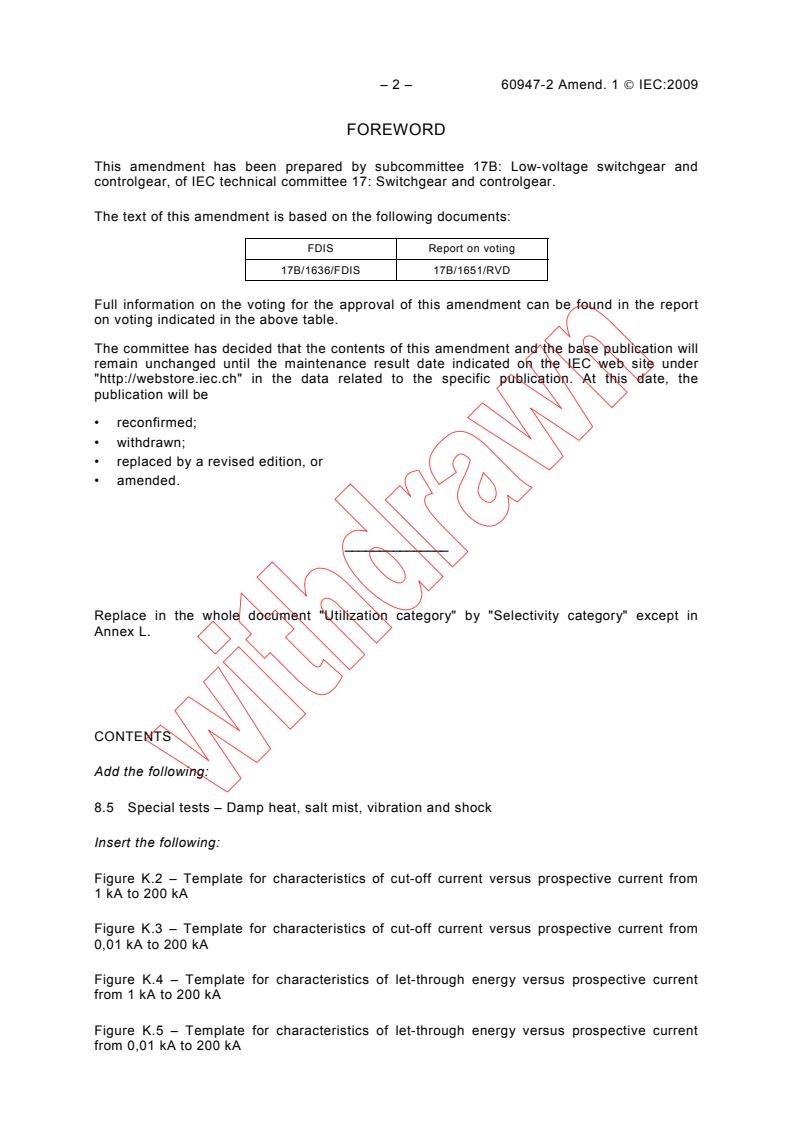
– 2 – 60947-2 Amend. 1 © IEC:2009
FOREWORD
This amendment has been prepared by subcommittee 17B: Low-voltage switchgear and
controlgear, of IEC technical committee 17: Switchgear and controlgear.
The text of this amendment is based on the following documents:
FDIS Report on voting
17B/1636/FDIS 17B/1651/RVD
Full information on the voting for the approval of this amendment can be found in the report
on voting indicated in the above table.
The committee has decided that the contents of this amendment and the base publication will
remain unchanged until the maintenance result date indicated on the IEC web site under
"http://webstore.iec.ch" in the data related to the specific publication. At this date, the
publication will be
• reconfirmed;
• withdrawn;
• replaced by a revised edition, or
• amended.
_______________
Replace in the whole document "Utilization category" by "Selectivity category" except in
Annex L.
CONTENTS
Add the following:
8.5 Special tests – Damp heat, salt mist, vibration and shock
Insert the following:
Figure K.2 – Template for characteristics of cut-off current versus prospective current from
1 kA to 200 kA
Figure K.3 – Template for characteristics of cut-off current versus prospective current from
0,01 kA to 200 kA
Figure K.4 – Template for characteristics of let-through energy versus prospective current
from 1 kA to 200 kA
Figure K.5 – Template for characteristics of let-through energy versus prospective current
from 0,01 kA to 200 kA
60947-2 Amend. 1 © IEC:2009 – 3 –
Figure K.6 – Example of the use of template K.2
Figure K.7 – Example of the use of template K.4
Insert the following:
Table 9b – Applicability of tests or test sequences to four-pole circuit-breakers in a
given frame size and design when tested according to the alternative programme 1 of 8.3.1.4
Table 9c – Applicability of tests or test sequences to 3-pole circuit-breakers in a
given frame size and design when tested according to the alternative programme 2 of 8.3.1.4
1.2 Normative references
Delete the reference to IEC 60364-4-41:2001.
Add the following reference:
IEC 60417, Graphical symbols for use on equipment
IEC 60617, Graphical symbols for diagrams
Replace “IEC 60755:1983” by “IEC/TR 60755:1983”.
Replace the reference to IEC 60947-1:2004 by the following:
IEC 60947-1:2007, Low-voltage switchgear and controlgear – Part 1: General rules
Add, after IEC 60947-4-1:2000, the following reference:
Amendment 2 (2005)
Replace the reference to IEC 61000-3-2:2000 by the following:
IEC 61000-3-2:2005, Electromagnetic compatibility (EMC) – Part 3-2: Limits – Limits for
harmonic current emissions (equipment input current ≤ 16 A per phase)
Add, after IEC 61000-3-3:1994, the following reference:
Amendment 2 (2005)
Replace the reference to IEC 61000-4-3:2002 by the following:
– 4 – 60947-2 Amend. 1 © IEC:2009
IEC 61000-4-3:2006, Electromagnetic compatibility (EMC) – Part 4-3: Testing and
measurement techniques – Radiated, radio-frequency, electromagnetic field immunity test
Replace the reference to IEC 61000-4-4:1995 by the following:
IEC 61000-4-4:2004, Electromagnetic compatibility (EMC) – Part 4-4: Testing and
measurement techniques – Electrical fast transient/burst immunity test
Replace the reference to IEC 61000-4-5:1995 by the following:
IEC 61000-4-5:2005, Electromagnetic compatibility (EMC) – Part 4-5: Testing and
measurement techniques – Surge immunity test
Add, after IEC 61000-4-6:2003, the following reference:
Amendment 2 (2006)
Replace “IEC 61000-5-2:1997” by “IEC/TR 61000-5-2:1997”.
Add, after IEC 61008-1:1996, the following reference:
Amendment 2 (2006)
Add, after IEC 61009-1:1996, the following reference:
Amendment 2 (2006)
Add, after IEC 61009-1:1996, the following reference:
IEC 61131-1:2003, Programmable controllers – Part 1: General information
Add, after CISPR 11:2003, the following reference:
Amendment 2 (2006)
Add, after CISPR 22:2005, the following reference:
Amendment 2 (2006)
2.3
current-limiting circuit-breaker
Replace the existing definition by the following:
circuit-breaker that, within a specified range of current, prevents the let-through current
reaching the prospective peak value and which limits the let-through energy (I t) to a value
less than the let-through energy of a half-cycle wave of the symmetrical prospective current
NOTE 1 Reference may be made to either the symmetrical or asymmetrical prospective peak value of let-through
current.
NOTE 2 The let-through current is also referred to as the cut-off current (see IEV 441-17-12).
60947-2 Amend. 1 © IEC:2009 – 5 –
NOTE 3 Templates for the graphical representation of the cut-off current characteristic and the let-through energy
characteristic are given in Figures K.2 to K.5 and examples of the use of the templates in Figures K.6 and K.7.
Add, after definition 2.20, the following new definition 2.21:
2.21
programmable logic controller
PLC
digitally operating electronic system, designed for use in an industrial environment, which
uses a programmable memory for the internal storage of user-oriented instructions for
implementing specific functions such as logic, sequencing, timing, counting and arithmetic, to
control, through digital or analogue inputs and outputs, various types of machines or
processes. Both the PLC and its associated peripherals are designed so that they can be
easily integrated into an industrial control system and easily used in all their intended
functions
[IEC 61131-1, definition 3.5]
3.8
Replace the reference to 7.1.11 of IEC 60947-1 by the reference to 7.1.12 of IEC 60947-1.
4.3.2.4 Current rating for four-pole circuit-breakers
Replace the reference to 7.1.8 of IEC 60947-1 by the reference to 7.1.9 of IEC 60947-1.
5.2 Marking
Replace, under item a), last bullet, the reference to 7.1.5.1 of IEC 60947-1 by the reference to
7.1.6.1 of IEC 60947-1.
Correct, under item b),7th bullet, the symbol with the symbol
Replace, under item b), 13th bullet, the reference to 7.1.9.3 of IEC 60947-1 by the reference
to 7.1.10.3 of IEC 60947-1.
Replace, under item e), the reference to 7.1.7.4 of IEC 60947-1 by the reference to 7.1.8.4 of
IEC 60947-1.
– 6 – 60947-2 Amend. 1 © IEC:2009
7.1 Constructional requirements
Replace the five first paragraphs of the subclause by the following:
Subclause 7.1 of IEC 60947-1 applies. Where, in Subclause 7.1.2.2 of IEC 60947-1, the test
temperature is to be specified, the test temperature required by this standard is 960°C.
7.1.2 Additional requirements for circuit-breakers suitable for isolation
Replace, in the second paragraph, the reference to 7.1.6 of IEC 60947-1 by the reference to
7.1.7 of IEC 60947-1.
7.1.5 List of construction breaks
Add a new item f).
th
f) in the case of the 4-pole variant, replacement of the trip unit in the 4 pole by a link, to
provide an unprotected neutral.
7.1.6 Additional requirements for circuit-breakers provided with a neutral pole
Replace, in the first paragraph, the reference to 7.1.8 of IEC 60947-1 by the reference to
7.1.9 of IEC 60947-1.
Add, after Subclause 7.1.6, the following new Subclause 7.1.7:
7.1.7 Digital inputs and outputs for use with programmable logic controllers (PLCs)
Annex S of IEC 60947-1 applies. For the purposes of this standard this requirement does not
apply to digital inputs and outputs dedicated to devices other than PLCs.
8.1.1
Add, after the second dashed item, the following new third dashed item:
− special tests (see 8.5).
60947-2 Amend. 1 © IEC:2009 – 7 –
8.3.1 Test sequences
Replace the first four paragraphs of this subclause by the following:
8.3.1.1 General
Type tests are grouped together in a number of sequences, as shown in Table 9.
For each sequence, tests shall be made in the order listed unless otherwise specified in this
standard.
8.3.1.2 Tests omitted from sequence I and made separately
With reference to 8.1.1 of IEC 60947-1, the following tests of test sequence I (see 8.3.3) may
be omitted from the sequence and made on separate samples:
– tripping limits and characteristics (8.3.3.1); in which case the sample(s) tested in the
sequence shall be subjected to the tests of 8.3.3.1.3, at the maximum setting only and
without the additional test of item b) to verify the time-current characteristic;
– test of dielectric properties (8.3.3.2);
– test of under-voltage releases of 8.3.3.3.2 (item c) and 8.3.3.3.3, to verify the
requirements of 7.2.1.3 of IEC 60947-1, and tests of under-voltage releases at alternative
frequencies (see 8.3.2.1);
– test of shunt releases of 8.3.3.3.2 (item d) and 8.3.3.3.3, to verify the requirements of
7.2.1.4 of IEC 60947-1, and tests of shunt releases at alternative frequencies (see
8.3.2.1);
– additional tests for operational capability without current for withdrawable circuit-breakers
(8.3.3.3.5).
8.3.1.3 Applicability of sequences according to the relationship between short-circuit
ratings
The applicability of test sequences according to the relationship between I , I and I is
cs cu cw
given in Table 9a.
a
Table 9 – Overall schema of test sequences
Replace, in the fifth row (sequence V), third column:
– “Short-circuit at take-over current” by “Short-circuit at 1,1 times the take-over current”, and
– “Short-circuit at rated ultimate short-circuit braking capacity” by “Short-circuit at rated ultimate short-circuit
breaking capacity”.
Replace footnote b by:
b Except where Sequence VI is applied.
nd
dashed item by:
Replace, in footnote c, the 2
– where Sequence VI is applied
– 8 – 60947-2 Amend. 1 © IEC:2009
Add, after Table 9a, the following new Subclause 8.3.1.4, Table 9b and Table 9c:
8.3.1.4 Alternative test programmes for circuit-breakers having both three-pole and
four-pole variants
These alternative test programmes may be applied when there is no construction break (see
7.1.5) between the poles of the four-pole variant and the poles of the three-pole variant.
Compliance with the test requirements may be met by carrying out one of the alternative
programmes 1 or 2 below.
– Programme 1: The applicable test sequences according to Table 9 shall be carried out
on the three-pole variant of the circuit-breaker. In addition, the tests or test sequences
listed in Table 9b shall be carried out on the four-pole variant.
– Programme 2: The applicable test sequences according to Table 9 shall be carried out
on the four-pole variant of the circuit-breaker. In addition, the tests or test sequences
listed in Table 9c shall be carried out on the three-pole variant.
60947-2 Amend. 1 © IEC:2009 – 9 –
Table 9b – Applicability of tests or test sequences to four-pole circuit-breakers in a
given frame size and design when tested according to the alternative programme 1 of
8.3.1.4
Test Test clause Test Four identical Fourth pole Fourth pole
sequence poles, neutral identified, neutral identified, neutral
identified or not unprotected protected rated
differently to the
(See Note 2 to
phase poles
8.3.1.4)
Test of tripping limits and
8.3.3.1
characteristics
8.3.3.1.1 General
8.3.3.1.2 Short-circuit releases X X X
one test on one one test on one i) one test on one
pair of poles pair of pair of
a
chosen at random phase poles phase poles
a a
chosen at random chosen at random
X
ii) one test on N
+ one phase pole
at random
Overload releases:
8.3.3.1.3 a) X X X
− instantaneous/definite
time-delay 3-phase 3-phase i) 3-phase poles
X
or ii) N
8.3.3.1.3 b) X X X
I
− inverse time-delay
3-phase 3-phase i) 3-phase poles
(as
applicable) X
ii) N
8.3.3.1.4 Additional test for definite
time-delay releases:
X
− overload releases
i) 3-phase poles
X
ii) N
X
− short-circuit releases
i) one test on one
pair of
phase poles
a
chosen at random
X
ii) one test on N
+ one phase pole
chosen at random
– 10 – 60947-2 Amend. 1 © IEC:2009
Table 9b (continued)
Test Test clause Test Four identical Fourth pole Fourth pole
sequence poles, neutral identified, neutral identified, neutral
identified or not unprotected protected rated
differently to the
(See Note 2 to
phase poles
8.3.1.4)
8.3.3.2 Dielectric properties X X X
8.3.3.3 Mechanical operation and
operational performance
capability
8.3.3.3.1 General
Construction and
8.3.3.3.2 X X X
mechanical operation
Operational performance
8.3.3.3.3 X X X
capability without current
Operational performance
8.3.3.3.4 X X X
capability with current
Withdrawable circuit-
8.3.3.3.5 X X X
breakers
8.3.3.4 Overload performance X X X
Verification of dielectric
8.3.3.5 X X X
withstand
Verification of
8.3.3.6
X X X
temperature-rise
Verification of overload
8.3.3.7
releases
Verification of
8.3.3.8 undervoltage and shunt X X X
releases
Verification of the main
8.3.3.9 X X X
contact position
Rated service short-circuit
II 8.3.4
breaking capacity
b Rated ultimate short-
III X X X
8.3.5
circuit breaking capacity
X X X
Rated short-time 4th pole and 4th pole and 4th pole and
IV 8.3.6
withstand current adjacent pole only adjacent pole only adjacent pole only
(see 8.3.2.6.4) (see 8.3.2.6.4) (see 8.3.2.6.4)
Performance of integrally
V 8.3.7
fused circuit-breakers
VI 8.3.8 Combined test sequence
NOTE The applicability of a test or test sequence is indicated by X in the relevant space.
a
In the case of an electronic trip unit, these tests may be made on one pole chosen at random.
b
This test sequence also applies when, for the 3-pole testing, Sequence III on the 3-pole variant is replaced by
Sequence II or Sequence VI (see Table 9).
60947-2 Amend. 1 © IEC:2009 – 11 –
Table 9c – Applicability of tests or test sequences to 3-pole circuit-breakers in a
given frame size and design when tested according to the alternative programme 2 of
8.3.1.4
Test Test clause Test Test or
sequence sequence of
tests on 3-pole
variant
8.3.3.1 Test of tripping limits and characteristics
8.3.3.1.1 General
8.3.3.1.2 Short-circuit releases
Overload releases:
8.3.3.1.3 a)
− instantaneous/definite time-delay
or
− inverse time-delay
8.3.3.1.3 b)
(as
applicable)
8.3.3.1.4 Additional test for definite time-delay releases:
I − overload release
− short-circuit releases
8.3.3.2 Dielectric properties X
8.3.3.3 Mechanical operation and operational performance
capability
8.3.3.3.1 General
8.3.3.3.2 Construction and mechanical operation
8.3.3.3.3 Operational performance capability without current X
8.3.3.3.4 Operational performance capability with current X
8.3.3.3.5 Withdrawable circuit-breakers
8.3.3.4 Overload performance
X
8.3.3.5 Verification of dielectric withstand X
8.3.3.6 Verification of temperature-rise X
8.3.3.7 Verification of overload releases
8.3.3.8 Verification of undervoltage and shunt releases
8.3.3.9 Verification of the main contact position
II 8.3.4 Rated service short-circuit breaking capacity
b
Rated ultimate short-circuit breaking capacity
III X
8.3.5
IV 8.3.6 Rated short-time withstand current
V 8.3.7 Performance of integrally fused circuit-breakers
VI 8.3.8 Combined test sequence
NOTE The applicability of a test or test sequence is indicated by X in the relevant space.
a
In the case of an electronic trip unit, these tests may be made on one pole chosen at random.
b This test sequence also applies when, for the 4-pole testing, Sequence III on the 4-pole variant is
replaced by Sequence II or Sequence VI (see Table 9).
– 12 – 60947-2 Amend. 1 © IEC:2009
8.3.2 General test conditions
Delete NOTE 1.
Renumber NOTE 2 as NOTE.
8.3.2.1 General requirements
Replace in the fifth paragraph the reference to Note 8 by Footnote g.
Replace the existing text of the eighth paragraph by the following:
Unless otherwise stated, the tests shall be made with the same kind of current and, in the
case of a.c., at the same rated frequency and with the same number of phases as in the
intended service. Tests performed at 50 Hz cover 60 Hz applications and vice-versa, except
for the performance of under-voltage and shunt releases (see 7.2.2 and 7.2.2.6 of
IEC 60947-1).
Replace in the 12th paragraph the reference to Note 1 by Footnote a.
Replace the existing Table 10 by the following new Table 10:
60947-2 Amend. 1 © IEC:2009 – 13 –
Table 10 – Number of samples for test
Tem-
Number of Terminals Number
Sample Current perature- Foot-
marked marked of Test voltage Test current
a
Test
No. setting rise notes
U ratings line/load samples
e
sequence
verification
1 2 Mul. Yes No Min. Max. Corr. Max.
I X X X X X 1 1 X U max See 8.3.3 X g
e
1 X U X X h
e
X X 2
2 X U X b
e
1 X U X X h
e
X X 3 2 X U X b
e
II 3 X U X X j
e
(I )
cs
1 X U max corr. X X h
e
and
X X X 3 2 X U max corr. X b
e
VI
(combined) 3 X U max X X k
e
1 X U max corr. X X h
e
2 X U max corr. X b
e
X X X 4
3 X Uintermed.X X e
e
4 X U max X X k
e
1 X U X g
e
X X 2
2 X U X b
e
1 X U X g
e
X X 3
2 X U X b
e
3 X U X c
e
1 X U max corr. X g
e
III
(I )
cu
X X X 3
2 X U max corr. X b
e
3 X Umax X d
e
1 X U max corr. X g
e
2 X U max corr. X b
e
X X X 4
3 X Uintermed.X e
e
4 X U max X d
e
Tem-
Rated I
Number of Terminals Number cw
Sample Current perature- Foot-
marked marked of Test voltage
Test a
No. setting rise notes
Test
I ratings line/load samples
cw Time delay
sequence
verification
current
1 Mul. Yes No Min. Max. Corr. Max. Corr. Max.
1 X U max X X X g
e
X X X 2
2 X U max X X X m
e
IV
1 X U max corr. X X X g
l
e
(I )
cw
X X X 3
2 X U max corr. X X X i
e
3 X U max X X X m
e
– 14 – 60947-2 Amend. 1 © IEC:2009
Table 10 (continued)
Tem-
Number of Terminals Number
Sample Current perature- Foot-
marked marked of Test voltage Test current
a
Test
No. setting rise notes
U ratings line/load samples
e
sequence
verification
1 2 Mul. Yes No Min. Max. Corr. Max.
V 1 X U max X X f, g
e
Integral
X X X X X
2 X U max X b
e
fused
(I )
cu
Individual 1 X U max I g
e su
pole
X X X X X 2
(Annex C)
2 X U max I _
e su
(I )
su
Individual
pole
U max
X X X X X 1 1 X I g
e IT
(Annex H)
(I )
IT
Mul. = multiple; Corr. = corresponding; Intermed. = intermediate
NOTE The applicability of a test or test sequence is indicated by X in the relevant space.
a
Min means the minimum I of a given frame size; in the case of adjustable overload releases, it means the minimum
n
setting of the minimum I . Max means the maximum I of a given frame size.
n n
b
This sample is omitted in the following cases:
– a circuit-breaker having a single non-adjustable current setting for a given frame size;
– a circuit-breaker provided only with a shunt release (i.e. without an integral overcurrent release);
– a circuit-breaker with electronic overcurrent protection, of a given frame size, having an adjustable current rating
by electronic means only (i.e. without change of current sensors).
c
Connections reversed.
d
Connections reversed, if terminals unmarked.
e
To be agreed between test station and manufacturer.
f
If terminals unmarked, an additional sample shall be tested with connections reversed.
g
In the case of one or more construction breaks (see 2.1.2 and 7.1.5) within the frame size, a further sample is tested
at the maximum rated current corresponding to each construction, under the conditions applicable to sample 1.
h
The requirement of footnote g applies to sequence VI (combined) and also to sequence II where I = I .
cs cu
i
This sample is selected based on the highest value of thermal energy (I t; where “t” is the corresponding short-time
cw
delay, see 4.3.5.4). This sample is omitted if the highest thermal energy condition is met by sample 1 or 3.
j
This sample, with connections reversed, is only required when sequence III is replaced by sequence II (I = I ,
cu cs
see 8.3.5).
k
Connections reversed, if terminals unmarked, when sequence III is replaced by sequence II (I = I , see 8.3.5) or
cu cs
when sequence VI replaces sequences II, III and IV (I = I = I , see 8.3.8), otherwise this sample is tested forward
cu cs cw
connected.
l
Applies to category B circuit-breakers and also to category A circuit-breakers covered by Note 3 of Table 4.
m
This sample, with connections reversed, is only required when sequence III is replaced by sequence IV (I = I , see
cu cw
8.3.5).
60947-2 Amend. 1 © IEC:2009 – 15 –
8.3.2.5 Test conditions for temperature-rise test
Replace the fourth paragraph by the following:
During the temperature rise test of sequence I (see 8.3.3.6) coils of under-voltage releases,
where applicable, shall be supplied at one rated frequency and corresponding voltage, chosen
at random. Additional tests to verify coils at other rated frequencies and voltages shall be
made outside the sequence.
8.3.2.6.4 Test procedure
Replace the existing text of this subclause by the following new Subclause 8.3.2.6.4.1 to
Subclause 8.3.2.6.4.4:
8.3.2.6.4.1 General
Subclause 8.3.4.1.6 of IEC 60947-1 applies, with the following addition.
8.3.2.6.4.2 Tests on one-, two- and three-pole circuit-breakers
After calibration of the test circuit in accordance with 8.3.2.6.3, the temporary connections are
replaced by the circuit-breaker under test and its connecting cables if applicable.
Tests for the performance under short-circuit conditions shall be made according to the
sequences in Table 9 (see 8.3.1).
For circuit-breakers having a rated current up to and including 630 A, a cable of maximum
length 75 cm, having a cross-section corresponding to the conventional thermal current (see
8.3.3.3.4, Tables 9 and 10 of IEC 60947-1) shall be included as follows:
– approximately 50 cm on the supply side;
– approximately 25 cm on the load side.
The sequence of operations shall be that which is applicable to each test sequence, as
specified in 8.3.4.1, 8.3.5.2, 8.3.6.4 and 8.3.7.6.
Alternative test programmes for circuit-breakers having three-pole and four-pole variants are
given in 8.3.1.4.
8.3.2.6.4.3 Tests on four-pole circuit-breakers
The requirements of 8.3.2.6.4.2 apply.
An additional sequence of operations on one or more new samples, in accordance with
Table 10, shall be made on the fourth pole and its adjacent pole for sequences III and IV, or
IV and V, or VI, as applicable. At the request of the manufacturer these tests may be
combined with the three-pole tests of 8.3.2.6.4.2 and made on the same samples, in which
case the test in each relevant test sequence shall comprise
− the test on three adjacent poles,
– 16 – 60947-2 Amend. 1 © IEC:2009
− the test on the fourth pole and the adjacent pole.
The tests on the fourth pole and the adjacent pole are made at an applied voltage of U /√3, in
e
the circuit shown in Figure 12 of IEC 60947-1 with the connections C1 and C2 removed. The
test current shall be agreed between manufacturer and user but shall be not less than 60 % of
I or I , as applicable.
cu cw
Alternative test programmes for circuit-breakers having three-pole and four-pole variants are
given in 8.3.1.4.
8.3.2.6.4.4 Test operations
The following symbols are used for defining the sequence of operations:
O represents a breaking operation;
CO represents a making operation followed, after the appropriate opening time, by a
breaking operation:
t represents the time interval between two successive short-circuit operations which shall
be as short as possible, allowing for the resetting time of the circuit-breaker (see 2.19),
but not less than 3 min. The actual value of t shall be stated in the test report.
The maximum resetting time shall be 15 min or such longer time as may be stated by
the manufacturer, but not exceeding 1 h, during which time the circuit-breaker shall not
be displaced. Attempts to re-close the circuit-breaker during the resetting time shall be
spaced by at least 1 min.
The maximum value of I t (see 2.5.18 of IEC 60947-1) during these tests may be recorded in
the test report (see 7.2.1.2.4, item a).
8.3.3.1.4 Additional test for definite time-delay releases
Replace the last paragraph of item a) by the following:
If the test current overlaps with another tripping characteristic (e.g. an instantaneous tripping
characteristic), the trip setting (e.g. I , see Figure K.1) and the test current shall be reduced
sd
as necessary to prevent premature tripping. Both values shall be recorded in the test report.
8.3.5 Test sequence III: Rated ultimate short-circuit breaking capacity
Replace the existing text of the fourth paragraph of 8.3.5 by the following:
Where I = I , this test sequence need not be made, in which case construction break tests
cs cu
are required in Sequence II (see Table 10) and the following verifications shall additionally be
made in test sequence II:
– the verification of 8.3.5.1, at the beginning of the test sequence;
– the verification of 8.3.5.4, at the end of the test sequence.
60947-2 Amend. 1 © IEC:2009 – 17 –
8.3.7.6 Short-circuit at ultimate short-circuit breaking capacity
Replace the existing title of this subclause by the following:
8.3.7.6 Short-circuit at rated ultimate short-circuit breaking capacity
Add, after Subclause 8.4.6, the following new Subclause 8.5:
8.5 Special tests – Damp heat, salt mist, vibration and shock
The following special tests shall be made either at the discretion of the manufacturer or
according to agreement between the manufacturer and user (see 2.6.4 of IEC 60947-1). As
special tests, these additional tests are not mandatory, and it is not necessary for a circuit-
breaker to satisfy any of these tests to conform to this standard.
Annex Q of IEC 60947-1 applies.
Where Table Q.1 of IEC 60947-1 calls for verification of operational capability, this shall be
made by carrying out the routine tests to 8.4 of this standard, except for the dielectric tests of
8.4.5, which are covered by the tests of Table Q.1 of IEC 60947-1.
A.1 Introduction
Add, at the end of the third paragraph, the following sentence:
Preferred templates for the representation of cut-off current and let-through energy (I t)
characteristics are given in Annex K.
B.4.2.4.2.1 Limiting non-actuating time (see B.2.3.7)
Delete the last sentence.
H.2 Individual pole short circuit
Replace the second dashed item and last line of the first paragraph by the following:
– 1,2 times the maximum setting of the definite time delay release tripping current,
but not less than 500 A nor exceeding 50 kA.
– 18 – 60947-2 Amend. 1 © IEC:2009
Table J.1 – EMC − Immunity tests
Replace the existing Table J.1 by the following:
Table J.1 − EMC − Immunity tests
a
Description Reference standard Test level Performance Mounting
criterion
Electrostatic IEC 61000-4-2 8 kV contact B Enclosure
discharges Figure J.1
8 kV air
c
Radiated radio- IEC 61000-4-3 10 V/m A Free air
frequency
electromagnetic fields
Electrical fast IEC 61000-4-4 Power port: B Enclosure
transients/bursts Figure J.1
U ≥ 100 V, a.c. or d.c.: 4 kV
e
f
U < 100 V, a.c. or d.c.: 2 kV
e
g
Signal port: 2 kV
Surges IEC 61000-4-5 Power port, U ≥ 100 V a.c.: B Enclosure
e
Figure J.1
4 kV line-to-earth
2 kV line-to-line (Annexes F
and N)
4 kV line-to-line (Annexes B
e
and M)
Power port, U < 100 V a.c.:
e
2 kV line-to-earth
1 kV line-to-line
f
Power port, d.c. :
0,5 kV line-to-earth
0,5 kV line-to-line
h
Signal port :
2 kV line-to-earth
1 kV line-to-line
c
Conducted IEC 61000-4-6 Power port: 10 V A Free air
disturbances induced
g
Signal port: 10 V
by radio-frequency
fields
Power frequency Not applicable Not applicable Not applicable Not applicable
magnetic fields
d d
d
Voltage dips and IEC 61000-4-11 Free air
interruptions
b b
b
Harmonics IEC 61000-4-13 Free air
b b b
Current dips Free air
60947-2 Amend. 1 © IEC:2009 – 19 –
Table J.1 (continued)
a
The immunity levels specified are generally higher than the requirements of IEC 60947-1 in order to provide
greater security for the circuit protection functions of the device.
b
A specific test procedure is defined in the case of electronic overcurrent devices in Annex F, in the absence of
an appropriate basic standard.
c
Unless the circuit-breaker is intended to be used only in a specified individual enclosure, in which case it shall
be tested in such an enclosure. Details, including dimensions of the enclosure, shall be stated in the test
report. The enclosure shall be connected to the ground plane in accordance with the manufacturer’s
instructions.
d
A specific test procedure and a performance criterion are defined in Annex B in the case of CBRs functionally
dependent on line voltage and in Annex M in the case of MRCDs functionally dependent on a voltage source, in
the absence of an appropriate basic standard. These tests are not applicable to circuit-breakers with electronic
overcurrent protection as described in Annex F (see F.1), but are replaced by tests for current dips and
interruptions (see F.4.7).
e
The immunity level is higher for residual current devices because they perform safety functions.
f
Not applicable to input ports intended for connection to a battery or a rechargeable battery which must be
removed or disconnected from the apparatus for recharging. Apparatus with a d.c. power input port intended for
use with an a.c.-d.c. power adapter shall be tested on the a.c. power input of the a.c.-d.c. power adapter
specified by the manufacturer or, where none is so specified, using a typical a.c.-d.c. power adapter. The test
is not applicable to d.c. power input ports intended to be permanently connected to cables less than 3 m in
length.
g
Applicable only to ports interfacing with cables whose total length according to the manufacturer’s functional
specification may exceed 3 m.
h
Applicable only to ports interfacing with cables whose total length according to the manufacturer’s functional
specification may exceed 10 m. When shielded cables are used, this test is applied only to the shield.
Annex K (informative) – Glossary of symbols related to products covered by this
standard
Replace the existing title by the following:
Annex K (informative) – Glossary of symbols and graphical representation of
characteristics
Replace the existing table by the following new table:
– 20 – 60947-2 Amend. 1 © IEC:2009
Characteristics list Symbol IEC 60417 or Subclause of
IEC 60617 this standard
reference
IEC 60417-5007
Circuit-breaker, closed position 5.2
(2007-01)
IEC 60417-5008
Circuit-breaker, open position 5.2
(2007-01)
IEC 60617-
S00287
5.2
Isolation suitability – circuit-breaker and ICB combined with
O.4
60617- S00220
(2007-01)
IEC 60617-
Isolation suitability – CBI S00288 L.5
(2007-01)
Neutral pole terminal N 5.2
IEC 60417-5019
Protective earth terminal 5.2
(2007-01)
Rated control circuit voltage U 4.7.2
c
Rated voltage of the voltage source of an MRCD U M.4.1.2.1
s
Rated voltage of the monitored circuit for an MRCD U Annex M
n
Rated current I 4.3.2.3
n
Rated impulse withstand voltage U 4.3.1.3
imp
Rated insulation voltage U 4.3.1.2
i
Rated operational voltage U 4.3.1.1
e
Rated service short-circuit breaking capacity I 4.3.5.2.2
cs
Rated short-circuit making capacity I 4.3.5.1
cm
Rated short time withstand current I 4.3.5.4
cw
Rated residual short time withstand current of an MRCD I M.4.3.5
Δw
Annex L
Rated conditional short-circuit current I
cc
Annex M
Rated conditional residual short-circuit current of an MRCD I M.4.3.2
Δc
Rated ultimate short-circuit breaking capacity I 4.3.5.2.1
cu
Selectivity limit current I 2.17.4
s
Take-over current I 2.17.6
B
Conventional enclosed thermal current I 4.3.2.2
the
Conventional free air thermal current I 4.3.2.1
th
B.4.4.1
CBRs and MRCDs of type AC
M.4.4.1
B.4.4.2
CBRs and MRCDs of type A
M.4.2.2.2
MRCDs of type B M.4.2.2.3
B.7.2.6
Test device CBR or MRCD
T
M.7.2.6
a
Current setting of adjustable overload release I
R
a
Corresponding tripping time t
R
60947-2 Amend. 1 © IEC:2009 – 21 –
Characteristics list Symbol IEC 60417 or Subclause of
IEC 60617 this standard
reference
a
Ground fault current setting I
g
a
Corresponding tripping time t
g
Individual pole short-circuit breaking capacity
I Annex C
su
(phase/earthed systems)
Individual pole short-circuit test current (IT systems) I Annex H
IT
2.20
Figure K.1
Rated instantaneous short-circuit current setting I
i
Annex L
Annex O
a
Maximum corresponding tripping time t
i
Not suitable for use in IT systems Annex H
IT
Annex B
Rated residual short-circuit making and breaking capacity I
Δm
Annex M
Annex B
Rated residual non-operating current I
Δno
Annex M
Annex B
Rated residual operating current I
Δn
Annex M
a
Residual operating current I
ΔR
a
Short time pick-up current I
sd
a
Corresponding tripping time t
sd
Suitability for phase earthed systems C 4.3.1.1
Annex B
Limiting non-actuating time at 2 I Δt
Δn
Time delay CBR or MRCD with limiting non-actuating time B.5 a)
S
of 0,06 s M.3.4
B.8.9.2
1Ph
CBRs for use with 3-phase supply only
a
These terms are not used in this standard. For their identification, see Figure K.1.
– 22 – 60947-2 Amend. 1 © IEC:2009
Figure K.1 – Relationship between symbols and tripping characteristics
Replace the existing Figure K.1 by the following:
I t c haracteristic
(non I t) characteristic
I
R
t
LT
GF
I
sd
t
R
I
Δ R
ST
RC
I
i
t
sd
INST
t
g
t
i
I I I . I I
Δ X I I
n g n i
R sd
IEC 2388/08
RC residual current LT long time INST instantaneous
GF ground fault ST short time
Figure K.1 – Relationship between symbols and tripping characteristics
60947-2 Amend. 1 © IEC:2009 – 23 –
Add, after Figure K.1, the following new Figures K.2 to K.7:
1 10 100 200
Prospective current (kA r.m.s.)
IEC 2389/08
Figure K.2 – Template for characteristics of cut-off current versus
prospective current from 1 kA to 200 kA
Peak current (kA)
– 24 – 60947-2 Amend. 1 © IEC:2009
0,01 0,1 1 10 100 200
Prospective current (kA r.m.s.)
IEC 2390/08
Figure K.3 – Template for characteristics of cut-off current versus
prospective current from 0,01 kA to 200 kA
Peak current (kA)
60947-2 Amend. 1 © IEC:2009 – 25 –
1 10 100 200
Prospective current (kA r.m.s.)
IEC 2391/08
Figure K.4 – Template for characteristics of let-through energy
versus prospective current from 1 kA to 200 kA
Let-through energy (A s)
– 26 – 60947-2 Amend. 1 © IEC:2009
0,01 0,1 1 10 100
Prospective current (kA r.m.s.)
IEC 2392/08
Figure K.5 – Template for characteristics of let-through energy
versus prospective current from 0,01 kA to 200 kA
Let-through energy (A s)
60947-2 Amend. 1 © IEC:2009 – 27 –
A
B
C
1 10 100 200
Prospective current (kA r.m.s.)
IEC 2393/08
A prospective asymmetric peak current under the test conditions of this standard
B prospective symmetrical peak current
C typical cut-off current characteristic
The use of the templates by manufacturers to plot the characteristics of circuit-breakers will provide common
presentation, allowing easier interpretation by the user.
In the case of cut-off current the effect of current limiting is shown by comparison with the current that would be let
through (prospective current) if the circuit-breaker were not present. The comparison is made with the asymmetric
(inrush) peak current or the symmetrical peak current (see 2.3).
The typical curve does not imply any requirement of the standard for a particular curve shape or value, which will
vary according to the design of the product.
Figure K.6 – Example of the use of template K.2
Peak current (kA)
– 28 – 60947-2 Amend. 1 © IEC:2009
A
B
10 100 200
Prospective current (kA r.m.s.) IEC 2394/08
A let-through energy of one half cycle of prospective current at 50 Hz
B typical let-through energy characteristic of a 250A MCCB at 400 V 50 Hz
The use of the templates by manufacturers to plot the characteristics of circuit-breakers will provide common
presentation, allowing easier interpretation by the user.
In the case of let-through energy the effect of current limiting is shown by comparison with the energy that would
be let through in one half-cycle of the symmetrical prospective current if the circuit-breaker were not present (see
2.3).
The typical curve for the 250A MCCB does not imply any requirement of the standard for a particular curve shape
or value, which will vary according to the design of the product.
Figure K.7 – Example of the use of template K.4
Let-through energy (A s)
60947-2 Amend. 1 © IEC:2009 – 29 –
Table M.1 – Product information
Replace rows “r)” and “s)” of this table by the following:
………
a a
r) operating characteristic in case of residual Visible
currents in the presence or absence of a d.c. Type AC
component
Type A
Type B
a a
s) limiting non-operating time (value or range) Visible
Δt or S
at 2 I for time-delay type, as applicable
Δn
………
_______________
– 30 – 60947-2 Amend. 1 © CEI:2009
AVANT-PROPOS
Le présent amendement a été préparé par le sous-comité 17B: Appareillage à basse tension,
du comité d'études 17 de la CEI: Appareillage.
Le t
...