

EN 50625-2-1:2014
(Main)Collection, logistics and treatment requirements for WEEE - Part 2-1: Treatment requirements for lamps
General Information
- Abstract
This clause of Part 1 is replaced by the following: This European standard is applicable to the treatment of lamps. This European Standard applies to the treatment of lamps until end-of-waste status is ful-filled, or lamp fractions are recycled, recovered, or disposed of. This European Standard addresses all operators involved in the treatment including related handling, sorting, and storage of lamps. This European Standard applies to all facilities including those whose treatment operations use mobile equipment.
- Status
- Published
- Publication Date
- 18-Dec-2014
- Withdrawal Date
- 12-Oct-2017
- Technical Committee
- CLC/TC 111X - Environment
- Drafting Committee
- CLC/TC 111X - Environment
- Current Stage
- 6060 - Document made available - Publishing
- Start Date
- 19-Dec-2014
- Due Date
- 26-Dec-2015
- Completion Date
- 19-Dec-2014


Overview
EN 50625-2-1:2014 (CLC) - Collection, logistics and treatment requirements for WEEE, Part 2-1: Treatment requirements for lamps - is a European normative standard that specifies technical, organisational and operational requirements for the treatment of waste lamps (WEEE lamps). It supplements EN 50625-1 (General treatment requirements) and applies to lamp treatment until end-of-waste status is achieved or lamp fractions are recycled, recovered or disposed of. The standard addresses all operators and facilities (including mobile equipment operations) involved in handling, sorting, storage and treatment of lamps.
Key topics and technical requirements
- Scope and applicability
- Treatment of lamps across all facility types until fractions reach end‑of‑waste, recycling, recovery or disposal.
- Use in conjunction with EN 50625-1 and aligned with Directive 2012/19/EC references.
- Administrative & organisational controls
- Site risk management process that identifies hazards, assesses risks and documents controls (including emergency and fire scenarios).
- Occupational health measures addressing mercury and other lamp‑specific hazards.
- Infrastructure and technical pre-conditions
- Facilities sized and equipped for the performed activities (including impermeable surfaces and weatherproof coverings where emissions may occur).
- Access and security measures to prevent theft and damage.
- Handling, receiving and storage
- Verification of incoming deliveries and mass recording.
- Limit: stored lamps should not exceed the quantity that can be treated within six months under normal production conditions.
- Careful handling to prevent breakage and uncontrolled release of hazardous substances.
- De-pollution and mercury management
- Mercury must be removed; treatment design must minimise mercury releases.
- Prohibition of diluting mercury-containing fractions to lower concentration for disposal.
- Examples of mercury recovery methods are referenced (e.g., enclosed thermal retort).
- Monitoring and documentation
- Regular monitoring of emissions and occupational exposure (Annex AA referenced).
- Record-keeping on deliveries, treatment, monitoring and fractions produced.
- Fractions and recovery
- Separation of fractions to facilitate recycling (glass, metals, plastics, phosphor powders, elemental mercury); potential applications referenced in Annex BB.
Practical applications - who uses this standard
- WEEE treatment operators and recyclers of lamps
- Facility designers, mobile treatment contractors and plant managers
- Environmental compliance officers and permitting authorities
- Occupational health & safety professionals and auditors
- Waste logistics providers and collection schemes seeking compliant treatment pathways
Related standards and legislation
- EN 50625-1 (General treatment requirements for WEEE)
- EU Directive 2012/19/EC (WEEE), including Annex VII provisions
- National permitting and emission limit regulations (site-specific requirements may apply)
Keywords: EN 50625-2-1:2014, WEEE lamps, lamp treatment, mercury de-pollution, lamp recycling, treatment facility requirements, CENELEC standard, WEEE compliance.
Relations
- Effective Date
- 03-Feb-2026
Get Certified
Connect with accredited certification bodies for this standard

IMQ S.p.A. (Certification)
Italian electrical product certification.

SLG Prüf- und Zertifizierungs GmbH
German testing and certification body.

UL Solutions
Global safety science company with testing, inspection and certification.
Sponsored listings
Frequently Asked Questions
EN 50625-2-1:2014 is a standard published by CLC. Its full title is "Collection, logistics and treatment requirements for WEEE - Part 2-1: Treatment requirements for lamps". This standard covers: This clause of Part 1 is replaced by the following: This European standard is applicable to the treatment of lamps. This European Standard applies to the treatment of lamps until end-of-waste status is ful-filled, or lamp fractions are recycled, recovered, or disposed of. This European Standard addresses all operators involved in the treatment including related handling, sorting, and storage of lamps. This European Standard applies to all facilities including those whose treatment operations use mobile equipment.
This clause of Part 1 is replaced by the following: This European standard is applicable to the treatment of lamps. This European Standard applies to the treatment of lamps until end-of-waste status is ful-filled, or lamp fractions are recycled, recovered, or disposed of. This European Standard addresses all operators involved in the treatment including related handling, sorting, and storage of lamps. This European Standard applies to all facilities including those whose treatment operations use mobile equipment.
EN 50625-2-1:2014 is classified under the following ICS (International Classification for Standards) categories: 13.030.99 - Other standards related to wastes; 29.100.01 - Components for electrical equipment in general; 31.220.01 - Electromechanical components in general. The ICS classification helps identify the subject area and facilitates finding related standards.
EN 50625-2-1:2014 has the following relationships with other standards: It is inter standard links to CLC/TS 50625-3-2:2016. Understanding these relationships helps ensure you are using the most current and applicable version of the standard.
EN 50625-2-1:2014 is associated with the following European legislation: EU Directives/Regulations: 2012/19/EC, 2012/19/EU; Standardization Mandates: M/490, M/518. When a standard is cited in the Official Journal of the European Union, products manufactured in conformity with it benefit from a presumption of conformity with the essential requirements of the corresponding EU directive or regulation.
EN 50625-2-1:2014 is available in PDF format for immediate download after purchase. The document can be added to your cart and obtained through the secure checkout process. Digital delivery ensures instant access to the complete standard document.
Standards Content (Sample)
2003-01.Slovenski inštitut za standardizacijo. Razmnoževanje celote ali delov tega standarda ni dovoljeno.HOHNWURQVNHCollection, logistics and treatment requirements for WEEE - Part 2-1: Treatment requirements for lamps29.140.99Drugi standardi v zvezi z žarnicamiOther standards related to lamps13.030.99Drugi standardi v zvezi z odpadkiOther standards related to wastesICS:Ta slovenski standard je istoveten z:EN 50625-2-1:2014SIST EN 50625-2-1:2015sl,en,fr,de01-junij-2015SIST EN 50625-2-1:2015SLOVENSKI
STANDARD
EUROPEAN STANDARD NORME EUROPÉENNE EUROPÄISCHE NORM
EN 50625-2-1
December 2014 ICS 13.030.99; 29.100.01; 31.220.01
English Version
Collection, logistics and treatment requirements for WEEE - Part 2-1: Treatment requirements for lamps
Exigences de collecte, logistique et traitement pour les déchets d'équipements électriques et électroniques (DEEE) - Partie 2-1: Exigences de traitement des lampes
Anforderungen an die Behandlung von Elektro- und Elektronik-Altgeräten (WEEE) - Teil 2-1: Anforderungen an die Behandlung von Lampen This European Standard was approved by CENELEC on 2014-10-13. CENELEC members are bound to comply with the CEN/CENELEC Internal Regulations which stipulate the conditions for giving this European Standard the status of a national standard without any alteration. Up-to-date lists and bibliographical references concerning such national standards may be obtained on application to the CEN-CENELEC Management Centre or to any CENELEC member.
This European Standard exists in three official versions (English, French, German). A version in any other language made by translation under the responsibility of a CENELEC member into its own language and notified to the CEN-CENELEC Management Centre has the same status as the official versions. CENELEC members are the national electrotechnical committees of Austria, Belgium, Bulgaria, Croatia, Cyprus, the Czech Republic, Denmark, Estonia, Finland, Former Yugoslav Republic of Macedonia, France, Germany, Greece, Hungary, Iceland, Ireland, Italy, Latvia, Lithuania, Luxembourg, Malta, the Netherlands, Norway, Poland, Portugal, Romania, Slovakia, Slovenia, Spain, Sweden, Switzerland, Turkey and the United Kingdom. European Committee for Electrotechnical Standardization
Comité Européen de Normalisation Electrotechnique Europäisches Komitee für Elektrotechnische Normung CEN-CENELEC Management Centre: Avenue Marnix 17,
B-1000 Brussels © 2014 CENELEC All rights of exploitation in any form and by any means reserved worldwide for CENELEC Members.
Ref. No. EN 50625-2-1:2014 E SIST EN 50625-2-1:2015
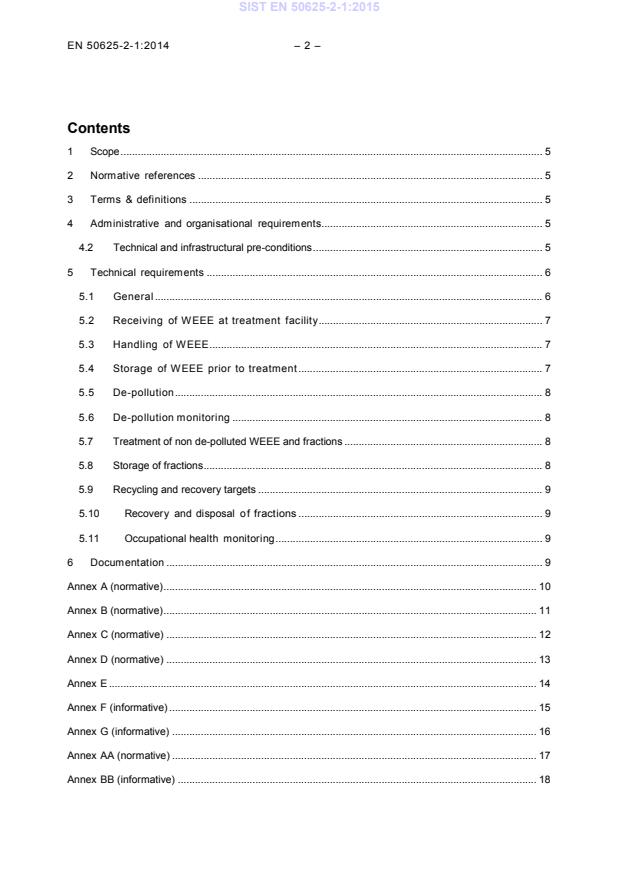
Contents 1 Scope . 5 2 Normative references . 5 3 Terms & definitions . 5 4 Administrative and organisational requirements. 5 4.2 Technical and infrastructural pre-conditions . 5 5 Technical requirements . 6 5.1 General . 6 5.2 Receiving of WEEE at treatment facility . 7 5.3 Handling of WEEE . 7 5.4 Storage of WEEE prior to treatment . 7 5.5 De-pollution . 8 5.6 De-pollution monitoring . 8 5.7 Treatment of non de-polluted WEEE and fractions . 8 5.8 Storage of fractions . 8 5.9 Recycling and recovery targets . 9 5.10 Recovery and disposal of fractions . 9 5.11 Occupational health monitoring . 9 6 Documentation . 9 Annex A (normative) . 10 Annex B (normative) . 11 Annex C (normative) . 12 Annex D (normative) . 13 Annex E . 14 Annex F (informative) . 15 Annex G (informative) . 16 Annex AA (normative) . 17 Annex BB (informative) . 18 SIST EN 50625-2-1:2015
- 3 - EN 50625-2-1:2014 Foreword This document (EN 50625-2-1:2014) has been prepared by CLC/TC 111X "Environment". The following dates are fixed: • latest date by which this document has to be implemented at national level by publication of an identical national standard or by endorse-ment (dop) 2015-10-13 • latest date by which the national standards con-flicting with this document have to be withdrawn (dow) 2017-10-13
This part 2 is to be used in conjunction with the latest edition of EN 50625-1.
NOTE 1 When “Part 1” is mentioned in this standard, it refers to EN 50625-1.
This Part 2 supplements or modifies the corresponding clauses in EN 50625-1, so as to convert that publication into the European Standard: Treatment requirements for lamps.
When a particular subclause of Part 1 is not mentioned in this Part 2, that subclause applies as far as is reasonable. When this standard states "addition", "modification" or "replacement", the relevant text in Part 1 is to be adapted accordingly.
NOTE 2 The following numbering system is used: – additional annexes are lettered AA, BB, etc.
NOTE 3 The following print types are used: – requirements: in roman type; – changes compared to part 1: in italic type.
Attention is drawn to the possibility that some of the elements of this document may be the subject of patent rights. CENELEC [and/or CEN] shall not be held responsible for identifying any or all such patent rights.
This document has been prepared under a mandate given to CENELEC by the European Commission and the European Free Trade Association, and supports essential requirements of EU Directive(s).
For the relationship with EU Directive(s) see informative Annex ZZ, which is an integral part of this doc-ument. SIST EN 50625-2-1:2015
Introduction This clause of Part 1 is replaced by the following: This European Standard aims to assist organisations in: − achieving effective and efficient treatment and disposal of waste lamps in order to prevent pollution and minimise emissions; − promoting increased material recycling; − promoting high quality recovery operations; − preventing inappropriate disposal of lamps and fractions thereof; − assuring protection of human health and safety, and the environment; − preventing shipments of lamps to operators whose operations fail to comply with this normative document or a comparable set of requirements.
This European Standard supports the objectives of the Community's environment policy. These aim to preserve, protect and improve the quality of the environment, protect human health and utilise natural resources prudently and rationally. That policy is based on the pre-cautionary principle and the maxims that preventive action to minimise environmental dam-age should, where possible, be rectified at source and the polluter should pay.
This European Standard contains requirements applicable to the treatment of lamps and is a Part 2 of EN 50625-1, Collection, logistics & Treatment requirements for WEEE - Part 1: General treatment requirements. Additionally, this standard will be supported by a technical report that will provide a more detailed comparison between normative treatment require-ments derived directly from the legal text of Directive 2012/19/EC, especially Annex VII, and between informative treatment requirements going beyond the strict requirements of Di-rective 2012/19/EC.
This European Standard has been prepared in order to support European legislation and so uses some of the terms defined in European law. In order to ensure that the definitions used in this standard are identical to those defined by law these terms are identified as 'void', indicating that this standard does not contain a definition, and a 'Note to entry' that identi-fies which law contains the legal definition and the term as defined in that law.
- 5 - EN 50625-2-1:2014 1 Scope
This clause of Part 1 is replaced by the following:
This European standard is applicable to the treatment of lamps.
This European Standard applies to the treatment of lamps until end-of-waste status is ful-filled, or lamp fractions are recycled, recovered, or disposed of.
This European Standard addresses all operators involved in the treatment including related handling, sorting, and storage of lamps. This European Standard applies to all facilities includ-ing those whose treatment operations use mobile equipment.
2 Normative references This clause of Part 1 is applicable.
3 Terms & definitions This clause of Part 1 is applicable.
4 Administrative and organisational requirements This clause of Part 1 is applicable except as follows.
Sub-clause 4.2 is replaced with the following:
4.2 Technical and infrastructural pre-conditions
The lamp treatment operator shall possess infrastructure, in terms of size, technologies in-stalled and characteristics of the operations, that is suitable for the activities performed on site. A risk management process shall be in operation at the site. This shall monitor and con-trol all tasks performed on site and include the identification of hazards, the assessment of risk and, where appropriate, the elimination or reduction of the risk and documentation of the process.
The risk assessment shall consider emissions to the environment (i.e. water, air and soil) and occupational health. It shall include normal storage, treatment, plant maintenance and servicing, as well as cases of emergencies including accidental fire events. The treatment op-erator shall implement measures to prevent emissions into the environment, reflecting all rele-vant risks identified in the risk assessment. Used carbon filters shall be treated appropriately. If water is used in processing it shall be appropriately stored and treated / disposed of. The ef-fectiveness of the risk assessment shall be verified by regular monitoring, according to An-nex AA.
NOTE 1 Examples of measures to prevent hazardous emissions: environmental management system, carbon filters, a closed water sewer system or a firewater retention reservoir.
Treatment operators shall perform regular monitoring of emissions of hazardous substances to the en-vironment so as to ensure levels that none are at a level which is considered to present an unaccepta-ble risk.
NOTE 2 The fulfilment of limit values that define unacceptable risks for various substances and associated requirements for the frequency of monitoring are often described in national regulations or site permitting requirements.
The risk assessment shall include the identification of those locations and activities that require the use of personal protective equipment and procedures to be followed.
NOTE 3 Directive 89/391/EEC provides requirements for the safety and health for the protec-tion of workers at work.
The operator shall implement appropriate measures to control its employees’ exposure to mer-cury and other hazards specific to lamps. Such measures shall include, but are not limited to:
• Personal protective equipment removed and stored in a designated area/container before leaving the work place (at the end of the day or before commencing a break) to avoid contamination; and • Workers washing their hands whenever leaving the worki
...