

FprEN 50625-1:2026
(Main)Collection, logistics and treatment requirements for WEEE - Part 1: General treatment requirements
- Abstract
This document sets general requirements for the treatment of waste electrical and electronic equipment (WEEE) except for preparing for re-use. The requirements for the treatment process preparing for re-use are described in EN 50614. This document is supplemented, for example by standards covering specific equipment. NOTE 1 This document is intended to cover WEEE arising from electrical and electronic equipment as listed under Annex III of Directive 2012/19/EU. NOTE 2 For the purposes of this document, treatment includes recovery or disposal operations, including preparation prior to recovery or disposal. This document addresses all operators involved in the treatment including related handling, sorting, and storage of WEEE. This document applies to operators processing WEEE and non-WEEE at the same facility and in the same process, regardless the size of the WEEE-related activities.
- Status
- Not Published
- Publication Date
- 31-Jan-2027
- Technical Committee
- CLC/TC 111X - Environment
- Drafting Committee
- CLC/TC 111X/WG 06 - WEEE Recycling Standards
- Current Stage
- 5020 - Vote circulated - Formal Approval
- Start Date
- 02-Oct-2026
- Due Date
- 18-Sep-2026
- Completion Date
- 18-Sep-2026

FprEN 50625-1:2026 is a draft European Standard from CENELEC (CLC) for the treatment of waste electrical and electronic equipment (WEEE). It sets general treatment requirements for operators handling, sorting, storing, de-polluting, monitoring and documenting WEEE, while preparing for re-use is covered separately by EN 50614. The document is written for treatment facilities and related operators, including sites that process WEEE together with non-WEEE in the same facility and process.
What does FprEN 50625-1:2026 specify?
FprEN 50625-1:2026 specifies general requirements for the treatment of WEEE and the supporting administration around that treatment. It covers the treatment chain from receiving and storage through de-pollution, downstream monitoring, recycling and recovery calculations, and final documentation.
The scope covers WEEE arising from electrical and electronic equipment listed under Annex III of Directive 2012/19/EU, and it treats recovery or disposal operations, including preparation before those operations, as part of treatment. The document also applies when WEEE and non-WEEE are processed together at the same site and in the same process.
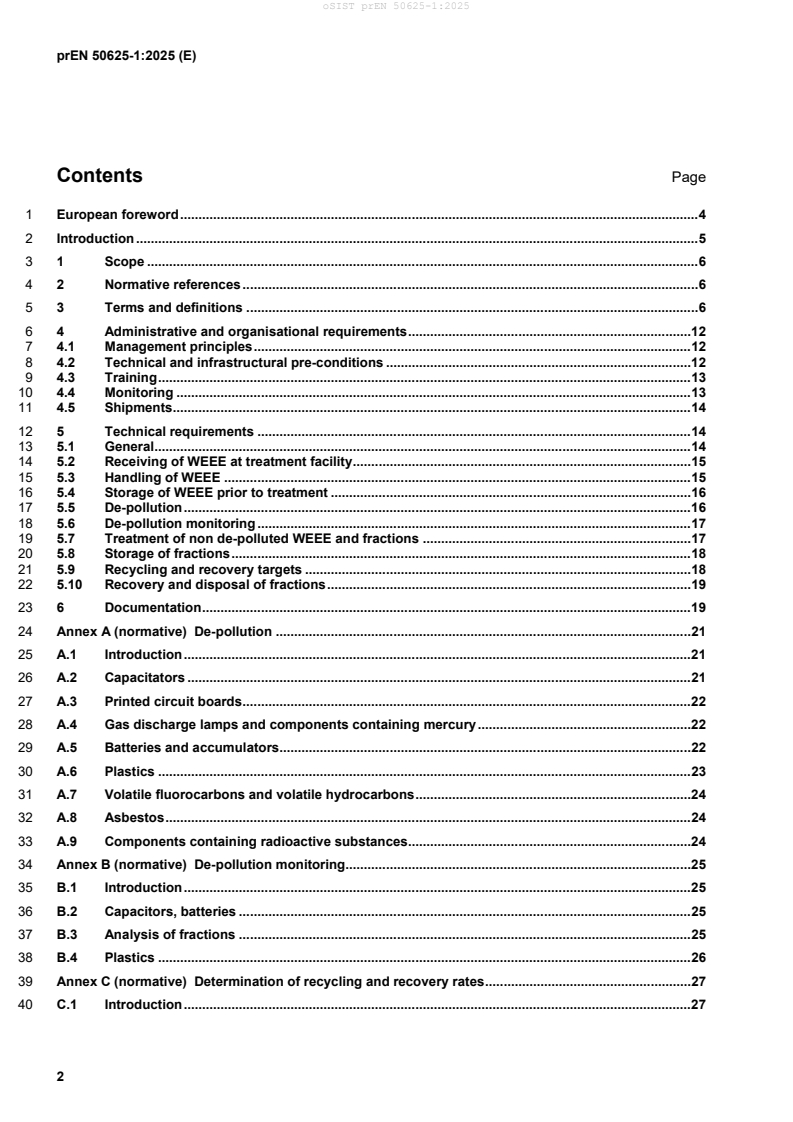
The document is organized into three main clauses and seven annexes.
| Clause / annex | What it covers |
|---|---|
| Clause 4 | Administrative and organisational requirements |
| Clause 5 | Technical requirements |
| Clause 6 | Documentation |
| Annex A | De-pollution |
| Annex B | De-pollution monitoring |
| Annex C | Determination of recycling and recovery rates |
| Annex D | Requirements concerning batch tests |
| Annex E | Void |
| Annex F | Materials and components of WEEE requiring selective treatment |
| Annex G | Documentation for downstream monitoring and establishment of recycling and recovery rates |
What are the key requirements of FprEN 50625-1:2026?
FprEN 50625-1:2026 sets requirements that are practical for day-to-day plant control: management systems, site suitability, staff training, careful handling, selective removal of hazardous parts, traceable monitoring of outputs, and documented calculations of recycling and recovery. The main point is that operators must be able to show how WEEE is controlled from receipt to final destination.
Management, site readiness and training
Clause 4 requires a management system covering health, safety, environment and quality, with continuous improvement and a procedure for identifying applicable legal requirements. In practice, operators need a structured way to keep permits, reviews and compliance records aligned with their actual activities.
Clause 4 also requires suitable infrastructure, risk assessment, fire-risk control and secure, weatherproof storage where needed. This matters because the document expects the site layout, equipment and protection measures to match the risks of the WEEE handled, including lithium batteries, mercury-containing items and other sensitive fractions.
Training under 4.3 has to cover the facility policy, emergency response, occupational health and safety, relevant work tasks and, where needed, PPE use. This means staff and contractors need instructions they can understand and access at the workplace.
Receiving, handling, storage and de-pollution
Clause 5.2 requires each delivery to be weighed and recorded, and WEEE to be separated from non-WEEE on receipt. That gives traceability at the gate and prevents unsuitable material entering the treatment stream unnoticed.
Clause 5.3 requires appropriate tools, containers and fixings so handling does not damage WEEE that could be prepared for re-use or release hazardous substances. It also prohibits uncontrolled tipping for several sensitive item types, including lithium batteries, CRT equipment, flat panel display equipment, temperature exchange equipment and gas discharge lamps.
Clause 5.4 limits stored WEEE to what can be treated within twelve months and requires impermeable surfaces, spillage mitigation and weatherproof covering where relevant. This keeps storage from becoming long-term accumulation and reduces contamination risk.
Clause 5.5 requires procedures to identify WEEE containing the substances, mixtures and components listed in Annex F, and to remove them in line with Annex A. If there is doubt, the WEEE is to be treated as if it contains those items, which pushes operators toward conservative sorting and selective treatment.
Clause 5.6 requires de-pollution monitoring where appropriate, using a target-value method, mass balance or analysis of representative samples. In practice, operators must choose a method that fits the stream and keep documented evidence that de-pollution is working.
Downstream control, recycling rates and batch tests
Clause 4.4 requires operators to record the origin of each consignment and the downstream treatment of WEEE and fractions until end-of-waste status or final treatment. It also sets detailed record requirements for output fractions, first acceptors, downstream acceptors and final treatment technologies.
Clause 5.7 requires non-de-polluted WEEE and fractions with hazardous substances, mixtures or components to be treated separately unless specific permitted mixing conditions are met. The practical effect is that hazardous streams must stay controlled and the downstream operator must be informed of any remaining hazard.
Clause 5.8 requires hazardous fractions to be stored so that material cannot disperse into the environment, with weatherproof covering for the listed sensitive items in the clause. Clause 5.10 adds rules for mixed-material output fractions and when downstream composition checks or batch tests are needed.
Clause 5.9 requires recycling and recovery rates to be determined at least annually for each treatment stream, using Annex C, and batch tests to be carried out according to Annex D at least every two years per site and per treatment stream. This is the core control for operators who have to demonstrate performance against recycling and recovery targets.
Clause 6 requires a full documentation set: legal compliance records, process diagrams, management review records, data destruction records, maintenance and health-and-safety records, training records, container cleaning records, batch-test results, downstream monitoring records and recycling/recovery calculations. The storage periods in Clause 6 and Annex D and Annex C make documentation a standing operational requirement, not an afterthought.
What terms does FprEN 50625-1:2026 define?
- WEEE - waste electrical and electronic equipment, including the discarded product and its components, subassemblies and consumables.
- treatment operator - the operator responsible for the treatment of WEEE.
- de-pollution - selective treatment that removes certain substances, mixtures and components from the WEEE stream.
- fraction - a separate output stream generated by treatment of WEEE.
- batch - a definite and well-defined amount of WEEE or a fraction of WEEE.
- batch test - a procedure where a batch is processed to determine the composition of output fractions and de-pollution performance.
- end-of-waste - the result of treatment when the resulting fractions are no longer classified as waste.
- acceptor - the organisation that takes ownership of fractions after treatment, including first, downstream and final acceptors.
Who uses FprEN 50625-1:2026?
FprEN 50625-1:2026 is used by treatment operators, plant managers, environmental and quality staff, and people responsible for health and safety at WEEE facilities. It also matters to downstream processors, acceptors, brokers and dealers because the document tracks what happens to fractions after the first treatment step.
It is relevant for operators handling lamps, CRT equipment, flat panel displays, temperature exchange equipment, photovoltaic panels and mixed WEEE streams, especially where hazardous components need selective removal. National competent authorities and auditors can use it as a reference for checking whether treatment, monitoring and records are aligned with the expected process controls.
What changed in FprEN 50625-1:2026 from the previous edition?
FprEN 50625-1:2026 supersedes EN 50625-1:2014. The foreword says the revision was made to improve the clarity of requirements, update outdated references, align with technological developments, and clarify relationships and boundaries with the CLC/TS 50625 series, the EN 50625 series and EN 50614.
Which standards are used with FprEN 50625-1:2026?
| Standard | What it contributes |
|---|---|
| CLC/TS 50625-3-1:2015 | General de-pollution specification and support for de-pollution monitoring and plastic-related checks |
| EN 50625-2-3:2017 | Treatment requirements for temperature exchange equipment and other WEEE containing VFC and/or VHC |
| EN 50614:2020 | Requirements for preparing for re-use |
| EN 50625-2-1:2014 | Treatment requirements for lamps |
| EN 50625-2-2:2015 | Treatment requirements for WEEE containing CRTs and flat panel displays |
| EN 50625-2-4:2017 | Treatment requirements for photovoltaic panels |
| CLC/TS 50625-3-2:2016 | De-pollution specification for lamps |
| CLC/TS 50625-3-3:2017 | De-pollution specification for WEEE containing CRTs and flat panel displays |
| CLC/TS 50625-3-4:2017 | De-pollution specification for temperature exchange equipment |
| CLC/TS 50625-3-5:2017 | De-pollution specification for photovoltaic panels |
| CLC/TS 50625-4:2017 | Collection and logistics associated with WEEE |
| CLC/TS 50625-5:2017 | Final treatment of WEEE fractions - Copper and precious metals |
| CLC/TR 50625-6:2018 | Alignment report between the Directive 2012/19/EU and the EN 50625 series and EN 50614 |
What does the FprEN 50625-1:2026 document contain?
FprEN 50625-1:2026 contains operational rules, monitoring methods, and documentation requirements rather than a single test method or a product specification. Annex A lists the substances, mixtures and components that require selective removal and gives treatment guidance for capacitors, printed circuit boards, lamps, batteries, plastics, asbestos and radioactive components.
Annex B sets out how to monitor de-pollution performance, including batch-based weighing and chemical analysis of relevant fractions. Annex C gives the calculation framework for recycling and recovery rates, including how to classify final use and how to treat fractions with low impurity levels. Annex D explains how batch tests are planned, run, checked and validated, and Table D.1 sets the batch mass expectations by treatment stream.
Annex G collects the information needed for downstream monitoring and for establishing recycling and recovery rates. Together, these annexes support plant control, verification, reporting and traceable documentation across the treatment chain.
Relations
- Effective Date
- 16-Jul-2024
Get Certified
Connect with accredited certification bodies for this standard

IMQ S.p.A. (Certification)
Italian electrical product certification.

SLG Prüf- und Zertifizierungs GmbH
German testing and certification body.

UL Solutions
Global safety science company with testing, inspection and certification.
Sponsored listings
Frequently Asked Questions
FprEN 50625-1:2026 is a draft published by CLC. Its full title is "Collection, logistics and treatment requirements for WEEE - Part 1: General treatment requirements". This standard covers: This document sets general requirements for the treatment of waste electrical and electronic equipment (WEEE) except for preparing for re-use. The requirements for the treatment process preparing for re-use are described in EN 50614. This document is supplemented, for example by standards covering specific equipment. NOTE 1 This document is intended to cover WEEE arising from electrical and electronic equipment as listed under Annex III of Directive 2012/19/EU. NOTE 2 For the purposes of this document, treatment includes recovery or disposal operations, including preparation prior to recovery or disposal. This document addresses all operators involved in the treatment including related handling, sorting, and storage of WEEE. This document applies to operators processing WEEE and non-WEEE at the same facility and in the same process, regardless the size of the WEEE-related activities.
This document sets general requirements for the treatment of waste electrical and electronic equipment (WEEE) except for preparing for re-use. The requirements for the treatment process preparing for re-use are described in EN 50614. This document is supplemented, for example by standards covering specific equipment. NOTE 1 This document is intended to cover WEEE arising from electrical and electronic equipment as listed under Annex III of Directive 2012/19/EU. NOTE 2 For the purposes of this document, treatment includes recovery or disposal operations, including preparation prior to recovery or disposal. This document addresses all operators involved in the treatment including related handling, sorting, and storage of WEEE. This document applies to operators processing WEEE and non-WEEE at the same facility and in the same process, regardless the size of the WEEE-related activities.
FprEN 50625-1:2026 is classified under the following ICS (International Classification for Standards) categories: 13.030.99 - Other standards related to wastes; 29.100.01 - Components for electrical equipment in general; 31.220.01 - Electromechanical components in general. The ICS classification helps identify the subject area and facilitates finding related standards.
FprEN 50625-1:2026 has the following relationships with other standards: It is inter standard links to EN 50625-1:2014. Understanding these relationships helps ensure you are using the most current and applicable version of the standard.
FprEN 50625-1:2026 is associated with the following European legislation: EU Directives/Regulations: 2012/19/EU; Standardization Mandates: M/518. When a standard is cited in the Official Journal of the European Union, products manufactured in conformity with it benefit from a presumption of conformity with the essential requirements of the corresponding EU directive or regulation.
FprEN 50625-1:2026 is available in PDF format for immediate download after purchase. The document can be added to your cart and obtained through the secure checkout process. Digital delivery ensures instant access to the complete standard document.
Standards Content (Sample)
69 Introduction
70 This document aims to assist organisations in:
71 — achieving effective and efficient treatment of waste electrical and electronic equipment (WEEE) in order 72 to prevent pollution and minimize emissions; 73 — promoting increased recycling to facilitate a circular economy; 74 — promoting high quality recovery; 75 — preventing inappropriate disposal of WEEE and fractions thereof; 76 — assuring protection of human health and safety, and the environment; 77 — preventing shipments of WEEE to operators whose operations fail to comply with this normative 78 document or a comparable set of requirements.
79 This document supports the objectives of the Community's environment policy. These aim to preserve, protect 80 and improve the quality of the environment, protect human health and utilize natural resources prudently and 81 rationally. That policy is based on the precautionary principle and the maxims that preventive action to 82 minimize environmental damage should, where possible, be rectified at source and the polluter should pay. 83 The requirements of this document are applicable to all types of WEEE. It is supported by other standards 84 covering particular treatment requirements for:
85 — lamps (EN 50625-2-1:2014, CLC/TS 50625-3-2:2016), 86 — flat panel displays (FPD), cathode ray tubes (CRT) (EN 50625-2-2:2015, CLC/TS 50625-3-3:2017), 87 — temperature exchange equipment (EN 50625-2-3:2017, CLC/TS 50625-3-4:2017), 88 — photovoltaic panels (EN 50625-2-4:2017, CLC/TS 50625-3-5:2017), 89 — collection and logistics (CLC/TS 50625-4:2017), 90 — final processing CLC/TS 50625-5:2017), 91 — preparing for re-use (EN 50614: 2020).
92 Additionally this document is supported by a technical report which provides a more detailed comparison 93 between normative treatment requirements derived directly from the legal text of Directive 2012/19/EC, 94 especially Annex VII, and between informative treatment requirements going beyond the strict requirements of 95 Directive 2012/19/EC.
96 This document has been prepared in order to support European legislation and so uses some of the terms 97 defined in European law. In order to ensure that the definitions used in this document are identical to those 98 defined by law these terms are identified as 'void', indicating that this document does not contain a definition, 99 and a 'Note to entry' that identifies which law contains the legal definition and the term as defined in that law. 100 EN 50625-1:2014 was revised in and replaced by this edition to improve the clarity of requirements, to update 101 outdated references, to align with technological developments and to clarify relationships and boundaries with 102 the CLC/TS 50625 series and EN 50625 series and EN 50614.
oSIST prEN 50625-1:2025 prEN 50625-1:2025 (E) 103 1 Scope 104 This document sets general requirements for the treatment of waste electrical and electronic equipment 105 (WEEE) except for preparing for re-use. The requirements for the treatment process preparing for re-use are 106 described in EN 50614:2020. This document is supplemented, for example by standards covering specific 107 equipment.
108 NOTE 1 This document is intended to cover WEEE arising from electrical and electronic equipment as listed under 109 Annex III of Directive 2012/19/EU.
110 NOTE 2 For the purposes of this document, treatment includes recovery or disposal operations, including preparation 111 prior to recovery or disposal.
112 This document addresses all operators involved in the treatment including related handling, sorting, and 113 storage of WEEE.
114 This document applies to operators processing WEEE and non-WEEE at the same facility and in the same 115 process, regardless the size of the WEEE-related activities. 116 2 Normative references 117 The following documents are referred to in the text in such a way that some or all of their content constitutes 118 requirements of this document. For dated references, only the edition cited applies. For undated references, 119 the latest edition of the referenced document (including any amendments) applies. 120 CLC/TS 50625-3-1:2015, Collection, logistics & treatment requirements for WEEE - Part 3-1: Specification for 121 de-pollution - General 122 EN 50625-2-3:2017, Collection, logistics & treatment requirements for WEEE - Part 2-3: Treatment 123 requirements for temperature exchange equipment and other WEEE containing VFC and/or VHC 124 3 Terms and definitions 125 For the purposes of this document, the following terms and definitions apply. 126 3.1 127 acceptor 128 organisation that physically and/or contractually takes ownership of fractions derived from WEEE, after 129 processing has been carried out by a treatment operator 130 Note 1 to entry: For the purposes of this document, this definition also applies to acceptors processing fractions derived 131 from WEEE and other waste at the same facility.
132 Note 2 to entry: Acceptors may include first acceptor (that directly accepts one or more fractions from the treatment 133 operators), downstream acceptor (every acceptor in the processing chain following after the first acceptor), and final 134 acceptor (acceptor where the final processing step takes place). 135 3.2 136 backlight 137 part of the flat panel display, used with certain flat panel display technologies, that illuminates the flat panel to 138 make the image visible 139 3.3 140 batch 141 definite and well-defined amount of WEEE or fractions thereof
oSIST prEN 50625-1:2025 prEN 50625-1:2025 (E) 142 3.4 143 batch test 144 procedure where a batch is processed to determine the composition of the resulting output fractions and de- 145 pollution performance 146 3.5 147 category 148 group of WEEE to describe types of electrical and electronic equipment within its scope 149 Note 1 to entry: When used in this document, the word “category” should be construed as applying in a comparable 150 manner.
151 Note 2 to entry: WEEE are listed in Directive 2012/19/EU, Annex III. 152 3.6 153 component 154 constituent part of a device which cannot be physically divided into smaller parts without losing its particular 155 function 156 [SOURCE: IEV 151-11-21] 157 3.7 158 cathode ray tube 159 CRT 160 component used to display images comprising a vacuum tube and integral fluorescent screen 161 3.8 162 CRT equipment 163 equipment containing at least one cathode ray tube 164 3.9 165 collection 166 gathering of WEEE, including the preliminary sorting and preliminary storage of WEEE for the purposes of 167 transport to a logistics facility or a treatment facility 168 Note 1 to entry: The term “collection” is adapted from Directive 2008/98/EC. “Collection” means the gathering of waste, 169 including the preliminary sorting and preliminary storage of waste for the purposes of transport to a waste treatment 170 facility.
171 3.10 172 collection facility 173 location designated for the gathering of WEEE to facilitate separate collection 174 Note 1 to entry: Collection facilities and their operators are typically registered, listed, or otherwise approved or 175 designated in accordance with the national legislation implementing Directive 2012/19/EU and Directive 2008/98/EU. 176 Note 2 to entry: A collection facility is different from a collection point. For the definition of the collection point see the 177 CLC/TS 50625-4.
178 3.11 179 de-pollution 180 selective treatment during which certain substances, mixtures and components are removed from the WEEE 181 stream 182 Note 1 to entry: Annex F identifies which (certain) substances, mixtures and components shall be removed and treated 183 from separately collected WEEE, the process being de-pollution. 184 Note 2 to entry: For the purposes of this document, de-pollution is concerned only with the removal of substances, 185 mixtures and components that are hazardous or substances of concern.
oSIST prEN 50625-1:2025 prEN 50625-1:2025 (E) 186 3.12 187 disposal 188 void 189 Note 1 to entry: Directive 2008/98/EC defines disposal: “‘disposal’ means any operation which is not recovery even 190 where the operation has as a secondary consequence the reclamation of substances or energy. Annex I sets out a non- 191 exhaustive list of disposal operations”.
192 3.13 193 end-of-waste 194 result of treatment whereby the resulting fractions are no longer classified as waste 195 Note 1 to entry: Fractions that cease to become waste, following a recovery or recycling operation in compliance with 196 specific criteria according to Article 6 of Directive 2008/98/EC, are regarded as secondary materials and so have achieved 197 end-of-waste status.
198 3.14 199 energy recovery 200 production of useful energy through direct and controlled combustion or other processing of waste 201 Note 1 to entry: Energy recovery is a recovery operation where the material is used principally as a fuel or other means 202 to generate energy, see R1 of Annex II of Directive 2008/98/EC. 203 3.15 204 flat panel 205 that part of the flat panel display where the image is produced 206 3.16 207 flat panel display 208 FPD 209 assembly of components that use technologies that produce and display an image without the use of cathode 210 ray tubes 211 Note 1 to entry: The term “flat panel module” is also used as an alternative to the term flat panel display. 212 3.17 213 FPD equipment
214 equipment using a flat panel display having a display screen larger than 100 cm 215 EXAMPLES LCD TV, plasma TV, LCD screens and monitors, and notebooks 216 3.18 217 fraction 218 separate output stream generated by the treatment of WEEE 219 3.19 220 hazardous waste 221 void 222 Note 1 to entry: The term “hazardous waste” – “waste which exhibits one or more hazardous properties” is defined in 223 Directive 2008/98/EC; the properties of hazardous waste are described in Annex III of Directive 2008/98/EC. 224 3.20 225 lamp 226 electric light source, for general or special lighting purposes, but excluding filament bulbs 227 Note 1 to entry: General lighting can include straight and compact fluorescent lamps, high intensity discharge lamps – 228 including high pressure sodium and metal halide lamps, low pressure sodium lamps, and Light Emitting Diodes (including
oSIST prEN 50625-1:2025 prEN 50625-1:2025 (E) 229 organic). Special lighting is provided by lamps for the purpose of spreading or controlling light (UV lamps, projection 230 lamps, xenon lamps, etc.). A non-exhaustive list can be found in Directive 2012/19/EU. 231 3.21 232 gas discharge 233 void 234 Note 1 to entry: Commission Regulation (EU) 2019/2020 of 1 October 2019 laying down ecodesign requirements for 235 light sources and separate control gears pursuant to Directive 2009/125/EC of the European Parliament and of the Council 236 and repealing Commission Regulations (EC) No 244/2009, (EC) No 245/2009 and (EU) No 1194/2012 (Text with EEA 237 relevance.) contains the following: “gas discharge’ means a phenomenon where light is produced, directly or indirectly, by 238 an electric discharge through a gas, plasma, metal vapour or mixture of gases and vapours; 239 Note 2 to entry: Examples of lamps featuring gas discharge technology include straight fluorescent lamps, compact 240 fluorescent lamps, fluorescent lamps, high intensity discharge lamps – including pressure sodium lamps and metal halide 241 lamps, low pressure sodium lamps, and exclude LED lamps and filament lamps. 242 Note 3 to entry: Some backlighting lamps (typically non-LED types), as mentioned in Annex F and Directive 2012/19/EU 243 Annex VII, contain mercury.
244 3.22 245 logistics 246 planning, implementing and controlling of the transportation, handling, preliminary storage and/or preliminary 247 sorting of WEEE from the point of origin to point of delivery 248 [SOURCE: CLC/TS 50625-4:2017, 3.10, modified] 249 3.23 250 logistics facility 251 facility where an operator performs receiving and preparing for transportation to WEEE treatment operators 252 3.24 253 material recovery 254 void 255 Note 1 to entry: Decision 2011/753/EU contains the following: “’material recovery’ means any recovery operation, 256 excluding energy recovery and the reprocessing into materials which are to be used as fuel”. 257 3.25 258 national competent authority 259 body appointed in accordance with the prevailing laws of a Member State to execute various functions 260 Note 1 to entry: Examples of such functions include performing market surveillance and issuing licences or permits 261 3.26 262 operator 263 entity that performs one or more processes on WEEE 264 Note 1 to entry: Processes on WEEE could include collection, logistics, handling, shipping, sorting, storage, transport, 265 trading, treatment, or preparing for re-use.
266 Note 2 to entry: For the purposes of this document, this definition applies to operators processing WEEE and non-WEEE 267 at the same facility and in the same process, regardless the size of the WEEE related activities. 268 3.27 269 photovoltaic panel 270 PV panel 271 equipment intended to be permanently installed to a fixed installation that converts solar radiation into 272 electrical energy
oSIST prEN 50625-1:2025 prEN 50625-1:2025 (E) 273 3.28 274 preparing for re-use 275 void 276 Note 1 to entry: Directive 2008/98/EC contains the following: “‘preparing for re-use’ means checking, cleaning or 277 repairing recovery operations, by which products or components of products that have become waste are prepared so that 278 they can be re-used without any other pre-processing”.
279 3.29 280 recovery 281 void 282 Note 1 to entry: Directive 2008/98/EC contains the following: “‘recovery’ means any operation the principal result of 283 which is waste serving a useful purpose by replacing other materials which would otherwise have been used to fulfil a 284 particular function, or waste being prepared to fulfil that function, in the plant or in the wider economy. Annex II sets out a 285 non-exhaustive list of recovery operations”.
286 3.30 287 recycling 288 void 289 Note 1 to entry: Directive 2008/98/EC contains the following: “‘recycling’ means any recovery operation by which waste 290 materials are reprocessed into products, materials or substances whether for the original or other purposes. It includes the 291 reprocessing of organic material but does not include energy recovery and the reprocessing into materials that are to be 292 used as fuels or for backfilling operations”.
293 3.31 294 removal 295 void 296 Note 1 to entry: Directive 2012/19/EU contains the following: “‘removal’ means manual, mechanical, chemical or 297 metallurgic handling with the result that hazardous substances, mixtures and components are contained in an identifiable 298 stream or are an identifiable part of a stream within the treatment process. A substance, mixture or component is 299 identifiable if it can be monitored to verify environmentally safe treatment”. 300 Note 2 to entry: Where used in this standard, it is essential that the word “remove” be construed as having a meaning 301 that corresponds to the defined word “removal”.
302 3.32 303 re-use 304 void 305 Note 1 to entry: Directive 2008/98/EC contains the following: “‘re-use’ means any operation by which products or 306 components that are not waste are used again for the same purpose for which they were conceived”. 307 3.33 308 storage 309 process whereby WEEE is selected and placed in a particular location awaiting treatment or preparing for re- 310 use 311 3.34 312 temperature exchange equipment 313 equipment using fluids other than water for temperature exchange 314 Note 1 to entry: This is a category of electrical and electronic equipment covered by Directive 2012/19/EU. This Directive 315 does not define what is meant by “temperature exchange equipment” but Annex IV contains the following non-exhaustive 316 list: refrigerators, freezers, equipment which automatically delivers cold products, air conditioning equipment, 317 dehumidifying equipment, heat pumps, radiators containing oil and other temperature exchange equipment using fluids
oSIST prEN 50625-1:2025 prEN 50625-1:2025 (E) 318 other than water for the temperature exchange. If this term is clarified further by the European Commission or the Courts 319 then it is essential that the term as used in this standard is construed in the same way as those clarifications. 320 3.35 321 treatment 322 void 323 Note 1 to entry: Directive 2008/98/EC contains the following: “‘treatment’ means recovery or disposal operations, 324 including preparation prior to recovery or disposal”.
325 Note 2 to entry: Requirements for the treatment operation of preparing for re-use are set out in EN 50614. 326 3.36 327 treatment facility 328 location where WEEE undergoes treatment 329 3.37 330 treatment operator 331 operator responsible for the treatment of WEEE 332 3.38 333 volatile fluorocarbon 334 VFC 335 organic chemical compound consisting of carbon and fluorine atoms (in some cases also with chlorine and/or 336 hydrogen), which is able to change phase when used as a refrigerant or produce cells in plastic structure of an 337 insulating foam when used as a blowing agent 338 Note 1 to entry: Common commercial designations for these materials are R12, R11 for CFCs, R22, R141b for HCFCs 339 and R134a, R410A, R407C, R32, R1234yf and R1234ze for HFCs. 340 Note 2 to entry: Chemically, volatile fluorocarbons could be either alkyl halides or alkene halides. 341 Note 3 to entry: CFC, HCFC, HFC and HC are all VOCs – Volatile Organic Compounds. 342 Note 4 to entry: Annex F and Directive 2012/19/EU Annex VII part 2 refers to ‘foam’ rather than ‘insulating foam’, as 343 used in the above definition.
344 3.39 345 volatile hydrocarbon 346 VHC 347 organic chemical compound consisting entirely of hydrogen and carbon which is able to change phase when 348 used as a refrigerant or produce cells in plastic structure of an insulating foam when used as a blowing agent 349 Note 1 to entry: Common designations for volatile hydrocarbons are R290 for propane, R600a for isobutane, R1270 for 350 propene and RC601 for cyclopentane. Mixtures of VHC are also possible. 351 Note 2 to entry: Annex F and Directive 2012/19/EU Annex VII part 2 refers to ‘foam’ rather than ‘insulating foam’, as 352 used in the above definition.
353 3.40 354 waste 355 void 356 Note 1 to entry: Directive 2008/98/EC contains the following: “‘waste’ means any substance or object which the holder 357 discards or intends or is required to discard”.
oSIST prEN 50625-1:2025 prEN 50625-1:2025 (E) 358 3.41 359 waste electrical and electronic equipment 360 WEEE 361 void 362 Note 1 to entry: Directive 2012/19/EU contains the following: “‘waste electrical and electronic equipment’ or ‘WEEE’ 363 means electrical or electronic equipment which is waste within the meaning of Article 3(1) of Directive 2008/98/EC, 364 including all components, subassemblies and consumables which are part of the product at the time of discarding”. 365 Note 2 to entry: Considering note 1 to entry, this standard covers whole equipment discarded as WEEE and fractions 366 thereof.
367 Note 3 to entry: For the purposes of this document the terms equipment and appliances have the same meaning. 368 4 Administrative and organisational requirements 369 4.1 Management principles 370 The treatment operator shall ensure that a management system is in place for all WEEE-related activities in 371 the fields of health, safety, environment and quality.
...