

EN ISO 11721-2:2003
(Main)Textiles - Determination of the resistance of cellulose-containing textiles to micro-organisms - Soil burial test - Part 2: Identification of long-term resistance of a rot retardant finish (ISO 11721:2003)
- Abstract
ISO 11721-2:2003 describes a test procedure for identification of the long-term resistance of a rot-retardant finish against the attack of microorganisms in the soil.
It permits a distinction to be made between rot-retardant finishes with no long-term resistance, with regular long-term resistance and with increased long-term resistance, in order to assess the suitability for use in the tropics.
As the soil burial test is a biological process and the test soil not accurately defined, ISO 11721-2:2003 only covers the comparison of finished and unfinished specimens.
- Status
- Published
- Publication Date
- 30-Sep-2003
- Technical Committee
- CEN/TC 248 - Textiles and textile products
- Current Stage
- 9093 - Decision to confirm - Review Enquiry
- Start Date
- 06-Jun-2008
- Completion Date
- 06-Jun-2008

Overview
EN ISO 11721-2:2003 is a European and international standard that specifies a test method for assessing the long-term resistance of cellulose-containing textiles treated with rot retardant finishes against microbial degradation in soil. This standard focuses on the soil burial test to evaluate how effectively these finishes protect textiles from decomposition caused by micro-organisms over an extended period.
Developed by CEN in cooperation with ISO, the standard enables manufacturers and testing laboratories to differentiate rot retardant finishes into categories of no resistance, regular long-term resistance, and increased long-term resistance. This distinction assists in assessing their suitability for use, especially in tropical environments where microbial activity in soil is significant.
Key Topics
Soil Burial Test Methodology
The test involves burying finished and unfinished textile specimens into test soil and monitoring changes over time. Key measurement parameters include:- Maximum tensile strength before and after burial
- Relative decrease in tensile strength as an indicator of microbial degradation
Definition of Time Intervals
- f1: Time for control (unfinished) specimens to lose 80% tensile strength
- 2 · f1: Interval to assess regular long-term resistance
- 4 · f1: Interval to assess increased long-term resistance
Criteria for Long-term Resistance
A rot retardant finish is considered effective if the loss in maximum tensile strength of buried specimens compared to unburied controls does not exceed 25%.Specimen Preparation and Testing
The standard outlines the preparation of test specimens, including leached and unleached samples, to account for effects like waterproofing finishes. Testing incorporates appropriate safety measures due to the biological nature of fungus and bacteria involved.Evaluation and Reporting
Test results include quantitative tensile strength loss calculations and qualitative assessments of physical changes in textiles post-burial. The report covers soil conditions, testing duration, and detailed tensile strength data.
Applications
EN ISO 11721-2:2003 serves several practical uses in the textile industry and beyond:
Quality Control for Textile Finishes
Textile manufacturers utilize this standard to verify and validate the effectiveness of rot retardant finishes on cellulose fibers such as cotton, rayon, and linen.Product Development and Innovation
Research and development teams apply the soil burial test to improve formulations of rot retardant chemicals that extend the service life of textiles exposed to harsh microbial environments.Suitability Assessment for Tropical Use
Given the accelerated microbial activity in tropical climates, this standard helps determine if textiles treated with specific finishes are appropriate for these regions.Regulatory Compliance and Market Access
Meeting EN ISO 11721-2:2003 requirements ensures that textile products comply with international norms, facilitating market entry and consumer confidence.
Related Standards
EN ISO 11721-1:2001
Part 1 of the soil burial test series, providing the general assessment method for rot-retardant finishing on cellulose textiles.EN ISO 13934-1:1999
Defines the procedure for tensile property measurement critical to evaluating mechanical degradation after soil burial.ISO 7218
Covers microbiological examination protocols, outlining safety and hygiene requirements relevant when handling microorganisms in testing.
Keywords: textile microbial resistance, rot retardant finish, cellulose textiles, soil burial test, tensile strength degradation, long-term resistance, textile durability, microbial attack on textiles, textile testing standard, EN ISO 11721-2, rot resistance assessment
This standard is essential for ensuring that cellulose-based textiles exhibit sufficient durability against microorganism-induced rot, guaranteeing longer product life and performance in microbial-challenging environments such as tropical soils.
Relations
- Effective Date
- 03-Jun-2026
- Effective Date
- 28-Jan-2026
- Effective Date
- 28-Jan-2026
- Effective Date
- 28-Jan-2026
- Effective Date
- 12-Feb-2026
Get Certified
Connect with accredited certification bodies for this standard

Control Union Certifications
Global certification for agriculture and sustainability.

Hohenstein Institut
Textile testing and certification.

Bureau Veritas Bangladesh
Bureau Veritas certification services in Bangladesh.
Sponsored listings
Frequently Asked Questions
EN ISO 11721-2:2003 is a standard published by the European Committee for Standardization (CEN). Its full title is "Textiles - Determination of the resistance of cellulose-containing textiles to micro-organisms - Soil burial test - Part 2: Identification of long-term resistance of a rot retardant finish (ISO 11721:2003)". This standard covers: ISO 11721-2:2003 describes a test procedure for identification of the long-term resistance of a rot-retardant finish against the attack of microorganisms in the soil. It permits a distinction to be made between rot-retardant finishes with no long-term resistance, with regular long-term resistance and with increased long-term resistance, in order to assess the suitability for use in the tropics. As the soil burial test is a biological process and the test soil not accurately defined, ISO 11721-2:2003 only covers the comparison of finished and unfinished specimens.
ISO 11721-2:2003 describes a test procedure for identification of the long-term resistance of a rot-retardant finish against the attack of microorganisms in the soil. It permits a distinction to be made between rot-retardant finishes with no long-term resistance, with regular long-term resistance and with increased long-term resistance, in order to assess the suitability for use in the tropics. As the soil burial test is a biological process and the test soil not accurately defined, ISO 11721-2:2003 only covers the comparison of finished and unfinished specimens.
EN ISO 11721-2:2003 is classified under the following ICS (International Classification for Standards) categories: 07.100.99 - Other standards related to microbiology; 59.080.30 - Textile fabrics. The ICS classification helps identify the subject area and facilitates finding related standards.
EN ISO 11721-2:2003 has the following relationships with other standards: It is inter standard links to ISO 7218:1996, EN ISO 13934-1:2013, EN 12396-3:2000, EN ISO 11721-1:2001, ISO 11721-2:2003. Understanding these relationships helps ensure you are using the most current and applicable version of the standard.
EN ISO 11721-2:2003 is available in PDF format for immediate download after purchase. The document can be added to your cart and obtained through the secure checkout process. Digital delivery ensures instant access to the complete standard document.
Standards Content (Sample)
SLOVENSKI STANDARD
01-december-2003
Tekstilije - Ugotavljanje odpornosti tekstilij, ki vsebujejo celulozo proti
mikroorganizmom - Preskus z zakopavanjem v zemljo - 2. del: Prepoznavanje
dolgotrajne odpornosti apretur proti gnitju
Textiles - Determination of the resistance of cellulose-containing textiles to micro-
organisms - Soil burial test - Part 2: Identification of long-term resistance of a rot
retardant finish (ISO 11721:2003)
Textilien - Bestimmung der Widerstandsfähigkeit zellulosehaltiger Textilien gegen
Mikroorganismen - Erdeingrabetest - Teil 2: Nachweis der Langzeitbeständigkeit einer
verrottungshemmenden Ausrüstung (ISO 11721-2:2003)
Textiles - Détermination de la résistance aux micro-organismes des textiles contenant de
la cellulose - Essai d'enfouissement - Partie 2: Identification de la résistance a long
terme d'un traitement d'imputrescibilité (ISO 11721-2:2003 )
Ta slovenski standard je istoveten z: EN ISO 11721-2:2003
ICS:
07.100.99 Drugi standardi v zvezi z Other standards related to
mikrobiologijo microbiology
59.080.30 Tkanine Textile fabrics
2003-01.Slovenski inštitut za standardizacijo. Razmnoževanje celote ali delov tega standarda ni dovoljeno.
EUROPEAN STANDARD
EN ISO 11721-2
NORME EUROPÉENNE
EUROPÄISCHE NORM
October 2003
ICS 07.100.99; 59.080.30
English version
Textiles - Determination of the resistance of cellulose-containing
textiles to micro-organisms - Soil burial test - Part 2:
Identification of long-term resistance of a rot retardant finish
(ISO 11721:2003)
Textiles - Détermination de la résistance aux micro- Textilien - Bestimmung der Widerstandsfähigkeit
organismes des textiles contenant de la cellulose - Essai zellulosehaltiger Textilien gegen Mikroorganismen -
d'enfouissement - Partie 2: Identification de la résistance à Erdeingrabetest - Teil 2: Nachweis der
long terme d'un traitement d'imputrescibilité (ISO 11721- Langzeitbeständigkeit einer verrottungshemmenden
2:2003 ) Ausrüstung (ISO 11721-2:2003)
This European Standard was approved by CEN on 15 May 2003.
CEN members are bound to comply with the CEN/CENELEC Internal Regulations which stipulate the conditions for giving this European
Standard the status of a national standard without any alteration. Up-to-date lists and bibliographical references concerning such national
standards may be obtained on application to the Management Centre or to any CEN member.
This European Standard exists in three official versions (English, French, German). A version in any other language made by translation
under the responsibility of a CEN member into its own language and notified to the Management Centre has the same status as the official
versions.
CEN members are the national standards bodies of Austria, Belgium, Czech Republic, Denmark, Finland, France, Germany, Greece,
Hungary, Iceland, Ireland, Italy, Luxembourg, Malta, Netherlands, Norway, Portugal, Slovakia, Spain, Sweden, Switzerland and United
Kingdom.
EUROPEAN COMMITTEE FOR STANDARDIZATION
COMITÉ EUROPÉEN DE NORMALISATION
EUROPÄISCHES KOMITEE FÜR NORMUNG
Management Centre: rue de Stassart, 36 B-1050 Brussels
© 2003 CEN All rights of exploitation in any form and by any means reserved Ref. No. EN ISO 11721-2:2003 E
worldwide for CEN national Members.
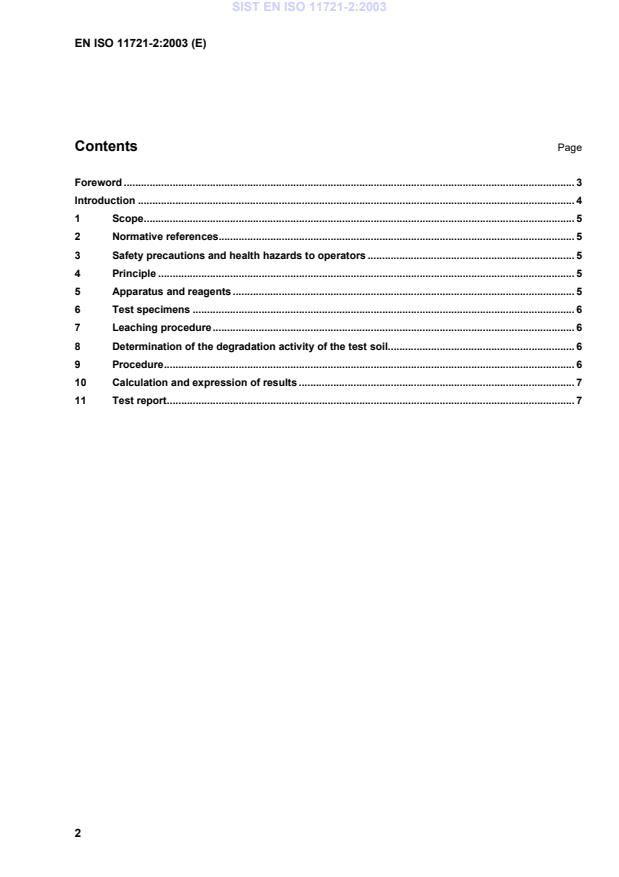
Contents Page
Foreword . 3
Introduction . 4
1 Scope. 5
2 Normative references. 5
3 Safety precautions and health hazards to operators . 5
4 Principle . 5
5 Apparatus and reagents . 5
6 Test specimens . 6
7 Leaching procedure. 6
8 Determination of the degradation activity of the test soil. 6
9 Procedure. 6
10 Calculation and expression of results . 7
11 Test report. 7
Foreword
This document (EN ISO 11721-2:2003) has been prepared by Technical Committee CEN/TC 248
“Textiles and textile products”, the secretariat of which is held by BSI, in collaboration with Technical
Committee ISO/TC 38 “Textiles”.
This European Standard shall be given the status of a national standard, either by publication of an
identical text or by endorsement, at the latest by April 2004, and conflicting national standards shall
be withdrawn at the latest by April 2004.
According to the CEN/CENELEC Internal Regulations, the national standards organizations of the
following countries are bound to implement this European Standard: Austria, Belgium, Czech
Republic, Denmark, Finland, France, Germany, Greece, Hungary, Iceland, Ireland, Italy, Luxembourg,
Malta, Netherlands, Norway, Portugal, Slovakia, Spain, Sweden, Switzerland and the United
Kingdom.
Introduction
Cellulose containing textiles are considered as resistant against the attack of microorganisms living in
the soil, provided that their structure, appearance and maximum tensile strength have not been
altered essentially after a soil burial test.
The assessment of damage resistance takes into account the structure, the aspect and the changes
in the maximum tensile strength, compared to untreated specimens of the same material quality. It is
assessed by comparing the relative decrease of maximum tensile strength of buried specimens, with
that of unburied control specimens.
A long-term rot retardant finish or an increased long-term resistance meets with the requirements for
cellulose containing textiles if the maximum tensile strength of a buried specimen, compared with an
unburied specimen, does not decrease by more than 25 %.
The soil burial intervals for long-term retardant finishes take twice the time needed for control
specimens to lose 80 % of their maximum tensile strength. The soil burial intervals for increased long-
term resistant finishes takes four times the time needed for the controls to lose 80 % of their maximum
tensile strength.
1 Scope
This European Standard describes a test procedure for identification of the long-term resist
...