

EN 12396-3:2000
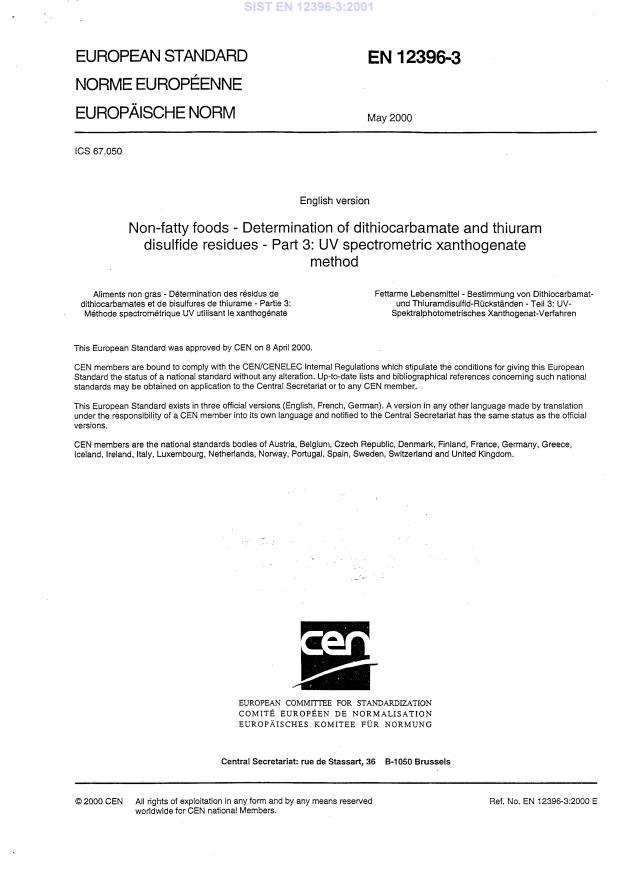
(Main)Non-fatty foods - Determination of dithiocarbamate and thiuram disulfide residues - Part 3: UV spectrometric xanthogenate method
- Abstract
This European Standard specifies a UV spectrometric method for the determination of low-level residues of dithiocarbamate and thiuram disulfide fungicides as xanthogenate. Dithiocarbamate and thiuram disulfide fungicides release carbon disulfide under specified conditions (e.g. mancozeb, maneb, propineb, thiram, zineb). It is applicable to such compounds especially in and on those foodstuffs of plant origin for which low maximum residue levels have been set.
- Status
- Published
- Publication Date
- 23-May-2000
- Technical Committee
- CEN/TC 275 - Food analysis - Horizontal methods
- Drafting Committee
- CEN/TC 275/WG 3 - Pesticides and PCB's in foods of animal origin
- Current Stage
- 9093 - Decision to confirm - Review Enquiry
- Start Date
- 02-Jul-2021
- Completion Date
- 30-Sep-2026

Overview
EN 12396-3:2000 is a European Standard developed by CEN that defines a precise UV spectrometric xanthogenate method for the determination of residues from dithiocarbamate and thiuram disulfide fungicides in non-fatty foods. These fungicides, including commonly used compounds such as mancozeb, maneb, propineb, thiram, and zineb, release carbon disulfide under controlled conditions, which can then be measured accurately. This method is especially critical for plant-origin foodstuffs where stringent maximum residue levels (MRLs) are imposed to ensure food safety and regulatory compliance.
Key Topics
Dithiocarbamate and Thiuram Disulfide Fungicides
These fungicides are widely used in agriculture to protect crops from fungal diseases. Monitoring their residues is vital for consumer protection and maintaining food quality.Xanthogenate Formation and UV Spectrometry
The method relies on converting residues into xanthogenates, which can be quantified by ultraviolet (UV) spectrometric techniques. This allows sensitive detection of low-level fungicide residues.Residue Detection in Non-Fatty Food Matrices
The standard specifically addresses foods low in fat content, ensuring accurate analysis without interference from fatty substances.Compliance with Maximum Residue Levels (MRLs)
The procedure supports monitoring against regulatory limits, aiding producers, regulators, and laboratories in meeting legal requirements.
Applications
Food Safety Testing Laboratories
Laboratories performing routine pesticide residue analysis in fruits, vegetables, and other plant-derived foods benefit from the reliable UV spectrometric xanthogenate method described in EN 12396-3:2000.Regulatory Compliance and Monitoring
Food control authorities use this standard to enforce pesticide regulations and protect consumer health by verifying that dithiocarbamate and thiuram disulfide residues remain below established MRLs.Agricultural Product Quality Control
Producers and exporters employ this testing method to certify that their products meet international safety standards for export and domestic sale.Research and Development in Agrochemical Analysis
Researchers studying fungicide residue behavior and degradation can utilize this validated analytical technique for accurate residue quantification.
Related Standards
EN 12396 Series
Part 1 and Part 2 methods may cover alternative analytical techniques or fatty food matrices, complementing the Part 3 xanthogenate UV spectrometric method.General Food Testing Standards (ICS 67.050)
This standard aligns with other general methods of tests and analysis for food products, harmonizing approaches across European food safety laboratories.International Pesticide Residue Analysis Standards
EN 12396-3:2000 works alongside Codex Alimentarius and ISO standards addressing pesticide residue determination to facilitate global trade and compliance.
Keywords: EN 12396-3, UV spectrometric xanthogenate method, dithiocarbamate residues, thiuram disulfide residues, non-fatty foods, fungicide residue analysis, food safety testing, pesticide maximum residue levels, plant-origin food analysis, European food standards, CEN pesticide testing standard.
Relations
- Effective Date
- 09-Feb-2026
- Effective Date
- 28-Jan-2026
- Effective Date
- 28-Jan-2026
- Effective Date
- 28-Jan-2026
- Effective Date
- 28-Jan-2026
- Effective Date
- 28-Jan-2026
- Effective Date
- 28-Jan-2026
- Effective Date
- 28-Jan-2026
- Effective Date
- 28-Jan-2026
- Effective Date
- 28-Jan-2026
- Effective Date
- 28-Jan-2026
- Effective Date
- 28-Jan-2026
- Effective Date
- 28-Jan-2026
- Effective Date
- 28-Jan-2026
- Referred By
EN 14569:2004 - Foodstuffs - Microbiological screening for irradiated food using LAL/GNB procedures - Effective Date
- 28-Jan-2026
Get Certified
Connect with accredited certification bodies for this standard

BSI Group
BSI (British Standards Institution) is the business standards company that helps organizations make excellence a habit.

Bureau Veritas
Bureau Veritas is a world leader in laboratory testing, inspection and certification services.

DNV
DNV is an independent assurance and risk management provider.
Sponsored listings
Frequently Asked Questions
EN 12396-3:2000 is a standard published by the European Committee for Standardization (CEN). Its full title is "Non-fatty foods - Determination of dithiocarbamate and thiuram disulfide residues - Part 3: UV spectrometric xanthogenate method". This standard covers: This European Standard specifies a UV spectrometric method for the determination of low-level residues of dithiocarbamate and thiuram disulfide fungicides as xanthogenate. Dithiocarbamate and thiuram disulfide fungicides release carbon disulfide under specified conditions (e.g. mancozeb, maneb, propineb, thiram, zineb). It is applicable to such compounds especially in and on those foodstuffs of plant origin for which low maximum residue levels have been set.
This European Standard specifies a UV spectrometric method for the determination of low-level residues of dithiocarbamate and thiuram disulfide fungicides as xanthogenate. Dithiocarbamate and thiuram disulfide fungicides release carbon disulfide under specified conditions (e.g. mancozeb, maneb, propineb, thiram, zineb). It is applicable to such compounds especially in and on those foodstuffs of plant origin for which low maximum residue levels have been set.
EN 12396-3:2000 is classified under the following ICS (International Classification for Standards) categories: 67.050 - General methods of tests and analysis for food products. The ICS classification helps identify the subject area and facilitates finding related standards.
EN 12396-3:2000 has the following relationships with other standards: It is inter standard links to ISO 1750:1981, EN 12396-1:1998, EN 12393-1:1998, EN 12396-2:1998, EN ISO 6888-2:1999, EN ISO 21567:2004, EN ISO 7932:2004, EN ISO 10273:2003, EN ISO 6888-3:2003, EN ISO 6887-1:1999, EN ISO 10272-1:2006, EN ISO 21871:2006, EN ISO 7937:2004, EN ISO 6888-1:1999, EN 14569:2004. Understanding these relationships helps ensure you are using the most current and applicable version of the standard.
EN 12396-3:2000 is available in PDF format for immediate download after purchase. The document can be added to your cart and obtained through the secure checkout process. Digital delivery ensures instant access to the complete standard document.
Standards Content (Sample)
2003-01.Slovenski inštitut za standardizacijo. Razmnoževanje celote ali delov tega standarda ni dovoljeno.Fettarme Lebensmittel - Bestimmung von Dithiocarbamat- und Thiuramdisulfid-Rückständen - Teil 3: UV-Spektralphotometrisches Xanthogenat-VerfahrenAliments non gras - Détermination des résidus de dithiocarbamates et de bisulfures de thiurame - Partie 3: Méthode spectrométrique UV utilisant le xanthogénateNon-fatty foods - Determination of dithiocarbamate and thiuram disulfide residues - Part 3: UV spectrometric xanthogenate metho
...