

ISO 11721-2:2003
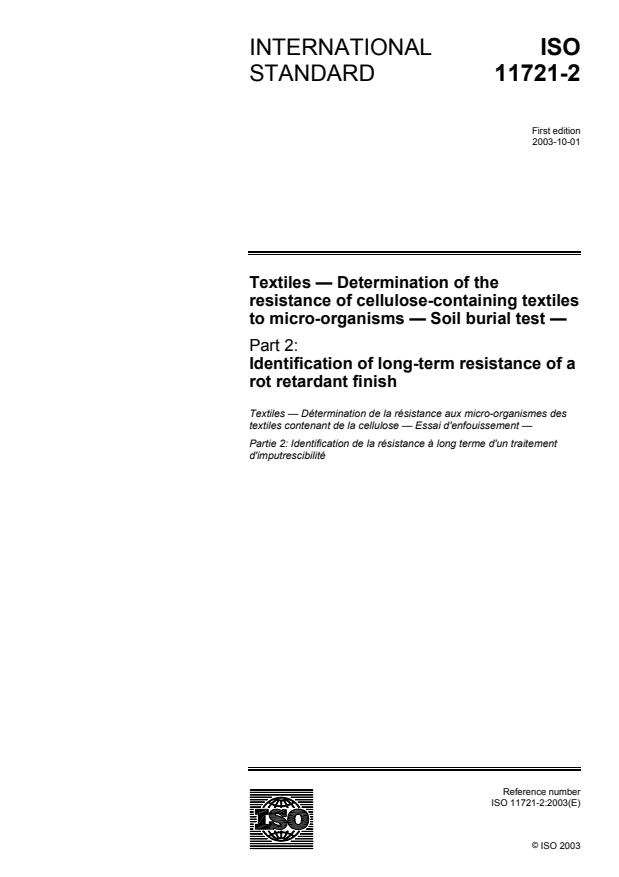
(Main)Textiles — Determination of the resistance of cellulose-containing textiles to micro-organisms — Soil burial test — Part 2: Identification of long-term resistance of a rot retardant finish
General Information
- Abstract
ISO 11721-2:2003 describes a test procedure for identification of the long-term resistance of a rot-retardant finish against the attack of microorganisms in the soil. It permits a distinction to be made between rot-retardant finishes with no long-term resistance, with regular long-term resistance and with increased long-term resistance, in order to assess the suitability for use in the tropics. As the soil burial test is a biological process and the test soil not accurately defined, ISO 11721-2:2003 only covers the comparison of finished and unfinished specimens.
- Status
- Published
- Publication Date
- 09-Oct-2003
- Technical Committee
- ISO/TC 38 - Textiles
- Drafting Committee
- ISO/TC 38 - Textiles
- Current Stage
- 9093 - International Standard confirmed
- Start Date
- 14-Mar-2025
- Completion Date
- 29-Aug-2026
Buy Documents
ISO 11721-2:2003 - Textiles — Determination of the resistance of cellulose-containing textiles to micro-organisms — Soil burial test — Part 2: Identification of long-term resistance of a rot retardant finish Released:10/10/2003
ISO 11721-2:2003 - Textiles — Détermination de la résistance aux micro-organismes des textiles contenant de la cellulose — Essai d'enfouissement — Partie 2: Identification de la résistance a long terme d'un traitement d'imputrescibilité Released:10/10/2003
Overview
ISO 11721-2:2003 is an international standard developed by the International Organization for Standardization (ISO) that specifies a test method for determining the long-term resistance of rot-retardant finishes applied to cellulose-containing textiles against biodegradation by soil microorganisms. The standard focuses on the soil burial test, which evaluates how these finishes protect textiles from rot caused by microbial attack under natural soil conditions.
This procedure enables manufacturers, researchers, and quality control laboratories to differentiate between finishes with no resistance, regular long-term resistance, and increased long-term resistance. The goal is to assess the durability and suitability of textile products, especially for use in tropical climates where microbial degradation is more aggressive.
Key Topics
Scope and Purpose
ISO 11721-2:2003 targets cellulose-based textiles treated with rot-retardant finishes. It identifies the efficacy of these treatments in preventing microbial decay during prolonged soil exposure.Test Principle
The method involves burying finished and unfinished fabric specimens in soil and measuring the loss of tensile strength over time. Long-term resistance is classified by comparing tensile strength reductions of treated samples relative to controls.Assessment Criteria
- No long-term resistance: Specimens lose tensile strength rapidly.
- Regular long-term resistance: Specimens retain at least 75% tensile strength after exposure twice the time needed for control samples to lose 80%.
- Increased long-term resistance: Specimens maintain at least 75% tensile strength after four times the control exposure duration.
Test Procedure and Soil Conditions
The biological soil burial test is inherently variable due to differences in soil composition and microbial populations. Hence, the standard focuses on comparative results rather than absolute values, requiring the use of control specimens to measure relative degradation.Sample Preparation and Leaching
Specimens must be prepared according to ISO 11721-1 and may include leached and unleached samples to assess the durability of waterproof or leachable finishes.Data Reporting
Comprehensive test reports should include specimen descriptions, soil moisture content, tensile strength values before and after burial, and any changes in textile appearance or structure.
Applications
Textile Manufacturing Quality Control
Implementing ISO 11721-2 helps producers ensure that rot retardant treatments meet minimum durability requirements, improving product reliability for environments with high microbial activity.Product Development and Comparison
R&D teams use this test to compare new rot retardant finishes and optimize formulations for enhanced long-term resistance, particularly for outdoor or tropical use.Regulatory Compliance and Certification
The standard provides a recognized methodology for certification bodies assessing microbial resistance claims of cellulose-containing textiles.Environmental and Tropical Textile Products
Textile products intended for tropical climates, where soil microorganisms accelerate degradation, benefit from validation through this soil burial test for suitable rot retardant treatments.
Related Standards
ISO 11721-1:2001
Specifies the general soil burial test and assessment of rot-retardant finishing and serves as a normative reference for sample preparation and test execution in ISO 11721-2.ISO 13934-1:1999
Defines the tensile properties test method for fabrics, utilized here to measure maximum tensile strength before and after soil burial.ISO 7218
Provides microbiological examination rules crucial for ensuring safe handling and operator protection during the soil burial test involving mold fungi and bacteria.ISO 11721-3 and ISO 11721-4
Cover additional aspects of microbial resistance assessment, such as toxicity of textile finishes and mildew resistance in saturated atmospheres.
By following the ISO 11721-2:2003 standard, textile industries can effectively evaluate and assure the long-term microbial durability of cellulose-containing textiles. This ensures enhanced product performance and consumer confidence, especially for applications exposed to challenging soil environments.
Relations
- Effective Date
- 12-Feb-2026
Buy Documents
ISO 11721-2:2003 - Textiles — Determination of the resistance of cellulose-containing textiles to micro-organisms — Soil burial test — Part 2: Identification of long-term resistance of a rot retardant finish Released:10/10/2003
ISO 11721-2:2003 - Textiles — Détermination de la résistance aux micro-organismes des textiles contenant de la cellulose — Essai d'enfouissement — Partie 2: Identification de la résistance a long terme d'un traitement d'imputrescibilité Released:10/10/2003
Get Certified
Connect with accredited certification bodies for this standard

Control Union Certifications
Global certification for agriculture and sustainability.

Hohenstein Institut
Textile testing and certification.

Bureau Veritas Bangladesh
Bureau Veritas certification services in Bangladesh.
Sponsored listings
Frequently Asked Questions
ISO 11721-2:2003 is a standard published by the International Organization for Standardization (ISO). Its full title is "Textiles — Determination of the resistance of cellulose-containing textiles to micro-organisms — Soil burial test — Part 2: Identification of long-term resistance of a rot retardant finish". This standard covers: ISO 11721-2:2003 describes a test procedure for identification of the long-term resistance of a rot-retardant finish against the attack of microorganisms in the soil. It permits a distinction to be made between rot-retardant finishes with no long-term resistance, with regular long-term resistance and with increased long-term resistance, in order to assess the suitability for use in the tropics. As the soil burial test is a biological process and the test soil not accurately defined, ISO 11721-2:2003 only covers the comparison of finished and unfinished specimens.
ISO 11721-2:2003 describes a test procedure for identification of the long-term resistance of a rot-retardant finish against the attack of microorganisms in the soil. It permits a distinction to be made between rot-retardant finishes with no long-term resistance, with regular long-term resistance and with increased long-term resistance, in order to assess the suitability for use in the tropics. As the soil burial test is a biological process and the test soil not accurately defined, ISO 11721-2:2003 only covers the comparison of finished and unfinished specimens.
ISO 11721-2:2003 is classified under the following ICS (International Classification for Standards) categories: 59.080.01 - Textiles in general. The ICS classification helps identify the subject area and facilitates finding related standards.
ISO 11721-2:2003 has the following relationships with other standards: It is inter standard links to EN ISO 11721-2:2003. Understanding these relationships helps ensure you are using the most current and applicable version of the standard.
ISO 11721-2:2003 is available in PDF format for immediate download after purchase. The document can be added to your cart and obtained through the secure checkout process. Digital delivery ensures instant access to the complete standard document.
Standards Content (Sample)
INTERNATIONAL ISO
STANDARD 11721-2
First edition
2003-10-01
Textiles — Determination of the
resistance of cellulose-containing textiles
to micro-organisms — Soil burial test —
Part 2:
Identification of long-term resistance of a
rot retardant finish
Textiles — Détermination de la résistance aux micro-organismes des
textiles contenant de la cellulose — Essai d'enfouissement —
Partie 2: Identification de la résistance à long terme d'un traitement
d'imputrescibilité
Reference number
©
ISO 2003
PDF disclaimer
This PDF file may contain embedded typefaces. In accordance with Adobe's licensing policy, this file may be printed or viewed but
shall not be edited unless the typefaces which are embedded are licensed to and installed on the computer performing the editing. In
downloading this file, parties accept therein the responsibility of not infringing Adobe's licensing policy. The ISO Central Secretariat
accepts no liability in this area.
Adobe is a trademark of Adobe Systems Incorporated.
Details of the software products used to create this PDF file can be found in the General Info relative to the file; the PDF-creation
parameters were optimized for printing. Every care has been taken to ensure that the file is suitable for use by ISO member bodies. In
the unlikely event that a problem relating to it is found, please inform the Central Secretariat at the address given below.
© ISO 2003
All rights reserved. Unless otherwise specified, no part of this publication may be reproduced or utilized in any form or by any means,
electronic or mechanical, including photocopying and microfilm, without permission in writing from either ISO at the address below or
ISO's member body in the country of the requester.
ISO copyright office
Case postale 56 • CH-1211 Geneva 20
Tel. + 41 22 749 01 11
Fax + 41 22 749 09 47
E-mail copyright@iso.org
Web www.iso.org
Published in Switzerland
ii © ISO 2003 – All rights reserved
Foreword
ISO (the International Organization for Standardization) is a worldwide federation of national standards bodies
(ISO member bodies). The work of preparing International Standards is normally carried out through ISO
technical committees. Each member body interested in a subject for which a technical committee has been
established has the right to be represented on that committee. International organizations, governmental and
non-governmental, in liaison with ISO, also take part in the work. ISO collaborates closely with the
International Electrotechnical Commission (IEC) on all matters of electrotechnical standardization.
International Standards are drafted in accordance with the rules given in the ISO/IEC Directives, Part 2.
The main task of technical committees is to prepare International Standards. Draft International Standards
adopted by the technical committees are circulated to the member bodies for voting. Publication as an
International Standard requires approval by at least 75 % of the member bodies casting a vote.
Attention is drawn to the possibility that some of the elements of this document may be the subject of patent
rights. ISO shall not be held responsible for identifying any or all such patent rights.
ISO 11721-2 was prepared by the European Committee for Standardization (CEN) in collaboration with
Technical Committee ISO/TC 38, Textiles, in accordance with the Agreement on technical cooperation
between ISO and CEN (Vienna Agreement).
Throughout the text of this document, read ".this European Standard." to mean ".this International
Standard.".
ISO 11721 consists of the following parts, under the general title Textiles — Determination of the resistance of
cellulose-containing textiles to micro-organisms — Soil burial test:
Part 1: Assessment of rot-retardant finishing
Part 2: Identification of long-term resistance of a rot retardant finish
Part 3: Toxicity of textile materials and finishing agents
Part 4: Saturated atmosphere test (mildew)
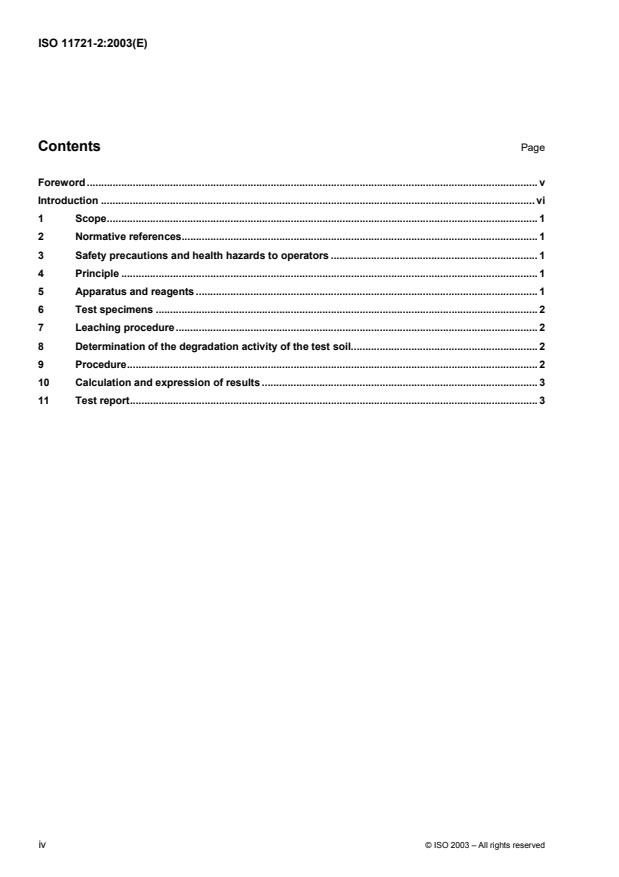
Contents Page
Foreword . v
Introduction . vi
1 Scope. 1
2 Normative references. 1
3 Safety precautions and health hazards to operators . 1
4 Principle . 1
5 Apparatus and reagents . 1
6 Test specimens . 2
7 Leaching procedure. 2
8 Determination of the degradation activity of the test soil. 2
9 Procedure. 2
10 Calculation and expression of results . 3
11 Test report. 3
iv © ISO 2003 – All rights reserved
Foreword
This document (EN ISO 11721-2:2003) has been prepared by Technical Committee CEN/TC 248
“Textiles and textile products”, the secretariat of which is held by BSI, in collaboration with Technical
Committee ISO/TC 38 “Textiles”.
This European Standard shall be given the status of a national standard, either by publication of an
identical text or by endorsement, at the latest by April 2004, and conflicting national standards shall
be withdrawn at the latest by April 2004.
According to the CEN/CENELEC Internal Regulations, the national standards organizations of the
following countries are bound to implement this European Standard: Austria, Belgium, Czech
Republic, Denmark, Finland, France, Germany, Greece, Hungary, Iceland, Ireland, Italy, Luxembourg,
Malta, Netherlands, Norway, Portugal, Slovakia, Spain, Sweden, Switzerland and the United
Kingdom.
Introduction
Cellulose containing textiles are considered as resistant against the attack of microorganisms living in
the soil, provided that their structure, appearance and maximum tensile strength have not been
altered essentially after a soil burial test.
The assessment of damage resistance takes into account the structure, the aspect and the changes
in the maximum tensile strength, compared to untreated specimens of the same material quality. It is
assessed by comparing the relative decrease of maximum tensile strength of buried specimens, with
that of unburied control specimens.
A long-term rot retardant finish or an increased long-term resistance meets with the requirements for
cellulose containing textiles if the maximum tensile strength of a buried specimen, compared with an
unburied specimen, does not decrease by more than 25 %.
The soil burial intervals for long-term retardant finishes take twice the time needed for control
specimens to lose 80 % of their maximum tensile strength. The soil burial intervals for increased long-
term resistant finishes takes four times the time needed for the cont
...
NORME ISO
INTERNATIONALE 11721-2
Première édition
2003-10-01
Textiles — Détermination de la résistance
aux micro-organismes des textiles
contenant de la cellulose — Essai
d'enfouissement —
Partie 2:
Identification de la résistance à long
terme d'un traitement d'imputrescibilité
Textiles — Determination of the resistance of cellulose-containing
textiles to micro-organisms — Soil burial test —
Part 2: Identification of long-term resistance of a rot retardant finish
Numéro de référence
©
ISO 2003
PDF – Exonération de responsabilité
Le présent fichier PDF peut contenir des polices de caractères intégrées. Conformément aux conditions de licence d'Adobe, ce fichier
peut être imprimé ou visualisé, mais ne doit pas être modifié à moins que l'ordinateur employé à cet effet ne bénéficie d'une licence
autorisant l'utilisation de ces polices et que celles-ci y soient installées. Lors du téléchargement de ce fichier, les parties concernées
acceptent de fait la responsabilité de ne pas enfreindre les conditions de licence d'Adobe. Le Secrétariat central de l'ISO décline toute
responsabilité en la matière.
Adobe est une marque déposée d'Adobe Systems Incorporated.
Les détails relatifs aux produits logiciels utilisés pour la création du présent fichier PDF sont disponibles dans la rubrique General Info
du fichier; les paramètres de création PDF ont été optimisés pour l'impression. Toutes les mesures ont été prises pour garantir
l'exploitation de ce fichier par les comités membres de l'ISO. Dans le cas peu probable où surviendrait un problème d'utilisation,
veuillez en informer le Secrétariat central à l'adresse donnée ci-dessous.
© ISO 2003
Droits de reproduction réservés. Sauf prescription différente, aucune partie de cette publication ne peut être reproduite ni utilisée sous
quelque forme que ce soit et par aucun procédé, électronique ou mécanique, y compris la photocopie et les microfilms, sans l'accord écrit
de l'ISO à l’adresse ci-après ou du comité membre de l'ISO dans le pays du demandeur.
ISO copyright office
Case postale 56 • CH-1211 Geneva 20
Tel. + 41 22 749 01 11
Fax. + 41 22 749 09 47
E-mail copyright@iso.org
Web www.iso.org
Publié en Suisse
ii © ISO 2003 – Tous droits réservés
Avant-propos
L'ISO (Organisation internationale de normalisation) est une fédération mondiale d'organismes nationaux de
normalisation (comités membres de l'ISO). L'élaboration des Normes internationales est en général confiée
aux comités techniques de l'ISO. Chaque comité membre intéressé par une étude a le droit de faire partie du
comité technique créé à cet effet. Les organisations internationales, gouvernementales et non
gouvernementales, en liaison avec l'ISO participent également aux travaux. L'ISO collabore étroitement avec
la Commission électrotechnique internationale (CEI) en ce qui concerne la normalisation électrotechnique.
Les Normes internationales sont rédigées conformément aux règles données dans les Directives ISO/CEI,
Partie 2.
La tâche principale des comités techniques est d'élaborer les Normes internationales. Les projets de Normes
internationales adoptés par les comités techniques sont soumis aux comités membres pour vote. Leur
publication comme Normes internationales requiert l'approbation de 75 % au moins des comités membres
votants.
L'attention est appelée sur le fait que certains des éléments du présent document peuvent faire l'objet de
droits de propriété intellectuelle ou de droits analogues. L'ISO ne saurait être tenue pour responsable de ne
pas avoir identifié de tels droits de propriété et averti de leur existence.
L'ISO 11721-2 a été élaborée par le Comité européen de normalisation (CEN) en collaboration avec le comité
technique ISO/TC 38, Textiles, conformément à l'Accord de coopération technique entre l'ISO et le CEN
(Accord de Vienne).
Tout au long du texte du présent document, lire «… la présente Norme européenne …» avec le sens de
«… la présente Norme internationale …».
L'ISO 11721 comprend les parties suivantes, présentées sous le titre général Textiles — Détermination de la
résistance aux micro-organismes des textiles contenant de la cellulose — Essai d'enfouissement:
Partie 1: Évaluation d'un traitement d'imputrescibilité
Partie 2: Identification de la résistance à long terme d'un traitement d'imputrescibilité
Partie 3: Toxicité des matériaux textiles et des agents de finissage
Partie 4: Essai en atmosphère saturée (moisissures)
Sommaire Page
Avant-propos. v
Introduction . vi
1 Domaine d'application. 1
2 Références normatives. 1
3 Précautions de sécurité et risques pour la santé encourus par les opérateurs . 1
4 Principe . 1
5 Appareillage et réactifs. 1
6 Éprouvettes. 2
7 Mode opératoire de lixiviation . 2
8 Détermination de l’activité de dégradation de la terre d’essai. 2
9 Mode opératoire . 2
10 Calcul et expression des résultats. 3
11 Rapport d'essai . 4
iv © ISO 2003 – Tous droits réservés
Avant-propos
Le présent document EN ISO 11721-2:2003 a été élaboré par le Comité Technique CEN/TC 248 “Textiles et
produits textiles”, dont le secrétariat est tenu par BSI, en collaboration avec le Comité Technique ISO/TC 38
“Textiles”.
Cette Norme européenne devra recevoir le statut de norme nationale, soit par publication d'un texte identique, soit
par entérinement, au plus tard en avril 2004, et toutes les normes nationales en contradiction devront être retirées
au plus tard en avril 2004.
Selon le Règlement Intérieur du CEN/CENELEC, les instituts de normalisation nationaux des pays suivants sont
tenus de mettre cette Norme européenne en application : Allemagne, Autriche, Belgique, Danemark, Espagne,
Finlande, France, Grèce, Hongrie, Irlande, Islande, Italie, Luxembourg, Malte, Norvège, Pays-Bas, Portugal,
République Tchèque, Royaume-Uni, Slovaquie, Suède et Suisse.
Introduction
On estime que les textiles contenant de la cellulose résistent aux attaques des micro-organismes vivant dans la
terre à condition que leur structure, leur aspect et leur résistance maximale à la traction n’aient pas été modifiés de
façon significative après un essai d’enfouissement.
L’évaluation de la résistance à la détérioration tient compte de la structure, de l’aspect et des variations de la
résistance maximale à la traction par rapport aux éprouvettes non traitées réalisées dans un matériau de même
qualité. La résistance est évaluée en mesurant la diminution relative de la résistance maximale à la traction des
éprouvettes enfouies par rapport à celle des éprouvettes témoins non enfouies.
Un traitement d’imputrescibilité à long terme ou une résistance à long terme accrue satisfait aux exigences établies
pour les textiles contenant de la cellulose si la résistance maximale à la traction d’une éprouvette enfouie,
comparée à celle d’une éprouvette non enfouie, ne diminue pas de plus de 25 %.
La durée d’enfouissement des éprouvettes traitées pour une résistance à long terme correspond à deux fois la
durée nécessaire aux éprouvettes témoins pour perdre 80 % de leur résistance maximale à la traction. La durée
d’enfouissement des éprouvettes traitées pour une résistance à long terme accrue correspond à quatre fois la
durée nécessaire aux éprouvettes témoins pour perdre 80 % de leur résistance maximale à la traction.
vi © ISO 2003 – Tous droits réservés
1 Domaine d'application
La présente Norme européenne décrit un mode opératoire d’essai permettant d’identifier la résistance à long terme
d’un traitement d’imputrescibilité aux attaques
...