

EN 1822-3:2009
(Main)High efficiency air filters (EPA, HEPA and ULPA) - Part 3: Testing flat sheet filter media
- Abstract
This European Standard applies to high efficiency particulate air filters and ultra low penetration air filters (EPA, HEPA and ULPA) used in the field of ventilation and air conditioning and for technical processes, e.g. for applications in clean room technology or pharmaceutical industry.
It establishes a procedure for the determination of the efficiency on the basis of a particle counting method using a liquid test aerosol, and allows a standardized classification of these filters in terms of their efficiency.
This European Standard applies to testing sheet filter media used in high efficiency air filters. The procedure includes methods, test assemblies and conditions for carrying out the test, and the basis for calculating results.
- Status
- Withdrawn
- Publication Date
- 17-Nov-2009
- Withdrawal Date
- 06-Oct-2026
- Technical Committee
- CEN/TC 195 - Air filters for general air cleaning
- Drafting Committee
- CEN/TC 195/WG 2 - HEPA and ULPA filters
- Current Stage
- 9960 - Withdrawal effective - Withdrawal
- Start Date
- 10-Oct-2018
- Completion Date
- 07-Oct-2026



Relations
- Effective Date
- 22-Dec-2008
- Effective Date
- 17-Oct-2018
- Effective Date
- 28-Jan-2026
- Effective Date
- 28-Jan-2026
- Effective Date
- 28-Jan-2026
Get Certified
Connect with accredited certification bodies for this standard

CIS Institut d.o.o.
Personal Protective Equipment (PPE) certification body. Notified Body NB-2890 for EU Regulation 2016/425 PPE.
Institut za varilstvo d.o.o. (Welding Institute)
Slovenia's leading welding institute since 1952. ISO 3834, EN 1090, pressure equipment certification, NDT personnel, welder qualification. Only IIW Au

Kiwa BDA Testing
Building and construction product certification.
Sponsored listings
Frequently Asked Questions
EN 1822-3:2009 is a standard published by the European Committee for Standardization (CEN). Its full title is "High efficiency air filters (EPA, HEPA and ULPA) - Part 3: Testing flat sheet filter media". This standard covers: This European Standard applies to high efficiency particulate air filters and ultra low penetration air filters (EPA, HEPA and ULPA) used in the field of ventilation and air conditioning and for technical processes, e.g. for applications in clean room technology or pharmaceutical industry. It establishes a procedure for the determination of the efficiency on the basis of a particle counting method using a liquid test aerosol, and allows a standardized classification of these filters in terms of their efficiency. This European Standard applies to testing sheet filter media used in high efficiency air filters. The procedure includes methods, test assemblies and conditions for carrying out the test, and the basis for calculating results.
This European Standard applies to high efficiency particulate air filters and ultra low penetration air filters (EPA, HEPA and ULPA) used in the field of ventilation and air conditioning and for technical processes, e.g. for applications in clean room technology or pharmaceutical industry. It establishes a procedure for the determination of the efficiency on the basis of a particle counting method using a liquid test aerosol, and allows a standardized classification of these filters in terms of their efficiency. This European Standard applies to testing sheet filter media used in high efficiency air filters. The procedure includes methods, test assemblies and conditions for carrying out the test, and the basis for calculating results.
EN 1822-3:2009 is classified under the following ICS (International Classification for Standards) categories: 13.040.40 - Stationary source emissions; 23.120 - Ventilators. Fans. Air-conditioners. The ICS classification helps identify the subject area and facilitates finding related standards.
EN 1822-3:2009 has the following relationships with other standards: It is inter standard links to EN 1822-3:1998, EN ISO 29463-3:2018, EN 1822-2:2009, EN 14799:2007, EN 1822-1:2009. Understanding these relationships helps ensure you are using the most current and applicable version of the standard.
EN 1822-3:2009 is available in PDF format for immediate download after purchase. The document can be added to your cart and obtained through the secure checkout process. Digital delivery ensures instant access to the complete standard document.
Standards Content (Sample)
2003-01.Slovenski inštitut za standardizacijo. Razmnoževanje celote ali delov tega standarda ni dovoljeno.Schwebstofffilter (EPA, HEPA und ULPA) - Teil 3: Prüfung des planen FiltermediumsFiltres à air à haute efficacité (EPA, HEPA et ULPA) - Partie 3: Essais de medias filtrants plansHigh efficiency air filters (EPA, HEPA and ULPA) - Part 3: Testing flat sheet filter media23.120QDSUDYHVentilators. Fans. Air-conditionersICS:Ta slovenski standard je istoveten z:EN 1822-3:2009SIST EN 1822-3:2010en01-januar-2010SIST EN 1822-3:2010SLOVENSKI
STANDARDSIST EN 1822-3:20001DGRPHãþD
EUROPEAN STANDARD NORME EUROPÉENNE EUROPÄISCHE NORM
EN 1822-3
November 2009 ICS 13.040.40 Supersedes EN 1822-3:1998English Version
High efficiency air filters (EPA, HEPA and ULPA) - Part 3: Testing flat sheet filter media
Filtres à air à haute efficacité (EPA, HEPA et ULPA) - Partie 3: Essais de medias filtrants plans
Schwebstofffilter (EPA, HEPA und ULPA) - Teil 3: Prüfung des planen Filtermediums This European Standard was approved by CEN on 17 October 2009.
CEN members are bound to comply with the CEN/CENELEC Internal Regulations which stipulate the conditions for giving this European Standard the status of a national standard without any alteration. Up-to-date lists and bibliographical references concerning such national standards may be obtained on application to the CEN Management Centre or to any CEN member.
This European Standard exists in three official versions (English, French, German). A version in any other language made by translation under the responsibility of a CEN member into its own language and notified to the CEN Management Centre has the same status as the official versions.
CEN members are the national standards bodies of Austria, Belgium, Bulgaria, Cyprus, Czech Republic, Denmark, Estonia, Finland, France, Germany, Greece, Hungary, Iceland, Ireland, Italy, Latvia, Lithuania, Luxembourg, Malta, Netherlands, Norway, Poland, Portugal, Romania, Slovakia, Slovenia, Spain, Sweden, Switzerland and United Kingdom.
EUROPEAN COMMITTEE FOR STANDARDIZATION
COMITÉ EUROPÉEN DE NORMALISATION EUROPÄISCHES KOMITEE FÜR NORMUNG
Management Centre:
Avenue Marnix 17,
B-1000 Brussels © 2009 CEN All rights of exploitation in any form and by any means reserved worldwide for CEN national Members. Ref. No. EN 1822-3:2009: ESIST EN 1822-3:2010
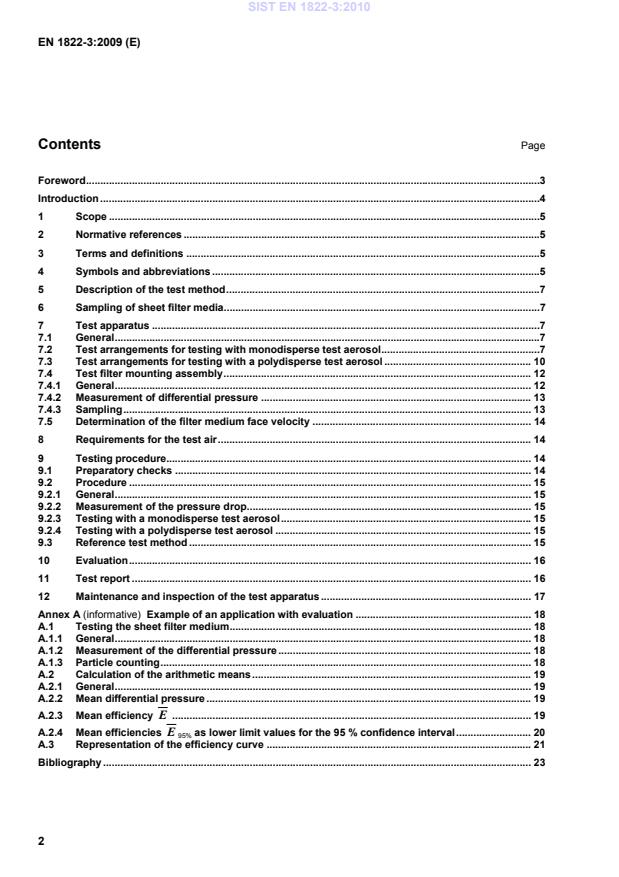
Example of an application with evaluation . 18A.1Testing the sheet filter medium . 18A.1.1General . 18A.1.2Measurement of the differential pressure . 18A.1.3Particle counting . 18A.2Calculation of the arithmetic means . 19A.2.1General . 19A.2.2Mean differential pressure . 19A.2.3Mean efficiency E . 19A.2.4Mean efficiencies E95% as lower limit values for the 95 % confidence interval . 20A.3Representation of the efficiency curve . 21Bibliography . 23 SIST EN 1822-3:2010
According to the CEN/CENELEC Internal Regulations, the national standards organizations of the following countries are bound to implement this European Standard: Austria, Belgium, Bulgaria, Cyprus, Czech Republic, Denmark, Estonia, Finland, France, Germany, Greece, Hungary, Iceland, Ireland, Italy, Latvia, Lithuania, Luxembourg, Malta, Netherlands, Norway, Poland, Portugal, Romania, Slovakia, Slovenia, Spain, Sweden, Switzerland and the United Kingdom.
Test volume flow rate V& cm³/s
Pressure drop ∆p Pa
Mean particle diameter p~d µm
Particle number N -
Sampling volume flow rate s&V cm³/s
Sampling duration t s
Calculated quantities Filter medium face velocity u cm/s AVu&= Mean differential pressure
∆p Pa p∆= 1n ∑=∆niip1 Particle number concentration cN cm-³ tVNcN⋅=S& Penetration for particles in size range i Pi a iuNidNiccP,,,,=
b Mean penetration P a ∑==niiPnP11 Mean efficiency E a PE−=1 Number of particles for the upper or lower limit of the 95 % level of confidence N95% - See Clause 7 of EN 1822-2:2009 Penetration as upper limit value for the 95 % level of confidence P95%, i a iuNidNiccP%,95,,%,95,,%,95= b Mean penetration as upper limit value for the 95 % level of confidence %95P a ∑==niiPnP1%,95%951 Mean efficiency as lower limit value for the 95 % level of confidence %95E a %95%951PE−= a These quantities are usually given as a percentage. b The index "u" refers to up-stream particle counts, and the index "d" refers to down-stream particle counts. SIST EN 1822-3:2010
In order to achieve a sufficiently high particle number concentration over the entire test range from 0,04 µm to
0,8 µm it may prove necessary to use several jet nebulizers with differing concentrations of the aerosol substances in the solvent. Numerical concentrations which are too high can be adjusted by diluting the test aerosol before the test filter mounting assembly. The number concentration in the test aerosol shall be selected so that no dilution is necessary for the measurements made downstream from the filter. A pump positioned downstream draws the test aerosol through the test filter mounting assembly. This ensures that the differential mobility analyser can always operate under nearly the same conditions, independent of the pressure drop across the tested filter medium. In contrast, where the testing system operates with an overpressure this ensures that leaks in the system do not falsify the test measurements. Particles are counted upstream and downstream from the filter using either two condensation nucleus counters in parallel, or using only one such counter to measure the upstream and downstream concentrations alternately. If the level of the upstream number concentration exceeds the measuring range of the counter then a dilution system shall be included between the sampling point and the counter.
1) Actually, the adjustment gives the mode of number distribution. This can be taken as equal to the median value with sufficient accuracy. SIST EN 1822-3:2010
Key 1 Filter 2 Pressure valve 3 Solenoid valve 4 Jet nebuliser 5 Neutraliser 6 Differential mobility analyser 7 Needle valve 8 Test filter mounting assembly 9 Differential pressure gauge 10 Dilution system 11 Condensation nucleus counter 12 Measuring equipment for absolute pressure, temperature and relative humidity 13 Volume flow rate meter 14 Vacuum pump 15 Computer for control and data storage Figure 1 — Setup for testing with monodisperse test aerosols SIST EN 1822-3:2010
...