

EN 13850:2002+A1:2007
(Main + Amendment)Postal service - Quality of service - Measurement of the transit time of end-to end-services for single piece priority mail and first class mail
- Abstract
This European Standard specifies methods for measuring the end-to-end transit time of the domestic and cross-border priority single piece letter mail, collected, processed and distributed by postal service operators. It considers methods using a representative end-to-end sample of all types of single piece addressed letter mail. End-to-end is defined as from the point mail is placed into the collection/acceptance system under the responsibility of the postal operators, to the final delivery point under the responsibility of the postal operators.
The overall transit time quality-of-service result is to be expressed as percentage of mail delivered within
J + n days end-to-end according to the EC postal directive.
This quality of service indicator does not measure the postal operator’s overall performance in a way that provides direct comparison of postal service operators, and does not include other service performance indicators than those related to transit time. In particular this European Standard does not measure whether the timing of the last collection of the day meets customer’s requirements.
It specifies a set of requirements for the design of a quality of service measuring system for single piece priority mail, involving the selection and distribution of test item sent and received by selected panellists. The sample design gives the specifications for the item to be representative of the real mail flows.
This European Standard relates to the measurement of the so-called "normal" services given to private persons / households and businesses that post mail at street letter boxes, over the counter at post offices, have pick ups at their offices or give their mail directly at postal service operators sorting centres.
For technical reasons this European Standard may not in all parts be suitable for the measuring of very small volumes of mail and for operators with limited coverage.
This European Standard is not applicable for measuring the end-to-end tran
- Status
- Withdrawn
- Publication Date
- 27-Mar-2007
- Withdrawal Date
- 18-Dec-2012
- Technical Committee
- CEN/TC 331 - Postal services
- Drafting Committee
- CEN/TC 331/WG 1 - Quality of service
- Current Stage
- 9960 - Withdrawal effective - Withdrawal
- Start Date
- 19-Dec-2012
- Completion Date
- 19-Dec-2012


Relations
- Effective Date
- 19-Jan-2023
- Effective Date
- 19-Jan-2023
- Effective Date
- 22-Dec-2008
- Effective Date
- 17-Sep-2026
- Effective Date
- 25-Aug-2026
- Effective Date
- 25-Aug-2026
- Refers
ISO 10011-3:1991 - Guidelines for auditing quality systems — Part 3: Management of audit programmes - Effective Date
- 25-Aug-2026
- Effective Date
- 25-Aug-2026
- Effective Date
- 25-Aug-2026
- Effective Date
- 25-Aug-2026
- Effective Date
- 25-Aug-2026
- Effective Date
- 03-Jun-2026
- Effective Date
- 28-Jan-2026
- Effective Date
- 28-Jan-2026
- Effective Date
- 28-Jan-2026
Get Certified
Connect with accredited certification bodies for this standard

Great Wall Tianjin Quality Assurance Center
Established 1993, first batch to receive national accreditation with IAF recognition.
Hong Kong Quality Assurance Agency (HKQAA)
Hong Kong's leading certification body.

Innovative Quality Certifications Pvt. Ltd. (IQCPL)
Known for integrity, providing ethical & impartial Assessment & Certification. CMMI Institute Partner.
Sponsored listings
Frequently Asked Questions
EN 13850:2002+A1:2007 is a standard published by the European Committee for Standardization (CEN). Its full title is "Postal service - Quality of service - Measurement of the transit time of end-to end-services for single piece priority mail and first class mail". This standard covers: This European Standard specifies methods for measuring the end-to-end transit time of the domestic and cross-border priority single piece letter mail, collected, processed and distributed by postal service operators. It considers methods using a representative end-to-end sample of all types of single piece addressed letter mail. End-to-end is defined as from the point mail is placed into the collection/acceptance system under the responsibility of the postal operators, to the final delivery point under the responsibility of the postal operators. The overall transit time quality-of-service result is to be expressed as percentage of mail delivered within J + n days end-to-end according to the EC postal directive. This quality of service indicator does not measure the postal operator’s overall performance in a way that provides direct comparison of postal service operators, and does not include other service performance indicators than those related to transit time. In particular this European Standard does not measure whether the timing of the last collection of the day meets customer’s requirements. It specifies a set of requirements for the design of a quality of service measuring system for single piece priority mail, involving the selection and distribution of test item sent and received by selected panellists. The sample design gives the specifications for the item to be representative of the real mail flows. This European Standard relates to the measurement of the so-called "normal" services given to private persons / households and businesses that post mail at street letter boxes, over the counter at post offices, have pick ups at their offices or give their mail directly at postal service operators sorting centres. For technical reasons this European Standard may not in all parts be suitable for the measuring of very small volumes of mail and for operators with limited coverage. This European Standard is not applicable for measuring the end-to-end tran
This European Standard specifies methods for measuring the end-to-end transit time of the domestic and cross-border priority single piece letter mail, collected, processed and distributed by postal service operators. It considers methods using a representative end-to-end sample of all types of single piece addressed letter mail. End-to-end is defined as from the point mail is placed into the collection/acceptance system under the responsibility of the postal operators, to the final delivery point under the responsibility of the postal operators. The overall transit time quality-of-service result is to be expressed as percentage of mail delivered within J + n days end-to-end according to the EC postal directive. This quality of service indicator does not measure the postal operator’s overall performance in a way that provides direct comparison of postal service operators, and does not include other service performance indicators than those related to transit time. In particular this European Standard does not measure whether the timing of the last collection of the day meets customer’s requirements. It specifies a set of requirements for the design of a quality of service measuring system for single piece priority mail, involving the selection and distribution of test item sent and received by selected panellists. The sample design gives the specifications for the item to be representative of the real mail flows. This European Standard relates to the measurement of the so-called "normal" services given to private persons / households and businesses that post mail at street letter boxes, over the counter at post offices, have pick ups at their offices or give their mail directly at postal service operators sorting centres. For technical reasons this European Standard may not in all parts be suitable for the measuring of very small volumes of mail and for operators with limited coverage. This European Standard is not applicable for measuring the end-to-end tran
EN 13850:2002+A1:2007 is classified under the following ICS (International Classification for Standards) categories: 03.240 - Postal services. The ICS classification helps identify the subject area and facilitates finding related standards.
EN 13850:2002+A1:2007 has the following relationships with other standards: It is inter standard links to EN 13850:2002, EN 13850:2002/prA1, EN 13850:2012, EN ISO 9001:2026, ISO 10011-1:1990, ISO 10011-2:1991, ISO 10011-3:1991, ISO 10005:2005, ISO 3534-2:2006, ISO 10007:2003, ISO 3534-1:1993, EN ISO 9000:2026, EN 16430-2:2014, EN ISO 9004:2018, EN ISO 11212-2:1997. Understanding these relationships helps ensure you are using the most current and applicable version of the standard.
EN 13850:2002+A1:2007 is associated with the following European legislation: EU Directives/Regulations: 2002/39/EC, 97/67/EC; Standardization Mandates: M/312. When a standard is cited in the Official Journal of the European Union, products manufactured in conformity with it benefit from a presumption of conformity with the essential requirements of the corresponding EU directive or regulation.
EN 13850:2002+A1:2007 is available in PDF format for immediate download after purchase. The document can be added to your cart and obtained through the secure checkout process. Digital delivery ensures instant access to the complete standard document.
Standards Content (Sample)
2003-01.Slovenski inštitut za standardizacijo. Razmnoževanje celote ali delov tega standarda ni dovoljeno.D]UHGDPostalische Dienstleistungen - Dienstqualität - Laufzeitmessung end-to-end für Vorrangssendungen und Sendungen erster KlasseServices postaux - Qualité de service - Mesure du délai d´acheminement des services de bout en bout pour le courrier prioritaire égrené et de premiere classePostal service - Quality of service - Measurement of the transit time of end-to end-services for single piece priority mail and first class mail03.240Poštne storitvePostal services03.120.99Drugi standardi v zvezi s kakovostjoOther standards related to qualityICS:Ta slovenski standard je istoveten z:EN 13850:2002+A1:2007SIST EN 13850:2004+A1:2007en01-maj-2007SIST EN 13850:2004+A1:2007SLOVENSKI
STANDARD
EUROPEAN STANDARD NORME EUROPÉENNE EUROPÄISCHE NORM
EN 13850:2002+A1
March 2007 ICS 03.240 SupersedesEN 13850:2002English Version
Postal service - Quality of service - Measurement of the transit time of end-to end-services for single piece priority mail and first class mail
Services postaux - Qualité de service - Mesure du délai d´acheminement des services de bout en bout pour le courrier prioritaire égrené et de première classe
Postalische Dienstleistungen - Dienstqualität - Laufzeitmessung end-to-end für Vorrangssendungen und Sendungen erster Klasse This European Standard was approved by CEN on 16 February 2002 and includes Amendment 1 approved by CEN on 4 February 2007.
CEN members are bound to comply with the CEN/CENELEC Internal Regulations which stipulate the conditions for giving this European Standard the status of a national standard without any alteration. Up-to-date lists and bibliographical references concerning such national standards may be obtained on application to the CEN Management Centre or to any CEN member.
This European Standard exists in three official versions (English, French, German). A version in any other language made by translation under the responsibility of a CEN member into its own language and notified to the CEN Management Centre has the same status as the official versions.
CEN members are the national standards bodies of Austria, Belgium, Bulgaria, Cyprus, Czech Republic, Denmark, Estonia, Finland, France, Germany, Greece, Hungary, Iceland, Ireland, Italy, Latvia, Lithuania, Luxembourg, Malta, Netherlands, Norway, Poland, Portugal, Romania, Slovakia, Slovenia, Spain, Sweden, Switzerland and United Kingdom.
EUROPEAN COMMITTEE FOR STANDARDIZATION
COMITÉ EUROPÉEN DE NORMALISATION EUROPÄISCHES KOMITEE FÜR NORMUNG
Management Centre: rue de Stassart, 36
B-1050 Brussels © 2007 CEN All rights of exploitation in any form and by any means reserved worldwide for CEN national Members. Ref. No. EN 13850:2002+A1:2007: ESIST EN 13850:2004+A1:2007
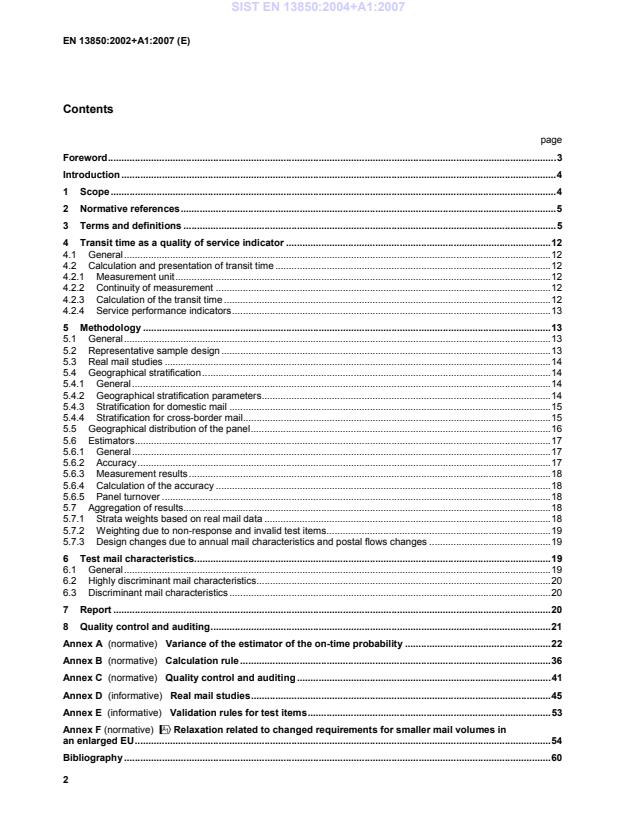
(normative)
Variance of the estimator of the on-time probability.22 Annex B
(normative)
Calculation rule.36 Annex C
(normative)
Quality control and auditing.41 Annex D
(informative)
Real mail studies.45 Annex E
(informative)
Validation rules for test items.53 Annex F (normative)
!Relaxation related to changed requirements for smaller mail volumes in an enlarged EU.54 Bibliography.60 SIST EN 13850:2004+A1:2007
Foreword This document (EN 13850:2002+A1:2007) has been prepared by Technical Committee CEN/TC 331 "Postal services", the secretariat of which is held by NEN. This document shall be given the status of a national standard, either by publication of an identical text or by endorsement, at the latest by September 2007 and conflicting national standards shall be withdrawn at the latest by September 2007. This document includes Amendment 1, approved by CEN on 2007-02-04. This document supersedes EN 13850:2002. The start and finish of text introduced or altered by amendment is indicated in the text by tags ! ". This document has been prepared under a mandate given to CEN by the European Commission and the European Free Trade Association, and supports essential requirements of EU Directive(s). According to the CEN/CENELEC Internal Regulations, the national standards organizations of the following countries are bound to implement this European Standard: Austria, Belgium, Bulgaria, Cyprus, Czech Republic, Denmark, Estonia, Finland, France, Germany, Greece, Hungary, Iceland, Ireland, Italy, Latvia, Lithuania, Luxembourg, Malta, Netherlands, Norway, Poland, Portugal, Romania, Slovakia, Slovenia, Spain, Sweden, Switzerland and United Kingdom.
— independent end-to-end measurement capabilities; — a focus on cross-border delivery service performance; — a single, uniform and reliable system for monitoring delivery service performance within the Union. The Commission acknowledged that the different postal traditions and cultures in Europe would not allow for the establishment of one common unified European measurement system and that national systems should have sufficient degrees of freedom to reflect national needs and peculiarities. On the other hand, they should fulfil a defined set of minimum requirements to satisfy the information interests of the national regulatory authority, postal customers and postal operators themselves.
The objective of the measurement is to estimate the transit time quality of service given to the customer in each European country domestically and cross-border between the European countries. This European Standard refers to a number of principles and minimum requirements to be applied for the measurement of the transit time of the national and cross-border mail. !When EN 13850 was developed it was decided to base it on existing measuring systems already in use among the European Union member states. Since the publication of EN 13850 in 2002 more countries have joined the European Union which have increased the number of cross-border mail flows significantly and therefore made it necessary to adapt the standard accordingly. Amendment 1 to this European Standard has been developed to make it possible to economically measure a larger number of mail flows from a wider range of countries than the original versions of the standard were made for. Amendment 1 to this European Standard gives information on how to categorize mail flows for measuring purposes and explain how required accuracy for small and medium sized mail flows can be obtained by measuring under a consecutive number of years." 1 Scope This European Standard specifies methods for measuring the end-to-end transit time of the domestic and cross-border priority single piece letter mail, collected, processed and distributed by postal service operators. It considers methods using a representative end-to-end sample of all types of single piece addressed letter mail. End-to-end is defined as from the point mail is placed into the collection/acceptance system under the responsibility of the postal operators, to the final delivery point under the responsibility of the postal operators. The overall transit time quality-of-service result is to be expressed as percentage of mail delivered within
J + n days end-to-end according to the EC postal directive. This quality of service indicator does not measure the postal operator’s overall performance in a way that provides direct comparison of postal service operators, and does not include other service performance indicators than those related to transit time. In particular this European Standard does not measure whether the timing of the last collection of the day meets customer’s requirements. It specifies a set of requirements for the design of a quality of service measuring system for single piece priority mail, involving the selection and distribution of test item sent and received by selected panellists. The sample design gives the specifications for the item to be representative of the real mail flows. This European Standard relates to the measurement of the so-called “normal” services given to private persons / households and businesses that post mail at street letter boxes, over the counter at post offices, have pick ups at their offices or give their mail directly at postal service operators sorting centres. For technical reasons this European Standard may not in all parts be suitable for the measuring of very small volumes of mail and for operators with limited coverage. This European Standard is not applicable for measuring the end-to-end transit time distribution of large bulk mailers’ services and hybrid mail, which require different measurement systems and methodologies. This European Standard includes specifications for the quality control and auditing of the measurement system. SIST EN 13850:2004+A1:2007
The term accuracy, when applied to a set of test results, involves a combination of random components and a common systematic error or bias component. [ISO 3534-1] NOTE 2
In this standard the accuracy is given by the length 2ε of the confidence interval at the confidence level 95 % for the parameter being estimated, namely the probability of attaining the specification with respect to the transit time. 3.2 aggregation compounding of primary data into an aggregate for the purpose of expressing them in a summary form 3.3 audit systematic and independent examination to determine whether activities and related results comply with planned arrangements and whether these arrangements are implemented effectively and are suitable to achieve objectives [EN ISO 9000] 3.4 average (arithmetic mean) sum of values divided by the number of values [ISO 3534-1] 3.5 bring service mail collection or mail delivery service specifically contracted by the customer SIST EN 13850:2004+A1:2007
The characteristics may be either quantitative - by variables, or qualitative - by attributes [ISO 3534-1]. NOTE 2
In this standard the population is postal test items and the characteristics are related to type of senders, type of receivers, times and types of induction or delivery, physical aspects of test items, franking, etc. 3.8 city geographically defined area according to national classification systems 3.9 conformity fulfilment of specified requirements [EN ISO 9000] 3.10 corrective action action taken to eliminate the causes of an existing non-conformity, defect or other undesirable situation in order to prevent recurrence [EN ISO 9000] 3.11 correlation relationship between two or several random variables within a distribution of two or more random variables NOTE
Most statistical measures of correlation measure only the degree of linear relationship [ISO 3534-1]. 3.12 correlation coefficient ratio of the covariance of two random variables to the product of their standard deviations [ISO 3534-1] 3.13 country territory of a nation with its own government 3.14 cross-border mail mail distributed from one country to another country 3.15 customer natural or legal person having a business relation with a postal operator 3.16 date of delivery date on which a postal item is delivered to the address or to the addressee 3.17 date of deposit (J) day on which a postal item is posted, provided posting takes place before the last collection of that day NOTE 1
The term date of deposit is used in relation to quality of service measurement. The definition is based on the Postal Directive 97/67/EC. SIST EN 13850:2004+A1:2007
Last collection refers to the advertised last time for collection (not the actual time). 3.18 delivery point physical location at which delivery of postal items by a postal operator takes place and where they leave the operator’s responsibility 3.19 design factor ratio of the variance of the estimator in the given sample design by the variance of the estimator in an elementary sample design of the same size. The design factor is related to a given sample design and estimator 3.20 discriminant (characteristic) characteristic affecting the outcome
NOTE
In this standard a characteristic is discriminant when transit time differs according to the different modes of the characteristic. 3.21 distribution process from collecting mail at collecting points through sorting at the distribution centre to delivery of mail items to the addressee 3.22 domestic mail mail items sent and received within one country 3.23 end-to-end (transit time) from the point mail is placed into the collection/acceptance system under the responsibility of the collecting postal operator to the final delivery point under the responsibility of the delivering
postal operators 3.24 estimate value of an estimator obtained as a result of an estimation [ISO 3534-1] 3.25 estimator statistic used to estimate a population parameter
[ISO 3534-1] NOTE
In this European Standard, a function of the observed values of test item transit times allowing the estimation of the probability of attaining the specification with respect to the transit time. 3.26 expectation for a discrete random variable X taking the values xi, with the probabilities pi, the expectation if it exists, is: µ = E(X) = Σpi xi the sum being extended over all the values xi which can be taken by X [ISO 3534-1] 3.27 field of study total mail flow between defined postal areas NOTE 1
Field of study could be defined for example as: — Domestic – one operator in one country SIST EN 13850:2004+A1:2007
operators in one country — Cross-border – one operator to one country
— Cross-border – one operator to a group of countries — Cross-border – one country to one country — Cross-border – one country to a group of countries NOTE 2
Some mail flows between postal operators may not meet the technical requirements in this standard to qualify as fields of study 3.28 frequency the number of occurrences of a given type of event or the number of observations falling into a specified class [ISO 3534-1] 3.29 geographical coverage spread of postal services within a pre-defined geographical area 3.30 independent performance monitoring organisation
body charged with the monitoring of the QoS according to the methodology specified in this standard and which body is external to, and having no links of ownership or control with the postal service provider thus monitored
3.31 independence two random variables are independent if their distribution functions are related by
F(x, y) = F(x, ∞) . F(∞,y) = G(x) . H(y) where F(x, ∞) = G(x) and F(∞ , y) =H(y) are the marginal distribution functions of X and Y, respectively for all pairs (x, y) [ISO 3534-1] 3.32 induction deposition of mail into the postal network 3.33 inspection activity such as measuring, examining, testing or gauging one or more characteristics of an entity and comparing the results with specified requirements in order to establish whether conformity is achieved for each characteristic [EN ISO 9000 and ISO 3534-2] 3.34 metered mail mail franked by franking machines 3.35 national and regional holiday day with limited postal collection or delivery activities 3.36 observed value value of a characteristic obtained as the result of a single observation [ISO 3534-1] SIST EN 13850:2004+A1:2007
3.38 on-time performance proportion of postal items within a given period of time t with transit times meeting the specification Formal definition: ∑=)(1iX)(1tNitNwhere )(tNis the total number of postal items inducted during the period, and1=iX if postal items
i fulfils the specification and otherwise 0i=X 3.39 on-time probability probability of the event that the transit time Tof a mail item meets the specification s, i.e. does not exceed the specified number s of days:
()sT≤Pr 3.40 performance indicator expression derived from postal transit time statistics and data used to characterise the performance of a postal operator 3.41 postal catchment area postal area served by a domestic sorting centre or by an office of exchange for cross border mail outbound or inbound. Catchment areas may be different for outbound and inbound mail, or for different fields of study 3.42 postal area one of the parts into which a postal operator’s whole territory is divided and which is suitable for characterising postal delivery peculiarities 3.43 postal service services involving the clearance, sorting, transport and delivery of postal items 3.44 priority item, first class item, A-class item letter post item sent with priority by air or by surface and receiving different processing compared to items classified as non-priority 3.45 probability distribution function giving the probability that a random variable takes any given value or belongs to a given set of values [ISO 3534-1] 3.46 quality totality of characteristics of an entity that bear on its ability to satisfy stated and implied needs [EN ISO 9000] 3.47 quality assurance all the planned and systematic activities implemented within the quality system and demonstrated as needed, to provide adequate confidence that an entity will fulfil requirements for quality [EN ISO 9000] SIST EN 13850:2004+A1:2007
3.53 real mail flow number and types of postal items distributed end-to-end by postal operators 3.54 real mail study studies on real mail flows or real mail characteristics 3.55 rural cities and communes with less than a specified number of inhabitants 3.56 sample one or more sampling units taken from a population and intended to provide information on the population [ISO 3534-1] 3.57 service standard standard that specifies requirements to be fulfilled by a service, to establish its fitness for purpose 3.58 single piece mail postal items posted and distributed individually 3.59 sorting centre place where the main sorting of mail is done 3.60 stamped mail postal items paid for with postage stamps SIST EN 13850:2004+A1:2007
Standards should be based on the consolidated results of science, technology and experience, and aimed at the promotion of optimum community benefits [EN 45020]. 3.62 stratification division of a population into mutually exclusive and exhaustive subpopulations (called strata) which are thought to be more homogeneous with respect to the characteristics investigated than the total population
[ISO 3534-1] 3.63 study domain subpopulations for which separate results can be appropriate NOTE
Study domains could be defined for example by geographic segmentation or by product 3.64 test item postal item produced in the test measurement system for the purpose of measuring real mail performances. Test items shall be representative of real mail 3.65 test period period of time under which measurement has been carried out and for which the results are presented in a separate test report 3.66 time of delivery time when a postal item is delivered at its delivery point 3.67 transit time number of days elapsed between induction and delivery of mail item as calculated in 4.2.3 3.68 transit time distribution transit time of a mail item is random and therefore it is modelled as a random variable; the set of probabilities of any event concerning the random variable transit time of a mail item forms its probability distribution 3.69 urban cities, including their outskirts, with not less than a specified number of inhabitants 3.70 variance measure of dispersion, which is the sum of the squared deviations of observations from their average divided by one less than the number of observations [ISO 3534-1] 3.71 weight value to compensate for the difference between the distribution of characteristics in the measurement system compared to real mail SIST EN 13850:2004+A1:2007
Postcode/zip code areas (key zones or key areas) may be used as a tool to define the distance. 5.4.3 Stratification for domestic mail The sample of test items shall be representative of the real mail for at least the following total strata: — urban - urban - distance I — urban - urban - distance II — urban - rural - distance I — urban - rural - distance II — rural - urban - distance I — rural - urban - distance II — rural - rural - distance I — rural - rural - distance II — local I total — local II total
EXAMPLE “Urban - urban - distance I” means: The total of the mail sent from all cities and their outskirts above 50 000 inhabitants in the field of study to the total of all cities and their outskirts above 50 000 inhabitants in the field of study, within distance I except local l. 5.4.4 Stratification for cross-border mail For each cross-border field of study the sample of test items shall be representative of the real mail for: — urban –
total outbound; — urban –
total inbound; — rural –
total outbound; — rural –
total inbound. where — total outbound is the total of the strata category outbound from a field of study; — total inbound is the total of the strata category inbound to a field of study. EXAMPLE If the field of study were one country, ‘total’ would mean total urban (or rural) in that country to or from all other countries. Each cross-border field of study sample of test items shall be representative of the real mail postal catchment areas proportions.
Within each field of study, the sample of test items shall be representative of the real mail domestic distance I and distance II proportions, in relation to the distance from the posting / induction point to the outbound office of exchange and from the inbound office of exchange to the final delivery point. By ‘inbound’ or ‘outbound’ is meant: SIST EN 13850:2004+A1:2007
EXAMPLE 1 Suppose that 120 panellists are required and these are to be distributed over 80 areas by random sampling. Then there are on average 1,50 panellists per area. The minimum number of areas to be covered is 68 % of 80 equals 54,4 areas, which should be rounded up to 55 areas. Thus the panellists should be distributed so that between 55 and
...