


EN 13850:2002
(Main)Postal services - Quality of service - Measurement of the transit time of end-to-end services for single piece priority mail and first class mail
Postal services - Quality of service - Measurement of the transit time of end-to-end services for single piece priority mail and first class mail
This European Standard specifies methods for measuring the end-to-end transit time of the domestic and cross-border priority single piece letter mail, collected, processed and distributed by postal service operators. It considers methods using a representative end-to-end sample of all types of single piece addressed letter mail. End-to-end is defined as from the point mail is placed into the collection/acceptance system under the responsibility of the postal operators, to the final delivery point under the responsibility of the postal operators.
The overall transit time quality-of-service result is to be expressed as percentage of mail delivered within
J + n days end-to-end according to the EC postal directive.
This quality of service indicator does not measure the postal operator's overall performance in a way that provides direct comparison of postal service operators, and does not include other service performance indicators than those related to transit time. In particular this European Standard does not measure whether the timing of the last collection of the day meets customer's requirements.
It specifies a set of requirements for the design of a quality of service measuring system for single piece priority mail, involving the selection and distribution of test item sent and received by selected panellists. The sample design gives the specifications for the item to be representative of the real mail flows.
This European Standard relates to the measurement of the so-called "normal" services given to private persons / households and businesses that post mail at street letter boxes, over the counter at post offices, have pick ups at their offices or give their mail directly at postal service operators sorting centres.
For technical reasons this European Standard may not in all parts be suitable for the measuring of very small volumes of mail and for operators with limited coverage.
Postalische Dienstleistungen - Dienstqualität - Laufzeitmessung "end-to-end" für Vorrangsendungen und Sendungen erster Klasse
In dieser Europäischen Norm werden Verfahren für die Messung der Laufzeit "end-to-end" einer Einzelbriefsendung mit Vorrang im nationalen und grenzüberschreitenden Verkehr konkretisiert, die von Postdienstbetreibern abgeholt, bearbeitet und ausgeliefert wird. Bei den angewandten Verfahren wird eine repräsentative Laufzeit-Erhebungsauswahl bestehend aus allen Arten von adressierten Einzelbriefsendungen verwendet. Laut Definition beginnt die Laufzeit an dem Punkt, an dem eine Sendung dem Abhol-/Annahmesystem der verantwortlichen Postbetreiber übergeben wird, und endet an dem Punkt der endgültigen Ablieferung, für den die Postbetreiber ebenfalls verantwortlich sind.
Die Gesamtdienstqualität wird ausgedrückt als der prozentuale Anteil der Sendungen, die gemäß der EU-Postrichtlinie innerhalb von J + n Tagen "end-to-end" befördert werden.
Mit diesem Dienstqualitätsindikator wird nicht die Gesamtleistung des Postbetreibers in einer Weise gemessen, die den direkten Vergleich der Postdienstbetreiber erlaubt, und es gehen auch keine anderen Leistungsindikatoren außer der Laufzeit in die Beurteilung ein. Insbesondere wird in dieser Europäischen Norm nicht gemessen, ob der Zeitpunkt der letzten Einsammlung eines Tages den Kundenanforderungen genügt.
Es werden darin eine Reihe von Anforderungen in Bezug auf die Anlage eines Qualitätsmesssystems für Einzelbriefsendungen mit Vorrang genannt, die die Auswahl und Verteilung der Testsendungen, die von ausgewählten Panelteilnehmern abgesandt und empfangen werden, betreffen. Die Stichprobenanlage verlangt, dass diese Sendungen repräsentativ für tatsächliche Sendungsströme sind.
Services postaux - Qualité de service - Mesure du délai d'acheminement des services de bout en bout pour le courrier prioritaire égrené et de première classe
La présente Norme européenne spécifie les méthodes pour mesurer le délai d'acheminement bout en bout du courrier égrené prioritaire, national et transfrontière, collecté, traité et distribué par des opérateurs postaux. Elle s'appuie sur des méthodes utilisant un échantillon de bout en bout représentatif de tous les types de courrier égrené adressé de cette catégorie. Le bout en bout est défini comme démarrant au point où le courrier est introduit dans le système de collecte/prise en charge, sous la responsabilité des opérateurs postaux, jusqu'au point de distribution finale sous la responsabilité des opérateurs postaux.
Le résultat global de la qualité de service du délai d'acheminement est exprimé en pourcentage de courrier distribué en J + n jours, de bout en bout, conformément à la directive postale européenne.
Cet indicateur de qualité de service ne mesure pas la performance globale de l'opérateur postal, d'une manière qui permette une comparaison directe entre les opérateurs du service postal, et il n'inclut pas d'indicateurs de performance de service autres que ceux relatifs au délai d'acheminement. La présente Norme européenne en particulier ne mesure pas si l'heure limite de dépôt journalier satisfait aux exigences des clients.
Il spécifie un ensemble des exigences requises pour la conception du système de mesure de la qualité de service du courrier égrené prioritaire, intégrant le choix et la répartition d'objets test envoyés et reçus par des panélistes sélectionnés. La modélisation de l'échantillon indique les spécifications requises pour que cet objet soit représentatif des flux de courrier réels.
La présente Norme européenne porte sur la mesure de ce que l'on appelle les services " normaux " offerts aux personnes physiques/ménages et entreprises qui déposent leur courrier dans les boîtes aux lettres de rue, au guichet des bureaux de poste, le font relever à leurs bureaux ou le déposent directement aux centres de tri des opérateurs du service postal.
Poštne storitve - Kakovost storitev - Merjenje časa prenosa od sprejema do vročitve za posamične pošiljke prednostne pošte in pošte prvega razreda
General Information
- Status
- Withdrawn
- Publication Date
- 21-May-2002
- Withdrawal Date
- 27-Mar-2007
- Technical Committee
- CEN/TC 331 - Postal services
- Drafting Committee
- CEN/TC 331/WG 1 - Quality of service
- Current Stage
- 9960 - Withdrawal effective - Withdrawal
- Start Date
- 28-Mar-2007
- Completion Date
- 28-Mar-2007
Relations
- Effective Date
- 19-Jan-2023
- Effective Date
- 28-Jan-2026
- Effective Date
- 28-Jan-2026
- Effective Date
- 28-Jan-2026
- Effective Date
- 22-Dec-2008

Get Certified
Connect with accredited certification bodies for this standard

Great Wall Tianjin Quality Assurance Center
Established 1993, first batch to receive national accreditation with IAF recognition.
Hong Kong Quality Assurance Agency (HKQAA)
Hong Kong's leading certification body.

Innovative Quality Certifications Pvt. Ltd. (IQCPL)
Known for integrity, providing ethical & impartial Assessment & Certification. CMMI Institute Partner.
Sponsored listings
Frequently Asked Questions
EN 13850:2002 is a standard published by the European Committee for Standardization (CEN). Its full title is "Postal services - Quality of service - Measurement of the transit time of end-to-end services for single piece priority mail and first class mail". This standard covers: This European Standard specifies methods for measuring the end-to-end transit time of the domestic and cross-border priority single piece letter mail, collected, processed and distributed by postal service operators. It considers methods using a representative end-to-end sample of all types of single piece addressed letter mail. End-to-end is defined as from the point mail is placed into the collection/acceptance system under the responsibility of the postal operators, to the final delivery point under the responsibility of the postal operators. The overall transit time quality-of-service result is to be expressed as percentage of mail delivered within J + n days end-to-end according to the EC postal directive. This quality of service indicator does not measure the postal operator's overall performance in a way that provides direct comparison of postal service operators, and does not include other service performance indicators than those related to transit time. In particular this European Standard does not measure whether the timing of the last collection of the day meets customer's requirements. It specifies a set of requirements for the design of a quality of service measuring system for single piece priority mail, involving the selection and distribution of test item sent and received by selected panellists. The sample design gives the specifications for the item to be representative of the real mail flows. This European Standard relates to the measurement of the so-called "normal" services given to private persons / households and businesses that post mail at street letter boxes, over the counter at post offices, have pick ups at their offices or give their mail directly at postal service operators sorting centres. For technical reasons this European Standard may not in all parts be suitable for the measuring of very small volumes of mail and for operators with limited coverage.
This European Standard specifies methods for measuring the end-to-end transit time of the domestic and cross-border priority single piece letter mail, collected, processed and distributed by postal service operators. It considers methods using a representative end-to-end sample of all types of single piece addressed letter mail. End-to-end is defined as from the point mail is placed into the collection/acceptance system under the responsibility of the postal operators, to the final delivery point under the responsibility of the postal operators. The overall transit time quality-of-service result is to be expressed as percentage of mail delivered within J + n days end-to-end according to the EC postal directive. This quality of service indicator does not measure the postal operator's overall performance in a way that provides direct comparison of postal service operators, and does not include other service performance indicators than those related to transit time. In particular this European Standard does not measure whether the timing of the last collection of the day meets customer's requirements. It specifies a set of requirements for the design of a quality of service measuring system for single piece priority mail, involving the selection and distribution of test item sent and received by selected panellists. The sample design gives the specifications for the item to be representative of the real mail flows. This European Standard relates to the measurement of the so-called "normal" services given to private persons / households and businesses that post mail at street letter boxes, over the counter at post offices, have pick ups at their offices or give their mail directly at postal service operators sorting centres. For technical reasons this European Standard may not in all parts be suitable for the measuring of very small volumes of mail and for operators with limited coverage.
EN 13850:2002 is classified under the following ICS (International Classification for Standards) categories: 03.240 - Postal services. The ICS classification helps identify the subject area and facilitates finding related standards.
EN 13850:2002 has the following relationships with other standards: It is inter standard links to EN 13850:2002+A1:2007, EN 14137:2003, CEN/TS 14773:2004, EN 14508:2003+A1:2007, EN 13850:2002/prA1. Understanding these relationships helps ensure you are using the most current and applicable version of the standard.
EN 13850:2002 is associated with the following European legislation: EU Directives/Regulations: 2002/39/EC, 97/67/EC; Standardization Mandates: M/240. When a standard is cited in the Official Journal of the European Union, products manufactured in conformity with it benefit from a presumption of conformity with the essential requirements of the corresponding EU directive or regulation.
EN 13850:2002 is available in PDF format for immediate download after purchase. The document can be added to your cart and obtained through the secure checkout process. Digital delivery ensures instant access to the complete standard document.
Standards Content (Sample)
2003-01.Slovenski inštitut za standardizacijo. Razmnoževanje celote ali delov tega standarda ni dovoljeno.D]UHGDPostalische Dienstleistungen - Dienstqualität - Laufzeitmessung "end-to-end" für Vorrangsendungen und Sendungen erster KlasseServices postaux - Qualité de service - Mesure du délai d'acheminement des services de bout en bout pour le courrier prioritaire égrené et de premiere classePostal services - Quality of service - Measurement of the transit time of end-to-end services for single piece priority mail and first class mail03.240Poštne storitvePostal servicesICS:Ta slovenski standard je istoveten z:EN 13850:2002SIST EN 13850:2004en01-januar-2004SIST EN 13850:2004SLOVENSKI
STANDARD
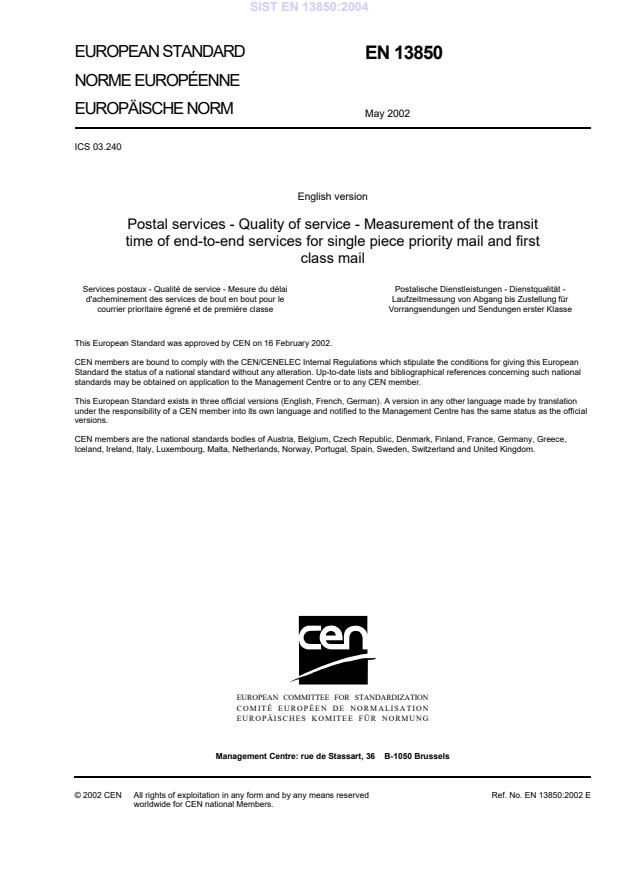
EUROPEAN STANDARDNORME EUROPÉENNEEUROPÄISCHE NORMEN 13850May 2002ICS 03.240English versionPostal services - Quality of service - Measurement of the transittime of end-to-end services for single piece priority mail and firstclass mailServices postaux - Qualité de service - Mesure du délaid'acheminement des services de bout en bout pour lecourrier prioritaire égrené et de première classePostalische Dienstleistungen - Dienstqualität -Laufzeitmessung von Abgang bis Zustellung fürVorrangsendungen und Sendungen erster KlasseThis European Standard was approved by CEN on 16 February 2002.CEN members are bound to comply with the CEN/CENELEC Internal Regulations which stipulate the conditions for giving this EuropeanStandard the status of a national standard without any alteration. Up-to-date lists and bibliographical references concerning such nationalstandards may be obtained on application to the Management Centre or to any CEN member.This European Standard exists in three official versions (English, French, German). A version in any other language made by translationunder the responsibility of a CEN member into its own language and notified to the Management Centre has the same status as the officialversions.CEN members are the national standards bodies of Austria, Belgium, Czech Republic, Denmark, Finland, France, Germany, Greece,Iceland, Ireland, Italy, Luxembourg, Malta, Netherlands, Norway, Portugal, Spain, Sweden, Switzerland and United Kingdom.EUROPEAN COMMITTEE FOR STANDARDIZATIONCOMITÉ EUROPÉEN DE NORMALISATIONEUROPÄISCHES KOMITEE FÜR NORMUNGManagement Centre: rue de Stassart, 36
B-1050 Brussels© 2002 CENAll rights of exploitation in any form and by any means reservedworldwide for CEN national Members.Ref. No. EN 13850:2002 ESIST EN 13850:2004
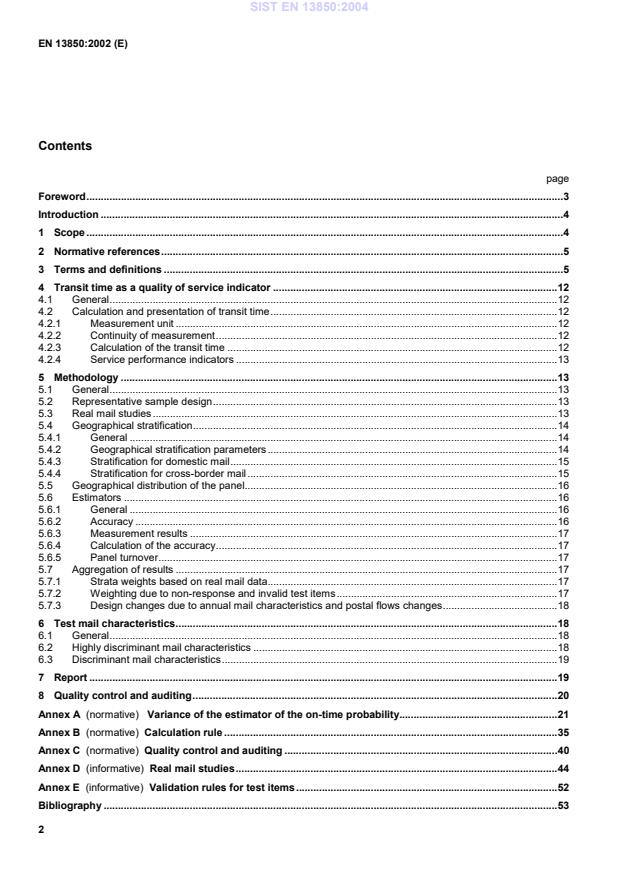
(normative)
Variance of the estimator of the on-time probability.21Annex B
(normative)
Calculation rule.35Annex C
(normative)
Quality control and auditing.40Annex D
(informative)
Real mail studies.44Annex E
(informative)
Validation rules for test items.52Bibliography.53SIST EN 13850:2004
The term accuracy, when applied to a set of test results, involves a combination of random components and acommon systematic error or bias component. [ISO 3534-1]NOTE 2
In this standard the accuracy is given by the length 2e of the confidence interval at the confidence level 95 % for theparameter being estimated, namely the probability of attaining the specification with respect to the transit time.3.2aggregationcompounding of primary data into an aggregate for the purpose of expressing them in a summary form3.3auditsystematic and independent examination to determine whether activities and related results comply with plannedarrangements and whether these arrangements are implemented effectively and are suitable to achieve objectives[EN ISO 9000]3.4average (arithmetic mean)sum of values divided by the number of values [ISO 3534-1]3.5bring servicemail collection or mail delivery service specifically contracted by the customerSIST EN 13850:2004
The characteristics may be either quantitative - by variables, or qualitative - by attributes [ISO 3534-1].NOTE 2
In this standard the population is postal test items and the characteristics are related to type of senders, type ofreceivers, times and types of induction or delivery, physical aspects of test items, franking, etc.3.8citygeographically defined area according to national classification systems3.9conformityfulfilment of specified requirements [EN ISO 9000]3.10corrective actionaction taken to eliminate the causes of an existing non-conformity, defect or other undesirable situation in order toprevent recurrence [EN ISO 9000]3.11correlationrelationship between two or several random variables within a distribution of two or more random variablesNOTE
Most statistical measures of correlation measure only the degree of linear relationship [ISO 3534-1].3.12correlation coefficientratio of the covariance of two random variables to the product of their standard deviations [ISO 3534-1]3.13countryterritory of a nation with its own government3.14cross-border mailmail distributed from one country to another country3.15customernatural or legal person having a business relation with a postal operator3.16date of deliverydate on which a postal item is delivered to the address or to the addressee3.17date of deposit (J)day on which a postal item is posted, provided posting takes place before the last collection of that dayNOTE 1
The term date of deposit is used in relation to quality of service measurement. The definition is based on the PostalDirective 97/67/EC.SIST EN 13850:2004
Last collection refers to the advertised last time for collection (not the actual time).3.18delivery pointphysical location at which delivery of postal items by a postal operator takes place and where they leave theoperator’s responsibility3.19design factorratio of the variance of the estimator in the given sample design by the variance of the estimator in an elementarysample design of the same size. The design factor is related to a given sample design and estimator3.20discriminant (characteristic)characteristic affecting the outcomeNOTE
In this standard a characteristic is discriminant when transit time differs according to the different modes of thecharacteristic.3.21distributionprocess from collecting mail at collecting points through sorting at the distribution centre to delivery of mail items tothe addressee3.22domestic mailmail items sent and received within one country3.23end-to-end (transit time)from the point mail is placed into the collection/acceptance system under the responsibility of the collecting postaloperator to the final delivery point under the responsibility of the delivering
postal operators3.24estimatevalue of an estimator obtained as a result of an estimation [ISO 3534-1]3.25estimatorstatistic used to estimate a population parameter
[ISO 3534-1]NOTE
In this European Standard, a function of the observed values of test item transit times allowing the estimation of theprobability of attaining the specification with respect to the transit time.3.26expectationfor a discrete random variable X taking the values xi, with the probabilities pi, the expectation if it exists, is:m = E(X) = Spi xithe sum being extended over all the values xi which can be taken by X [ISO 3534-1]3.27field of studytotal mail flow between defined postal areasNOTE 1
Field of study could be defined for example as:— Domestic – one operator in one countrySIST EN 13850:2004
operators in one country— Cross-border – one operator to one country— Cross-border – one operator to a group of countries— Cross-border – one country to one country— Cross-border – one country to a group of countriesNOTE 2
Some mail flows between postal operators may not meet the technical requirements in this standard to qualify asfields of study3.28frequencythe number of occurrences of a given type of event or the number of observations falling into a specified class[ISO 3534-1]3.29geographical coveragespread of postal services within a pre-defined geographical area3.30independent performance monitoring organisationbody charged with the monitoring of the QoS according to the methodology specified in this standard and whichbody is external to, and having no links of ownership or control with the postal service provider thus monitored3.31independencetwo random variables are independent if their distribution functions are related byF(x, y) = F(x, ) . F(y) = G(x) . H(y)where F(x, ) = G(x) and F( , y) =H(y) are the marginal distribution functions of X and Y, respectively for all pairs(x, y) [ISO 3534-1]3.32inductiondeposition of mail into the postal network3.33inspectionactivity such as measuring, examining, testing or gauging one or more characteristics of an entity and comparingthe results with specified requirements in order to establish whether conformity is achieved for each characteristic[EN ISO 9000 and ISO 3534-2]3.34metered mailmail franked by franking machines3.35national and regional holidayday with limited postal collection or delivery activities3.36observed valuevalue of a characteristic obtained as the result of a single observation [ISO 3534-1]SIST EN 13850:2004
fulfils the specification and otherwise 0i=X3.39on-time probabilityprobability of the event that the transit time Tof a mail item meets the specification s, i.e. does not exceed thespecified number s of days:()sT£Pr3.40performance indicatorexpression derived from postal transit time statistics and data used to characterise the performance of a postaloperator3.41postal catchment areapostal area served by a domestic sorting centre or by an office of exchange for cross border mail outbound orinbound. Catchment areas may be different for outbound and inbound mail, or for different fields of study3.42postal areaone of the parts into which a postal operator’s whole territory is divided and which is suitable for characterisingpostal delivery peculiarities3.43postal serviceservices involving the clearance, sorting, transport and delivery of postal items3.44priority item, first class item, A-class itemletter post item sent with priority by air or by surface and receiving different processing compared to items classifiedas non-priority3.45probability distributionfunction giving the probability that a random variable takes any given value or belongs to a given set of values [ISO3534-1]3.46qualitytotality of characteristics of an entity that bear on its ability to satisfy stated and implied needs [EN ISO 9000]3.47quality assuranceall the planned and systematic activities implemented within the quality system and demonstrated as needed, toprovide adequate confidence that an entity will fulfil requirements for quality [EN ISO 9000]SIST EN 13850:2004
Standards should be based on the consolidated results of science, technology and experience, and aimed at thepromotion of optimum community benefits [EN 45020].3.62stratificationdivision of a population into mutually exclusive and exhaustive subpopulations (called strata) which are thought tobe more homogeneous with respect to the characteristics investigated than the total population
[ISO 3534-1]3.63study domainsubpopulations for which separate results can be appropriateNOTE
Study domains could be defined for example by geographic segmentation or by product3.64test itempostal item produced in the test measurement system for the purpose of measuring real mail performances. Testitems shall be representative of real mail3.65test periodperiod of time under which measurement has been carried out and for which the results are presented in aseparate test report3.66time of deliverytime when a postal item is delivered at its delivery point3.67transit timenumber of days elapsed between induction and delivery of mail item as calculated in 4.2.33.68transit time distributiontransit time of a mail item is random and therefore it is modelled as a random variable; the set of probabilities of anyevent concerning the random variable transit time of a mail item forms its probability distribution3.69urbancities, including their outskirts, with not less than a specified number of inhabitants3.70variancemeasure of dispersion, which is the sum of the squared deviations of observations from their average divided byone less than the number of observations [ISO 3534-1]3.71weightvalue to compensate for the difference between the distribution of characteristics in the measurement systemcompared to real mailSIST EN 13850:2004
Postcode/zip code areas (key zones or key areas) may be used as a tool to define the distance.5.4.3 Stratification for domestic mailThe sample of test items shall be representative of the real mail for at least the following total strata:— urban - urban - distance I— urban - urban - distance II— urban - rural - distance I— urban - rural - distance II— rural - urban - distance I— rural - urban - distance II— rural - rural - distance I— rural - rural - distance II— local I total— local II totalEXAMPLE “Urban - urban - distance I” means: The total of the mail sent from all cities and their outskirts above 50 000inhabitants in the field of study to the total of all cities and their outskirts above 50 000 inhabitants in the field of study, withindistance I except local l.5.4.4 Stratification for cross-border mailFor each cross-border field of study the sample of test items shall be representative of the real mail for:— urban –
total outbound;— urban –
total inbound;— rural –
total outbound;— rural –
total inbound.where— total outbound is the total of the strata category outbound from a field of study;— total inbound is the total of the strata category inbound to a field of study.EXAMPLE If the field of study were one country, ‘total’ would mean total urban (or rural) in that country to or from all othercountries.Each cross-border field of study sample of test items shall be representative of the real mail postal catchment areasproportions.Within each field of study, the sample of test items shall be representative of the real mail domestic distance I anddistance II proportions, in relation to the distance from the posting / induction point to the outbound office ofexchange and from the inbound office of exchange to the final delivery point.By ‘inbound’ or ‘outbound’ is meant:— inbound: for inbound mail, the proportion of international mail going from the inbound office of exchange to thefinal delivery point, according to distance 1 and distance 2, shall be representative of the real inbound mailproportion. Besides, the spread of the test items over the field of study shall be representative of the spread ofthe real inbound mail over urban and rural areas;— outbound: for outbound mail, the proportion of international mail going from the posting/induction point to theoutbound office of exchange, according to distance 1 and distance 2, shall be representative of the realoutbound mail proportion. Besides, the spread of the test items over the field of study shall be representative ofthe spread of the real outbound mail over urban and rural areas.SIST EN 13850:2004
the true probability for attaining the specification with respect to the transit time fordomestic mail;— P2 be the estimator for p2
the true probability for attaining the specification with respect to the transit time forcross-border mail.5.6.2 AccuracyFor the estimation iˆP, i=1,2, the prescribed accuracy per year is given by the maximum length 2ei of theconfidence interval for pi, for a given confidence level (1 - a1).— for a domestic result, the confidence level is set to be 1 - a1= 95 %, and the maximum length of the confidenceinterval to 2e1 =0,02.
This means an accuracy level of ± 0,01.SIST EN 13850:2004
This means an accuracy level of ± 0,05.5.6.3 Measurement resultsThe domestic measurement system shall provide one annual result for the overall transit time quality of service forthe field of study.The cross-border measurement system shall provide one annual result for the overall transit time quality of servicefor the field of study.These results shall be estimates of the probability that the transit time of a randomly selected item has attained thespecifications.5.6.4 Calculation of the accuracyThe accuracy of the transit time shall be assessed by calculating the variance of the estimator and the designfactor. These calculations of the accuracy shall take into account as a minimum:— the number of points of induction and the number of receiving points;— the correlation of test itemsin accordance with annex A.5.6.5 Panel turnoverOn-time indicators of test items sent from the same panellist, that is test items sent from a small geographic area,are correlated with each other even if the test items are not sent within a short period of time. A turnover of thepanel is one way to increase the number of induction points or receiving points during the period of analysis andthus to decrease the impact of correlation on the variance of the estimator of on-time probability. This impactshould be balanced against economic factors and the importance of experienced and reliable panellists.Any mailbox induction point and receiving household address shall not be used for more than 4 consecutive years.The exact location of the active panel shall remain unknown to the postal operator. If panellists become known theyshall be excluded.5.7 Aggregation of results5.7.1 Strata weights based on real mail dataThe strata weights shall be determined based on real mail studies and shall contribute to the overall transit timeaccuracy.5.7.2 Weighting due to non-response and invalid test itemsThe correct proportions of test items for the geographical strata or for the highly discriminant mail characteristicsshall not be achieved, due to cases of non-response or invalid test items. Weighting shall be implemented tocorrect these according to the following procedure, after every possible weighting of the sample intended forrestoring the proportionality of the test mail flows with respect to the real mail flows:— geographical strata shall be weighted in reference to real mail information weights;— highly discriminant mail characteristics discrepancies shall be corrected through corrective weighting.Two constraints shall be taken into account for mail characteristics:a) The mail characteristic weights shall not vary more than between 0,25 and 4 around the average value;SIST EN 138
...
Questions, Comments and Discussion
Ask us and Technical Secretary will try to provide an answer. You can facilitate discussion about the standard in here.
Loading comments...