

EN 14070:2003+A1:2009
(Main)Safety of machine tools - Transfer and special-purpose machines
- Abstract
1.1 This standard specifies the technical safety requirements and protective measures to be adopted by persons undertaking the design, construction and supply (including information which must be provided for installation and dismantling, with arrangements for transport and maintenance) of transfer and special purpose machines (see 3.1). These machines are designed to process only a pre-specified metal or analogous material workpiece, or limited family of similar workpieces by means of a predetermined sequence of machining operations and process parameters.
1.2 This standard takes account of intended use, including reasonably foreseeable misuse, maintenance, cleaning, and setting operations. It specifies access arrangements to machining positions and manual load/unload stations (see 3.4). It presumes access to the machine from all directions. It describes means to reduce risks to operators and other exposed persons.
1.3 This standard also applies to transport devices for workpiece load/unload when they form an integral part of the machine.
1.4 This standard deals with significant hazards relevant to transfer and special purpose machines when they are used as intended and under the conditions foreseen by the manufacturer (see clause 4). The safety requirements and/or protective measures to prevent or minimise those hazards identified in Table 1 and procedures for verification of these requirements or measures are found in clause 5. Safety requirements and/or measures are not specified for: Fire and Explosion
1.5 Where machines employ processes which are covered by other standards (e.g. grinding, turning, forming, EDM, laser processing), the requirements of those standards should be applied (see Bibliography).
1.6 This standard applies to machines which are manufactured after publication of this standard by CEN.
- Status
- Withdrawn
- Publication Date
- 10-Feb-2009
- Withdrawal Date
- 29-Sep-2026
- Technical Committee
- CEN/TC 143 - Machine tools - Safety
- Drafting Committee
- CEN/TC 143/WG 4 - Machining centres, etc. - Safety
- Current Stage
- 9960 - Withdrawal effective - Withdrawal
- Start Date
- 04-Apr-2018
- Completion Date
- 30-Sep-2026
- Directive
- 2006/42/EC - Directive 2006/42/EC of the European Parliament and of the Council of 17 May 2006 on machinery, and amending Directive 95/16/EC (recast)OJ Ref: C, C 214 OJ Date: 08-Sep-2009


Relations
- Effective Date
- 19-Jan-2023
- Effective Date
- 11-Apr-2018
- Effective Date
- 25-Aug-2026
- Effective Date
- 18-Mar-2026
- Effective Date
- 09-Feb-2026
- Effective Date
- 09-Feb-2026
- Effective Date
- 09-Feb-2026
- Effective Date
- 09-Feb-2026
- Effective Date
- 09-Feb-2026
- Effective Date
- 09-Feb-2026
- Effective Date
- 28-Jan-2026
- Effective Date
- 28-Jan-2026
- Effective Date
- 28-Jan-2026
- Effective Date
- 28-Jan-2026
- Effective Date
- 28-Jan-2026
Get Certified
Connect with accredited certification bodies for this standard

DVS-ZERT GmbH
German welding certification society.
CARES (UK Certification Authority for Reinforcing Steels)
UK certification for reinforcing steels and construction.
EWF/IIW (European/International Welding Federation)
International welding personnel certification.
Sponsored listings
Frequently Asked Questions
EN 14070:2003+A1:2009 is a standard published by the European Committee for Standardization (CEN). Its full title is "Safety of machine tools - Transfer and special-purpose machines". This standard covers: 1.1 This standard specifies the technical safety requirements and protective measures to be adopted by persons undertaking the design, construction and supply (including information which must be provided for installation and dismantling, with arrangements for transport and maintenance) of transfer and special purpose machines (see 3.1). These machines are designed to process only a pre-specified metal or analogous material workpiece, or limited family of similar workpieces by means of a predetermined sequence of machining operations and process parameters. 1.2 This standard takes account of intended use, including reasonably foreseeable misuse, maintenance, cleaning, and setting operations. It specifies access arrangements to machining positions and manual load/unload stations (see 3.4). It presumes access to the machine from all directions. It describes means to reduce risks to operators and other exposed persons. 1.3 This standard also applies to transport devices for workpiece load/unload when they form an integral part of the machine. 1.4 This standard deals with significant hazards relevant to transfer and special purpose machines when they are used as intended and under the conditions foreseen by the manufacturer (see clause 4). The safety requirements and/or protective measures to prevent or minimise those hazards identified in Table 1 and procedures for verification of these requirements or measures are found in clause 5. Safety requirements and/or measures are not specified for: Fire and Explosion 1.5 Where machines employ processes which are covered by other standards (e.g. grinding, turning, forming, EDM, laser processing), the requirements of those standards should be applied (see Bibliography). 1.6 This standard applies to machines which are manufactured after publication of this standard by CEN.
1.1 This standard specifies the technical safety requirements and protective measures to be adopted by persons undertaking the design, construction and supply (including information which must be provided for installation and dismantling, with arrangements for transport and maintenance) of transfer and special purpose machines (see 3.1). These machines are designed to process only a pre-specified metal or analogous material workpiece, or limited family of similar workpieces by means of a predetermined sequence of machining operations and process parameters. 1.2 This standard takes account of intended use, including reasonably foreseeable misuse, maintenance, cleaning, and setting operations. It specifies access arrangements to machining positions and manual load/unload stations (see 3.4). It presumes access to the machine from all directions. It describes means to reduce risks to operators and other exposed persons. 1.3 This standard also applies to transport devices for workpiece load/unload when they form an integral part of the machine. 1.4 This standard deals with significant hazards relevant to transfer and special purpose machines when they are used as intended and under the conditions foreseen by the manufacturer (see clause 4). The safety requirements and/or protective measures to prevent or minimise those hazards identified in Table 1 and procedures for verification of these requirements or measures are found in clause 5. Safety requirements and/or measures are not specified for: Fire and Explosion 1.5 Where machines employ processes which are covered by other standards (e.g. grinding, turning, forming, EDM, laser processing), the requirements of those standards should be applied (see Bibliography). 1.6 This standard applies to machines which are manufactured after publication of this standard by CEN.
EN 14070:2003+A1:2009 is classified under the following ICS (International Classification for Standards) categories: 25.080.01 - Machine tools in general. The ICS classification helps identify the subject area and facilitates finding related standards.
EN 14070:2003+A1:2009 has the following relationships with other standards: It is inter standard links to EN 14070:2003, EN ISO 16090-1:2018, IEC 61496-2:2006, EN ISO 3744:2026, EN 60204-1:1997, EN 61310-3:2008, EN IEC 61000-6-4:2019, EN IEC 61496-1:2020, EN IEC 61000-6-2:2019, EN 60825-1:1994/A1:2002, EN ISO 9614-1:2009, EN ISO 3744:2010, EN 983:1996, EN ISO 13854:2019, EN 294:1992. Understanding these relationships helps ensure you are using the most current and applicable version of the standard.
EN 14070:2003+A1:2009 is associated with the following European legislation: EU Directives/Regulations: 2006/42/EC, 98/37/EC; Standardization Mandates: M/079, M/396. When a standard is cited in the Official Journal of the European Union, products manufactured in conformity with it benefit from a presumption of conformity with the essential requirements of the corresponding EU directive or regulation.
EN 14070:2003+A1:2009 is available in PDF format for immediate download after purchase. The document can be added to your cart and obtained through the secure checkout process. Digital delivery ensures instant access to the complete standard document.
Standards Content (Sample)
2003-01.Slovenski inštitut za standardizacijo. Razmnoževanje celote ali delov tega standarda ni dovoljeno.Varnost obdelovalnih strojev - Stroji za prenos in posebne nameneSicherheit von Werkzeugmaschinen - Transfer- und Einzweck- oder
SondermaschinenSécurité des machines-outils - Machines transfert et machines spécialesSafety of machine tools - Transfer and special-purpose machines25.080.01Stroji na splošnoMachine tools in generalICS:Ta slovenski standard je istoveten z:EN 14070:2003+A1:2009SIST EN 14070:2004+A1:2009en,fr,de01-maj-2009SIST EN 14070:2004+A1:2009SLOVENSKI
STANDARD
EUROPEAN STANDARD NORME EUROPÉENNE EUROPÄISCHE NORM
EN 14070:2003+A1
February 2009 ICS 25.080.01 Supersedes EN 14070:2003English Version
Safety of machine tools - Transfer and special-purpose machines
Sécurité des machines-outils - Machines transfert et machines spéciales
Sicherheit von Werkzeugmaschinen - Transfer- und Einzweck- oder
Sondermaschinen This European Standard was approved by CEN on 24 July 2003 and includes Amendment 1 approved by CEN on 29 December 2008.
CEN members are bound to comply with the CEN/CENELEC Internal Regulations which stipulate the conditions for giving this European Standard the status of a national standard without any alteration. Up-to-date lists and bibliographical references concerning such national standards may be obtained on application to the CEN Management Centre or to any CEN member.
This European Standard exists in three official versions (English, French, German). A version in any other language made by translation under the responsibility of a CEN member into its own language and notified to the CEN Management Centre has the same status as the official versions.
CEN members are the national standards bodies of Austria, Belgium, Bulgaria, Cyprus, Czech Republic, Denmark, Estonia, Finland, France, Germany, Greece, Hungary, Iceland, Ireland, Italy, Latvia, Lithuania, Luxembourg, Malta, Netherlands, Norway, Poland, Portugal, Romania, Slovakia, Slovenia, Spain, Sweden, Switzerland and United Kingdom.
EUROPEAN COMMITTEE FOR STANDARDIZATION
COMITÉ EUROPÉEN DE NORMALISATION EUROPÄISCHES KOMITEE FÜR NORMUNG
Management Centre:
Avenue Marnix 17,
B-1000 Brussels © 2009 CEN All rights of exploitation in any form and by any means reserved worldwide for CEN national Members. Ref. No. EN 14070:2003+A1:2009: ESIST EN 14070:2004+A1:2009
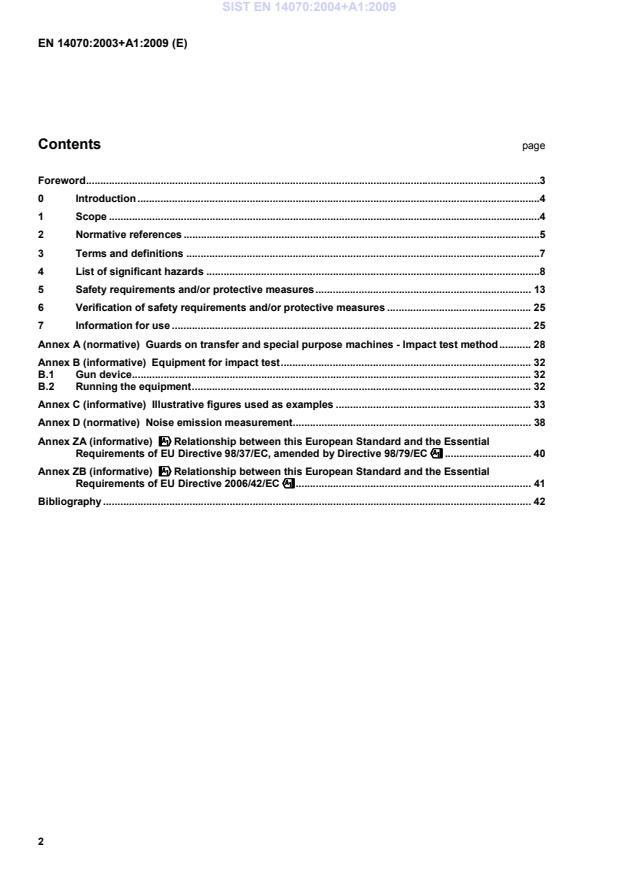
Guards on transfer and special purpose machines - Impact test method . 28 Annex B (informative)
Equipment for impact test . 32 B.1 Gun device . 32 B.2 Running the equipment . 32 Annex C (informative)
Illustrative figures used as examples . 33 Annex D (normative)
Noise emission measurement . 38 Annex ZA (informative)
!!!!Relationship between this European Standard and the Essential Requirements of EU Directive 98/37/EC, amended by Directive 98/79/EC"""" . 40 Annex ZB (informative)
!!!!Relationship between this European Standard and the Essential Requirements of EU Directive 2006/42/EC"""" . 41 Bibliography . 42
It presumes access to the machine from all directions.
It describes means to reduce risks to operators and other exposed persons. 1.3 This standard also applies to transport devices for workpiece load/unload when they form an integral part of the machine. 1.4 This standard deals with significant hazards relevant to transfer and special purpose machines when they are used as intended and under the conditions foreseen by the manufacturer (see clause 4).
The safety requirements and/or protective measures to prevent or minimise those hazards identified in Table 1 and procedures for verification of these requirements or measures are found in clause 5. Safety requirements and/or measures are not specified for: Fire and Explosion 1.5 Where machines employ processes which are covered by other standards (e.g. grinding, turning, forming, EDM, laser processing), the requirements of those standards should be applied (see Bibliography). 1.6 This standard applies to machines which are manufactured after publication of this standard by CEN. SIST EN 14070:2004+A1:2009
Additional terms and definitions specifically needed for this document are added below. 3.1 transfer and special purpose machines machine designed to process only a pre-specified workpiece or family of workpieces, by means of a pre-determined sequence of machining operations and process parameters (see Figures C.1 and C.2) NOTE These machines can include one or more of the following elements: station(s) incorporating unit(s) (see 3.4 and 3.5 below); transport system(s) for the workpiece; clamping devices; metal working fluid system(s); swarf/chip removal system(s); measurement and test systems. 3.2 work zone space within which the machine mechanisms are located and the process(es) are performed 3.3 machine working cycle period of time between the start of process on one workpiece and the start of process on the next workpiece after a transfer NOTE This is determined by the longest individual station time. 3.4 station term applied to the fixed positions within a machine at which workpieces are located during the processing portion of the machine working cycle NOTE Stations are normally identified by sequential numbering e.g.: Station 1
– Load station Station 2
– Machining station Station 3
– Gauging station Station 4
– Idle station Station XX – Unload station
The term station also covers the fixtures, units, heads and other mechanisms associated with the process performed at a particular station (see Figures C.3, C.4 and C.5). SIST EN 14070:2004+A1:2009
workpiece clamping loading/reorienting/ unloading between clamps and workpiece 1.2
transfer mechanism maintenance within pits 1.5
movement of
workpiece handling devices,
transfer mechanism or unit heads operating cycle of machine, process control,
manual tool change, maintenance at machine 1.1, 1.2 1.2 Shearing movement of axes,
workpiece handling devices or transfer mechanism operating cycle of machine, manual tool change,
maintenance at machine 1.1 to 1.1.5, 1.2, 1.3, 1.4 1.3 Cutting or severing spindle or tool running or cutting spindle running at spindle or tool 1.1 to 1.1.5 1.4 Entanglement rotating tools spindle running at spindle or tool 1.1 to 1.1.5 SIST EN 14070:2004+A1:2009
removal of swarf/chips power–operated swarf/chip removal swarf/chip collection and discharge zones 1.3 1.5 Drawing–in or trapping movement of workpiece handling, transfer mechanism or unit head power–operated motion of workpiece
or tool in spindle envelope of movement of workpiece or at unit head
1.1 to 1.1.5, 1.2, 1.3, 1.4
rotating power transmission mechanisms
maintenance in or around machine 1.4 1.6 Impact moving/rotating tool spindle running at spindle or tool 1.1 to 1.1.6.4
workpiece transfer
power-operated workpiece transfer envelope of motion of workpiece and workpiece transfer mechanisms 1.2 1.7 Stabbing or puncture moving tool (especially eccentric tools) process control at tool in spindle 1.1 to 1.1.6.4
handling tools during manual tool change or replenishing tool magazine at sharp cutter faces (see clause 7)
handling swarf/chips during loading/ unloading and cleaning at workpiece, table, and swarf /chip collecting and discharge zones (see clause 7) 1.9 High pressure fluid ejection Pipes or hoses carrying high pressure fluids machine operating,
maintenance at or near machine 13, 17 2 Electrical hazards due to: 2.1 Contact of persons with live parts (direct contact) contact with live parts or connections during commissioning, maintenance, trouble shooting electrical cabinet, terminal boxes, control panels at machine
2.2 Contact of persons with parts which have become live under faulty conditions (indirect contact) contact with live parts or connections during operation, inspection and maintenance of machine at machine or faulty part
3 Thermal hazards resulting in: 3.1 Burns or scalds by a possible contact of persons ejection of swarf
during cutting at or near machine 1.1.1, 1.1.2, 17 SIST EN 14070:2004+A1:2009
handling of hot work material during unloading at unload position 7.2.f
contact with hot tooling
during tool change,
process control,
maintenance at unit heads 7.2.f 4 Hazards generated by noise resulting in: 4.1 Hearing loss (deafness), other physiological disorders (e.g. loss of balance, loss of awareness) motion of power transmission elements, cutting processes and fluid power systems during operating cycle of machine near machine 4 4.2 Interference with speech communication, acoustical signals air blast used for cleaning of tool or fixture/pallet locations
during operating cycle of machine near machine 4 6 Hazards generated by radiation 6.5 Lasers direct or reflected visual exposure to laser radiation maintenance of laser positional feedback system within machine 6.5 7 Hazards generated by materials and substances (and their constituent elements) processed or used by the machinery 7.1 Hazards from contact with or inhalation of harmful fluids, gases, mists, fumes, and dusts conditions near machine caused by ejection of particles of work material, fluid droplets or mist from metal working fluids during operating cycle of the machine at or near machine 7.1 7.2 Fire or explosion flammable work material, flammable (low flash point) metal working fluids during operating cycle of the machine at or near machine 7.2 7.3 Biological or micro–biological (viral or bacterial) hazards contact with hydraulic or metal working fluid as liquid or mist containing detritus and bacteria during operation, process control, and maintenance at or near machine 7.3 SIST EN 14070:2004+A1:2009
e.g.
hazards from: 8.1 Unhealthy postures or excessive effort (repetitive strain)
lifting and reaching while handling workpiece, tooling or
machine parts during loading/ unloading, process control, and maintenance at load/unload and tool mounting positions, maintenance action points 8.1 8.2 Inadequate consideration of hand-arm or foot-leg anatomy inappropriate location of controls during loading/ unloading, process control, and maintenance at load/unload and tool mounting positions, maintenance action points 8.2 8.4 Inadequate local lighting judgement and accuracy of manual actions impaired during handling or positioning of workpiece or tooling during loading /unloading, process control,
handling of tooling at load/unload, tool mounting positions 8.4 8.6 Human errors, human behaviour reasonably foreseeable misuse, inadvertent operation of controls, incorrect work material or cutter handling/setting during loading/ unloading, process control, tool handling at load/unload, tool mounting positions 8.6 8.7 Inadequate design, location or identification of manual controls inadvertent
operation of controls during operating cycle of machine,
setting,
maintenance at or near machine 8.7 8.8 Inadequate design or location of visual display units misinterpretation of displayed information during operating cycle of machine, setting,
maintenance at or near machine 8.8 10 Unexpected start-up, unexpected overrun/ over speed (or any similar malfunction) from: 10.1 Failure/disorder of the control system mechanical hazards associated with selected machine movement during setting, cleaning
at machine 10.1 10.2 Restoration of energy supply after an interruption unexpected movements of machineduring setting, cleaning or maintenance at or near machine 10.2 10.3 External influences on the electrical equipment unpredictable behaviour of electronic controls due to electromagnetic interference during setting or operating cycle of the machine at or near machine 10.3 SIST EN 14070:2004+A1:2009
Power work holding fails, motor over speed. Part breakage causes machine elements to move under residual forces (inertia, gravity, spring/ energy storage means) causing external elements to move unexpectedly during operation, process control, maintenance at machine where machine elements retained in a safe condition by the application of power or fluid pressure. 13 14 Failure of the control circuit Unexpected movements of machine during setting, cleaning or maintenance at or near machine 14 15 Errors of fitting machine elements fail or move unexpectedly during process control, tool mounting, maintenance at machine 15 17 Falling or ejected objects or fluids ejection of machine parts, workpiece or tools caused by clamping device, control system failures or collision due to data errors during the operating cycle of the machine at or near machine 17 18 Loss of stability, overturning of machinery unrestrained machine or machine part (maintained in position by gravity), falls or overturns during loading/ unloading of heavy/unwieldy workpieces or
maintenance (disassembly/ relocation) at machine
18 19 Slip , trip, and fall of persons (related to machinery) ejection or spillage of metal working fluids and lubricants (also hydraulic fluid if used); work at heights during workpiece load/unload, setting, process control and maintenance work at heights work to replenish fluids (e.g. lubricants) machine table, floor area around machine and workpiece permanent means of access to the machine 19 a This list is derived from annex A of EN 1050:1996. SIST EN 14070:2004+A1:2009
5.1 General requirements Transfer and special purpose machines shall comply with the safety requirements and/or protective measures of this clause. In addition, the transfer and special purpose machines shall be designed according to the principles of EN 292 for hazards relevant but not significant which are not dealt with by this standard. 5.2 Specific requirements Table 2 — List of safety requirements and/or protective measures and their verification procedures NOTE The numbering of various provisions in this table is in accordance with Table 1 and hence missing numbers correspond to hazards which are not significant Hazards
Safety requirement and/or protective measure Verification 1 Mechanical 1.1 Work zone
1.1.1 Guarding strategy Fixed and/or interlocked movable guards shall enclose the work zone during the operating cycle of the machine (see Figure C.7). NOTE
General guidance for the design and selection of safeguards, where the hazards from moving parts cannot be avoided by design is given in 4.1, 4.2 and Table 1 of EN 292-2:1991. For the purposes of this clause,
1) all applications of protective equipment shall be in accordance with the following:electro sensitive protective equipment (ESPE) in accordance with EN 61496-1, active opto–electronic protective devices (AOPDs) in accordance with IEC 61496-2, type 4, pressure sensitive protective devices (PSPDs) in accordance with EN 1760-1. 2) Guards shall be in accordance with EN 953, and interlocking devices shall be in accordance with EN 1088. Visual inspection
1. 1. 2 Guard characteristics
1.1.2.1 Location and height
Where reasonably practicable, work zone guarding shall be fixed to the structure of the machine and prevent access to the hazard. Any opening between the bottom of the guard and the floor shall not exceed 300 mm with a corresponding distance to the hazard, (s), in accordance with Table A.1 of EN 811:1996. Where guards are floor mounted (e.g. perimeter fencing), they shall be securely fixed and have a minimum height of 1,4 m at a distance in accordance with Table 2 of EN 294:1992 from the hazard zone.
Measurements to ensure compliance with EN 294
1.1.2.2 Containment Guards shall be designed to contain and/or prevent exposure to swarf/chips, fluids and parts that can be discharged or ejected (see also 17.1 and 17.2 ejection, 7.1.4 fluids mists and 19.2 slip, trip and fall of persons). Practical check SIST EN 14070:2004+A1:2009
Safety requirement and/or protective measure Verification 1 Mechanical (continued) 1.1.2.3 Observation Where, during the operating cycle of the machine, observation of the machine process(es) is required, means (e.g. windows, mesh panels) shall be provided so that this can be achieved without the need to open, remove or suspend any work zone guard or other protective device(s) (see also 8.4 lighting, in this table).
If these measures are not practicable for maintenance and trouble-shooting activities, alternative safe systems of work (see 3.7.10 and 4.1.4 of EN 292–2:1991) shall be prescribed (see clause 7). Visual inspection
1.1.3 Interlocking
All guards through which frequent access to the work zone is required (i.e. more than once per shift) shall be interlocked and guard locking shall be provided (see 3.3 of EN 1088:1995) Measures to minimize the possible defeat of interlocking device(s) shall be taken (see clauses 5 and 7 of EN 1088:1995).
Visual inspection, practical check
1.1.4 Modes of operation
1.1.4.1 General The machine shall be provided with at least two basic modes of operation. These modes shall be: 1 Automatic (either single cycle or continuous cycle) and 2 Setting
Visual inspection, practical check
1.1.4.2 Mode selection Operating modes shall be selected by means of a key switch, access code or equally secure means at the main control console.
Where mode selection is also provided at individual unit control consoles, automatic operation shall only be permitted when all mode selection switches are set to automatic.
The machine shall be provided with a stop end of cycle control device. The actuation of this device shall cause the machine to stop at the end of the current cycle and further cycling shall be inhibited,
When the setting mode is selected at the main control console and the machine is in its working cycle, the cycle shall be interrupted and any further automatic operation shall be inhibited. When the setting mode is selected at any unit control while the machine is in its working cycle, the cycle of that unit shall be interrupted and the cycles of all other units shall stop at the end of the current machine cycle. Any further automatic operation shall be inhibited.
The interlocked guards shall remain locked. Subsequent access can be gained by activating human machine interface (HMI) or pushbutton as applicable to release the lock. A visual indicating device at the main control console shall be provided when setting mode has been selected and an interlocked work zone guard is open. Mode selection on the main control console shall be in accordance with 3.7.9 of EN 292-2:1991
Visual inspection,
practical check, examination of circuit diagrams
1.1.4.3 Requirements for automatic operation All moveable interlocked guards shall be closed and/or the protective devices shall be active to permit operation in automatic cycle.
Where multiple main control cycle start devices are provided only one shall be enabled at any time (See also 3.7.8 of EN 292–2:1991). An audible warning shall be provided prior to the start of automatic operation if the entire work zone is not visible from the start control location.
Visual inspection, practical check, examination of circuit diagrams SIST EN 14070:2004+A1:2009
Safety requirement and/or protective measure Verification 1 Mechanical (continued) 1.1.4.4 Setting Setting mode is a mode of operation in which adjustments for the subsequent machining process are performed by the operator. When any interlocked movable guard is open or a protective device is suspended, powered machine movements shall be inhibited except under the following conditions:
a) Axis movements at a maximum rate of 2 m/min. or a maximum increment of 10 mm. These movements shall be selected one axis at a time and may be initiated and maintained by one of the following means: – a hold-to-run control device;– manual data input (MDI) followed by cycle start together with an enabling device (see 9.2.5.8 of EN 60204-1:1997). (See also 3.7.10 of EN 292-2:1991) Measurement, practical check
b) If provided powered spindle speeds shall be limited by their stopping performance which shall not exceed 2 revolutions. Measurement
Spindle rotation shall only be initiated and maintained by one of the following means: – a hold-to-run control device at the unit control console or a hand held pendant; – a spindle start control device together with an enabling device. Release of an enabling device shall initiate a category 1 stop in accordance with 9.2.2 of EN 60204-1:1997. Practical check
c) The limits of speed or incremental distance [defined in a) and b) above] shall be monitored and if exceeded, the power to the drives shall be removed by a controlled stop (Category 1 - see 9.2.2 of EN 60204–1:1997). Examination of circuit diagrams, practical check
d) Means shall be provided to prevent hazardous movements of vertical or slant axes under gravity (e.g. brakes, counter balance). Practical check
e) Unguarded swarf/chip conveyor movements shall only be initiated and maintained by a hold-to-run control device. Visual inspection, examination of circuit diagrams
f) Where multiple hold-to-run control device locations are provided (e.g. main control console, unit control consoles, hand-held pendant), only one device shall be active at a time.
NOTE 1
Assessment of tool or workpiece position, e.g. by touching the workpiece with a probe or tool, and programme sequence checking, belong to the setting mode. NOTE 2
Movements can be restricted to a predetermined sequence of the machine operating cycle. Practical check SIST EN 14070:2004+A1:2009
Safety requirement and/or protective measure Verification 1 Mechanical (continued) 1.1.5 Release of trapped persons Means shall be provided for the movement of machine axes for emergency purposes (e.g. release of trapped persons). These means are for example: a) With power off: - manually operated relief valves to depressurise systems under pressure;
- manual release of power-actuated brakes provided that weight-balancing exists;
b) With power on: - manual control facilities of power-piloted valves/ drives; -
control facilities to start counter motions. (see also 7.2 m).
Visual inspection, verification against circuit diagrams, practical check
1.2 Workpiece handling mechanisms
1.2.1 The positions for operators at workpiece load/unload mechanisms shall be located outside the work zone and away from other hazardous machine movements. Visual inspection
1.2.2 Movement of power operated workpiece clamping shall be: – restricted to 4mm or less, or – protected by guards (e.g. control guard), and/or protective devices (e.g. electro-sensitive protective equipment), or – operated by a type III two-hand control device (see 9.2.5.7 of EN 60204–1:1997) Where a two-hand control device is provided, it shall be in accordance with 9.2.5.7 of EN 60204-1:1997. The two-hand control shall be at a safe distance from the hazardous movement (see EN 574 and EN 999). No hazardous movement shall arise from the actuation of any sensor or feedback device (see 10.1.4 EN 60204-1:1997 and 7.2 in this standard).
1.2.3 Access to hazardous movement(s) of workpiece handling mechanisms shall be prevented by means of fixed and/or interlocked movable guards, or hazardous movement(s) shall be either stopped or inhibited by the actuation of protective devices (e.g. electro-sensitive protective equipment, active opto–electronic protective devices (ESPE, AOPD). Visual inspection, practical check
1.2 4 Where access is required with the guards open or the protective devices suspended, powered motion shall only be initiated in the setting mode under the control of an enabling device together with a hold-to-run device to permit step-by-step movement. When continuous movement is required, a two-hand control device shall be provided. This device shall be in accordance with 9.2.5.7 Type 3 of EN 60204-1:1997. The two-hand control shall be at a safe distance from the hazardous movement (see EN 574 and EN 999). No hazardous movement shall arise from the actuation of any sensor or feedback device (see 10.1.4 of EN 60204-1:1997 and 7.2 in this standard). Examination of circuit diagrams, measurement, practical check
Safety requirement and/or protective measure Verification 1 Mechanical 1.3 Swarf /chip collection and removal
(continued) 1.3.1 Means shall be provided to enable the collection and removal of swarf/chips without the need to remove guards (e.g. fixture design to promote swarf/chip shedding, directed flows of metal working fluid). Visual inspection, practical check
1.3.2 Access to hazardous moving parts of swarf/chip collection and removal systems shall be prevented by means of fixed guards. Where operators have a need to access more frequently than once per shift, interlocked movable guards shall be provided. Guards shall be in accordance with EN 953 and EN 1088. Visual inspection, practical check
1.3.3 Opening an interlocked movable guard, which provides access to the hazardous moving parts of a swarf/chip system, shall cause a category 1 stop unless the risk allows a category 0 stop to be applied (see 9.2.2 of EN 60204–1:1997). Examination of circuit diagrams, practical check
1.3.4 If movement of a swarf/chip system with an interlocked movable guard open is essential (e.g. for cleaning purposes) the movement shall only be permitted under the control of a hold–to–run device with an adjacent emergency stop device. A warning sign shall indicate the hazardous area of the swarf/chip system discharge (see also 7.2 f). Examination of circuit diagrams, practical check
1.4 Power transmission mechanisms (e.g. drive shafts, belts, pulleys, chains, gears)
1.4.1 Access to hazardous power transmission parts (e g belts, chains, gears, pulleys, shafts) shall be prevented by means of fixed guards. Interlocked movable guards shall be provided where operators have a need to access more frequently than once per shift. Guard shall be in accordance with EN 953 and EN 1088. Visual inspection
1.4.2 Opening an interlocked movable guard, which exposes moving power transmission parts, shall cause a Category 1 stop in accordance with 9.2.2 of EN 60204-1:1997.
Interlocking provisions shall conform to EN 1088 (See also 14.1.1). Visual inspection
1.4.3 Where the hazardous moving parts can be reached before they come to rest, guard locking shall be applied to prevent opening of the guard until the hazardous movement has ceased. Delayed unlocking shall be achieved by means of a motion detector or timer control (see 7.2 and 7.3 of EN 1088:1995 and EN 999). Visual inspection
1.5 Pits
1.5.1 Pits in or around a machine shall be covered (e.g. floor grids) or secured against persons falling into them by guard rails (see EN ISO 14122–3) or similar forms of protection Visual inspection
1.5.2 Where access to pits is necessary for observation, maintenance, or adjustment purposes, entry into the pit shall be via interlocked access gates which prevent automatic cycle operation of the machine. Where powered machine movements are necessary, machine elements may be moved under the conditions set out in 1.1.4.4, and 1.3 of this table.
Visual inspection
1.5.3 Minimum gaps between moving machine elements and pit walls or other fixed parts shall be in accordance with EN 349. Where these minimum gaps cannot be achieved, additional protective measures shall be provided to minimise the risk of crushing or trapping. If impact hazards may also be present, the access to the moving parts of machinery shall be prevented. Measurement of distance, visual inspection, practical check
Safety requirement and/or protective measure Verification 2 Electrical 2.1 Direct contact To minimize the hazards of malfunction, shock or burn, all electrical equipment shall be designed and applied in accordance with EN 60204-1. Means shall be provided to isolate the machine from sources of electrical energy (see 5.3 of EN 60204-1:1997). Means of isolation shall be located at the main electrical enclosure in accordance with 6.2.2 (b) of EN 60204–1:1997.
All other enclosures shall be in accordance with 6.2.2(a) of EN 60204–1:1997.
All live parts shall be protected against direct contact to at least IP2X in accordance with 6.22(c) of EN 60204–1:1997. Verify compliance with the requirements in EN 60204-1:1997 and in particular clause 19.
2.2 Indirect contact (See 3.27 of EN 60204-1:1997 for definition) The requirements of 6.3 of EN 60204-1:1997 shall be followed. Verify compliance with the require–ments in EN 60204–1:1997 and in particular clause 19.
2.3 Protection of control gear Enclosures of control gear shall provide a degree of protection in accordance with 12.3 of EN 60204–1:1997. Control gear enclosures within the work zone shall have a degree of protection of at least IP 54.
Visual inspection 4 Hazards
4.1 Noise reduction methods
generated by noise 4.1.1 Control of noise at source When designing transfer and special purpose machines, the information and technical measures to control noise at source given in EN ISO 11688-1 and EN ISO 11688-2 shall be followed. The design shall take into account noise from each source. Appropriate technical measures for reducing noise at the main sound sources of the transfer and special purpose machines are listed below: a) transmission noise gearbox damping b) pneumatic exhaust silencers c) power generation source damping or absorber
By examination of noise declaration.
d) noise under cutting process e) cutting tool change f) workpiece change }damping or absorber inside the work zone enclosing guard
The above list is not exhaustive. Alternative technical measures for noise reduction with identical or greater efficiency may be used.
4.1.2 Control of transmission paths Where noise levels must be reduced beyond those achievable by design at source the machine shall be provided with protective measures (e.g.; noise enclosures, screens fitted to the machinery, silencers).
By examination of noise declaration
6 Radiation Hazard 6.5 Lasers Built–in laser feedback systems sh
...