

EN 1005-3:2002+A1:2008
(Main + Amendment)Safety of machinery - Human physical performance - Part 3: Recommended force limits for machinery operation
- Abstract
This European Standard presents guidance to the manufacturer of machinery or its component parts and the writer of C-standards in controlling health risks due to machine-related muscular force exertion.
This standard specifies recommended force limits for actions during machinery operation including construction, transport and commissioning (assembly, installation, adjustment), use (operation, cleaning, fault finding, maintenance, setting, teaching or process changeover) decommissioning, disposal and dismantling. The standard applies primarily to machines which are manufactured after the date of issue of the standard.
This standard applies on one hand to machinery for professional use operated by the adult working population, who are healthy workers with ordinary physical capacity, and on the other hand to machinery for domestic use operated by the whole population including youth and old people.
The recommendations are derived from research on European population.
This document is not applicable to specify the machinery which are manufactured before the date of publication of this document by CEN.
- Status
- Published
- Publication Date
- 30-Sep-2008
- Withdrawal Date
- 27-Dec-2009
- Technical Committee
- CEN/TC 122 - Ergonomics
- Drafting Committee
- CEN/TC 122/WG 4 - Biomechanics
- Current Stage
- 9093 - Decision to confirm - Review Enquiry
- Start Date
- 20-Sep-2022
- Completion Date
- 14-Oct-2026
- Directive
- 2006/42/EC - Directive 2006/42/EC of the European Parliament and of the Council of 17 May 2006 on machinery, and amending Directive 95/16/EC (recast)OJ Ref: C, C 214 OJ Date: 08-Sep-2009
98/37/EC - MachineryOJ Ref: C, C 74 OJ Date: 28-Mar-2009

Overview
EN 1005-3:2002+A1:2008 - Safety of machinery: Human physical performance - Part 3 - provides manufacturers and standards writers with guidance and recommended force limits for machinery operation. The standard covers machine-related muscular force exertion across the machine life cycle (construction, transport, commissioning, use, cleaning, fault‑finding, maintenance, setting/teaching/process changeover, decommissioning, disposal and dismantling). It is intended primarily for machines manufactured after the date of issue and is derived from research on the European population.
Key topics and requirements
- Risk-based approach to action forces: A three-step risk assessment procedure:
- Step A - determine maximal isometric force capacity (FB) for intended users (three alternative methods, including pre-calculated values where available).
- Step B - apply multipliers to account for operational conditions (velocity, frequency, duration) to estimate sustainable force.
- Step C - evaluate tolerability and assign risk levels using additional risk multipliers.
- Recommended force limits: Limits are set relative to population percentiles:
- For professional machinery aimed at adult workers with ordinary physical capacity: use around the 15th percentile of the adult population.
- For domestic machinery used by the whole population (including youth and elderly): use around the 1st percentile.
- Ergonomic design expectations: Machines should enable optimal posture, appropriate direction of force application, variation in movements and allow operators to control sequence and pace of tasks.
- Scope constraints: Focuses on musculo‑skeletal health risks (fatigue, discomfort, disorders), not accident risk. Not applicable to machines manufactured before the standard’s publication.
- Informative annexes: Annex A and B contain calculation procedures for alternative methods; Annexes ZA/ZB relate the standard to EU Machinery Directives.
Practical applications
- Use EN 1005-3 to:
- Specify actuator forces, handles, levers, and manual interfaces to reduce musculo‑skeletal load.
- Perform ergonomic risk assessments during design and documentation of machinery.
- Define user instructions and maintenance procedures that limit required exertion.
- Support conformity assessments and harmonisation with the EU Machinery Directive (e.g., 2006/42/EC).
- Typical contexts: industrial machinery design, consumer/domestic product design, maintenance planning, ergonomics consultancy and C-standard development.
Who should use this standard
- Machinery manufacturers and component designers
- Ergonomists and occupational health professionals
- Standards writers and conformity assessors
- Safety engineers responsible for human-machine interaction, manual controls and maintenance procedures
Related standards
- EN 1005-1:2001 (terms and definitions)
- EN 614-1 (ergonomic design principles)
- EN 1070 (safety of machinery - terminology)
- EN 894-3 (controls/actuators) - complementary for control actuator design
Keywords: EN 1005-3:2002+A1:2008, safety of machinery, force limits, ergonomics, risk assessment, musculo‑skeletal, machinery operation, manufacturer guidance.
Relations
- Effective Date
- 18-Jan-2023
- Effective Date
- 28-Jan-2026
- Refers
EN 1005-1:2001 - Safety of machinery - Human physical performance - Part 1: Terms and definitions - Effective Date
- 28-Jan-2026
- Effective Date
- 01-Jul-2026
- Effective Date
- 28-Jan-2026
- Effective Date
- 28-Jan-2026
- Effective Date
- 28-Jan-2026
- Effective Date
- 28-Jan-2026
- Effective Date
- 28-Jan-2026
- Effective Date
- 28-Jan-2026
- Effective Date
- 28-Jan-2026
- Effective Date
- 28-Jan-2026
- Referred By
EN 12331:2015 - Food processing machinery - Mincing machines - Safety and hygiene requirements - Effective Date
- 28-Jan-2026
- Effective Date
- 28-Jan-2026
- Referred By
EN 15861:2012 - Food processing machinery - Smokehouses - Safety and hygiene requirements - Effective Date
- 28-Jan-2026
Get Certified
Connect with accredited certification bodies for this standard

CIS Institut d.o.o.
Personal Protective Equipment (PPE) certification body. Notified Body NB-2890 for EU Regulation 2016/425 PPE.

Kiwa BDA Testing
Building and construction product certification.
Kmetijski inštitut Slovenije
Agricultural Institute of Slovenia. Soil testing, plant health, agricultural product analysis.
Sponsored listings
Frequently Asked Questions
EN 1005-3:2002+A1:2008 is a standard published by the European Committee for Standardization (CEN). Its full title is "Safety of machinery - Human physical performance - Part 3: Recommended force limits for machinery operation". This standard covers: This European Standard presents guidance to the manufacturer of machinery or its component parts and the writer of C-standards in controlling health risks due to machine-related muscular force exertion. This standard specifies recommended force limits for actions during machinery operation including construction, transport and commissioning (assembly, installation, adjustment), use (operation, cleaning, fault finding, maintenance, setting, teaching or process changeover) decommissioning, disposal and dismantling. The standard applies primarily to machines which are manufactured after the date of issue of the standard. This standard applies on one hand to machinery for professional use operated by the adult working population, who are healthy workers with ordinary physical capacity, and on the other hand to machinery for domestic use operated by the whole population including youth and old people. The recommendations are derived from research on European population. This document is not applicable to specify the machinery which are manufactured before the date of publication of this document by CEN.
This European Standard presents guidance to the manufacturer of machinery or its component parts and the writer of C-standards in controlling health risks due to machine-related muscular force exertion. This standard specifies recommended force limits for actions during machinery operation including construction, transport and commissioning (assembly, installation, adjustment), use (operation, cleaning, fault finding, maintenance, setting, teaching or process changeover) decommissioning, disposal and dismantling. The standard applies primarily to machines which are manufactured after the date of issue of the standard. This standard applies on one hand to machinery for professional use operated by the adult working population, who are healthy workers with ordinary physical capacity, and on the other hand to machinery for domestic use operated by the whole population including youth and old people. The recommendations are derived from research on European population. This document is not applicable to specify the machinery which are manufactured before the date of publication of this document by CEN.
EN 1005-3:2002+A1:2008 is classified under the following ICS (International Classification for Standards) categories: 13.110 - Safety of machinery; 13.180 - Ergonomics. The ICS classification helps identify the subject area and facilitates finding related standards.
EN 1005-3:2002+A1:2008 has the following relationships with other standards: It is inter standard links to EN 1005-3:2002, EN 614-1:2006+A1:2009, EN 1005-1:2001, EN ISO 6909:2026, EN 12855:2003+A1:2010, EN 12622:2009, EN 14010:2003+A1:2009, EN 940:2009+A1:2012, EN 13885:2005+A1:2010, EN 1870-19:2013, EN 1009-1:2020, EN 1870-14:2007+A2:2012, EN 12331:2015, EN 13852-1:2004, EN 15861:2012. Understanding these relationships helps ensure you are using the most current and applicable version of the standard.
EN 1005-3:2002+A1:2008 is associated with the following European legislation: EU Directives/Regulations: 2006/42/EC, 98/37/EC; Standardization Mandates: M/079, M/396. When a standard is cited in the Official Journal of the European Union, products manufactured in conformity with it benefit from a presumption of conformity with the essential requirements of the corresponding EU directive or regulation.
EN 1005-3:2002+A1:2008 is available in PDF format for immediate download after purchase. The document can be added to your cart and obtained through the secure checkout process. Digital delivery ensures instant access to the complete standard document.
Standards Content (Sample)
2003-01.Slovenski inštitut za standardizacijo. Razmnoževanje celote ali delov tega standarda ni dovoljeno.Sicherheit von Maschinen - Menschliche körperliche Leistung - Teil 3: Empfohlene Kraftgrenzen bei MaschinenbetätigungSécurité des machines - Performance physique humaine - Partie 3: Limites des forces recommandées pour l'utilisation de machinesSafety of machinery - Human physical performance - Part 3: Recommended force limits for machinery operation13.180ErgonomijaErgonomics13.110Varnost strojevSafety of machineryICS:Ta slovenski standard je istoveten z:EN 1005-3:2002+A1:2008SIST EN 1005-3:2002+A1:2008en,fr,de01-december-2008SIST EN 1005-3:2002+A1:2008SLOVENSKI
STANDARD
EUROPEAN STANDARD NORME EUROPÉENNE EUROPÄISCHE NORM
EN 1005-3:2002+A1
October 2008 ICS 13.110; 13.180 Supersedes EN 1005-3:2002 English Version
Safety of machinery - Human physical performance - Part 3: Recommended force limits for machinery operation
Sécurité des machines - Performance physique humaine - Partie 3: Limites des forces recommandées pour l'utilisation de machines
Sicherheit von Maschinen - Menschliche körperliche Leistung - Teil 3: Empfohlene Kraftgrenzen bei Maschinenbetätigung This European Standard was approved by CEN on 8 November 2001 and includes Amendment 1 approved by CEN on 18 August 2008.
CEN members are bound to comply with the CEN/CENELEC Internal Regulations which stipulate the conditions for giving this European Standard the status of a national standard without any alteration. Up-to-date lists and bibliographical references concerning such national standards may be obtained on application to the CEN Management Centre or to any CEN member.
This European Standard exists in three official versions (English, French, German). A version in any other language made by translation under the responsibility of a CEN member into its own language and notified to the CEN Management Centre has the same status as the official versions.
CEN members are the national standards bodies of Austria, Belgium, Bulgaria, Cyprus, Czech Republic, Denmark, Estonia, Finland, France, Germany, Greece, Hungary, Iceland, Ireland, Italy, Latvia, Lithuania, Luxembourg, Malta, Netherlands, Norway, Poland, Portugal, Romania, Slovakia, Slovenia, Spain, Sweden, Switzerland and United Kingdom.
EUROPEAN COMMITTEE FOR STANDARDIZATION
COMITÉ EUROPÉEN DE NORMALISATION EUROPÄISCHES KOMITEE FÜR NORMUNG
Management Centre: rue de Stassart, 36
B-1050 Brussels © 2008 CEN All rights of exploitation in any form and by any means reserved worldwide for CEN national Members. Ref. No. EN 1005-3:2002+A1:2008: ESIST EN 1005-3:2002+A1:2008
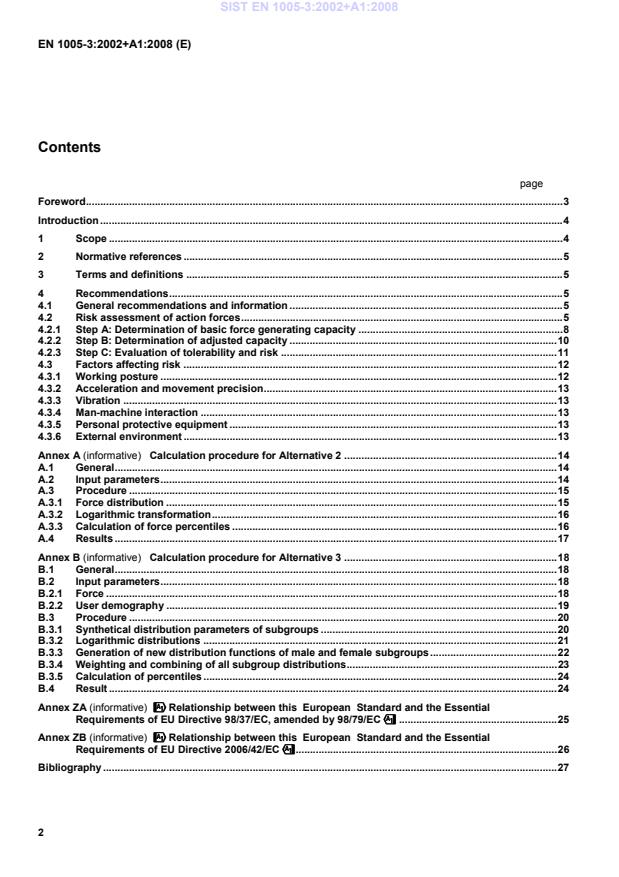
Calculation procedure for Alternative 2.14 A.1 General.14 A.2 Input parameters.14 A.3 Procedure.15 A.3.1 Force distribution.15 A.3.2 Logarithmic transformation.16 A.3.3 Calculation of force percentiles.16 A.4 Results.17 Annex B (informative)
Calculation procedure for Alternative 3.18 B.1 General.18 B.2 Input parameters.18 B.2.1 Force.18 B.2.2 User demography.19 B.3 Procedure.20 B.3.1 Synthetical distribution parameters of subgroups.20 B.3.2 Logarithmic distributions.21 B.3.3 Generation of new distribution functions of male and female subgroups.22 B.3.4 Weighting and combining of all subgroup distributions.23 B.3.5 Calculation of percentiles.24 B.4 Result.24 Annex ZA (informative)
!!!!Relationship between this
European
Standard and the Essential Requirements of EU Directive 98/37/EC, amended by 98/79/EC"""".25 Annex ZB (informative)
!!!!Relationship between this
European
Standard and the Essential Requirements of EU Directive 2006/42/EC"""".26 Bibliography.27
1) This European Standard is under preparation by CEN/TC 122/WG 4 "Biomechanics". SIST EN 1005-3:2002+A1:2008
Figure 1 — Illustration of the step procedure leading to risk evaluation of action forces during machinery use for specified intended user populations SIST EN 1005-3:2002+A1:2008
Alternative 2 Calculating FB by an easy procedure as described in annex A. Alternative 2 is a rough approximation assuming equal representation of males and females and may be applied: if the intended user population is similar to the general European population, or if a specific demographic profile of the intended user population is not available. Alternative 2 refers to strength data of the general female population.
Activity
Professional use FB in N Domestic use FB in N
Hand work (one hand): Power grip
Arm work (sitting posture, one arm): - upwards - downwards - outwards - inwards - pushing - with trunk support - without trunk support - pulling - with trunk support - without trunk support
50 75 55 75
275 62
225 55
31 44 31 49
186 30
169 28
Whole body work (standing posture): - pushing - pulling
200 145
119 96
Pedal work (sitting posture, with trunk support): - ankle action - leg action
250 475
154 308 SIST EN 1005-3:2002+A1:2008
...