

EN IEC 61000-6-2:2019
(Main)Electromagnetic compatibility (EMC) - Part 6-2: Generic standards - Immunity standard for industrial environments
General Information
- Abstract
applies to electrical and electronic apparatus intended for use in industrial environments, as described below. Immunity requirements in the frequency range 0 Hz to 400 GHz are covered. No tests need to be performed at frequencies where no requirements are specified. This generic EMC immunity standard is applicable if no relevant dedicated product or product-family EMC immunity standard exists. This standard applies to apparatus intended to be connected to a power network supplied from a high or medium voltage transformer dedicated to the supply of an installation feeding manufacturing or similar plant, and intended to operate in or in proximity to industrial locations, as described below. This standard applies also to apparatus which is battery operated and intended to be used in industrial locations. The environments encompassed by this standard are industrial, both indoor and outdoor. The immunity requirements have been selected to ensure an adequate level of immunity for apparatus at industrial locations. The levels do not, however, cover extreme cases, which may occur at any location, but with an extremely low probability of occurrence. Not all disturbance phenomena have been included for testing purposes in this standard, but only those considered as relevant for the equipment covered by this standard. These test requirements represent essential electromagnetic compatibility immunity requirements.
- Status
- Published
- Publication Date
- 21-Feb-2019
- Withdrawal Date
- 21-Feb-2022
- Technical Committee
- CLC/TC 210 - Electromagnetic Compatibility (EMC)
- Drafting Committee
- IEC/TC 77 - IEC_TC_77
- Current Stage
- 6060 - Document made available - Publishing
- Start Date
- 22-Feb-2019
- Completion Date
- 22-Feb-2019


Overview
EN IEC 61000-6-2:2019 (published by CLC) is the generic EMC immunity standard for industrial environments. It specifies immunity test requirements for electrical and electronic apparatus intended for industrial locations (indoor and outdoor) where no product-specific EMC immunity standard exists. The standard covers the frequency range 0 Hz to 400 GHz and addresses continuous and transient, conducted and radiated disturbances to ensure an adequate level of electromagnetic compatibility (EMC) for industrial equipment.
Key topics and technical requirements
- Scope and applicability: Applies to apparatus intended for connection to industrial power networks (including networks supplied from high/medium voltage transformers), DC distribution, and battery-operated equipment used in industrial locations. Used when no dedicated product-family standard is available.
- Immunity test coverage: Defines essential immunity tests including electrostatic discharge (ESD), radiated RF fields, electrical fast transients (EFT), surge, conducted RF disturbances, power-frequency magnetic fields, and voltage dips/interruptions. Tests reference the IEC 61000-4-x series.
- Ports and test levels: Test requirements are organized by equipment port type (enclosure, signal/control, DC/AC power ports) with defined applicability and performance criteria per port.
- Performance criteria and conditions: Includes criteria for acceptable operation during/after disturbances and specifies test conditions, measurement uncertainty considerations and documentation requirements.
- Technical updates: The 2019 (edition 3) revision improves environmental description, extends RF test frequency range, revises test levels, introduces requirements per IEC 61000-4-34, adjusts EFT repetition frequency, and adds guidance for product committees (Annex A).
Practical applications and users
- Manufacturers and design engineers of industrial equipment use this standard to:
- Define immunity requirements when no product-specific standard exists.
- Guide EMC design, component selection and system hardening for industrial use.
- Prepare for laboratory and on-site immunity testing and pre‑compliance validation.
- EMC test laboratories and certification bodies use it to develop test plans and assess conformity for industrial apparatus.
- System integrators, maintenance teams and procurement specialists reference the standard to ensure equipment robustness in manufacturing plants, process control, robotics, power distribution and other industrial installations.
Related standards
This standard is used together with the IEC/EN 61000-4 series for test methods, including but not limited to:
- IEC 61000-4-2 (ESD), 4-3 (radiated RF), 4-4 (EFT), 4-5 (surge), 4-6 (conducted RF)
- IEC 61000-4-8 (power-frequency magnetic field), 4-11 and 4-34 (voltage dips/interruptions)
- IEC 61000-4-20/21/22 (TEM/reverberation/anechoic chamber methods)
EN IEC 61000-6-2:2019 is essential reading for anyone responsible for ensuring electromagnetic immunity of equipment intended for industrial environments.
Relations
- Effective Date
- 07-Jul-2015
- Effective Date
- 09-Feb-2026
- Effective Date
- 03-Feb-2026
- Effective Date
- 03-Feb-2026
- Effective Date
- 03-Feb-2026
- Effective Date
- 03-Feb-2026
- Effective Date
- 03-Feb-2026
- Effective Date
- 03-Feb-2026
- Effective Date
- 03-Feb-2026
- Effective Date
- 03-Feb-2026
- Effective Date
- 03-Feb-2026
- Effective Date
- 03-Feb-2026
- Effective Date
- 03-Feb-2026
- Effective Date
- 03-Feb-2026
- Effective Date
- 03-Feb-2026
Get Certified
Connect with accredited certification bodies for this standard

ANCE
Mexican certification and testing association.

Intertek Slovenia
Intertek testing, inspection, and certification services in Slovenia.

LNE (Laboratoire National de Métrologie et d'Essais)
French national laboratory for metrology and testing.
Sponsored listings
Frequently Asked Questions
EN IEC 61000-6-2:2019 is a standard published by CLC. Its full title is "Electromagnetic compatibility (EMC) - Part 6-2: Generic standards - Immunity standard for industrial environments". This standard covers: applies to electrical and electronic apparatus intended for use in industrial environments, as described below. Immunity requirements in the frequency range 0 Hz to 400 GHz are covered. No tests need to be performed at frequencies where no requirements are specified. This generic EMC immunity standard is applicable if no relevant dedicated product or product-family EMC immunity standard exists. This standard applies to apparatus intended to be connected to a power network supplied from a high or medium voltage transformer dedicated to the supply of an installation feeding manufacturing or similar plant, and intended to operate in or in proximity to industrial locations, as described below. This standard applies also to apparatus which is battery operated and intended to be used in industrial locations. The environments encompassed by this standard are industrial, both indoor and outdoor. The immunity requirements have been selected to ensure an adequate level of immunity for apparatus at industrial locations. The levels do not, however, cover extreme cases, which may occur at any location, but with an extremely low probability of occurrence. Not all disturbance phenomena have been included for testing purposes in this standard, but only those considered as relevant for the equipment covered by this standard. These test requirements represent essential electromagnetic compatibility immunity requirements.
applies to electrical and electronic apparatus intended for use in industrial environments, as described below. Immunity requirements in the frequency range 0 Hz to 400 GHz are covered. No tests need to be performed at frequencies where no requirements are specified. This generic EMC immunity standard is applicable if no relevant dedicated product or product-family EMC immunity standard exists. This standard applies to apparatus intended to be connected to a power network supplied from a high or medium voltage transformer dedicated to the supply of an installation feeding manufacturing or similar plant, and intended to operate in or in proximity to industrial locations, as described below. This standard applies also to apparatus which is battery operated and intended to be used in industrial locations. The environments encompassed by this standard are industrial, both indoor and outdoor. The immunity requirements have been selected to ensure an adequate level of immunity for apparatus at industrial locations. The levels do not, however, cover extreme cases, which may occur at any location, but with an extremely low probability of occurrence. Not all disturbance phenomena have been included for testing purposes in this standard, but only those considered as relevant for the equipment covered by this standard. These test requirements represent essential electromagnetic compatibility immunity requirements.
EN IEC 61000-6-2:2019 is classified under the following ICS (International Classification for Standards) categories: 33.100.20 - Immunity. The ICS classification helps identify the subject area and facilitates finding related standards.
EN IEC 61000-6-2:2019 has the following relationships with other standards: It is inter standard links to EN 61000-6-2:2005, EN 13589:2003, EN 61000-4-3:2006, EN 61000-4-34:2007, EN 61000-4-6:2014, EN 61000-4-21:2011, EN 61000-4-8:2010, EN 61000-4-20:2010, EN 61000-4-3:2006/A2:2010, EN 61000-4-11:2004, EN 61000-4-5:2014, EN 61000-4-34:2007/A1:2009, EN 61000-4-2:2009, EN 61000-4-4:2012, EN 61000-4-3:2006/A1:2008. Understanding these relationships helps ensure you are using the most current and applicable version of the standard.
EN IEC 61000-6-2:2019 is associated with the following European legislation: EU Directives/Regulations: 1999/5/EC, 2004/108/EC, 2004/108/EU, 2014/30/EU, 2014/53/EU; Standardization Mandates: M/404, M/490, M/536, M/552. When a standard is cited in the Official Journal of the European Union, products manufactured in conformity with it benefit from a presumption of conformity with the essential requirements of the corresponding EU directive or regulation.
EN IEC 61000-6-2:2019 is available in PDF format for immediate download after purchase. The document can be added to your cart and obtained through the secure checkout process. Digital delivery ensures instant access to the complete standard document.
Standards Content (Sample)
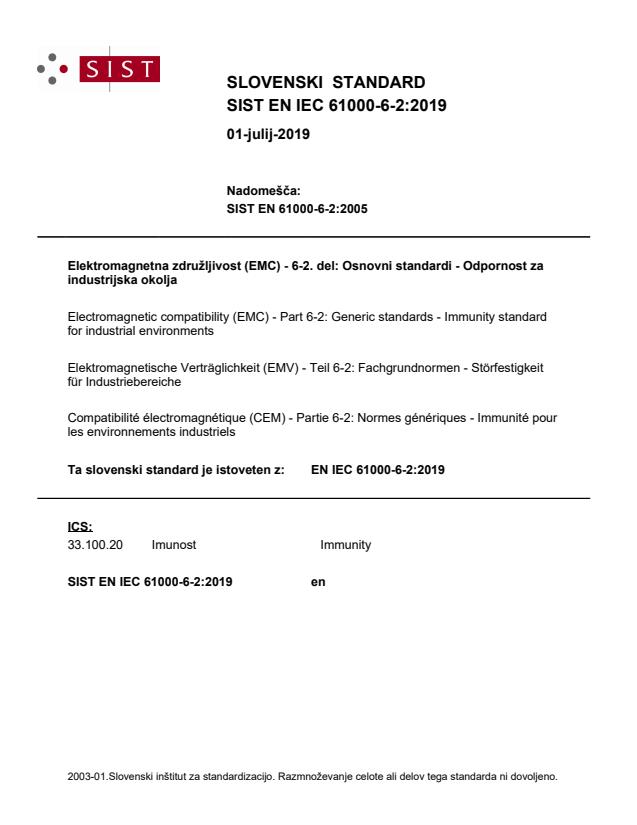
SLOVENSKI STANDARD
01-julij-2019
Nadomešča:
SIST EN 61000-6-2:2005
Elektromagnetna združljivost (EMC) - 6-2. del: Osnovni standardi - Odpornost za
industrijska okolja
Electromagnetic compatibility (EMC) - Part 6-2: Generic standards - Immunity standard
for industrial environments
Elektromagnetische Verträglichkeit (EMV) - Teil 6-2: Fachgrundnormen - Störfestigkeit
für Industriebereiche
Compatibilité électromagnétique (CEM) - Partie 6-2: Normes génériques - Immunité pour
les environnements industriels
Ta slovenski standard je istoveten z: EN IEC 61000-6-2:2019
ICS:
33.100.20 Imunost Immunity
2003-01.Slovenski inštitut za standardizacijo. Razmnoževanje celote ali delov tega standarda ni dovoljeno.
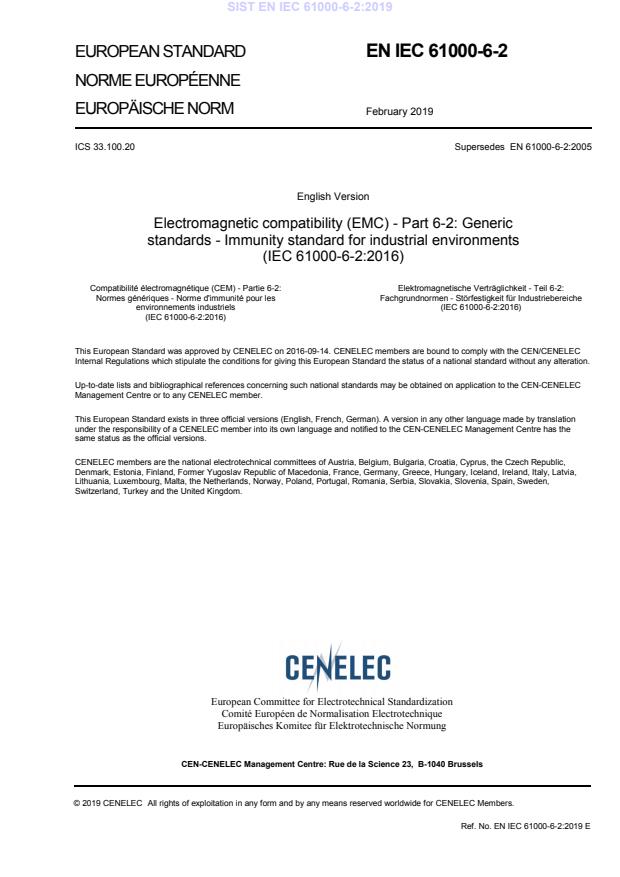
EUROPEAN STANDARD EN IEC 61000-6-2
NORME EUROPÉENNE
EUROPÄISCHE NORM
February 2019
ICS 33.100.20 Supersedes EN 61000-6-2:2005
English Version
Electromagnetic compatibility (EMC) - Part 6-2: Generic
standards - Immunity standard for industrial environments
(IEC 61000-6-2:2016)
Compatibilité électromagnétique (CEM) - Partie 6-2: Elektromagnetische Verträglichkeit - Teil 6-2:
Normes génériques - Norme d'immunité pour les Fachgrundnormen - Störfestigkeit für Industriebereiche
environnements industriels (IEC 61000-6-2:2016)
(IEC 61000-6-2:2016)
This European Standard was approved by CENELEC on 2016-09-14. CENELEC members are bound to comply with the CEN/CENELEC
Internal Regulations which stipulate the conditions for giving this European Standard the status of a national standard without any alteration.
Up-to-date lists and bibliographical references concerning such national standards may be obtained on application to the CEN-CENELEC
Management Centre or to any CENELEC member.
This European Standard exists in three official versions (English, French, German). A version in any other language made by translation
under the responsibility of a CENELEC member into its own language and notified to the CEN-CENELEC Management Centre has the
same status as the official versions.
CENELEC members are the national electrotechnical committees of Austria, Belgium, Bulgaria, Croatia, Cyprus, the Czech Republic,
Denmark, Estonia, Finland, Former Yugoslav Republic of Macedonia, France, Germany, Greece, Hungary, Iceland, Ireland, Italy, Latvia,
Lithuania, Luxembourg, Malta, the Netherlands, Norway, Poland, Portugal, Romania, Serbia, Slovakia, Slovenia, Spain, Sweden,
Switzerland, Turkey and the United Kingdom.
European Committee for Electrotechnical Standardization
Comité Européen de Normalisation Electrotechnique
Europäisches Komitee für Elektrotechnische Normung
CEN-CENELEC Management Centre: Rue de la Science 23, B-1040 Brussels
© 2019 CENELEC All rights of exploitation in any form and by any means reserved worldwide for CENELEC Members.
Ref. No. EN IEC 61000-6-2:2019 E
European foreword
The text of document 77/521/FDIS, future edition 3 of IEC 61000-6-2, prepared by IEC/TC 77
"Electromagnetic compatibility" was submitted to the IEC-CENELEC parallel vote and approved by
CENELEC as EN IEC 61000-6-2:2019.
The following dates are fixed:
• latest date by which the document has to be implemented at national (dop) 2019-08-22
level by publication of an identical national standard or by endorsement
• latest date by which the national standards conflicting with the (dow) 2022-02-22
document have to be withdrawn
This document supersedes EN 61000-6-2:2005.
Attention is drawn to the possibility that some of the elements of this document may be the subject of
patent rights. CENELEC shall not be held responsible for identifying any or all such patent rights.
This document has been prepared under a mandate given to CENELEC by the European
Commission and the European Free Trade Association, and supports essential requirements of EU
Directive(s).
For the relationship with EU Directive(s) see informative Annex ZZ, which is an integral part of this
document.
Endorsement notice
The text of the International Standard IEC 61000-6-2:2016 was approved by CENELEC as a
European Standard without any modification.
In the official version, for Bibliography, the following notes have to be added for the standards
indicated:
IEC 61000-4-12 NOTE Harmonized as EN 61000-4-12
IEC 61000-4-13 NOTE Harmonized as EN 61000-4-13
IEC 61000-4-16 NOTE Harmonized as EN 61000-4-16
IEC 61000-4-18 NOTE Harmonized as EN 61000-4-18
IEC 61000-4-19 NOTE Harmonized as EN 61000-4-19
IEC 61000-4-29 NOTE Harmonized as EN 61000-4-29
IEC 61000-4-31 NOTE Harmonized as EN 61000-4-31
CISPR 11:2009 NOTE Harmonized as EN 55011:2009 (modified).
Annex ZA
(normative)
Normative references to international publications
with their corresponding European publications
The following documents are referred to in the text in such a way that some or all of their content
constitutes requirements of this document. For dated references, only the edition cited applies. For
undated references, the latest edition of the referenced document (including any amendments)
applies.
NOTE 1 Where an International Publication has been modified by common modifications, indicated by (mod), the relevant
EN/HD applies.
NOTE 2 Up-to-date information on the latest versions of the European Standards listed in this annex is available here:
www.cenelec.eu.
Publication Year Title EN/HD Year
IEC 60050-161 - International Electrotechnical Vocabulary. - -
Chapter 161: Electromagnetic compatibility
IEC 61000-4-2 2008 Electromagnetic compatibility (EMC) - PartE N 61000-4-2 2009
4-2: Testing and measurement techniques
- Electrostatic discharge immunity test
IEC 61000-4-3 2006 Electromagnetic compatibility (EMC) - PartE N 61000-4-3 2006
4-3 : Testing and measurement techniques
- Radiated, radio-frequency,
electromagnetic field immunity test
+ A1 2007 + A1 2008
+ A2 2010 + A2 2010
IEC 61000-4-4 2012 Electromagnetic compatibility (EMC) - PartE N 61000-4-4 2012
4-4: Testing and measurement techniques
- Electrical fast transient/burst immunity
test
IEC 61000-4-5 2014 Electromagnetic compatibility (EMC) - PartE N 61000-4-5 2014
4-5: Testing and measurement techniques
- Surge immunity test
IEC 61000-4-6 2013 Electromagnetic compatibility (EMC) - PartE N 61000-4-6 2014
4-6: Testing and measurement techniques
- Immunity to conducted disturbances,
induced by radio-frequency fields
IEC 61000-4-8 2009 Electromagnetic compatibility (EMC) - PartE N 61000-4-8 2010
4-8: Testing and measurement techniques
- Power frequency magnetic field immunity
test
IEC 61000-4-11 2004 Electromagnetic compatibility (EMC) - PartE N 61000-4-11 2004
4-11: Testing and measurement
techniques - Voltage dips, short
interruptions and voltage variations
immunity tests
Publication Year Title EN/HD Year
IEC 61000-4-20 2010 Electromagnetic compatibility (EMC) - PartE N 61000-4-20 2010
4-20: Testing and measurement
techniques - Emission and immunity
testing in transverse electromagnetic
(TEM) waveguides
IEC 61000-4-21 2011 Electromagnetic compatibility (EMC) - PartEN 61000-4-21 2011
4-21: Testing and measurement
techniques - Reverberation chamber test
methods
IEC 61000-4-22 2010 Electromagnetic compatibility (EMC) - PartE N 61000-4-22 2011
4-22: Testing and measurement
techniques - Radiated emissions and
immunity measurements in fully anechoic
rooms (FARs)
IEC 61000-4-34 2005 Electromagnetic compatibility (EMC) - PartE N 61000-4-34 2007
4-34: Testing and measurement
techniques - Voltage dips, short
interruptions and voltage variations
immunity tests for equipment with input
current more than 16 A per phase
+ A1 2009 + A1 2009
IEC 61000-6-2 ®
Edition 3.0 2016-08
INTERNATIONAL
STANDARD
NORME
INTERNATIONALE
Electromagnetic compatibility (EMC) –
Part 6-2: Generic standards – Immunity standard for industrial environments
Compatibilité électromagnétique (CEM) –
Partie 6-2: Normes génériques – Norme d'immunité pour les environnements
industriels
INTERNATIONAL
ELECTROTECHNICAL
COMMISSION
COMMISSION
ELECTROTECHNIQUE
INTERNATIONALE
ICS 33.100.20 ISBN 978-2-8322-3566-9
– 2 – IEC 61000-6-2:2016 © IEC 2016
CONTENTS
FOREWORD . 3
INTRODUCTION . 5
1 Scope . 6
2 Normative references. 6
3 Terms and definitions . 7
4 Performance criteria . 9
5 Conditions during testing . 9
6 Product documentation . 10
7 Applicability . 10
8 Measurement uncertainty . 10
9 Immunity test requirements . 10
Annex A (informative) Guidance for product committees . 16
Bibliography . 18
Figure 1 – Equipment ports . 8
Table 1 – Immunity requirements – Enclosure ports . 12
Table 2 – Immunity requirements – Signal/control ports . 13
Table 3 – Immunity requirements – Input and output DC power ports . 14
Table 4 – Immunity requirements – Input and output AC power ports . 15
Table A.1 – Immunity tests and test levels to be considered in future or for particular
product families . 17
IEC 61000-6-2:2016 © IEC 2016 – 3 –
INTERNATIONAL ELECTROTECHNICAL COMMISSION
____________
ELECTROMAGNETIC COMPATIBILITY (EMC) –
Part 6-2: Generic standards –
Immunity standard for industrial environments
FOREWORD
1) The International Electrotechnical Commission (IEC) is a worldwide organization for standardization comprising
all national electrotechnical committees (IEC National Committees). The object of IEC is to promote
international co-operation on all questions concerning standardization in the electrical and electronic fields. To
this end and in addition to other activities, IEC publishes International Standards, Technical Specifications,
Technical Reports, Publicly Available Specifications (PAS) and Guides (hereafter referred to as “IEC
Publication(s)”). Their preparation is entrusted to technical committees; any IEC National Committee interested
in the subject dealt with may participate in this preparatory work. International, governmental and non-
governmental organizations liaising with the IEC also participate in this preparation. IEC collaborates closely
with the International Organization for Standardization (ISO) in accordance with conditions determined by
agreement between the two organizations.
2) The formal decisions or agreements of IEC on technical matters express, as nearly as possible, an international
consensus of opinion on the relevant subjects since each technical committee has representation from all
interested IEC National Committees.
3) IEC Publications have the form of recommendations for international use and are accepted by IEC National
Committees in that sense. While all reasonable efforts are made to ensure that the technical content of IEC
Publications is accurate, IEC cannot be held responsible for the way in which they are used or for any
misinterpretation by any end user.
4) In order to promote international uniformity, IEC National Committees undertake to apply IEC Publications
transparently to the maximum extent possible in their national and regional publications. Any divergence
between any IEC Publication and the corresponding national or regional publication shall be clearly indicated in
the latter.
5) IEC itself does not provide any attestation of conformity. Independent certification bodies provide conformity
assessment services and, in some areas, access to IEC marks of conformity. IEC is not responsible for any
services carried out by independent certification bodies.
6) All users should ensure that they have the latest edition of this publication.
7) No liability shall attach to IEC or its directors, employees, servants or agents including individual experts and
members of its technical committees and IEC National Committees for any personal injury, property damage or
other damage of any nature whatsoever, whether direct or indirect, or for costs (including legal fees) and
expenses arising out of the publication, use of, or reliance upon, this IEC Publication or any other IEC
Publications.
8) Attention is drawn to the Normative references cited in this publication. Use of the referenced publications is
indispensable for the correct application of this publication.
9) Attention is drawn to the possibility that some of the elements of this IEC Publication may be the subject of
patent rights. IEC shall not be held responsible for identifying any or all such patent rights.
International Standard IEC 61000-6-2 has been prepared by IEC technical committee 77:
Electromagnetic compatibility.
This third edition cancels and replaces the second edition published in 2005. This edition
constitutes a technical revision.
This edition includes the following significant technical changes with respect to the previous
edition:
a) improvement of the environmental description;
b) extension of the frequency range for the radio-frequency electromagnetic field test
according to IEC 61000-4-3;
c) amended test levels at particular frequencies for the radio-frequency electromagnetic field
test according to IEC 61000-4-3;
– 4 – IEC 61000-6-2:2016 © IEC 2016
d) change of the repetition frequency for the fast transients immunity test according to
IEC 61000-4-4;
e) introduction of requirements according to IEC 61000-4-34;
f) revision of the test levels;
g) consideration of measurement uncertainty;
h) addition of Annex A.
The text of this standard is based on the following documents:
FDIS Report on voting
77/521/FDIS 77/523/RVD
Full information on the voting for the approval of this standard can be found in the report on
voting indicated in the above table.
This publication has been drafted in accordance with the ISO/IEC Directives, Part 2.
A list of all parts in the IEC 61000 series, published under the general title Electromagnetic
compatibility (EMC), can be found on the IEC website.
The committee has decided that the contents of this publication will remain unchanged until
the stability date indicated on the IEC website under "http://webstore.iec.ch" in the data
related to the specific publication. At this date, the publication will be
• reconfirmed,
• withdrawn,
• replaced by a revised edition, or
• amended.
IEC 61000-6-2:2016 © IEC 2016 – 5 –
INTRODUCTION
IEC 61000 is published in separate parts according to the following structure:
Part 1: General
General considerations (introduction, fundamental principles)
Definitions, terminology
Part 2: Environment
Description of the environment
Classification of the environment
Compatibility levels
Part 3: Limits
Emission limits
Immunity limits (insofar as these limits do not fall under the responsibility of the product
committees)
Part 4: Testing and measurement techniques
Measurement techniques
Testing techniques
Part 5: Installation and mitigation guidelines
Installation guidelines
Mitigation methods and devices
Part 6: Generic standards
Part 9: Miscellaneous
Each part is further subdivided into several parts, published either as International Standards
or as Technical Specifications or Technical Reports, some of which have already been
published as sections. Others will be published with the part number followed by a dash and a
second number identifying the subdivision (example: IEC 61000-6-1).
– 6 – IEC 61000-6-2:2016 © IEC 2016
ELECTROMAGNETIC COMPATIBILITY (EMC) –
Part 6-2: Generic standards –
Immunity standard for industrial environments
1 Scope
This part of IEC 61000 for EMC immunity requirements applies to electrical and electronic
equipment intended for use in industrial locations, as described below. Immunity requirements
in the frequency range 0 Hz to 400 GHz are covered. No tests need to be performed at
frequencies where no requirements are specified.
This generic EMC immunity standard is applicable if no relevant dedicated product or product-
family EMC immunity standard exists.
This standard applies to electrical and electronic equipment intended to be operated in
industrial locations, as defined in 3.7, both indoor and outdoor.
This standard applies also to equipment intended to be directly connected to a DC distribution
network or which is battery operated, and intended to be used in industrial locations.
This standard defines the immunity test requirements for equipment specified in the scope in
relation to continuous and transient, conducted and radiated disturbances, including
electrostatic discharges.
The immunity requirements have been selected to ensure an adequate level of immunity for
equipment operating within industrial locations. The levels do not, however, cover extreme
cases, which may occur at any location, but with an extremely low probability of occurrence.
Not all disturbance phenomena have been included for testing purposes in this standard, but
only those considered as relevant for the equipment covered by this standard. These test
requirements represent essential electromagnetic compatibility immunity requirements. They
are specified for each port considered.
NOTE 1 Information on other disturbance phenomena is given in IEC TR 61000-4-1.
NOTE 2 Safety considerations are not covered by this standard.
NOTE 3 In special cases, situations will arise where the level of disturbances may exceed the levels specified in
this standard, for example where equipment is installed in proximity to industrial, scientific and medical equipment
as defined in CISPR 11 or where a hand-held transmitter is used in close proximity to equipment. In these
instances, special mitigation measures may have to be employed.
The industrial environment may be changed by special mitigation measures. Where such
measures can be shown to produce an electromagnetic environment equivalent to the
residential, commercial or light-industrial environment, then the generic standard for this
environment, or the relevant product standard, may be applied.
2 Normative references
The following documents, in whole or in part, are normatively referenced in this document and
are indispensable for its application. For dated references, only the edition cited applies. For
undated references, the latest edition of the referenced document (including any
amendments) applies.
IEC 61000-6-2:2016 © IEC 2016 – 7 –
IEC 60050-161, International Electrotechnical Vocabulary – Part 161: Electromagnetic
compatibility (available at: www.electropedia.org)
IEC 61000-4-2:2008, Electromagnetic compatibility (EMC) – Part 4-2: Testing and
measurement techniques – Electrostatic discharge immunity test
IEC 61000-4-3:2006, Electromagnetic compatibility (EMC) – Part 4-3: Testing and
measurement techniques – Radiated, radio-frequency, electromagnetic field immunity test
IEC 61000-4-3:2006/AMD1:2007
IEC 61000-4-3:2006/AMD2:2010
IEC 61000-4-4:2012, Electromagnetic compatibility (EMC) – Part 4-4: Testing and
measurement techniques – Electrical fast transient/burst immunity test
IEC 61000-4-5:2014, Electromagnetic compatibility (EMC) – Part 4-5: Testing and
measurement techniques – Surge immunity test
IEC 61000-4-6:2013, Electromagnetic compatibility (EMC) – Part 4-6: Testing and
measurement techniques – Immunity to conducted disturbances, induced by radio-frequency
fields
IEC 61000-4-8:2009, Electromagnetic compatibility (EMC) – Part 4-8: Testing and
measurement techniques – Power frequency magnetic field immunity test
IEC 61000-4-11:2004, Electromagnetic compatibility (EMC) – Part 4-11: Testing and
measurement techniques – Voltage dips, short interruptions and voltage variations immunity
tests
IEC 61000-4-20:2010, Electromagnetic compatibility (EMC) – Part 4-20: Testing and
measurement techniques – Emission and immunity testing in transverse electromagnetic
(TEM) waveguides
IEC 61000-4-21:2011, Electromagnetic compatibility (EMC) – Part 4-21: Testing and
measurement techniques – Reverberation chamber test methods
IEC 61000-4-22:2010, Electromagnetic compatibility (EMC) – Part 4-22: Testing and
measurement techniques – Radiated emissions and immunity measurements in fully anechoic
rooms (FARs)
IEC 61000-4-34:2005, Electromagnetic compatibility (EMC) – Part 4-34: Testing and
measurement techniques – Voltage dips, short interruptions and voltage variations immunity
tests for equipment with mains current more than 16 A per phase
IEC 61000-4-34:2005/AMD1:2009
3 Terms and definitions
For the purposes of this document, the terms and definitions given in IEC 60050-161 as well
as the following apply.
NOTE Additional definitions
...