

CEN/TR 17603-40-01:2022
(Main)Space engineering - Agile software development handbook
- Abstract
This Handbook provides recommendations for the implementation of an Agile approach in space software projects complying with EN 16603-40 (based on ECSS-E-ST-40) and EN 16602-80 (based on ECSS-Q-ST-80).
This handbook is not an Agile development book, though it provides an Agile reference model based on Scrum and also covers other major Agile methods and techniques. Scrum has been selected as reference because of its widespread application in industry and its flexibility as a development framework to introduce or merge with other Agile methods and techniques. In relation to the EN 16603-40 and EN 16602-80, this handbook does not provide any tailoring of their requirements due to the use of the Agile approach, but demonstrates how compliance towards ECSS can be achieved. This handbook does not cover contractual aspects for this particular engineering approach, although it recognises that considering the approach of fixing cost and schedule and making the scope of functionalities variable, the customer and supplier need to establish specific contractual arrangements. Furthermore, it does not impose a particular finality for the use of Agile, either as a set of team values, project management process, specific techniques or supporting exploration by prototypes.
- Status
- Published
- Publication Date
- 07-Jun-2022
- Technical Committee
- CEN/CLC/TC 5 - Space
- Drafting Committee
- CEN/CLC/TC 5/WG 6 - Upstream standards
- Current Stage
- 6060 - Definitive text made available (DAV) - Publishing
- Start Date
- 08-Jun-2022
- Due Date
- 29-Jun-2022
- Completion Date
- 08-Jun-2022



Overview
CEN/TR 17603-40-01:2022 - Space engineering: Agile software development handbook is a technical report published by CEN in 2022 that gives practical recommendations for applying an Agile approach in space software projects. It is explicitly intended to help teams comply with EN 16603-40 (based on ECSS‑E‑ST‑40) and EN 16602-80 (based on ECSS‑Q‑ST‑80) while using Agile methods. The handbook uses Scrum as a reference model (because of its industrial prevalence) and also covers other Agile techniques and Lean concepts. It does not re‑tailor ECSS requirements nor address contractual models; instead it shows how ECSS compliance can be achieved within Agile lifecycles.
Key topics and technical focus
The handbook provides structured guidance across the full software lifecycle, including:
- Agile introduction and selection - characteristics of Agile, Lean thinking, and decision factors for choosing Agile vs. plan‑driven lifecycles (customer, supplier, project, team contexts).
- Reference Scrum‑like lifecycle models - roles (Scrum Master, Product Owner, Dev Team, Agile Coach), sprint structure, backlog management, planning, reviews and retrospectives.
- Mapping to ECSS/EN requirements - tables and guidance that map ECSS‑E‑ST‑40 and ECSS‑Q‑ST‑80 requirements to Agile activities (requirements, architecture, design, verification, validation, delivery).
- Project management - Agile scheduling, risk management, monitoring & control, staffing, continuous integration and metrics (burn‑down, value delivered).
- Engineering processes - requirements engineering, architectural design, coding, testing, validation, acceptance, operations and maintenance adapted for Agile.
- Product assurance & configuration management - planning assurance activities, managing technical debt and non‑conformances, and Agile approaches for configuration control and release baselines.
- Independent verification & validation (IV&V) - integration of independent review activities within Agile iterations.
(See the handbook’s tables and figures for exemplars, lifecycle models and selection matrices.)
Practical applications and users
This handbook is aimed at practitioners and organizations implementing Agile in regulated space projects:
- Space software engineers and development teams adopting Scrum or other Agile methods
- Project managers and systems engineers responsible for ECSS/EN compliance
- Quality, product assurance and configuration management specialists in space programs
- Suppliers and prime contractors designing an Agile lifecycle that meets ECSS reviews
Use cases include choosing an Agile lifecycle, tailoring sprint cadence to ECSS milestones, mapping ECSS verification and validation activities to iterative releases, and defining product assurance & configuration processes for continuous delivery.
Related standards
- EN 16603-40 (based on ECSS‑E‑ST‑40) - software engineering requirements
- EN 16602-80 (based on ECSS‑Q‑ST‑80) - software product assurance
- CEN/TR 17603-40-01:2022 provides implementation guidance to meet those standards while using Agile methods.
Get Certified
Connect with accredited certification bodies for this standard

BSI Group
BSI (British Standards Institution) is the business standards company that helps organizations make excellence a habit.

BUREAU VERITAS Certification Germany
Bureau Veritas certification in Germany.

Element Materials Technology
Materials testing and product certification.
Sponsored listings
Frequently Asked Questions
CEN/TR 17603-40-01:2022 is a technical report published by the European Committee for Standardization (CEN). Its full title is "Space engineering - Agile software development handbook". This standard covers: This Handbook provides recommendations for the implementation of an Agile approach in space software projects complying with EN 16603-40 (based on ECSS-E-ST-40) and EN 16602-80 (based on ECSS-Q-ST-80). This handbook is not an Agile development book, though it provides an Agile reference model based on Scrum and also covers other major Agile methods and techniques. Scrum has been selected as reference because of its widespread application in industry and its flexibility as a development framework to introduce or merge with other Agile methods and techniques. In relation to the EN 16603-40 and EN 16602-80, this handbook does not provide any tailoring of their requirements due to the use of the Agile approach, but demonstrates how compliance towards ECSS can be achieved. This handbook does not cover contractual aspects for this particular engineering approach, although it recognises that considering the approach of fixing cost and schedule and making the scope of functionalities variable, the customer and supplier need to establish specific contractual arrangements. Furthermore, it does not impose a particular finality for the use of Agile, either as a set of team values, project management process, specific techniques or supporting exploration by prototypes.
This Handbook provides recommendations for the implementation of an Agile approach in space software projects complying with EN 16603-40 (based on ECSS-E-ST-40) and EN 16602-80 (based on ECSS-Q-ST-80). This handbook is not an Agile development book, though it provides an Agile reference model based on Scrum and also covers other major Agile methods and techniques. Scrum has been selected as reference because of its widespread application in industry and its flexibility as a development framework to introduce or merge with other Agile methods and techniques. In relation to the EN 16603-40 and EN 16602-80, this handbook does not provide any tailoring of their requirements due to the use of the Agile approach, but demonstrates how compliance towards ECSS can be achieved. This handbook does not cover contractual aspects for this particular engineering approach, although it recognises that considering the approach of fixing cost and schedule and making the scope of functionalities variable, the customer and supplier need to establish specific contractual arrangements. Furthermore, it does not impose a particular finality for the use of Agile, either as a set of team values, project management process, specific techniques or supporting exploration by prototypes.
CEN/TR 17603-40-01:2022 is classified under the following ICS (International Classification for Standards) categories: 35.080 - Software; 49.140 - Space systems and operations. The ICS classification helps identify the subject area and facilitates finding related standards.
CEN/TR 17603-40-01:2022 is available in PDF format for immediate download after purchase. The document can be added to your cart and obtained through the secure checkout process. Digital delivery ensures instant access to the complete standard document.
Standards Content (Sample)
SLOVENSKI STANDARD
01-september-2022
Vesoljska tehnika - Priročnik o spreminjajočem se razvoju programske opreme
Space engineering - Agile software development handbook
Raumfahrttechnik - Handbuch zur agilen Softwareentwicklung
Ingénierie spatiale - Guide de développement logiciel en mode agile
Ta slovenski standard je istoveten z: CEN/TR 17603-40-01:2022
ICS:
35.080 Programska oprema Software
49.140 Vesoljski sistemi in operacije Space systems and
operations
2003-01.Slovenski inštitut za standardizacijo. Razmnoževanje celote ali delov tega standarda ni dovoljeno.
TECHNICAL REPORT CEN/TR 17603-40-01
RAPPORT TECHNIQUE
TECHNISCHER BERICHT
June 2022
ICS 49.140; 35.080
English version
Space engineering - Agile software development handbook
Ingénierie spatiale - Guide de développement logiciel Raumfahrttechnik - Handbuch zur agilen
en mode agile Softwareentwicklung
This Technical Report was approved by CEN on 20 April 2022. It has been drawn up by the Technical Committee CEN/CLC/JTC 5.
CEN and CENELEC members are the national standards bodies and national electrotechnical committees of Austria, Belgium,
Bulgaria, Croatia, Cyprus, Czech Republic, Denmark, Estonia, Finland, France, Germany, Greece, Hungary, Iceland, Ireland, Italy,
Latvia, Lithuania, Luxembourg, Malta, Netherlands, Norway, Poland, Portugal, Republic of North Macedonia, Romania, Serbia,
Slovakia, Slovenia, Spain, Sweden, Switzerland, Turkey and United Kingdom.
CEN-CENELEC Management Centre:
Rue de la Science 23, B-1040 Brussels
© 2022 CEN/CENELEC All rights of exploitation in any form and by any means
Ref. No. CEN/TR 17603-40-01:2022 E
reserved worldwide for CEN national Members and for
CENELEC Members.
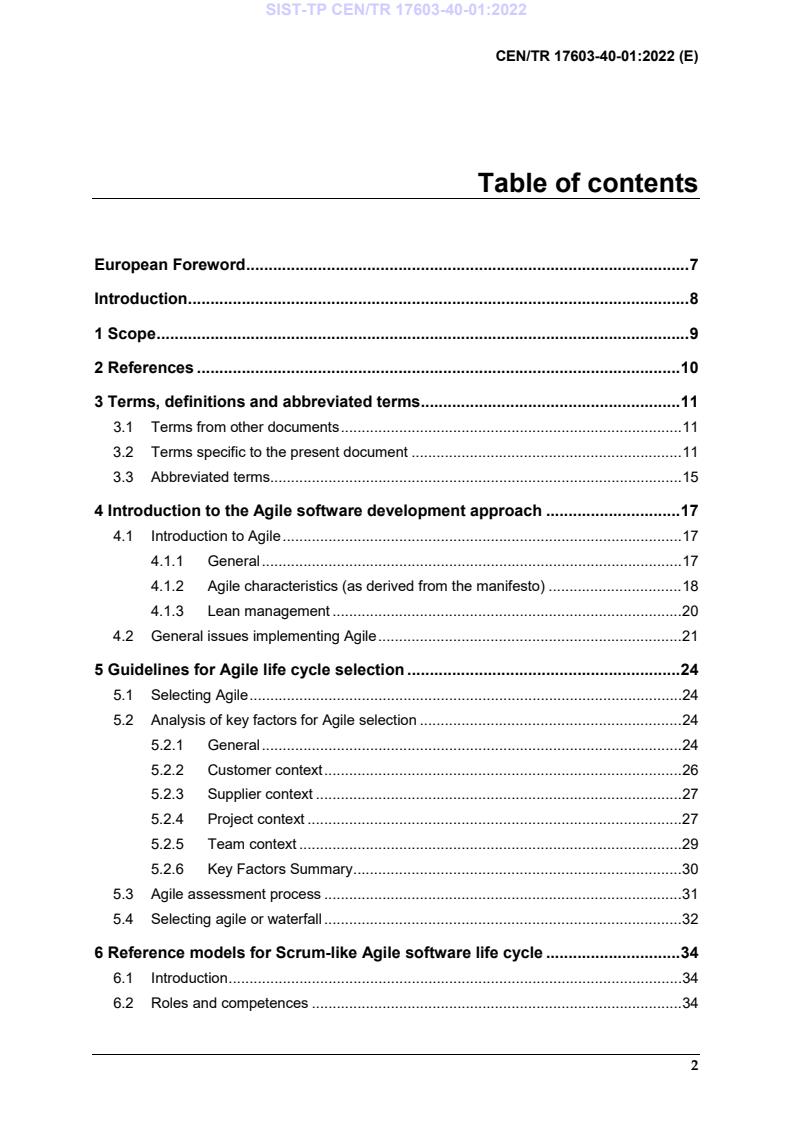
Table of contents
European Foreword . 7
Introduction . 8
1 Scope . 9
2 References . 10
3 Terms, definitions and abbreviated terms . 11
3.1 Terms from other documents . 11
3.2 Terms specific to the present document . 11
3.3 Abbreviated terms. 15
4 Introduction to the Agile software development approach . 17
4.1 Introduction to Agile . 17
4.1.1 General . 17
4.1.2 Agile characteristics (as derived from the manifesto) . 18
4.1.3 Lean management . 20
4.2 General issues implementing Agile . 21
5 Guidelines for Agile life cycle selection . 24
5.1 Selecting Agile . 24
5.2 Analysis of key factors for Agile selection . 24
5.2.1 General . 24
5.2.2 Customer context . 26
5.2.3 Supplier context . 27
5.2.4 Project context . 27
5.2.5 Team context . 29
5.2.6 Key Factors Summary . 30
5.3 Agile assessment process . 31
5.4 Selecting agile or waterfall . 32
6 Reference models for Scrum-like Agile software life cycle . 34
6.1 Introduction . 34
6.2 Roles and competences . 34
6.2.1 Overiew . 34
6.2.2 Scrum master . 34
6.2.3 Product owner . 35
6.2.4 Development team . 35
6.2.5 SCRUM team . 36
6.2.6 Agile coach . 36
6.2.7 Training and competencies . 36
6.3 Exemplary Agile activities . 37
6.3.1 Distinction between meeting or activity . 37
6.3.2 Planning I – What will be delivered . 38
6.3.3 Planning II – How will it be delivered . 38
6.3.4 Sprint backlog management . 39
6.3.5 Product backlog refinement . 39
6.3.6 Progress tracking . 40
6.3.7 Product backlog update . 40
6.3.8 Coding, testing and documenting . 40
6.3.9 User feedback . 41
6.3.10 Review preparation . 41
6.3.11 Sprint review . 41
6.4 Meetings . 42
6.4.1 Daily meeting . 42
6.4.2 Management meeting . 42
6.4.3 Retrospective . 42
6.5 Organising the Agile activities and meetings in a project to create a life-cycle
compliant to ECSS-E-ST-E-40 . 43
6.5.1 Preliminaries . 43
6.5.2 Product releases . 44
6.5.3 Start of the project: Sprint#0 . 44
6.5.4 Development phase: Sprints #1 - #N . 45
6.5.5 Acceptance phase. 45
6.6 Software lifecycle definition . 46
6.6.1 ECSS-E-ST-40 reviews . 46
6.6.2 Organising the ECSS-E-ST-40 reviews in an Agile software approach . 47
6.6.3 Selecting the right model . 56
7 Guidelines for software project management . 57
7.1 Introduction . 57
7.2 Software Project Management approach . 57
7.2.1 Overview . 57
7.2.2 Management objectives and priorities . 57
7.2.3 Schedule management . 61
7.2.4 Assumptions, dependencies and constraints. 63
7.2.5 Work breakdown structure . 64
7.2.6 Roles. 64
7.2.7 Risk management . 65
7.2.8 Monitoring and controlling mechanisms . 66
7.2.9 Staffing Plan. 70
7.2.10 Software procurement process. 72
7.2.11 Supplier management . 72
7.3 Software development approach . 73
7.3.1 Strategy to the software development . 73
7.3.2 Software project development lifecycle . 73
7.3.3 Relationship with the system development lifecycle . 73
7.3.4 Reviews and milestones identification and associated documentation . 73
7.4 Software engineering standards and techniques . 73
7.5 Software development and software testing environment . 73
7.6 Software documentation plan . 74
8 Guidelines for software engineering processes . 75
8.1 Overview . 75
8.2 Software related system requirements process . 75
8.3 requirements and architectural engineering . 75
8.3.1 Software requirements analysis . 75
8.3.2 Software architectural design . 81
8.4 Software design and implementation engineering . 83
8.5 Software validation . 85
8.6 Software delivery and acceptance . 86
8.7 Software verification . 88
8.8 Software operations . 91
8.9 Software maintenance . 91
8.9.1 Overview . 91
8.9.2 Agile maintenance challenges . 91
8.9.3 Tailoring Agile to Maintenance . 92
8.10 Independent software verification and validation . 95
9 Guidelines for software product assurance and configuration
management . 96
9.1 Software product assurance . 96
9.1.1 Introduction . 96
9.1.2 Planning of software product assurance activities . 97
9.1.3 Software product assurance reporting . 97
9.1.4 Technical Debt and noncompliance of Quality Requirements . 98
9.1.5 Software criticality . 99
9.1.6 Software problem management . 99
9.1.7 Control of non-conformances . 100
9.1.8 Software development environment aspects . 100
9.1.9 Summary of software product assurance activities in Agile . 100
9.2 Software configuration management . 102
9.2.1 Introduction . 102
9.2.2 Agile software configuration management challenges . 102
9.2.3 Agile methods for configuration management . 104
9.2.4 Summary of software configuration activities in Agile . 105
Figures
Figure 4-1: From Plan-driven approach to Value-driven approach . 19
Figure 4-2: The Lean Thinking House (for details see LEAN-PRIMER) . 21
Figure 5-1: Factors for adopting Agile process . 25
Figure 5-2: Agile selection factors scale . 26
Figure 6-1: Organisation of activities during a sprint . 37
Figure 6-2: Exemplar Agile lifecycle. 43
Figure 6-3: Model 1: Review driven lifecycle . 51
Figure 6-4 Model 2: More flexible review driven lifecycle . 53
Figure 6-5: Review driven lifecycle with full flexibility . 54
Figure 6-6: Sprint driven lifecycle with formalisation . 55
Figure 7-1: Project Management Triangle. 58
Figure 7-2: Cost Management: change for free . 59
Figure 7-3: Sample Burndown Chart for a Sprint . 62
Figure 7-4: Example for an Agile work breakdown . 64
Figure 7-5: Agile model supports risk management . 65
Figure 7-6: Success of continuous integration tests . 68
Figure 7-7: A team metric dashboard . 68
Figure 7-8: Summary of performed work . 69
Figure 7-9: Delivered business value in a project . 70
Figure 8-1: Example of User Story and Tasks . 77
Figure 8-2: Kano model showing means to ensure customer satisfaction . 79
Tables
Table 5-1: Supplier context . 27
Table 5-2: Project context . 28
Table 5-3: Team context . 29
Table 5-4: Key factors for selection of classical or agile lifecycle . 30
Table 5-5: Aspects for the selection of agile or waterfall approach . 32
Table 6-1 – Overview of the different models . 49
Table 6-2 – Examples of selection of models based on project characteristics . 56
Table 8-1: Mapping ECSS-E-ST-40 to Agile activities. Software Requirements Analysis . 80
Table 8-2: Mapping ECSS-E-ST-40 to Agile activities. Software architectural design . 82
Table 8-3: Mapping ECSS-E-ST-40 to Agile activities. Software Detailed Design,
Coding and testing, and Integration . 83
Table 8-4: Mapping ECSS-E-ST-40 to Agile activities. Software validation. 85
Table 8-5: Mapping ECSS-E-ST-40 to Agile activities. Software Delivery and
Acceptance . 87
Table 8-6 Mapping ECSS-E-ST-40 to Agile activities. Software Verification . 89
Table 8-7: Mapping ECSS-E-ST-40 to Agile activities. Software Maintenance . 94
Table 9-1: Mapping ECSS-Q-ST-80 to Agile activities. Software product assurance . 100
Table 9-2: Mapping ECSS-M-ST-40 to Agile activities. Software Configuration
Management . 105
European Foreword
This document (CEN/TR 17603-40-01:2022) has been prepared by Technical Committee
CEN/CLC/JTC 5 “Space”, the secretariat of which is held by DIN.
It is highlighted that this technical report does not contain any requirement but only collection of data
or descriptions and guidelines about how to organize and perform the work in support of EN 16603-
40.
This Technical report (CEN/TR 17603-40-01:2022) originates from ECSS-E-HB-40-01A.
Attention is drawn to the possibility that some of the elements of this document may be the subject of
patent rights. CEN [and/or CENELEC] shall not be held responsible for identifying any or all such
patent rights.
This document has been prepared under a mandate given to CEN by the European Commission and
the European Free Trade Association.
This document has been developed to cover specifically space systems and has therefore precedence
over any TR covering the same scope but with a wider domain of applicability (e.g.: aerospace).
Introduction
EN 16603-40 (ECSS-E-ST-40) Space Engineering Software Standard defines the principles and
requirements applicable to space software engineering. ECSS-E-ST-40 is always complemented by the
EN 16602-80 (ECSS-Q-ST-80) Space Product Assurance Standard, which specifies the product
assurance aspects. This ECSS-E-HB-40-01 handbook provides more detailed guidelines and advice for
adopting an Agile software development approach in space projects where ECSS-E-ST-40 and ECSS-
Q-ST-80 are applicable.
Scope
This Handbook provides recommendations for the implementation of an Agile approach in space
software projects complying with EN 16603-40 (ECSS-E-ST-40) and EN 16602-80 (ECSS-Q-ST-80).
This handbook is not an Agile development book, though it provides an Agile reference model based
on Scrum and also covers other major Agile methods and techniques. Scrum has been selected as
reference because of its widespread application in industry and its flexibility as a development
framework to introduce or merge with other Agile methods and techniques. In relation to the ECSS-E-
ST-40 and ECSS-Q-ST-80, this handbook does not provide any tailoring of their requirements due to
the use of the Agile approach, but demonstrates how compliance towards ECSS can be achieved. This
handbook does not cover contractual aspects for this particular engineering approach, although it
recognises that considering the approach of fixing cost and schedule and making the scope of
functionalities variable, the customer and supplier need to establish specific contractual arrangements.
Furthermore, it does not impose a particular finality for the use of Agile, either as a set of team values,
project management process, specific techniques or supporting exploration by prototypes.
This handbook, covers, in particular, the following:
• In clause 4, the fundamentals and principles of Agile. It also describes major Agile methods and
general issues of implementing an Agile approach.
• In clause 5, the criteria for selecting an Agile lifecycle.
• In clause 6, a reference process model based on Scrum to be used to map its elements to relevant
clauses of ECSS-E-ST-40.
• In clause 7, guidelines for software project management, providing advice for ECSS-E-ST-40
clause 5.3 considering the reference process model based on Scrum.
• In clause 8, guidelines for software engineering processes, providing advice for ECSS-E-ST-40
clauses 5.2, and 5.4 to 5.10, considering the reference process model based on Scrum.
• In clause 9, guidelines for software product assurance and software configuration management,
providing general advice for the implementation of ECSS-Q-ST-80 and ECSS-M-ST-40 with an
Agile approach.
Individual agile practices, introduced in this HB, can also be taken on-board in other software
development life-cycles.
References
EN Reference Reference in text Title
EN 16601-00-01 ECSS-S-ST-00-01 ECSS system - Glossary of terms
EN 16603-40 ECSS-E-ST-40 Space engineering - Software
EN 17603-40 ECSS-E-HB-40 Space engineering - Software engineering handbook
EN 16601-10 ECSS-M-ST-10 Space project management - Project planning and
implementation
EN 16601-40 ECSS-M-ST-40 Space project management - Configuration and information
management
EN 16601-80 ECSS-M-ST-80 Space project management - Risk management
EN 16602-80 ECSS-Q-ST-80 Space product assurance - Software product assurance
EN 16601-80-04 ECSS-Q-HB-80-04 Space product assurance - Software metrication
programme definition and implementation handbook
Agile Manifesto Beck, K., et al.: Agile Manifesto and Twelve Principles of
Agile Software (2001). http://agilemanifesto.org
ISO/IEC Systems and software engineering - Developing user
26515:2011 documentation in an Agile environment
LEAN-PRIMER Craig Larman and Bas Vodde. 2009.
Lean Primer.
Available at:
http://www.leanprimer.com/downloads/lean_primer.pdf
Agilealliance https://www.agilealliance.org
SCRUM https://www.scrum.org
Terms, definitions and abbreviated terms
3.1 Terms from other documents
a. For the purpose of this document, the terms and definitions from ECSS-S-ST-00-01 apply, in
particular the following terms:
1. process
2. product
b. For the purpose of this document, the terms and definitions from ECSS-E-ST-40 apply, in
particular the following term:
1. critical software
3.2 Terms specific to the present document
3.2.1 Burndown chart
A chart that records project status, usually showing tasks completed versus time and against total
number of tasks
[ISO/IEC 26515:2011]
3.2.2 Capacity
Total number of available hours for a sprint. The capacity is the available hours calculated based on
resources planned holiday and company holiday if any.
3.2.3 Continuous integration
development practice according to which the source code in development is uploaded into a shared
repository regularly to allow automated build, tests and quality control tools to detect and raise issues
early to the development team
3.2.4 Cycle time
time elapsed between the start of the work on a particular task and its completion.
3.2.5 Daily stand-up
short daily team meeting where the team members share their project activities, synchronize
themselves and identify and solve impediments that hamper them from being productive
NOTE 1 It is also known as daily meeting, daily Scrum or roll-call.
NOTE 2 Duration of a “Daily stand-up” is about 15 minutes.
3.2.6 Definition of done (DoD)
list of activities and criteria to be achieved to declare an element of the backlog as complete
NOTE 1 This element can be defined at user story, epic, feature, sprint and
product release levels
NOTE 2 Elements of the DoD can be, for example: writing source code,
update specification, design and user documentation, execution of
unit testing, achieving a certain level of test coverage, establish
compliance to a certain level of coding rules.
[adapted from the Agile Alliance]
3.2.7 Definition of ready
list of criteria that a user story has to meet to be accepted into the upcoming sprint or iteration
[adapted from the Agile Alliance]
3.2.8 Epic
big user story that is too big to be estimated. It is usually too big for an iteration and will be broken
down into smaller user stories.
NOTE It is usually too big for an iteration and will be broken down into
smaller user stories.
3.2.9 Feature
functional or non-functional distinguishing characteristic of a system, usually an enhancement to an
existing system
[ISO/IEC 26515:2011]
3.2.10 Increment
sum of all the Product Backlog items completed during a sprint and the value of the increments of all
previous sprints
3.2.11 Iteration
See “sprint”[3.2.22].
3.2.12 Lead time
time elapsed between the customer request for an increment and its delivery
3.2.13 Load factor
KPI measuring how many person days it takes to complete a story point
NOTE A story point is a relative measurement unit used to compare
relatively user stories, epics (e.g. one ideal working day).
3.2.14 Pair programming
practice where two developers share the same development environment, where the first developer
writes the code and the second reviews the code simultaneously and thinks ahead
NOTE Both change roles often so that the strong points of both
developers can be utilised and knowledge is shared in the team.
3.2.15 Peer review
practice where code written by a developer is reviewed by another developer of the same team
3.2.16 Product backlog
ordered list of everything that is known to be needed in the product
NOTE 1 It is the single source of requirements for any changes to be made
to the product.
NOTE 2 A Product Backlog is never complete. The earliest development of
it lays out the initially known and best-understood requirements.
The Product Backlog evolves as the product and the environment
in which it will be used evolves. The Product Backlog is dynamic;
it constantly changes to identify what the product needs to be
appropriate, competitive, and useful. If a product exists, its
Product Backlog also exists.
NOTE 3 The items can be, for examples, features, requirements, software
problem reports or technical tasks.
NOTE 4 The backlog is the primary point of entry for knowledge about
requirements, and the single authoritative source defining the
work to be done.
[adapted from the Agile Alliance]
3.2.17 Product Owner
entity as close as possible to the end customer and users and as knowledgeable as possible to the
business and solution context
NOTE See also clause 6.2.3.
3.2.18 Product Backlog Refinement
formal or informal meeting or activity to refine the backlog
NOTE 1 Examples of refinement are:
• removing user stories that no longer appear relevant,
• creating new user stories in response to newly discovered
needs,
• re-assessing the relative priority of user stories, assigning
estimates to user stories which have yet to receive one,
• correcting estimates in light of newly discovered information,
splitting user stories which are high priority but too coarse
grained to fit in an upcoming iteration.
NOTE 2 For detailed information about “Product backlog refinement” see
clause 6.3.5.
[adapted from the Agile Alliance]
3.2.19 Sprint backlog
set of product backlog items selected for the sprint, plus a plan for delivering the product increment
and realizing the sprint goal
3.2.20 Release plan
plan to deliver an increment to the product with a release estimated date and providing for each
related sprint, an outline that specifies its content
3.2.21 Retrospective
meeting that is held at the end of an iteration with the objective of improving the process by reviewing
what happened in the last iteration and identifying the good things done in it and what could have
been done better in order to identify improvement actions for next iterations
NOTE The sprint retrospective occurs after the sprint review and prior to
the next sprint planning.
3.2.22 Sprint
short time frame, in which a set of software features is developed, leading to a working product that
can be demonstrated to stakeholders
NOTE Also known as iteration.
[ISO/IEC 26515:2011]
3.2.23 Sprint review
review that is held at the end of the sprint to inspect the increment and adapt the product backlog if
needed
3.2.24 Stakeholder
entity who have a vested interest in the success of the project, but do not belong to the core team
3.2.25 Technical debt
metaphor for the efforts and costs that built up when code is developed without applying the optimal
solution, therefore being more difficult to maintain over time
3.2.26 Test driven development
programming practice where test cases are specified before the software code is written
3.2.27 User story
story that consists of one or more sentences in the language of the end user that captures what a user
does or needs to do as part of his or her job function.
NOTE It captures the 'who', 'what' and 'why' of a requirement in a simple,
concise way, often limited in detail by what can be hand-written
on a small paper notecard.
A good scheme for creating user stories and other backlog items is
INVEST:
I Independent: The user story is self-contained, in a way that there
is no inherent dependency on another user story
N Negotiable: User stories are not explicit contracts and should
leave space for discussion.
V Valuable: A user story must deliver value to the stakeholders.
E Estimable: Possibility to estimate the size of a user story.
S Small: The size of User stories is such that is does not become
impossible to plan/task/prioritize with a certain level of accuracy.
T Testable: The user story or its related description provides the
necessary information to make test development possible.
INVEST is often used as part of the Definition of Ready for a user
story.
3.2.28 Velocity
number of story points delivered/demo in a sprint. The velocity is the measure of the amount of work
a team can tackle during a single sprint
The velocity is the measure of the amount of work a team can tackle during a single sprint. The
velocity is calculated at the end of the sprint by adding up the points for all fully completed user
stories
[adapted from SCRUM]
3.3 Abbreviated terms
For the purpose of this document, the abbreviated terms from ECSS-S-ST-00-01, ECSS-E-ST-40 and the
following apply:
Abbreviation Meaning
AR
acceptance review
CDR
critical design review
CM
configuration management
DDR
detailed design review
DoD
definition of done
DRD
document requirements definition
ECSS
European Cooperation for Space Standardization
FDD
feature driven development
HMI
human machine interface
ICD
Interface control document
IDD
ideal developer day
ISVV
independent software verification and validation
KPI
Key performance indicator
MoM
minutes of meeting
MoSCoW
Must Should Could Won’t
N/A
not applicable
NCR
Non-conformance report
OBS
organisation breakdown structure
OBSW
on-board software
PBI
product backlog item
PBS
product breakdown structure
PDR
preliminary design review
QA
Quality assurance
QR
qualification review
Abbreviation Meaning
RB
requirement baseline
SDD
Software design document
SDLC
software development lifecycle
SDP
software development plan
SLA
service level agreement
SPA
Software product assurance
SPR
Software problem report
SRS
software requirements specification
SW
software
SWRR
software requirements review
TDD
test driven development
TS
technical specification
WBS
work breakdown structure
XP
extreme programming
Introduction to the Agile software
development approach
4.1 Introduction to Agile
4.1.1 General
Agile is an iterative, time-boxed approach to software development in which a software product is
built through an evolutionary process characterised by early and frequent deliveries of product
increments, intensive customer collaboration and adaptive planning and goals, with the aim of
responding to change in a rapid and flexible manner.
Agile development is inspired by the Agile Manifesto, which identifies four basic values:
• “Individuals and interactions over Processes and tools
• Working software over Comprehensive documentation
• Customer collaboration over Contract negotiation
• Responding to change over Following a plan”
[Agile Manifesto]
Each statement asserts that what is in the sentence on the left side (in bold) is valued more than what
is on the right side.
Behind the Agile Manifesto lie the twelve principles, which teams working in an Agile environment
follow
1. “Our highest priority is to satisfy the customer through early and continuous delivery of valuable
software.
2. Welcome changing requirements, even late in development. Agile processes harness change for the
customer's competitive advantage.
3. Deliver working software frequently, from a couple of weeks to a couple of months, with a
preference to the shorter timescale.
4. Business people and developers work together daily throughout the project.
5. Build projects around motivated individuals. Give them the environment and support their need,
and trust them to get the job done.
6. The most efficient and effective method of conveying information to and within a development
team is face-to-face conversation.
7. Working software is the primary measure of progress.
8. Agile processes promote sustainable development. The sponsors, developers, and users should be
able to maintain a constant pace indefinitely.
9. Continuous attention to technical excellence and good design enhances agility.
10. Simplicity--the art of maximizing the amount of work not done--is essential.
11. The best architectures, requirements, and designs emerge from self-organizing teams.
12. At regular intervals, the team reflects on how to become more effective, then tunes and adjusts its
behaviour accordingly.”
[Agile Manifesto]
NOTE Clause 5 provides concrete models for different approaches
towards adopting the change of requirements late in the lifecycle
in compliance with ECSS-E-ST-40.
At the core of Agile software development lies the high quality of deliverables, as a result of
continuous product and process improvement. Agile teams develop a working system where they
optimise the way they communicate and organise their work in order to achieve the highest value.
There is a strong link with Lean management as detailed in clause 4.1.3.
4.1.2 Agile characteristics (as derived from the manifesto)
Agile development methodologies heavily rely on customer collaboration and feedback and therefore
offer the chance to examine the direction in which a project is heading while it is ongoing. Compared
to waterfall methodologies, where product development depends on the initial requirements and
testing is done at the end of the implementation, in an Agile context teams continuously review and
improve requirements, design, implementation and testing throughout the life cycle. In waterfall
models, by the time the project is finished it can occur that the needs of the business have changed –
this fact is embraced in Agile, by providing a framework where the scope can vary and planning is
adaptive.
There are different Agile methods or frameworks that can be applied, such as Scrum, Kanban,
Extreme Programming, or Feature Driven Development. Irrespective of which method is chosen, all of
them are Agile, hence highly adaptable to support the need of the project and company, and they have
the following common characteristics:
• They are iterative and evolutionary. The software product is developed through repeated cycles
in a rapid feedback loop between customer and technologists. The customer adaptively
specifies the requirements for the next iteration based on the observations on the evolving
software product.
• Analysis, design, coding and testing are continuous activities.
• The iteration length can be pre-determined (time-boxed) and the scope is fixed for each
iteration. One of the main differences of Agile compared to other iterative methods is that the
length of each iteration is much shorter: typically two to four weeks.
• They support adaptive planning. Agile methods are intended for situations that foresee changes
during the development time and the final delivery. It can be possible that requirements
change, technology changes and staff changes.
• They recognise the importance of people as the most influential factor of the project. The self-
organized team plays an important role delivering working software as a primary measure of
success. Agile methods focus on the competence and motivation of the software engineers as
well as the organisation, communication and management.
• They attempt to reduce resource-intensive intermediate artefacts. Resources are prioritised to
produce working software from the very beginning, in some cases it can be deployed directly
into operation.
Agile emphasizes the value of better dealing with justified or valuable change. Addressing the
changes (e.g. to the requirements, design or implementation) is in effect a change to the scope of the
project. Having three parameters: Scope, Schedule and Cost, the impact of the change can be either
handled by impact on the cost and schedule or by adapting the scope accordingly. Agile lifecycle
provides the methodology for handling the changes to the scope in a fixed cost and schedule frame
(see Figure 4-1). The details of how changes to the schedule, cost and scope can be handled
contractually are out of the scope of this Handbook.
Plan driven process Agile process
Fixed
Requirements Cost Schedule
Lean on
the value
Lean on
the
plan
Estimated
Cost Schedule Features
From plan follow From the value follow
the estimations relative to the estimations relative to the
features.
cost and schedule
Figure 4-1: From Plan-driven approach to Value-driven approach
While defining what Agile is, it is equally important to emphasize what it is not. Agile is not:
• A silver bullet. Agile cannot solve all development problems and the methods are adapted to
the needs of the organisation.
• Anti-documentation. Documentation is just another valuable deliverable that can be estimated
and prioritised like other user functionalities. Compliance to standards is also possible. An
important note is that in an Agile context classical documents are converted into “living
documents” (evolving documents) that are updated on an ongoing basis.
• Anti-planning. Agile methods involve a lot of planning (daily meetings, iteration and release
planning meetings); therefore it is not advised to roll out an Agile project solely on the basis
that it cannot be planned.
• Anti-architecture. An architecture needs to exist before starting the project, otherwise the lack of
such an artefact indicates that the user needs are still unknown and further clarification is
needed (i.e. the user needs are not clear). The architecture needs to be updated regularly as it
evolves while the project is running.
4.1.3 Lean management
The core idea of Lean Management is to maximise customer value while minimising waste, where
waste is any unprofitable action. In simple terms, a lean approach aims at creating more value for
customers with fewer resources. An organisation that follows the lean principles understands
customer value and focuses its key processes to continuously increase it. The ultimate goal is to
provide perfect value to the customer through a perfect value creation process that has zero waste.
The idea of providing customer value relates directly to the Agile principles.
Figure 4-2 shows the principles of Lean, also applicable to Agile. The layout follows the major
structure of a house and is as follows:
• The roof defines the goal of a project, i.e. to quickly deliver things of value, while still achieving
the highest quality. This c
...