

EN 1073-2:2002
(Main)Protective clothing against radioactive contamination - Part 2: Requirements and test methods for non-ventilated protective clothing against particulate radioactive contamination
General Information
- Abstract
This European Standard specifies the requirements and test methods for non-ventilated protective clothing protecting the wearer against particulate radioactive contamination. Such clothing is intended to protect only the body, arms and legs of the wearer, but it may be used with accessories which provide protection to additional areas of the wearer (e.g. boots, gloves, RPE). Protection to these other areas is specified in other European Standards.
This European Standard does not apply for the protection against ionizing radiation and the protection of patients against contamination with radioactive substances by diagnostic and/or therapeutic measures.
- Status
- Published
- Publication Date
- 09-Jul-2002
- Current Stage
- 9093 - Decision to confirm - Review Enquiry
- Start Date
- 23-Sep-2011
- Completion Date
- 23-Sep-2011
- Directive
- 2016/425 - Regulation (EU) 2016/425 of the European Parliament and of the Council of 9 March 2016 on personal protective equipment and repealing Council Directive 89/686/EECOJ Ref: C, C 113 OJ Date: 27-Mar-2018
89/686/EEC - Personal protective equipment (PPE)OJ Ref: C 203, C 24, C 247, C 306, C 46, C 91 OJ Date: 28-Aug-2003


Overview
EN 1073-2:2002 is a European Standard developed by CEN that specifies the requirements and test methods for non-ventilated protective clothing designed to protect the wearer against particulate radioactive contamination. This standard focuses on clothing intended to shield the body, arms, and legs from contamination by radioactive particles. It excludes protection against ionizing radiation and contamination protection for patients undergoing diagnostic or therapeutic radioactive procedures.
The standard is crucial for industries and environments where workers are exposed to radioactive particles but do not require full respiratory protection or ventilated suits.
Key Topics
Scope and Application
- Protects only the body, arms, and legs; additional accessories (e.g., gloves, boots, respiratory protective equipment) protect other body parts as specified in other standards.
- Non-ventilated, meaning the suit is not supplied with clean air and does not maintain positive pressure inside.
- Applicable to both single-use and reusable protective clothing.
Design Requirements
- The clothing must be easy to put on and remove to minimize contamination risk.
- Must reduce physiological stress on the wearer.
- Can be a single garment or a combination designed to be worn with accessories.
- Tested with accessories fitted, according to manufacturer’s instructions.
Material Criteria
- Materials must have high abrasion resistance, puncture resistance, tear resistance, and resistance to ignition.
- Materials undergo conditioning and testing to simulate actual use and cleaning cycles for reusable suits.
- Standard classifies materials and garments according to test results (abrasion cycles, puncture force, tear force, etc.).
Protection Performance
- Measured by the Nominal Protection Factor (NPF), which is the ratio of ambient particle concentration to particle concentration inside the suit.
- Total Inward Leakage (TIL) is quantified to classify protective performance.
- Classification ensures a minimum protection level (class 1 or above).
Seam and Joins Strength
- Seam strength and integrity are critical to prevent particulate ingress.
- Specific seam strength thresholds classify the garment.
- Joins and assemblages between clothing and detachable parts (gloves, boots) are pull-tested for durability.
Testing Procedures
- Includes practical performance tests simulating realistic movements like walking and handling materials.
- Tests are performed under controlled temperature and humidity.
- Visual inspection and preconditioning simulate real industrial conditions.
- Test subjects evaluate comfort, ease of movement, and fastening security during the practical performance test.
- Nominal protection factor is determined with accessories attached as prescribed.
Marking and Information
- Clothing must be clearly marked with manufacturer ID, standard number, performance level, year of manufacture, size, and standardized pictogram.
- Manufacturers must provide detailed user information in the official language(s) of the country.
Applications
EN 1073-2:2002 compliant non-ventilated protective clothing is essential for:
- Nuclear power plants and nuclear fuel cycle facilities.
- Radiological emergency response teams.
- Decontamination and decommissioning operations involving radioactive dust or particulate contamination.
- Industrial environments where workers may encounter particulate radioactive substances.
- Research institutions handling radioactive materials that require body protection but not respirators.
This protective clothing provides effective particulate contamination protection while enabling freedom of movement and reducing physiological strain, supporting safe work practices in radioactive environments.
Related Standards
- EN 1073-1: Requirements and test methods for ventilated protective clothing against particulate radioactive contamination.
- EN 340: General requirements for protective clothing.
- prEN 943-1: Protective clothing against chemical hazards, including gas-tight suits.
- EN 863: Protective clothing - Test methods for puncture resistance.
- EN 530: Abrasion resistance test methods for protective clothing materials.
- prEN 13982-2: Test methods for inward leakage of solid particulate chemicals into suits.
- EN 1146 & EN 13274-4: Test methods for ignition resistance of respiratory protective devices, applicable to integrated suit components.
These interconnected standards ensure comprehensive protection against various hazardous agents, supporting worker safety across chemical, radioactive, and industrial hazards.
By adhering to EN 1073-2:2002, manufacturers and safety professionals can ensure that non-ventilated protective clothing reliably defends against harmful particulate radioactive contamination, while maintaining wearer comfort and operational functionality.
Relations
- Effective Date
- 28-Jan-2026
- Effective Date
- 28-Jan-2026
- Effective Date
- 28-Jan-2026
- Effective Date
- 28-Jan-2026
- Effective Date
- 28-Jan-2026
- Effective Date
- 28-Jan-2026
- Effective Date
- 28-Jan-2026
- Effective Date
- 28-Jan-2026
- Effective Date
- 28-Jan-2026
- Effective Date
- 28-Jan-2026
- Effective Date
- 28-Jan-2026
- Effective Date
- 28-Jan-2026
- Effective Date
- 28-Jan-2026
Get Certified
Connect with accredited certification bodies for this standard

CIS Institut d.o.o.
Personal Protective Equipment (PPE) certification body. Notified Body NB-2890 for EU Regulation 2016/425 PPE.

Kiwa BDA Testing
Building and construction product certification.
Kmetijski inštitut Slovenije
Agricultural Institute of Slovenia. Soil testing, plant health, agricultural product analysis.
Sponsored listings
Frequently Asked Questions
EN 1073-2:2002 is a standard published by the European Committee for Standardization (CEN). Its full title is "Protective clothing against radioactive contamination - Part 2: Requirements and test methods for non-ventilated protective clothing against particulate radioactive contamination". This standard covers: This European Standard specifies the requirements and test methods for non-ventilated protective clothing protecting the wearer against particulate radioactive contamination. Such clothing is intended to protect only the body, arms and legs of the wearer, but it may be used with accessories which provide protection to additional areas of the wearer (e.g. boots, gloves, RPE). Protection to these other areas is specified in other European Standards. This European Standard does not apply for the protection against ionizing radiation and the protection of patients against contamination with radioactive substances by diagnostic and/or therapeutic measures.
This European Standard specifies the requirements and test methods for non-ventilated protective clothing protecting the wearer against particulate radioactive contamination. Such clothing is intended to protect only the body, arms and legs of the wearer, but it may be used with accessories which provide protection to additional areas of the wearer (e.g. boots, gloves, RPE). Protection to these other areas is specified in other European Standards. This European Standard does not apply for the protection against ionizing radiation and the protection of patients against contamination with radioactive substances by diagnostic and/or therapeutic measures.
EN 1073-2:2002 is classified under the following ICS (International Classification for Standards) categories: 13.280 - Radiation protection; 13.340.10 - Protective clothing. The ICS classification helps identify the subject area and facilitates finding related standards.
EN 1073-2:2002 has the following relationships with other standards: It is inter standard links to EN ISO 13934-2:1999, EN ISO 5978:2023, EN 863:1995, EN ISO 9073-4:2021, EN ISO 13982-2:2004, EN ISO 11610:2023, EN ISO 13688:2013, EN 1073-1:2016+A1:2018, EN 530:1994, EN 1146:2005, EN 943-1:2015+A1:2019, EN 13274-4:2020, EN 943-1:2015. Understanding these relationships helps ensure you are using the most current and applicable version of the standard.
EN 1073-2:2002 is associated with the following European legislation: EU Directives/Regulations: 2016/425, 89/686/EEC, 93/68/EEC, 93/95/EEC, 96/58/EC; Standardization Mandates: M/031. When a standard is cited in the Official Journal of the European Union, products manufactured in conformity with it benefit from a presumption of conformity with the essential requirements of the corresponding EU directive or regulation.
EN 1073-2:2002 is available in PDF format for immediate download after purchase. The document can be added to your cart and obtained through the secure checkout process. Digital delivery ensures instant access to the complete standard document.
Standards Content (Sample)
2003-01.Slovenski inštitut za standardizacijo. Razmnoževanje celote ali delov tega standarda ni dovoljeno.Protective clothing against radioactive contamination - Part 2: Requirements and test methods for non-ventilated protective clothing against particulate radioactive contaminationVetements de protection contre la contamination radioactive - Partie 2: Exigences et méthodes d'essai des vetements de protection non ventilés contre la contamination radiocative sous forme de particulesSchutzkleidung gegen radioaktive Kontamination - Teil 2: Anforderungen und Prüfverfahren für unbelüftete Schutzkleidung gegen radioaktive Kontamination durch feste Partikel13.340.10Varovalna oblekaProtective clothing13.280Varstvo pred sevanjemRadiation protectionICS:SIST EN 1073-2:2002enTa slovenski standard je istoveten z:EN 1073-2:200201-november-2002SIST EN 1073-2:2002SLOVENSKI
STANDARD
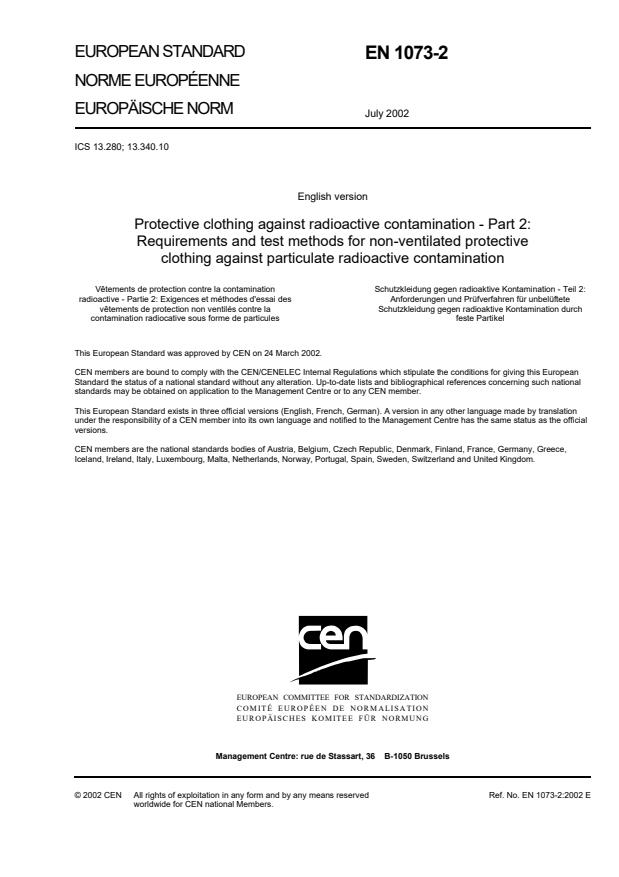
EUROPEAN STANDARDNORME EUROPÉENNEEUROPÄISCHE NORMEN 1073-2July 2002ICS 13.280; 13.340.10English versionProtective clothing against radioactive contamination - Part 2:Requirements and test methods for non-ventilated protectiveclothing against particulate radioactive contaminationVêtements de protection contre la contaminationradioactive - Partie 2: Exigences et méthodes d'essai desvêtements de protection non ventilés contre lacontamination radiocative sous forme de particulesSchutzkleidung gegen radioaktive Kontamination - Teil 2:Anforderungen und Prüfverfahren für unbelüfteteSchutzkleidung gegen radioaktive Kontamination durchfeste PartikelThis European Standard was approved by CEN on 24 March 2002.CEN members are bound to comply with the CEN/CENELEC Internal Regulations which stipulate the conditions for giving this EuropeanStandard the status of a national standard without any alteration. Up-to-date lists and bibliographical references concerning such nationalstandards may be obtained on application to the Management Centre or to any CEN member.This European Standard exists in three official versions (English, French, German). A version in any other language made by translationunder the responsibility of a CEN member into its own language and notified to the Management Centre has the same status as the officialversions.CEN members are the national standards bodies of Austria, Belgium, Czech Republic, Denmark, Finland, France, Germany, Greece,Iceland, Ireland, Italy, Luxembourg, Malta, Netherlands, Norway, Portugal, Spain, Sweden, Switzerland and United Kingdom.EUROPEAN COMMITTEE FOR STANDARDIZATIONCOMITÉ EUROPÉEN DE NORMALISATIONEUROPÄISCHES KOMITEE FÜR NORMUNGManagement Centre: rue de Stassart, 36
B-1050 Brussels© 2002 CENAll rights of exploitation in any form and by any means reservedworldwide for CEN national Members.Ref. No. EN 1073-2:2002 E
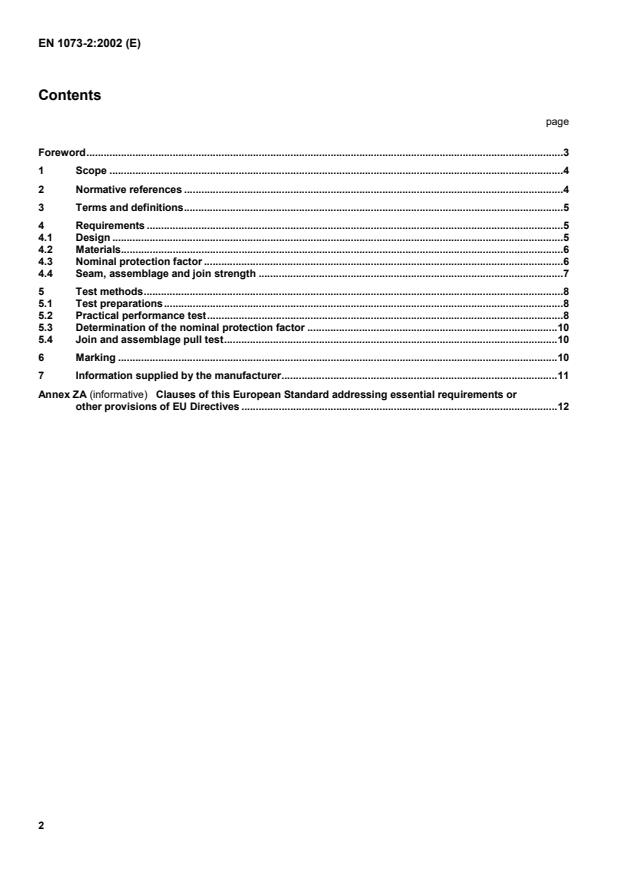
Clauses of this European Standard addressing essential requirements orother provisions of EU Directives.12
13934-2, Textiles — Tensile properties of fabrics — Part 2: Determination of maximum force using the grabmethod (ISO 13934-2:1999).
be harmful4 RequirementsThe design and the material of non-ventilated protective clothing against particulate radioactive contamination shall fulfilall mandatory requirements of this standard. In case of classification at least class 1 shall be reached.4.1 Design4.1.1The non-ventilated protective clothing against radioactive contamination shall comply with the generalrequirements specified in EN
...