

EN 13450:2013
(Main)Aggregates for railway ballast
- Abstract
This European Standard specifies the properties of aggregates obtained by processing natural, manufactured or recycled crushed unbound aggregates for use in construction of the upper layer of railway track. For the purposes of this standard, the aggregate is referred to as railway ballast.
A list of the source materials that have been considered and are within the scope of this European Standard is given in Annex E (normative).
NOTE Reused railway ballast: railway ballast resulting of previously used railway ballast on site and without putting it on the market is not covered by this European Standard.
It also specifies that a quality control system is in place for use in factory production control and it provides for the evaluation of conformity of the products to this European Standard.
It incorporates a general requirement that railway ballast should not release any dangerous substances in excess of the maximum permitted levels specified in a relevant European Standard for the material or permitted in the national regulations of the member state of destination.
Railway ballast used in construction should comply with all the requirements of this European Standard. The standard includes comprehensive and specific requirements for natural aggregates and recycled ballast, dealing with, for example, the stability of certain basalts.
For materials from some other secondary sources, however, work is ongoing and the requirements are incomplete. In the meantime such materials, when placed on the market as railway ballast, should conform fully to this standard but may also be required to conform to specific relevant additional requirements at the place of use. Additional characteristics and requirements may be specified on a case by case basis depending upon experience of use of the product, and defined in specific contractual documents.
Requirements for the declaration of the potential of railway ballast to release regulated dangerous substances are currently under development. Until such time as these are finalised, attention should be paid to requirements at the place of use.
- Status
- Withdrawn
- Publication Date
- 30-Apr-2013
- Withdrawal Date
- 11-Dec-2013
- Technical Committee
- CEN/TC 154 - Aggregates
- Drafting Committee
- CEN/TC 154/WG 11 - Railway ballast
- Current Stage
- 9960 - Withdrawal effective - Withdrawal
- Start Date
- 12-Dec-2013
- Completion Date
- 12-Dec-2013

Relations
- Effective Date
- 08-May-2013
- Effective Date
- 08-May-2013
- Effective Date
- 28-Jan-2026
- Effective Date
- 28-Jan-2026
- Effective Date
- 28-Jan-2026
- Effective Date
- 28-Jan-2026
- Effective Date
- 28-Jan-2026
- Effective Date
- 28-Jan-2026
- Effective Date
- 28-Jan-2026
- Effective Date
- 28-Jan-2026
- Effective Date
- 28-Jan-2026
- Effective Date
- 28-Jan-2026
- Effective Date
- 28-Jan-2026
- Effective Date
- 28-Jan-2026
- Effective Date
- 28-Jan-2026
Get Certified
Connect with accredited certification bodies for this standard

DIBt (Deutsches Institut für Bautechnik)
German Institute for Building Technology.
DIN CERTCO
DIN Group product certification.
Zavod za gradbeništvo Slovenije (ZAG) - Inšpekcija
ZAG inspection body for construction products, structures, and materials.
Sponsored listings
Frequently Asked Questions
EN 13450:2013 is a standard published by the European Committee for Standardization (CEN). Its full title is "Aggregates for railway ballast". This standard covers: This European Standard specifies the properties of aggregates obtained by processing natural, manufactured or recycled crushed unbound aggregates for use in construction of the upper layer of railway track. For the purposes of this standard, the aggregate is referred to as railway ballast. A list of the source materials that have been considered and are within the scope of this European Standard is given in Annex E (normative). NOTE Reused railway ballast: railway ballast resulting of previously used railway ballast on site and without putting it on the market is not covered by this European Standard. It also specifies that a quality control system is in place for use in factory production control and it provides for the evaluation of conformity of the products to this European Standard. It incorporates a general requirement that railway ballast should not release any dangerous substances in excess of the maximum permitted levels specified in a relevant European Standard for the material or permitted in the national regulations of the member state of destination. Railway ballast used in construction should comply with all the requirements of this European Standard. The standard includes comprehensive and specific requirements for natural aggregates and recycled ballast, dealing with, for example, the stability of certain basalts. For materials from some other secondary sources, however, work is ongoing and the requirements are incomplete. In the meantime such materials, when placed on the market as railway ballast, should conform fully to this standard but may also be required to conform to specific relevant additional requirements at the place of use. Additional characteristics and requirements may be specified on a case by case basis depending upon experience of use of the product, and defined in specific contractual documents. Requirements for the declaration of the potential of railway ballast to release regulated dangerous substances are currently under development. Until such time as these are finalised, attention should be paid to requirements at the place of use.
This European Standard specifies the properties of aggregates obtained by processing natural, manufactured or recycled crushed unbound aggregates for use in construction of the upper layer of railway track. For the purposes of this standard, the aggregate is referred to as railway ballast. A list of the source materials that have been considered and are within the scope of this European Standard is given in Annex E (normative). NOTE Reused railway ballast: railway ballast resulting of previously used railway ballast on site and without putting it on the market is not covered by this European Standard. It also specifies that a quality control system is in place for use in factory production control and it provides for the evaluation of conformity of the products to this European Standard. It incorporates a general requirement that railway ballast should not release any dangerous substances in excess of the maximum permitted levels specified in a relevant European Standard for the material or permitted in the national regulations of the member state of destination. Railway ballast used in construction should comply with all the requirements of this European Standard. The standard includes comprehensive and specific requirements for natural aggregates and recycled ballast, dealing with, for example, the stability of certain basalts. For materials from some other secondary sources, however, work is ongoing and the requirements are incomplete. In the meantime such materials, when placed on the market as railway ballast, should conform fully to this standard but may also be required to conform to specific relevant additional requirements at the place of use. Additional characteristics and requirements may be specified on a case by case basis depending upon experience of use of the product, and defined in specific contractual documents. Requirements for the declaration of the potential of railway ballast to release regulated dangerous substances are currently under development. Until such time as these are finalised, attention should be paid to requirements at the place of use.
EN 13450:2013 is classified under the following ICS (International Classification for Standards) categories: 91.100.15 - Mineral materials and products; 93.100 - Construction of railways. The ICS classification helps identify the subject area and facilitates finding related standards.
EN 13450:2013 has the following relationships with other standards: It is inter standard links to EN 13450:2002, EN 13450:2002/AC:2004, EN 1097-1:2023, EN 1097-6:2022, EN 933-4:2008, EN 1367-1:2007, EN 1367-3:2001, EN 1367-6:2008, EN 1097-2:2020, EN 932-3:2022, EN 933-3:2012, EN 932-1:1996, EN 16236:2013, EN 1367-2:2009, EN 933-1:2012. Understanding these relationships helps ensure you are using the most current and applicable version of the standard.
EN 13450:2013 is associated with the following European legislation: EU Directives/Regulations: 305/2011, 89/106/EEC; Standardization Mandates: M/125. When a standard is cited in the Official Journal of the European Union, products manufactured in conformity with it benefit from a presumption of conformity with the essential requirements of the corresponding EU directive or regulation.
EN 13450:2013 is available in PDF format for immediate download after purchase. The document can be added to your cart and obtained through the secure checkout process. Digital delivery ensures instant access to the complete standard document.
Standards Content (Sample)
2003-01.Slovenski inštitut za standardizacijo. Razmnoževanje celote ali delov tega standarda ni dovoljeno.Agregati za grede železniških progGesteinskörnungen für GleisschotterGranulats pour ballasts de voies ferréesAggregates for railway ballast93.100Gradnja železnicConstruction of railways91.100.15Mineralni materiali in izdelkiMineral materials and productsICS:Ta slovenski standard je istoveten z:EN 13450:2013SIST EN 13450:2013en,fr,de01-julij-2013SIST EN 13450:2013SLOVENSKI
STANDARDSIST EN 13450:2003/AC:2004SIST EN 13450:20031DGRPHãþD
EUROPEAN STANDARD NORME EUROPÉENNE EUROPÄISCHE NORM
EN 13450
May 2013 ICS 91.100.15; 93.100 Supersedes EN 13450:2002English Version
Aggregates for railway ballast
Granulats pour ballasts de voies ferrées
Gesteinskörnungen für Gleisschotter This European Standard was approved by CEN on 22 December 2012.
CEN members are bound to comply with the CEN/CENELEC Internal Regulations which stipulate the conditions for giving this European Standard the status of a national standard without any alteration. Up-to-date lists and bibliographical references concerning such national standards may be obtained on application to the CEN-CENELEC Management Centre or to any CEN member.
This European Standard exists in three official versions (English, French, German). A version in any other language made by translation under the responsibility of a CEN member into its own language and notified to the CEN-CENELEC Management Centre has the same status as the official versions.
CEN members are the national standards bodies of Austria, Belgium, Bulgaria, Croatia, Cyprus, Czech Republic, Denmark, Estonia, Finland, Former Yugoslav Republic of Macedonia, France, Germany, Greece, Hungary, Iceland, Ireland, Italy, Latvia, Lithuania, Luxembourg, Malta, Netherlands, Norway, Poland, Portugal, Romania, Slovakia, Slovenia, Spain, Sweden, Switzerland, Turkey and United Kingdom.
EUROPEAN COMMITTEE FOR STANDARDIZATION
COMITÉ EUROPÉEN DE NORMALISATION EUROPÄISCHES KOMITEE FÜR NORMUNG
Management Centre:
Avenue Marnix 17,
B-1000 Brussels © 2013 CEN All rights of exploitation in any form and by any means reserved worldwide for CEN national Members. Ref. No. EN 13450:2013: ESIST EN 13450:2013
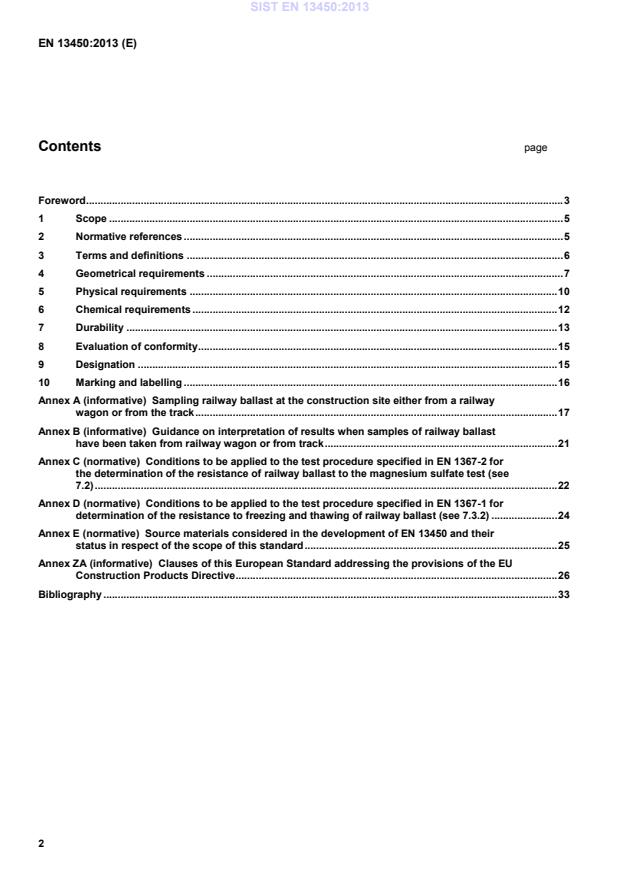
Foreword . 3 1 Scope . 5 2 Normative references . 5 3 Terms and definitions . 6 4 Geometrical requirements . 7 5 Physical requirements . 10 6 Chemical requirements . 12 7 Durability . 13 8 Evaluation of conformity . 15 9 Designation . 15 10 Marking and labelling . 16 Annex A (informative)
Sampling railway ballast at the construction site either from a railway wagon or from the track . 17 Annex B (informative)
Guidance on interpretation of results when samples of railway ballast have been taken from railway wagon or from track . 21 Annex C (normative)
Conditions to be applied to the test procedure specified in EN 1367-2 for the determination of the resistance of railway ballast to the magnesium sulfate test (see 7.2) . 22 Annex D (normative)
Conditions to be applied to the test procedure specified in EN 1367-1 for determination of the resistance to freezing and thawing of railway ballast (see 7.3.2) . 24 Annex E (normative)
Source materials considered in the development of EN 13450 and their status in respect of the scope of this standard . 25 Annex ZA (informative)
Clauses of this European Standard addressing the provisions of the EU Construction Products Directive . 26 Bibliography . 33
EN 16236-2013). 2) Modification of the definition to "recycled railway ballast". 3) Addition of note 3 in Clause 4. 4) Modification of Tables 1, 2, 3, 4, 5, 6, 7, 8 and 9 due to changes in the category names. 5) Addition of new sub-clauses 7.3 "Freeze-thaw resistance" and 7.4 "Electrical conductivity". 6) Modification of sub-clause 7.5 "Sonnenbrand". This document has been prepared under a mandate given to CEN by the European Commission and the European Free Trade Association, and supports essential requirements of EU Directive(s). For relationship with EU Directive(s), see informative Annex ZA, which is an integral part of this document. Requirements for other end uses of aggregates will be specified in the following European Standards: EN 12620, Aggregates for concrete; EN 13043, Aggregates for bituminous mixtures and surface treatments for roads, airfields and other trafficked areas; EN 13055, Lightweight aggregates; EN 13139, Aggregates for mortar; EN 13242, Aggregates for unbound and hydraulically bound materials for use in civil engineering work and road construction; EN 13383-1, Armourstone – Part 1: Specification. Considering evaluation of conformity see EN 16236, Evaluation of Conformity. SIST EN 13450:2013
NOTE Reused railway ballast: railway ballast resulting of previously used railway ballast on site and without putting it on the market is not covered by this European Standard. It also specifies that a quality control system is in place for use in factory production control and it provides for the evaluation of conformity of the products to this European Standard. It incorporates a general requirement that railway ballast should not release any dangerous substances in excess of the maximum permitted levels specified in a relevant European Standard for the material or permitted in the national regulations of the member state of destination. Railway ballast used in construction should comply with all the requirements of this European Standard. The standard includes comprehensive and specific requirements for natural aggregates and recycled ballast, dealing with, for example, the stability of certain basalts. For materials from some other secondary sources, however, work is ongoing and the requirements are incomplete. In the meantime such materials, when placed on the market as railway ballast, should conform fully to this standard but may also be required to conform to specific relevant additional requirements at the place of use. Additional characteristics and requirements may be specified on a case by case basis depending upon experience of use of the product, and defined in specific contractual documents.
Requirements for the declaration of the potential of railway ballast to release regulated dangerous substances are currently under development. Until such time as these are finalised, attention should be paid to requirements at the place of use. 2 Normative references The following documents, in whole or in part, are normatively referenced in this document and are indispensable for its application. For dated references, only the edition cited applies. For undated references, the latest edition of the referenced document (including any amendments) applies. EN 932-1:1996, Tests for general properties of aggregates — Part 1: Methods for sampling EN 932-3, Tests for general properties of aggregates — Part 3: Procedure and terminology for simplified petrographic description EN 933-1, Tests for geometrical properties of aggregates — Part 1: Determination of particle size distribution — Sieving method EN 933-3, Tests for geometrical properties of aggregates — Part 3: Determination of particle shape — Flakiness index EN 933-4, Tests for geometrical properties of aggregates — Part 4: Determination of particle shape — Shape index EN 1097-1, Tests for mechanical and physical properties of aggregates — Part 1: Determination of the resistance to wear (micro-Deval) SIST EN 13450:2013
granular material used in construction Note 1 to entry: Aggregates may be natural, manufactured or recycled. 3.2 railway ballast aggregate where 100 % of the surface of the particles can be described as totally crushed used in the construction of the upper layer of railway track, with sizes e. g. 22/40 mm, 31,5/50 mm or 31,5/63 mm 3.3 natural railway ballast aggregate for railway ballast from mineral sources which have been subjected to nothing more than mechanical processing Note 1 to entry: Natural railway ballast should be produced without blending material from different geological sources. 3.4 manufactured railway ballast railway ballast of mineral origin resulting from an industrial process involving thermal or other modification 3.5 recycled railway ballast railway ballast resulting from the processing of inorganic or mineral material previously used in construction 3.6 category level of a property of railway ballast expressed as a range of values or a limiting value Note 1 to entry: There is no relationship between the categories of different properties. SIST EN 13450:2013
mm Railway ballast size 31,5 mm to 50 mm Railway ballast size 31,5 mm to 63 mm Railway ballast size 22 mm to 40 mm Percentage passing by mass Grading category GC RB A GC RB B GC RB C GC RB D GC RB E 80 63 50 40 31,5 22,4 16 8 31,5 to 50 31,5 to 63 100 100 70 to 99 30 to 65 1 to 25 0 to 3 - - ≥ 50 - 100 95 to 100 65 to 99 30 to 65 1 to 25 0 to 3 - - - ≥ 50 100 95 to 100 55 to 99 25 to 75 1 to 25 0 to 3 - - - ≥ 50 100 93 to 100 45 to 70 15 to 40 0 to 7 0 to 7 - - - ≥ 85 - - 100 90 to 100 60 to 98 15 to 60 0 to 15 0 to 2 - - NOTE The requirement for passing the 22,4 mm sieve applies to railway ballast sampled at the place of production.
In certain circumstances a 25 mm sieve may be used as an alternative to the 22,4 mm sieve, when a tolerance of 0 to 5 would apply. When assessing production within a system of FPC, at least 90 % of gradings, taken on different batches within a maximum period of 6 months, shall fall within the limits specified in Table 1.
4.4 Content of fine particles The content of fine particles shall be determined in accordance with EN 933-1 and the results declared in accordance with the relevant category specified in Table 2. Table 2 — Categories for fine particles content Sieve size Maximum percentage passing by mass Fine particle category mm GF RB A GF RB B GF RB Declared GF RB C 0,5 0,6 1,0 > 1,0 No requirement NOTE The requirement applies to railway ballast sampled at the place of production.
4.5 Fines content The fines content shall be determined in accordance with EN 933-1 and the results declared in accordance with the relevant category specified in Table 3. When required, cleanliness shall be assessed from the fines content. Fines shall be considered non-harmful if the total fines content is less than the relevant category specified in Table 3 in accordance with the provisions valid in the place of use of the aggregate. SIST EN 13450:2013
Sieve size Maximum percentage passing by mass Fines content category mm fRB A fRB B fRB C fRB Declared fRB D 0,063 0,5 1,0 1,5 > 1,5 No requirement NOTE The requirement applies to railway ballast sampled at the place of production.
4.6 Particle shape - Flakiness index and shape index When required, the shape of railway ballast shall be determined in accordance with EN 933-3 in terms of the flakiness index and the results declared in accordance with the relevant category specified in Table 4. The flakiness index shall be the reference test for the determination of the shape. Table 4 — Categories for maximum values of flakiness index Flakiness Index Category FIRB ≤ 15 ≤ 20 ≤ 25 4 to 25 > 25 FIRB 15 FIRB 20 FIRB 25 FIRB 4/25 FIRB Declared No requirement FIRB NR
When required, the shape index of railway ballast shall be determined in accordance with EN 933-4 and the results declared in accordance with the relevant category specified in Table 5. Table 5 — Categories for maximum values of shape index Shape Index Category SIRB ≤ 10 ≤ 20 ≤ 30 5 to 30 > 30 SIRB 10 SIRB 20 SIRB 30 SIRB 5/30
SIRB Declared No requirement SIRB NR
Percentage by mass with length ≥ 100 mm in a greater than 40 kg sample Particle length category LRB A LRB B LRB C LRB D LRB Declared LRB E ≤ 4 ≤ 6 ≤ 8 ≤ 12 > 12 No requirement
5 Physical requirements 5.1 General The necessity for testing and declaring all properties specified in this clause shall be limited according to the particular application at end use or origin of the railway ballast. When required, the tests specified in Clause 5 shall be carried out to determine appropriate physical properties. When the value of a property is required but not defined by specified limits the value should be declared as an XXDeclared category, e.g. in Table 7 a Los Angeles coefficient of say 30 corresponds to LARB 30(Declared value). NOTE 1 When a property is not required, a “No requirement” category can be used. NOTE 2 Guidance on selection of appropriate categories for specific applications can be found in national provisions in the place of use of the railway ballast. NOTE 3 Where conformity with a category is based on a value of a property being less than or equal to a given value, conformity with a more severe category (lower value) automatically confers conformity with all less severe categories (higher values). Similarly for categories based on the value of a property being greater than or equal to a given value, conformity with a more severe (higher value) automatically confers conformity with all less severe categories (lower values). 5.2 Resistance to fragmentation 5.2.1 Los Angeles
When required, the resistance to fragmentation of railway ballast shall be determined in terms of the Los Angeles coefficient as specified in EN 1097-2, using the conditions as specified in Annex A, and the results declared in accordance with the relevant category specified in Table 7.
LARB Declared No requirement LARB NR
5.2.2 Resistance to impact Where required, the impact value of railway ballast shall be determined in accordance with EN 1097-2, using the conditions as specified in Annex A, and the results declared in accordance with the relevant category specified in Table 8. Table 8 — Categories for maximum values of resistance to impact Impact value % Category SZRB ≤ 14 ≤ 18 ≤ 20 ≤ 22 > 22 SZRB 14 SZRB 18 SZRB 20 SZRB 22
SZRB Declared No requirement SZRB NR
MDE RB Declared No requirement MDE RB NR
5.4 Particle density and water absorption 5.4.1 Particle density When required, the particle density shall be determined in accordance with EN 1097-6 (apparent density) and the results declared. 5.4.2 Water absorption When required, the water absorption shall be determined in accordance with EN 1097-6 depending upon the size of the railway ballast and the results declared. 6 Chemical requirements 6.1 General Railway ballast shall not contain other components or matter than specified in this standard. 6.2 Petrographic description When required, the petrographic description of railway ballast shall be determined and described in accordance with EN 932-3 and the results declared. SIST EN 13450:2013
≤ 3 MSRB 3 ≤ 6 MSRB 6 > 6 MSRB Declared No requirement MSRB NR
7.3 Freeze-thaw resistance
7.3.1 Water absorption as a screening test for freeze-thaw resistance When required, the water absorption value as a screening test shall be determined in accordance with the procedures specified in EN 1097-6 and the result declared. If the water absorption, determined in accordance with EN 1097-6 (water absorption of railway ballast saturated to constant mass), is not greater than 0,5, the railway ballast shall be assumed to be freeze thaw resistant. If the water absorption, determined in accordance with EN 1097-6 (water absorption of railway ballast saturated to constant mass), is greater than 0,5, then the resistance to freezing and thawing shall be determined in accordance with 7.3.2 or 7.3.3. NOTE With some railway ballast containing a proportion of porous flint aggregate sources the differentiation between satisfactory and unsatisfactory freeze-thaw durability can be better assessed by density measurements rather than water absorption. 7.3.2 Resistance to freezing and thawing When required, the resistance to freezing and thawing shall be determined in accordance with EN 1367-1, using the conditions as specified in Annex D, and the results declared in accordance with the relevant category specified in Table 11. SIST EN 13450:2013
7.3.3 Resistance to freezing and thawing in the presence of salt (extreme conditions) When required (see Note below), the resistance to freezing and thawing shall be determined in accordance with EN 1367-6 and the results declared in accordance with the relevant category specified in Table 12. In this case, the resistance to freezing and thawing (see 7.3.2.) shall not be determined. NOTE The results of this test provide a means for assessing an aggregate’s resistance to frost weathering in areas where frequent freeze-thaw cycling occurs with seawater sprays or abundant de-icers conditions, and where result values of EN 1367-1 test method do not describe correctly aggregate performance in extreme conditions. This test has been found to be appropriate for certain petrographic types of aggregate (e.g. basalts) under severe conditions of use and may not be universally applicable to all rock types. Table 12 — Categories for maximum freeze-thaw resistance in the presence of salt
Freeze-thaw Category Percentage loss of mass
FEC RB ≤ 2 FEC RB 2 ≤ 4 FEC RB 4 ≤ 5 FEC RB 5 ≤ 6 FEC RB 6 ≤ 8 FEC RB 8 > 8 F EC RB Declared No requirement FEC RB NR NOTE When tests using de-icing solutions other than NaCl, the limits of Table 12 would not apply.
7.4 Electrical conductivity When required, the electrical conductivity of railway ballast shall be determined.
Requirements for the declaration of the electrical conductivity of railway ballast are currently under development. Until such time as these are finalised attention should be paid to requirements at the place of use. SIST EN 13450:2013
Table 13 — Categories for maximum values of resistance to “Sonnenbrand” Test Method Result Value Category SBRB Boiling test And either a) Impact test or b) Los Angeles test Loss of mass after boiling
Increase of impact value after boiling
Increase of Los Angeles coefficient after boiling ≤ 1
...