

EN 10270-1:2024
(Main)Steel wire for mechanical springs - Part 1: Patented cold drawn unalloyed spring steel wire
- Abstract
This document applies to patented cold drawn unalloyed steel wire of circular cross-section for the manufacture of mechanical springs for static duty and dynamic duty applications.
General technical delivery requirements can be found in EN 10021.
- Status
- Published
- Publication Date
- 27-Feb-2024
- Technical Committee
- ECISS/TC 106 - Wire rod and wires
- Drafting Committee
- CEN/TC 459/SC 6/WG 3 - Revision of EN 10270-1+A1
- Current Stage
- 6060 - Definitive text made available (DAV) - Publishing
- Start Date
- 28-Feb-2024
- Due Date
- 28-Apr-2024
- Completion Date
- 28-Feb-2024

Overview - EN 10270-1:2024 (Patented cold drawn unalloyed spring steel wire)
EN 10270-1:2024 is a CEN European standard that specifies requirements for patented cold drawn unalloyed spring steel wire of circular cross‑section used in the manufacture of mechanical springs for static duty and dynamic duty applications. Approved in September 2023 (superseding the 2011/2017 edition), this part of EN 10270 covers material composition, mechanical and technological properties, surface quality, dimensions, testing, marking and delivery information. General delivery rules reference EN 10021.
Key topics and technical requirements
- Scope and classification
- Wire grades classified for duty and tensile strength: SL (low), SM (medium), SH (high) for static duty; DM, DH for dynamic duty.
- Dynamic‑duty wire is recommended to have more homogeneous microstructure (continuous patenting preferred).
- Material and chemical composition
- Chemical ranges (heat analysis) defined in Table 2:
- SL/SM/SH: C 0.35–1.00%, Si 0.10–0.30%, Mn 0.40–1.20%, P ≤0.035%, S ≤0.035%, Cu ≤0.20%
- DM/DH: C 0.45–1.00%, Si 0.10–0.30%, Mn 0.40–1.20%, P ≤0.020%, S ≤0.025%, Cu ≤0.12%
- Micro‑alloying may be agreed between purchaser and supplier.
- Chemical ranges (heat analysis) defined in Table 2:
- Mechanical and technological tests
- Tensile and mechanical properties, coiling test, simple torsion, wrapping and simple bend tests.
- Surface quality, dimensional tolerances, decarburization limits and protection/performance classes are specified.
- Supply, packaging and ordering
- Purchaser must state steel grade, nominal diameter, coating/surface finish, form of delivery, unit mass and type of inspection document (e.g., EN 10204).
Practical applications
EN 10270-1:2024 is used to specify and procure spring wire for manufacturing mechanical springs subjected to either static loads or repeated dynamic loading. It provides the basis for:
- Selecting wire grades for appropriate fatigue resistance and processing behavior.
- Defining acceptance criteria for suppliers and inspection/testing regimes.
- Ensuring consistent wire quality for spring production and downstream forming/coiling operations.
Who should use this standard
- Spring manufacturers and designers
- Wire producers and mill quality teams
- Purchasing and procurement specialists specifying wire material
- Test laboratories and quality assurance engineers
Related standards
- EN 10021 (general technical delivery conditions)
- EN 10204 (inspection documents)
- EN 10218‑1 / EN 10218‑2 (test methods; dimensions/tolerances)
- EN 10244‑2 (zinc coatings)
- EN ISO 16120 series (wire rod requirements)
- EN ISO 6892‑1 (tensile testing)
Keywords: EN 10270-1:2024, patented cold drawn unalloyed spring steel wire, spring wire, mechanical springs, static duty, dynamic duty, CEN.
Relations
- Effective Date
- 16-Mar-2022
- Effective Date
- 28-Jan-2026
- Effective Date
- 28-Jan-2026
- Effective Date
- 28-Jan-2026
- Effective Date
- 28-Jan-2026
- Effective Date
- 28-Jan-2026
- Refers
EN 10218-2:2012 - Steel wire and wire products - General - Part 2: Wire dimensions and tolerances - Effective Date
- 28-Jan-2026
- Effective Date
- 28-Jan-2026
- Effective Date
- 28-Jan-2026
- Effective Date
- 28-Jan-2026
- Effective Date
- 28-Jan-2026
- Effective Date
- 28-Jan-2026
- Effective Date
- 28-Jan-2026
- Effective Date
- 28-Jan-2026
- Effective Date
- 08-Apr-2026
Get Certified
Connect with accredited certification bodies for this standard

Element Materials Technology
Materials testing and product certification.

Inštitut za kovinske materiale in tehnologije
Institute of Metals and Technology. Materials testing, metallurgical analysis, NDT.
Sponsored listings
Frequently Asked Questions
EN 10270-1:2024 is a standard published by the European Committee for Standardization (CEN). Its full title is "Steel wire for mechanical springs - Part 1: Patented cold drawn unalloyed spring steel wire". This standard covers: This document applies to patented cold drawn unalloyed steel wire of circular cross-section for the manufacture of mechanical springs for static duty and dynamic duty applications. General technical delivery requirements can be found in EN 10021.
This document applies to patented cold drawn unalloyed steel wire of circular cross-section for the manufacture of mechanical springs for static duty and dynamic duty applications. General technical delivery requirements can be found in EN 10021.
EN 10270-1:2024 is classified under the following ICS (International Classification for Standards) categories: 77.140.25 - Spring steels. The ICS classification helps identify the subject area and facilitates finding related standards.
EN 10270-1:2024 has the following relationships with other standards: It is inter standard links to EN 10270-1:2011+A1:2017, EN ISO 16120-2:2017, EN 10021:2006, EN ISO 6892-1:2019, EN ISO 3887:2023, EN 10204:2004, EN 10218-2:2012, EN ISO 14284:2022, EN ISO 377:2017, CEN/TR 10261:2023, EN 10218-1:2012, EN ISO 16120-1:2017, EN 10244-2:2023, EN ISO 16120-4:2017, EN 16820:2026. Understanding these relationships helps ensure you are using the most current and applicable version of the standard.
EN 10270-1:2024 is available in PDF format for immediate download after purchase. The document can be added to your cart and obtained through the secure checkout process. Digital delivery ensures instant access to the complete standard document.
Standards Content (Sample)
SLOVENSKI STANDARD
01-maj-2024
Jeklena žica za vzmeti - 1. del: Patentirana hladno vlečena nelegirana jeklena žica
za vzmeti
Steel wire for mechanical springs - Part 1: Patented cold drawn unalloyed spring steel
wire
Stahldraht für Federn - Teil 1: Patentiert gezogener unlegierter Federstahldraht
Fils en acier pour ressorts mécaniques - Partie 1 : Fils pour ressorts en acier non allié,
patentés, tréfilés à froid
Ta slovenski standard je istoveten z: EN 10270-1:2024
ICS:
77.140.25 Vzmetna jekla Spring steels
77.140.65 Jeklene žice, jeklene vrvi in Steel wire, wire ropes and
verige link chains
2003-01.Slovenski inštitut za standardizacijo. Razmnoževanje celote ali delov tega standarda ni dovoljeno.
EN 10270-1
EUROPEAN STANDARD
NORME EUROPÉENNE
February 2024
EUROPÄISCHE NORM
ICS 77.140.25 Supersedes EN 10270-1:2011+A1:2017
English Version
Steel wire for mechanical springs - Part 1: Patented cold
drawn unalloyed spring steel wire
Fils en acier pour ressorts mécaniques - Partie 1 : Fils Stahldraht für Federn - Teil 1: Patentiert gezogener
pour ressorts en acier non allié, patentés, tréfilés à unlegierter Federstahldraht
froid
This European Standard was approved by CEN on 4 September 2023.
CEN members are bound to comply with the CEN/CENELEC Internal Regulations which stipulate the conditions for giving this
European Standard the status of a national standard without any alteration. Up-to-date lists and bibliographical references
concerning such national standards may be obtained on application to the CEN-CENELEC Management Centre or to any CEN
member.
This European Standard exists in three official versions (English, French, German). A version in any other language made by
translation under the responsibility of a CEN member into its own language and notified to the CEN-CENELEC Management
Centre has the same status as the official versions.
CEN members are the national standards bodies of Austria, Belgium, Bulgaria, Croatia, Cyprus, Czech Republic, Denmark, Estonia,
Finland, France, Germany, Greece, Hungary, Iceland, Ireland, Italy, Latvia, Lithuania, Luxembourg, Malta, Netherlands, Norway,
Poland, Portugal, Republic of North Macedonia, Romania, Serbia, Slovakia, Slovenia, Spain, Sweden, Switzerland, Türkiye and
United Kingdom.
EUROPEAN COMMITTEE FOR STANDARDIZATION
COMITÉ EUROPÉEN DE NORMALISATION
EUROPÄISCHES KOMITEE FÜR NORMUNG
CEN-CENELEC Management Centre: Rue de la Science 23, B-1040 Brussels
© 2024 CEN All rights of exploitation in any form and by any means reserved Ref. No. EN 10270-1:2024 E
worldwide for CEN national Members.
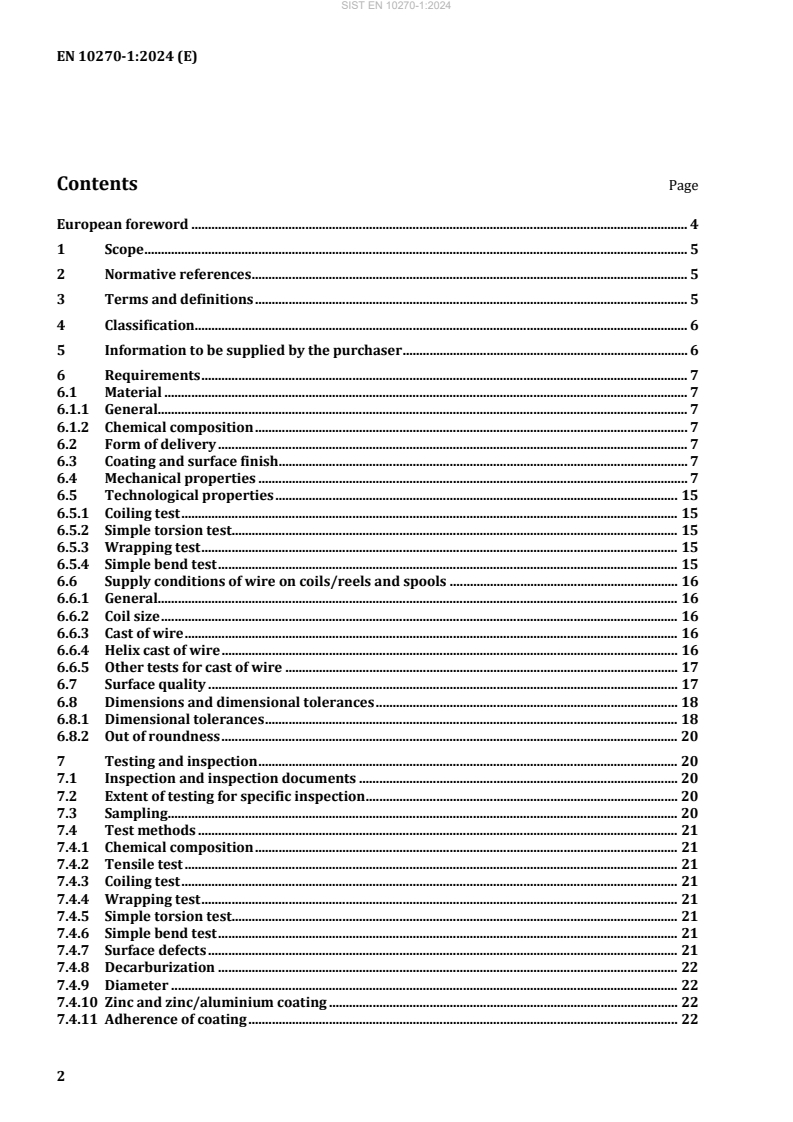
Contents Page
European foreword . 4
1 Scope . 5
2 Normative references . 5
3 Terms and definitions . 5
4 Classification. 6
5 Information to be supplied by the purchaser . 6
6 Requirements . 7
6.1 Material . 7
6.1.1 General. 7
6.1.2 Chemical composition . 7
6.2 Form of delivery . 7
6.3 Coating and surface finish. 7
6.4 Mechanical properties . 7
6.5 Technological properties . 15
6.5.1 Coiling test . 15
6.5.2 Simple torsion test. 15
6.5.3 Wrapping test . 15
6.5.4 Simple bend test . 15
6.6 Supply conditions of wire on coils/reels and spools . 16
6.6.1 General. 16
6.6.2 Coil size . 16
6.6.3 Cast of wire . 16
6.6.4 Helix cast of wire . 16
6.6.5 Other tests for cast of wire . 17
6.7 Surface quality . 17
6.8 Dimensions and dimensional tolerances . 18
6.8.1 Dimensional tolerances . 18
6.8.2 Out of roundness . 20
7 Testing and inspection . 20
7.1 Inspection and inspection documents . 20
7.2 Extent of testing for specific inspection . 20
7.3 Sampling . 20
7.4 Test methods . 21
7.4.1 Chemical composition . 21
7.4.2 Tensile test . 21
7.4.3 Coiling test . 21
7.4.4 Wrapping test . 21
7.4.5 Simple torsion test. 21
7.4.6 Simple bend test . 21
7.4.7 Surface defects . 21
7.4.8 Decarburization . 22
7.4.9 Diameter . 22
7.4.10 Zinc and zinc/aluminium coating . 22
7.4.11 Adherence of coating . 22
7.5 Retests . 22
8 Marking and packaging . 22
Annex A (informative) Additional information . 26
A.1 Definition of surface condition of the wire . 26
A.2 Physical characteristics at room temperature . 27
A.3 Accuracy of measuring instruments . 27
A.4 Tensile strength formula . 27
A.5 Indication for the use of cold drawn spring steel wire . 28
Annex B (informative) Protection performance classes . 29
Bibliography . 30
European foreword
This document (EN 10270-1:2024) has been prepared by Technical Committee CEN/TC 459 “ECISS –
European Committee for Iron and Steel Standardization” , the secretariat of which is held by AFNOR.
This European Standard shall be given the status of a national standard, either by publication of an
identical text or by endorsement, at the latest by August 2024 and conflicting national standards shall be
withdrawn at the latest by August 2024.
Attention is drawn to the possibility that some of the elements of this document may be the subject of
patent rights. CEN shall not be held responsible for identifying any or all such patent rights.
This document will supersede EN 10270-1:2017.
In comparison with the previous edition, the following technical modifications have been made:
— 3.1, added specific requirements for Dynamic duty (D);
— 6.7.3, added “Protection Performance class”.
EN 10270, Steel wire for mechanical springs is composed of the following parts:
— Part 1: Patented cold drawn unalloyed spring steel wire;
— Part 2: Oil hardened and tempered spring steel wire.
Any feedback and questions on this document should be directed to the users’ national standards body.
A complete listing of these bodies can be found on the CEN website.
According to the CEN-CENELEC Internal Regulations, the national standards organizations of the
following countries are bound to implement this European Standard: Austria, Belgium, Bulgaria, Croatia,
Cyprus, Czech Republic, Denmark, Estonia, Finland, France, Germany, Greece, Hungary, Iceland, Ireland,
Italy, Latvia, Lithuania, Luxembourg, Malta, Netherlands, Norway, Poland, Portugal, Republic of North
Macedonia, Romania, Serbia, Slovakia, Slovenia, Spain, Sweden, Switzerland, Türkiye and the United
Kingdom.
Through its sub-committee SC 6 “Wire rod and wires” (secretariat: AFNOR).
1 Scope
This document applies to patented cold drawn unalloyed steel wire of circular cross-section for the
manufacture of mechanical springs for static duty and dynamic duty applications.
General technical delivery requirements can be found in EN 10021.
2 Normative references
The following documents are referred to in the text in such a way that some or all of their content
constitutes requirements of this document. For dated references, only the edition cited applies. For
undated references, the latest edition of the referenced document (including any amendments) applies.
EN 10021, General technical delivery conditions for steel products
EN 10204, Metallic products - Types of inspection documents
EN 10218-1, Steel wire and wire products - General - Part 1: Test methods
EN 10218-2, Steel wire and wire products - General - Part 2: Wire dimensions and tolerances
EN 10244-2, Steel wire and wire products - Non-ferrous metallic coatings on steel wire - Part 2: Zinc or zinc
alloy coatings
CEN/TR 10261, Iron and steel - European standards for the determination of chemical composition
EN ISO 377, Steel and steel products - Location and preparation of samples and test pieces for mechanical
testing (ISO 377)
EN ISO 3887, Steels - Determination of the depth of decarburization (ISO 3887)
EN ISO 6892-1, Metallic materials - Tensile testing - Part 1: Method of test at room temperature (ISO 6892-
1)
EN ISO 14284, Steel and iron - Sampling and preparation of samples for the determination of chemical
composition (ISO 14284)
EN ISO 16120-1, Non-alloy steel wire rod for conversion to wire - Part 1: General requirements (ISO 16120-
1)
EN ISO 16120-2, Non-alloy steel wire rod for conversion to wire - Part 2: Specific requirements for general
purpose wire rod (ISO 16120-2)
EN ISO 16120-4, Non-alloy steel wire rod for conversion to wire - Part 4: Specific requirements for wire rod
for special applications (ISO 16120-4)
3 Terms and definitions
For the purposes of this document, the following terms and definitions apply.
ISO and IEC maintain terminology databases for use in standardization at the following addresses:
— IEC Electropedia: available at https://www.electropedia.org/
— ISO Online browsing platform: available at https://www.iso.org/obp/
3.1
patented cold drawn wire
wire drawn to size by cold deformation of a starting material that has been subjected to a thermal
treatment of patenting (see EN ISO 4885), giving structure suitable for subsequent rolling or drawing
Note 1 to entry: For spring with Dynamic duty (D) according to Table 1, the wire is preferably subjected to
continuous patenting to achieve a more homogeneous microstructure.
4 Classification
The grade of spring wire used depends on the stress level and the nature of the duty. Where springs are
subjected to static stresses or infrequent dynamic loading, a wire grade for static duty (S) shall be used.
In the other cases with frequent or predominantly dynamic loading and where small coiling ratios or
severe bending radius is required, a wire grade for dynamic duty (D) shall be used. Depending on the
stress level, spring wire is manufactured in 3 tensile strength grades: low, medium and high.
Table 1 gives an overview of the different grades.
Table 1 — Spring wire grades
a
Tensile strength Static Dynamic
Low tensile strength SL —
Medium tensile strength SM DM
High tensile strength SH DH
a
For specific applications, another tensile strength may be agreed.
5 Information to be supplied by the purchaser
The purchaser shall clearly state in his enquiry or order the product and following information:
a) the desired quantity;
b) the term spring steel wire or straightened and cut lengths;
c) the number of this document: EN 10270-1;
d) the steel grade (see Tables 1 and 2);
e) the nominal wire diameter selected from Table 3 and for cut length the length and the length
tolerance class (see Table 7);
f) the coating indicated by its abbreviation and surface finish (see 6.3);
g) the form of delivery and unit mass (see 6.2);
h) the type of inspection document (see 7.1);
i) any particular agreement.
EXAMPLE 5 t patented cold drawn tempered spring steel wire according to this standard, grade SM, nominal
diameter 2,50 mm, phosphate coated on spools of about 300 kg; inspection certificate type 3.1 according to
EN 10204:
5 t spring steel wire EN 10270-1 — SM-2,50 ph on spools of about 300 kg; EN 10204:—, 3.1.
6 Requirements
6.1 Material
6.1.1 General
Steel spring wire shall be made from steel grades according to:
— for SL, SM and SH EN ISO 16120-2;
— for DM and DH EN ISO 16120-4.
For general requirements, EN ISO 16120-1 applies.
6.1.2 Chemical composition
The chemical composition according to the heat analysis shall comply with the limit values shown in
Table 2. The permissible deviation of the product analysis from the heat analysis shall be in accordance
with EN ISO 16120-2 and EN ISO 16120-4 respectively.
Table 2 — Chemical composition, % by mass
a b
Grade C Si Mn P S Cu
SL, SM, SH 0,35 to 1,00 0,10 to 0,30 0,40 to 1,20 0,035 max. 0,035 max. 0,20 max.
DM, DH 0,45 to 1,00 0,10 to 0,30 0,40 to 1,20 0,020 max. 0,025 max. 0,12 max.
a
Such a wide range is stipulated to accommodate the whole range of sizes. For individual sizes the carbon
range is substantially more restricted.
b
For the manganese content, a different range from the one indicated in the table may be agreed at the time
of ordering, with a maximum not exceeding 1,20 % and with a minimum range of 0,20 %.
The addition of micro-alloying elements may be agreed between the manufacturer and the purchaser.
NOTE Some diameter ranges require particular attention for residuals. Therefore, no figures are mentioned for
chromium, nickel, molybdenum, tin, etc., leaving room for special arrangements between purchaser and supplier,
dependent on their mutual processing conditions. This is also the case for the aluminium content.
6.2 Form of delivery
The wire shall be delivered in unit packages of a coil (singles, carriers or formers), spools, spoolless cores
or as straight lengths. Unless otherwise agreed at the time of ordering, the form of delivery will be coils;
straight lengths shall be supplied in bundles.
6.3 Coating and surface finish
The spring wire may be supplied phosphate coated (ph) either dry drawn or wet drawn, copper coated
(cu), zinc (Z) or zinc/aluminium (ZA) coated.
Other coatings, considered as special, can be agreed between the purchaser and the supplier
(see Annex A).
If no specific surface finish is specified, the type of finish shall be at the manufacturer’s discretion.
In addition, the wire can be ordered with an oiled surface for all surface finishes.
6.4 Mechanical properties
For the tensile strength (R ) and reduction in area after fracture (Z), the wire grades shall satisfy the
m
values listed in Table 3. Reduction of area shall be measured only for wire diameter 0,80 mm < d.
The range of tensile strength values within a unit package shall not exceed the values of Table 4.
a
Table 3 — Mechanical properties and quality requirements for wire grades SL, SM, DM, SH and DH
1 2 3 4 5 6 7 8 9 10 11 12
b c d h
Wire diameter d Tensile strength Rm Minimum Minimum Permissible Permissible Mass
reduction in number of depth of decarburization
kg/1 000 m
area after twists in the surface depth for wire
fracture Z for torsion test Nt defects for grades DM, DH
wire grades SL, for wire grades wire grades
SM, SH, DM and SL, SM, SH, DM DM, DH
c
DH and DH
For wire grades
e
Nominal size Permissible SL SM DM SH DH
deviations
mm mm MPa MPa MPa MPa MPa % mm mm
d = 0,05 2 800 to 0,015 4
3 520
0,05 < d ≤ 0,06 2 800 to 0,022 2
3 520
0,06 < d ≤ 0,07 ±0,003 2 800 to 0,030 2
3 520
0,07 < d ≤ 0,08 2 800 to 0,039 5
3 480
0,08 < d ≤ 0,09 2 800 to 0,049 9
3 430
0,09 < d ≤ 0,10 2 800 to 0,061 7
3 380
0,10 < d ≤ 0,11 2 800 to 0,074 6
3 350
0,11 < d ≤ 0,12 ±0,004 2 800 to 0,088 8
3 320 coiling test
0,12 < d ≤ 0,14 2 800 to 0,121
f f
as specified in - -
3 250
0,14 < d ≤ 0,16 2 800 to 7.4.3 0,158
3 200
1 2 3 4 5 6 7 8 9 10 11 12
0,16 < d ≤ 0,18 2 800 to 0,200
3 160
0,18 < d ≤ 0,20 ±0,005 2 800 to 0,247
3 110
0,20 < d ≤ 0,22 2 770 to 0,298
3 080
0,22 < d ≤ 0,25 2 720 to 0,385
3 010
0,25 < d ≤ 0,28 2 680 to 0,488
2 970
0,28 < d ≤ 0,30 2 370 to 2 370 to 2 660 to 2 660 to 0,555
2 650 2 650 2 940 2 940
0,30 < d ≤ 0,32 ±0,008 2 350 to 2 350 to 2 640 to 2 640 to 0,631
2 630 2 630 2 920 2 920
0,32 < d ≤ 0,34 2 330 to 2 330 to 2 610 to 2 610 to 0,713
2 600 2 600 2 890 2 890
0,34 < d ≤ 0,36 2 310 to 2 310 to 2 590 to 2 590 to 0,799
2 580 2 580 2 870 2 870
0,36 < d ≤ 0,38 2 290 to 2 290 to 2 570 to 2 570 to 0,890
2 560 2 560 2 850 2 850
0,38 < d ≤ 0,40 2 270 to 2 270 to 2 560 to 2 560 to
0,985
2 550 2 550 2 830 2 830
0,40 < d ≤ 0,43 2 250 to 2 250 to 2 530 to 2 530 to
1,14
2 520 2 520 2 800 2 800
0,43 < d ≤ 0,45 2 240 to 2 240 to 2 510 to 2 510 to
1,25
2 500 2 500 2 780 2 780 coiling test
0,45 < d ≤ 0,48 2 220 to 2 220 to 2 490 to 2 490 to
f f
as specified in - - 1,42
2 480 2 480 2 760 2 760
0,48 < d ≤ 0,50 ±0,008 2 200 to 2 200 to 2 480 to 2 480 to 7.4.3
1,54
2 470 2 470 2 740 2 740
1 2 3 4 5 6 7 8 9 10 11 12
0,50 < d ≤ 0,53 2 180 to 2 180 to 2 460 to 2 460 to
1,73
2 450 2 450 2 720 2 720
0,53 < d ≤ 0,56 2 170 to 2 170 to 2 440 to 2 440 to
1,93
2 430 2 430 2 700 2 700
0,56 < d ≤ 0,60 2 140 to 2 140 to 2 410 to 2 410 to
2,22
2 400 2 400 2 670 2 670
0,60 < d ≤ 0,63 2 130 to 2 130 to 2 390 to 2 390 to
2,45
2 380 2 380 2 650 2 650
0,63 < d ≤ 0,65 2 120 to 2 120 to 2 380 to 2 380 to
2,60
2 370 2 370 2 640 2 640
0,65 < d ≤ 0,70 ±0,010 2 090 to 2 090 to 2 360 to 2 360 to
3,02
2 350 2 350 2 610 2 610
0,70 < d ≤ 0,75 2 070 to 2 070 to 2 330 to 2 330 to
3,47
2 320 2 320 2 580 2 580
0,75 < d ≤ 0,80 2 050 to 2 050 to 2 310 to 2 310 to
3,95
2 300 2 300 2 560 2 560
0,80 < d ≤ 0,85 ±0,015 2 030 to 2 030 to 2 290 to 2 290 to
4,45
2 280 2 280 2 530 2 530
0,85 < d ≤ 0,90 2 010 to 2 010 to 2 270 to 2 270 to
4,99
2 260 2 260 2 510 2 510
0,90 < d ≤ 0,95 2 000 to 2 000 to 2 250 to 2 250 to 25
5,59
2 240 2 240 2 490 2 490
0,95 < d ≤ 1,00 1 720 to 1 980 to 1 980 to 2 230 to 2 230 to
6,17
1 970 2 220 2 220 2 470 2 470
1,00 < d ≤ 1,05 1 710 to 1 960 to 1 960 to 2 210 to 2 210 to
6,80
1 950 2 200 2 200 2 450 2 450 1 % max. of 1,5 % max. of
1,05 < d ≤ 1,10 ±0,020 1 690 to 1 950 to 1 950 to 2 200 to 2 200 to 40
wire diameter wire diameter 7,46
1 940 2 190 2 190 2 430 2 430
1,10 < d ≤ 1,20 1 670 to 1 920 to 1 920 to 2 170 to 2 170 to
8,88
1 910 2 160 2 160 2 400 2 400
1 2 3 4 5 6 7 8 9 10 11 12
1,20 < d ≤ 1,25 1 660 to 1 910 to 1 910 to 2 150 to 2 150 to
9,63
2 380
1 900 2 140 2 140 2 380
1,25 < d ≤ 1,30 1 640 to 1 900 to 1 900 to 2 140 to 2 140 to 25
10,42
1 890 2 130 2 130 2 370 2 370
1,30 < d ≤ 1,40 1 620 to 1 870 to 1 870 to 2 110 to 2 110 to
12,08
1 860 2 100 2 100 2 340 2 340
2 090 to
1,40 < d ≤ 1,50 ±0,020 1 600 to 1 850 to 1 850 to 2 090 to
13,90
1 840 2 080 2 080 2 310 2 310
1,50 < d ≤ 1,60 1 590 to 1 830 to 1 830 to 2 060 to 2 060 to
15,8
1 820 2 050 2 050 2 290 2 290
1,60 < d ≤ 1,70 1 570 to 1 810 to 1 810 to 2 040 to 2 040 to
17,8
1 800 2 030 2 030 2 260 2 260
1,70 < d ≤ 1,80 1 550 to 1 790 to 1 790 to 2 020 to 2 020 to
20,0
1 780 2 010 2 010 2 240 2 240
1,80 < d ≤ 1,90 1 540 to 1 770 to 1 770 to 2 000 to 2 000 to
22,3
1 760 1 990 1 990 2 220 2 220
1,90 < d ≤ 2,00 1 520 to 1 760 to 1 760 to 1 980 to 1 980 to 1 % max. of 1,5 % max. of
1 750 1 970 1 970 2 200 2 200 wire wire
24,7
diameter diameter
2,00 < d ≤ 2,10 ±0,025 1 510 to 1 740 to 1 740 to 1 970 to 1 970 to 22
27,2
1 730 1 960 1 960 2 180 2 180
2,10 < d ≤ 2,25 1 490 to 1 720 to 1 720 to 1 940 to 1 940 to
40 31,2
1 710 1 930 1 930 2 150 2 150
2,25 < d ≤ 2,40 1 470 to 1 700 to 1 700 to 1 920 to 1 920 to
35,5
1 690 1 910 1 910 2 130 2 130
2,40 < d ≤ 2,50 1 460 to 1 690 to 1 690 to 1 900 to 1 900 to
38,5
1 680 1 890 1 890 2 110 2 110
2,50 < d ≤ 2,60 1 450 to 1 670 to 1 670 to 1 890 to 1 890 to
41,7
1 660 1 880 1 880 2 100 2 100
1 2 3 4 5 6 7 8 9 10 11 12
2,60 < d ≤ 2,80 1 420 to 1 650 to 1 650 to 1 860 to 1 860 to
48,3
2 070
1 640 1 850 1 850 2 070
2,80 < d ≤ 3,00 1 410 to 1 630 to 1 630 to 1 840 to 1 840 to
55,5
1 620 1 830 1 830 2 040 2 040
3,00 < d ≤ 3,20 ±0,030 1 390 to 1 610 to 1 610 to 1 820 to 1 820 to
63,1
1 600 1 810 1 810 2 020 2 020
1 790 to
3,20 < d ≤ 3,40 1 370 to 1 590 to 1 590 to 1 790 to
71,3
1 580 1 780 1 780 1 990 1 990
3,40 < d ≤ 3,60 1 350 to 1 570 to 1 570 to 1 770 to 1 770 to 16
79,9
1 560 1 760 1 760 1 970 1 970
3,60 < d ≤ 3,80 1 340 to 1 550 to 1 550 to 1 750 to 1 750 to
89,0
1 540 1 740 1 740 1 950 1 950
3,80 < d ≤ 4,00 ±0,030 1 320 to 1 530 to 1 530 to 1 740 to 1 740 to
98,6
1 520 1 730 1 730 1 930 1 930
4,00 < d ≤ 4,25 1 310 to 1 510 to 1 510 to 1 710 to 1 710 to 16
1 500 1 700 1 700 1 900 1 900
4,25 < d ≤ 4,50 1 290 to 1 500 to 1 500 to 1 690 to 1 690 to
1 490 1 680 1 680 1 880 1 880
4,50 < d ≤ 4,75 ±0,035 1 270 to 1 480 to 1 480 to 1 680 to 1 680 to 12
1 470 1 670 1 670 1 860 1 860
4,75 < d ≤ 5,00 1 260 to 1 460 to 1 460 to 1 660 to 1 660 to
1 450 1 650 1 650 1 840 1 840
5,00 < d ≤ 5,30 1 240 to 1 440 to 1 440 to 1 640 to 1 640 to 35 11
1 430 1 630 1 630 1 820 1 820
5,30 < d ≤ 5,60 1 230 to 1 430 to 1 430 to 1 620 to 1 620 to 11
1 420 1 610 1 610 1 800 1 800
5,60 < d ≤ 6,00 1 210 to 1 400 to 1 400 to 1 590 to 1 590 to 10 1 % max. 1,5 % max.
1 390 1 580 1 580 1 770 1 770
of wire of wire 222
diameter diameter
1 2 3 4 5 6 7 8 9 10 11 12
6,00 < d ≤ 6,30 ±0,040 1 190 to 1 390 to 1 390 to 1 570 to 1 570 to 9
1 750
1 380 1 560 1 560 1 750
6,30 < d ≤ 6,50 1 180 to 1 380 to 1 380 to 1 560 to 1 560 to 9
1 370 1 550 1 550 1 740 1 740
6,50 < d ≤ 7,00 1 160 to 1 350 to 1 350 to 1 540 to 1 540 to 9
1 340 1 530 1 530 1 710 1 710
g
1 510 to
7,00 < d ≤ 7,50 1 140 to 1 330 to 1 330 to 1
...