

EN 9104-1:2023
(Main)Aerospace series - Quality management systems - Part 1: Requirements for Certification of aviation, space, and defense
- Abstract
This document defines the industry-accepted requirements for the ICOP scheme, which provides confidence to ASD customers, that organizations with certification of their QMS, issued by accredited CBs, meet applicable AQMS standard requirements. The requirements in this document are applicable to all participants in the ICOP scheme. If there is a conflict between the requirements of this document, and customer or applicable statutory/regulatory requirements, the latter takes precedence.
- Status
- Published
- Publication Date
- 05-Dec-2023
- Technical Committee
- ASD-STAN - Aerospace
- Drafting Committee
- ASD-STAN/D 6/S 1 - EAQG European Aerospace Quality Group
- Current Stage
- 6060 - Definitive text made available (DAV) - Publishing
- Start Date
- 06-Dec-2023
- Completion Date
- 06-Dec-2023

Overview
EN 9104-1:2023 - Aerospace series - Quality management systems - Part 1: Requirements for Certification of aviation, space, and defense - defines the industry-accepted requirements for the ICOP (Industry Controlled Other Party) scheme. Published by CEN and prepared by IAQG/ASD‑STAN, this standard establishes how certification and oversight for Aerospace Quality Management Systems (AQMS) should be managed so that certifications issued by accredited Certification Bodies (CBs) give ASD customers confidence that organizations meet applicable AQMS requirements. Where conflicts arise, customer or statutory/regulatory requirements take precedence.
Key Topics and Requirements
- Scope & Principles: Purpose of the ICOP scheme and core industry principles for AQMS certification.
- Policy, Ethics & Oversight: Requirements for documented policy, ethical conduct, and oversight mechanisms to ensure impartiality and credibility.
- Scheme Structure: Industry‑controlled other party management structure and responsibilities across regional, sector, and management teams.
- Accreditation Bodies: Requirements and resource expectations for Accreditation Bodies participating in the ICOP scheme.
- Certification Bodies (CBs): Structural, resource and process requirements for CBs, including certification decision-making and certificate transfer.
- Audit Processes: Planning and execution of aerospace QMS audits, integrated management system audits, audit team formation, reporting, and the use of ICT in audits.
- Performance-Based Surveillance / Recertification: Requirements for ongoing surveillance and recertification based on performance indicators.
- Auditor Authentication & Training: Interfaces with auditor authentication bodies and training provider approval processes (links to EN 9104‑3 and EN 9104‑2).
- Online Supplier Database: Requirements for the online aerospace supplier information system used for data-sharing and transparency.
- Normative References: Alignment with EN 9100-series, ISO 9001, ISO/IEC 17021-1, ISO/IEC 17011, ISO 19011 and relevant IAF documents.
Applications - Who Uses It
- Aerospace, aviation, space, and defense organizations seeking internationally recognized AQMS certification.
- Certification Bodies (CBs) and Accreditation Bodies (ABs) implementing or participating in the ICOP scheme.
- Purchasing and supply chain managers who require consistent certification acceptance across suppliers.
- Auditors, auditor authentication bodies, and training providers involved in AQMS competence, authentication and oversight.
- Regulatory and quality assurance teams aligning company QMS requirements with industry certification best practices.
Related Standards
- EN 9100, EN 9110, EN 9120 (EN 9100-series)
- EN 9104-2 (oversight) and EN 9104-3 (auditor training & authentication)
- ISO 9001, ISO 19011, ISO/IEC 17021-1, ISO/IEC 17011
- IAF mandatory and informative documents (IAF MD / ID series)
Keywords: EN 9104-1:2023, ICOP scheme, aerospace quality management, AQMS certification, certification bodies, accreditation bodies, aerospace audits, EN 9100-series.
Relations
- Effective Date
- 19-Jan-2023
- Effective Date
- 25-Aug-2026
- Effective Date
- 25-Aug-2026
- Effective Date
- 25-Aug-2026
- Effective Date
- 25-Aug-2026
- Effective Date
- 25-Aug-2026
- Effective Date
- 09-Feb-2026
- Effective Date
- 28-Jan-2026
- Effective Date
- 28-Jan-2026
- Effective Date
- 28-Jan-2026
- Effective Date
- 28-Jan-2026
- Refers
EN 9110:2018 - Quality Management Systems - Requirements for Aviation Maintenance Organizations - Effective Date
- 28-Jan-2026
- Effective Date
- 28-Jan-2026
- Effective Date
- 28-Jan-2026
- Effective Date
- 28-Jan-2026
Get Certified
Connect with accredited certification bodies for this standard

BSI Group
BSI (British Standards Institution) is the business standards company that helps organizations make excellence a habit.

Bureau Veritas
Bureau Veritas is a world leader in laboratory testing, inspection and certification services.

DNV
DNV is an independent assurance and risk management provider.
Sponsored listings
Frequently Asked Questions
EN 9104-1:2023 is a standard published by the European Committee for Standardization (CEN). Its full title is "Aerospace series - Quality management systems - Part 1: Requirements for Certification of aviation, space, and defense". This standard covers: This document defines the industry-accepted requirements for the ICOP scheme, which provides confidence to ASD customers, that organizations with certification of their QMS, issued by accredited CBs, meet applicable AQMS standard requirements. The requirements in this document are applicable to all participants in the ICOP scheme. If there is a conflict between the requirements of this document, and customer or applicable statutory/regulatory requirements, the latter takes precedence.
This document defines the industry-accepted requirements for the ICOP scheme, which provides confidence to ASD customers, that organizations with certification of their QMS, issued by accredited CBs, meet applicable AQMS standard requirements. The requirements in this document are applicable to all participants in the ICOP scheme. If there is a conflict between the requirements of this document, and customer or applicable statutory/regulatory requirements, the latter takes precedence.
EN 9104-1:2023 is classified under the following ICS (International Classification for Standards) categories: 03.100.70 - Management systems; 03.120.10 - Quality management and quality assurance; 03.120.20 - Product and company certification. Conformity assessment; 49.020 - Aircraft and space vehicles in general. The ICS classification helps identify the subject area and facilitates finding related standards.
EN 9104-1:2023 has the following relationships with other standards: It is inter standard links to EN 9104-001:2013, ISO 19011:2018, ISO/IEC 17000:2020, ISO/IEC 17011:2017, ISO 9001:2015, ISO/IEC 17021-1:2015, ISO 9000:2015, EN 9120:2018, EN 9104-3:2023, EN 9100:2018, EN ISO 19115-2:2019/A1:2022, EN 9110:2018, EN ISO 17468:2023, EN 14752:2019, EN 9101:2023. Understanding these relationships helps ensure you are using the most current and applicable version of the standard.
EN 9104-1:2023 is available in PDF format for immediate download after purchase. The document can be added to your cart and obtained through the secure checkout process. Digital delivery ensures instant access to the complete standard document.
Standards Content (Sample)
SLOVENSKI STANDARD
01-februar-2024
Aeronavtika - Sistemi vodenja kakovosti - 1. del: Zahteve za certificiranje letalstva,
vesoljskih dejavnosti in obrambe
Aerospace series - Quality management systems - Part 1: Requirements for Certification
of aviation, space, and defense
Luft- und Raumfahrt - Qualitätsmanagementsysteme - Teil 1: Anforderungen an
Zertifizierungsverfahren für Qualitätsmanagementsysteme der Luftfahrt, Raumfahrt und
Verteidigung
Série aérospatiale - Systèmes de management de la qualité - Partie 1 : Exigences
relatives à la certification dans l'aéronautique, l'espace et la défense
Ta slovenski standard je istoveten z: EN 9104-1:2023
ICS:
03.100.70 Sistemi vodenja Management systems
03.120.10 Vodenje in zagotavljanje Quality management and
kakovosti quality assurance
49.020 Letala in vesoljska vozila na Aircraft and space vehicles in
splošno general
2003-01.Slovenski inštitut za standardizacijo. Razmnoževanje celote ali delov tega standarda ni dovoljeno.
EN 9104-1
EUROPEAN STANDARD
NORME EUROPÉENNE
December 2023
EUROPÄISCHE NORM
ICS 03.100.70; 03.120.10; 03.120.20; 49.020 Supersedes EN 9104-001:2013
English Version
Aerospace series - Quality management systems - Part 1:
Requirements for Certification of aviation, space, and
defense
Série aérospatiale - Systèmes de management de la Luft- und Raumfahrt - Qualitätsmanagementsysteme -
qualité - Partie 1 : Exigences relatives à la certification Teil 1: Anforderungen an Zertifizierungsverfahren für
dans l'aéronautique, l'espace et la défense Qualitätsmanagementsysteme der Luftfahrt,
Raumfahrt und Verteidigung
This European Standard was approved by CEN on 7 May 2023.
CEN members are bound to comply with the CEN/CENELEC Internal Regulations which stipulate the conditions for giving this
European Standard the status of a national standard without any alteration. Up-to-date lists and bibliographical references
concerning such national standards may be obtained on application to the CEN-CENELEC Management Centre or to any CEN
member.
This European Standard exists in three official versions (English, French, German). A version in any other language made by
translation under the responsibility of a CEN member into its own language and notified to the CEN-CENELEC Management
Centre has the same status as the official versions.
CEN members are the national standards bodies of Austria, Belgium, Bulgaria, Croatia, Cyprus, Czech Republic, Denmark, Estonia,
Finland, France, Germany, Greece, Hungary, Iceland, Ireland, Italy, Latvia, Lithuania, Luxembourg, Malta, Netherlands, Norway,
Poland, Portugal, Republic of North Macedonia, Romania, Serbia, Slovakia, Slovenia, Spain, Sweden, Switzerland, Türkiye and
United Kingdom.
EUROPEAN COMMITTEE FOR STANDARDIZATION
COMITÉ EUROPÉEN DE NORMALISATION
EUROPÄISCHES KOMITEE FÜR NORMUNG
CEN-CENELEC Management Centre: Rue de la Science 23, B-1040 Brussels
© 2023 CEN All rights of exploitation in any form and by any means reserved Ref. No. EN 9104-1:2023 E
worldwide for CEN national Members.
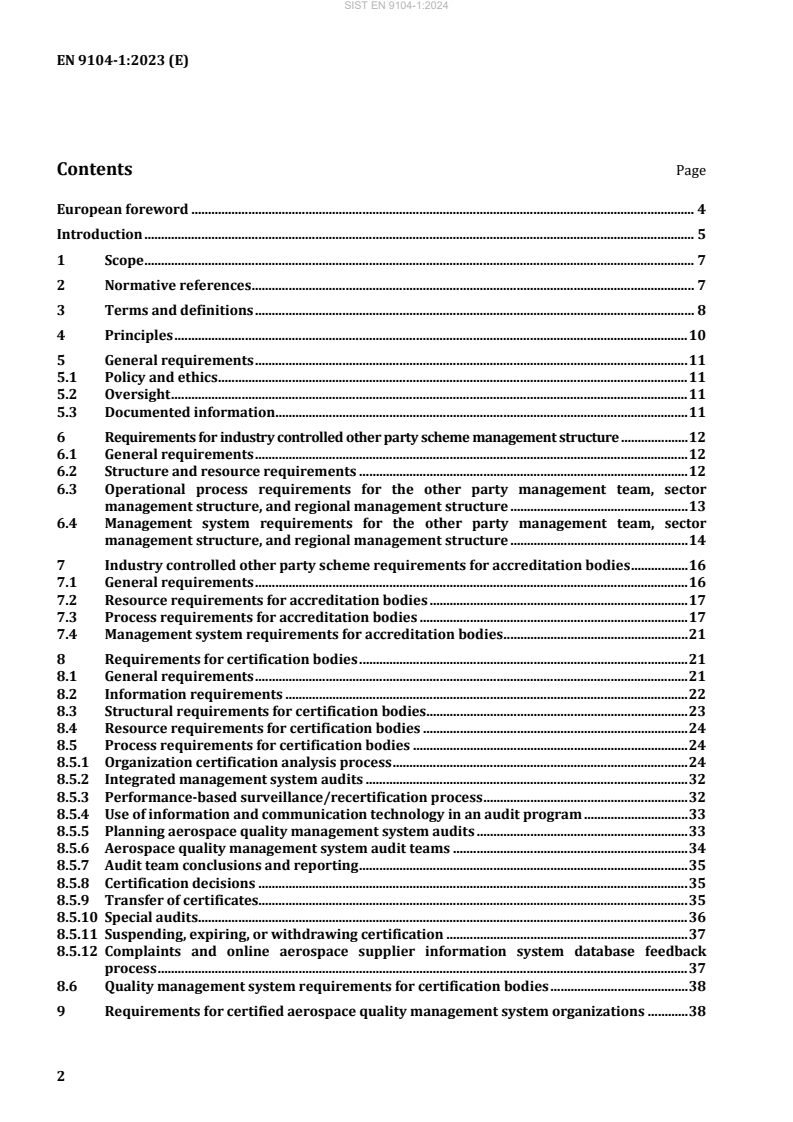
Contents Page
European foreword . 4
Introduction . 5
1 Scope . 7
2 Normative references . 7
3 Terms and definitions . 8
4 Principles . 10
5 General requirements . 11
5.1 Policy and ethics . 11
5.2 Oversight . 11
5.3 Documented information . 11
6 Requirements for industry controlled other party scheme management structure . 12
6.1 General requirements . 12
6.2 Structure and resource requirements . 12
6.3 Operational process requirements for the other party management team, sector
management structure, and regional management structure . 13
6.4 Management system requirements for the other party management team, sector
management structure, and regional management structure . 14
7 Industry controlled other party scheme requirements for accreditation bodies . 16
7.1 General requirements . 16
7.2 Resource requirements for accreditation bodies . 17
7.3 Process requirements for accreditation bodies . 17
7.4 Management system requirements for accreditation bodies . 21
8 Requirements for certification bodies . 21
8.1 General requirements . 21
8.2 Information requirements . 22
8.3 Structural requirements for certification bodies . 23
8.4 Resource requirements for certification bodies . 24
8.5 Process requirements for certification bodies . 24
8.5.1 Organization certification analysis process . 24
8.5.2 Integrated management system audits . 32
8.5.3 Performance-based surveillance/recertification process . 32
8.5.4 Use of information and communication technology in an audit program . 33
8.5.5 Planning aerospace quality management system audits . 33
8.5.6 Aerospace quality management system audit teams . 34
8.5.7 Audit team conclusions and reporting . 35
8.5.8 Certification decisions . 35
8.5.9 Transfer of certificates. 35
8.5.10 Special audits . 36
8.5.11 Suspending, expiring, or withdrawing certification . 37
8.5.12 Complaints and online aerospace supplier information system database feedback
process . 37
8.6 Quality management system requirements for certification bodies . 38
9 Requirements for certified aerospace quality management system organizations . 38
9.1 General requirements . 38
9.2 Requirements for use of performance-based surveillance/recertification process . 39
10 Requirements for auditor authentication bodies . 39
11 Requirements for training provider approval bodies . 39
12 Online aerospace supplier information system database requirements . 39
Annex A (informative) Acronym log . 41
Annex B (normative) Industry controlled other party scheme . 43
Annex C (normative) Use of online aerospace supplier information system database functionality . 44
Annex D (normative) Performance-based surveillance/recertification process . 47
Bibliography . 50
European foreword
This document (EN 9104-1:2023) has been prepared by the Aerospace and Defence Industries
Association of Europe — Standardization (ASD-STAN).
After enquiries and votes carried out in accordance with the rules of this Association, this
document has received the approval of the National Associations and the Official Services of the
member countries of ASD-STAN, prior to its presentation to CEN.
This document shall be given the status of a national standard, either by publication of an identical
text or by endorsement, at the latest by June 2024, and conflicting national standards shall be
withdrawn at the latest by June 2024.
Attention is drawn to the possibility that some of the elements of this document may be the subject
of patent rights. CEN shall not be held responsible for identifying any or all such patent rights.
This document supersedes EN 9104-001:2013.
According to the CEN-CENELEC Internal Regulations, the national standards organizations of the
following countries are bound to implement this document: Austria, Belgium, Bulgaria, Croatia,
Cyprus, Czech Republic, Denmark, Estonia, Finland, France, Germany, Greece, Hungary, Iceland,
Ireland, Italy, Latvia, Lithuania, Luxembourg, Malta, Netherlands, Norway, Poland, Portugal,
Republic of North Macedonia, Romania, Serbia, Slovakia, Slovenia, Spain, Sweden, Switzerland,
Türkiye and the United Kingdom.
Introduction
To assure customer satisfaction, ASD organizations must provide, and continually improve, safe and
reliable products and services that meet or exceed customer and applicable statutory and regulatory
requirements. The globalization of the industry and the resulting diversity of regional and national
requirements and expectations have complicated this objective. Organizations have the challenge of
purchasing products and services from external providers throughout the world and at all levels of the
supply chain. External providers have the challenge of delivering products and services to multiple
customers having varying quality requirements and expectations.
Industry established the IAQG, with representatives from ASD companies in the Americas, Asia/Pacific,
and Europe, to implement initiatives that make significant improvements in quality and reductions in
cost throughout the value stream. This document has been prepared by the IAQG.
The IAQG develops documents that standardize QMS requirements to the greatest extent possible and
can be used at all levels of the supply chain by organizations around the world. Their use should result
in improved quality, cost, and delivery performance through the reduction or elimination of
organization-unique requirements, effective implementation of the QMS, and wider application of good
practices. While primarily developed for the ASD industry, these EN 9100-series standards
(i.e., EN 9100, EN 9110, and EN 9120) can also be used in other industry sectors when a QMS with
supplemental requirements, beyond an ISO 9001 system, is needed.
Subsequently, the IAQG developed a global scheme for the acceptance and recognition of certification of
an organization’s AQMS performed by Certification Bodies (CBs), using the EN 9100-series, and taking
into account the existing schemes for QMS certification. The scheme relies on:
— the use of CBs with specific ASD elements and requirements, under the guidance and oversight of
the ASD industry; and
— the use of a harmonized approach with the CBs for improving the quality and process control
throughout the entire supply chain.
This document defines the scheme requirements for managing AQMS certification (commonly referred
to as the ‘ICOP scheme’). Other standards in this series (i.e., EN 9104-2, EN 9104-3) provide specific
requirements for defining the industry oversight process, and the AQMS requirements for ASD auditor
training, development, competence, and authentication, respectively. The three ICOP scheme
requirements documents are:
— EN 9104-1, Aerospace series — Quality management systems — Part 1: Requirements for certification
of aviation, space and defence;
— EN 9104-2, Aerospace series — Quality management systems — Part 2: Requirements for the
oversight of aviation, space, and defence quality management system certification programs; and
— EN 9104-3, Aerospace series — Quality management systems — Part 3: Requirements for aviation,
space and defence auditor training, development, competence, and authentication.
In this document, the following terms are used:
— “shall” indicates a requirement;
— “should” indicates a recommendation;
— “may” indicates a permission;
— “can” indicates a possibility or capability;
st st
— “annual” or “annually” indicates a 12-month period beginning January 1 and ending December 31 ; and
— “days” are calendar days, unless otherwise specified.
Words “example” or “e.g.” indicate suggestions given for guidance and information marked “NOTE” is
for guidance in understanding or clarifying the associated requirement .
Notes to entry used in definitions, however, are considered normative and will provide additional information
that supplements the terminological data such as statements, instructions, recommendations or requirements
relating to the use of a term.
1 Scope
This document defines the industry-accepted requirements for the ICOP scheme, which provides
confidence to ASD customers, that organizations with certification of their QMS, issued by accredited
CBs, meet applicable AQMS standard requirements. The requirements in this document are applicable
to all participants in the ICOP scheme. If there is a conflict between the requirements of this document,
and customer or applicable statutory/regulatory requirements, the latter shall take precedence.
2 Normative references
The following documents are referred to in the text in such a way that some or all of their content
constitutes requirements of this document. For dated references, only the edition cited applies. For
undated references, the latest edition of the referenced document (including any amendments) applies.
EN 9100, Quality management systems — Requirements for aviation, space, and defence organizations
2, 3
EN 9101, Aerospace series — Requirements for conducting audits of aviation, space and defence quality
management systems
EN 9104-2, Aerospace series — Quality management systems — Part 2: Requirements for the oversight of
aviation, space, and defence quality management system certification programs
2, 3
EN 9104-3, Aerospace series — Quality management systems — Part 3: Requirements for aviation,
space, and defence auditor training, development, competence, and authentication
EN 9110, Quality management systems — Requirements for aviation maintenance organizations
EN 9120, Quality management systems — Requirements for aviation, space and defence distributors
ISO 9000, Quality management systems — Fundamentals and vocabulary
ISO 9001, Quality management systems — Requirements
ISO 19011, Guidelines for auditing management systems
ISO/IEC 17000, Conformity assessment — Vocabulary and general principles
ISO/IEC 17011, Conformity assessment — Requirements for accreditation bodies accrediting conformity
assessment bodies
ISO/IEC 17021-1, Conformity assessment — Requirements for bodies providing audit and certification of
management systems — Part 1: Requirements
IAF ID 3, IAF Informative Document for Management of Extraordinary Events or Circumstances Affecting
ABs, CABs and Certified Organizations
As developed under the auspices of the IAQG and published by various standards bodies [e.g., ASD-STAN, SAE
International, European Committee for Standardization (CEN), Japanese Standards Association (JSA)/Society
of Japanese Aerospace Companies (SJAC), Brazilian Association for Technical Norms (ABNT)].
Published as ASD-STAN Standard at the date of publication of this document by Aerospace and Defence
industries Association of Europe — Standardization (ASD-STAN), https://www.asd-stan.org/.
IAF MD 1, IAF Mandatory Document for the Audit and Certification of a Management System Operated by
a Multi-Site Organization
IAF MD 2, IAF Mandatory Document for the Transfer of Accredited Certification of Management Systems
IAF MD 4, IAF Mandatory Document for the Use of Information and Communication Technology (ICT) for
Auditing/Assessment Purposes
IAF MD 5, IAF Mandatory Document — Determination of Audit Time of Quality, Environmental, and
Occupational Health & Safety Management Systems
IAF MD 11, IAF Mandatory Document for the Application of ISO/IEC 17021 for Audits of Integrated
Management Systems
IAF ML 4, IAF Multilateral Recognition Arrangements — Policies and Procedures for a MLA on the Level of
Single Accreditation Bodies and on the Level of Regional Accreditation Groups
3 Terms and definitions
For the purposes of this document, the terms and definitions given in ISO 9000, ISO/IEC 17000, the
IAQG International Dictionary4 and the following apply.
NOTE An acronym log for this document is presented in Annex A
ISO and IEC maintain terminology databases for use in standardization at the following addresses:
— ISO Online browsing platform: available at https://www.iso.org/obp/
— IEC Electropedia: available at https://www.electropedia.org/
3.1
aerospace quality management system
AQMS
QMS based upon ISO 9001 that includes additional ASD requirements, as established in EN 9100,
EN 9110, and EN 9120
3.2
aerospace quality management system (AQMS) auditor
person with the demonstrated attributes (i.e., training, audit experience, industry experience) and
competence to conduct an audit on ASD organizations
Note 1 to entry: an AQMS auditor is either an authenticated experienced auditor (AEA) or an authenticated
auditor (AA), and shall have met the requirements set forth in EN 9104-3.
3.3
industry controlled other party (ICOP) scheme
IAQG and industry managed scheme for the audit and certification of an organization’s AQMS by
accredited other party CBs, in accordance with the requirements defined in the EN 9104-series
Located on the IAQG website, www.iaqg.org.
3.4
international aerospace quality group
IAQG
non-profit global association comprised of member companies from the ASD industries, whose mission
is to achieve significant performance improvements world-wide in terms of quality, delivery, and cost,
through the development and deployment of standards, industry oversight, and guidance materials for
use at all levels of the global supply chain
3.5
international aerospace quality group (IAQG) other party management team (OPMT)
organization comprised of member companies within the ASD industries who design, develop,
manufacture, and support original equipment at system or subsystem levels; established by the IAQG to
manage the ICOP scheme
3.6
international aerospace quality group (IAQG) sector
sub-structure of the IAQG that consists of members in a specific geographic area (i.e., Americas, Europe,
Asia/Pacific)
3.7
online aerospace supplier information system (OASIS™) database
web-based IAQG application containing information on participating national aerospace industry
associations (NAIAs), accreditation bodies (ABs), training provider approval bodies (TPABs), auditor
authentication bodies (AABs), accredited CBs, AQMS auditors, certified organizations, and audits, which
are approved and recognized by the sector management structure (SMS) through the ICOP scheme
3.8
organization certification analysis process
OCAP
interactive process between the organization and CB to determine the organization’s AQMS scope and
associated certification audit program, and conduct a risk assessment for certification within the ICOP
scheme
3.9
Performance-based surveillance/recertification process
PBS/RP
ICOP scheme AQMS surveillance and recertification optional process based on objective evidence and
demonstration that a certified organization continually maintains a conforming, effective, and high
performing AQMS
3.10
regional management structure
RMS
committee within a SMS that operates at the regional level, responsible for the EN 9104-series
conformance in their respective regions
Note 1 to entry: they perform the same functions as the SMS, under control of the SMS within their sector.
3.11
sector management structure
SMS
committee established in an IAQG sector that manages the application and oversight of the ICOP scheme
Note 1 to entry: each sector may use a different name for this organization.
3.12
training provider approval body
TPAB
body approved by the SMS or RMS that has the primary responsibility to conduct the review and
approval of training courses and training providers (TPs)
4 Principles
4.1 The ICOP scheme (see Annex B) is globally recognized, and includes AQMS certifications, auditor
authentications, and the bodies and entities approved in accordance with the EN 9104-series
(i.e., EN 9104-1, EN 9104-2, and EN 9104-3) and all published resolutions.
4.2 The IAQG has established the IAQG other party management team (OPMT) to act as the scheme
owner that develops, implements, maintains, and improves the requirements of the ICOP scheme.
4.3 The IAQG OPMT is supported by a SMS for each sector (i.e., Americas, Europe, Asia-Pacific).
4.4 The IAQG has established the OASIS database as the mandated repository for ICOP scheme
certification data.
4.5 The OASIS database supports the collection, issuance, and management of feedback between
various stakeholders in the ICOP scheme, as depicted in Annex C.
a) OASIS database users can provide feedback to ICOP scheme stakeholders (e.g., CBs, ABs, IAQG
leadership, document representatives).
b) Feedback can include ICOP scheme information, complaints, questions, or suggestions users have
with respect to:
— management of the ICOP scheme;
— AQMS certificates;
— AQMS audit data;
— certified organization performance;
— clarification of standards; or
— support needed.
4.6 The ICOP scheme participants identified within the OASIS database have demonstrated their
initial and continuing conformance to the applicable requirements.
a) The OASIS database identifies the status of ICOP scheme participants.
b) ICOP scheme entities that are suspended are at risk and their status is temporarily invalid.
c) ICOP scheme participants that are expired, withdrawn, or deleted are no longer in conformance
with the scheme requirements.
5 General requirements
5.1 Policy and ethics
5.1.1 IAQG member company representatives and other ICOP scheme participants shall be in
compliance with local and national laws and anti-trust regulations.
5.1.2 All participants in the IAQG ICOP scheme shall report conduct that adversely affects the
integrity of the scheme to the appropriate entity(ies).
5.1.3 When an AB, CB, SMS, or regional management structure (RMS) representative encounters an
AQMS auditor misconduct issue, they shall share relevant documented information detailing the
misconduct with the AAB responsible for the subject auditor’s AQMS authentication.
5.2 Oversight
5.2.1 The ICOP scheme oversight process and associated activities, including the management and
performance of oversight, shall be in accordance with the requirements defined in EN 9104-2.
5.2.2 Entities participating in the ICOP scheme shall agree to EN 9104-2 oversight by the IAQG OPMT
and the applicable SMS or RMS.
5.2.3 Complaints generated from the ICOP scheme shall be directed to the entity of the complaint. If
not resolved, the complaint may be escalated in accordance with Table 1.
Escalated complaints should focus on process issues and not process decisions.
Table 1 — Complaint resolution escalation
If complaint is Certified
Auditor Assessor AB CB RMS SMS
against the: Organization
The issue shall be
Assessor’s SMS or IAQG
communicated to CB CB AB SMS
Organization RMS OPMT
the:
5.3 Documented information
5.3.1 Documented information and data in the form of audit reports, nonconformities, checklists, or
other company specific information, generated by the application of this document, shall be considered
confidential (also referred to as proprietary or sensitive) between the parties generating, collecting, or
using the data; and be managed as such, except as required by law.
a) Organizations using this information shall keep it confidential (both internally and externally),
unless otherwise agreed by the consenting parties.
b) IAQG OPMT ICOP scheme participants shall not be provided with access to records of their
competitors.
Documented information retained by ABs and CBs on certified organizations may be subject to an audit
or review, at any time, by applicable ABs, SMS, RMS, government, or regulatory authorities.
5.3.2 Access to documented information required by the ICOP scheme, shall be available to the IAQG
OPMT, SMS, or RMS (if applicable) for evaluating operation of the scheme and conformance with this
document.
5.3.3 Records demonstrating conformance to the ICOP scheme requirements of the EN 9104-series
shall be retained by the originator for a minimum period of ten years.
6 Requirements for industry controlled other party scheme management structure
6.1 General requirements
6.1.1 The IAQG SMS may be supported by a RMS. When established, an RMS shall operate as a part of
the SMS, performing the same functions on a regional level.
6.1.2 The IAQG OPMT, SMS, and RMS (if applicable) shall be in conformance with IAQG published
policies and operating management system (OMS) written rules and procedures that pertain to the
ICOP scheme.
6.2 Structure and resource requirements
6.2.1 The IAQG OPMT shall be composed of the following:
a) three IAQG member company representatives with voting rights, which are members of and
appointed by each SMS;
b) alternate voting members from IAQG member companies, appointed by each SMS, to ensure full
representation at all meetings or votes; and
c) other non-voting stakeholder representatives that may include sector AB representatives, sector CB
representatives, regulatory authorities, IAF representatives, IAQG sector member companies, IAQG
strategy streams representatives, and other invited organizations or persons (as necessary) to
support the operations of the IAQG OPMT.
6.2.2 All IAQG OPMT, SMS, or RMS voting, alternate members, non-voting stakeholder representatives
and observers shall have completed an IAQG confidentiality agreement and conflict of interest
declaration.
6.2.3 IAQG OPMT, SMS, or RMS members that have an employment relationship (direct or
contractual) with an ICOP scheme recognized CB are prohibited from being an ICOP scheme voting
member.
6.2.4 Each SMS and RMS (if applicable) shall be composed of the following:
a) representatives from the IAQG sector member companies or RMS, as voting members; and
b) other non-voting stakeholders that may include representatives from ABs, CBs, AABs, TPABs,
interested parties (e.g., regulatory, customer, governmental agencies), and other invited
organizations or persons, as necessary, to support the operations of the SMS.
6.2.5 At least one annual meeting shall be held by the IAQG OPMT, each sector SMS, and each RMS (if
applicable). Meetings may be open to all stakeholders (per the stated agenda) or restricted to voting
members and invited members for industry-specified topics.
6.3 Operational process requirements for the other party management team, sector
management structure, and regional management structure
6.3.1 The IAQG OPMT shall develop and implement processes to:
a) develop, implement, maintain, and improve the requirements of the ICOP scheme;
b) operate an effective oversight program in accordance with EN 9104-2 standard requirements,
including the oversight of each SMS;
c) establish resolutions for the interpretation, clarification, and changes to the ICOP scheme
requirements;
d) define SMS reporting requirements;
e) conduct reviews of ICOP scheme activities to identify lessons learned, improvement opportunities,
and manage risks;
f) review and respond to any issues, queries, or feedback from ICOP scheme stakeholders.
The IAQG OPMT may establish alleviations for extraordinary events in accordance with guidance
defined in IAF ID 3;
g) resolve appeals and complaints directed or elevated to the IAQG OPMT; and
h) elevate complaints which cannot be resolved by the IAQG OPMT to the IAQG Executive Committee
for final disposition.
6.3.2 The SMS shall develop and implement processes to:
a) ensure conformity to the requirements of this document in their sector;
b) report the status and activities of the SMS to the IAQG OPMT in accordance with IAQG OPMT
requirements and
c) determine if one or more RMS is needed as part of the SMS, including defining the geographic area
of each RMS utilized.
6.3.3 When one or more RMS are determined to be needed, there shall be:
a) a definition of the structure and interface established between the SMS and RMS;
b) an approval of any RMS operating within the SMS in accordance with applicable requirements; and
c) an acceptance of the voluntary suspension or withdrawal of a RMS.
6.3.4 Each SMS or RMS shall develop and implement processes to:
a) approve an applicant AB, AAB, or TPAB in accordance with applicable requirements;
b) suspend or withdraw the approval of an AB, AAB, or TPAB;
c) recommend the suspension or withdrawal of:
1) a CB that is accredited for the ICOP scheme by an AB,
2) an AQMS auditor authenticated by an AAB,
3) a TP or training course approved by a TPAB, or
4) an organization certified for an AQMS standard by a CB operating in the ICOP scheme;
d) review and recognize AB accreditation decisions (i.e., accreditation, extensions of AQMS scope,
suspension, or withdrawal);
e) recognize the authentication of AQMS auditors, and approval of TPs and training courses in the
SMS or RMS;
f) ensure the status (i.e., approved, suspended, expired, or withdrawn) of the participating entities is
correctly recorded in the OASIS database within 10 days of the status change;
g) operate an effective oversight program in accordance with EN 9104-2 standard requirements;
h) manage appeals and complaints directed to either the RMS or SMS; and
i) conduct reviews of the SMS or RMS activities to identify lessons learned and improvement
opportunities and manage risks.
6.3.5 Complaints or appeals shall be summarized and reviewed by the respective SMS or RMS on an
annual basis. The process shall include the reporting of the results of this review to the IAQG OPMT.
NOTE Complaints will be escalated, as necessary, in accordance with Table 1.
6.3.6 An RMS shall report the status and activities of the RMS to the SMS.
6.4 Management system requirements for the other party management team, sector
management structure, and regional management structure
6.4.1 The IAQG OPMT shall operate in accordance with the IAQG Governance and OMS.
6.4.2 The IAQG OPMT shall develop operational processes, documented procedures, and documented
information (as needed) to manage the operation of the IAQG ICOP scheme.
6.4.3 Management system requirements for the SMS shall include:
a) documented information to support effective operation of the ICOP scheme;
b) conformance to the process requirements of this document;
c) the SMS structure; and
d) any associated RMS structures (if applicable).
6.4.4 When a SMS includes a RMS in its structure, the SMS shall document:
a) a methodology for delegating appropriate process requirements and operational activities from the
SMS to a RMS;
b) a description of the interface between the SMS and RMS that includes arrangements for
communication and reporting and
c) a methodology for approving and, where appropriate, accepting the voluntary suspension or
withdrawal of any RMS operating within the SMS.
6.4.5 The SMS or RMS shall develop and maintain documented information to support the following:
a) the review, approval, implementation, and modification of procedure(s);
b) the identification and retention of records that demonstrate the effective operation of the ICOP
scheme;
c) the process for approval of an AB, AAB, or TPAB;
d) that participants in the evaluation or decision-making associated with the approval, suspension, or
withdrawal of an AB, AAB, or TPAB shall be impartial and shall not have participated in the
development or operations of the AB, AAB, or TPAB in any way for a period of two years prior to
the decision being made; and
e) that the suspension or withdrawal of an AB includes:
1) required actions and conditions for the removal of a suspension,
2) communication of the changed status to the IAQG OPMT and other IAQG sectors within 30 days,
3) ensuring there is no recognition of any AB accreditation decisions for any CBs entering the ICOP
scheme during the period of suspension,
4) where a suspended AB fails to provide acceptable corrective action within 90 days, the AB shall
be withdrawn for a minimum of 12 months, and
5) ensuring that when an AB is withdrawn:
— accredited CBs shall have six months to seek accreditation by another AB approved for the
ICOP scheme and recognition withdrawn from the CB, if a new accreditation is not granted,
— AQMS certifications issued by the affected CBs are eligible for reissue under the new AB or
transfer to another accredited CB during this six-month period, and
— AQMS certificates shall be withdrawn, if not reissued under the new AB or transferred to
another accredited CB within the six-month period.
7 Industry controlled other party scheme requirements for accreditation bodies
7.1 General requirements
7.1.1 ABs that meet the requirements for participation in the ICOP scheme shall apply to be approved
by the SMS or RMS in the geographic area in which the AB is located.
7.1.2 ABs shall maintain membership in the IAF and be a signatory of the IAF Multilateral Agreement
(MLA) for management systems certification based on ISO/IEC 17021-1 and IAF ML 4, including
ISO 9001 QMS.
7.1.3 ABs shall conform to requirements defined in this document, ISO/IEC 17011, IAF MDs, and
IAF MLA policies and procedures applicable to the ICOP scheme.
7.1.4 ABs shall identify this document as a normative document for AQMS accreditation purposes.
7.1.5 The accreditation agreement with CBs shall:
a) grant right of access to relevant CB documented information and client agreements in accordance
with this document;
b) commit in writing that CBs are prohibited from issuing unaccredited AQMS certifications, during
application or when accredited;
c) identify a single fixed office location (8.3.1), where the management of the ICOP scheme,
certification decisions, auditors (competence, approval, and evaluation), and retained documented
information are located;
NOTE This location is where the office assessment to the requirements of this document will take place,
when the CB operates from multiple locations.
d) state that during suspension of an ICOP scheme AQMS accreditation the CB shall:
1) notify all existing and certification applicants of the CBs suspended status and any consequences,
within 15 days of the suspension notification,
2) continue surveillance and recertification audits,
3) not perform Stage 1 audits for initial certification,
4) not perform AQMS scope extensions,
5) not accept an AQMS certificate transfer from other CBs, and
6) provide the AB and either the SMS or RMS (if applicable) with information of any certification
decisions issued during the suspension.
7.1.6 ABs shall initiate the process and make a decision for withdrawal of AQMS accreditation for CBs
that fail to conform to the defined suspension requirements (see 7.1.5 d)) within the AB defined
timeframe.
7.1.7 ABs shall agree to oversight, by the approving SMS or RMS (if applicable).
7.1.8 ABs shall provide the IAQG OPMT, SMS, RMS (if applicable), and applicable regulatory
authorities ‘right of access’ to applicable AB documented information related to the implementation and
maintenance of the ICOP scheme.
7.1.9 When an AB accredits a CB outside of its country (subject to regional/local regulations), it shall
notify in advance the local ICOP scheme approved AB (if there is one), and the SMS or RMS
(if applicable) in the region the CB is located.
When an AB performs assessment activities in a region where another AB operates, the AB may at its
discretion utilize the services of another ICOP scheme approved AB in that region under the IAF and/or
regional policies and procedures regarding mutual recognition arrangements.
7.1.10 ABs shall notify the applicable IAQG SMS or RMS within 10 days, whenever an AQMS
accredited CB has a change to its AQMS or ISO 9001 accreditation (e.g., suspension, withdrawal, scope
extensions) that impacts existing AQMS certifications.
7.2 Resource requirements for accreditation bodies
7.2.1 ABs shall conform to the requirements of ISO/IEC 17011 for personnel competencies for the
ICOP scheme.
7.2.2 AB personnel involved in AQMS accreditation decisions shall have demonstrated knowledge and
understanding of the EN 9104-series, AQMS standards, and the OASIS database. A majority of persons
making an AQMS accreditation decision shall have work experience and/or demonstrated knowledge of
the ASD industry and the regulatory environment in which the scheme operates.
7.2.3 AB assessors (witness and office) conducting AQMS accreditation assessments shall have
demonstrated knowledge and understanding of the ICOP scheme, including the OASIS database, this
document, and AQMS standards.
7.2.4 AB witness assessors shall have demonstrated competency that includes ASD industry
knowledge work experience and training for each AQMS standard being assessed.
NOTE Reference EN 9104-3 for industry knowledge and work experience requirements.
Technical experts may be used, in accordance with ISO/IEC 17011, to supplement the assessment team
qualifications.
7.2.5 AB assessors conducting AQMS accreditation assessments shall have continuing professional
development (CPD) of not less than 24 hours in 3 years on the ICOP scheme and applicable AQMS
standards.
NOTE Each hour of structured learning activity is equivalent to one CPD hour.
7.2.6 ABs shall initiate and maintain AB and CB accreditation information and data requirements in
the OASIS database.
7.3 Process requirements for accreditation bodies
7.3.1 ABs shall define their process(es) for initial accreditation, scope extensions, and approval of
performance-based surveillance/recertification process (PBS/RP).
7.3.2 The ABs initial accreditation process shall include an assessment of the CBs conformance to
ISO/IEC 17021-1, the applicable requirements of this document, and the following:
a) ABs shall perform an initial office assessment;
b) ABs shall perform an initial stage 1 and stage 2 Witness Assessment (WA) for an AQMS standard; and
c) ABs shall perform at least one stage 2 WA for each additional AQMS standard for which an AQMS
accreditation is being sought.
7.3.3 The AB shall have a process for rejecting applications for AQMS accreditation for CBs whose
accreditation or application has been withdrawn within the last 12 months.
7.3.4 ABs shall have an assessment program for CBs that includes:
a) at least one annual office assessment at the single fixed office location (8.3.1);
b) an annual assessment of CB AQMS client files in accordance with Table 2, as determined during the
assessment planning.
Client files sampled should be proportional to the types of EN 9100-series certificates issued by the CB.
c) an assessment of an AQMS PBS/RP file at the office assessment after PBS/RP approval; and
d) at least one AQMS PBS/RP client file shall be reviewed during each accreditation cycle, when
applicable.
Table 2 — Accreditation body file review requirements of certification bodies
Total number of certificates issued Minimum number of CB AQMS client files to be
(all 91xx standards) reviewed annually
1 – 3 All client files
4 – 25 3
26 – 50 4
51 – 90 6
91 – 150 7
151 – 280 9
281 – 500 10
501 – 1 200 11
1 201 and above 12
7.3.5 ABs shall perform WAs of each CB's AQMS accreditation(s) that include:
a
...