

EN 15979:2025
(Main)Testing of ceramic raw materials and ceramic materials - Direct determination of mass fractions of impurities in powders and granules of silicon carbide by optical emission spectrometry by direct current arc excitation (DCArc-OES)
- Abstract
This document describes a method for the analysis of mass fractions of the impurities Al, B, Ca, Cr, Cu, Fe, Mg, Ni, Ti, V and Zr in powdered and grain-shaped silicon carbide of ceramic raw materials and ceramic materials. This application can also be extended to other metallic elements and other similar non-metallic powdered and grain-shaped materials such as carbides, nitrides, graphite, carbon blacks, cokes, carbon, as well as a number of further oxidic raw and basic materials after appropriate testing.
NOTE There is positive experience with materials such as, for example, graphite, boron carbide (B4C), boron nitride (BN), tungsten carbide (WC) and several refractory metal oxides.
This testing procedure is applicable to mass fractions of the impurities mentioned above from approximately 1 mg/kg up to approximately 3 000 mg/kg, after verification. In some cases, it is possible to extend the range up to 5 000 mg/kg depending on element, emission lines, DCArc parameters, and sample mass.
- Status
- Published
- Publication Date
- 23-Sep-2025
- Technical Committee
- CEN/TC 187 - Refractory products and materials
- Drafting Committee
- CEN/TC 187/WG 4 - Chemical analysis
- Current Stage
- 6060 - Definitive text made available (DAV) - Publishing
- Start Date
- 24-Sep-2025
- Due Date
- 02-Aug-2025
- Completion Date
- 24-Sep-2025

Overview
EN 15979:2025 - Testing of ceramic raw materials and ceramic materials - specifies a direct DCArc-OES (direct current arc optical emission spectrometry) method for measuring mass fractions of impurities in powdered and granulated silicon carbide. The standard covers determination of Al, B, Ca, Cr, Cu, Fe, Mg, Ni, Ti, V and Zr in SiC and can be extended, after validation, to other metallic elements and similar non‑metallic powders (carbides, nitrides, graphite, carbon blacks, cokes, carbon) and various refractory oxides. The method is applicable roughly from 1 mg/kg to 3 000 mg/kg and - depending on element, emission lines and instrument settings - can be extended up to ~5 000 mg/kg.
Key topics and technical requirements
- Principle: Direct evaporation and excitation of powdered sample in a DC arc plasma; emitted line spectra are measured by a simultaneous optical emission spectrometer.
- Analytes: Al, B, Ca, Cr, Cu, Fe, Mg, Ni, Ti, V, Zr (with possibility to extend to additional elements after testing).
- Working range & sensitivity: Lower mg/kg level detection; typical application range ~1–3 000 mg/kg (occasionally up to 5 000 mg/kg).
- Apparatus: Simultaneous emission spectrometer (e.g., Echelle or Paschen‑Runge), DCArc system with Stallwood jet, controlled Ar/O2 flows, spectral‑grade carbon/graphite electrodes, high‑precision balance and sample press.
- Sampling & sample prep: Representative sampling, drying to constant mass if wet, particle size ≤ 150 µm (100 mesh), careful milling/homogenization and contamination control.
- Calibration: Matrix‑matched calibration with certified reference materials (CRMs) where possible; minimum three‑point calibration within each measuring cycle; linear or quadratic regression for calibration curves.
- Data quality: Clauses cover procedure variants, emission lines, interference handling, calculation, expression of results, precision (repeatability/reproducibility), and uncertainty evaluation (informative annexes).
Practical applications
- Quality control and incoming inspection of silicon carbide powders and granules used in ceramics, refractories and abrasives.
- Material characterization in R&D labs for advanced ceramics and refractory materials.
- Routine monitoring of trace metal contamination in carbides, nitrides, graphite and selected oxide raw materials where wet digestion is undesirable.
- Faster, cost‑effective alternative to wet‑chemical ICP methods when many samples of the same matrix are analyzed.
Who should use this standard
- Ceramic and refractory manufacturers, materials testing laboratories, quality assurance teams, instrument vendors and researchers involved in trace analysis of powder materials.
Related standards and resources
- Supersedes EN 15979:2011.
- Sampling guidance referenced (informative): ISO 5022, ISO 8656‑1, ISO 21068‑1.
- Informative annexes in EN 15979:2025 detail emission lines, interferences, CRMs and interlaboratory results to support method implementation.
Keywords: EN 15979:2025, DCArc‑OES, optical emission spectrometry, silicon carbide impurities, powders and granules, mass fractions, calibration, certified reference materials.
Relations
- Effective Date
- 17-Jan-2024
- Effective Date
- 28-Jan-2026
Frequently Asked Questions
EN 15979:2025 is a standard published by the European Committee for Standardization (CEN). Its full title is "Testing of ceramic raw materials and ceramic materials - Direct determination of mass fractions of impurities in powders and granules of silicon carbide by optical emission spectrometry by direct current arc excitation (DCArc-OES)". This standard covers: This document describes a method for the analysis of mass fractions of the impurities Al, B, Ca, Cr, Cu, Fe, Mg, Ni, Ti, V and Zr in powdered and grain-shaped silicon carbide of ceramic raw materials and ceramic materials. This application can also be extended to other metallic elements and other similar non-metallic powdered and grain-shaped materials such as carbides, nitrides, graphite, carbon blacks, cokes, carbon, as well as a number of further oxidic raw and basic materials after appropriate testing. NOTE There is positive experience with materials such as, for example, graphite, boron carbide (B4C), boron nitride (BN), tungsten carbide (WC) and several refractory metal oxides. This testing procedure is applicable to mass fractions of the impurities mentioned above from approximately 1 mg/kg up to approximately 3 000 mg/kg, after verification. In some cases, it is possible to extend the range up to 5 000 mg/kg depending on element, emission lines, DCArc parameters, and sample mass.
This document describes a method for the analysis of mass fractions of the impurities Al, B, Ca, Cr, Cu, Fe, Mg, Ni, Ti, V and Zr in powdered and grain-shaped silicon carbide of ceramic raw materials and ceramic materials. This application can also be extended to other metallic elements and other similar non-metallic powdered and grain-shaped materials such as carbides, nitrides, graphite, carbon blacks, cokes, carbon, as well as a number of further oxidic raw and basic materials after appropriate testing. NOTE There is positive experience with materials such as, for example, graphite, boron carbide (B4C), boron nitride (BN), tungsten carbide (WC) and several refractory metal oxides. This testing procedure is applicable to mass fractions of the impurities mentioned above from approximately 1 mg/kg up to approximately 3 000 mg/kg, after verification. In some cases, it is possible to extend the range up to 5 000 mg/kg depending on element, emission lines, DCArc parameters, and sample mass.
EN 15979:2025 is classified under the following ICS (International Classification for Standards) categories: 81.060.10 - Raw materials. The ICS classification helps identify the subject area and facilitates finding related standards.
EN 15979:2025 has the following relationships with other standards: It is inter standard links to EN 15979:2011, EN ISO 1927-3:2012. Understanding these relationships helps ensure you are using the most current and applicable version of the standard.
EN 15979:2025 is available in PDF format for immediate download after purchase. The document can be added to your cart and obtained through the secure checkout process. Digital delivery ensures instant access to the complete standard document.
Standards Content (Sample)
SLOVENSKI STANDARD
01-december-2025
Preskušanje keramičnih surovin in keramičnih materialov - Neposredno
določevanje masnih frakcij nečistoč v prahu in zrnih silicijevega karbida z optično
emisijsko spektrometrijo z vzbujanjem obloka z enosmernim tokom (DCArc-OES)
Testing of ceramic raw materials and ceramic materials - Direct determination of mass
fractions of impurities in powders and granules of silicon carbide by optical emission
spectrometry by direct current arc excitation (DCArc-OES)
Prüfung keramischer Rohstoffe und keramischer Materialien - Direkte Bestimmung der
Massenanteile an Verunreinigungen in pulver- und kornförmigem Siliciumcarbid mittels
optischer Emissionsspektrometrie und Anregung im Gleichstrombogen (DCArc-OES)
Essai des matières premières céramiques et des matériaux céramiques - Détermination
directe des fractions massiques d'impuretés dans les poudres et granulés de carbure de
silicium par spectrométrie d'émission optique à excitation par arc de courant continu
(DCArc-OES)
Ta slovenski standard je istoveten z: EN 15979:2025
ICS:
81.060.10 Surovine Raw materials
2003-01.Slovenski inštitut za standardizacijo. Razmnoževanje celote ali delov tega standarda ni dovoljeno.
EN 15979
EUROPEAN STANDARD
NORME EUROPÉENNE
September 2025
EUROPÄISCHE NORM
ICS 81.060.10 Supersedes EN 15979:2011
English Version
Testing of ceramic raw materials and ceramic materials -
Direct determination of mass fractions of impurities in
powders and granules of silicon carbide by optical
emission spectrometry by direct current arc excitation
(DCArc-OES)
Essai des matières premières et matériaux de base Prüfung keramischer Roh- und Werkstoffe - Direkte
céramiques - Détermination directe des fractions Bestimmung der Massenanteile an Verunreinigungen
massiques d'impuretés dans les poudres et granulés de in pulver- und kornförmigem Siliciumcarbid mittels
carbure de silicium par OES à l'excitation d'arc DC optischer Emissionsspektrometrie und Anregung im
(DCArc-OES) Gleichstrombogen (DCArc-OES)
This European Standard was approved by CEN on 27 July 2025.
CEN members are bound to comply with the CEN/CENELEC Internal Regulations which stipulate the conditions for giving this
European Standard the status of a national standard without any alteration. Up-to-date lists and bibliographical references
concerning such national standards may be obtained on application to the CEN-CENELEC Management Centre or to any CEN
member.
This European Standard exists in three official versions (English, French, German). A version in any other language made by
translation under the responsibility of a CEN member into its own language and notified to the CEN-CENELEC Management
Centre has the same status as the official versions.
CEN members are the national standards bodies of Austria, Belgium, Bulgaria, Croatia, Cyprus, Czech Republic, Denmark, Estonia,
Finland, France, Germany, Greece, Hungary, Iceland, Ireland, Italy, Latvia, Lithuania, Luxembourg, Malta, Netherlands, Norway,
Poland, Portugal, Republic of North Macedonia, Romania, Serbia, Slovakia, Slovenia, Spain, Sweden, Switzerland, Türkiye and
United Kingdom.
EUROPEAN COMMITTEE FOR STANDARDIZATION
COMITÉ EUROPÉEN DE NORMALISATION
EUROPÄISCHES KOMITEE FÜR NORMUNG
CEN-CENELEC Management Centre: Rue de la Science 23, B-1040 Brussels
© 2025 CEN All rights of exploitation in any form and by any means reserved Ref. No. EN 15979:2025 E
worldwide for CEN national Members.
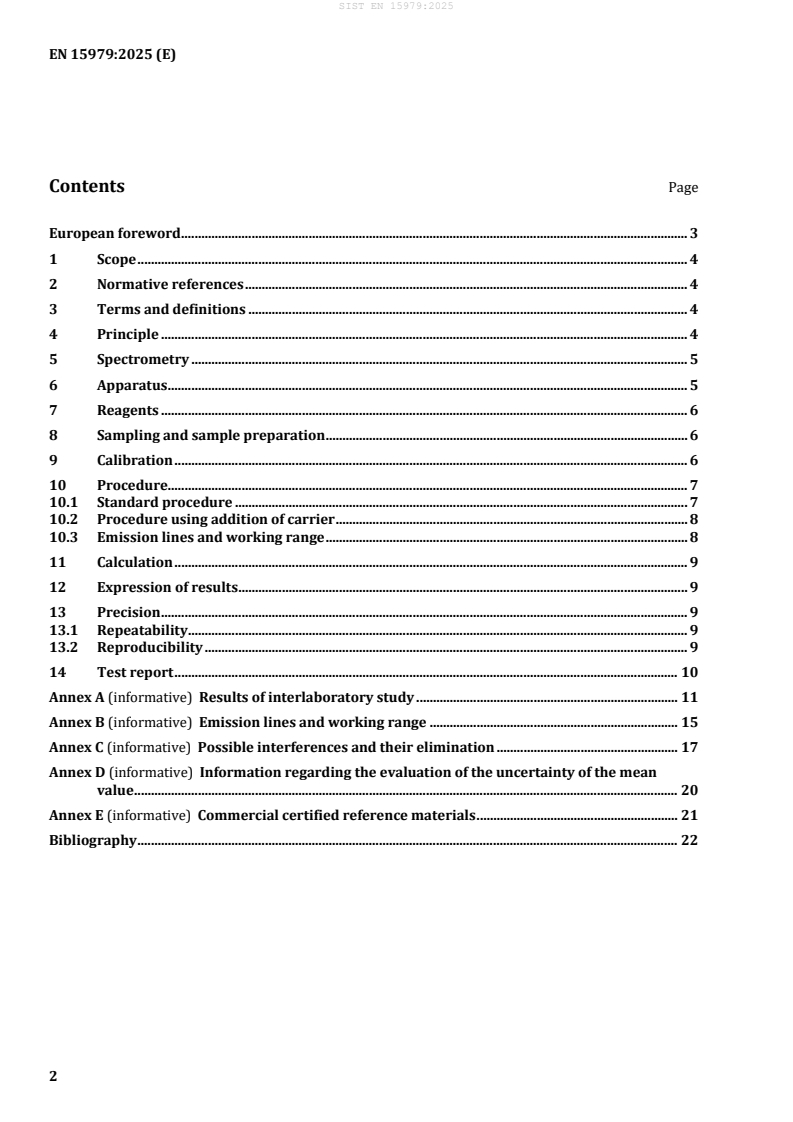
Contents Page
European foreword . 3
1 Scope . 4
2 Normative references . 4
3 Terms and definitions . 4
4 Principle . 4
5 Spectrometry . 5
6 Apparatus . 5
7 Reagents . 6
8 Sampling and sample preparation . 6
9 Calibration . 6
10 Procedure. 7
10.1 Standard procedure . 7
10.2 Procedure using addition of carrier . 8
10.3 Emission lines and working range . 8
11 Calculation . 9
12 Expression of results . 9
13 Precision . 9
13.1 Repeatability . 9
13.2 Reproducibility . 9
14 Test report . 10
Annex A (informative) Results of interlaboratory study . 11
Annex B (informative) Emission lines and working range . 15
Annex C (informative) Possible interferences and their elimination . 17
Annex D (informative) Information regarding the evaluation of the uncertainty of the mean
value . 20
Annex E (informative) Commercial certified reference materials . 21
Bibliography . 22
European foreword
This document (EN 15979:2025) has been prepared by Technical Committee CEN/TC 187 “Refractory
products and materials”, the secretariat of which is held by BSI.
This European Standard shall be given the status of a national standard, either by publication of an
identical text or by endorsement, at the latest by March 2026, and conflicting national standards shall be
withdrawn at the latest by March 2026.
Attention is drawn to the possibility that some of the elements of this document may be the subject of
patent rights. CEN shall not be held responsible for identifying any or all such patent rights.
This document supersedes EN 15979:2011.
— Clause 2 and Clause 3 have been added, noting that they neither add any normative references nor
terms and definitions to the document;
— Clause 9 adds more detail about calculation of the calibration functions;
— subclause 10.2 adds more detail about the procedure using addition of carrier;
— Clause 14 now provides the completeness of the information required by CEN/CENELEC Internal
Regulations Part 3;
— Annex A, Tables A.1 to A.4 now provides the correct printing of variables required by CEN/CENELEC
Internal Regulations Part 3;
— Annex B, Table B.1 provides additional information on the limits of determination.
Any feedback and questions on this document should be directed to the users’ national standards body.
A complete listing of these bodies can be found on the CEN website.
According to the CEN-CENELEC Internal Regulations, the national standards organisations of the
following countries are bound to implement this European Standard: Austria, Belgium, Bulgaria, Croatia,
Cyprus, Czech Republic, Denmark, Estonia, Finland, France, Germany, Greece, Hungary, Iceland, Ireland,
Italy, Latvia, Lithuania, Luxembourg, Malta, Netherlands, Norway, Poland, Portugal, Republic of North
Macedonia, Romania, Serbia, Slovakia, Slovenia, Spain, Sweden, Switzerland, Türkiye and the United
Kingdom.
1 Scope
This document describes a method for the analysis of mass fractions of the impurities Al, B, Ca, Cr, Cu, Fe,
Mg, Ni, Ti, V and Zr in powdered and grain-shaped silicon carbide of ceramic raw materials and ceramic
materials. This application can also be extended to other metallic elements and other similar non-metallic
powdered and grain-shaped materials such as carbides, nitrides, graphite, carbon blacks, cokes, carbon,
as well as a number of further oxidic raw and basic materials after appropriate testing.
NOTE There is positive experience with materials such as, for example, graphite, boron carbide (B C), boron
nitride (BN), tungsten carbide (WC) and several refractory metal oxides.
This testing procedure is applicable to mass fractions of the impurities mentioned above from
approximately 1 mg/kg up to approximately 3 000 mg/kg, after verification. In some cases, it is possible
to extend the range up to 5 000 mg/kg depending on element, emission lines, DCArc parameters, and
sample mass.
2 Normative references
There are no normative references in this document.
3 Terms and definitions
No terms and definitions are listed in this document.
ISO and IEC maintain terminology databases for use in standardization at the following addresses:
— ISO Online browsing platform: available at https://www.iso.org/obp
— IEC Electropedia: available at https://www.electropedia.org/
4 Principle
With DCArc-OES, the impurities are measured directly from the powdered silicon carbide sample, thus
avoiding the disadvantages of the usually applied wet-chemical digestion of silicon carbide such as high
time-consumption, the use of hazardous chemicals, dilution of the sample and the possibility of
systematic errors due to introduction of impurities as well as analyte losses. Compared to wet-chemical
ICP-OES methods, DCArc-OES requires more effort for method development and is therefore particularly
suitable when many samples of one matrix are to be measured. With DCArc-OES, impurities in silicon
carbide can be measured cost-effective, with high sample throughput and with a detection sensitivity
down to the lower mg/kg level.
In DCArc-OES, the powdered silicon carbide sample is evaporated and excited in the direct current arc-
plasma of the DCArc-system. The combustion and evaporation of the powdered sample material takes
place in the arc-plasma in an atmosphere of oxygen, mixed argon and oxygen or in air. The metallic traces
in the silicon carbide sample are excited in the arc-plasma to emission of optical radiation. The optical
radiation from the DCArc-system is guided into a simultaneous emission spectrometer by coupling via
fibre-optics or directly. If the coupling takes place via fibre-optics, the simultaneous emission
spectrometer can be a commercially available ICP-OES device, provided that the measurement can be
started with the plasma switched off.
NOTE As the fibre-optics used for coupling is usually made of quartz, emission lines with wavelengths of less
than around 220 nm can no longer be measured due to absorption.
Literature on DCArc-OES see [1], [3], [4], [5], [6], [8], [9] and [10].
5 Spectrometry
Optical emission spectrometry is based on the generation of line spectra of excited atoms or ions, where
each emission line is associated with an element and the line intensities are proportional to the mass
fractions of the elements in the analysed sample (see [6], [7] and [12]).
In a simultaneous emission spectrometer in, for example Paschen-Runge- or Echelle-configuration, the
optical radiation is dispersed. The intensities of suited emission lines or background positions are
registered with applicable detectors like photomultipliers (PMT), charge coupled devices (CCD),
complementary metal-oxide semiconductor (CMOS), charge injection devices (CID), and serial coupled
devices (SCD). By comparison of the intensities of the element-specific emission lines of the sample with
calibration samples of known composition, the mass fractions of the trace elements in the sample are
determined.
6 Apparatus
6.1 Common laboratory equipment, and the following:
6.2 Emission spectrometer, simultaneous, with the possibility to register transient emission signals
with a sampling rate of at least 5 Hz, suitable for the synchronised start of the DCArc-program and the
registration of the emission signals and possibility for coupling to the DCArc-system.
NOTE 1 If the coupling of the DCArc-system to the emission spectrometer takes place via fibre-optics, the
simultaneous emission spectrometer can be a commercially available ICP-OES device, provided that the
measurement can be started with the plasma switched off.
6.3 DCArc-system, with Stallwood jet, controlled gas-flows for argon and oxygen, preferably with
mass-flow control, and controlled setting of arc-current, preferably with the possibility of programmable
current vs. time programs with freely definable ramp- and hold-steps.
NOTE 2 When working with air, Stallwood jet and gas-flow controllers can be omitted.
6.4 Tweezers, self-closing.
6.5 Analytical balance, with a resolution of at least 0,01 mg.
6.6 Pressing tool, for compacting the sample into the electrode.
6.7 Drying cabinet, adjustable to (60 ± 5) °C.
NOTE 3 A drying cabinet will only be required if wet mixed and subsequently dried samples are used.
6.8 Stirring balls made out of polytetrafluoroethylene (PTFE), diameter 6 mm, for example.
NOTE 4 Stirring balls will be required if wet mixed and subsequently dried samples are used.
6.9 Plastic vessel, with screw cap, volume 25 ml, made of, for example, polyethylene (PE) or
polypropylene (PP).
NOTE 5 Plastic vessels will be required if mixed and subsequently dried samples are used.
6.10 High resistance carbon electrodes or graphite electrodes, spectral-grade, peak-shaped or
elliptical counter electrode (cathode), cup-shaped carrier electrode (anode) with groove or taper.
7 Reagents
Only analytical grade reagents shall be used unless stated otherwise.
7.1 Calibration samples with well-defined mass fractions of trace-impurities, preferably certified
reference materials (CRM).
NOTE Certified reference materials are available for main-, minor- and trace components (see Annex E).
7.2 Oxygen, purity ≥ 99,99 % (volume fraction).
7.3 Argon, purity ≥ 99,99 % (volume fraction).
7.4 Dichloromethane, CH Cl .
2 2
NOTE Dichloromethane will be required if wet mixed and subsequently dried samples are used.
8 Sampling and sample preparation
Sampling shall be performed in a way that the sample to be analysed is representative for the total
amount of material.
NOTE 1 For example, according to ISO 5022 [13], ISO 8656-1 [14] or ISO 21068-1 [15].
If the sample is not received in a dry state, it shall be dried at (110 ± 10) °C until constant mass is achieved
(<0,5 % variation). The sample is then cooled down to room temperature and stored in a desiccator.
NOTE 2 Drying for 2 h is normally sufficient.
The particle size of sample material shall be ≤ 150 µm (100 mesh). If necessary, the sample shall be
crushed, milled and homogenized. Regarding possible contamination, the material of the equipment used
shall be suited for the analytical task.
9 Calibration
Calibration shall be carried out for each measuring cycle with calibration samples (7.1) of defined mass
fractions of traces-impurities in accordance with Clause 10. Calibration samples shall be measured at the
beginning and at the end of the measuring cycle. Within the calibration range at least a three-point
calibration shall be performed (as shown, for example, in [4] and [8]).
Calibration samples (7.1) of identical or similar material as the unknown sample, if possible certified
reference materials or matrix matched synthetic calibration samples, shall be used. The mass fractions of
trace-impurities in the calibration samples should be within in the range of those of the sample material.
The calibration function for each emission line shall be calculated using the analyte masses of the
calibration samples used and the net-intensities of the emission line measured for these analyte masses.
A monotonically increasing slope of the calibration functions with a sufficiently high gradient is essential.
NOTE The calculation of the calibration functions is usually carried out as linear regression. If necessary, a
quadratic regression can also be used.
10 Procedure
10.1 Standard procedure
The sample prepared in accordance with Clause 8 is filled into the carrier electrode. One of the three
following procedures shall be applied:
a) The sample material is filled into the carrier electrode using a small, precisely tailored funnel and
applying mechanical compression;
b) The carrier electrode is filled by repeatedly pressing the cup (orifice downwards) onto the sample
material which is lying on a clean carrier (for example filter paper);
c) A sub-sample of the sample material is weighed to the nearest 0,01 mg into the carrier electrode in a
defined narrow weighing rang, for example 4,5 mg to 5,5 mg. The mass of the weighed sub-sample
shall be documented. Subsequently, the sub-sample shall be compacted in the cup of the carrier
electrode by slightly striking it on a rigid underlay or by knocking with a spatula at the tweezers
holding the carrier electrode.
Depending on dimension and shape of the carrier electrode the mass of the sub-sample can vary. In case
of trace-impurities with mass fractions above the calibrated range, the sample mass can be reduced to a
minimum of approximately 1 mg. In this case, a material of the same type, which does not contain the
elements to be measured, shall be added to the carrier electrode and mixed with the sub-sample. The
total mass of material in the carrier electrode shall correspond to that of the calibration sample (7.1).
Instead of a pure material of the same matrix, spectral-grade graphite powder can be used.
To avoid contamination, the tweezers (6.4) shall only be used in the clamping area of the carrier electrode
of the electrode holder of the DCArc-system.
The carrier electrode shall be fixed in the optical path using the electrode holder of the DCArc-system.
The distance to the upper counter electrode (cathode) shall be adjusted to the nearest 0,1 mm in a range
of 3,5 mm to 4,0 mm.
NOTE 1 The distance between the electrodes can vary according to the diameter of the electrodes.
The position of the electrodes, and thus the arc-discharge, shall be constant with respect to the optical
axis of the optical system. Any change of the optical adjustment will lead to different results. Parts of the
electrodes shall not be visible to the emission spectrometer. This is especially true for the upper electrode
(cathode) whereas the lower electrode (anode), because of the high burn-off rate, normally remains a
significantly shorter time in the optical path.
NOTE 2 Electrodes visible in the optical path result in a strong enhancement of the spectral background in some
spectral ranges.
The arc-discharge shall be started at the same time as the data acquisition of the emission spectrometer
(6.2).
The evaporation or combustion of the sample in the DCArc shall be carried out preferably under shielding
gas excluding any nitrogen. The mixing ratio of the shielding gas is about 70 parts by volume argon and
30 parts by volume oxygen at a constant gas flow of about (4 ± 1) l/min.
The combustion can also be performed in oxygen or in air. If air is used, one shall pay attention to spectral
interferences, for example CN-bands. In addition, a negative influence on the reproducibility can be
expected.
WARNING — It is not safe to look into the arc-plasma without eye protection (UV- and IR-radiation).
Reflections on reflective areas can be dangerous too.
Each sample shall be measured at least 3 times. If the single values of the multiple determinations of the
analyte contents deviate by more than a given degree, depending on the repeatability of the method, then
the analysis shall be repeated according to Clause 10.
In case of continuing poor reproducibility of the measured values of the contents of one or more analytes,
the sample shall be homogenized, for example using a mortar.
NOTE 3 If the measured analyte contents are near the limit of determination homogenization usually does not
improve the reproducibility and this additional step can be omitted.
10.2 Procedure using addition of carrier
This procedure is especially suitable for low analyte contents.
Weigh the sample, carrier and spectral-grade graphite to the nearest 0,1 mg into a plastic vessel (6.9).
The optimum mixing ratio as well as the selection of an appropriate carrier shall be investigated for each
sample material experimentally.
NOTE 1 Examples for such investigation are shown in [2] and [11].
Add one stirring ball (6.8) and 6 ml dichloromethane (7.4). Seal the plastic vessel and shake it for at least
10 min. Open the plastic vessel, place it in a drying oven and evaporate the dichloromethane at 60 °C for
1 h. Close the plastic bottle and loosen up the dried mixture by gently shaking. Use this mixture for
analysis.
WARNING — Dichloromethane should be handled with care, be aware of local safety regulations.
NOTE 2 Lower determination limits are achieved by adding a carrier material. Suitable carrier materials are
halides such as silver chloride (AgCl) and barium chloride (BaCl ).
For materials such as silicon carbide (SiC) and tungsten carbide (WC) and also for oxides such as
molybdenum oxide (MoO ), tungsten oxide (WO ), tantalum oxide (Ta O ) and niobium oxide (Nb O ),
3 3 2 3 2 3
BaCl with a mass-ratio of sample/graphite/BaCl of 10/4/1 shall be used as carrier. In the individual
2 2
case the ratio should be checked and, if necessary, be optimized.
The calibration samples (7.1) shall be processed in the same manner.
Filling of the carrier electrode and measurement shall be carried out in accordance with 10.1.
10.3 Emission lines and working range
When selecting the emission lines used to determine the content of an analyte, care shall be taken that
these are free of interferences originating from the sample matrix and other impurities. Only emission
lines shall be selected where under the chosen working conditions neither self-absorption nor self-
reversal can occur. Care shall also be taken regarding order interferences which may occur, in particular,
with Echelle-type spectrometers.
NOTE 1 Recommended emission lines and information on working ranges are given in Annex B.
NOTE 2 Possible interferences and their elimination are given in Annex C.
The upper working range is limited by a decrease in sensitivity (slope of the calibration function) to
approximately 80 % of its initial value. If necessary, less sensitive emission lines may be used to expand
the working range. To ensure correct measurement results, more than one emission line should
preferably be selected for each element.
11 Calculation
The intensities of emission lines measured by the emission spectrometer (6.2) shall be corrected to net-
intensities using the background intensities measured at the background measuring points. Using the
calibration functions, the net-intensities shall be assigned to the corresponding masses of the respective
analytes in the sample measured (see Clause 10), which shall then be used together with the sample
masses to calculate the mass fractions of analytes in the sample.
NOTE To improve accuracy, the method of internal standard can be applied. For this purpose, the ratio of
intensities of the emission lines of analyte elements to the intensity of the emission line of a reference element is
used to compensate for matrix effects and changed excitation conditions. For the analysis of silicon carbide, silicon
can be used as internal standard for example.
12 Expression of results
The contents of the ana
...