

EN 15991:2025
(Main)Testing of ceramic raw materials and ceramic materials - Direct determination of mass fractions of impurities in powders and granules of silicon carbide by inductively coupled plasma optical emission spectrometry with electrothermal vaporisation (ETV-ICP-OES)
- Abstract
This document specifies a method for the determination of the mass fractions of the elements Al, Ca, Cr, Cu, Fe, Mg, Ni, Ti, V and Zr in powdered and granular silicon carbide.
Dependent on element, emission lines, plasma conditions and sample mass, this test method is applicable for mass fractions of the above trace contaminations from about 0,1 mg/kg to about 1 000 mg/kg, after evaluation also from 0,001 mg/kg to about 5 000 mg/kg.
NOTE 1 Generally for optical emission spectrometry using inductively coupled plasma and electrothermal vaporization (ETV-ICP-OES) there is a linear working range of up to four orders of magnitude. This range can be expanded for the respective elements by variation of the sample mass or by choosing emission lines with different sensitivity.
After adequate verification, this document is also applicable to further metallic elements (excepting Rb and Cs) and some non-metallic contaminations (like P and S) and other allied non-metallic powdered or granular materials like carbides, nitrides, graphite, soot, coke, coal, and some other oxidic materials (see [1], [4], [5], [6], [7], [8], [9] and [10]).
NOTE 2 There is positive experience with materials like, for example, graphite, boron carbide (B4C), silicon nitride (Si3N4), boron nitride (BN) and several metal oxides as well as with the determination of P and S in some of these materials.
- Status
- Published
- Publication Date
- 23-Sep-2025
- Technical Committee
- CEN/TC 187 - Refractory products and materials
- Drafting Committee
- CEN/TC 187/WG 4 - Chemical analysis
- Current Stage
- 6060 - Definitive text made available (DAV) - Publishing
- Start Date
- 24-Sep-2025
- Due Date
- 02-Aug-2025
- Completion Date
- 24-Sep-2025

Overview
EN 15991:2025 is a CEN standard for the direct determination of trace impurities in powdered and granular silicon carbide (SiC) using electrothermal vaporisation inductively coupled plasma optical emission spectrometry (ETV‑ICP‑OES). The method covers mass fractions of Al, Ca, Cr, Cu, Fe, Mg, Ni, Ti, V and Zr and-after evaluation-can reach from about 0,001 mg/kg to 5 000 mg/kg (typical working range ~0,1 mg/kg to 1 000 mg/kg). EN 15991:2025 supersedes EN 15991:2015 and is intended for adoption by CEN member bodies.
Key topics and technical requirements
- Principle: Direct electrothermal vaporisation of solid SiC samples avoids wet chemical digestion, generating a dry aerosol transported to a simultaneous ICP‑OES for emission measurement.
- Elements covered: Al, Ca, Cr, Cu, Fe, Mg, Ni, Ti, V, Zr (with possible extension to other metals except Rb/Cs, and some non‑metals like P and S after verification).
- Instrumentation:
- Simultaneous ICP‑OES capable of recording transient signals (minimum sampling rate 5 Hz).
- ETV system with graphite tube furnace, spectral‑grade graphite sample boats and controlled gas flows; optimized transition zone to transport tube (e.g., alumina, PFA, PTFE).
- Detectors: CCD, PMT, CMOS, etc., with synchronized ETV vaporisation and signal registration.
- Reagents & calibration:
- Use certified reference materials (CRMs) where possible; aqueous calibration solutions and powdered calibration samples are addressed.
- Dichlorodifluoromethane (CCl2F2) is specified as reaction gas for converting refractory carbides to volatile halides; its laboratory use is regulated (labODS registry in the EU).
- Performance & validation:
- Linear working range up to four orders of magnitude; expandability via sample mass or alternate emission lines.
- Clauses and annexes provide details on emission lines, limits of determination, interlaboratory precision, interference elimination and uncertainty evaluation.
Applications and users
This standard is targeted at organizations involved in quality control, materials testing and research for ceramic and high‑performance materials:
- Refractory and ceramic manufacturers and suppliers of silicon carbide.
- Third‑party analytical laboratories performing trace‑element analysis.
- R&D groups in materials science and process development requiring high sensitivity impurity data.
- Industries using SiC in electronics, abrasives, or high‑temperature components where trace contaminants affect performance.
Benefits include elimination of hazardous wet digestion, improved detection limits, reduced contamination risk and high throughput for repetitive analyses.
Related standards
- EN 15991:2025 replaces EN 15991:2015 (see foreword).
- Annexes in EN 15991:2025 reference interlaboratory studies, emission line tables, CRM guidance and procedures for uncertainty evaluation. For terminology and broader lab standards refer to ISO/IEC resources (OBP and Electropedia).
Relations
- Effective Date
- 19-Jul-2023
- Effective Date
- 28-Jan-2026
- Effective Date
- 28-Jan-2026
- Effective Date
- 28-Jan-2026
- Effective Date
- 28-Jan-2026
Frequently Asked Questions
EN 15991:2025 is a standard published by the European Committee for Standardization (CEN). Its full title is "Testing of ceramic raw materials and ceramic materials - Direct determination of mass fractions of impurities in powders and granules of silicon carbide by inductively coupled plasma optical emission spectrometry with electrothermal vaporisation (ETV-ICP-OES)". This standard covers: This document specifies a method for the determination of the mass fractions of the elements Al, Ca, Cr, Cu, Fe, Mg, Ni, Ti, V and Zr in powdered and granular silicon carbide. Dependent on element, emission lines, plasma conditions and sample mass, this test method is applicable for mass fractions of the above trace contaminations from about 0,1 mg/kg to about 1 000 mg/kg, after evaluation also from 0,001 mg/kg to about 5 000 mg/kg. NOTE 1 Generally for optical emission spectrometry using inductively coupled plasma and electrothermal vaporization (ETV-ICP-OES) there is a linear working range of up to four orders of magnitude. This range can be expanded for the respective elements by variation of the sample mass or by choosing emission lines with different sensitivity. After adequate verification, this document is also applicable to further metallic elements (excepting Rb and Cs) and some non-metallic contaminations (like P and S) and other allied non-metallic powdered or granular materials like carbides, nitrides, graphite, soot, coke, coal, and some other oxidic materials (see [1], [4], [5], [6], [7], [8], [9] and [10]). NOTE 2 There is positive experience with materials like, for example, graphite, boron carbide (B4C), silicon nitride (Si3N4), boron nitride (BN) and several metal oxides as well as with the determination of P and S in some of these materials.
This document specifies a method for the determination of the mass fractions of the elements Al, Ca, Cr, Cu, Fe, Mg, Ni, Ti, V and Zr in powdered and granular silicon carbide. Dependent on element, emission lines, plasma conditions and sample mass, this test method is applicable for mass fractions of the above trace contaminations from about 0,1 mg/kg to about 1 000 mg/kg, after evaluation also from 0,001 mg/kg to about 5 000 mg/kg. NOTE 1 Generally for optical emission spectrometry using inductively coupled plasma and electrothermal vaporization (ETV-ICP-OES) there is a linear working range of up to four orders of magnitude. This range can be expanded for the respective elements by variation of the sample mass or by choosing emission lines with different sensitivity. After adequate verification, this document is also applicable to further metallic elements (excepting Rb and Cs) and some non-metallic contaminations (like P and S) and other allied non-metallic powdered or granular materials like carbides, nitrides, graphite, soot, coke, coal, and some other oxidic materials (see [1], [4], [5], [6], [7], [8], [9] and [10]). NOTE 2 There is positive experience with materials like, for example, graphite, boron carbide (B4C), silicon nitride (Si3N4), boron nitride (BN) and several metal oxides as well as with the determination of P and S in some of these materials.
EN 15991:2025 is classified under the following ICS (International Classification for Standards) categories: 81.060.10 - Raw materials. The ICS classification helps identify the subject area and facilitates finding related standards.
EN 15991:2025 has the following relationships with other standards: It is inter standard links to EN 15991:2015, EN ISO 2361:2025, EN ISO 2081:2025, EN ISO 4042:2022, EN ISO 1927-3:2012. Understanding these relationships helps ensure you are using the most current and applicable version of the standard.
EN 15991:2025 is available in PDF format for immediate download after purchase. The document can be added to your cart and obtained through the secure checkout process. Digital delivery ensures instant access to the complete standard document.
Standards Content (Sample)
SLOVENSKI STANDARD
01-december-2025
Preskušanje keramičnih surovin in keramičnih materialov - Neposredno
določevanje masnih frakcij nečistoč v prahu in zrnih silicijevega karbida z optično
emisijsko spektroskopijo in induktivno sklopljeno plazmo z elektrotermičnim
izparevanjem (ETV-ICP-OES)
Testing of ceramic raw materials and ceramic materials - Direct determination of mass
fractions of impurities in powders and granules of silicon carbide by inductively coupled
plasma optical emission spectrometry with electrothermal vaporisation (ETV-ICP-OES)
Prüfung keramischer Roh- und Werkstoffe - Direkte Bestimmung der Massenanteile von
Spurenverunreinigungen in pulver- und kornförmigem Siliciumcarbid mittels optischer
Emissionsspektroskopie mit induktiv gekoppeltem Plasma und elektrothermischer
Verdampfung (ETV-ICP-OES)
Essai des matières premières céramiques et des matériaux céramiques - Détermination
directe des fractions massiques d'impuretés dans les poudres et les granulés de carbure
de silicium par spectroscopie d'émission optique avec plasma induit par haute fréquence
avec vaporisation électrothermique (ETV-ICP-OES)
Ta slovenski standard je istoveten z: EN 15991:2025
ICS:
81.060.10 Surovine Raw materials
2003-01.Slovenski inštitut za standardizacijo. Razmnoževanje celote ali delov tega standarda ni dovoljeno.
EN 15991
EUROPEAN STANDARD
NORME EUROPÉENNE
September 2025
EUROPÄISCHE NORM
ICS 81.060.10 Supersedes EN 15991:2015
English Version
Testing of ceramic raw materials and ceramic materials -
Direct determination of mass fractions of impurities in
powders and granules of silicon carbide by inductively
coupled plasma optical emission spectrometry with
electrothermal vaporisation (ETV-ICP-OES)
Essai des matières premières céramiques et des Prüfung keramischer Roh- und Werkstoffe - Direkte
matériaux céramiques - Détermination directe des Bestimmung der Massenanteile von
fractions massiques d'impuretés dans les poudres et Spurenverunreinigungen in pulver- und kornförmigem
les granulés de carbure de silicium par spectroscopie Siliciumcarbid mittels optischer
d'émission optique avec plasma induit par haute Emissionsspektroskopie mit induktiv gekoppeltem
fréquence avec vaporisation électrothermique (ETV- Plasma und elektrothermischer Verdampfung (ETV-
ICP-OES) ICP-OES)
This European Standard was approved by CEN on 27 July 2025.
CEN members are bound to comply with the CEN/CENELEC Internal Regulations which stipulate the conditions for giving this
European Standard the status of a national standard without any alteration. Up-to-date lists and bibliographical references
concerning such national standards may be obtained on application to the CEN-CENELEC Management Centre or to any CEN
member.
This European Standard exists in three official versions (English, French, German). A version in any other language made by
translation under the responsibility of a CEN member into its own language and notified to the CEN-CENELEC Management
Centre has the same status as the official versions.
CEN members are the national standards bodies of Austria, Belgium, Bulgaria, Croatia, Cyprus, Czech Republic, Denmark, Estonia,
Finland, France, Germany, Greece, Hungary, Iceland, Ireland, Italy, Latvia, Lithuania, Luxembourg, Malta, Netherlands, Norway,
Poland, Portugal, Republic of North Macedonia, Romania, Serbia, Slovakia, Slovenia, Spain, Sweden, Switzerland, Türkiye and
United Kingdom.
EUROPEAN COMMITTEE FOR STANDARDIZATION
COMITÉ EUROPÉEN DE NORMALISATION
EUROPÄISCHES KOMITEE FÜR NORMUNG
CEN-CENELEC Management Centre: Rue de la Science 23, B-1040 Brussels
© 2025 CEN All rights of exploitation in any form and by any means reserved Ref. No. EN 15991:2025 E
worldwide for CEN national Members.
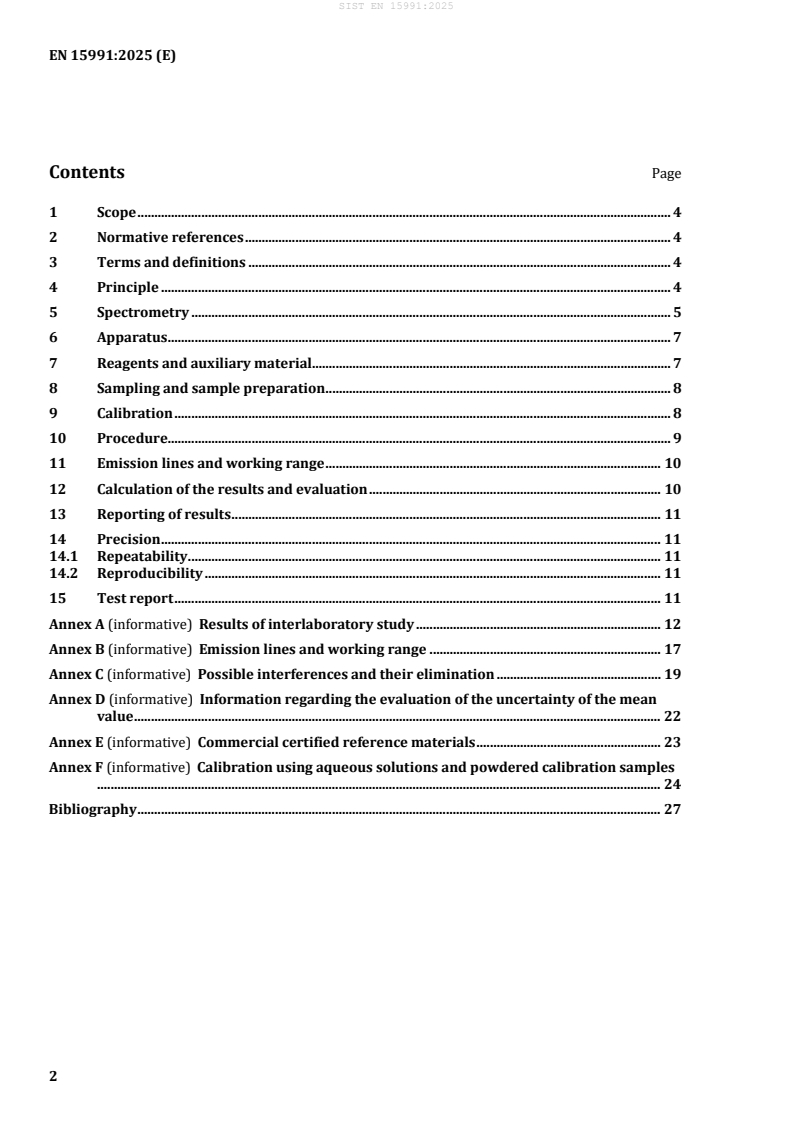
Contents Page
1 Scope . 4
2 Normative references . 4
3 Terms and definitions . 4
4 Principle . 4
5 Spectrometry . 5
6 Apparatus . 7
7 Reagents and auxiliary material . 7
8 Sampling and sample preparation . 8
9 Calibration . 8
10 Procedure. 9
11 Emission lines and working range . 10
12 Calculation of the results and evaluation . 10
13 Reporting of results . 11
14 Precision . 11
14.1 Repeatability . 11
14.2 Reproducibility . 11
15 Test report . 11
Annex A (informative) Results of interlaboratory study . 12
Annex B (informative) Emission lines and working range . 17
Annex C (informative) Possible interferences and their elimination . 19
Annex D (informative) Information regarding the evaluation of the uncertainty of the mean
value . 22
Annex E (informative) Commercial certified reference materials . 23
Annex F (informative) Calibration using aqueous solutions and powdered calibration samples
........................................................................................................................................................................ 24
Bibliography . 27
European foreword
This document (EN 15991:2025) has been prepared by Technical Committee CEN/TC 187 “Refractory
products and materials”, the secretariat of which is held by BSI.
This European Standard shall be given the status of a national standard, either by publication of an
identical text or by endorsement, at the latest by March 2026, and conflicting national standards shall be
withdrawn at the latest by March 2026.
Attention is drawn to the possibility that some of the elements of this document may be the subject of
patent rights. CEN shall not be held responsible for identifying any or all such patent rights.
This document supersedes EN 15991:2015.
— Clause 2 and Clause 3 have been added, noting that they neither add any normative references nor
terms and definitions to the document;
— Clause 4 adds significantly more detail about the analysis and process;
— Clause 5 provides additional information on the spectrometry methodology;
— Annex B, Table B.1 provides additional information on the limits of determination.
Any feedback and questions on this document should be directed to the users’ national standards body.
A complete listing of these bodies can be found on the CEN website.
According to the CEN-CENELEC Internal Regulations, the national standards organisations of the
following countries are bound to implement this European Standard: Austria, Belgium, Bulgaria, Croatia,
Cyprus, Czech Republic, Denmark, Estonia, Finland, France, Germany, Greece, Hungary, Iceland, Ireland,
Italy, Latvia, Lithuania, Luxembourg, Malta, Netherlands, Norway, Poland, Portugal, Republic of North
Macedonia, Romania, Serbia, Slovakia, Slovenia, Spain, Sweden, Switzerland, Türkiye and the United
Kingdom.
1 Scope
This document specifies a method for the determination of the mass fractions of the elements Al, Ca, Cr,
Cu, Fe, Mg, Ni, Ti, V and Zr in powdered and granular silicon carbide.
Dependent on element, emission lines, plasma conditions and sample mass, this test method is applicable
for mass fractions of the above trace contaminations from about 0,1 mg/kg to about 1 000 mg/kg, after
evaluation also from 0,001 mg/kg to about 5 000 mg/kg.
NOTE 1 Generally for optical emission spectrometry using inductively coupled plasma and electrothermal
vaporization (ETV-ICP-OES) there is a linear working range of up to four orders of magnitude. This range can be
expanded for the respective elements by variation of the sample mass or by choosing emission lines with different
sensitivity.
After adequate verification, this document is also applicable to further metallic elements (excepting Rb
and Cs) and some non-metallic contaminations (like P and S) and other allied non-metallic powdered or
granular materials like carbides, nitrides, graphite, soot, coke, coal, and some other oxidic materials (see
[1], [4], [5], [6], [7], [8], [9] and [10]).
NOTE 2 There is positive experience with materials like, for example, graphite, boron carbide (B C), silicon
nitride (Si N ), boron nitride (BN) and several metal oxides as well as with the determination of P and S in some of
3 4
these materials.
2 Normative references
There are no normative references in this document.
3 Terms and definitions
No terms and definitions are listed in this document.
ISO and IEC maintain terminology databases for use in standardization at the following addresses:
— ISO Online browsing platform: available at https://www.iso.org/obp
— IEC Electropedia: available at https://www.electropedia.org/
4 Principle
For the determination of impurities in silicon carbide, ICP-OES is a suited method. The classic application
of ICP-OES is based on the nebulization of sample solutions. For silicon carbide, sample digestion by wet-
chemical methods is required to obtain these sample solutions, for example by melt-fusion or
acid/pressure-decomposition. These sample digestion procedures are time-consuming, require the use
of hazardous chemicals, deteriorate the detection limits due to the dilution of the sample and the
possibility of introduction of impurities as well as analyte losses represents a source of systematic errors.
With ETV-ICP-OES, the impurities are measured directly from the powdered silicon carbide sample, thus
avoiding sample digestion and the associated disadvantages. Compared to wet-chemical ICP-OES
methods, ETV-ICP-OES requires more effort for method development and is therefore particularly
suitable when many samples of one matrix are to be measured with high sample throughput and with
high detection sensitivity.
In ETV-ICP-OES, sample introduction by nebulization of liquids is replaced by the electrothermal
vaporization of solid samples at high temperatures in the graphite tube furnace of the ETV-system.
The sample material, crushed if necessary, is evaporated in an argon carrier-gas stream in a graphite boat
in the graphite tube furnace of the ETV-system. A suitable design of the furnace (see Figures 1 and 2) and
an optimized gas flow in the transition area between graphite tube and transport tube (see Figure 3)
ensure that the sample vapour is transferred into a form that is transported to the ICP-OES with almost
no losses (see [5], [6], [7], [8], [10]). Elements, for example titanium or zirconium, forming refractory
carbides that are incompletely or not evaporating need to be converted in the graphite tube furnace into
a chemical form which easily evaporates. For this purpose, a suitable reaction gas (halogenating agent)
is mixed to the argon carrier-gas stream (see Figures 1 and 2) which converts the carbides into volatile
halides (see [1], [3], [5] and [10].)
The evaporation products containing the element traces are transported by the transport tube as dry
aerosol to the ICP-torch, injected into the plasma and there excited for the emission of optical radiation
(see Figure 2).
5 Spectrometry
Optical emission spectrometry is based on the generation of line spectra of excited atoms or ions, where
each emission line is associated with an element and the line intensities are proportional to the mass
fractions of the elements in the analysed sample.
In a simultaneous emission spectrometer in, for example Paschen-Runge- or Echelle-configuration, the
optical radiation is dispersed. The intensities of suited emission lines or background positions are
registered with applicable detectors like photomultipliers (PMT), charge coupled devices (CCD),
complementary metal-oxide semiconductor (CMOS), charge injection devices (CID), and serial coupled
devices (SCD). By comparison of the intensities of the element-specific emission lines of the sample with
calibration samples of known composition, the mass fractions of the trace elements in the sample are
determined.
Key
1 graphite tube with graphite boat and sample 5 bypass gas (Ar)
2 carrier gas (Ar) 6 dry aerosol
3 reaction gas (CCl F ) 7 to the ICP-torch
2 2
4 shield gas (Ar)
Figure 1 — Schematic representation of the ETV gas flows
Key
1 graphite tube furnace 6 bypass-gas (Ar)
2 pyrometer 7 dry aerosol to ICP-OES
3 carrier gas (Ar) + reaction gas (CCl F ) 8 transport tube
2 2
4 solid sample in graphite boat 9 inductively coupled plasma of the OES
5 evaporation products 10 power supply for graphite tube furnace
Figure 2 — Schematic design of the ETV-system/ICP-OES coupling (example)
Key
1 alumina transport tube 5 carrier gas (Ar + CCl F ) and evaporation products of the sample
2 2
2 alumina transition ring 6 bypass gas (Ar)
3 nozzle of graphite tube 7 dry aerosol in laminar flow to ICP-OES
4 graphite tube
Figure 3 — Schematic design of the transition area between graphite-tube and transport-tube
(example)
NOTE Figure 1, Figure 2 and Figure 3 show a commercially available ETV-system.
6 Apparatus
6.1 Common laboratory instruments and laboratory instruments according to 6.2 to 6.7.
6.2 Inductively coupled plasma optical emission spectrometer (ICP-OES), simultaneous, with the
possibility to register transient emission signals with a sampling rate of minimum 5 Hz and suited for the
synchronised start of ETV vaporization cycle and registration of emission signals.
NOTE Especially for changing matrices the measurement of the spectral background near the emission lines is
beneficial, because by this the systematic and stochastic contributions of the measurement uncertainty can be
decreased, the latter only by simultaneous measurement of the background. The use of spectrometers equipped
with area- or array-detectors is an advantage in such cases as they allow simultaneous background measurement.
6.3 Electrothermal vaporization (ETV) system, with graphite tube furnace with suited transition
zone between graphite tube and transport tube for optimized aerosol formation, to be connected to the
injector tube of the ICP-torch by a transport tube for example made of alumina (Al O ),
2 3
polytetrafluoroethylene (PTFE), perfluoroalkoxy (PFA) or polyvinyl chloride (PVC), with controlled gas
flows (preferably with mass flow control) and furnace control (preferably with continuous temperature
control of the graphite boat by a pyrometer) for a reproducible control of the ETV-system.
NOTE The use of an automatic sample changer improves the reproducibility of measurements.
6.4 Tweezers, self-closing, made of a material preventing contamination.
6.5 Micro spatula, made of a material preventing contamination.
6.6 Analytical balance, with a resolution of at least 0,01 mg.
NOTE An analytical balance with a resolution of 0,001 mg can improve the reproducibility of the
measurements.
6.7 Mill or crusher, made of a material that does not contaminate the sample with any of the analytes
to be determined, for example a mortar.
7 Reagents and auxiliary material
Only analytical grade reagents shall be used unless stated otherwise.
7.1 Sample boats, high-purity graphite (spectral grade) with low porosity, the size adapted to the
graphite tube of the ETV-system.
7.2 Calibration samples with well-defined mass fractions of trace-impurities, preferably certified
reference materials (CRM).
NOTE Certified reference materials are available for main-, minor- and trace-components. (see Annex E.)
7.3 Calibration solutions, aqueous single- or multi-element calibration solutions, prepared by
dilution of commercially available standard-stock solutions with water to the required concentration.
7.4 Reaction gas, Dichlorodifluoromethane (CCl F ) shall be used as reaction gas for simultaneous
2 2
determination of the elements listed in Clause 1.
NOTE 1 The results of the interlaboratory study (see Annex A) were obtained using CCl F as reaction gas.
2 2
NOTE 2 Inside the EU, according to the “EC-regulation on substances that deplete the ozone layer” (see [12]), the
use of CCl F is allowed for laboratory and analytical purposes. CCl F is completely decomposed in the hot graphite
2 2 2 2
furnace and in the downstream inductively coupled plasma. The use of CCl F for laboratory and analysis purposes
2 2
is, however, subject to registration at the European Commission (registration on the website of the European
Commission, search for “labODS registry”).
Alternative reaction gases:
In general, compared to CCl F the use of alternative reaction gases (halogenating agents) for analysis of
2 2
silicon carbide can lead for some elements to a deterioration of release behaviour and transport
efficiency. The suitability of an alternative reaction gas shall therefore be checked in advance.
The following alternative reaction gases have been used in practice for ETV-ICP-OES: trifluoromethane
(CHF ), tetrafluoromethane (CF ), trichloromethane (CHCl ), chlorodifluoromethane (CHClF ), 1,1,1,2-
3 4 3 2
tetrafluoroethane (C H F ), sulphur hexafluoride (SF ) und nitrogen trifluoride (NF ). In practice, for
2 2 4 6 3
CF a comparable performance to CCl F could be confirmed.
4 2 2
7.5 Carrier, bypass and shield gases, argon (Ar), purity ≥ 99,996 % (volume fraction).
8 Sampling and sample preparation
Sampling shall be performed in a way that the sample to be analysed is representative for the total
amount of material.
NOTE 1 For example, according to ISO 5022 [13], ISO 8656-1 [14] or ISO 21068-1 [15].
If the sample is not received in a dry state, it shall be dried at (110 ± 10) °C until constant mass is achieved
(<0,5 % variation). The sample is then cooled down to room temperature and stored in a desiccator.
NOTE 2 Drying for 2 h is normally sufficient.
The sample material shall have a particle size of ≤ 50 µm. If necessary, the sample shall be crushed, milled
and homogenized. For this, devices suited for the analytical task shall be applied. For porous materials, it
shall be checked whether crushing is required.
Crushing is necessary if the transient analysis signals show an unusual long decay (tailing).
9 Calibration
The calibration shall be performed for each measuring cycle with calibration samples with defined mass
fractions of the elements to be determined. The procedure shall be carried out in accordance with
Clause 10. The calibration shall be carried out over a range adapted to the analytical task.
NOTE 1 This can be achieved by different masses of the same calibration sample or same masses of different
calibration samples with different mass fractions of the analytes or by a combination of both possibilities.
Calibration samples and the sample to be analysed shall be measured under identical conditions.
Because of the low sample mass used and therefore the resulting scattering of the measurements, the
number of calibration samples shall be adapted to the desired accuracy. Practically about 10 to 15
calibration samples have proved to be successful. For example, for 10 calibration samples, five different
masses of two different calibration samples with different mass fractions of the analytes are required.
Preferably calibration samples of the same or similar material should be used, if possible certified
reference materials (CRM) or matrix-adapted synthetic calibration samples.
The mass fractions of trace-impurities in the calibration samples should be in the same range as of the
sample material.
Dependent on the grain size distribution of the sample, the material properties of the material to be
analysed and the analytical performance of the used ETV-system for certain analytes and matrices also
aqueous calibration solutions which are pipetted into the sample boats and then dried may be used for
calibration (see [1], [6] to [9] and Annex F). The use of dried aqueous calibration solutions shall be
validated by calibration samples or certified reference materials. If such materials are not available, the
results of alternative analysis methods can be used for comparison.
To extend the applicability of calibration with dried aqueous calibration solutions matrix adaptation may
be helpful. For matrix adaptation, so-called blank samples are suitable. These are materials with the same
matrix as the sample and with mass fractions of trace-impurities negligible to those expected in the
sample. The blank sample is weighed into the graphite boat with the same mass as the sample to be
analysed, the aqueous calibration solution is added and then dried.
The calibration function for each emission line shall be calculated using the analyte masses of the
calibration samples used and the net-intensities of the emission line measured for these analyte masses.
A monotonically increasing slope of the calibration functions with a sufficiently high gradient is essential.
NOTE 2 The calculation of the calibration functions is usually carried out as linear regression. A quadratic
regression can also be used.
10 Procedure
The ICP-OES (6.2) shall be set up in accordance with its operations manual. After an adequate waiting
time (20 min is recommended) measurements can be started.
The temperature programme of the ETV-system shall be adjusted to the trace elements to be determined.
For this, suited calibration samples shall be used. They also shall be used to select suitable emission lines.
The time interval for the integration of the signal intensity of the emission lines shall be adjusted to the
release behaviour of the analytes using the recorded transient emission signals.
Use the sample prepared according to Clause 8 and weigh between 1 mg and 5 mg with a precision of
0,01 mg into the sample boats. Before use, the sample boats shall be cleaned by thermo-halogenation in
the graphite tube furnace of the ETV-system at a temperature not lower than the vaporization
temperature used for sample analysis.
Dependent on the material, the analytes, the mass fractions of the analytes, the selected emission lines
and the ETV-system higher sample masses may be used. The sample masses shall be documented.
Before the analysis run is started, the blank value shall be determined with an empty and cleaned sample
boat. A sample boat containing a few milligrams of a calibration sample or a dried calibration solution
shall be used to verify that the measuring position for the selected emission lines and background is at
optimum position.
The sample boats shall be measured in the following order: dried aqueous calibration solutions (if
available) in ascending analyte mass – calibration samples in ascending analyte mass – silicon carbide
samples.
The first sample boat is inserted into the furnace of the ETV-system by tweezers (6.4) or by an automated
sampler changer. The analysis programme is started, while the vaporization cycle of the ETV-system and
the registration of the emission signals by the spectrometer shall be triggered simultaneously.
After the end of the analysis programme the sample boat is removed from the furnace of the ETV-system
by tweezers or by an automated sample changer and the next sample boat is inserted into the furnace.
The predefined ETV program for the determination of all the elements indicated in Clause 1 in silicon
carbide is to be as follows:
a) gas flows: carrier gas (7.5) 170 ml/min, bypass gas (7.5) 370 ml/min, reaction gas (7.4) 2,3 ml/min;
b) conditioning step: 3 s heating from room temperature to 450 °C, 27 s holding time at 450 °C;
c) vaporization step: 3 s heating to 2 300 °C, 27 s holding time at 2 300 °C;
d) cooling;
e) integration interval: 30 s to 60 s after starting the furnace program;
f) integration time: 30 s. Same integration time for all emission lines or, preferably, individually for
each emission line depending on the release behaviour of the analytes.
The cooling rate depends on the performance of the cooling system. The sample boat shall be changed at
a temperature of < 200 °C.
Each sample shall be measured several times, but at least 3 times. If the single values of the multiple
determinations of the analyte contents deviate by more than a given degree, depending on the
repeatability of the method, then the analysis shall be repeated according to Clause 10.
In case of continuing poor reproducibility of the measured value of the contents of one or more analytes,
the sample shall be homogenized, for example using a mortar.
NOTE If the measured analyte contents are near the limit of determination homogenization usually does not
improve the reproducibility and this additional step can be omitted.
11 Emission lines and working range
When selecting the emission lines used to determine the content of an analyte, care shall be taken that
these are free of interferences originating from the sample matrix and other impurities. Only emission
lines shall be selected where under the chosen working conditions neither self-absorption nor self-
reversal can occur. Care shall also be taken regarding order interferences which can occur, in particular,
with Echelle-type spectrometers.
NOTE 1 Recommended emission lines and information on working ranges are given in Annex B.
NOTE 2 Possible interferences and their elimination are given in Annex C.
The upper working range is limited by a decrease in sensitivity (slope of the calibration function) to
approximately 80 % of its initial value. If necessary, less sensitive emission lines may be used instead. To
ensure correct measurement results, more than one emission line should preferably be selected for each
element.
12 Calculation of the results and evaluation
The intensities of the emission lines measured by the spectrometer shall be corrected to net-intensities
using the background intensities measured at the background measuring points. Using the c
...