


FprEN ISO 14720-1
(Main)Testing of ceramic materials - Determination of sulfur in non-oxidic ceramic raw materials and ceramic materials - Part 1: Infrared measurement methods (ISO/FDIS 14720-1:2025)
Testing of ceramic materials - Determination of sulfur in non-oxidic ceramic raw materials and ceramic materials - Part 1: Infrared measurement methods (ISO/FDIS 14720-1:2025)
ISO 14720-1:2013 defines a method for the determination of sulfur in powdered and granular non-oxidic ceramic raw materials and materials, such as silicon carbides, silicon nitrides, graphites, carbon blacks, cokes, carbon powders. If proved by the recovery rate, this method can also be applied for other non-metallic powdered and granular materials, e.g. silicon dioxide.
ISO 14720-1:2013 is applicable for materials with mass fractions of sulfur from 0,005 % to 2 %.
ISO 14720-1:2013 can also be applied for materials with higher mass fractions of sulfur after verification of the particular case.
Prüfung keramischer Werkstoffe - Bestimmung des Schwefelgehaltes in nichtoxidischen keramischen Roh- und Werkstoffen - Teil 1: Infrarotmessverfahren (ISO/FDIS 14720-1:2025)
Dieses Dokument legt ein Verfahren für die Bestimmung des Schwefelgehaltes in nichtoxidischen keramischen Roh- und Werkstoffen, wie Siliciumcarbiden, Siliciumnitriden, Graphiten, (Flamm-)Rußen, Koksen und Kohlepulvern, fest. Bei nachgewiesener guter Wiederfindungsrate kann dieses Dokument auch für andere nichtmetallische pulver- oder kornförmige (granulatförmige) Roh- und Werkstoffe angewendet werden, z. B. Siliciumdioxid.
Dieses Dokument ist anwendbar für Werkstoffe mit einem Massenanteil an Schwefel von 0,005 % bis 2 %.
Dieses Dokument kann auch auf Werkstoffe mit höheren Massenanteilen an Schwefel nach Prüfung im jeweiligen Einzelfall angewendet werden.
Analyse des matériaux céramiques - Dosage du soufre dans les produits et les matières premières céramiques non oxydes - Partie 1: Méthodes d'essai par infrarouge (ISO/FDIS 14720-1:2025)
Preskušanje keramičnih materialov - Določanje žvepla v neoksidativnih keramičnih surovinah in osnovnih materialih - 1. del: Infrardeče merilne metode (ISO/FDIS 14720-1:2025)
General Information
- Status
- Not Published
- Publication Date
- 27-Apr-2026
- Technical Committee
- CEN/TC 187 - Refractory products and materials
- Drafting Committee
- CEN/TC 187/WG 4 - Chemical analysis
- Current Stage
- 6055 - CEN Ratification completed (DOR) - Publishing
- Start Date
- 28-Feb-2026
- Completion Date
- 28-Feb-2026
Relations
- Effective Date
- 12-Feb-2026
- Effective Date
- 17-Apr-2024
Overview
The standard FprEN ISO 14720-1:2025 specifies a reliable method for testing sulfur content in non-oxidic ceramic raw materials and ceramic materials using infrared measurement techniques. Developed under the CEN framework and aligned with ISO/FDIS 14720-1:2025, this standard addresses accurate sulfur determination in samples such as silicon carbides, silicon nitrides, graphites, carbon blacks, cokes, and carbon powders. It also has potential application for other non-metallic powdered and granular materials like silicon dioxide, subject to verification by recovery rate. This method is applicable for sulfur mass fractions from 0.005% up to 2% and beyond with adequate confirmation.
Key Topics
- Scope and Materials: Targets powdered and granular non-oxidic ceramics, vital for quality and purity assessment in ceramic processing industries.
- Analytical Principle: Uses an inductive furnace under oxygen atmosphere to combust the sample, releasing sulfur as sulfur dioxide (SO₂). The SO₂ is measured by its infrared absorption characteristics.
- Equipment and Apparatus:
- Induction or resistance furnace combined with an infrared absorption cell.
- Analytical balances with precision up to 0.01 mg.
- Ceramic crucibles with lids (mullite or alumina).
- Reagents and Calibration:
- High purity tungsten and iron granules to assist combustion.
- Certified reference materials (CRM) for calibration and accuracy verification.
- Oxygen with purity ≥ 99.998%.
- Sampling and Preparation:
- Representative sampling according to ISO 8656-1.
- Sample drying at 110 ± 5 °C to constant mass.
- Particle size ≤ 160 µm through crushing and homogenization.
- Performance Criteria:
- Repeatability and reproducibility limits ensuring reliable results.
- Blank determination and repeated analyses to guarantee precision.
- Calculation and Reporting:
- Results expressed as mass fraction, with calibration and blank corrections.
- Reports must include test conditions, sample identification, uncertainty, and analyst details.
Applications
This standard is essential in industries and laboratories focused on:
- Ceramic Materials Testing: Ensuring sulfur content complies with manufacturing and quality standards.
- Refractory and Advanced Ceramics Production: Monitoring impurities that affect thermal and mechanical properties.
- Raw Materials Quality Control: For silicon carbides, nitrides, graphite materials and carbon black powders.
- Research and Development: Developing new ceramic materials and processes with controlled sulfur content.
- Environmental and Regulatory Compliance: Meeting sulfur limits for industrial ceramics to reduce emissions and improve sustainability.
Related Standards
- ISO 8656-1: Sampling methods for ceramic raw materials.
- ISO 14720-2: Determination of sulfur by ICP-OES or ion chromatography after oxygen flow burning.
- Other ISO/TC 33 Standards: Focused on refractories and ceramic materials testing.
- Relevant national standards harmonized with CEN and ISO methodologies.
Keywords: sulfur determination, non-oxidic ceramic materials, infrared measurement, ceramic raw materials testing, sulfur content analysis, silicon carbide testing, ceramic quality control, ISO 14720-1, ceramic materials standard, inductive furnace analysis

Frequently Asked Questions
FprEN ISO 14720-1 is a draft published by the European Committee for Standardization (CEN). Its full title is "Testing of ceramic materials - Determination of sulfur in non-oxidic ceramic raw materials and ceramic materials - Part 1: Infrared measurement methods (ISO/FDIS 14720-1:2025)". This standard covers: ISO 14720-1:2013 defines a method for the determination of sulfur in powdered and granular non-oxidic ceramic raw materials and materials, such as silicon carbides, silicon nitrides, graphites, carbon blacks, cokes, carbon powders. If proved by the recovery rate, this method can also be applied for other non-metallic powdered and granular materials, e.g. silicon dioxide. ISO 14720-1:2013 is applicable for materials with mass fractions of sulfur from 0,005 % to 2 %. ISO 14720-1:2013 can also be applied for materials with higher mass fractions of sulfur after verification of the particular case.
ISO 14720-1:2013 defines a method for the determination of sulfur in powdered and granular non-oxidic ceramic raw materials and materials, such as silicon carbides, silicon nitrides, graphites, carbon blacks, cokes, carbon powders. If proved by the recovery rate, this method can also be applied for other non-metallic powdered and granular materials, e.g. silicon dioxide. ISO 14720-1:2013 is applicable for materials with mass fractions of sulfur from 0,005 % to 2 %. ISO 14720-1:2013 can also be applied for materials with higher mass fractions of sulfur after verification of the particular case.
FprEN ISO 14720-1 is classified under the following ICS (International Classification for Standards) categories: 81.060.10 - Raw materials. The ICS classification helps identify the subject area and facilitates finding related standards.
FprEN ISO 14720-1 has the following relationships with other standards: It is inter standard links to ISO 14720-1, EN ISO 14720-1:2013. Understanding these relationships helps ensure you are using the most current and applicable version of the standard.
FprEN ISO 14720-1 is available in PDF format for immediate download after purchase. The document can be added to your cart and obtained through the secure checkout process. Digital delivery ensures instant access to the complete standard document.
Standards Content (Sample)
SLOVENSKI STANDARD
oSIST prEN ISO 14720-1:2025
01-april-2025
Preskušanje keramičnih materialov - Določanje žvepla v neoksidativnih
keramičnih surovinah in osnovnih materialih - 1. del: Infrardeče merilne metode
(ISO/DIS 14720-1:2025)
Testing of ceramic materials - Determination of sulfur in non-oxidic ceramic raw materials
and ceramic materials - Part 1: Infrared measurement methods (ISO/DIS 14720-1:2025)
Prüfung keramischer Werkstoffe - Bestimmung des Schwefelgehaltes in nichtoxidischen
keramischen Roh- und Werkstoffen - Teil 1: Infrarotmessverfahren (ISO/DIS 14720-
1:2025)
Analyse des matériaux céramiques - Dosage du soufre dans les produits et les matières
premières céramiques non oxydes - Partie 1: Méthodes d'essai par infrarouge (ISO/DIS
14720-1:2025)
Ta slovenski standard je istoveten z: prEN ISO 14720-1
ICS:
81.060.10 Surovine Raw materials
oSIST prEN ISO 14720-1:2025 en,fr,de
2003-01.Slovenski inštitut za standardizacijo. Razmnoževanje celote ali delov tega standarda ni dovoljeno.
oSIST prEN ISO 14720-1:2025
oSIST prEN ISO 14720-1:2025
DRAFT
International
Standard
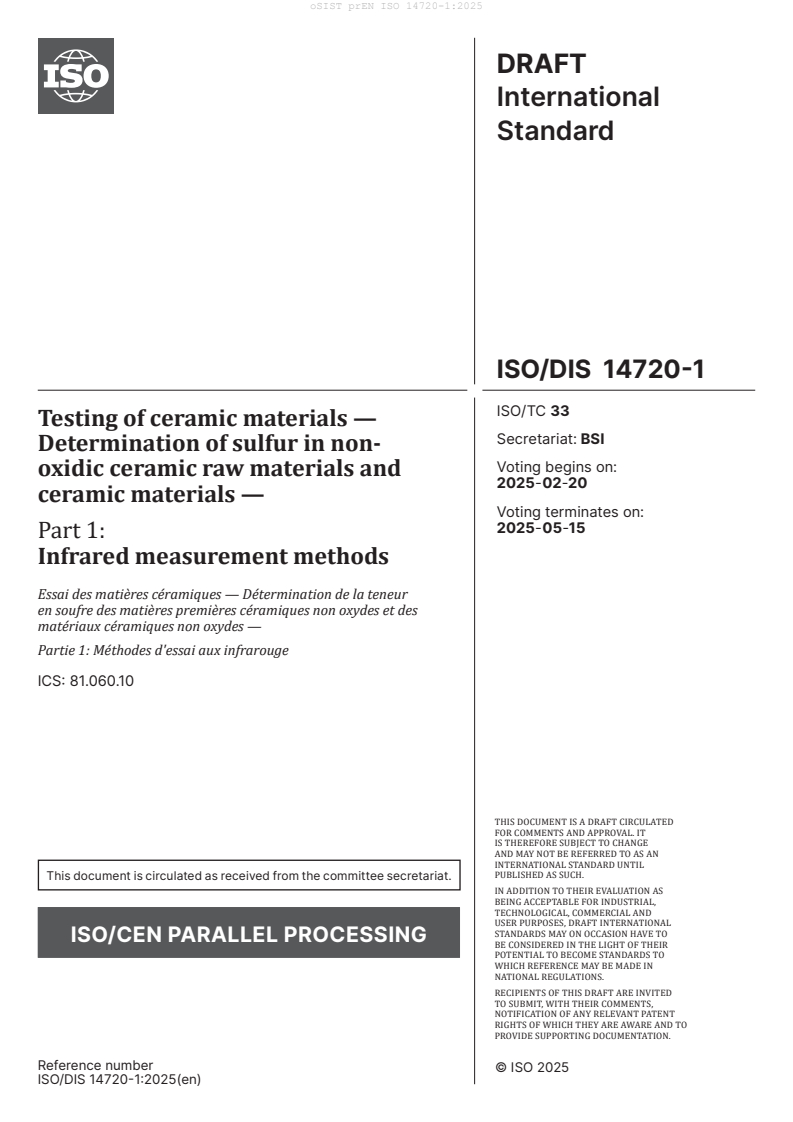
ISO/DIS 14720-1
ISO/TC 33
Testing of ceramic materials —
Secretariat: BSI
Determination of sulfur in non-
Voting begins on:
oxidic ceramic raw materials and
2025-02-20
ceramic materials —
Voting terminates on:
2025-05-15
Part 1:
Infrared measurement methods
Essai des matières céramiques — Détermination de la teneur
en soufre des matières premières céramiques non oxydes et des
matériaux céramiques non oxydes —
Partie 1: Méthodes d'essai aux infrarouge
ICS: 81.060.10
THIS DOCUMENT IS A DRAFT CIRCULATED
FOR COMMENTS AND APPROVAL. IT
IS THEREFORE SUBJECT TO CHANGE
AND MAY NOT BE REFERRED TO AS AN
INTERNATIONAL STANDARD UNTIL
PUBLISHED AS SUCH.
This document is circulated as received from the committee secretariat.
IN ADDITION TO THEIR EVALUATION AS
BEING ACCEPTABLE FOR INDUSTRIAL,
TECHNOLOGICAL, COMMERCIAL AND
USER PURPOSES, DRAFT INTERNATIONAL
STANDARDS MAY ON OCCASION HAVE TO
ISO/CEN PARALLEL PROCESSING
BE CONSIDERED IN THE LIGHT OF THEIR
POTENTIAL TO BECOME STANDARDS TO
WHICH REFERENCE MAY BE MADE IN
NATIONAL REGULATIONS.
RECIPIENTS OF THIS DRAFT ARE INVITED
TO SUBMIT, WITH THEIR COMMENTS,
NOTIFICATION OF ANY RELEVANT PATENT
RIGHTS OF WHICH THEY ARE AWARE AND TO
PROVIDE SUPPORTING DOCUMENTATION.
Reference number
ISO/DIS 14720-1:2025(en)
oSIST prEN ISO 14720-1:2025
DRAFT
ISO/DIS 14720-1:2025(en)
International
Standard
ISO/DIS 14720-1
ISO/TC 33
Testing of ceramic materials —
Secretariat: BSI
Determination of sulfur in non-
Voting begins on:
oxidic ceramic raw materials and
ceramic materials —
Voting terminates on:
Part 1:
Infrared measurement methods
Essai des matières céramiques — Détermination de la teneur
en soufre des matières premières céramiques non oxydes et des
matériaux céramiques non oxydes —
Partie 1: Méthodes d'essai aux infrarouge
ICS: 81.060.10
THIS DOCUMENT IS A DRAFT CIRCULATED
FOR COMMENTS AND APPROVAL. IT
IS THEREFORE SUBJECT TO CHANGE
AND MAY NOT BE REFERRED TO AS AN
INTERNATIONAL STANDARD UNTIL
PUBLISHED AS SUCH.
This document is circulated as received from the committee secretariat.
IN ADDITION TO THEIR EVALUATION AS
BEING ACCEPTABLE FOR INDUSTRIAL,
© ISO 2025
TECHNOLOGICAL, COMMERCIAL AND
USER PURPOSES, DRAFT INTERNATIONAL
All rights reserved. Unless otherwise specified, or required in the context of its implementation, no part of this publication may
STANDARDS MAY ON OCCASION HAVE TO
ISO/CEN PARALLEL PROCESSING
be reproduced or utilized otherwise in any form or by any means, electronic or mechanical, including photocopying, or posting on
BE CONSIDERED IN THE LIGHT OF THEIR
the internet or an intranet, without prior written permission. Permission can be requested from either ISO at the address below
POTENTIAL TO BECOME STANDARDS TO
WHICH REFERENCE MAY BE MADE IN
or ISO’s member body in the country of the requester.
NATIONAL REGULATIONS.
ISO copyright office
RECIPIENTS OF THIS DRAFT ARE INVITED
CP 401 • Ch. de Blandonnet 8
TO SUBMIT, WITH THEIR COMMENTS,
CH-1214 Vernier, Geneva
NOTIFICATION OF ANY RELEVANT PATENT
Phone: +41 22 749 01 11
RIGHTS OF WHICH THEY ARE AWARE AND TO
PROVIDE SUPPORTING DOCUMENTATION.
Email: copyright@iso.org
Website: www.iso.org
Published in Switzerland Reference number
ISO/DIS 14720-1:2025(en)
ii
oSIST prEN ISO 14720-1:2025
ISO/DIS 14720-1:2025(en)
Contents Page
Foreword .iv
1 Scope . 1
2 Principle . 1
3 Apparatus . 1
4 Reagents . 2
5 Sampling and sample preparation . 2
6 Calibration . 2
7 Performance . 2
7.1 Preparation of analysis .2
7.2 Determination of blank value .3
7.3 Determination of sulfur content .3
8 Calculation and report of the results . 3
9 Precision . 3
9.1 Repeatability .3
9.2 Reproducibility .3
10 Test report . 3
Annex A (informative) Results of the round-robin test . 5
Annex B (informative) Information regarding the validation of the uncertainty of the mean
value . 7
Annex C (informative) Commercial Certified Reference Materials (CRM) . 8
Bibliography . 9
iii
oSIST prEN ISO 14720-1:2025
ISO/DIS 14720-1:2025(en)
Foreword
ISO (the International Organization for Standardization) is a worldwide federation of national standards
bodies (ISO member bodies). The work of preparing International Standards is normally carried out through
ISO technical committees. Each member body interested in a subject for which a technical committee
has been established has the right to be represented on that committee. International organizations,
governmental and non-governmental, in liaison with ISO, also take part in the work. ISO collaborates closely
with the International Electrotechnical Commission (IEC) on all matters of electrotechnical standardization.
International Standards are drafted in accordance with the rules given in the ISO/IEC Directives, Part 2.
The main task of technical committees is to prepare International Standards. Draft International Standards
adopted by the technical committees are circulated to the member bodies for voting. Publication as an
International Standard requires approval by at least 75 % of the member bodies casting a vote.
Attention is drawn to the possibility that some of the elements of this document may be the subject of patent
rights. ISO shall not be held responsible for identifying any or all such patent rights.
ISO 14720-1 was prepared by Technical Committee ISO/TC 33, Refractories.
ISO 14720 consists of the following parts, under the general title Testing of ceramic materials — Determination
of sulfur in non-oxidic ceramic raw materials and ceramic materials:
— Part 1: Infrared measurement methods
— Part 2: Inductively coupled plasma optical emission spectrometry (ICP-OES) or ion chromatography (IC)
after burning in the oxygen flow
iv
oSIST prEN ISO 14720-1:2025
DRAFT International Standard ISO/DIS 14720-1:2025(en)
Testing of ceramic materials — Determination of sulfur in
non-oxidic ceramic raw materials and ceramic materials —
Part 1:
Infrared measurement methods
1 Scope
This part of ISO 14720 defines a method for the determination of sulfur in non-oxidic ceramic raw materials
and ceramic materials, such as silicon carbides, silicon nitrides, graphites, carbon blacks, cokes, carbon
powders. If proved by the recovery rate, this method can also be applied for other non-metallic powdered
and granular materials, for example silicon dioxide.
This part of ISO 14720 is applicable for materials with mass fractions of sulfur from 0,005 % to 2 %.
This part of ISO 14720 can also be applied for materials with higher mass fractions of sulfur after verification
of the particular case.
2 Principle
The sample and added combustion accelerators (mostly tungsten- or iron-granules) are heated in an
inductive furnace under oxygen atmosphere. The high-frequency field of the furnace couples with electrically
conductive components of sample and combustion accelerators. The sample is heated to temperatures
above 1 800 °C and the total sulfur content of the sample is released as sulfur dioxide. The reaction gas is
transferred to the infrared absorption cell of the analyser. The molecular absorption of sulfur dioxide is
measured by using a narrow-band optical filter which is translucent for the wavelength of the characteristic
infrared absorption of sulfur dioxide. The mass fraction of sulfur dioxide in the reaction gas is proportional
to peak-height and peak-area, respectively, of the transient absorption signal. The mass fraction of sulfur in
the sample is calculated by using a calibration function established by suitable calibration samples measured
under comparable conditions.
3 Apparatus
3.1 Device with induction furnace or alternatively resistance furnace and infrared cell.
NOTE The correctness of the analysis result can be proved by using matrix-analogous reference materials or by
comparing with an independent alternative test method. If determining mass fractions below 100 mg/kg, it has to be
considered that some analytical de
...
Questions, Comments and Discussion
Ask us and Technical Secretary will try to provide an answer. You can facilitate discussion about the standard in here.
Loading comments...