

EN 13149-1:2004
(Main)Public transport - Road vehicle scheduling and control systems - Part 1: WORLDFIP definition and application rules for onboard data transmission
- Abstract
The present document specifies the choice and the general application's rules of an onboard data transmission bus between the different equipment for service operations and monitoring of the fleet. This applies to equipment installed onboard buses, trolleybuses and tramways only as part of a bus fleet operation. It excludes tramways when they are operated as part of a train, subway or metro operation. The equipment includes operations aid systems, automatic passenger information systems, fare collection systems, etc....
The equipment directly related to the functioning of the vehicle (driver dashboard, engine management, brake systems, door opening systems, etc...) are excluded from the scope of the present document and are dealt with in other standardisation bodies.
Two alternative transmission buses will be accepted. This document refers to the so called WORLDFIP bus. A second set of documents will be published for the second solution (so called CAN). There is no ranking between the two solutions and the selected bus system, between the two standardised alternatives, shall be subject to an agreement between each transport operating organisation and its equipment providers.
The present document refers to the so called OSI transmission model and covers OSI layers 1,2,7, the other layers are not used in our applications.
The present document covers the link between equipment inside a single vehicle. Although it could be applied to multiple vehicles, this application is not explicitly covered by this document.
The present document is the first part of a set of standards, related to the onboard transmission bus, which will comprise, for each allowed transmission bus, the following set of documents:
a) choice of the bus and general application's rules (EN 13149-1)
b) cabling specifications (EN 13149-2)
c) message's content specifications (prENV 13149-3)
- Status
- Withdrawn
- Publication Date
- 17-Aug-2004
- Withdrawal Date
- 06-Oct-2026
- Technical Committee
- CEN/TC 278 - Road transport and traffic telematics
- Drafting Committee
- CEN/TC 278/WG 3 - Public transport (PT)
- Current Stage
- 9960 - Withdrawal effective - Withdrawal
- Start Date
- 24-Mar-2021
- Completion Date
- 07-Oct-2026

Relations
- Effective Date
- 22-Dec-2008
- Effective Date
- 09-Feb-2026
- Effective Date
- 09-Feb-2026
- Refers
EN IEC 61784-1:2019 - Industrial communication networks - Profiles - Part 1: Fieldbus profiles - Effective Date
- 09-Feb-2026
- Effective Date
- 09-Feb-2026
- Effective Date
- 09-Feb-2026
- Effective Date
- 09-Feb-2026
- Effective Date
- 09-Feb-2026
- Effective Date
- 28-Jan-2026
- Effective Date
- 09-Feb-2026
- Effective Date
- 09-Feb-2026
- Effective Date
- 09-Feb-2026
- Effective Date
- 28-Jan-2026
- Effective Date
- 28-Jan-2026
Get Certified
Connect with accredited certification bodies for this standard

BSI Group
BSI (British Standards Institution) is the business standards company that helps organizations make excellence a habit.

TÜV Rheinland
TÜV Rheinland is a leading international provider of technical services.

TÜV SÜD
TÜV SÜD is a trusted partner of choice for safety, security and sustainability solutions.
Sponsored listings
Frequently Asked Questions
EN 13149-1:2004 is a standard published by the European Committee for Standardization (CEN). Its full title is "Public transport - Road vehicle scheduling and control systems - Part 1: WORLDFIP definition and application rules for onboard data transmission". This standard covers: The present document specifies the choice and the general application's rules of an onboard data transmission bus between the different equipment for service operations and monitoring of the fleet. This applies to equipment installed onboard buses, trolleybuses and tramways only as part of a bus fleet operation. It excludes tramways when they are operated as part of a train, subway or metro operation. The equipment includes operations aid systems, automatic passenger information systems, fare collection systems, etc.... The equipment directly related to the functioning of the vehicle (driver dashboard, engine management, brake systems, door opening systems, etc...) are excluded from the scope of the present document and are dealt with in other standardisation bodies. Two alternative transmission buses will be accepted. This document refers to the so called WORLDFIP bus. A second set of documents will be published for the second solution (so called CAN). There is no ranking between the two solutions and the selected bus system, between the two standardised alternatives, shall be subject to an agreement between each transport operating organisation and its equipment providers. The present document refers to the so called OSI transmission model and covers OSI layers 1,2,7, the other layers are not used in our applications. The present document covers the link between equipment inside a single vehicle. Although it could be applied to multiple vehicles, this application is not explicitly covered by this document. The present document is the first part of a set of standards, related to the onboard transmission bus, which will comprise, for each allowed transmission bus, the following set of documents: a) choice of the bus and general application's rules (EN 13149-1) b) cabling specifications (EN 13149-2) c) message's content specifications (prENV 13149-3)
The present document specifies the choice and the general application's rules of an onboard data transmission bus between the different equipment for service operations and monitoring of the fleet. This applies to equipment installed onboard buses, trolleybuses and tramways only as part of a bus fleet operation. It excludes tramways when they are operated as part of a train, subway or metro operation. The equipment includes operations aid systems, automatic passenger information systems, fare collection systems, etc.... The equipment directly related to the functioning of the vehicle (driver dashboard, engine management, brake systems, door opening systems, etc...) are excluded from the scope of the present document and are dealt with in other standardisation bodies. Two alternative transmission buses will be accepted. This document refers to the so called WORLDFIP bus. A second set of documents will be published for the second solution (so called CAN). There is no ranking between the two solutions and the selected bus system, between the two standardised alternatives, shall be subject to an agreement between each transport operating organisation and its equipment providers. The present document refers to the so called OSI transmission model and covers OSI layers 1,2,7, the other layers are not used in our applications. The present document covers the link between equipment inside a single vehicle. Although it could be applied to multiple vehicles, this application is not explicitly covered by this document. The present document is the first part of a set of standards, related to the onboard transmission bus, which will comprise, for each allowed transmission bus, the following set of documents: a) choice of the bus and general application's rules (EN 13149-1) b) cabling specifications (EN 13149-2) c) message's content specifications (prENV 13149-3)
EN 13149-1:2004 is classified under the following ICS (International Classification for Standards) categories: 35.160 - Microprocessor systems; 35.240.60 - IT applications in transport; 43.080.20 - Buses; 45.060.01 - Railway rolling stock in general. The ICS classification helps identify the subject area and facilitates finding related standards.
EN 13149-1:2004 has the following relationships with other standards: It is inter standard links to ENV 13149-1:1999, EN 61158-3-14:2014, EN 61158-2:1994, EN IEC 61784-1:2019, EN IEC 61158-2:2023, EN IEC 61158-4-2:2023, EN IEC 61158-6-3:2019, EN 61158-5-13:2014, EN 13149-2:2004, EN IEC 61918:2018/A2:2024, EN IEC 61918:2018, EN IEC 60512-99-002:2019, CEN/TS 17402:2020, CEN/TS 13149-3:2007. Understanding these relationships helps ensure you are using the most current and applicable version of the standard.
EN 13149-1:2004 is available in PDF format for immediate download after purchase. The document can be added to your cart and obtained through the secure checkout process. Digital delivery ensures instant access to the complete standard document.
Standards Content (Sample)
2003-01.Slovenski inštitut za standardizacijo. Razmnoževanje celote ali delov tega standarda ni dovoljeno.RSUHPRÖffentlicher Verkehr - Planungs- und Steuerungssysteme für Straßenfahrzeuge - Teil 1: WORLDFIP Definitions- und Anwendungsregel für bordgebundene DatenübertragungTransport Public - Systemes de planification et de contrôle des véhicles routiers - Partie 1: Regles de définition et d'application WORLDFIP pour les systemes embarqués de transmission de donnéesPublic transport - Road vehicle scheduling and control systems - Part 1: WORLDFIP definition and application rules for onboard data transmission43.040.15Car informatics. On board computer systems35.240.60Uporabniške rešitve IT v transportu in trgoviniIT applications in transport and trade03.220.20Cestni transportRoad transportICS:Ta slovenski standard je istoveten z:EN 13149-1:2004SIST EN 13149-1:2005en01-januar-2005SIST EN 13149-1:2005SLOVENSKI
STANDARDSIST ENV 13149-1:20031DGRPHãþD
EUROPEAN STANDARDNORME EUROPÉENNEEUROPÄISCHE NORMEN 13149-1July 2004ICS 35.100.05; 35.240.60; 43.080.20; 45.060.01Supersedes ENV 13149-1:1999
English versionPublic transport - Road vehicle scheduling and control systems -Part 1: WORLDFIP definition and application rules for onboarddata transmissionÖffentlicher Verkehr - Planungs- und Steuerungssystemefür Straßenfahrzeuge - Teil 1: WORLDFIP Definitions- undAnwendungsrichtlinien für bordeigene DatenübertragungThis European Standard was approved by CEN on 1 April 2004.CEN members are bound to comply with the CEN/CENELEC Internal Regulations which stipulate the conditions for giving this EuropeanStandard the status of a national standard without any alteration. Up-to-date lists and bibliographical references concerning such nationalstandards may be obtained on application to the Central Secretariat or to any CEN member.This European Standard exists in three official versions (English, French, German). A version in any other language made by translationunder the responsibility of a CEN member into its own language and notified to the Central Secretariat has the same status as the officialversions.CEN members are the national standards bodies of Austria, Belgium, Cyprus, Czech Republic, Denmark, Estonia, Finland, France,Germany, Greece, Hungary, Iceland, Ireland, Italy, Latvia, Lithuania, Luxembourg, Malta, Netherlands, Norway, Poland, Portugal, Slovakia,Slovenia, Spain, Sweden, Switzerland and United Kingdom.EUROPEAN COMMITTEE FOR STANDARDIZATIONCOMITÉ EUROPÉEN DE NORMALISATIONEUROPÄISCHES KOMITEE FÜR NORMUNGManagement Centre: rue de Stassart, 36
B-1050 Brussels© 2004 CENAll rights of exploitation in any form and by any means reservedworldwide for CEN national Members.Ref. No. EN 13149-1:2004: ESIST EN 13149-1:2005
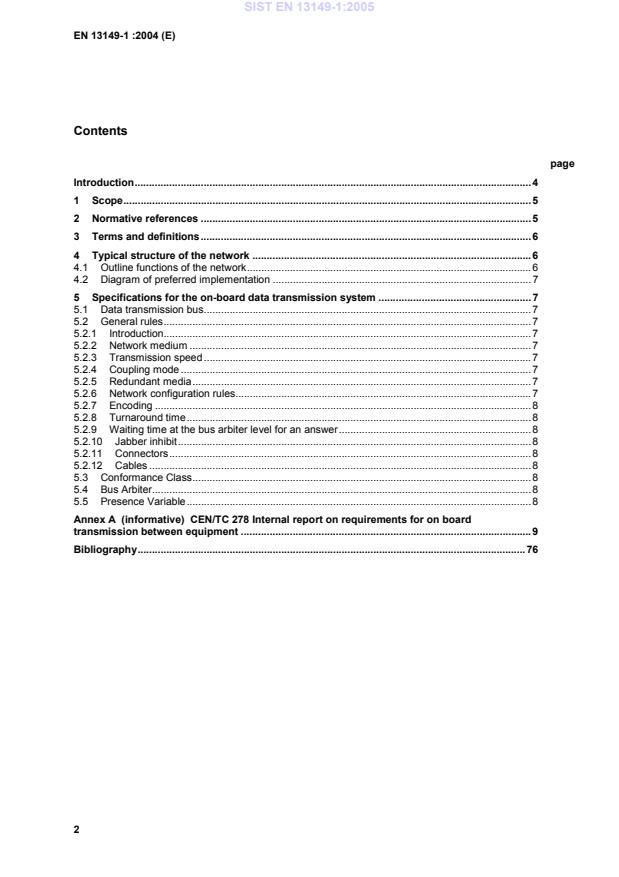
EN 13149-1 :2004 (E) 2 Contents page Introduction.4 1 Scope.5 2 Normative references.5 3 Terms and definitions.6 4 Typical structure of the network.6 4.1 Outline functions of the network.6 4.2 Diagram of preferred implementation.7 5 Specifications for the on-board data transmission system.7 5.1 Data transmission bus.7 5.2 General rules.7 5.2.1 Introduction.7 5.2.2 Network medium.7 5.2.3 Transmission speed.7 5.2.4 Coupling mode.7 5.2.5 Redundant media.7 5.2.6 Network configuration rules.7 5.2.7 Encoding.8 5.2.8 Turnaround time.8 5.2.9 Waiting time at the bus arbiter level for an answer.8 5.2.10 Jabber inhibit.8 5.2.11 Connectors.8 5.2.12 Cables.8 5.3 Conformance Class.8 5.4 Bus Arbiter.8 5.5 Presence Variable.8 Annex A
(informative)
CEN/TC 278 Internal report on requirements for on board transmission between equipment.9 Bibliography.76
EN 13149-1 :2004 (E) 3
Foreword This document (EN 13149-1:2004) has been prepared by Technical Committee CEN/TC 278 "Road Transport and Traffic Telematics", the secretariat of which is held by NEN. This European Standard shall be given the status of a national standard, either by publication of an identical text or by endorsement, at the latest by February 2005, and conflicting national standards shall be withdrawn at the latest by February 2005. This document supersedes ENV 13149-1:1999. According to the CEN/CENELEC Internal Regulations, the national standards organizations of the following countries are bound to implement this European Standard: Austria, Belgium, Cyprus, Czech Republic, Denmark, Estonia, Finland, France, Germany, Greece, Hungary, Iceland, Ireland, Italy, Latvia, Lithuania, Luxembourg, Malta, Netherlands, Norway, Poland, Portugal, Slovakia, Slovenia, Spain, Sweden, Switzerland and United Kingdom.
EN 13149-1 :2004 (E) 4 Introduction The present situation is the following: — A large number of Vehicle Scheduling and Control Systems (VSCS) do not use a data bus, resulting in — point to point data links with expensive cabling which cannot be preinstalled during the manufacturing of the vehicle, increasing the cost of the system — different proprietary transmission protocols which have to be implemented as and when required — difficulty in changing the provider of a given type of equipment as no compatibility exists between different providers of the same type of equipment — Some systems implement the VDV IBIS bus specification, but: — IBIS bus is very slow and no longer covers the need for high speed data transmission between equipment — IBIS bus is not an open system and does not cover some of the necessary messages — practically every VSCS manufacturer has been obliged to implement a second high speed data bus which is proprietary, resulting in no possibility of interchanging equipment with other manufacturers The buses, which are proposed by CEN/TC278, aim at avoiding the preceding difficulties with the following characteristics: — high capacity and high speed data bus — consistent workplan ensuring interoperability down to the message level — low cost solution — already standardised data bus — large number of already existing and future applications outside the VSCS area, ensuring the existence of equipment on the market, the progressive decrease of the cost of the necessary chips and the timelessness of the solution — existing chips and basic software up to and including the layer 7 of the ISO 7 layer communication model and existing developments tools, minimising the development costs The buses proposed by CEN/TC 278 have been chosen among others through a progressive selection process. This work took into account a flexible approach to the range of applications, the potential traffic loading under different operating circumstances and the definition of objective criteria for a transmission bus. The candidate buses were evaluated against the criteria in terms of performance, cost, industrial support and the existence of maintained documents. SIST EN 13149-1:2005
EN 13149-1 :2004 (E) 5 1 Scope The present document specifies the choice and the general application’s rules of an onboard data transmission bus between the different equipment for service operations and monitoring of the fleet. This applies to equipment installed onboard buses, trolleybuses and tramways only as part of a bus fleet operation. It excludes tramways when they are operated as part of a train, subway or metro operation. The equipment includes operations aid systems, automatic passenger information systems, fare collection systems, etc. The equipment directly related to the functioning of the vehicle (driver dashboard, engine management, brake systems, door opening systems, etc.) are excluded from the scope of the present document and are dealt with in other standardisation bodies. Two alternative transmission buses will be accepted. This document refers to the so called WORLDFIP bus. A second set of documents will be published for the second solution (so called CAN). There is no ranking between the two solutions and the selected bus system, between the two standardised alternatives, shall be subject to an agreement between each transport operating organisation and its equipment providers. The present document refers to the so-called OSI transmission model and covers OSI layers 1,2,7, the other layers are not used in our applications. The present document covers the link between equipment inside a single vehicle. Although it could be applied to multiple vehicles, this application is not explicitly covered by this document. The present document is the first part of a set of standards, related to the onboard transmission bus, which will comprise, for each allowed transmission bus, the following set of documents: a) choice of the bus and general application’s rules (EN 13149-1) b) cabling specifications (EN 13149-2) c) message’s content specifications (prCEN TS 13149-3) 2 Normative references The following referenced documents are indispensable for the application of this document. For dated references, only the edition cited applies. For undated references, the latest edition of the referenced document (including any amendments) applies. EN 13149-2
Public transport - Road vehicle scheduling and control systems - Part 2:
WORLDFIP cabling specifications EN 50170
General purpose field communication system EN 61158-2:1994
Fieldbus standard for use in industrial control systems; part 2: physical layer specification and service definition (IEC 61158-2:1993)
EN 13149-1 :2004 (E) 6 3 Terms and definitions For the purposes of this document, the following terms and definitions apply: 3.1 network system formed by a particular implementation of the data transmission bus 3.2 presence variable variable transmitted by a device to indicate that it is present on the bus 4 Typical structure of the network 4.1 Outline functions of the network The network is provided as a means of communication between equipment, not as a means of power distribution. It will provide for the Physical, Data Link and Application layers. Power distribution may be provided within the same cable (on different wires) provided it does not contravene other requirements of this document. The following gives a brief summary of some of the main features of the network: — Essentially fieldbus linear topology — Periodic (Cyclic) data — A periodic (Events) data — Message and file transfer — Provides for control and information transfer — Deterministic performance-parametering of priority order and periods — Bus arbitration to ensure time critical data is undisturbed by less critical events and messages — Producer consumer model with provision to broadcast data — Open network — Self clocking — Half duplex — Medium redundancy possibility — Remote monitoring — Intelligent and non-intelligent devices — Distributed database — Error detection SIST EN 13149-1:2005
EN 13149-1 :2004 (E) 7 4.2 Diagram of preferred implementation Figure 1 shows a diagram of the preferred implementation.
Device 1 Device 2Device N
4 wires
4 wires 4 wires
Termination
Tap 2 wires Tap 2 wires Tap
Termination Figure 1 — Preferred implementation 5 Specifications for the on-board data transmission system 5.1 Data transmission bus The data transmission bus shall be as defined in EN 50170, which is generally known as WorldFIP. 5.2 General rules 5.2.1 Introduction These general rules are derived from EN 61158-2, and particularly those referring to the Medium Attachment Unit (MAU): 1Mbits/s, voltage mode, wire medium. The following are particularly relevant and shall apply. 5.2.2 Network medium This consists of shielded twisted pair wires mainly used in a linear topology 5.2.3 Transmission speed The devices connected to the bus shall operate at the nominal rate of 1Mbit/second. 5.2.4 Coupling mode The coupling of a device to the medium shall be by the voltage mode (parallel coupling) using transformers. 5.2.5 Redundant media Four wire configurations providing a medium redundancy network are permitted but not mandatory 5.2.6 Network configuration rules The network configuration rules of EN 61158-2:1994, section 12 shall apply with the exception that the limit to 32 devices on a bus applies only to a bus segment. The bus can consist of more than one segment resulting in more than 32 devices attached to the same bus. SIST EN 13149-1:2005
EN 13149-1 :2004 (E) 8 5.2.7 Encoding The Preamble and Delimiters coding shall be as defined by EN 61158-2:1994 section 9. CRC coding shall be as defined by EN 50170. 5.2.8 Turnaround time The turnaround time TR of the different devices shall be set to 10 µs. plus or minus 0,025µs. 5.2.9 Waiting time at the bus arbiter level for an answer The waiting time (or silence time) for an answer after requesting a given variable or message (when the corresponding equipment fails to answer) shall be set to 150µs. plus or minus 0,025µs. 5.2.10 Jabber inhibit The jabber inhibits requirements of EN 61158-2:1994 section 12 shall apply. 5.2.11 Connectors The connectors referred to in EN 61158-2:1994 section 12 are not mandatory. They are defined in EN 13149-2. 5.2.12 Cables Cables are referred to in EN 61158-2:1994 section 12 and the corresponding specifications are laid down in EN 13149-2. 5.3 Conformance Class The network shall operate to electrical conformance class CH as defined in EN 50170. 5.4 Bus Arbiter The following rules apply: a) There shall be at least one bus arbiter but any device can be nominated as the main bus arbiter. b) Secondary bus arbiters are permitted to suit the application. c) It shall be possible to modify the arbitration table easily by updating the memory.
d) It shall be possible for the arbiter to store and manage at least four arbitration tables, which can be received and switched via the bus e) The arbiter shall provide for a minimum of 64 Kbytes of dedicated memory for the arbitration function. 5.5 Presence Variable Each device connected to the bus shall have one variable, which acts as a presence variable. SIST EN 13149-1:2005
EN 13149-1 :2004 (E) 9 Annex A
(informative)
CEN/TC 278 Internal report on requirements for on board transmission between equipment SIST EN 13149-1:2005
EN 13149-1 :2004 (E) 10 TABLE OF CONTENTS 1-Introduction: 2-General description of the overall Vehicle Scheduling and Control System: 2-1-Functions of the system 2-2-Architecture of the system 3-The on board subsystem: 3-1-General presentation of the subsystem 3-2-The on board equipment 4-Characteristics of the on board interequipment data exchanges: 4-1-Inventory of data exchanges between functions 4-2-Synthesis of the data inventory 5-Criteria for selecting a new vehicle bus: SIST EN 13149-1:2005
EN 13149-1 :2004 (E) 11 1-Introduction: 1-1-Scope: This informative annex is aimed at explaining the path followed to choose the transmission buses. The purpose of this document is to specify the main requirements of a transmission bus to be used between the on board equipment of a Vehicle Scheduling and Control System for road public transport vehicles. It corresponds to the Work Item 3.1.1 of the program of work of the CEN TC278/WG3 "Public Transport". It applies to equipment installed onboard buses, trolleybuses and tramways only as part of a bus fleet operation. It excludes tramways when they are operated as part of a train, subway or metro operation. This document has been the basis for the rest of the standardisation work on the on board data transmission bus, it has first been published as part of an Internal Technical report. The use of this transmission bus is limited to the systems and equipment on board the vehicles of urban and interurban public transportation (buses and tramways when they are operated as buses, excluding transportation in complete individual sites such as trains or tramways operated as trains) that are designed for the operation of public transportation (operation aid systems, automatic passenger information systems, fare collection systems, maintenance aid systems). The functions corresponding to the management of the vehicle itself (such as for example engine control, brake control, etc.) are totally excluded from the scope of work of the present document. Normally the scope of the document is limited to the transmissions taking place onboard a single vehicle, the transmission between more than one vehicle may require a separate intervehicle bus. However, it would be preferred (but it is not taken as mandatory for the definition of the required bus), to be able to extend the bus through multiple vehicles (3 at the maximum) to avoid the complication of an intervehicle bus. To evaluate this possibility, the additional transmission load corresponding to the addition of a supplementary vehicle will be defined. The Tables given in chapter 4 to evaluate the transmission busload are only rough estimates and shall not been taken as mandatory. SIST EN 13149-1:2005
EN 13149-1 :2004 (E) 12 1-2-Environment of production:
Figure A.1 – VSCS General Description SIST EN 13149-1:2005
EN 13149-1 :2004 (E) 13 The present document has been produced by a subgroup of the working group N°3 "Public Transport" of the Technical Committee N°278 of CEN. 1-3-Definitions: -Vehicle Scheduling and Control Systems (VSCS)/Automatic Vehicle Monitoring Systems (AVMS): System equipment on board the vehicle of urban and interurban public transportation (buses and tramways, excluding transportation in complete individual sites such as trains) and the corresponding equipment installed on ground, that are designed for the operation of public transportation (operation aid systems, automatic passenger information systems, maintenance aid systems) -Transmission bus: A set of wires connecting together the different on board VSCS/AVMS equipment for powering and data transmission, and the associated transmission protocols 2-General description of the overall VSCS: Generally speaking a comprehensive VSCS is a system based on the automatic localisation of the Public Transport vehicles in a central control room cyclically or on demand with a two-way radio data transmission between each vehicle and a central computer. The vehicles are equipped with microcomputers linked to various on board sensors, actuators and peripherals and specially a driver console allowing the system to communicate with the driver. The localisation information is used for various purposes, for example: -calculation of advances or delays of the vehicles as compared to theoretical schedules and/or headway monitoring, and transmission of this information to the driver and to the central control room operator -transmission to the driver of the orders of departure in terminals or in selected stations -management of the large deviations from the theoretical schedule by specific algorithms acting for example on departure orders -management of the connections between different Public Transport lines -information of the passengers at home, at stops and onboard the vehicle -management of the fare collection function -vehicle priority at intersections -Etc. On the other hand, the data transmission system coupled with the on board system is used to acquire information (statistics on the travel times, on the functioning of the vehicle, on the passengers and the corresponding revenues, etc.) and to load the vehicle with different data (fare tariffs, black lists of tickets, description of the lines, schedules, etc.). Not all of the systems are comprehensive and there exist systems that have only a very limited subset of these functions. For example there exist fare collection systems which are not linked to a localisation system and which have no data communication with a central control room except perhaps by exchanging memory modules. Nevertheless as soon as these limited systems have on board equipment they will make use of the transmission bus. 2-1-Functions of the system: The VSCS may implement a subset or all of the main following functions: -Voice communications management between the mobiles and the Central Control Room SIST EN 13149-1:2005
EN 13149-1 :2004 (E) 14 -Emergency calls management -Medium range (radiotelephone) data communications between the vehicles and the VSCS computer -Short range (typically using infrared or microwaves links) data communications between the vehicles and the VSCS computer or the Garage computer -On board and/or Central Control Room real time continuous or discrete localisation of the vehicles -Automatic and manual Control of the vehicles: schedule or interval adherence, interchanges management, departure time at terminals and specific stations management -Vehicle duty management -Driver duty management -Fare collection management -Passenger counting and vehicle charge monitoring -Fuel consumption monitoring -Vehicle alarms monitoring -Driver dialogue -Passenger information on board the vehicle, on ground and at home -Traffic lights priority -Automatic statistics acquisition and processing -Control of the garages
2-2-Architecture of the system: Depending on the subset of functions being performed, the architecture of the system may vary. The most general architecture is represented on the Figure 1 (coming from the DRIVE project BARTOC) taking into account the different possibilities to implement the system. Figure 1 represents the main elements of the system and their links. The most comprehensive systems are composed of: -a Control Centre with a VSCS computer and the attached regulator or operator workstations. The VSCS computer normally manages the whole system and communicates in real time with the vehicles and other peripherals. There exist also completely decentralised systems in which the central computer is reduced and does not communicate in real time with the vehicles. -links to other control and information centres to exchange information for example with an external transport user information server. -a specific link to the traffic control centre in order to implement a centralised priority at traffic lights (this priority may also be implemented without any link to the traffic control centre in a decentralised concept) and to exchange information on congestion and travel times. -a link to the company database in order to automatically receive the theoretical parameters of the system (schedules, driver duties, vehicle duties, etc.) and to download the statistics produced by the system. -a link to the fuel distribution subsystem -a link to the driver sign on subsystem -a link to the garage management subsystem -voice links to the network agents. SIST EN 13149-1:2005
EN 13149-1 :2004 (E) 15 -voice and data transmission links (for localisation or call purposes) to the service vehicles. -voice and data links between the control centre and the public transport vehicles. These links may be of different nature: .a short-range link, to be used at the garage, to download statistics into the VSCS computer and to upload different information into the on board equipment (schedules, description of the lines, fare collection tariffs and black lists, etc.). This short-range link may be used also for passenger information, priority at traffic lights etc. .a medium range transmission link to exchange, permanently or on specific events, different data (at least localisation data) with the control centre and to be able to communicate by voice with the driver. This link may be of different nature either a set of dedicated radiotelephone channels or a radiotelephone shared network. When it is a dedicated channel, this transmission link may be used to request priority at isolated traffic lights. -possibly a specific short range transmission link on the vehicle to request priority at traffic lights. -equipment on board of the vehicle (see next chapter for more details) which is linked to the vehicle, to the driver, to the passengers and to specific localisation devices. -a short-range transmission link between the vehicle and localisation tags or beacons and the corresponding roadside equipment -user information devices on ground (non interactive or interactive displays, vocal synthesis systems and in certain cases direct voice link to the Control Centre) which may be linked to the vehicle by a short or medium range communication or which may be linked to the control centre by different alternative means (radiotelephone, RDS broadcasting or cables). -user information devices at home (data terminals such as minitel or voice communication), which are linked to the control centre through public, switched telephone network. 3 - THE ON BOARD SUBSYSTEM 3-1-General presentation of the subsystem: The on board equipment is arranged around an internal transmission bus which runs all around the vehicle to interconnect each device. This transmission system is different from the vehicle bus, provided by the bus manufacturers, for vehicle management and diagnosis, but may be interfaced with these buses, in order to acquire some data. The list hereafter defined, gives the different types of devices, and the maximum number, which may be found in the vehicle. This list is limited to the case where there is only one vehicle, and do not present the coupling between multiple vehicles (trams). In this case, the link between the two vehicles may be done either by a prolongation of the in vehicle bus, or by a separate transmission medium. 3-2-The on board equipment: The following drawing shows the reference bloc diagram of all the devices, their interconnections, and has been set-up for the analysis in the other parts of the document. However, other architectures may also exist. The transmission bus cable will be defined in 2 classes: SIST EN 13149-1:2005
EN 13149-1 :2004 (E) 16 • Class 1: * the transmission bus wires. * the power wires: . 1 for ground. . 2 for powers
-switched on by the system itself. -switched on by main switch of vehicle. * two spare wires. • Class 2: * the transmission bus wires. * the power wires: . 1 for ground. . 2 for powers
-switched on by the system itself. -switched on by main switch of vehicle. * the loudspeakers and microphone. * two spare wires. Whatever the class of the bus cable, some part of the system may be permanently switched on to the vehicle power supply. 3-3-Definition of devices: The following on board devices can be connected to the transmission bus, inside the vehicle: - Ticket Cancellor or Validator : Device dedicated to fare control, using pre-paid tickets and smart cards. - Ticket printer, or Vending Machine: Device dedicated to fare management and ticket printing. -Passenger counting device: Device dedicated to passenger counting management. - Load Measurement Device: Device dedicated to passenger load measurement. - Vehicle Identity Code: Device dedicated to vehicle identity assignment. -Digital/Analogue Inputs/Outputs Interface Device : SIST EN 13149-1:2005
EN 13149-1 :2004 (E) 17 Device deduced to D/A Inputs/Outputs interface management, such as technical alarms, vehicle status,. -Variable External sign: Device dedicated to outside user information, about details of operation of particular vehicle such as line identification, destination, route taken,. -Internal Passenger Information Display: Device dedicated to inside passenger information, about details of operation of particular vehicle such as line identification, destination, next stop,. -Voice Announcement System and Public Address: Device dedicated to inside passenger audio information, about details of operation of particular vehicle such as line identification, destination, next stop,. -Driver Console: Device dedicated to primary man/machine interface, which gives audio and visual information to the driver, or accepts inputs from the driver, in order to take into account events of vehicle operation. - Short range Communication System: Device dedicated to the extension of the AVMS Serial Bus Data Bar, for data transmission into the garage environment. - Tag Reader: Device dedicated to onroad beacons reading. - 2
Dimensions Location Devisse : Device dedicated to vehicle location, which is capable of feeding out two dimensional information (northern, eastern), and data as waypoints. - Main Onboard Computer: Main device dedicated to data transmission management and general onboard devices management. - Test and maintenance Device: Device dedicated to test maintenance purposes, which is considered as logger of status and alarms messages for the vehicle. - Gateway device to ancient bus: Device dedicated to the link with an existing AVMS bus, inside the vehicle. -Radio Communication Devisse : Device dedicated to the duplex data and speech communication, between the vehicle and the Central Control Room. - Vehicle Equipment Bridge or Interface: SIST EN 13149-1:2005
EN 13149-1 :2004 (E) 18 Device dedicated to the link with a vehicle manufacturer bus. TABLE A - LIST OF DEVICES
DEVICE MAIN FUNCTIONS MAXI NUMBER
OF DEVICES MAXI NUMBER OF NODES
Bus Tram Bus Tram • Ticket Cancellors or Validators • Tickets and cards management4 8 4 8 • Tickets Printer or Vending Machine • Ticket printing 1 2 1 2 • Passenger Counting Device •Passengers counting 1 or 4 1 or 6 1 or 4 1 or 6 •Load Measurement Device •Passenger loading measurement 1 1 1 1 • Vehicle I/D Code • Identity of vehicle 1 1 1 1 • Digital/Analogue Input/ Output Interface Device • Connection to external device
19 33 4 4 • Variable External Sign •Route/Destination display • Public relations messages display 1 or 4 1 or 8 1 or 4 1 or 8 • Internal Passenger Information Display • Destination/next stop display • Interchanges display • Variable messages display 1 or 3 1 or 6 1 or 3 1 or 6 • Voice Announcement System and Public Address • Route/ Destination/next stop and Interchanges announcement1 1 1 1 • Driver Console • Primary man/machine interface • Driver entries on keypad • Visual and audio (tones) information to the driver • Remote control of on board devices 1 2 1 2 • Short Range Communication System • Local data transfer device, to/from the bus, at garage • Local vehicle detection, for traffic light priority •Remote Control of onboard devices 1 2 1 2 • Tag Reader •Beacon reader (identity) • Vehicle restriction warning • Remote control of onboard displays 1 2 1 2 • Badge Reader • Driver Identity (name/number) 1 2 1 2 SIST EN 13149-1:2005
EN 13149-1 :2004 (E) 19
DEVICE MAIN FUNCTIONS MAXI NUMBER
OF DEVICES MAXI NUMBER OF NODES
Bus Tram Bus Tram • 2 Dimensions Location Device • Vehicle location (2 dimensions) 1 1 1 1 • Main onboard computer • Onboard device management • Data transmission
management 1 1 1 1 • Test and Maintenance Device • Bus transmission test • Specific up/downloading of device
• Test of device 1 1 1 1 • Gateway device to ancient bus • Connection to external device (existing buses) 1 1 1 1 • Radio Communication Device • Duplex Communication with Central Control Room, or Onroad Equipment 1 1 1 1 • Vehicle Equipment Bridge or Interface • Manufacturer Vehicle Bus Interfacing 1 1 4 4
TOTAL 28 to 36 37 to 54
EN 13149-1 :2004 (E) 20
Figure A.2 - REFERENCE BLOC DIAGRAM OF ON BOARD SUBSYSTEM, USED FOR THE ANALYSIS SIST EN 13149-1:2005
EN 13149-1 :2004 (E) 21 4. CHARACTERISTICS OF THE ON-BOARD INTER EQUIPMENT DATA EXCHANGES 4.1 Inventory of Data Exchanges The following explanatory notes are provided as a guide to the inventory: • The terminology conforms to document No. 21 - Glossary of terms reference EuroBus Project V2025 where possible. • The inventory is related to the communications between devices listed in Chapter 3. • Data may be transmitted to different devices. For example a tag (beacon) identity may be required by the destination sign, or the main on board computer unit, or the ticket machine. To consider the worst-case situation for the transmission system, the destination of the data is therefore given as the main on board computer, which then relays the data and obtains acknowledgements to ensure the integrity of the Serial Data-Bus Bar. • It is envisaged that any device containing a microprocessor, could be programmed with its individual application code via the data-bus. Since this would not occur whilst the vehicle is in service such traffic is not included in the inventory. 4.2 Assumptions The following assumptions are made to avoid duplication of exchanges for the following tables: Table B1): Ticket cancellors or validators have sufficient processing power and intelligence to accept, deduct and cancel pre-paid tickets or smart cards. They will require configuration data for a trip, a black list, exchange data for the man/machine interface, and produce statistics via the Main Onboard Computer. Table B2): The Ticket issuing Machine or Vending machine will accept printing and formatting instructions from the console via the Main Onboard Computer. Table B3): The Passenger Counter communicates with the Main Onboard computer only. Table B4): The Load Measurement Device communicates with the Main Onboard Computer only. Table B5): The Vehicle I/D Code Device provides a fixed identity for external communications, and for fleet management in the VSCS system. Table B6): The Digital inputs and outputs are summarised as follows: Digital Inputs SIST EN 13149-1:2005
EN 13149-1 :2004 (E) 22 1. Battery switch (main key) 2. Driver keys (2 for a tram) 3. Cold start (to warm up the vehicle in advance) 4. Alarm on maximum folding (limit of the authorised angle of the articulation of an articulated vehicle) 5. Air suspension pressure (alarm) 6. Engine oil pressure (alarm) 7. Engine temperature limit-fire (alarm) 8. Engine temperature high (alarm) 9. Water temperature high (alarm) 10. Rear door open 11. Middle door open 12. Front door open 13. Next stop request 14. Engine speed (may be analogous) 15. Fuel consumption 16. Oil temperature gearbox high (alarm) 17. Voltage alarm 18. Emergency push buttons 19. External push to talk (radio) Digital Outputs 1. Side of door opening (tramways) 2. Exhaust filter burning 3. Driver speaker level control (may be analogous) 4. Switch on traffic pre-emption signal 5. Blocking of the ticket cancellors 6. Control of point movement (tramway) 7. Command to grease the wheel (tramway) Vehicle Monitoring Error Login is assumed to be stored in the Main On Board Computer, where it is later accessed via the Short range Communication System. Table B7): SIST EN 13149-1:2005
EN 13149-1 :2004 (E) 23 The External Destination Sign are assumed to be configured from the Drivers Console using menu selection, or automatically from the Main Onboard Computer at the start of the trip. The data containing the home garage, route, and destination for all possible routes for the vehicle are assumed to be updated by the Short range Communications System in the garage. Table B8): The Internal Passenger Information signals are considered to be configured by the Short range Communications System, triggered by Location Device, and manually controlled from the Console via the Main Onboard Computer. Table B9): The Voice Announcement System is considered to be configured by the Short Range Communication System, triggered by location Devices and manually controlled from the Console. Table B10): The drivers Console is considered as the primary man/machine interface giving audio (tones/speech) and visual information to the driver. It will be user friendly to minimise training and operation, and be somewhat dependant upon other input devices to minimise initialisation of the vehicle. Functions could be key or menu driven. It will enable/disable the vehicle equipment and support fare collection and tele-diagnosis. Table B11): The Short Range Data Transmission Transceiver (Short Range Communication System in short) is considered essentially as an extension of the VSCS Serial Data Bus Bar into the garage data environment. It could also be a local link to traffic management systems such as traffic light priority. Table B12): The Tag reader is considered as a beacon reader as illustrated in Fig. 2, rather than as a vehicle identification device. Table B13): The Badge Reader is considered as a security device and source of information for the VSCS management system. Table B14): The Two Dimension Location Device is considered to be capable of feeding out two dimensional information and data as waypoints. Table B15): The Main Onboard Computer will store and buffer data, and manage control, status and confidence messages on the data bus. Table B16): The Test Maintenance Device is considered as a first in/first out data logger of status and alarm messages for the vehicle and an access port for external test equipment. Table B17): The Gateway to Ancient Bus is a link to an existing vehicle control bus, i.e. IBIS or VDV. The data traffic is not considered as significant in this analysis as it is already included in the other items. SIST EN 13149-1:2005
EN 13149-1 :2004 (E) 24 Table B18): The Radio Communications Device is considered capable of receiving and transmitting speech and data via duplex or semi duplex radio frequency channels. These may be configured in a trunked or non-a trunked system and use either control or traffic channels. It is assumed that digital inputs from the drivers console may be used to configure channels, status messages or operational data. It is also assumed that vehicle's location or other two way data exchanges can be made to the VSCS Central Computer. Table B19): The Vehicle Equipment Bridge is capable of communicating with the vehicle manufacturer’s bus.
4.3 Explanation on the Table B headings 1. Function: It is the function for which a transmission takes place (ex: internal display or on board passenger display) and is related to the VSCS. 2. Data: It is the data contained in the transmission exchange considered (ex: next stop identification). 3. Type: it is the type of data (message or file) 4. Input/Outputs: Qualifies the direction of the transmission in reference to the function (input or output from the considered function) 5. Destination/source: It is the function destination or source of the transmission 6. Size: Estimation of the number of useful (not taking into account the protocol encapsulation) bytes of the transmission 7. Recurrence: Number of occurrences/hour based on the assumption that there are 1 run per hour and 30 stops per run. 8. Ack: Maximum time allowed for an acknowledgement by the receiver. If there is no answer after this time, a new transmission will be initiated. 9. Access time: Maximum acceptable delay between the decision to transmit by a sender and the effective transmission on the bus. 10. Moment or location when the transmission takes place: Self explaining (for example at stops). 11. Item: Table item reference number. 12. Device: Refers to the On Board Equipment Device. 13. Alternative: Refers to the alternative destination or source for a data exchange.
4.4 Events in the Operating day Cycle of a Vehicle To provide a realistic estimate of the data-bus traffic, the following series of tables (C1 to C5) analyse the functions from the Inventory of Data-Exchanges for a defined event in the operating day cycle of a vehicle. These tables consider possible events and permissible overall time durations for data-bus traffic, and the combined tables attempt to cover all events. No allowance is made at this point for addressing, prioritisation, parity and error checking. SIST EN 13149-1:2005
EN 13149-1 :2004 (E) 25 Table 1 - Garage Run Out The events here are minimised to ensure speedy entry of a vehicle into operational use. The equipment needs to be fully powered up in a controlled sequence, which minimises the effects from large fluctuations in the battery voltage which may occur during engine start up, and large current surges caused by many items of equipment being activated simultaneously. The activity on the data-bus will mostly be concerned with the final configuration of the vehicle for the day's service, and its registration onto the VSCS network, up to the point of arrival at the start terminus. Table 2 - In Service Events The events in this Table are concerned with normal activities in service, except for the Random, Cyclic, and Failure events. The number of passengers boarding at each stop is effectively 15 between all Ticket Cancellors and Validators and 5 for all Ticket printer or Vending Machines. Since the traffic load on the data-bus is not great, no further attempt has been made to re-estimate for a full transmission busload, as the time duration would increase proportionately. Table 3 - Failure/Maintenance Events The events in this Table may not be fully comprehensive, but the maximum time limit is generally not critical for maintenance events. Table 4 - Garage Run-in Events These are concerned with the downloading of the day's service records, equipment status, and the upgrade of the vehicle data-base for significant changes, i.e. a new route data-base; advertising; fare collection and statistics. Table 5 - Cyclic and Random Events These events are considered to occur within a very short time period to provide the worst-case estimate of data-traffic. The average load would be significantly less if taken over a period of, say, 10 seconds. The traffic for other situations such as In Service Events should be added to the contents of Table 5 to allow for simultaneous activity. A suitable protocol with prioritisation will enable the data-bus speed to be set to realistic level.
EN 13149-1 :2004 (E) 26 4.5 Synthesis of the Data The Garage Run out Events show that event C1.7 "Run to Outlet Gate" carries high data traffic due to final bus operating system configuration. This may occur as a result of vehicle substitution when it will be necessary to prepare the vehicle at the latest possible time for service. "In Service Events" in Table C2 do not impose a significant load on the data bus. Fault and maintenance Events in Table C3 can have some large data traffic, but the time constraints are much less onerou
...