


EN 1279-2:2002
(Main)Glass in building - Insulating glass units - Part 2: Long term test method and requirements for moisture penetration
General Information
- Abstract
This draft European Standard is the product standard fo insulating glass units, which defines insulating glass units, and ensures by means of an adequate evaluation of conformity to this standard that: - energy savings are made because the U-value and solar factor do not change significantly; - health because sound reduction and vision do not change significantly; - safety is provided because mechanical resistance does not change significantly.
- Status
- Withdrawn
- Publication Date
- 12-Nov-2002
- Withdrawal Date
- 16-Sep-2026
- Technical Committee
- CEN/TC 129 - Glass in building
- Drafting Committee
- CEN/TC 129/WG 4 - Insulating glass units
- Current Stage
- 9960 - Withdrawal effective - Withdrawal
- Start Date
- 25-Jul-2018
- Completion Date
- 17-Sep-2026
- Directive
- Harmonized Standard305/2011 - Regulation (eu) No 305/2011 of the European Parliament and of the Council of 9 march 2011 laying down harmonised conditions for the marketing of construction products and repealing council directive 89/106/eec
Not Harmonized89/106/EEC - Construction products



Relations
- Effective Date
- 08-Jun-2022
- Effective Date
- 25-Aug-2026
- Effective Date
- 28-Jan-2026
- Effective Date
- 28-Jan-2026
- Refers
EN 572-2:2012 - Glass in building - Basic soda lime silicate glass products - Part 2: Float glass - Effective Date
- 28-Jan-2026
- Effective Date
- 28-Jan-2026
- Effective Date
- 28-Jan-2026
- Effective Date
- 28-Jan-2026
- Effective Date
- 28-Jan-2026
Get Certified
Connect with accredited certification bodies for this standard

DIBt (Deutsches Institut für Bautechnik)
German Institute for Building Technology.
DIN CERTCO
DIN Group product certification.

Aboma Certification B.V.
Specialized in construction, metal, and transport sectors.
Sponsored listings
Frequently Asked Questions
EN 1279-2:2002 is a standard published by the European Committee for Standardization (CEN). Its full title is "Glass in building - Insulating glass units - Part 2: Long term test method and requirements for moisture penetration". This standard covers: This draft European Standard is the product standard fo insulating glass units, which defines insulating glass units, and ensures by means of an adequate evaluation of conformity to this standard that: - energy savings are made because the U-value and solar factor do not change significantly; - health because sound reduction and vision do not change significantly; - safety is provided because mechanical resistance does not change significantly.
This draft European Standard is the product standard fo insulating glass units, which defines insulating glass units, and ensures by means of an adequate evaluation of conformity to this standard that: - energy savings are made because the U-value and solar factor do not change significantly; - health because sound reduction and vision do not change significantly; - safety is provided because mechanical resistance does not change significantly.
EN 1279-2:2002 is classified under the following ICS (International Classification for Standards) categories: 81.040.20 - Glass in building; 91.100.99 - Other construction materials. The ICS classification helps identify the subject area and facilitates finding related standards.
EN 1279-2:2002 has the following relationships with other standards: It is inter standard links to EN 1279-2:2018, ISO 760:1978, EN 572-1:2012+A1:2016, EN 1279-1:2004, EN 572-2:2012, EN ISO 4630-1:2004, EN 1279-3:2018, EN 1279-4:2018, EN 1279-5:2005+A2:2010. Understanding these relationships helps ensure you are using the most current and applicable version of the standard.
EN 1279-2:2002 is associated with the following European legislation: EU Directives/Regulations: 305/2011, 89/106/EEC; Standardization Mandates: M/135, M/BC/CEN/91/7. When a standard is cited in the Official Journal of the European Union, products manufactured in conformity with it benefit from a presumption of conformity with the essential requirements of the corresponding EU directive or regulation.
EN 1279-2:2002 is available in PDF format for immediate download after purchase. The document can be added to your cart and obtained through the secure checkout process. Digital delivery ensures instant access to the complete standard document.
Standards Content (Sample)
2003-01.Slovenski inštitut za standardizacijo. Razmnoževanje celote ali delov tega standarda ni dovoljeno.Steklo v gradbeništvu - Izolacijski stekleni elementi - 2. del: Preskus tipa na izolacijskih steklenih elementih, polnjenih z zrakomGlas im Bauwesen - Mehrscheiben-Isolierglas - Teil 2: Langzeitprüfverfahren und Anforderungen bezüglich FeuchtigkeitsaufnahmeVerre dans la construction - Vitrage isolant préfabriqué scellé - Partie 2: Méthode d'essai de longue durée et exigences en matiere de pénétration d'humiditéGlass in building - Insulating glass units - Part 2: Long term test method and requirements for moisture penetration81.040.20Steklo v gradbeništvuGlass in buildingICS:Ta slovenski standard je istoveten z:EN 1279-2:2002SIST EN 1279-2:2004en01-september-2004SIST EN 1279-2:2004SLOVENSKI
STANDARD
EUROPEAN STANDARDNORME EUROPÉENNEEUROPÄISCHE NORMEN 1279-2November 2002ICS 81.040.20English versionGlass in building - Insulating glass units - Part 2: Long term testmethod and requirements for moisture penetrationVerre dans la construction - Vitrage isolant préfabriquéscellé - Partie 2: Méthode d'essai de longue durée etexigences en matière de pénétration d'humiditéGlas im Bauwesen - Mehrscheiben-Isolierglas - Teil 2:Langzeitprüfverfahren und Anforderungen bezüglichFeuchtigkeitsaufnahmeThis European Standard was approved by CEN on 5 September 2002.CEN members are bound to comply with the CEN/CENELEC Internal Regulations which stipulate the conditions for giving this EuropeanStandard the status of a national standard without any alteration. Up-to-date lists and bibliographical references concerning such nationalstandards may be obtained on application to the Management Centre or to any CEN member.This European Standard exists in three official versions (English, French, German). A version in any other language made by translationunder the responsibility of a CEN member into its own language and notified to the Management Centre has the same status as the officialversions.CEN members are the national standards bodies of Austria, Belgium, Czech Republic, Denmark, Finland, France, Germany, Greece,Iceland, Ireland, Italy, Luxembourg, Malta, Netherlands, Norway, Portugal, Spain, Sweden, Switzerland and United Kingdom.EUROPEAN COMMITTEE FOR STANDARDIZATIONCOMITÉ EUROPÉEN DE NORMALISATIONEUROPÄISCHES KOMITEE FÜR NORMUNGManagement Centre: rue de Stassart, 36
B-1050 Brussels© 2002 CENAll rights of exploitation in any form and by any means reservedworldwide for CEN national Members.Ref. No. EN 1279-2:2002 ESIST EN 1279-2:2004
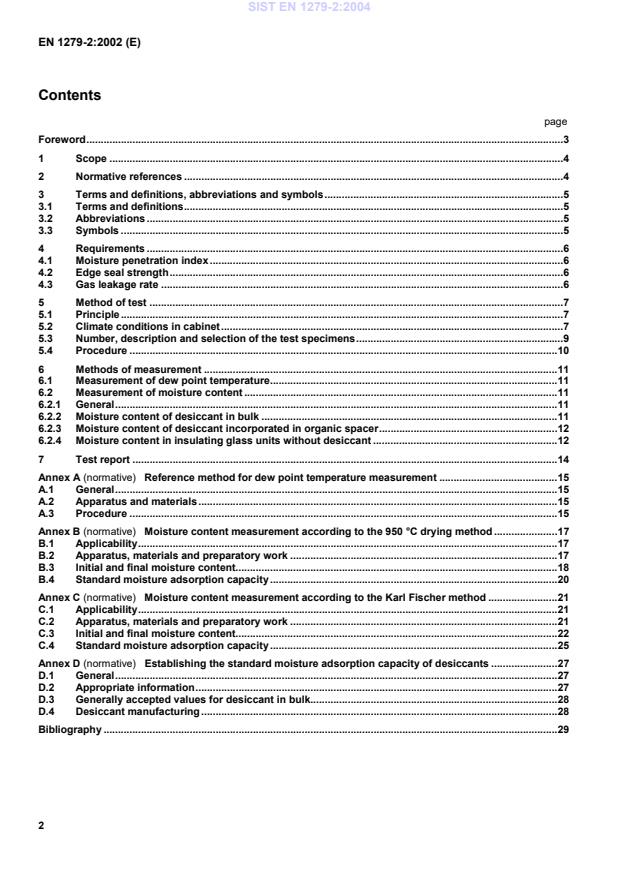
Reference method for dew point temperature measurement.15A.1General.15A.2Apparatus and materials.15A.3Procedure.15Annex B (normative)
Moisture content measurement according to the 950 °C drying method.17B.1Applicability.17B.2Apparatus, materials and preparatory work.17B.3Initial and final moisture content.18B.4Standard moisture adsorption capacity.20Annex C (normative)
Moisture content measurement according to the Karl Fischer method.21C.1Applicability.21C.2Apparatus, materials and preparatory work.21C.3Initial and final moisture content.22C.4Standard moisture adsorption capacity.25Annex D (normative)
Establishing the standard moisture adsorption capacity of desiccants.27D.1General.27D.2Appropriate information.27D.3Generally accepted values for desiccant in bulk.28D.4Desiccant manufacturing.28Bibliography.29SIST EN 1279-2:2004
t2 = 1 h,
t3 = 5 h,
t4 = 1 h,
t5 = total cycle time 12 h ;–Tolerance on time intervals: less than 1 min;–Temperatures of the centrally located test specimen during cycle:–Q h = (53,0 ± 1,0) °C (high temperature);–Q l = (-18,0 ± 1,0) °C (low temperature);–Q s = (14 ± 2) °C/h (slopes).Figure 2 — Temperature/time and humidity/time relations in cycling stageNOTEThe two parts of the process can be carried out in a single cabinet or in two separate cabinets. If two cabinets areused allow up to 4 h for moving the test specimens from one to the other for the second period.The indicated temperatures and temperature tolerances in Figures 1 and 2 are valid for the glass of that unit whichis centrally located in the cabinet(s). The temperature of that centrally located test specimen shall be recordedcontinuously. Also the relative humidity and air temperature, measured at the most suitable location in the testcabinet(s) shall be recorded continuously. Any deviations in temperature and in relative humidity will be noted in thetest report.The glass temperatures of the other test specimens in the cabinet shall be:–during cycling:· high temperatureQ = (Qh ± 1,0) °C;· low temperatureQ = (Ql
± 2,0) °C;SIST EN 1279-2:2004
or
ITTTTfiavcaviav=--100,,, in %(4)SIST EN 1279-2:2004
...