

EN 1279-5:2005+A2:2010
(Main + Amendment)Glass in building - Insulating glass units - Part 5: Evaluation of conformity
- Abstract
This European Standard specifies requirements, the evaluation of conformity and the factory production control of insulating glass units for use in buildings.
NOTE 1 For glass products with electrical wiring or connections for e.g. alarm or heating purposes, other directives, e.g. Low Voltage Directive, may apply.
The main intended uses of the insulating glass units are installations in windows, doors, curtain walling, roofs and partitions where there exists protection against direct ultraviolet radiation at the edges.
NOTE 2 In cases where there is no protection against direct ultra-violet radiation at the edges, such as structural sealant glazing systems, additional European technical specifications should be followed (e.g. !EN 15434", !EN 13022-1").
NOTE 3 Units for which the intended use is only ‘artistic’ and therefore no essential requirement is required, are not subject to CE marking and are not part of this European Standard.
- Status
- Withdrawn
- Publication Date
- 04-May-2010
- Withdrawal Date
- 06-Oct-2026
- Technical Committee
- CEN/TC 129 - Glass in building
- Drafting Committee
- CEN/TC 129/WG 4 - Insulating glass units
- Current Stage
- 9960 - Withdrawal effective - Withdrawal
- Start Date
- 25-Jul-2018
- Completion Date
- 07-Oct-2026
- Directive
- 305/2011 - Regulation (eu) No 305/2011 of the European Parliament and of the Council of 9 march 2011 laying down harmonised conditions for the marketing of construction products and repealing council directive 89/106/eecOJ Ref: C, C 259 OJ Date: 08-Aug-2014
89/106/EEC - Construction productsOJ Ref: C, C 344 OJ Date: 17-Dec-2010
Buy Documents


Relations
- Effective Date
- 19-Jan-2023
- Merged From
EN 1279-5:2005/FprA2 - Glass in building - Insulating glass units - Part 5: Evaluation of conformity - Effective Date
- 18-Jan-2023
- Effective Date
- 01-Aug-2018
- Effective Date
- 28-Jan-2026
- Effective Date
- 28-Jan-2026
- Effective Date
- 28-Jan-2026
- Effective Date
- 28-Jan-2026
- Effective Date
- 28-Jan-2026
- Effective Date
- 28-Jan-2026
- Effective Date
- 28-Jan-2026
- Effective Date
- 28-Jan-2026
- Effective Date
- 28-Jan-2026
- Effective Date
- 28-Jan-2026
- Effective Date
- 28-Jan-2026
- Effective Date
- 28-Jan-2026
Buy Documents
Frequently Asked Questions
EN 1279-5:2005+A2:2010 is a standard published by the European Committee for Standardization (CEN). Its full title is "Glass in building - Insulating glass units - Part 5: Evaluation of conformity". This standard covers: This European Standard specifies requirements, the evaluation of conformity and the factory production control of insulating glass units for use in buildings. NOTE 1 For glass products with electrical wiring or connections for e.g. alarm or heating purposes, other directives, e.g. Low Voltage Directive, may apply. The main intended uses of the insulating glass units are installations in windows, doors, curtain walling, roofs and partitions where there exists protection against direct ultraviolet radiation at the edges. NOTE 2 In cases where there is no protection against direct ultra-violet radiation at the edges, such as structural sealant glazing systems, additional European technical specifications should be followed (e.g. !EN 15434", !EN 13022-1"). NOTE 3 Units for which the intended use is only ‘artistic’ and therefore no essential requirement is required, are not subject to CE marking and are not part of this European Standard.
This European Standard specifies requirements, the evaluation of conformity and the factory production control of insulating glass units for use in buildings. NOTE 1 For glass products with electrical wiring or connections for e.g. alarm or heating purposes, other directives, e.g. Low Voltage Directive, may apply. The main intended uses of the insulating glass units are installations in windows, doors, curtain walling, roofs and partitions where there exists protection against direct ultraviolet radiation at the edges. NOTE 2 In cases where there is no protection against direct ultra-violet radiation at the edges, such as structural sealant glazing systems, additional European technical specifications should be followed (e.g. !EN 15434", !EN 13022-1"). NOTE 3 Units for which the intended use is only ‘artistic’ and therefore no essential requirement is required, are not subject to CE marking and are not part of this European Standard.
EN 1279-5:2005+A2:2010 is classified under the following ICS (International Classification for Standards) categories: 81.040.20 - Glass in building. The ICS classification helps identify the subject area and facilitates finding related standards.
EN 1279-5:2005+A2:2010 has the following relationships with other standards: It is inter standard links to EN 1279-5:2005+A1:2008, EN 1279-5:2005/FprA2, EN 1279-5:2018, EN 1279-1:2004, EN 1063:1999, EN 13501-5:2016, EN 1279-4:2002, EN 13541:2012, EN 1279-2:2002, EN 12758:2019+A1:2023, EN 13024-1:2011, EN 13501-2:2023, EN 572-1:2012+A1:2016, EN 12600:2002, EN 12150-1:2015+A1:2019. Understanding these relationships helps ensure you are using the most current and applicable version of the standard.
EN 1279-5:2005+A2:2010 is associated with the following European legislation: EU Directives/Regulations: 305/2011, 89/106/EEC; Standardization Mandates: M/135. When a standard is cited in the Official Journal of the European Union, products manufactured in conformity with it benefit from a presumption of conformity with the essential requirements of the corresponding EU directive or regulation.
EN 1279-5:2005+A2:2010 is available in PDF format for immediate download after purchase. The document can be added to your cart and obtained through the secure checkout process. Digital delivery ensures instant access to the complete standard document.
Standards Content (Sample)
2003-01.Slovenski inštitut za standardizacijo. Razmnoževanje celote ali delov tega standarda ni dovoljeno.Steklo v gradbeništvu - Izolacijsko steklo - 5. del: Ovrednotenje skladnostiGlas im Bauwesen - Mehrscheiben-Isolierglas - Teil 5: KonformitätsbewertungVerre dans la construction - Vitrage isolant préfabriqué scellé - Partie 5: Évaluation de la conformitéGlass in building - Insulating glass units - Part 5: Evaluation of conformity81.040.20Steklo v gradbeništvuGlass in buildingICS:Ta slovenski standard je istoveten z:EN 1279-5:2005+A2:2010SIST EN 1279-5:2005+A2:2010en,fr,de01-september-2010SIST EN 1279-5:2005+A2:2010SLOVENSKI
STANDARD
EUROPEAN STANDARD NORME EUROPÉENNE EUROPÄISCHE NORM
EN 1279-5:2005+A2
May 2010 ICS 81.040.20 Supersedes EN 1279-5:2005+A1:2008English Version
Glass in building - Insulating glass units - Part 5: Evaluation of conformity
Verre dans la construction - Vitrage isolant préfabriqué scellé - Partie 5: Évaluation de la conformité
Glas im Bauwesen - Mehrscheiben-Isolierglas - Teil 5: Konformitätsbewertung This European Standard was approved by CEN on 24 March 2005 and includes Amendment 1 approved by CEN on 2 October 2008 and Amendment 2 approved by CEN on 27 March 2010.
CEN members are bound to comply with the CEN/CENELEC Internal Regulations which stipulate the conditions for giving this European Standard the status of a national standard without any alteration. Up-to-date lists and bibliographical references concerning such national standards may be obtained on application to the CEN Management Centre or to any CEN member.
This European Standard exists in three official versions (English, French, German). A version in any other language made by translation under the responsibility of a CEN member into its own language and notified to the CEN Management Centre has the same status as the official versions.
CEN members are the national standards bodies of Austria, Belgium, Bulgaria, Croatia, Cyprus, Czech Republic, Denmark, Estonia, Finland, France, Germany, Greece, Hungary, Iceland, Ireland, Italy, Latvia, Lithuania, Luxembourg, Malta, Netherlands, Norway, Poland, Portugal, Romania, Slovakia, Slovenia, Spain, Sweden, Switzerland and United Kingdom.
EUROPEAN COMMITTEE FOR STANDARDIZATION
COMITÉ EUROPÉEN DE NORMALISATION EUROPÄISCHES KOMITEE FÜR NORMUNG
Management Centre:
Avenue Marnix 17,
B-1000 Brussels © 2010 CEN All rights of exploitation in any form and by any means reserved worldwide for CEN national Members. Ref. No. EN 1279-5:2005+A2:2010: ESIST EN 1279-5:2005+A2:2010
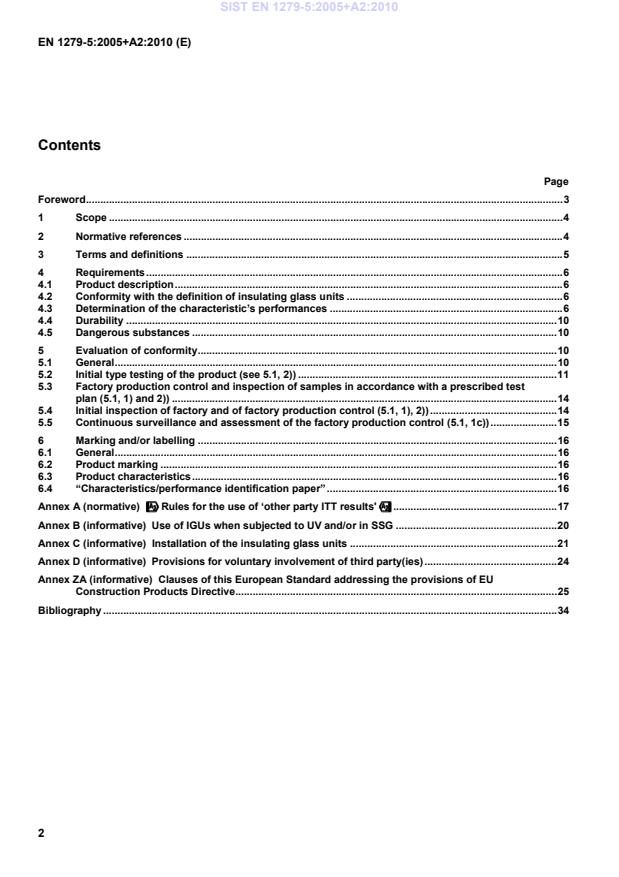
####Rules for the use of ‘other party ITT results'$$$$ . 17Annex B (informative)
Use of IGUs when subjected to UV and/or in SSG . 20Annex C (informative)
Installation of the insulating glass units . 21Annex D (informative)
Provisions for voluntary involvement of third party(ies) . 24Annex ZA (informative)
Clauses of this European Standard addressing the provisions of EU Construction Products Directive . 25Bibliography . 34
Characteristic
Symbol
Unit - density - hardness - Young's modulus - Poisson's ratio - characteristic bending strength - specific heat capacity - coefficient of linear expansion - thermal conductivity - mean refractive index to visible radiation - emissivity - light transmittance - solar direct transmittance - total solar energy transmittance ρ HK 0,1/20 E µ fk c α λ n ε τv τe g kg/m³ GPa Pa Dimensionless Pa J/(kg·K) K-1 W/(m·K) Dimensionless Dimensionless Dimensionless Dimensionless Dimensionless
4.3.2 Determination of characteristics of insulating glass units 4.3.2.1 General If the insulating glass manufacturer wishes to claim that any performance characteristic is independent of the production equipment used then the factory production control system shall be in accordance with this European Standard including his specific process control conditions. 4.3.2.2 Safety in the case of fire - Resistance to fire Fire resistance shall be determined and classified in accordance with EN 13501-2. NOTE EN 357 may be used as a classification reference specific to fire resistant glazed elements. 4.3.2.3 Safety in the case of fire - Reaction to fire Reaction to fire shall be determined and classified in accordance with EN 13501-1. For classification, consideration shall be given to: a) the following product changes require new type testing on reaction to fire: reduction of the reaction to fire classification of the glass components in the insulating glass unit; reduction of the reaction to fire performance of the organic sealant in the edge seal; b) however when not tested, the insulating glass unit shall be classified either: by the reaction to fire classification of the glass component used in the insulating glass unit, or by the classification of an insulating glass units using the same organic sealant in the edge seal, SIST EN 1279-5:2005+A2:2010
!EN 13022-1" using a sealant in accordance with !EN 15434". See Annex #B$. 4.3.2.11 Direct airborne sound reduction The sound reduction indexes shall be determined in accordance with EN 12758. 4.3.2.12 Energy conservation and heat retention - Thermal properties The thermal transmittance value (U-value) shall be determined by calculation in accordance with EN 673 with: emissivity ε: the declared value of the glass manufacturer. If the information is not available, the emissivity shall be determined in accordance with EN 12898; nominal thickness of the glass panes; nominal thickness of any other material layer, if any; the nominal cavity width; assuming that the panes are parallel; the nominal gas concentration ci,o , or the final gas concentration ci,f (see EN 1279-3). NOTE In the case of gas filled units EN 1279-3 should be consulted in order that the U-value for publication includes all the relevant negative aspects. In those instances when the thermal transmittance value (U-value) cannot be calculated then it shall be determined by testing in accordance with EN 674 or EN 675. 4.3.2.13 Energy conservation and heat retention - Radiation properties: Light transmittance and reflectance The light transmittance and reflectance shall be determined in accordance with EN 410. SIST EN 1279-5:2005+A2:2010
1 The terms ‘manufacturer’ and ‘producer’ are understood as being synonyms (see CPD working document NB-CPD/02/019-issued 24 April 2002 – page1). SIST EN 1279-5:2005+A2:2010
Applicable to:
Seal performance: Validation method: (Demonstration by means of available test report or by testing)
Requirement:
All systems of IGU Moisture vapour penetration EN 1279-2 refer to EN 1279-2
Adhesion sealant-glass (*) EN 1279-4 refer to EN 1279-4 NOTE Tests can be carried out by different test laboratories. (*) The test report of the component manufacturer may be used to validate the ITT test. "
! Table 3 - Seal performance, supplementary validation methods and supplementary requirements for gas-filled insulating glass units and units with coated glass
Applicable to:
Seal performance: Validation method: (Demonstration by means of available test report or by testing)
Requirement: Gas-filled IGU: Type of gas Gas leakage rate EN 1279-3 refer to EN 1279-3 Gas filled units: gas concentration
Subject of factory production control in accordance with EN 1279-6 refer to EN 1279-6:2002, Annex A.3 Seal bonding to glass coating (*) Adhesion: - sealant/coating - interlayers of coating EN 1279-4:2002, Annex D refer to EN 1279-4 NOTE Tests can be performed by different test laboratories. (*) The test report of the component manufacturer may be used to validate the ITT test. " Substitution of materials and of components shall maintain the conformity of the system with the definition of insulating glass units. The relevant seal properties, components and the related derived requirements are summarized in EN 1279-1:2004, Tables B.1 and B.2, together with the validation methods. The component manufacturer test reports may be used to validate the substitution. During factory production control the short climate test value of the test report shall be confirmed by the outcome value of the periodic test of the factory production control. Only one substitution shall be made at any one time. When a relevant material changes the short climate test shall be repeated (EN 1279-6:2002, B.4.2). When meeting the requirements, the substituting materials and components shall be added to the system description. In case of system description (processed edge seal description) change, test report on prototype can be used. During factory production control the short climate test value of the test report shall be confirmed by the outcome value of the periodic test of the factory production control. If glass panes are used which are not covered by European specifications, it shall be demonstrated that those glasses have a chemical and mechanical stability over time comparable with: SIST EN 1279-5:2005+A2:2010
B and C 2 Release of dangerous substances - Checking incoming materials Annex A 3 Bullet resistance Explosion resistance Burglar resistance Human impact resistance Resistance against sudden temperature changes and temperature differentials Wind, snow, permanent and imposed load resistance of the glass unit Wind, snow, permanent and imposed load resistance of the edge seal - Checking incoming materials - Checking production control - Labelling outgoing insulating glass units - Edge seal dimensions, gas filling rate, flatness and fogging - Periodic, low frequency tests and inspections Annexes A,
B and C 4 Sound reduction Light transmittance and reflection Solar energy characteristic Thermal conductivity - Checking incoming materials - Checking production control
- Labelling outgoing insulating glass units - Edge seal dimensions, gas filling rate, flatness and fogging - Periodic, low frequency tests and inspections Annexes A,
B and C
5.5 Continuous surveillance and assessment of the factory production control (5.1, 1c)) The continuous surveillance and assessment of the factory production control shall cover the parameters listed in Table 4 in conjunction with EN 1279-6:2002, Annex A. NOTE There may be a need to involve a third party for the purpose of regulatory marking (see Annex ZA). The frequency of production surveillance shall be twice per year for new production facilities or for facilities that do not already have an established factory production control system in accordance with this European Standard. When assessment of FPC fails to identify major non-conformances during four successive assessments, the frequency can be reduced to once a year. When a major non-conformance is recorded, the inspection shall be repeated within two month. The frequency of production surveillance shall return to, or remain at twice a year. When the repeated inspection also results in a non-conformance, then the production shall be subject within two months to a repeated initial inspection of the factory and of the factory production control together with a surveillance inspection. When this repeated initial inspection and surveillance inspection also results in a major non-conformance then the products are considered as no longer conforming to this European Standard. SIST EN 1279-5:2005+A2:2010
The manufacturer or his agent shall organise a system of references that allows for the following: the identification of exactly which characteristics have to be assessed (see 4.3.2); those characteristics that will be assessed; the values, classes, categories, etc. that have been determined for those characteristics. This system shall be documented as part of the evaluation of conformity. 6.4 “Characteristics/performance identification paper” The manufacturer shall prepare a “characteristics/performance identification paper” based on the information collected on the product characteristics (see 6.3). This document shall be part of the manufacturers technical file and is the basis for the accompanying information as required for regulator purposes. The "characteristics/performance identification paper" can be a catalogue in any media format (paper, disk, website, etc.), always identifiable by the reference that accompanies the marking with the product. The catalogue shall contain the values or classes of the characteristics for which a performance is declared. If no performance is declared, an indication of no performance determined (NPD) shall be made. NOTE 1 The conditions of use of NPD are given in Annex ZA. NOTE 2 The catalogue should not contain any information other than that relevant to the “characteristics/performance identification paper”.
####Rules for the use of ‘other party ITT results' A.1 General An IGU manufacturer may use ITT results obtained by a third party, e.g. other manufacturer, system developer, etc., to justify their conformity with this European Standard, i.e. EN 1279-5:2005, 5.2.2, for a product manufactured to the same design. This data is referred to as ‘other party ITT results’. However, to rely on ‘other party ITT results’ there needs to be in place appropriate agreements2,3 between the parties. A.2 Terms and definitions A.2.1 same design insulating glass unit that conforms to the ‘System Description’ of the manufacturer that holds the ITT report A.2.2 product characteristics characteristics according to 4.3.2.1 to 4.3.2.13 that are specific to the unit ‘System Description’, i.e. safety in case of fire – fire resistance, direct airborne sound reductions, etc. A.3 Role of the manufacturer supplying the ‘other party ITT results’ The manufacturer shall undertake, via a specific agreement, to supply the following:
1) a ‘System Description’ that details the insulating glass unit;
2) details of the essential characteristics the insulating glass unit is expected to comply with; 3) reports of Initial Type Testing to EN 1279-2 and if relevant EN 1279-3 on units representative of the ‘System Description’; NOTE The testing being undertaken by a Notified Body. 4) test reports to EN 1279-4 covering the applicable components as described in the ’System Description’; 5) fully documented factory production control system in accordance with EN 1279-6 specific to the ‘System Description’ and directly related to the production facility that is being operated; 6) details of all components and constituents necessary to produce an insulating glass unit to the ‘System Description’;
7) for the manufacturer requesting the use of ‘other party ITT results’, the appropriate procedures as detailed above shall be verified.
2 The formulation of such an agreement can be done by licence, contract, or any other type of written consent. 3 Bodies entering such agreements could be ‘mutually beneficial marketing organisations/clubs’ SIST EN 1279-5:2005+A2:2010
...
2003-01.Slovenski inštitut za standardizacijo. Razmnoževanje celote ali delov tega standarda ni dovoljeno.Steklo v gradbeništvu - Izolacijsko steklo - 5. del: Ovrednotenje skladnostiGlas im Bauwesen - Mehrscheiben-Isolierglas - Teil 5: KonformitätsbewertungVerre dans la construction - Vitrage isolant préfabriqué scellé - Partie 5: Évaluation de la conformitéGlass in building - Insulating glass units - Part 5: Evaluation of conformity81.040.20Steklo v gradbeništvuGlass in buildingICS:Ta slovenski standard je istoveten z:EN 1279-5:2005+A2:2010SIST EN 1279-5:2005+A2:2010en,fr,de01-september-2010SIST EN 1279-5:2005+A2:2010SLOVENSKI
STANDARD
EUROPÄISCHE NORM EUROPEAN STANDARD NORME EUROPÉENNE
EN 1279-5:2005+A2
Mai 2010 ICS 81.040.20 Ersatz für EN 1279-5:2005+A1:2008Deutsche Fassung
Glas im Bauwesen - Mehrscheiben-Isolierglas - Teil 5: Konformitätsbewertung
Glass in building - Insulating glass units - Part 5: Evaluation of conformity
Verre dans la construction - Vitrage isolant préfabriqué scellé - Partie 5: Évaluation de la conformité Diese Europäische Norm wurde vom CEN am 24. März 2005 angenommen und schließt Änderung 1 ein, die am 2. Oktober 2008 vom CENangenommen wurde, sowie Änderung 2, die am 27. März 2010 vom CEN angenommen wurde.
Die CEN-Mitglieder sind gehalten, die CEN/CENELEC-Geschäftsordnung zu erfüllen, in der die Bedingungen festgelegt sind, unter denen dieser Europäischen Norm ohne jede Änderung der Status einer nationalen Norm zu geben ist. Auf dem letzen Stand befindliche Listen dieser nationalen Normen mit ihren bibliographischen Angaben sind beim Management-Zentrum des CEN oder bei jedem CEN-Mitglied auf Anfrage erhältlich.
Diese Europäische Norm besteht in drei offiziellen Fassungen (Deutsch, Englisch, Französisch). Eine Fassung in einer anderen Sprache, die von einem CEN-Mitglied in eigener Verantwortung durch Übersetzung in seine Landessprache gemacht und dem Zentralsekretariat mitgeteilt worden ist, hat den gleichen Status wie die offiziellen Fassungen.
CEN-Mitglieder sind die nationalen Normungsinstitute von Belgien, Bulgarien, Dänemark, Deutschland, Estland, Finnland, Frankreich, Griechenland, Irland, Island, Italien, Kroatien, Lettland, Litauen, Luxemburg, Malta, den Niederlanden, Norwegen, Österreich, Polen, Portugal, Rumänien, Schweden, der Schweiz, der Slowakei, Slowenien, Spanien, der Tschechischen Republik, Ungarn, dem Vereinigten Königreich und Zypern.
EUROPÄISCHES KOMITEE FÜR NORMUNG EUROPEAN COMMITTEE FOR STANDARDIZATION
COMITÉ EUROPÉEN DE NORMALISATION
Management-Zentrum:
Avenue Marnix 17,
B-1000 Brüssel © 2010 CEN Alle Rechte der Verwertung, gleich in welcher Form und in welchem Verfahren, sind weltweit den nationalen Mitgliedern von CEN vorbehalten.Ref. Nr. EN 1279-5:2005+A2:2010 DSIST EN 1279-5:2005+A2:2010
#Regeln für die Verwendung der „Erstprüfungsergebnisse Dritter“.18 Anhang B (informativ)
Verwendung des Mehrscheiben-Isolierglases (MIG) unter UV-Strahlung und/oder in geklebten Verglasungen (SSG).21 Anhang C (informativ)
Einbau des Mehrscheiben-Isolierglases.23 Anhang D (informativ)
Bestimmungen hinsichtlich des freiwilligen Hinzuziehens unabhängiger Stellen.26 Anhang ZA (informativ)
Zusammenhang zwischen dieser Europäischen Norm und den grundlegenden Anforderungen der EG-Bauproduktenrichtlinie.27 Literaturhinweise.38
2 SIST EN 1279-5:2005+A2:2010
!" und #$ gekennzeichnet. Dieses Dokument wurde unter einem Mandat erarbeitet, das die Europäische Kommission und die Europäische Freihandelszone dem CEN erteilt haben, und unterstützt grundlegende Anforderungen der EG-Richtlinien. Zum Zusammenhang mit EG-Richtlinien siehe informativen Anhang ZA, der Bestandteil dieses Dokuments ist. Dieser Teil der Europäischen Norm stellt keine selbständige Norm dar, sondern ist Teil einer Norm mit dem Haupttitel Glas im Bauwesen — Mehrscheiben-Isolierglas: Teil 1: Allgemeines, Maßtoleranzen und Vorschriften für die Systembeschreibung Teil 2: Langzeitprüfverfahren und Anforderungen bezüglich Feuchtigkeitsaufnahme Teil 3: Langzeitprüfverfahren und Anforderungen bezüglich Gasverlustrate und Grenzabweichungen für die Gaskonzentration Teil 4: Verfahren zur Prüfung der physikalischen Eigenschaften des Randverbundes Teil 5: Konformitätsbewertung Teil 6: Werkseigene Produktionskontrolle und Auditprüfungen Diese Europäische Norm deckt zusätzliche Aspekte ab, die für den Handel von Bedeutung sind. Diese Europäische Norm enthält Literaturhinweise. Entsprechend der CEN/CENELEC-Geschäftsordnung sind die nationalen Normungsinstitute der folgenden Länder gehalten, diese Europäische Norm zu übernehmen: Belgien, Bulgarien, Dänemark, Deutschland, Estland, Finnland, Frankreich, Griechenland, Irland, Island, Italien, Kroatien, Lettland, Litauen, Luxemburg, Malta, Niederlande, Norwegen, Österreich, Polen, Portugal, Rumänien, Schweden, Schweiz, Slowakei, Slowenien, Spanien, Tschechische Republik, Ungarn, Vereinigtes Königreich und Zypern. 3 SIST EN 1279-5:2005+A2:2010
für die Verwendung in Mehrscheiben-Isolierglas Merkmal Symbol Einheit Dichte kg/m3 Härte HK0,1/20 GPa Elastizitätsmodul E Pa Poisson-Zahl Dimensionslos Charakteristische Biegefestigkeit fk Pa spezifische Wärmekapazität c J/(kg K) linearer Wärmeausdehnungskoeffizient K–1 Wärmeleitfähigkeit W/(m K) mittlerer Brechungsindex im Bereich der sichtbaren Strahlung n Dimensionslos Emissionsgrad Dimensionslos Lichttransmissionsgrad v Dimensionslos direkter Strahlungstransmissionsgrad e Dimensionslos Gesamtenergiedurchlassgrad g Dimensionslos
4.3.2 Bestimmung der Merkmale von Mehrscheiben-Isolierglas 4.3.2.1 Allgemeines Wenn der Hersteller des Isolierglases in Anspruch nehmen möchte, dass ein beliebiges der Leistungs-merkmale von den verwendeten Produktionseinrichtungen unabhängig ist, muss das System der werks-eigenen Produktionskontrolle einschließlich der besonderen Bedingungen für die Prozesslenkung dieser Europäischen Norm entsprechen. 4.3.2.2 Brandschutz — Feuerwiderstand Der Feuerwiderstand ist nach EN 13501-2 zu bestimmen und zu klassifizieren. ANMERKUNG EN 357 darf zur Klassifizierung speziell von Brandschutzverglasungen herangezogen werden. 7 SIST EN 1279-5:2005+A2:2010
Widerstand gegen Angriff Die Durchschusshemmung ist nach EN 1063 zu bestimmen und zu klassifizieren. In den Fällen, in denen eine durchschusshemmende Glaskomponente als die Fläche eines Mehrscheiben-Isolierglases angewendet wird, die gegen Angriff geschützt ist, ist keine Prüfung erforderlich. Bei der Klassifizierung des Mehrscheiben-Isolierglases muss es sich um dieselbe handeln wie bei der verwendeten Glaskomponente. 8 SIST EN 1279-5:2005+A2:2010
gegen Angriff Die Einbruchhemmung ist nach EN 356 zu bestimmen und zu klassifizieren. In den Fällen, in denen eine einbruchhemmende Glaskomponente als die Fläche eines Mehrscheiben-Iso-lierglases angewendet wird, die gegen Angriff geschützt ist, ist keine Prüfung erforderlich. Bei der Klassifi-zierung des Mehrscheiben-Isolierglases muss es sich um dieselbe handeln wie bei der verwendeten Glas-komponente. 4.3.2.8 Nutzungssicherheit — Widerstand gegen Pendelschlag: Brucheigenschaften
(sicheres Bruchverhalten) und Aufprallwiderstand Der Widerstand gegen Pendelschlag ist nach EN 12600 an den Glaskomponenten zu bestimmen und zu klassifizieren. ANMERKUNG Die EN 12600 behandelt die Prüfung und Klassifizierung von einzelnen Scheiben und NICHT die von Produkten wie Mehrscheiben-Isolierglas. Findet keine Prüfung statt, muss dem Mehrscheiben-Isolierglas im Hinblick auf den Widerstand gegen Pendelschlag dieselbe Klassifizierung zugewiesen werden wie der anfälligsten Glaskomponente, die im Mehrscheiben-Isolierglas verwendet wurde. !Wenn die Kennzeichnung der Zusammensetzung des Produkts klar genug ist, um Verwechslungen zu vermeiden, wird die Leistungsfähigkeit jeder Komponente in der Reihenfolge angegeben, die durch die erwähnte Zusammensetzung vorgegeben ist." !Die Leistungen entsprechen jenen Komponenten, die nach EN 12600, 4.3.2.8, als Einfachglas geprüft wurden. Es sollte sorgfältig darauf geachtet werden, das Mehrscheiben-Isolierglas in einer solchen Stellung einzusetzen, die den erwarteten Leistungen entspricht." 4.3.2.9 Nutzungssicherheit — Mechanische Beständigkeit: Beständigkeit gegen plötzliche Temperaturwechsel und Temperaturunterschiede Die Beständigkeit gegen plötzliche Temperaturwechsel und Temperaturunterschiede wird durch einen allgemein anerkannten Wert angegeben, der in den entsprechenden Normen, z. B. in EN 1863-1, EN 12150-1, EN 12337-1, EN 13024-1 usw., aufgeführt ist und durch Übereinstimmung mit dieser Europäischen Norm sicherzustellen ist. 4.3.2.10 Nutzungssicherheit — Mechanische Beständigkeit: Widerstand der Glaseinheit
gegen Wind-, Schnee-, Dauer- und/oder Nutzlasten Der in der Bestellung angegebene Aufbau des Mehrscheiben-Isolierglases (Dicke und Typen der Glas-komponenten, Breite der Scheibenzwischenräume) muss den Widerstand gegen Wind-, Schnee-, Dauerlast und weitere mechanische, (quasi-)statische Einwirkungen sicherstellen, was nach prEN 13474 zu prüfen ist. Trifft für das betreffende Bauwerk oder die betreffende Baustelle kein Teil der prEN 13474 zu, ist das im Bestimmungsland gebräuchliche Verfahren zur Bestimmung der mechanischen Beständigkeit anzuwenden. 9 SIST EN 1279-5:2005+A2:2010
zu bestimmen. #Siehe Anhang B $. 4.3.2.11 Direkte Luftschalldämmung Die Schalldämm-Maße sind nach EN 12758 zu bestimmen. 4.3.2.12 Energieerhaltung und Wärmerückhaltevermögen (Wärmeschutz) —
Thermische Eigenschaften Der Wärmedurchgangskoeffizient (U-Wert) ist durch Berechnung nach EN 673 zu bestimmen mit: dem Emissionsgrad : des vom Glashersteller angegebenen Wertes. Liegen keine Angaben vor, so ist der Emissionsgrad nach EN 12898 zu bestimmen; der Nenndicke der Glasscheiben; der Nenndicke jeglicher weiterer Werkstofflagen, sofern vorhanden; der Nennbreite der Scheibenzwischenräume unter der Annahme paralleler Scheiben; der Nenn-Gaskonzentration ci,o oder der endgültigen Gaskonzentration ci,f (siehe EN 1279-3). ANMERKUNG Im Falle von gasgefüllten Einheiten sollte EN 1279-3 herangezogen werden, damit bei dem veröffentlichten U-Wert sämtliche relevanten negativen Aspekte Berücksichtigung finden. In den Fällen, in denen der Wärmedurchgangskoeffizient (U-Wert) nicht berechnet werden kann, ist er durch Prüfung nach EN 674 oder EN 675 zu bestimmen. 4.3.2.13 Energieerhaltung und Wärmerückhaltevermögen (Wärmeschutz) —
Strahlungsphysikalische Eigenschaften: Lichttransmissionsgrad und Lichtreflexion Lichttransmissionsgrad und Lichtreflexion sind nach EN 410 zu bestimmen.
4.3.2.14 Energieerhaltung und Wärmerückhaltevermögen (Wärmeschutz) —
Strahlungsphysikalische Eigenschaften: Solarenergetische Merkmale Die solarenergetischen Merkmale sind nach EN 410 zu bestimmen. 4.4 Dauerhaftigkeit Stimmen Produkte mit der Definition von Mehrscheiben-Isolierglas nach 4.2 überein, sind die unter 4.3.2 aufgeführten Leistungsmerkmale über eine wirtschaftlich annehmbare Lebensdauer sichergestellt. Die Dauerhaftigkeit von Mehrscheiben-Isolierglas, einschließlich die seiner Merkmale, ist folgendermaßen sicherzustellen: durch Übereinstimmung mit dieser Europäischen Norm; 10 SIST EN 1279-5:2005+A2:2010
c) ständige Überwachung und Beurteilung der werkseigenen Produktionskontrolle. 2) Erstprüfung des Produktes. ANMERKUNG Für den Zweck der gesetzlich vorgeschriebenen Kennzeichnung kann es erforderlich sein, eine unabhängige Stelle an der Durchführung von 1) b), 1) c) und/oder 2) zu beteiligen (siehe Anhang ZA). 11 SIST EN 1279-5:2005+A2:2010
1) Die Begriffe „Hersteller“ (en: manufacturer) und „Produzent“ (en: producer) werden als Synonyme verstanden (siehe Arbeitsdokument zur Bauproduktenrichtlinie NB-CPD/02/019 — vom 24. April 2002 — Seite 1). 12 SIST EN 1279-5:2005+A2:2010
wurden, dürfen berücksichtigt werden, wenn alle folgenden Bedingungen erfüllt sind: 1) eine notifizierte Stelle hat die Ergebnisse der Prüfungen bestätigt, die von einer nicht notifizierten Stelle durchgeführt wurden, und hat die Kompetenz der Prüfstelle als zufrieden stellend bewertet; 2) die Prüfungen wurden nach einer prEN-Version durchgeführt, die sich nicht wesentlich von der EN unterscheiden darf, was die Prüfungen angeht; 3) die Prüfungen wurden vor Ende der Übergangsperiode, d. h. innerhalb von 21 Monaten nach dem Datum der Verfügbarkeit dieses Dokuments, abgeschlossen. 5.2.4 Erstprüfung von Mehrscheiben-Isolierglas Um festzustellen, ob ein Produkt der Definition von Mehrscheiben-Isolierglas entspricht, ist im Zuge der Erstprüfung die Erfüllung der Anforderungen nach den Tabellen 2 und 3 nachzuprüfen. ! Tabelle 2 — Leistung des Randverbundes, Validierungsverfahren und Anforderungen an MIG (Mehrscheiben-Isolierglas) Anwendbar auf: Leistung des Dichtstoffes: Validierungsverfahren: (Nachweis anhand des verfügbaren Prüfberichts oder durch Prüfung) Anforderung Feuchtigkeitsaufnahme (Eindringen von Wasserdampf) EN 1279-2 Siehe EN 1279-2 Alle MIG-Systeme Adhäsion Dichtstoff – Glas (*) EN 1279-4 Siehe EN 1279-4 ANMERKUNG Die Prüfungen können von unterschiedlichen Prüflaboratorien durchgeführt werden. (*) Zur Validierung der Erstprüfung kann der Prüfbericht des Komponenten-Herstellers verwendet werden. " 13 SIST EN 1279-5:2005+A2:2010
Gegenstand der werkseigenen Produktionskontrolle nach EN 1279-6 Siehe EN 1279-6:2002, Anhang A.3 Randverbund mit Glasbeschichtung verbunden (*) Adhäsion: – Dichtstoff/Beschichtung – Einzellagen der BeschichtungEN 1279-4:2002, Anhang D Siehe EN 1279-4 ANMERKUNG Die Prüfungen können von unterschiedlichen Prüflaboratorien durchgeführt werden. (*) Zur Validierung der Erstprüfung kann der Prüfbericht des Komponenten-Herstellers verwendet werden. " Werden Werkstoffe und Komponenten ausgetauscht, muss weiterhin Übereinstimmung des Systems mit der Definition von Mehrscheiben-Isolierglas gegeben sein. Die entsprechenden Eigenschaften des Randverbun-des, die Komponenten und die zugehörigen abgeleiteten Anforderungen sind zusammen mit den Validie-rungsverfahren, in EN 1279-1:2004, Tabellen B.1 und B.2, zusammengefasst. Für die Validierung des Austausches dürfen die Prüfberichte des Komponentenherstellers herangezogen werden. Während der werkseigenen Produktionskontrolle ist der im Prüfbericht angegebene Wert der Kurzzeit-Klimaprüfung durch das Ergebnis der periodischen Prüfung der werkseigenen Produktionskontrolle zu bestätigen. Zu einem Zeitpunkt darf nur ein Austausch stattfinden. Verändert sich ein wesentlicher Werkstoff, ist die Kurzzeit-Klimaprüfung zu wiederholen (EN 1279-6:2002, B.4.2). Sind die Anforderungen erfüllt, sind die Austauschwerkstoffe und -komponenten zur Systembeschreibung hinzuzufügen. Ändert sich die Systembeschreibung (Beschreibung des bearbeiteten Randverbundes), kann der Prüfbericht zum Prototypen verwendet werden. Während der werkseigenen Produktionskontrolle ist der im Prüfbericht angegebene Wert der Kurzzeit-Klimaprüfung durch das Ergebnis der periodischen Prüfung der werkseigenen Produktionskontrolle zu bestätigen. Werden Glasscheiben verwendet, die nicht durch Europäische Spezifikationen abgedeckt sind, ist nachzu-weisen, dass diese Glastypen über ihre Nutzungsdauer eine chemische und mechanische Beständigkeit aufweisen, die mit der von Folgendem vergleichbar ist: Kalk-Natronsilicatglas nach EN 572-1; oder Borosilicatglas nach EN 1748-1-1; oder Glaskeramik nach EN 1748-2-1; oder !Erdalkali-Silicatglas" nach EN 14178-1. 5.2.5 Erstprüfung der Leistungsmerkmale (5.1, 2)) Alle in 4.3.2 aufgeführten Merkmale sind Erstprüfungen nach 5.2.1 zu unterziehen. 14 SIST EN 1279-5:2005+A2:2010
Ändert sich die Systembeschreibung (Beschreibung des bearbeiteten Randverbundes), kann der Prüfbericht zum Prototypen verwendet werden. Während der werkseigenen Produktionskontrolle ist der im Prüfbericht angegebene Wert der Kurzzeit-Klimaprüfung durch das Ergebnis der periodischen Prüfung der werkseigenen Produktionskontrolle zu bestätigen. ANMERKUNG 1 Sowohl die Kurzzeit-Klimaprüfung als auch die weiteren Prüfungen im Rahmen der werkseigenen Produktionskontrolle dürfen entweder durch den Hersteller selbst oder einen Unterauftragnehmer ausgeführt werden. ANMERKUNG 2 Ein System der werkseigenen Produktionskontrolle, das dem nach EN ISO 9001 gleicht und auf die Produkte nach diesem Dokument abgestimmt wurde, gilt als den Anforderungen dieses Abschnitts entsprechend. 5.4 Erstinspektion des Werks und der werkseigenen Produktionskontrolle (5.1, 1), 2)) Die Erstinspektion des Werks und der werkseigenen Produktionskontrolle muss die in Tabelle 4 aufgeführten Parameter in Zusammenhang mit der EN 1279-6:2002, Anhang A, abdecken. ANMERKUNG 1 Für den Zweck der gesetzlich vorgeschriebenen Kennzeichnung kann es erforderlich sein, eine unabhängige Stelle einzubeziehen (siehe Anhang ZA). 15 SIST EN 1279-5:2005+A2:2010
5.5 Laufende Überwachung und Beurteilung der werkseigenen Produktionskontrolle (5.1, 1c)) Die laufende Überwachung und Beurteilung der werkseigenen Produktionskontrolle muss die in Tabelle 4 aufgeführten Parameter in Zusammenhang mit EN 1279-6:2002, Anhang A, abdecken. ANMERKUNG Für den Zweck der gesetzlich vorgeschriebenen Kennzeichnung kann es erforderlich sein, eine unabhängige Stelle einzubeziehen (siehe Anhang ZA). Die Häufigkeit der Produktionsüberwachung muss bei neuen Produktionseinrichtungen oder bei Einrichtungen, die noch nicht über ein System der werkseigenen Produktionskontrolle nach dieser Europäischen Norm verfügen, zweimal im Jahr betragen. Werden in vier aufeinander folgenden Beurteilungen der werkseigenen Produktionskontrolle (FPC) keine größeren Abweichungen von den Anforderungen festgestellt, kann die Häufigkeit auf einmal im Jahr verringert werden. 16 SIST EN 1279-5:2005+A2:2010
...