

EN 12600:2002
(Main)Glass in building - Pendulum test - Impact test method and classification for flat glass
- Abstract
This European Standard specifies a pendulum impact test method for single flat panes of glass for use in buildings. The test is intended to classify flat glass products in three principal classes by performance under impact and by mode of breakage.
This standard does not specify requirements for applications, nor does it specify requirements for durability.
- Status
- Published
- Publication Date
- 19-Nov-2002
- Withdrawal Date
- 30-May-2003
- Technical Committee
- CEN/TC 129 - Glass in building
- Drafting Committee
- CEN/TC 129/WG 13 - Safety glazing
- Current Stage
- 9060 - Closure of 2 Year Review Enquiry - Review Enquiry
- Start Date
- 02-Sep-2017
- Completion Date
- 02-Sep-2017


Overview
EN 12600:2002 - "Glass in building – Pendulum test – Impact test method and classification for flat glass" (CEN) specifies a standardized pendulum impact test for single flat panes used in buildings. The method classifies flat glass products into three principal classes by performance under impact and by mode of breakage, enabling consistent assessment of person‑impact safety. The standard is a test method only; it does not set application or durability requirements.
Key topics and technical requirements
- Test purpose: Classify flat glass by impact energy absorption and breakage behaviour (mode of breakage).
- Test pieces: Single panes representative of normal production. Required test-piece dimensions: 876 ± 2 mm (width) × 1 938 ± 2 mm (height). Four identical pieces are tested at each drop height (more for asymmetric materials).
- Impactor assembly: Dual-tyre pendulum impactor with total mass (50 ± 0.1) kg, tyres typically 3.50‑R8 type; suspended on a steel cable to swing and strike the test pane.
- Main/clamping frame: Rigid steel frame with specified internal dimensions (internal width 847 ± 5 mm, internal height 1 910 ± 5 mm) and rubber sealing strips in the clamping frame (20 ± 2 mm wide, 10 ± 1 mm thick, hardness 60 ± 5 IRHD).
- Calibration: Test rigs must be calibrated per Annex B to ensure energy transfer consistency between laboratories.
- Acceptance criteria / mode of breakage: Two principal break outcomes are defined:
- a) Numerous cracks but containment sufficient to prevent a 76 mm sphere passing with a maximum force of 25 N (see Annex A), and limits on detached particle mass (total and largest single particle equivalents expressed in mm² of original piece).
- b) Disintegration: limits on the total mass of the 10 largest crack‑free particles collected after impact (mass equivalents in mm²).
- Test reporting: Detailed results, calibration data and the observed mode of breakage are recorded to support classification.
Applications and who uses it
EN 12600 is used to:
- Support safety performance claims for flat glass in internal partitions, doors, balustrades, facades and other building situations where human impact is a concern.
- Provide consistent test evidence for manufacturers, independent testing laboratories, architects, façade engineers, specifiers, and building authorities evaluating glazing safety.
- Feed into product technical files, CE marking processes where applicable, and project specifications that reference impact performance.
Related standards
Normative references cited in EN 12600 include key glass standards used to define glass types and properties:
- EN 572-1 / EN 572-2 / EN 572-3 (basic soda lime silicate glass)
- EN 12150-1 (thermally toughened glass)
- EN 1863-1 (heat strengthened glass)
- EN 12337-1 (chemically strengthened glass)
- EN ISO 12543-1 (laminated glass)
Keywords: EN 12600, pendulum test, impact test, flat glass, classification, safety glass, test rig calibration, drop height, mode of breakage.
Relations
- Effective Date
- 25-Aug-2026
- Effective Date
- 25-Aug-2026
- Effective Date
- 25-Aug-2026
- Effective Date
- 28-Jan-2026
- Refers
EN 572-2:2012 - Glass in building - Basic soda lime silicate glass products - Part 2: Float glass - Effective Date
- 28-Jan-2026
- Effective Date
- 28-Jan-2026
- Effective Date
- 28-Jan-2026
- Effective Date
- 28-Jan-2026
- Effective Date
- 28-Jan-2026
- Effective Date
- 01-Jul-2026
- Effective Date
- 08-Apr-2026
- Effective Date
- 09-Feb-2026
- Effective Date
- 09-Feb-2026
- Effective Date
- 28-Jan-2026
- Effective Date
- 28-Jan-2026
Frequently Asked Questions
EN 12600:2002 is a standard published by the European Committee for Standardization (CEN). Its full title is "Glass in building - Pendulum test - Impact test method and classification for flat glass". This standard covers: This European Standard specifies a pendulum impact test method for single flat panes of glass for use in buildings. The test is intended to classify flat glass products in three principal classes by performance under impact and by mode of breakage. This standard does not specify requirements for applications, nor does it specify requirements for durability.
This European Standard specifies a pendulum impact test method for single flat panes of glass for use in buildings. The test is intended to classify flat glass products in three principal classes by performance under impact and by mode of breakage. This standard does not specify requirements for applications, nor does it specify requirements for durability.
EN 12600:2002 is classified under the following ICS (International Classification for Standards) categories: 81.040.20 - Glass in building. The ICS classification helps identify the subject area and facilitates finding related standards.
EN 12600:2002 has the following relationships with other standards: It is inter standard links to ISO 48:1994, ISO 4251-1:1998, ISO 2408:1985, EN 12337-1:2000, EN 572-2:2012, EN 572-3:2012, EN 596:1995, EN 572-1:2012+A1:2016, EN ISO 12543-1:2021, EN 581-3:2026, EN 1647:2026, EN 50583-1:2016, EN 50583-2:2016, EN 13830:2003, EN 14351-2:2018. Understanding these relationships helps ensure you are using the most current and applicable version of the standard.
EN 12600:2002 is associated with the following European legislation: EU Directives/Regulations: 305/2011, 89/106/EEC; Standardization Mandates: M/101, M/108, M/135. When a standard is cited in the Official Journal of the European Union, products manufactured in conformity with it benefit from a presumption of conformity with the essential requirements of the corresponding EU directive or regulation.
EN 12600:2002 is available in PDF format for immediate download after purchase. The document can be added to your cart and obtained through the secure checkout process. Digital delivery ensures instant access to the complete standard document.
Standards Content (Sample)
2003-01.Slovenski inštitut za standardizacijo. Razmnoževanje celote ali delov tega standarda ni dovoljeno.Steklo v stavbah – Preskus z nihalom – Preskusna metoda z udarcem in klasifikacija ravnega steklaGlas im Bauwesen - Pendelschlagversuch - Verfahren für die Stoßprüfung und die Klassifizierung von FlachglasVerre dans la construction - Essai au pendule - Méthode d'essai d'impact et classification du verre platGlass in building - Pendulum test - Impact test method and classification for flat glass81.040.20Steklo v gradbeništvuGlass in buildingICS:Ta slovenski standard je istoveten z:EN 12600:2002SIST EN 12600:2004en01-september-2004SIST EN 12600:2004SLOVENSKI
STANDARD
EUROPEAN STANDARDNORME EUROPÉENNEEUROPÄISCHE NORMEN 12600November 2002ICS 81.040.20; 91.100.99English versionGlass in building - Pendulum test - Impact test method andclassification for flat glassVerre dans la construction - Essai au pendule - Méthoded'essai d'impact et classification du verre platGlas im Bauwesen - Pendelschlagversuch - Verfahren fürdie Stoßprüfung und die Klassifizierung von FlachglasThis European Standard was approved by CEN on 10 August 2002.CEN members are bound to comply with the CEN/CENELEC Internal Regulations which stipulate the conditions for giving this EuropeanStandard the status of a national standard without any alteration. Up-to-date lists and bibliographical references concerning such nationalstandards may be obtained on application to the Management Centre or to any CEN member.This European Standard exists in three official versions (English, French, German). A version in any other language made by translationunder the responsibility of a CEN member into its own language and notified to the Management Centre has the same status as the officialversions.CEN members are the national standards bodies of Austria, Belgium, Czech Republic, Denmark, Finland, France, Germany, Greece,Iceland, Ireland, Italy, Luxembourg, Malta, Netherlands, Norway, Portugal, Spain, Sweden, Switzerland and United Kingdom.EUROPEAN COMMITTEE FOR STANDARDIZATIONCOMITÉ EUROPÉEN DE NORMALISATIONEUROPÄISCHES KOMITEE FÜR NORMUNGManagement Centre: rue de Stassart, 36
B-1050 Brussels© 2002 CENAll rights of exploitation in any form and by any means reservedworldwide for CEN national Members.Ref. No. EN 12600:2002 ESIST EN 12600:2004
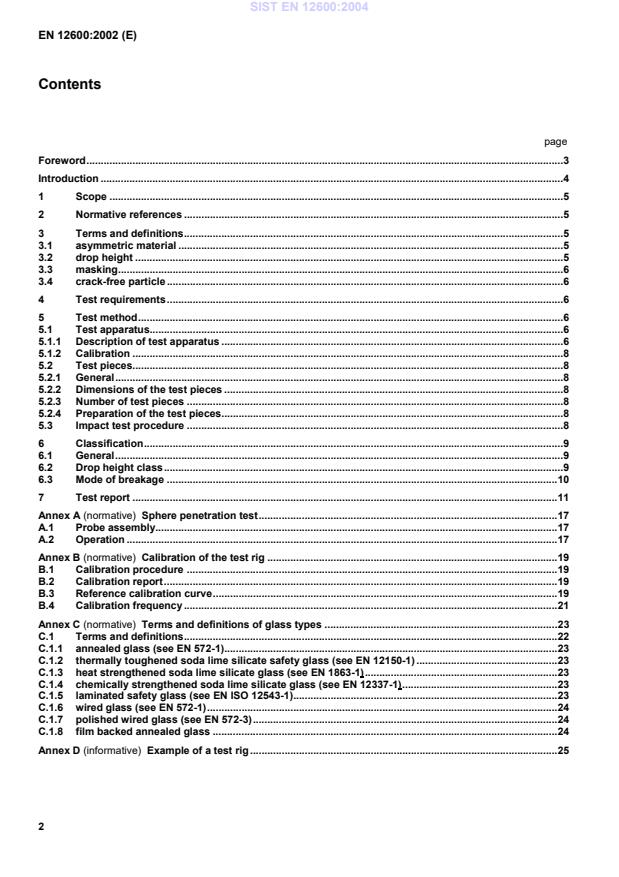
Sphere penetration test.17A.1Probe assembly.17A.2Operation.17Annex B (normative)
Calibration of the test rig.19B.1Calibration procedure .19B.2Calibration report.19B.3Reference calibration curve.19B.4 Calibration frequency.21Annex C (normative)
Terms and definitions of glass types.23C.1Terms and definitions.22C.1.1annealed glass (see EN 572-1).23C.1.2thermally toughened soda lime silicate safety glass (see EN 12150-1).23C.1.3heat strengthened soda lime silicate glass (see EN 1863-1).23C.1.4chemically strengthened soda lime silicate glass (see EN 12337-1).23C.1.5laminated safety glass (see EN ISO 12543-1).23C.1.6wired glass (see EN 572-1).24C.1.7polished wired glass (see EN 572-3).24C.1.8film backed annealed glass.24Annex D (informative)
Example of a test rig.25SIST EN 12600:2004
of cutting and piercing injuries to persons;-the containment characteristics of the material.SIST EN 12600:2004
(847 ± 5) mm;-internal height: (1 910 ± 5) mmEach part of the clamping frame shall be fitted with a strip of rubber. The rubber strips shall be the only element incontact with the test piece and shall be (20 ± 2) mm wide and (10 ± 1) mm thick and have a hardness of(60 ± 5) IRHD in accordance with ISO 48.NOTEIt is recommended to use polychloroprene or a similar material.5.1.1.4 Impactor (see Figures 5 and 6)Impactor consisting of two pneumatic tyres, Tyre 3.50-R8 4PR 1) in accordance with ISO 4251-1, with roundsection and flat longitudinal tread. The tyres shall be fitted to the rims of the wheels that carry two steel weights ofequal mass. The weights shall be dimensioned so that the total mass of the impactor is (50 ± 0,1) kg.NOTEAn example of the impactor, using steel with a density of 7 830 kg/m³, is shown in Figure 5.5.1.1.5 Suspension system (see Figure 2)The impactor shall be suspended by means of a steel cable of 5 mm in diameter conforming to ISO 2408, from abracket attached above the head of the main frame. The bracket shall be rigid to ensure that the point ofsuspension remains stationary during the test and shall be positioned to permit the impactor to strike the centre ofthe test piece.At the highest drop height the angle between the taut suspension cable and the bracket shall not be less than 14°from the horizontal.When the impactor is hanging freely, at rest, the distance between the fully inflated tyres and the surface of the testpiece shall not exceed 15 mm and shall not be less than 5 mm (see Figure 2; D) and the centre line of the impactorshall be within 50 mm radially from the centre of the test piece.
1) Tyre 3.50-R8 4PR manufactured by Vredestein can be used for the pendulum test. It can be obtained from Vredestein BV,Ingenieur Schiffstraat 370, NL - 7547 RD Enschede, Nederland or Vredestein GmbH, August-Horch-Strasse 7, D - 56070Koblenz, Deutschland.The above tyre does not mean that CEN is recommending the use of this particular tyre. Equivalent tyres may be used as longas it is demonstrated that equivalent results will be obtained.SIST EN 12600:2004
...