

EN 50583-2:2016
(Main)Photovoltaics in buildings - Part 2: BIPV systems
General Information
- Abstract
This document applies to photovoltaic systems that are integrated into buildings with the photovoltaic modules used as construction products. It focuses on the properties of these photovoltaic systems relevant to essential building requirements as specified in the European Construction Product Regulation CPR 89/106/EEC, and the applicable electro-technical requirements as stated in the Low Voltage Directive 2006/95/EC / or CENELEC standards. This document references international standards, technical reports and guidelines. For some applications in addition national standards (or regulations) for building works may apply in individual countries, which are not explicitly referenced here. The document is addressed to manufacturers, planners, system designers, installers, testing institutes and building authorities. This document does not apply to concentrating or building-attached photovoltaic systems. This document addresses requirements on the BIPV systems in the specific ways they are intended to be mounted but not the BIPV modules as construction products, which is the topic of FprEN 50583-1.
- Status
- Published
- Publication Date
- 14-Jan-2016
- Withdrawal Date
- 11-Oct-2018
- Technical Committee
- CLC/TC 82 - Solar photovoltaic energy systems
- Drafting Committee
- CLC/TC 82 - Solar photovoltaic energy systems
- Current Stage
- 6060 - Document made available - Publishing
- Start Date
- 15-Jan-2016
- Due Date
- 08-May-2017
- Completion Date
- 15-Jan-2016
Buy Documents

Overview
EN 50583-2:2016 - Photovoltaics in buildings: Part 2 - BIPV systems is a CLC/CENELEC standard that defines requirements for photovoltaic systems that are integrated into buildings where the PV modules are used as construction products. The document focuses on the properties of BIPV systems relevant to essential building requirements under the European Construction Product Regulation (CPR) and the applicable electro-technical rules of the Low Voltage Directive and CENELEC standards. It applies to how BIPV systems are mounted and operated (not to BIPV modules as construction products, which are covered by EN 50583-1). The standard excludes concentrating and building-attached PV systems.
Key topics and technical requirements
- Scope and definitions: Clarifies what constitutes a Building-Integrated Photovoltaic (BIPV) system versus Building-Attached (BAPV) systems.
- Integration with building regulations: Aligns BIPV system properties with CPR essential requirements (mechanical resistance & stability, fire safety, hygiene/health, safety in use, noise protection, energy performance, sustainable resource use).
- Electro-technical compliance: Requires conformity with the Low Voltage Directive (LVD 2006/95/EC), Electromagnetic Compatibility Directive (ECD 2004/108/EC) and relevant CENELEC/IEC norms (e.g., HD 60364-7-712).
- Structural and environmental performance: References wind load, watertightness, impact resistance and thermal transmittance standards (e.g., EN 12179, EN 1027, Eurocodes).
- Testing, labelling and documentation: Covers labelling, system documentation, commissioning tests and inspection requirements (see EN 62446 for PV system documentation and commissioning).
- Specific mounting-related requirements: Addresses system-level requirements based on intended mounting methods; module-level product characteristics are handled in EN 50583-1.
- Informative annexes: Include test principles and procedures (e.g., leakage/watertightness) and normative references to international and national standards.
Practical applications and users
EN 50583-2:2016 is intended for:
- Manufacturers and product developers specifying BIPV system performance and compliance
- Planners, architects and system designers integrating PV into building envelopes while meeting structural, fire and energy regulations
- Installers and contractors following approved mounting, electrical safety and commissioning procedures
- Testing institutes and certification bodies assessing system conformity with CPR and electro-technical directives
- Building authorities and procurement teams evaluating compliance for permits and tenders
Use this standard to ensure regulatory compliance across the EU, reduce integration risks, and document system performance for handover and inspection.
Related standards (selected)
- EN 50583-1 (BIPV modules)
- HD 60364-7-712 (PV electrical installations)
- EN 62446 (system documentation & commissioning)
- Eurocodes (EN 1990/1991/1993/1995/1999)
- EN 1027, EN 12179, EN 13501 (watertightness, wind load, fire classification)
Keywords: EN 50583-2:2016, BIPV systems, photovoltaics in buildings, building-integrated photovoltaics, CPR, Low Voltage Directive, CENELEC.
Relations
- Effective Date
- 01-Apr-2026
- Effective Date
- 25-Mar-2026
- Effective Date
- 25-Mar-2026
- Effective Date
- 25-Mar-2026
- Effective Date
- 25-Mar-2026
- Effective Date
- 10-Feb-2026
- Effective Date
- 09-Feb-2026
- Effective Date
- 09-Feb-2026
- Effective Date
- 09-Feb-2026
- Effective Date
- 09-Feb-2026
- Refers
EN 410:2011 - Glass in building - Determination of luminous and solar characteristics of glazing - Effective Date
- 09-Feb-2026
- Effective Date
- 09-Feb-2026
- Effective Date
- 09-Feb-2026
- Effective Date
- 09-Feb-2026
- Effective Date
- 09-Feb-2026
Buy Documents
Get Certified
Connect with accredited certification bodies for this standard

DNV
DNV is an independent assurance and risk management provider.

Lloyd's Register
Lloyd's Register is a global professional services organisation specialising in engineering and technology.
DNV Energy Systems
Energy and renewable energy certification.
Sponsored listings
Frequently Asked Questions
EN 50583-2:2016 is a standard published by CLC. Its full title is "Photovoltaics in buildings - Part 2: BIPV systems". This standard covers: This document applies to photovoltaic systems that are integrated into buildings with the photovoltaic modules used as construction products. It focuses on the properties of these photovoltaic systems relevant to essential building requirements as specified in the European Construction Product Regulation CPR 89/106/EEC, and the applicable electro-technical requirements as stated in the Low Voltage Directive 2006/95/EC / or CENELEC standards. This document references international standards, technical reports and guidelines. For some applications in addition national standards (or regulations) for building works may apply in individual countries, which are not explicitly referenced here. The document is addressed to manufacturers, planners, system designers, installers, testing institutes and building authorities. This document does not apply to concentrating or building-attached photovoltaic systems. This document addresses requirements on the BIPV systems in the specific ways they are intended to be mounted but not the BIPV modules as construction products, which is the topic of FprEN 50583-1.
This document applies to photovoltaic systems that are integrated into buildings with the photovoltaic modules used as construction products. It focuses on the properties of these photovoltaic systems relevant to essential building requirements as specified in the European Construction Product Regulation CPR 89/106/EEC, and the applicable electro-technical requirements as stated in the Low Voltage Directive 2006/95/EC / or CENELEC standards. This document references international standards, technical reports and guidelines. For some applications in addition national standards (or regulations) for building works may apply in individual countries, which are not explicitly referenced here. The document is addressed to manufacturers, planners, system designers, installers, testing institutes and building authorities. This document does not apply to concentrating or building-attached photovoltaic systems. This document addresses requirements on the BIPV systems in the specific ways they are intended to be mounted but not the BIPV modules as construction products, which is the topic of FprEN 50583-1.
EN 50583-2:2016 is classified under the following ICS (International Classification for Standards) categories: 27.160 - Solar energy engineering. The ICS classification helps identify the subject area and facilitates finding related standards.
EN 50583-2:2016 has the following relationships with other standards: It is inter standard links to EN 15978:2026, EN 1993-1-11:2026, EN 1991-1-4:2026, EN 1991-1-6:2026, EN 1991-1-8:2026, EN 1995-1-2:2004, EN ISO 12543-3:2021, EN 13501-5:2016, EN ISO 12543-6:2021, EN 1993-1-12:2007, EN 410:2011, EN 12758:2019+A1:2023, EN 1991-1-5:2025, EN 13022-1:2014, EN 1027:2016. Understanding these relationships helps ensure you are using the most current and applicable version of the standard.
EN 50583-2:2016 is available in PDF format for immediate download after purchase. The document can be added to your cart and obtained through the secure checkout process. Digital delivery ensures instant access to the complete standard document.
Standards Content (Sample)
SLOVENSKI STANDARD
01-marec-2016
Fotonapetostni elementi v stavbah - 2. del: Fotonapetostni sistemi, vgrajeni v
stavbo (BIPV)
Photovoltaics in buildings - Part 2: BIPV systems
Photovoltaik im Bauwesen - Teil 2: BIPV-Anlagen
Systèmes photovoltaïques dans la construction - Partie 2: Systèmes photovoltaïques
incorporés au bâti
Ta slovenski standard je istoveten z: EN 50583-2:2016
ICS:
27.160 Sončna energija Solar energy engineering
2003-01.Slovenski inštitut za standardizacijo. Razmnoževanje celote ali delov tega standarda ni dovoljeno.
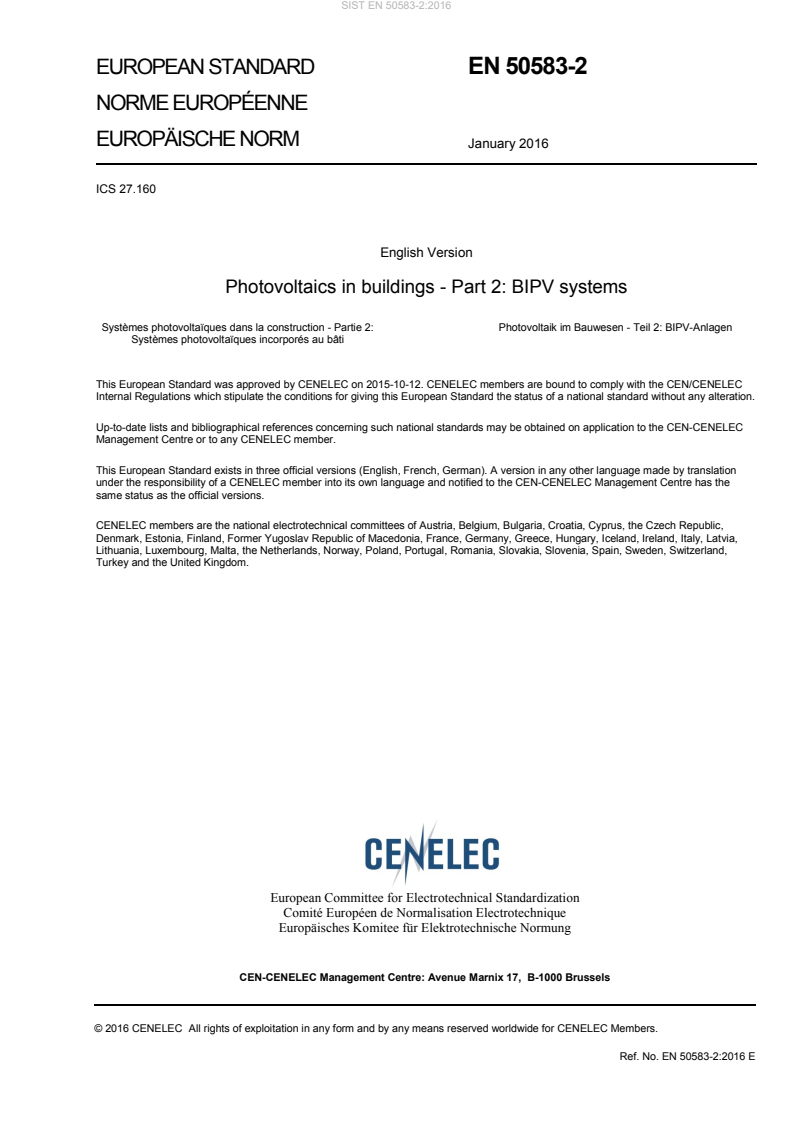
EUROPEAN STANDARD EN 50583-2
NORME EUROPÉENNE
EUROPÄISCHE NORM
January 2016
ICS 27.160
English Version
Photovoltaics in buildings - Part 2: BIPV systems
Systèmes photovoltaïques dans la construction - Partie 2: Photovoltaik im Bauwesen - Teil 2: BIPV-Anlagen
Systèmes photovoltaïques incorporés au bâti
This European Standard was approved by CENELEC on 2015-10-12. CENELEC members are bound to comply with the CEN/CENELEC
Internal Regulations which stipulate the conditions for giving this European Standard the status of a national standard without any alteration.
Up-to-date lists and bibliographical references concerning such national standards may be obtained on application to the CEN-CENELEC
Management Centre or to any CENELEC member.
This European Standard exists in three official versions (English, French, German). A version in any other language made by translation
under the responsibility of a CENELEC member into its own language and notified to the CEN-CENELEC Management Centre has the
same status as the official versions.
CENELEC members are the national electrotechnical committees of Austria, Belgium, Bulgaria, Croatia, Cyprus, the Czech Republic,
Denmark, Estonia, Finland, Former Yugoslav Republic of Macedonia, France, Germany, Greece, Hungary, Iceland, Ireland, Italy, Latvia,
Lithuania, Luxembourg, Malta, the Netherlands, Norway, Poland, Portugal, Romania, Slovakia, Slovenia, Spain, Sweden, Switzerland,
Turkey and the United Kingdom.
European Committee for Electrotechnical Standardization
Comité Européen de Normalisation Electrotechnique
Europäisches Komitee für Elektrotechnische Normung
CEN-CENELEC Management Centre: Avenue Marnix 17, B-1000 Brussels
© 2016 CENELEC All rights of exploitation in any form and by any means reserved worldwide for CENELEC Members.
Ref. No. EN 50583-2:2016 E
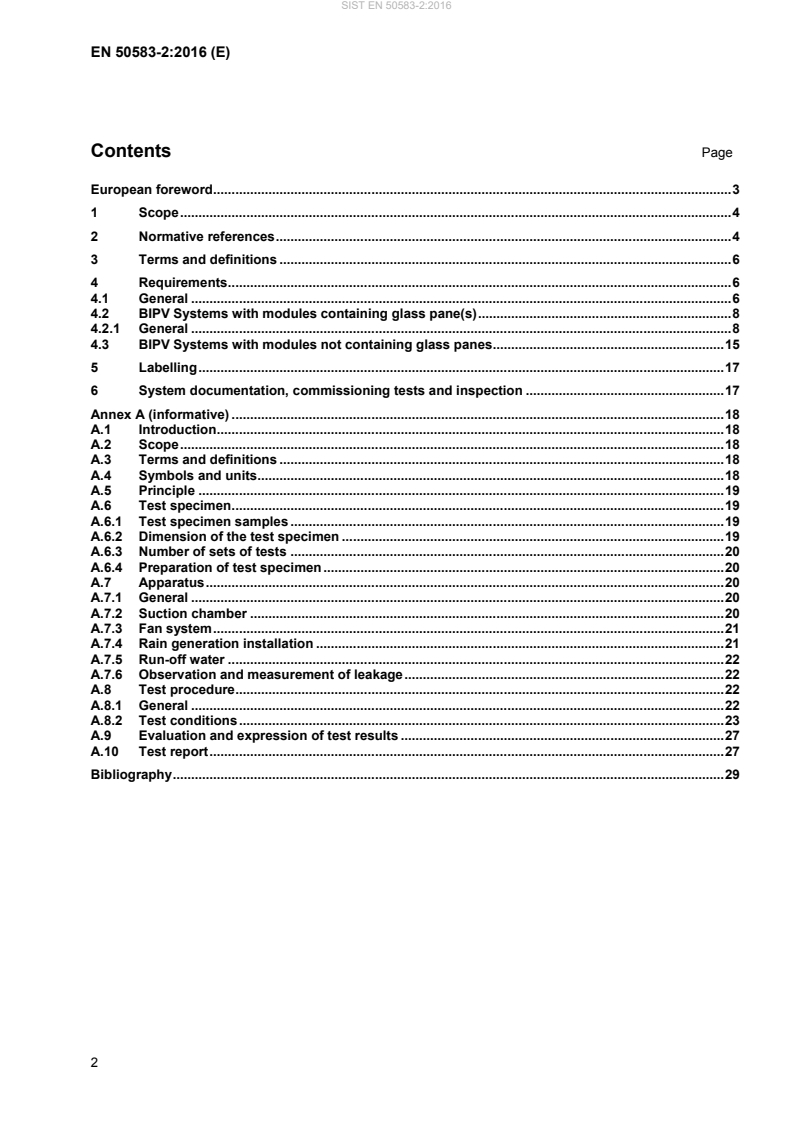
Contents Page
European foreword . 3
1 Scope . 4
2 Normative references . 4
3 Terms and definitions . 6
4 Requirements . 6
4.1 General . 6
4.2 BIPV Systems with modules containing glass pane(s) . 8
4.2.1 General . 8
4.3 BIPV Systems with modules not containing glass panes. 15
5 Labelling . 17
6 System documentation, commissioning tests and inspection . 17
Annex A (informative) . 18
A.1 Introduction . 18
A.2 Scope . 18
A.3 Terms and definitions . 18
A.4 Symbols and units. 18
A.5 Principle . 19
A.6 Test specimen . 19
A.6.1 Test specimen samples . 19
A.6.2 Dimension of the test specimen . 19
A.6.3 Number of sets of tests . 20
A.6.4 Preparation of test specimen . 20
A.7 Apparatus . 20
A.7.1 General . 20
A.7.2 Suction chamber . 20
A.7.3 Fan system . 21
A.7.4 Rain generation installation . 21
A.7.5 Run-off water . 22
A.7.6 Observation and measurement of leakage . 22
A.8 Test procedure . 22
A.8.1 General . 22
A.8.2 Test conditions . 23
A.9 Evaluation and expression of test results . 27
A.10 Test report . 27
Bibliography . 29
European foreword
This document (EN 50583-2:2016) has been prepared by CLC/TC 82 "Solar photovoltaic energy systems".
The following dates are fixed:
(dop) 2016-10-12
• latest date by which this document has
to be implemented at national level by
publication of an identical national
standard or by endorsement
• latest date by which the national (dow) 2018-10-12
standards conflicting with this
document have to be withdrawn
Attention is drawn to the possibility that some of the elements of this document may be the subject of patent
rights. CENELEC [and/or CEN] shall not be held responsible for identifying any or all such patent rights.
1 Scope
This document applies to photovoltaic systems that are integrated into buildings with the photovoltaic modules
used as construction products. It focuses on the properties of these photovoltaic systems relevant to essential
building requirements as specified in the European Construction Product Regulation CPR 89/106/EEC, and the
applicable electro-technical requirements as stated in the Low Voltage Directive 2006/95/EC / or CENELEC
standards. This document references international standards, technical reports and guidelines. For some
applications in addition national standards (or regulations) for building works may apply in individual countries,
which are not explicitly referenced here.
The document is addressed to manufacturers, planners, system designers, installers, testing institutes and
building authorities.
This document does not apply to concentrating or building-attached photovoltaic systems.
This document addresses requirements on the BIPV systems in the specific ways they are intended to be
mounted but not the BIPV modules as construction products, which is the topic of EN 50583-1.
2 Normative references
The following documents, in whole or in part, are normatively referenced in this document and are indispensable
for its application. For dated references, only the edition cited applies. For undated references, the latest edition
of the referenced document (including any amendments) applies.
EN 410, Glass in building — Determination of luminous and solar characteristics of glazing
EN 1027, Windows and doors — Watertightness — Test method
EN 1990, Eurocode: Basis of structural design
EN 1991 (all parts), Eurocode 1: Actions on structures
EN 1993 (all parts), Eurocode 3: Design of steel structures
EN 1995 (all parts), Eurocode 5: Design of timber structures
EN 1999 (all parts), Eurocode 9: Design of aluminium structures
EN 12179, Curtain walling — Resistance to wind load — Test method
prEN 12488, Glass in buildings — Glazing recommendations — Assembly principles for vertical and sloping
glazing
EN 12519, Windows and pedestrian doors — Terminology
EN 12600, Glass in building — Pendulum test — Impact test method and classification for flat glass
EN 12758, Glass in building — Glazing and airborne sound insulation — Product descriptions and determination
of properties
EN 13022 (all parts), Glass in building — Structural sealant glazing
EN 13116, Curtain walling — Resistance to wind load — Performance requirements
EN 13119, Curtain walling —Terminology
EN 13363-1, Solar protection devices combined with glazing — Calculation of solar and light transmittance —
Part 1: Simplified method
For the definition building-attached photovoltaic systems refer to 3.2
EN 13363-2, Solar protection devices combined with glazing — Calculation of total solar energy transmittance
and light transmittance — Part 2: Detailed calculation method
EN 13501-2, Fire classification of construction products and building elements — Part 2: Classification using
data from fire resistance tests, excluding ventilation services
EN 13501-5, Fire classification of construction products and building elements — Part 5: Classification using
data from external fire exposure to roofs tests
EN 13830, Curtain walling — Product standard
EN 13956, Flexible sheets for waterproofing — Plastic and rubber sheets for roof waterproofing — Definitions
and characteristics
EN 14351-1, Windows and doors — Product standard, performance characteristics — Part 1: Windows and
external pedestrian doorsets without resistance to fire and/or smoke leakage characteristics
EN 14500, Blinds and shutters — Thermal and visual comfort — Test and calculation methods
EN 14782, Self-supporting metal sheet for roofing, external cladding and internal lining — Product specification
and requirements
EN 14783, Fully supported metal sheet and strip for roofing, external cladding and internal lining — Product
specification and requirements
EN 15804, Sustainability of construction works — Environmental product declarations — Core rules for the
product category of construction products
CEN/TR 15941, Sustainability of construction works — Environmental product declarations — Methodology for
selection and use of generic data
EN 15942, Sustainability of construction works — Environmental product declarations — Communication format
business-to-business
EN 15978, Sustainability of construction works — Assessment of environmental performance of buildings —
Calculation method
EN 16002, Flexible sheets for waterproofing — Determination of the resistance to wind load of mechanically
fastened flexible sheets for roof waterproofing
EN 50583-1, Photovoltaics in buildings – Part 1: BIPV modules
HD 60364-7-712, Electrical installations of buildings — Part 7-712: Requirements for special installations or
locations — Solar photovoltaic (PV) power supply systems (IEC 60364-7-712)
CLC/TS 61836, Solar photovoltaic energy systems — Terms, definitions, symbols (IEC/TS 61836)
EN 62446, Grid connected photovoltaic systems — Minimum requirements for system documentation,
commissioning tests and inspection (IEC 62446)
EN ISO 6946, Building components and building elements — Thermal resistance and thermal transmittance —
— Calculation method (ISO 6946)
EN ISO 12543-1, Glass in building — Laminated glass and laminated safety glass — Part 1: Definitions and
description of component parts (ISO 12543-1)
EN ISO 12543-2, Glass in building — Laminated glass and laminated safety glass — Part 2: Laminated safety
glass (ISO 12543-2)
EN ISO 12543-3, Glass in building — Laminated glass and laminated safety glass — Part 3: Laminated glass
(ISO 12543-3)
EN ISO 12543-4, Glass in building — Laminated glass and laminated safety glass — Part 4: Test methods for
durability (ISO 12543-4)
EN ISO 12543-5, Glass in building — Laminated glass and laminated safety glass — Part 5: Dimensions and
edge finish (ISO 12543-5)
EN ISO 12543-6, Glass in building — Laminated glass and laminated safety glass — Part 6: Appearance
(ISO 12543-6)
prEN ISO 14439, Glass in building — Glazing requirements — Use of glazing blocks (ISO/DIS 14439)
EN ISO 12631, Thermal performance of curtain walling — Calculation of thermal transmittance (ISO 12631)
ETAG 002, Guideline for European Technical Approval for Structural Sealant Glazing Systems – SSGS
N 0068/CEN-TC128-WG3-N0068 TR Renewable energy systems for roof structural connections
3 Terms and definitions
For the purposes of this document, the terms and definitions given in EN 1990, EN ISO 12543 (Parts 1 to 6),
EN 12519, EN 13119, EN 13956, EN 14782, EN 14783, EN 13022, EN 16002, CLC/TS 61836, and the following
apply.
Annex-specific definitions are included in the annexes themselves.
NOTE Additional information are provided in the Low Voltage Directive 2006/95/EC, the Construction Product Regulation
305/2011 and the Electromagnetic Compatibility Directive ECD 2004/108/EC.
3.1
Building-Integrated Photovoltaic system
BIPV system
photovoltaic systems are considered to be building-integrated, if the PV modules they utilize fulfil the criteria for
BIPV modules as defined in EN 50583-1 and thus form a construction product providing a function as defined in
the European Construction Product Regulation CPR 305/2011
3.2
Building Attached Photovoltaic system
BAPV system
photovoltaic systems are considered to be building attached, if the PV modules they utilize do not fulfil the
criteria for BIPV modules as defined in EN 50583-1
Note 1 to entry: Further important information on this type of photovoltaic system on roofs is provided by the Technical
Report by CEN/TC 128/WG3 - Solar energy systems for roofs: Requirements for structural connections to solar panels.
4 Requirements
4.1 General
As BIPV systems contain electrical components, the systems are subject to the applicable electro-technical
requirements as stated in the Low Voltage Directive 2006/95/EC / or CENELEC standards. BIPV systems shall
be designed such that they do not contradict the requirements of HD 60364-7-712 for PV systems.
The essential requirements defined in the LVD 2006/95/EC are:
1. Protection against hazards arising from the electrical equipment,
2. Protection against hazards which may be caused by external influences on the electrical equipment.
As electrical systems, BIPV systems are subject to the applicable electro-technical requirements as stated in the
Electromagnetic Compatibility Directive ECD 2004/108/EC / or CENELEC standards.
The essential requirements defined in the ECD 2004/108/EC are:
3 Protection requirements:
Equipment shall be so designed and manufactured, having regard to the state of the art, as to ensure
that:
(a) the electromagnetic disturbance generated does not exceed the level above which radio and
telecommunications equipment or other equipment cannot operate as intended;
(b) it has a level of immunity to the electromagnetic disturbance to be expected in its intended use
which allows it to operate without unacceptable degradation of its intended use.
4 Specific requirements for fixed installations:
Installation and intended use of components
A fixed installation shall be installed applying good engineering practices and respecting the information
on the intended use of its components, with a view to meeting the protection requirements set out in
Point 1. Those good engineering practices shall be documented and the documentation shall be held by
the person(s) responsible at the disposal of the relevant national authorities for inspection purposes for
as long as the fixed installation is in operation.
As BIPV systems contain components that are used as construction products, these components are subject to
the Essential Requirements as specified in the European Construction Product Regulation CPR 305/2011.
The essential requirements defined in the CPR 305/2011 are:
5. Mechanical resistance and stability;
6. Safety in case of fire;
7. Hygiene, health and the environment ;
8. Safety and accessibility in use;
9. Protection against noise;
10. Energy economy and heat retention;
11. Sustainable use of natural resources.
The specific requirements on BIPV modules, which arise from these general CPR requirements, are treated in
EN 50583-1.
The integration of photovoltaics into an existing construction product to create a BIPV module necessarily
changes the properties with respect to the original construction product. New evaluation of a BIPV system
containing the BIPV module with respect to a basic requirement of the CPR is necessary only if an essential
characteristic of the BIPV module needed to meet this basic requirement is changed with respect to the original
construction product.
As construction products, BIPV modules and their mounting structure, frame and fastenings have to be
designed to comply with the wind, snow and mechanical loads as well as other requirements set out in the
Eurocodes EN 1990, EN 1991, EN 1993, EN 1995 and EN 1999.
This standard distinguishes between BIPV systems with modules that contain at least one pane of glass and
those that do not. In addition to naming the general requirements, this standard classifies BIPV systems with
modules containing glass into five different categories (depending on the intended mounting type). Specific
normative references are listed for each category.
As per Directive 2011/65/EU of the European parliament from 8th June 2011, photovoltaic modules have
been exempted from the ROHS directive.
Note the findings of CEN/TC128 WG3 – N0068 – TR renewable energy systems for roof structural connections.
4.2 BIPV Systems with modules containing glass pane(s)
4.2.1 General
Additional clauses from EN 13022-1 or ETAG 002 apply to BIPV modules that are used as part of a structural
sealant glazing system.
Table 1 — General requirements for all BIPV systems with modules containing glass panes
CPR Requirement Standards, Comment
guidelines, test
methods
1. Mechanical resistance prEN 12488 Basis of assembly rules for glazing
and stability
2. Safety in case of fire EN 13501-2 Fire classification standards
3. Hygiene, health and the
environment
4. Safety and accessibility in EN 13022-2 Only applicable for BIPV systems consisting of BIPV
use modules or PV insulating glass units to be bonded
adhesively which are sold separately from the framework
and installed under the responsibility of the designer and
assembler. National regulations may define restrictions or
4)
additional requirements.
ETAG 002 Applicable for structural sealant glazing systems put on the
market as a “kit” of components; specified by European
Technical Approval or National Approval
prEN ISO 14439 Applicable if contact of glass and frame cannot be excluded
5. Protection against noise EN 12758
6. Energy economy and heat
retention
7. Sustainable use of natural EN 15804 Additional information is provided in the final Report of IEA-
resources CEN/TR 15941 PVPS Task 12
EN 15942
EN 15978
4.2.2 Mounting categories
Additional requirements depend on the type of mounting. This standard differentiates five categories - A to E - of
mounting according to combinations of the following criteria:
) Structural sealant glazing systems (SSGS) or kits comprising PV modules are in the first consideration a
matter of Technical Approvals which set out the requirements for the complete product to be fulfilled by the
manufacturer. In the second consideration, PV modules as glass products to be sold separately and installed
into or onto a framework or into or onto the building using a structural glazing technique are specified in EN
13022-1. Meeting the requirements of this standard, they are suitable for use in SSGS as defined in ETAG
002 and EN 13022-2.
1. integrated into the building envelope: yes/no
2. accessible yes/no
3. sloped: yes/no
“Not accessible” means that another construction product still provides protection against mechanical impact,
even if the PV module has been damaged or removed.
The definition of “sloped glazing” is derived from EN 13830 and prEN 12488 and illustrated below (see
Figure 1).
2 2
Key
1 vertical glazing
2 angle of glazing considered sloped
3 angle of glazing considered non-sloped ± 15° from vertical
Figure 1 — Angle of glazing considered sloped and non-sloped as per EN 13830 and prEN 12488
Stated explicitly, “non-sloped” refers to the following angles:
75° ≤ angle ≤ 90° or 90° ≤ angle ≤ 105° from horizontal.
Table 2 — Mounting categories A – E
Category A: Sloped, roof-integrated, not accessible from within
the building
The PV modules are mounted in the building envelope
at an angle between 0° and 75° (see Fig. 1) with a
barrier underneath preventing large pieces of glass
falling onto accessible areas below
Category B: Sloped, roof-integrated, accessible from within the
building
The PV modules are mounted in the building envelope
at an angle between 0° and 75° (see Fig. 1)
Category C: Non-sloped (vertically) mounted not accessible
from within the building
The PV modules are mounted in the building envelope
at an angle of between and including both 75° and 90°
(see Fig. 1) with a barrier behind preventing large
pieces of glass or persons falling to an adjacent lower
area inside the building.
Category D: Non-sloped (vertically) mounted accessible from
within the building
The PV modules are mounted in the building envelope
at an angle of between and including both 75° and 90°
(see Fig. 1)
Category E: Externally integrated, accessible or not accessible
from within the building
The PV modules are mounted onto the building and
form an additional functional layer (as defined in 3.1)
exterior to its envelope (e.g. balconies, balustrades,
shutters, awnings, louvres, brise soleil etc.).
4.2.3 Additional requirements for Category A: sloped, roof-integrated, not accessible from within the
building
Table 3 — Additional requirements for BIPV systems - Category A
CPR Requirement Standards, guidelines, test Comment
methods
1. Mechanical
CEN-TC128-WG3-N0068 TR
resistance and stability
2. Safety in case of fire EN 13501-5 National requirements may demand B (t1),
Roof
(t2), (t3) or (t4)
3. Hygiene, health and
Rain penetration test according to
the environment Annex A.
4. Safety and
accessibility in use
5. Protection against
noise
6. Energy economy and EN 410 and B.2 Calculation of light and solar energy
heat retention
characteristics. Applicable only if underlying
layer is transparent or translucent. The PV
module in the system is to be characterised in
the open circuit condition.
EN ISO 6946 Calculation of thermal characteristics of roof
construction
7. Sustainable use of
natural resources
4.2.4 Additional requirements for Category B: Sloped, roof-integrated, accessible from within the
building / Skylight
If the BIPV system is covered by the scope of EN 14351-1 (windows, incl. roof windows, roof windows with
external fire resistance and French windows) the tests and classification specified in that standard concerning
CPR requirements shall be observed.
Table 4 — Additional requirements for BIPV systems - Category B
CPR Requirement Standards, guidelines, test Comment
methods
1. Mechanical
National regulations may define restrictions or
resistance and stability additional requirements.
2. Safety in case of fire EN 13501-2 Fire classification standards (applies to -2 and -
5)
EN 13501-5
EN 14351-1
3. Hygiene, health and Rain penetration test according to
the environment
EN 1027
4. Safety and
accessibility in use
5. Protection against
noise
6. Energy economy and
EN 410 and B.2 Calculation of light and solar energy
heat retention characteristics. The PV module in the system
is to be characterised in the open circuit
condition.
EN ISO 6946 Calculation of thermal characteristics of roof
construction
7. Sustainable use of
natural resources
4.2.5 Additional requirements for Category C: Non-sloped (Vertically mounted), not accessible from
within the building
If the BIPV system is covered by the scope of EN 13830 (curtain walling) the tests and classification specified in
that standard concerning CPR requirements shall be observed.
Table 5 — Additional requirements for BIPV systems - Category C
CPR Requirement Standards, guidelines, test Comment
methods
1. Mechanical
CEN-TC128-WG3-N0068 TR
resistance and stability
EN 12179
EN 13116
2. Safety in case of fire EN 13501-2 Fire classification
3. Hygiene, health and
the environment
4. Safety and
accessibility in use
5. Protection ag
...
SIST EN 50583-2
S L O V E N S K I
S T A N D A R D marec 2016
Fotonapetostni elementi v stavbah – 2. del: Fotonapetostni sistemi,
vgrajeni v stavbo (BIPV)
Photovoltaics in buildings – Part 2: BIPV systems
Systèmes photovoltaïques dans la construction –
Partie 2: Systèmes photovoltaïques incorporés au bâti
Photovoltaik im Bauwesen – Teil 2: BIPV-Anlagen
Referenčna oznaka
ICS 27.160 SIST EN 50583-2:2016 (sl)
Nadaljevanje na straneh II do IV in od 1 do 30
2025-06. Slovenski inštitut za standardizacijo. Razmnoževanje ali kopiranje celote ali delov tega dokumenta ni dovoljeno.
SIST EN 50583-2 : 2016
NACIONALNI UVOD
Standard SIST EN 50583-2, Fotonapetostni elementi v stavbah – 2. del: Fotonapetostni sistemi, vgrajeni
v stavbo (BIPV), 2016, ima status slovenskega standarda in je istoveten evropskemu standardu EN
50583-2, Photovoltaics in buildings – Part 2: BIPV systems, 2016.
NACIONALNI PREDGOVOR
Evropski standard EN 50583-2:2016 je pripravil tehnični odbor Evropskega komiteja za standardizacijo
v elektrotehniki CLC/TC 82 Sončni fotonapetostni sistemi. Slovenski standard SIST EN 50583-2:2016
je prevod evropskega standarda EN 50583-2:2016. V primeru spora glede besedila slovenskega
prevoda v tem standardu je odločilen izvirni evropski standard.
Odločitev za privzem tega standarda je 27. januarja 2016 sprejel SIST/TC PVS Fotonapetostni sistemi.
ZVEZA Z NACIONALNIMI STANDARDI
S privzemom tega evropskega standarda veljajo za omejeni namen referenčnih standardov vsi
standardi, navedeni v izvirniku, razen tistih, ki so že sprejeti v nacionalno standardizacijo:
SIST EN 410 Steklo v gradbeništvu – Določanje svetlobnih in sončnih karakteristik stekla
SIST EN 1027 Okna in vrata – Neprepustnost za vodo – Preskusna metoda
SIST EN 1990 Evrokod – Osnove projektiranja
SIST EN 1991 (vsi deli) Evrokod 1: Vplivi na konstrukcije
SIST EN 1993 (vsi deli) Evrokod 3: Projektiranje jeklenih konstrukcij
SIST EN 1995 (vsi deli) Evrokod 5: Projektiranje lesenih konstrukcij
SIST EN 1999 (vsi deli) Evrokod 9: Projektiranje konstrukcij iz aluminijevih zlitin
SIST EN 12179 Obešene fasade – Odpornost proti obremenitvi z vetrom – Preskusna
metoda
SIST EN 12488 Steklo v zgradbah – Priporočila za zasteklitev – Načela sestavljanja
navpične in poševne zasteklitve
SIST EN 12519 Okna in vhodna vrata – Terminologija
SIST EN 12600 Steklo v zgradbah – Preskus z nihalom – Preskusna metoda z udarcem in
klasifikacija ravnega stekla
SIST EN 12758, Steklo v zgradbah – Zasteklitev in zvočna izolacija v zraku – Opis in
opredelitev lastnosti
SIST EN 13022 (vsi deli) Steklo v zgradbah – Strukturna tesnilna zasteklitev
SIST EN 13116 Obešene fasade – Odpornost proti obremenitvi z vetrom – Zahtevane
tehnične lastnosti
SIST EN 13119 Obešene fasade – Terminologija
SIST EN 13363-1 Senčila v kombinaciji z zasteklitvijo – Izračun prepustnosti za energijo
sončnega sevanja in prepustnosti svetlobe – 1. del: Poenostavljena metoda
SIST EN 13363-2 Senčila v kombinaciji z zasteklitvijo – Izračun prepustnosti za energijo
sončnega sevanja in prepustnosti svetlobe – 2. del: Podrobna računska
metoda
SIST EN 13501-2 Požarna klasifikacija gradbenih proizvodov in elementov stavb – 2. del:
Klasifikacija na podlagi podatkov iz preskusov požarne odpornosti in/ali
dimotesnosti, izvzete so prezračevalne naprave
II
SIST EN 50583-2 : 2016
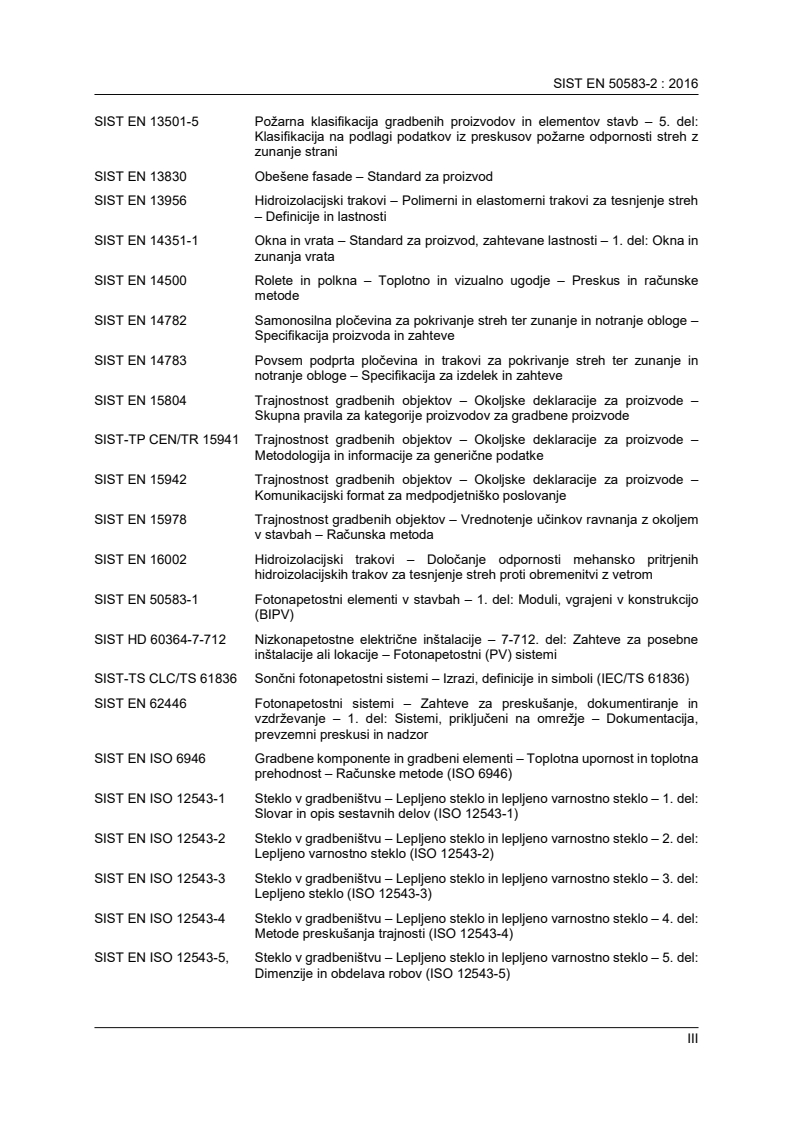
SIST EN 13501-5 Požarna klasifikacija gradbenih proizvodov in elementov stavb – 5. del:
Klasifikacija na podlagi podatkov iz preskusov požarne odpornosti streh z
zunanje strani
SIST EN 13830 Obešene fasade – Standard za proizvod
SIST EN 13956 Hidroizolacijski trakovi – Polimerni in elastomerni trakovi za tesnjenje streh
– Definicije in lastnosti
SIST EN 14351-1 Okna in vrata – Standard za proizvod, zahtevane lastnosti – 1. del: Okna in
zunanja vrata
SIST EN 14500 Rolete in polkna – Toplotno in vizualno ugodje – Preskus in računske
metode
SIST EN 14782 Samonosilna pločevina za pokrivanje streh ter zunanje in notranje obloge –
Specifikacija proizvoda in zahteve
SIST EN 14783 Povsem podprta pločevina in trakovi za pokrivanje streh ter zunanje in
notranje obloge – Specifikacija za izdelek in zahteve
SIST EN 15804 Trajnostnost gradbenih objektov – Okoljske deklaracije za proizvode –
Skupna pravila za kategorije proizvodov za gradbene proizvode
SIST-TP CEN/TR 15941 Trajnostnost gradbenih objektov – Okoljske deklaracije za proizvode –
Metodologija in informacije za generične podatke
SIST EN 15942 Trajnostnost gradbenih objektov – Okoljske deklaracije za proizvode –
Komunikacijski format za medpodjetniško poslovanje
SIST EN 15978 Trajnostnost gradbenih objektov – Vrednotenje učinkov ravnanja z okoljem
v stavbah – Računska metoda
SIST EN 16002 Hidroizolacijski trakovi – Določanje odpornosti mehansko pritrjenih
hidroizolacijskih trakov za tesnjenje streh proti obremenitvi z vetrom
SIST EN 50583-1 Fotonapetostni elementi v stavbah – 1. del: Moduli, vgrajeni v konstrukcijo
(BIPV)
SIST HD 60364-7-712 Nizkonapetostne električne inštalacije – 7-712. del: Zahteve za posebne
inštalacije ali lokacije – Fotonapetostni (PV) sistemi
SIST-TS CLC/TS 61836 Sončni fotonapetostni sistemi – Izrazi, definicije in simboli (IEC/TS 61836)
SIST EN 62446 Fotonapetostni sistemi – Zahteve za preskušanje, dokumentiranje in
vzdrževanje – 1. del: Sistemi, priključeni na omrežje – Dokumentacija,
prevzemni preskusi in nadzor
SIST EN ISO 6946 Gradbene komponente in gradbeni elementi – Toplotna upornost in toplotna
prehodnost – Računske metode (ISO 6946)
SIST EN ISO 12543-1 Steklo v gradbeništvu – Lepljeno steklo in lepljeno varnostno steklo – 1. del:
Slovar in opis sestavnih delov (ISO 12543-1)
SIST EN ISO 12543-2 Steklo v gradbeništvu – Lepljeno steklo in lepljeno varnostno steklo – 2. del:
Lepljeno varnostno steklo (ISO 12543-2)
SIST EN ISO 12543-3 Steklo v gradbeništvu – Lepljeno steklo in lepljeno varnostno steklo – 3. del:
Lepljeno steklo (ISO 12543-3)
SIST EN ISO 12543-4 Steklo v gradbeništvu – Lepljeno steklo in lepljeno varnostno steklo – 4. del:
Metode preskušanja trajnosti (ISO 12543-4)
SIST EN ISO 12543-5, Steklo v gradbeništvu – Lepljeno steklo in lepljeno varnostno steklo – 5. del:
Dimenzije in obdelava robov (ISO 12543-5)
III
SIST EN 50583-2 : 2016
SIST EN ISO 12543-6 Steklo v gradbeništvu – Lepljeno steklo in lepljeno varnostno steklo – 6. del:
Videz (ISO 12543-6)
SIST EN ISO 12631 Toplotne značilnosti obešenih fasad – Izračun toplotne prehodnosti (ISO
12631)
OSNOVA ZA IZDAJO STANDARDA
– privzem standarda EN 50583-2:2016
OPOMBE
– Povsod, kjer se v besedilu standarda uporablja izraz "evropski standard", v SIST EN 50583-2:2016
to pomeni "slovenski standard".
– Nacionalni uvod in nacionalni predgovor nista sestavni del standarda.
– Ta nacionalni dokument je istoveten EN 50583-2:2016 in je objavljen z dovoljenjem
CEN-CENELEC
Upravni center
Avenue Marnix 17
B-1000 Bruselj
This national document is identical with EN 50583-2:2016 and is published with the permission of
CEN-CENELEC
Management Centre
Avenue Marnix 17
B-1000 Brussels
IV
EVROPSKI STANDARD EN 50583-2
EUROPEAN STANDARD
januar 2016
NORME EUROPÉENNE
EUROPÄISCHE NORM
ICS 27.160
Slovenska izdaja
Fotonapetostni elementi v stavbah – 2. del: Fotonapetostni sistemi,
vgrajeni v stavbo (BIPV)
Photovoltaics in buildings – Systèmes photovoltaïques dans la Photovoltaik im Bauwesen –
Part 2: BIPV systems construction – Partie 2: Systèmes Teil 2: BIPV-Anlagen
photovoltaïques incorporés au bâti
Ta evropski standard je CENELEC sprejel 12. oktobra 2015. Člani CENELEC morajo izpolnjevati
notranje predpise CEN/CENELEC, ki določajo pogoje, pod katerimi dobi ta evropski standard status
nacionalnega standarda brez kakršnihkoli sprememb.
Najnovejši seznami teh nacionalnih standardov in njihovi bibliografski podatki se na zahtevo lahko dobijo
pri Upravnem centru CEN-CENELEC ali kateremkoli članu CENELEC.
Ta evropski standard obstaja v treh uradnih izdajah (angleški, francoski, nemški). Izdaje v drugih jezikih,
ki jih člani CENELEC na lastno odgovornost prevedejo in izdajo ter priglasijo pri Upravnem centru CEN-
CENELEC, imajo enak status kot uradne izdaje.
Člani CENELEC so nacionalni elektrotehniški komiteji Avstrije, Belgije, Bolgarije, Cipra, Češke
republike, Danske, Estonije, Finske, Francije, Grčije, Hrvaške, Islandije, Irske, Italije, Latvije, Litve,
Luksemburga, Madžarske, Malte, Nekdanje jugoslovanske republike Makedonije, Nemčije,
Nizozemske, Norveške, Poljske, Portugalske, Romunije, Slovaške, Slovenije, Španije, Švedske, Švice,
Turčije in Združenega kraljestva.
CENELEC
Evropski komite za standardizacijo v elektrotehniki
European Committee for Electrotechnical Standardisation
Comité Européen de Normalisation Electrotechnique
Europäisches Komitee für Elektrotechnische Normung
Upravni center CEN-CENELEC: Avenue Marnix 17, B-1000 Bruselj
© 2016 CENELEC Vse pravice do izkoriščanja v kakršnikoli obliki in na kakršenkoli Ref. oznaka EN 50583-2:2016 E
način imajo nacionalni člani CENELEC
SIST EN 50583-2 : 2016
VSEBINA Stran
Evropski predgovor . 4
1 Področje uporabe . 5
2 Zveze s standardi . 5
3 Izrazi in definicije . 7
4 Zahteve . 8
4.1 Splošno . 8
4.2 Sistemi BIPV z moduli, ki vsebujejo steklene plošče . 9
4.2.1 Splošno . 9
4.2.2 Kategorije pritrditve .10
4.2.3 Dodatne zahteve za kategorijo A: nagnjeno, vgrajeno v streho, nedostopno iz notranjosti stavbe .12
4.2.4 Dodatne zahteve za kategorijo B: nagnjeno, vgrajeno v stavbo, dostopno iz notranjosti stavbe /
strešno okno .13
4.2.5 Dodatne zahteve za kategorijo C: nenagnjeno (navpično), nameščeno nedostopno iz notranjosti
stavbe .14
4.2.6 Dodatne zahteve za kategorijo D: nenagnjeno (navpično), nameščeno dostopno iz notranjosti stavbe .15
4.2.7 Dodatne zahteve za kategorijo E:zunanje nameščeno, dostopno ali nedostopno iz notranjosti stavbe .16
4.3 Sistemi BIPV z moduli, ki ne vsebujejo steklenih plošč .17
4.3.1 Sistemi BIPV z moduli na podlagi polimerne nepremočljive plošče .17
4.3.2 Sistemi BIPV, vključno z moduli BIPV na pločevinasti podlagi .17
4.3.3 Sistemi BIPV z moduli na podlagi drugih materialov .18
5 Označevanje .18
6 Sistemska dokumentacija, prevzemni preskusi in nadzor .18
Dodatek A (informativni): Odpornost strešnih kritin BIPV s prekinjeno položenimi elementi
proti dežju z vetrom – Preskusna metoda .19
A.1 Uvod .19
A.2 Področje uporabe .19
A.3 Izrazi in definicije .19
A.4 Simboli in enote .19
A.5 Načelo .20
A.6 Preskušanec .20
A.6.1 Vzorci preskušanca .20
A.6.2 Mere preskušanca .20
A.6.3 Število preskusnih nizov .21
A.6.4 Priprava preskušanca .21
A.7 Aparat .21
A.7.1 Splošno .21
A.7.2 Sesalna komora .21
A.7.3 Ventilatorski sistem .21
A.7.4 Naprava za ustvarjanje dežja .22
A.7.5 Odtekajoča voda .22
A.7.6 Opazovanje in merjenje puščanja .23
A.8 Preskusni postopek .23
SIST EN 50583-2 : 2016
A.8.1 Splošno .23
A.8.2 Preskusni pogoji .24
A.9 Ocenjevanje in podajanje rezultatov preskusa .28
A.10 Poročilo o preskusu .28
Literatura .30
SIST EN 50583-2 : 2016
Evropski predgovor
Ta dokument (EN 50583-2:2016) je pripravil CLC/TC 82 "Sončni fotonapetostni energijski sistemi".
Določena sta naslednja datuma:
– zadnji datum, do katerega mora ta dokument dobiti (dop) 2016-10-12
status nacionalnega standarda, bodisi z objavo
istovetnega besedila ali z razglasitvijo
– zadnji datum, do katerega morajo biti razveljavljeni (dow) 2018-10-12
vsi nacionalni standardi, ki niso skladni s tem
dokumentom
Opozoriti je treba na možnost, da bi kateri od elementov tega dokumenta lahko bil predmet patentnih
pravic. CENELEC [in/ali CEN] nista odgovorna za identifikacijo nobene od teh patentnih pravic.
SIST EN 50583-2 : 2016
FOTONAPETOSTNI ELEMENTI V STAVBAH –
2. del: Fotonapetostni sistemi, vgrajeni v stavbo (BIPV)
1 Področje uporabe
Ta dokument se uporablja za fotonapetostne sisteme, ki so vgrajeni v stavbe, kjer se fotonapetostni
modul uporablja kot gradbeni proizvod. Osredotoča se na lastnosti teh fotonapetostnih sistemov, ki so
pomembne za osnovne gradbene zahteve, kot jih določa evropska Direktiva o gradbenih proizvodih
CPR 89/106/EGS, in ustrezne elektrotehniške zahteve, kot jih določa Nizkonapetostna direktiva
2006/95/ES ali standardi CENELEC. Ta dokument se sklicuje na mednarodne standarde, tehnična
poročila in smernice. Za nekatere uporabe lahko v posameznih državah dodatno veljajo nacionalni
standardi (ali predpisi) za graditev, ki tukaj niso izrecno navedeni.
Ta dokument je namenjen proizvajalcem, načrtovalcem, sistemskim načrtovalcem, montažerjem,
organom za preskušanje in organom, pristojnim za graditev.
Ta dokument se ne uporablja za koncentratorske fotonapetostne sisteme ali sisteme, pritrjene na
1)
stavbo.
Ta dokument obravnava zahteve za sisteme BIPV glede na specifične načine predvidene namestitve,
ne pa tudi module BIPV kot gradbene proizvode, kar obravnava EN 50583-1.
2 Zveze s standardi
V tem dokumentu so v celoti ali delno navedeni naslednji dokumenti, ki so nujno potrebni za njegovo
uporabo. Za datirana sklicevanja velja samo navedena izdaja. Za nedatirana sklicevanja velja zadnja
izdaja referenčnega dokumenta (vključno z vsemi dopolnili).
EN 410 Steklo v gradbeništvu – Določanje svetlobnih in sončnih karakteristik stekla
EN 1027 Okna in vrata – Neprepustnost za vodo – Preskusna metoda
EN 1990 Evrokod – Osnove projektiranja
EN 1991 (vsi deli) Evrokod 1: Vplivi na konstrukcije
EN 1993 (vsi deli) Evrokod 3: Projektiranje jeklenih konstrukcij
EN 1995 (vsi deli) Evrokod 5: Projektiranje lesenih konstrukcij
EN 1999 (vsi deli) Evrokod 9: Projektiranje konstrukcij iz aluminijevih zlitin
EN 12179 Obešene fasade – Odpornost proti obremenitvi z vetrom – Preskusna
metoda
prEN 12488 Steklo v zgradbah – Priporočila za zasteklitev – Načela sestavljanja
navpične in poševne zasteklitve
EN 12519 Okna in vhodna vrata – Terminologija
EN 12600 Steklo v zgradbah – Preskus z nihalom – Preskusna metoda z udarcem in
klasifikacija ravnega stekla
EN 12758 Steklo v zgradbah – Zasteklitev in zvočna izolacija v zraku – Opis in
opredelitev lastnosti
EN 13022 (vsi deli) Steklo v zgradbah – Strukturna tesnilna zasteklitev
EN 13116 Obešene fasade – Odpornost proti obremenitvi z vetrom – Zahtevane
tehnične lastnosti
1)
Za definicijo fotonapetostnih sistemov, pritrjenih na stavbo, glej 3.2.
SIST EN 50583-2 : 2016
EN 13119 Obešene fasade – Terminologija
EN 13363-1 Senčila v kombinaciji z zasteklitvijo – Izračun prepustnosti za energijo
sončnega sevanja in prepustnosti svetlobe – 1. del: Poenostavljena metoda
EN 13363-2 Senčila v kombinaciji z zasteklitvijo – Izračun prepustnosti za energijo
sončnega sevanja in prepustnosti svetlobe – 2. del: Podrobna računska
metoda
EN 13501-2 Požarna klasifikacija gradbenih proizvodov in elementov stavb – 2. del:
Klasifikacija na podlagi podatkov iz preskusov požarne odpornosti, izvzeti
prezračevalni sistemi
EN 13501-5 Požarna klasifikacija gradbenih proizvodov in elementov stavb – 5. del:
Klasifikacija na podlagi podatkov iz preskusov požarne odpornosti streh z
zunanje strani
EN 13830 Obešene fasade – Standard za proizvod
EN 13956 Hidroizolacijski trakovi – Polimerni in elastomerni trakovi za vodno tesnjenje
streh – Definicije in karakteristike
EN 14351-1 Okna in vrata – Standard za proizvod, karakteristike tehničnih lastnosti –
1. del: Okna in zunanja osebna vrata brez določenih karakteristik požarne
odpornosti in dimnotesnosti
EN 14500 Rolete in polkna – Toplotno in vizualno ugodje – Preskus in računske
metode
EN 14782 Samonosilna pločevina za pokrivanje streh ter zunanje in notranje obloge –
Specifikacija proizvoda in zahteve
EN 14783 Povsem podprta pločevina in trakovi za pokrivanje streh ter zunanje in
notranje obloge – Specifikacija za izdelek in zahteve
EN 15804 Sonaravnost gradbenih objektov – Okoljske deklaracije za proizvode -
Skupna pravila za kategorije proizvodov za gradbene proizvode
CEN/TR 15941 Sonaravnost gradbenih objektov – Okoljske deklaracije za proizvode -
Metodologija in informacije za generične podatke
EN 15942 Sonaravnost gradbenih objektov – Okoljske deklaracije za proizvode –
Komunikacijski format za medpodjetniško poslovanje
EN 15978 Sonaravnost gradbenih objektov – Ocenjevanje učinkovanja zgradb na
okolje – Računska metoda
EN 16002 Hidroizolacijski trakovi - Ugotavljanje odpornosti mehansko pritrjenih
hidroizolacijskih trakov za tesnjenje streh proti vetrni obremenitvi
EN 50583-1 Fotonapetostni sistemi v stavbah – 1. del: Fotonapetostni moduli, vgrajeni
v konstrukcijo (BIPV)
HD 60364-7-712 Nizkonapetostne električne inštalacije – 7-712. del: Zahteve za posebne
inštalacije ali lokacije – Sončna fotonapetostna (PV) napajalna omrežja
(IEC 60364-7-712)
CLC/TS 61836 Sončni fotonapetostni napajalni sistemi – Izrazi, definicije in simboli (IEC/TS
61836)
EN 62446 Fotonapetostni sistemi, priključeni na omrežje – Minimalne zahteve za
sistemsko dokumentacijo, prevzemne preskuse in nadzor (IEC 62446)
EN ISO 6946 Gradbene komponente in gradbeni elementi – Toplotna upornost in toplotna
prehodnost – Računske metode (ISO 6946)
SIST EN 50583-2 : 2016
EN ISO 12543-1 Steklo v gradbeništvu – Lepljeno steklo in lepljeno varnostno steklo – 1. del:
Definicije in opis sestavnih delov (ISO 12543-1)
EN ISO 12543-2 Steklo v gradbeništvu – Lepljeno steklo in lepljeno varnostno steklo – 2. del:
Lepljeno varnostno steklo (ISO 12543-2)
EN ISO 12543-3 Steklo v gradbeništvu – Lepljeno steklo in lepljeno varnostno steklo – 3. del:
Lepljeno steklo (ISO 12543-3)
EN ISO 12543-4 Steklo v gradbeništvu – Lepljeno steklo in lepljeno varnostno steklo – 4. del:
Metode preskušanja trajnosti (ISO 12543-4)
EN ISO 12543-5 Steklo v gradbeništvu – Lepljeno steklo in lepljeno varnostno steklo – 5. del:
Dimenzije in obdelava robov (ISO 12543-5)
EN ISO 12543-6 Steklo v gradbeništvu – Lepljeno steklo in lepljeno varnostno steklo – 6. del:
Videz (ISO 12543-6)
prEN ISO 14439 Steklo v gradbeništvu – Pravila za zastekljevanje – Zagozdna zasteklitev
(ISO/DIS 14439)
EN ISO 12631 Toplotne značilnosti obešenih fasad – Izračun toplotne prehodnosti (ISO
12631)
ETAG 002 Smernica za evropsko tehnično soglasje za sisteme zasteklitve s
konstrukcijskimi tesnili – SSGS
N 0068/CEN-TC128-WG3-N0068 TR Sistemi obnovljive energije za strešne konstrukcijske
povezave
3 Izrazi in definicije
V tem dokumenta se uporabljajo izrazi in definicije iz EN 1990, EN ISO 12543 (1. do 6. del), EN 12519,
EN 13119, EN 13956, EN 14782, EN 14783, EN 13022, EN 16002 in CLC/TS 61836 in naslednji.
Definicije, specifične za posamezne dodatke, so vključene v samih dodatkih.
OPOMBA: Dodatne informacije so na voljo v Nizkonapetostni direktivi 2006/95/ES, Uredbi o gradbenih proizvodih 305/2011
in Direktivi o elektromagnetni združljivosti ECD 2004/108/ES.
3.1
fotonapetostni sistem, vgrajen v stavbo
sistem BIPV
fotonapetostni sistemi se štejejo za vgrajene v stavbo, če fotonapetostni moduli, uporabljeni v njih,
izpolnjujejo merila za module BIPV, kot so določena v EN 50583-1, in torej tvorijo gradbeni proizvod, ki
izvaja funkcijo, kot je določena v evropski Uredbi o gradbenih proizvodih CPR 305/2011
3.2
fotonapetostni sistem, pritrjen na stavbo
sistem BAPV
fotonapetostni sistemi se štejejo za pritrjene na stavbo, če fotonapetostni moduli, uporabljeni v njih, ne
izpolnjujejo meril za module BIPV, kot so določena v EN 50583-1
OPOMBA: Nadaljnje pomembne informacije o tej vrsti fotonapetostnega sistema na strehah so podane v Tehničnem poročilu
CEN/TC 128/WG3, Sončni energijski sistemi za strehe: zahteve za konstrukcijske povezave na solarne plošče.
SIST EN 50583-2 : 2016
4 Zahteve
4.1 Splošno
Ker sistemi BIPV vsebujejo električne komponente, veljajo zanje ustrezne elektrotehniške zahteve, ki
so navedene v Nizkonapetostni direktivi 2006/95/ES ali standardih CENELEC. Sisteme BIPV morajo
biti zasnovani tako, da niso v nasprotju z zahtevami za fotonapetostne sisteme iz HD 60364-7-712.
Bistveni zahtevi, opredeljeni v LVD 2006/95/ES, sta:
1) zaščita pred nevarnostmi, ki izvirajo iz električne opreme,
2) zaščita pred nevarnostmi, ki jih lahko povzročijo zunanji vplivi na električno opremo.
Za BIPV kot električne sisteme veljajo ustrezne elektrotehniške zahteve, ki so navedene v Direktivi o
elektromagnetni združljivosti ECD 2004/108/EC ali standardih CENELEC.
Bistvene zahteve, opredeljene v Direktivi ECD 2004/108/ES, so:
3) zahteve zaščite:
Oprema mora biti zasnovana in izdelana tako, da z upoštevanjem stanja tehnike zagotavlja, da:
a) elektromagnetna motnja, ki jo ustvarja, ne presega ravni, nad katero radijska in
telekomunikacijska oprema ali druga oprema ne more delovati, kot je predvideno;
b) ima raven odpornosti proti elektromagnetnim motnjam, ki se pričakuje pri njeni predvideni
uporabi, kar ji omogoča, da deluje brez nesprejemljivega poslabšanja predvidene uporabe.
4) posebne zahteve za pritrjene namestitve:
Namestitev in predvidena uporaba sestavnih delov
Pritrjena namestitev mora biti izvedena z uporabo dobrih inženirskih praks in upoštevati podatke o
predvideni uporabi njenih sestavnih delov za izpolnitev zaščitnih zahtev iz 1. točke. Te dobre
inženirske prakse je treba dokumentirati, dokumentacija pa mora biti pri odgovorni(-ih) osebi(-ah)
na voljo ustreznim državnim organom za namene pregleda, vse dokler pritrjena namestitev
obratuje.
Ker sistemi BIPV vsebujejo sestavne dele, ki se uporabljajo kot gradbeni proizvodi, veljajo za te
sestavne dele bistvene zahteve, določene v evropski Uredbi o gradbenih proizvodih CPR 305/2011.
Bistvene zahteve, opredeljene v CPR 305/2011, so:
5) mehanska odpornost in stabilnost,
6) varnost pri požaru,
2)
7) higiena, zdravje in okolje,
8) varnost in dostopnost med uporabo,
9) zaščita pred hrupom,
10) varčevanje z energijo in ohranjanje toplote,
11) trajnostna raba naravnih virov.
Posebne zahteve za module BIPV, ki izhajajo iz teh splošnih zahtev CPR, obravnava standard EN
50583-1.
2)
Glede na Direktivo 2011/65/EU Evropskega parlamenta z dne 8. junija 2011 so bili fotonapetostni moduli izključeni iz Direktive
ROHS.
SIST EN 50583-2 : 2016
Integracija fotovoltaike v obstoječi gradbeni proizvod z namenom izdelave modula BIPV nujno spremeni
lastnosti glede na prvotni gradbeni proizvod. Nova ocena sistema BIPV, ki vsebuje modul BIPV, glede
na osnovne zahteve CPR je potrebna le, če se spremenijo bistvene značilnosti modula BIPV, ki so
potrebne za izpolnitev te osnovne zahteve glede na prvotni gradbeni proizvod.
Kot gradbeni proizvodi morajo biti moduli BIPV in njihovo pritrdilno ogrodje, okvir ter vezni elementi
zasnovani tako, da ustrezajo vetrovnim, snežnim in mehanskim obtežbam ter tudi drugim zahtevam,
3)
določenim v evrokodih EN 1990, EN 1991, EN 1993, EN 1995 in EN 1999.
Ta standard razlikuje med sistemi BIPV z moduli, ki vsebujejo vsaj eno stekleno ploščo, in tistimi, ki jih
ne. Poleg navajanja splošnih zahtev ta standard razvršča sisteme BIPV z moduli, ki vsebujejo steklo, v
pet različnih kategorij (glede na predvideni tip pritrditve). Za vsako kategorijo so navedene posebne
zveze s standardi.
4.2 Sistemi BIPV z moduli, ki vsebujejo steklene plošče
4.2.1 Splošno
Dodatne točke iz EN 13022-1 ali ETAG 002 veljajo za module BIPV, ki se uporabljajo kot del sistema
zasteklitve s konstrukcijskimi tesnili.
Preglednica 1: Splošne zahteve za vse sisteme BIPV z moduli, ki vsebujejo steklene plošče
Zahteva CPR Standardi, smernice, Komentar
preskusne metode
1. Mehanska odpornost in prEN 12488 Osnove pravil montaže za zasteklitev
stabilnost
2. Varnost pri požaru
EN 13501-2 Standardi požarne klasifikacije
3. Higiena, zdravje in okolje
4. Varnost in dostopnost med EN 13022-2 Uporaben samo za sisteme BIPV, sestavljene iz
uporabo modulov BIPV ali enot PV izolacijskega stekla
za spajanje z lepilom, ki se prodajajo ločeno od
ogrodja in nameščajo na odgovornost snovalca
in sestavljavca. Nacionalni predpisi lahko
4)
določijo omejitve ali dodatne zahteve.
ETAG 002
Uporaben za sisteme zasteklitve s
konstrukcijskimi tesnili, dane na trg kot
"komplet" sestavnih delov; določene v
evropskem tehničnem soglasju ali nacionalnem
soglasju
prEN ISO 14439 Uporaben, če stika stekla in okvirja ni mogoče
izključiti
5. Zaščita pred hrupom
EN 12758
6. Varčevanje z energijo in
ohranjanje toplote
3)
Upoštevajte ugotovitve CEN/TC128 WG3 – N0068 TR, Sistemi obnovljive energije za strešne konstrukcijske povezave.
4)
Sistemi zasteklitve s konstrukcijskimi tesnili (SSGS) ali kompleti, ki vsebujejo fotonapetostne module, so v prvi vrsti predmet
tehničnih soglasij, ki določajo zahteve za končni izdelek, ki jih mora proizvajalec izpolniti. Poleg tega so fotonapetostni moduli
kot stekleni proizvodi, ki se prodajajo ločeno in bodo vgrajeni v ali na ogrodje oziroma v ali na stavbo s tehniko konstrukcijske
zasteklitve, določeni v EN 13022-1. V skladu z zahtevami tega standarda so primerni za uporabo v SSGS, kot je opredeljeno
v ETAG 002 in EN 13022-2.
SIST EN 50583-2 : 2016
Zahteva CPR Standardi, smernice, Komentar
preskusne metode
7. Trajnostna raba naravnih virov EN 15804 Dodatne informacije so podane v Končnem
poročilu IEA-PVPS Naloga 12
CEN/TR 15941
EN 15942
EN 15978
4.2.2 Kategorije pritrditve
Dodatne zahteve so odvisne od vrste pritrditve. Ta standard razlikuje pet kategorij – od A do E – pritrditve
glede na kombinacije naslednjih meril:
1) vgrajeno v ovoj stavbe: da/ne
2) dostopno: da/ne
3) nagnjeno: da/ne
"Ni dostopno" pomeni, da drugi gradbeni proizvod še vedno zagotavlja zaščito pred mehanskimi vplivi,
tudi če je fotonapetostni modul poškodovan ali odstranjen.
Opredelitev "nagnjene zasteklitve" je izvedena iz EN 13830 in prEN 12488 ter je prikazana spodaj (glej
sliko 1).
Legenda:
1 navpična zasteklitev
2 kot zasteklitve, ki se šteje za nagnjeno
3 kot zasteklitve, ki se šteje za nenagnjeno ± 15° od navpičnega kota
Slika 1: Kot zasteklitve, ki se šteje za nagnjeno in nenagnjeno
v skladu z EN 13830 in prEN 12488
...