

EN 14511-3:2011
(Main)Air conditioners, liquid chilling packages and heat pumps with electrically driven compressors for space heating and cooling - Part 3: Test methods
- Abstract
1.1 The scope of EN 14511-1:2011 is applicable.
1.2 This European Standard specifies the test methods for the rating and performance of air conditioners, liquid chilling packages and heat pumps using either air, water or brine as heat transfer media, with electrically driven compressors when used for space heating and cooling.
It also specifies the method of testing and reporting for heat recovery capacities, system reduced capacities and the capacity of individual indoor units of multisplit systems, where applicable.
- Status
- Withdrawn
- Publication Date
- 25-Oct-2011
- Withdrawal Date
- 30-Jul-2013
- Technical Committee
- CEN/TC 113 - Heat pumps and air conditioning units
- Drafting Committee
- CEN/TC 113/WG 8 - Revision of existing standards
- Current Stage
- 9960 - Withdrawal effective - Withdrawal
- Start Date
- 31-Jul-2013
- Completion Date
- 31-Jul-2013

Relations
- Effective Date
- 08-Jun-2022
- Effective Date
- 03-Nov-2011
- Effective Date
- 07-Aug-2013
- Effective Date
- 28-Jan-2026
- Effective Date
- 09-Feb-2026
- Effective Date
- 09-Feb-2026
- Effective Date
- 09-Feb-2026
- Effective Date
- 28-Jan-2026
- Effective Date
- 28-Jan-2026
- Effective Date
- 28-Jan-2026
- Effective Date
- 28-Jan-2026
- Effective Date
- 28-Jan-2026
Get Certified
Connect with accredited certification bodies for this standard

DIBt (Deutsches Institut für Bautechnik)
German Institute for Building Technology.
DIN CERTCO
DIN Group product certification.

Aboma Certification B.V.
Specialized in construction, metal, and transport sectors.
Sponsored listings
Frequently Asked Questions
EN 14511-3:2011 is a standard published by the European Committee for Standardization (CEN). Its full title is "Air conditioners, liquid chilling packages and heat pumps with electrically driven compressors for space heating and cooling - Part 3: Test methods". This standard covers: 1.1 The scope of EN 14511-1:2011 is applicable. 1.2 This European Standard specifies the test methods for the rating and performance of air conditioners, liquid chilling packages and heat pumps using either air, water or brine as heat transfer media, with electrically driven compressors when used for space heating and cooling. It also specifies the method of testing and reporting for heat recovery capacities, system reduced capacities and the capacity of individual indoor units of multisplit systems, where applicable.
1.1 The scope of EN 14511-1:2011 is applicable. 1.2 This European Standard specifies the test methods for the rating and performance of air conditioners, liquid chilling packages and heat pumps using either air, water or brine as heat transfer media, with electrically driven compressors when used for space heating and cooling. It also specifies the method of testing and reporting for heat recovery capacities, system reduced capacities and the capacity of individual indoor units of multisplit systems, where applicable.
EN 14511-3:2011 is classified under the following ICS (International Classification for Standards) categories: 23.120 - Ventilators. Fans. Air-conditioners; 91.140.30 - Ventilation and air-conditioning systems. The ICS classification helps identify the subject area and facilitates finding related standards.
EN 14511-3:2011 has the following relationships with other standards: It is inter standard links to EN 14511-3:2007, EN 14511-3:2007/AC:2008, EN 14511-3:2013, EN 14511-1:2011, CLC/TS 50600-5-1:2023, CLC/TR 50600-99-1:2021, CLC/TR 50600-99-1:2020, EN 14825:2013, EN 14511-2:2011, EN 14825:2012, EN 14118-2:2003, EN 14511-4:2011. Understanding these relationships helps ensure you are using the most current and applicable version of the standard.
EN 14511-3:2011 is associated with the following European legislation: EU Directives/Regulations: 92/75/EEC; Standardization Mandates: M/274. When a standard is cited in the Official Journal of the European Union, products manufactured in conformity with it benefit from a presumption of conformity with the essential requirements of the corresponding EU directive or regulation.
EN 14511-3:2011 is available in PDF format for immediate download after purchase. The document can be added to your cart and obtained through the secure checkout process. Digital delivery ensures instant access to the complete standard document.
Standards Content (Sample)
2003-01.Slovenski inštitut za standardizacijo. Razmnoževanje celote ali delov tega standarda ni dovoljeno.Luftkonditionerer, Flüssigkeitskühlsätze und Wärmepumpen mit elektrisch angetriebenen Verdichtern für die Raumbehezung und Kühlung - Teil 3: PrüfverfahrenClimatiseurs, groupes refroidisseurs de liquide et pompes à chaleur avec compresseur entraîné par moteur électrique pour le chauffage et la réfrigération des locaux - Partie 3: Méthodes d'essaiAir conditioners, liquid chilling packages and heat pumps with electrically driven compressors for space heating and cooling - Part 3: Test methods91.140.30VLVWHPLVentilation and air-conditioning27.080Heat pumps23.120QDSUDYHVentilators. Fans. Air-conditionersICS:Ta slovenski standard je istoveten z:EN 14511-3:2011SIST EN 14511-3:2012en,fr01-januar-2012SIST EN 14511-3:2012SLOVENSKI
STANDARDSIST EN 14511-3:2008/AC:2008SIST EN 14511-3:20081DGRPHãþD
EUROPEAN STANDARD NORME EUROPÉENNE EUROPÄISCHE NORM
EN 14511-3
October 2011 ICS 91.140.30 Supersedes EN 14511-3:2007English Version
Air conditioners, liquid chilling packages and heat pumps with electrically driven compressors for space heating and cooling - Part 3: Test methods
Climatiseurs, groupes refroidisseurs de liquide et pompes à chaleur avec compresseur entraîné par moteur électrique pour le chauffage et la réfrigération des locaux - Partie 3: Méthodes d'essai
Luftkonditionierer, Flüssigkeitskühlsätze und Wärmepumpen mit elektrisch angetriebenen Verdichtern für die Raumbeheizung und Kühlung - Teil 3: PrüfverfahrenThis European Standard was approved by CEN on 20 August 2011.
CEN members are bound to comply with the CEN/CENELEC Internal Regulations which stipulate the conditions for giving this European Standard the status of a national standard without any alteration. Up-to-date lists and bibliographical references concerning such national standards may be obtained on application to the CEN-CENELEC Management Centre or to any CEN member.
This European Standard exists in three official versions (English, French, German). A version in any other language made by translation under the responsibility of a CEN member into its own language and notified to the CEN-CENELEC Management Centre has the same status as the official versions.
CEN members are the national standards bodies of Austria, Belgium, Bulgaria, Croatia, Cyprus, Czech Republic, Denmark, Estonia, Finland, France, Germany, Greece, Hungary, Iceland, Ireland, Italy, Latvia, Lithuania, Luxembourg, Malta, Netherlands, Norway, Poland, Portugal, Romania, Slovakia, Slovenia, Spain, Sweden, Switzerland and United Kingdom.
EUROPEAN COMMITTEE FOR STANDARDIZATION
COMITÉ EUROPÉEN DE NORMALISATION EUROPÄISCHES KOMITEE FÜR NORMUNG
Management Centre:
Avenue Marnix 17,
B-1000 Brussels © 2011 CEN All rights of exploitation in any form and by any means reserved worldwide for CEN national Members. Ref. No. EN 14511-3:2011: ESIST EN 14511-3:2012
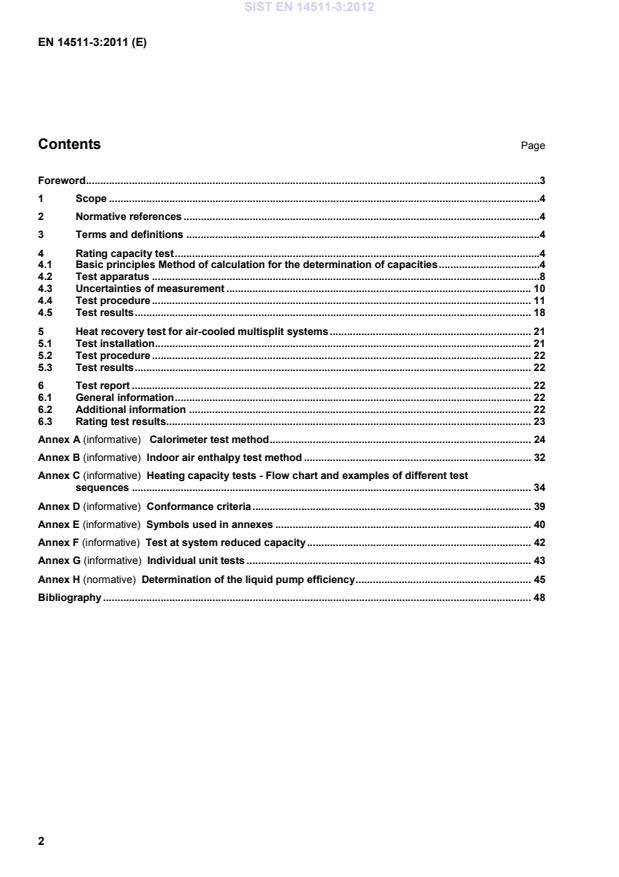
Calorimeter test method . 24Annex B (informative)
Indoor air enthalpy test method . 32Annex C (informative)
Heating capacity tests - Flow chart and examples of different test sequences . 34Annex D (informative)
Conformance criteria . 39Annex E (informative)
Symbols used in annexes . 40Annex F (informative)
Test at system reduced capacity . 42Annex G (informative)
Individual unit tests . 43Annex H (normative)
Determination of the liquid pump efficiency . 45Bibliography . 48 SIST EN 14511-3:2012
where PH is the heat capacity, expressed in Watts; q is the volume flow rate, expressed in cubic metres per second; ρ is the density, expressed in kilograms per cubic metre; SIST EN 14511-3:2012
NOTE 2
The enthalpy change ∆H can be directly measured instead of the term (cp x ∆t). For the heating capacity calculation in transient operation, refer to 4.5.3.2. The heating capacity shall be corrected for the heat from the fan or pump: a) If the fan or pump at the indoor heat exchanger is an integral part of the unit, the same power (calculated in 4.1.5.2 or 4.1.6.3) which is excluded from the total power input shall be also subtracted from the heating capacity; b) If the fan or pump at the indoor heat exchanger is not an integral part of the unit, the same power (calculated in 4.1.5.3 or 4.1.6.4) which is included in the effective power input shall be also added to the heating capacity. 4.1.2 Cooling capacity The cooling capacity of air conditioners and of air-to-air or water-to-air heat pumps shall be determined by measurements in a calorimeter room (see Annex A) or by the air enthalpy method (see Annex B). The cooling capacity of air-to-water, water-to-water heat pumps and liquid chilling packages shall be determined in accordance with the direct method at the water or brine heat exchanger, by determination of the volume flow of the heat transfer medium, and the inlet and outlet temperatures, taking into consideration the specific heat capacity and density of the heat transfer medium. The cooling capacity shall be determined using the following formula: tcqPpC∆ρ×××= (2) where PC is the cooling capacity, expressed in watts; q is the volume flow rate, expressed in cubic metres per second; ρ is the density, expressed in kilograms per cubic metre; cp is the specific heat at constant pressure, expressed in joules per kilogram and kelvin; ∆t is the difference between inlet and outlet temperatures, expressed in kelvin. NOTE
1 The mass flow rate can be determined directly instead of the term (q x ρ). NOTE
2 The enthalpy change ∆H can be directly measured instead of the term (cp x ∆t)” The cooling capacity shall be corrected for the heat from the fan or pump: a) If the fan or pump at the evaporator is an integral part of the unit, the same power (calculated in 4.1.5.2 or 4.1.6.3) which is excluded from the total power input is also added to the cooling capacity. b) If the fan or pump at the evaporator is not an integral part of the unit, the same power (calculated in 4.1.5.3 or 4.1.6.4) which is included in the effective power input is also subtracted from the cooling capacity. SIST EN 14511-3:2012
For single ducts, regardless of the manufacturer’s instructions, the discharge duct shall be as short and straight as possible compatibly with minimum distance between the unit and the wall for correct air inlet but not less than 50 cm. No accessory shall be connected to the discharge end of the duct.
For double duct units, the same requirements apply to both suction and discharge ducts, unless the appliance is designed to be installed directly on the wall. For multisplit systems, the test shall be performed with the system operating at a capacity ratio of 1, or as close as possible. SIST EN 14511-3:2012
b) The lines shall be installed so that the difference in elevation does not exceed 2,5 m. c) The thermal insulation of the lines shall be applied in accordance with the manufacturer's instructions. d) Unless constrained by the design, at least half of the connecting lines shall be exposed to the outside conditions, with the rest of the lines exposed to the inside conditions. 4.2.2.3 Indoor units of multisplit systems
When testing a multisplit system in a calorimeter room, the air flow rate and the external static pressure shall be adjusted separately for each one of the ducted indoor units. When testing a multisplit system using the air enthalpy method, the air flow rate and the external static pressure shall be adjusted separately for each indoor unit, ducted or not. In case of equipment with non ducted indoor units tested using the air enthalpy method, the above requirement on ducted indoor units shall apply. 4.2.2.4 Measuring points Temperature and pressure measuring points shall be arranged in order to obtain mean significant values. For free air intake temperature measurements, it is required: either to have at least one sensor per square meter, with not less than four measuring points and by restricting to 20 the number of sensors equally distributed on the free air surface; or to use a sampling device. It shall be completed by four sensors for checking uniformity if the surface area is greater than 1 m². Air temperature sensors shall be placed at a maximum distance of 0,25 m from the free air surface. SIST EN 14511-3:2012
- temperature difference K ± 0,15 K - temperature inlet/outlet K ± 0,15 K - volume flow m3/s ± 1 % - static pressure difference kPa ± 5 % Air
- dry bulb temperature °C ± 0,2 K - wet bulb temperature °C ± 0,4K - volume flow m3/s ± 5 % - static pressure difference Pa ± 5 Pa (∆p ≤ 100 Pa) or ± 5 %(∆p > 100 Pa) Refrigerant
- pressure at compressor outlet kPa ± 1 % - temperature °C ± 0,5 K Concentration
- Heat transfer medium % ± 2
Electrical quantities
- electric power W ± 1 % - voltage V ± 0,5 % - current A ± 0,5 % - electrical energy kWh ± 1 % Compressor rotational speed
min-1 ± 0,5 %
The heating or cooling capacities measured on the liquid side shall be determined within a maximum uncertainty of 5 % independent of the individual uncertainties of measurement including the uncertainties on the properties of fluids. The steady state heating or cooling capacities determined using the calorimeter method shall be determined with a maximum uncertainty of 5 %, independent of the individual uncertainties of measurement including the uncertainties on the properties of fluids; this maximum uncertainty is extended to 10% for single duct units due to the air exchange between the two compartments of the calorimeter room. SIST EN 14511-3:2012
ratings kW Minimum external static
pressure a b Pa 0 < Q < 8 25 8 ≤ Q < 12 37 12 ≤ Q < 20 50 20 ≤ Q < 30 62 30 ≤ Q < 45 75 45 ≤ Q < 82 100 82 ≤ Q < 117 125 117 ≤ Q < 147 150 Q ≥ 147 175 a For equipment tested without an air filter installed, the minimum external static pressure shall be increased by 10 Pa. b If the manufacturer’s installation instructions state that the maximum allowable discharge duct length is less than 1m, then the unit can be considered as a free delivery unit and be tested as a non ducted indoor unit with an ESP of 0 Pa.
Table 3 — Pressure requirement for close control air conditioners Capacity kW Pressure Pa For down-flow dischargeinto double floor For up-flow discharge into duct all units < 30 50 - ≥ 30 75 - All - 50
4.4.1.4 Units ducted on the outdoor heat exchanger The volume flow and the pressure difference shall be related to standard air and with dry heat exchanger. If the air flow rate is given by the manufacturer with no atmospheric pressure, temperature and humidity conditions, it shall be considered as given for standard air conditions. The air flow rate given by the manufacturer shall be converted into standard air conditions. The air flow rate setting shall be made when the fan only is operating. The rated air flow rate given by the manufacturer shall be set and the resulting external static pressure (ESP) measured. If the ESP is lower than 30 Pa, the air flow rate is decrease to reach this minimum value. SIST EN 14511-3:2012
- inlet temperature ± 0,2 K ± 0,5 K - outlet temperature ± 0,3 K ± 0,6 K - volume flow ± 1 % ± 2,5 % - static pressure difference -- ± 10 % Air
- inlet temperature (dry bulb/wet bulb)a
± 0,3 K ± 1 K - volume flow ± 5 % ± 10 % - static pressure difference - ± 10 % Refrigerant
- liquid temperature ± 1 K ± 2 K - saturated vapour/bubble point temperature ± 0,5 K ± 1 K Voltage ± 4 % ± 4 % a For units with outdoor heat exchanger surfaces greater than 5 m², the deviation on the air inlet dry bulb temperature is doubled. NOTE When testing single duct units the arithmetic mean value of the difference between the dry bulb temperature of the indoor compartment and of the air introduced from the outdoor compartment should have a maximum permissible deviation of 0,3 K. This requirement also applies to the wet bulb temperature difference.
4.4.2 Output measurement for water (brine)-to-water (brine) and water (brine)-to-air units 4.4.2.1 Steady state conditions This condition is considered obtained and maintained when all the measured quantities remain constant without having to alter the set values, for a minimum duration of 1 h, with respect to the tolerances given in Table 4. Periodic fluctuations of measured quantities caused by the operation of regulation and control devices are permissible, on condition the mean value of such fluctuations does not exceed the permissible deviations listed in Table 4. 4.4.2.2 Measurement of heating capacity, cooling capacity and heat recovery capacity For the output measurement, it is necessary to record all the meaningful data continuously. In the case of recording instruments which operate on a cyclic basis, the sequence shall be adjusted such that a complete recording is effected at least once every 30 s. SIST EN 14511-3:2012
- dry-bulb
± 0,6 K ± 1,5 K ± 1,0 K ± 2,5 K
- wet-bulb — — — — Temperature of air entering outdoor-side:
- dry-bulbc ± 0,6 K ± 1,5 K ± 1,0 K ± 5,0 K
- wet-bulb ± 0,3 K ± 1,0 K ± 0,6 K — Inlet water temperature ± 0,2 K — ± 0,5 K — Outlet water temperature ± 0,5 K — ± 1,0 K d a Applies when the heat pump is in the heating mode, except for the first 10 min after termination of a defrost cycle. b Applies during a defrost cycle and during the first 10 min after the termination of a defrost cycle when the heat pump is operating in the heating mode. c For units with outdoor heat exchanger surfaces greater than 5 m², the deviation on the air inlet dry bulb temperature is doubled. d The variation shall not exceed + 2,0 K.
4.4.5 Output measurement for heating capacity of air-to-air units with the calorimeter room 4.4.5.1 General The test procedure consists of two periods: an equilibrium period, and a data collection period. The duration of the data collection differs depending upon whether the heat pump’s operation is steady state or transient. SIST EN 14511-3:2012
...